Table of Contents
- Storm over Picardy: Setting the Stage for a Decisive Clash
- From Dynastic Rivalry to Total War: Europe before St. Quentin
- Kings, Commanders, and Cardinals: The Human Faces of the Conflict
- The Road to Picardy: Siege, Strategy, and a Fatal Decision
- August 10, 1557: Morning on the Somme
- The Trap Springs: Spanish-Imperial Forces Close In
- Chaos in the Marshes: Rout, Capture, and Heroic Stand
- Inside the Besieged City: Coligny’s Defiance at St. Quentin
- After the Cannons Fall Silent: Sack, Smoke, and Silence
- Echoes in the French Court: Humiliation and Reckoning
- Philip II’s Hollow Triumph: Glory, Caution, and Missed Chances
- Weapons, Walls, and Gunpowder: Warfare in Transition
- From Battlefield to Bonfire: The Human Cost in Picardy
- From Defeat to Civil War: St. Quentin and the Seeds of French Religious Conflict
- Memory, Myth, and Monument: How St. Quentin Was Remembered
- Comparing Catastrophes: St. Quentin beside Pavia and Gravelines
- St. Quentin in the Long War: Toward Cateau-Cambrésis and a New Europe
- Conclusion
- FAQs
- External Resource
- Internal Link
Article Summary: On 10 August 1557, on the windswept fields of Picardy, the battle of st quentin became one of the most crushing French defeats of the sixteenth century, reshaping the balance of power between France and Spain. This article follows the story from the simmering dynastic and religious rivalries that preceded the clash, to the desperate attempts of the French commanders to relieve the besieged town of St. Quentin. It recreates the confusion of marshy fields, broken formations, and sudden encirclement that turned a bold relief operation into catastrophe. It also explores the human stories: the captured constable, the stubborn admiral Coligny holding out inside the town, and the ordinary soldiers who vanished into mud and smoke. Beyond the battlefield, the narrative traces how the defeat rattled the French monarchy, emboldened Philip II of Spain, and helped set the scene for religious turmoil and the French Wars of Religion. The battle of st quentin is examined not just as a single violent day, but as a hinge in European history that led toward the Treaty of Cateau-Cambrésis and a new geopolitical map. Along the way, the article reflects on technology, fortifications, and the changing nature of Renaissance warfare. Ultimately, it shows how the memory of the battle of st quentin, both celebrated and half-forgotten, continues to echo in the landscape of Picardy and the political legacy of early modern Europe.
Storm over Picardy: Setting the Stage for a Decisive Clash
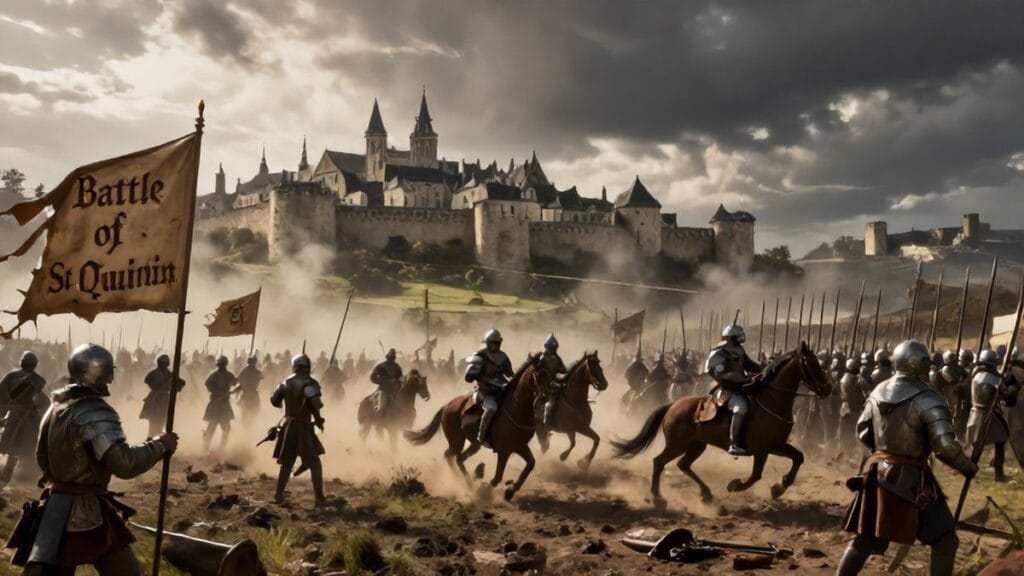
On the morning of 10 August 1557, the low skies over Picardy hung heavy with late-summer clouds, hazing the line where earth met heaven. To the north of the small town of St. Quentin, in the undulating fields and marshy crossings along the Somme, thousands of men shuffled into place, their pikes glinting dully, their arquebuses cold and silent—for the moment. The air carried the mingled scents of trampled grass, sweat, wet leather, and fear. This was the world into which the battle of st quentin erupted: a quiet agricultural landscape about to become a charnel ground.
Picardy, a patchwork of fields, woods, and half-flooded lowlands, had long been a frontier region, a corridor through which armies marched between the kingdoms of France and the Habsburg-dominated Low Countries. St. Quentin itself, perched near the Somme River and protected by medieval walls that had been hastily strengthened to withstand newer, more powerful artillery, was both a gateway and a shield. Controlling it meant commanding a road into the heart of France or barricading that same road against invasion.
The people of the region had seen war before, from the Hundred Years’ War to the Italian campaigns of the early sixteenth century. Yet by 1557, the stakes were different. Gunpowder had reshaped the way battles were fought; cannon and small arms dictated the rhythm of conflict; and the rivalry between France and the Habsburgs had swollen from a territorial struggle into something like a continental obsession. The battle of st quentin was not only another engagement in a long series of wars—it was a test of endurance between two empires that had exhausted their treasuries yet could not renounce their ambitions.
On one side stood the forces of King Henry II of France, determined to defend his northern frontier and his honor after years of bitter struggle against the Habsburgs. On the other, the army of Philip II of Spain, heir to Charles V’s sprawling dominions, was determined to strike a decisive blow. Whether the peasants who watched from the edges of the fields—faces weathered, hands calloused from harvesting wheat—understood it or not, they were witnessing a moment that would reverberate far beyond their county and their lifetime.
But before the first shot was fired and the first cavalry charge dissolved into chaos, the story of St. Quentin began in the courts of kings and the echoing chambers of European diplomacy.
From Dynastic Rivalry to Total War: Europe before St. Quentin
To understand why thousands of men converged on a modest town in Picardy in 1557, one must go back decades, to the long, bitter rivalry between the kings of France and the Habsburg dynasty. The battle of st quentin emerged out of a protracted struggle sometimes known as the Italian Wars—a misnomer, for by the mid-sixteenth century, those wars were no longer confined to Italy, and their causes extended beyond possession of a single peninsula.
At the heart of the conflict lay a simple, brutal arithmetic of power. The Habsburgs, through a series of fortunate marriages, inheritances, and conquests, had come to rule Spain, the Low Countries, much of Italy, Austria, and lands across the Atlantic. Emperor Charles V, Philip II’s father, presided—at least in theory—over a realm on which the sun rarely set. France, ringed by Habsburg possessions, feared encirclement and humiliation. The kings of France, from Francis I to Henry II, saw themselves as the natural counterweight to Habsburg dominance.
The early decades of the sixteenth century had already seen spectacular clashes: the French disaster at Pavia in 1525, where Francis I was captured; the sack of Rome in 1527, which shocked Christendom; and a revolving door of treaties that never seemed to hold. Even when Charles V abdicated in the 1550s, splitting his dominions between his brother Ferdinand (in the Holy Roman Empire) and his son Philip (in Spain and the Low Countries), the structure of rivalry remained intact. Philip II inherited not peace but a burning grudge against France and a network of strategic vulnerabilities along his northern frontier.
Religion, too, was beginning to complicate the picture. Though open religious wars in France would erupt only later, Protestant ideas had already taken root. The French crown, Catholic and increasingly rigid, fought heresy at home even as it waged war abroad. Spain, under Philip II, styled itself the champion of militant Catholicism. Officially, then, the wars between France and Spain were not religious conflicts, but the emerging religious divide colored diplomacy, propaganda, and even the way common people interpreted military events. Defeat or victory could easily be read as divine punishment or favor.
Economically, Europe was strained. The cost of gunpowder warfare—artillery, fortifications, mercenary armies—devoured treasuries. Both France and Spain resorted to heavy taxation, forced loans, and borrowing from financiers in Genoa, Augsburg, and elsewhere. Each major campaign carried the risk of fiscal ruin. Yet neither side could afford the shame or strategic cost of backing down. Thus, by 1557, Europe stumbled toward another decisive clash, with front lines stretching from Flanders to central Italy.
It was in this charged context that St. Quentin, a town better known for its fairs than its fortifications, became a critical pawn on the board.
Kings, Commanders, and Cardinals: The Human Faces of the Conflict
War is often narrated as the clash of armies and empires, but the battle of st quentin was also the convergence of particular, fallible personalities whose choices would define the outcome.
In France, King Henry II, who had come to the throne in 1547, carried the scars of his father’s humiliations and his own battlefield experiences. A proud, impulsive monarch, Henry was determined to assert French strength and preserve what remained of French influence in Italy and the Low Countries. He trusted old nobles of established reputation. Among them, Anne de Montmorency, the constable of France, stood foremost. Montmorency was seasoned, pious, and conservative in his methods, more at ease with the sword than with new doctrines of maneuver or combined arms.
Alongside him, however, rose a younger, more daring figure: Gaspard II de Coligny, Admiral of France. Coligny, whose name would later be linked indelibly with the Huguenot cause and the St. Bartholomew’s Day Massacre, was in 1557 still a loyal servant of a Catholic crown, admired for his courage and keen tactical sense. It was Coligny who would command the defense of St. Quentin itself, facing impossible odds yet refusing to surrender his post lightly.
On the other side of the frontier, Philip II of Spain, newly enthroned, was a very different kind of king. Reserved, methodical, haunted by a sense of moral and religious duty, Philip preferred paperwork and council chambers to the noise of the battlefield. He nonetheless understood the symbolic value of a major victory over France. Command in the field, therefore, was entrusted to Emmanuel Philibert, Duke of Savoy—a dispossessed prince who had lost his ancestral territories to France and now fought to regain both land and honor.
Emmanuel Philibert, sometimes known as “Testa di Ferro,” or “Iron Head,” was a capable, pragmatic commander, willing to exploit terrain, deception, and discipline over sheer bravado. Under him, a composite army gathered: Spanish tercios hardened by long campaigns, Italian and Burgundian contingents, German mercenaries, and troops from the Low Countries. Together, they formed a professional, if mixed, force, accustomed to the realities of early modern warfare.
In the background loomed cardinals, ambassadors, and courtiers. One of them, Cardinal Charles of Lorraine in France, juggled internal factional politics while urging vigorous prosecution of the war. Diplomats in Rome, Venice, and London watched nervously. Mary I of England—Philip II’s queen—had thrown her lot in with Spain, bringing English troops into the conflict. Behind these names, countless lesser captains, quartermasters, and engineers made decisions that would determine whether St. Quentin’s walls would hold or crumble.
“Great events,” the chronicler Brantôme later observed, “are rarely the product of a single man’s genius or folly; they are spun from the errors and ambitions of many.” The drama of August 1557 would prove him right.
The Road to Picardy: Siege, Strategy, and a Fatal Decision
The immediate road to the battle of st quentin began not with an open-field engagement, but with a siege. In the summer of 1557, Emmanuel Philibert, leading Philip II’s forces in the Low Countries, sought a way to strike the French heartland. Rather than driving straight at a major fortress like Cambrai or a heavily defended city, he turned his attention to St. Quentin, whose capture would open a path into northern France and potentially threaten Paris itself.
St. Quentin’s defenses, though improved, were far from impenetrable. Its walls were medieval in origin, thickened and modified to resist artillery but not designed according to the latest star-fort principles that were reshaping Italian cities. Its garrison was modest. Yet its location on the Somme and its role as a regional hub made it a tempting target. Emmanuel Philibert advanced with an army estimated at 50,000 men, screening his movements carefully, and in early August he laid siege to the town.
Inside St. Quentin, Coligny took command of the defense. He knew that the town could not stand indefinitely against a modern siege train. Its salvation lay in relief from the French crown. Messages slipped out through the lines, borne by couriers who risked capture or death, carrying urgent pleas to King Henry II and his constable, Montmorency.
At the French court, alarm spread quickly. The fall of St. Quentin could open a devastating wound in the kingdom’s northern defenses. Henry II decided to send a relief force under Montmorency himself, despite the constable’s age and perhaps waning energy. Montmorency gathered an army that, while not as numerous as Emmanuel Philibert’s, still numbered in the tens of thousands: French gendarmes (heavy cavalry), infantry, and supporting contingents. Time, however, was against him.
In early August, Montmorency approached the region around St. Quentin. His plan, bold but risky, was not simply to attack the besieging army head-on, but to use the difficult terrain of the Somme to sneak detachments into the town, reinforce Coligny, and possibly disrupt the siege lines. Narrow causeways, bridges, and marshy paths offered covert routes—but also the risk of bottlenecks and entrapment.
Here, a critical decision emerged. Rather than waiting for reinforcements or seeking a clearer strategic advantage, Montmorency moved aggressively, attempting to throw troops into St. Quentin from the east by means of a partially destroyed causeway and a ford across the Somme. Some of his forces succeeded in reaching the town, bringing hope to the defenders. Yet the maneuver exposed the rest of his army, dispersed and vulnerable, to counterattack.
Emmanuel Philibert watched and waited. The French were divided by the river and the marshes. Their lines of communication were stretched. The moment for the trap was approaching.
August 10, 1557: Morning on the Somme
The sun rose over St. Quentin on 10 August 1557 as it had on countless other harvest days, catching the dew on the fields, turning the river into a blade of light. For the townspeople, however, this was no ordinary day. The rumble of artillery had become a constant presence. The earth shivered at irregular intervals as cannonballs struck walls or bit into the sod beyond. Smoke hung in the air, mingling with the morning mist.
Coligny, surveying the ruined suburbs and the pitted walls, knew that his position was precarious. The previous days had seen some success—French detachments had pierced the siege ring and joined the garrison—but it was a victory bought at the price of exposing the larger French army. Outside the walls, Montmorency’s troops were still maneuvering, trying to regroup after their hazardous crossing attempts. They were stretched along narrow approaches, some units on firm ground, others hemmed in by marshes, with the river at their backs.
In the Spanish-Imperial camp, Emmanuel Philibert tightened his grip. Scouts and light cavalry had brought news of French movements. The duke waited for the moment when Montmorency would be most off-balance, his forces partly committed and partly immobilized. Early that morning, as drums sounded and standards were raised, he gave the order to prepare for battle.
The French camp, meanwhile, awoke in a state of growing unease. Signals from within St. Quentin—flares, flags, and the distant boom of cannon—were hard to interpret with certainty. Dust on the horizon announced enemy movement, but in what strength, and from which direction? Montmorency, bound by honor and responsibility to relieve the town, nonetheless faced a cruel choice: pull back to safer ground and abandon Coligny to his fate, or hold fast and risk a full-scale engagement in unfavorable terrain.
He chose to stand. Officers mounted, infantry formed ranks, and banners bearing the fleur-de-lis snapped in the wind. The gendarmes, in gleaming armor and on powerful horses, took positions that reflected an older vision of battle—one in which shock cavalry, well-handled, could still decide the day. Cannon were hastily emplaced where possible, but the ground was far from ideal. On this cramped stage, with mud at their feet and an enemy in motion, the French prepared to fight.
But this was only the beginning. The day would soon spiral beyond anyone’s careful plans.
The Trap Springs: Spanish-Imperial Forces Close In
As the morning advanced, Emmanuel Philibert executed the kind of maneuver that reveals the quiet brutality of professional warfare. Rather than hurling his entire army in a frontal assault, he sought to envelop the French in stages, using his superior mobility and the terrain’s bottlenecks against them.
Spanish tercios—those famed infantry formations combining pikes and arquebuses—began to advance in disciplined blocks, their flags bright against the fields. They moved with methodical steps, drums beating time, officers barking commands. Flanking them, light cavalry and mounted harquebusiers probed for weak points in the French deployment. The goal was clear: pin the French in place while cutting off their routes of retreat.
Montmorency, realizing too late the extent of the danger, tried to consolidate his forces. Some of his vanguards had already crossed narrow passages or were entangled in the low, wet ground, making rapid redeployment difficult. Messages flew back and forth on horseback: “Hold the line,” “Fall back to firmer ground,” “Protect the artillery.” Confusion bloomed as contradictory orders collided with reality.
Then came the artillery. Spanish-Imperial guns, more carefully sited and with clearer fields of fire, opened with a murderous barrage. Cannonballs ricocheted across the uneven ground, smashing into tight ranks of infantry, hurling men and earth into the air. The thunder of each discharge rolled over the fields, followed by the sharper crack of arquebus fire as skirmishers closed the range.
The French replied as best they could. Their own artillery roared defiantly, and arquebusiers tried to disrupt the advancing tercios. Yet the combination of constrained maneuver space, inferior positioning, and the shock of the first volleys began to erode French cohesion. Units became separated, some fighting bravely in small knots while others drifted out of alignment, uncertain whether to fall back or charge forward.
Emmanuel Philibert pressed the advantage. Seeing French cavalry threatened with encirclement, he directed his forces to deepen the pressure on their flanks. The enemy who had come to relieve a siege now found itself in desperate need of relief.
Chaos in the Marshes: Rout, Capture, and Heroic Stand
At some point in the tumult of late morning, the line between orderly resistance and disaster was crossed. Witnesses later struggled to describe the exact sequence of events at the heart of the battle of st quentin, for in the crush of men, horses, smoke, and shouted orders, memory fractured. But all agreed on one thing: the French army began to buckle.
French cavalry, attempting to counterattack and relieve pressure on their infantry, found themselves funneled into narrow, muddy lanes. Their charges lost momentum; horses slipped; formations broke. Spanish and Imperial troops, better positioned and supported by coordinated arquebus fire, shattered these efforts. Some squadrons were decimated; others turned back in confusion, colliding with friendly units.
In the infantry line, pockets of courage could not compensate for strategic disadvantage. French and allied soldiers fought hand to hand with pikes, halberds, and swords, blades clashing, men screaming in anger and terror. Clouds of gun smoke reduced visibility to a few dozen paces. Arquebus balls tore through armor at close range. Officers struggled to keep banners upright and cohesion intact, knowing that a lost standard could trigger panic.
Gradually, the French position unraveled into pockets of isolated resistance. Attempts to withdraw toward safer ground were met by Spanish cavalry and fresh infantry formations. Emmanuel Philibert had succeeded in doing what commanders dream of and fear to face: he had turned his enemy’s lines of maneuver into traps.
In the midst of this chaos, Anne de Montmorency fought with personal bravery. The aging constable, unwilling to desert his men, remained near the front and was eventually overwhelmed and taken prisoner. His capture symbolized the collapse of French command. Around him, hundreds of nobles and officers were cut down or seized, their ransoms already calculating themselves in the minds of their captors.
Yet even as catastrophe loomed, many French soldiers refused to dissolve into cowardly flight. Small groups formed hedgehogs of pikes or rallied around surviving banners, buying time with their lives. Chroniclers speak of unnamed captains who held crossroads or dikes for crucial minutes, and of gendarmes who, dismounted and encircled, fought until their armor was dented and bloodied beyond recognition.
The marshes magnified the horror. Men fleeing or trying to reposition stumbled into treacherous ground, sinking into mud under the weight of armor and equipment. Some drowned in shallow but sucking pools, their cries lost in the wider uproar. Others threw away shields and breastplates in a bid for speed, only to be overtaken by enemy horsemen.
By afternoon, the French army had ceased to exist as a coherent fighting force. Thousands lay dead or captured. The field belonged to Emmanuel Philibert. Yet within the still-besieged walls of St. Quentin, the fight was not yet over.
Inside the Besieged City: Coligny’s Defiance at St. Quentin
While the main French army was being crushed outside, the defenders within St. Quentin could only guess at the scale of disaster unfolding beyond their walls. The boom of distant cannon grew irregular, then faded. The banners glimpsed through the haze were no longer clearly distinguishable. Rumors flew: some said Montmorency had triumphed, others that he had been slaughtered. In this fog of war, Coligny chose to assume only one thing with certainty—he was now truly alone.
The admiral turned his attention back to the pressing matter of survival. St. Quentin’s walls were scarred by days of bombardment. Sections of the outer defenses had already crumbled. The suburbs outside the main fortifications had been burned and razed to deny the besiegers cover, leaving blackened skeletons of houses and charred timbers. Inside, civilians huddled in cellars and churches, clutching children and meager possessions, praying for deliverance.
Coligny’s character emerged sharply in these hours. He was calm, methodical, yet unyielding. He reorganized the remaining troops, distributing them to threatened sectors and personally inspecting the bastions. Food and ammunition were rationed more strictly. Any thought of a quick relief was now abandoned; the defenders had to buy time in the only currency left to them—blood and rubble.
Emmanuel Philibert, bolstered by his victory in the field, tightened the noose. Siege works crept closer, trenches zigzagging toward the walls. New batteries were positioned to exploit weaknesses torn open by earlier fire. The Spanish-Imperial command knew that an assault on a well-defended town, even one shaken by bombardment, could prove costly. Still, the psychological impact of the rout outside was on their side. They expected St. Quentin to fall; the only question was how long it would resist and at what price.
Several times, Coligny rejected calls to surrender. He understood that every day he held out pinned Philip II’s victorious army before the walls of St. Quentin instead of releasing it deeper into French territory. In that sense, his stubbornness transformed an outright French catastrophe into a strategic check. The more Emmanuel Philibert bled his troops against St. Quentin, the less strength he would have for an advance toward Paris.
Within the town, the human cost mounted. Food grew scarcer; wells were threatened by contamination; disease began to lurk in cramped shelters. Yet morale, though frayed, was stiffened by Coligny’s presence and by the knowledge that retreat was impossible. Men patched breaches at night, working by torchlight while enemy sappers dug and miners planted explosives beneath the bastions. Women carried water and stones, tended to the wounded, and sometimes joined in the defense from behind improvised barricades.
At last, after renewed bombardment and savage assaults, the walls yielded. Imperial troops surged through gaps and over broken ramparts. Street fighting erupted—a bitter, intimate contest in which the difference between soldier and civilian blurred. Coligny himself was captured in the melee, having fought until resistance became futile. St. Quentin had fallen, but the price would be etched into Philip II’s balance sheet and into the memory of Picardy.
After the Cannons Fall Silent: Sack, Smoke, and Silence
The fall of St. Quentin unleashed a familiar, dreadful ritual of early modern warfare: the sack. However much commanders might seek to restrain their men, an assaulted town that had resisted was, by the harsh conventions of the time, considered fair game for plunder. The soldiers who had endured trenches, hunger, and musket fire now claimed their grim reward.
Witnesses spoke of doors battered down, cellars forced open, and churches broken into. Gold, silver chalices, bolts of cloth, and household goods vanished into the hands of victors who had gone months without proper pay. Houses burned, whether by malice, accident, or as a byproduct of the chaos. Smoke coiled into the sky, visible for miles across the flat fields of Picardy.
The townspeople bore the brunt. Some tried to hide in attics or underground vaults; others ran into the streets, hoping for mercy or at least a swift end. There were acts of kindness amid the brutality—individual soldiers protecting families, officers imposing some order—but these were exceptions in a frenzy governed more by hunger and rage than by policy. The trauma would linger for generations, carried in local stories and parish records that tried to make sense of the devastation.
As the days passed, a ghostly quiet began to replace the noise of battle. Corpses were buried hastily in mass graves outside the walls or submerged in the river. Dead horses, broken wagons, and shattered guns dotted the landscape. The smell of rot fused with the lingering tang of powder. Inside the town, blackened ruins marked entire streets. For those who survived, daily life had to resume somehow—markets reopened, fields were tended—but nothing was quite the same.
For Emmanuel Philibert and Philip II’s commanders, the sack of St. Quentin was both a moral burden and a political fact. They issued orders to restore discipline, repaired fortifications under new flags, and sent dispatches describing the victory. Their reports, while proudly recounting the triumph, rarely lingered on the civilian suffering. War was harsh; such was the age’s fatalistic refrain.
And yet behind the celebrations in distant courts, a question whispered: what had been truly gained in this inferno, and at what enduring cost?
Echoes in the French Court: Humiliation and Reckoning
News of the defeat at the battle of st quentin and the loss of the town struck the French court like a thunderbolt. Courtiers who had days earlier spoken confidently of France’s strength now traded fearful glances in hushed corridors. Reports were conflicting—some minimized the scale of the defeat; others, brought by fugitives and messengers, painted the disaster in lurid detail: Montmorency captured, thousands dead or taken, the way to Paris seemingly open.
King Henry II was stunned. The constable had been one of his closest and most trusted servants; the loss of both a friend and a principal commander in such humiliating fashion devastated him personally and politically. Factions within the court were quick to interpret the calamity according to their own agendas. Some blamed Montmorency’s conservatism and rash deployment. Others whispered about bad omens, divine displeasure, or the corrosive effect of internal divisions among France’s high nobility.
The financial impact was immediate. The cost of rebuilding an army, reinforcing border fortifications, and managing the crisis strained an already overstretched treasury. Emergency taxes were raised; extraordinary measures debated. France, long a major force in Italy and the Low Countries, now had to concentrate on safeguarding its own northern frontier. The glamorous dream of dominating Lombardy or seizing control of the Po Valley receded in the face of harsh necessity.
Yet out of the shock emerged also a kind of bitter clarity. The French state recognized that it had stretched itself too thin and that its enemy, Spain under Philip II, possessed a logistical resilience and a disciplined army not easily matched. Advisors urged caution and consolidation. The humiliation of the battle of st quentin thus began to act as a brake on French expansionism, pointing the monarchy toward internal reform and, eventually, toward facing the religious tensions simmering within its own borders.
Emotionally, the blow ran deep. Pamphlets, poems, and private letters circulated, expressing grief, anger, and a search for meaning. Some invoked God’s anger at the spread of heresy or at the court’s perceived moral laxity. Others lamented the folly of endless wars that “bleed the kingdom for honor’s empty shadow,” as one contemporary put it. In this grief, the seeds of future conflicts—and of a more introspective French politics—were sown.
Philip II’s Hollow Triumph: Glory, Caution, and Missed Chances
In Madrid and Brussels, by contrast, the victory at St. Quentin was proclaimed with great fanfare. Philip II, who had aligned his fortunes with a risky land campaign, now appeared vindicated. Bells rang in cathedrals, Te Deums were sung, and court poets celebrated Emmanuel Philibert as the instrument of Spain’s divine mission. The battle of st quentin was heralded as proof that God favored the Habsburg cause.
Philip himself, austere and cautious, did not rush to exploit the success with a reckless invasion. This restraint has long fascinated historians. With the French field army shattered and a breach opened in the kingdom’s northern defenses, some argued that a thrust toward Paris might have brought France to its knees, compelling not just a favorable peace but perhaps a more enduring subjugation.
Instead, Philip chose consolidation. Part of this stemmed from the cost of the victory itself. His army, though triumphant, had bled heavily. Siege and battle had consumed ammunition and supplies. To drive deeper into France would have meant stretching supply lines in hostile territory, risking a reversal if the French rallied a new force or if local resistance stiffened. The experience of earlier campaigns, in which initial victories had not always translated into sustainable gains, weighed on his mind.
Moreover, Philip’s empire was a hydra-headed entity, beset with demands on multiple fronts—from unrest in the Low Countries to Ottoman pressure in the Mediterranean. Total commitment in France risked neglect elsewhere. So he chose, instead, to leverage the victory diplomatically, pressing for terms that would consolidate Habsburg gains without overextending his military machine.
To commemorate the triumph, Philip vowed to build El Escorial, the great monastery-palace complex near Madrid, in part as a thanksgiving offering. The stones of that austere and monumental edifice can thus be read as a distant architectural echo of the gunfire at St. Quentin. Yet even as he celebrated, there was a subtle sense that an opportunity had been left unused—a sentiment captured centuries later by historians who would call St. Quentin both a great and a limited victory.
It’s astonishing, isn’t it? A single decision not to march on Paris, born of prudence and calculation, may have spared France from deeper dismemberment and, by extension, preserved the balance of power in Western Europe.
Weapons, Walls, and Gunpowder: Warfare in Transition
The battle of st quentin belonged to a pivotal era in military history, when the shape of warfare was being remade by gunpowder, new formations, and changing fortification techniques. To walk the fields of Picardy in 1557 was to see not only knights and banners, but also the modernity creeping into the art of war.
Artillery played a central role. The siege of St. Quentin relied on heavy cannon to batter down medieval walls, demonstrating once again the vulnerability of traditional fortifications to concentrated bombardment. Cannon had, of course, been used for over a century, but by the mid-sixteenth century, improvements in metallurgy, casting, and logistics had made them more reliable and deadly. Sieges became contests not just of bravery but of engineering and supply.
On the battlefield, infantry formations were shifting from the medieval model of mixed, loosely organized troops to more disciplined, specialized units. The Spanish tercios embodied this change: large, flexible blocks combining pikemen with arquebusiers, capable of both resisting cavalry and delivering punishing volleys of gunfire. The French, while not ignorant of these developments, still relied heavily on heavily armored gendarmes and had not fully integrated firearms into a comparable doctrinal system.
The terrain around St. Quentin further highlighted the interplay between technology and environment. Marshes, rivers, and narrow causeways limited cavalry effectiveness and favored those who could coordinate infantry and artillery most efficiently. Emmanuel Philibert’s use of these features—channeling French movements into kill zones—showed a modern appreciation for operational art.
Meanwhile, fortification theory was in flux. The trace italienne, or star fort, with angled bastions designed to deflect cannon fire and provide overlapping fields of fire, was spreading from Italy across Europe. St. Quentin, whose defenses were partly updated but not comprehensively rebuilt, stood at an awkward midpoint between medieval and modern. Its fall underscored to all observers that yesterday’s walls could not stand indefinitely against today’s guns.
The battle thus became a teaching tool. Military engineers, captains, and princes studied its lessons. Some would apply them in the next generation of conflicts—from the Dutch Revolt, where fortresses and flooded fields became central, to the French Wars of Religion, in which cities and strongholds were repeatedly besieged, stormed, or starved into submission.
From Battlefield to Bonfire: The Human Cost in Picardy
Numbers can only roughly gesture at the human cost of St. Quentin, but they are sobering. Contemporary accounts and later estimates suggest that the French lost several thousand men killed, with many more captured. The Spanish-Imperial side also suffered significant casualties in both battle and siege, even if exact figures remain contested. Each number, however, was a life: a son, a father, a brother, often a peasant or artisan whose family now faced an uncertain, harsh future.
In Picardy itself, the suffering transcended the battlefield. Farms were trampled, crops destroyed, livestock requisitioned or slaughtered. Villages along the march routes found themselves suddenly at the mercy of foraging soldiers, who might pay, extort, or simply seize what they needed. Households that had barely survived previous campaigns now saw their reserves vanish in days.
The aftermath brought not just physical ruin but demographic wounds. Many young men of the region had joined local garrisons or levies; those who did not return left gaps in families and communities. Widows and orphans multiplied. Parish registers record sudden spikes in burials, some from battle injuries, others from diseases that followed in war’s wake: dysentery, fevers, and infections spreading in crowded, traumatized towns.
The psychological toll is harder to chart but no less real. Those who had survived the sack of St. Quentin lived with memories of violence that could surface unbidden for years. Children who had seen soldiers storm through their homes grew up in a world where authority was often associated with armed force. Priests tried to offer explanations, casting events within a providential framework—punishment for sins, trials meant to recall souls to piety—but for many, such answers could not fully heal the trauma.
And yet life went on. Fields were replanted; houses rebuilt, sometimes on the very foundations of their predecessors’ ashes. Over time, the raw scars in the landscape faded, replaced by the quieter scars in memory and story. The human capacity to endure—to reconstruct a normal life atop the ruins of catastrophe—may be the most striking legacy of St. Quentin for the people who lived through it.
From Defeat to Civil War: St. Quentin and the Seeds of French Religious Conflict
The battle of st quentin did not directly cause the French Wars of Religion, but it contributed to the conditions that made them possible and perhaps inevitable. Military defeat weakened the monarchy’s aura of invincibility, strained finances, and emboldened factions that would later clash over faith and power.
In the years after 1557, as France struggled to recover its position, religious tensions intensified. Protestant communities—often influenced by Reformed theology from Geneva—grew more numerous and more organized. Noble houses quietly, then more openly, aligned themselves with emerging confessional identities. Among them was Gaspard de Coligny, the very admiral who had defended St. Quentin so doggedly. His experience of hardship and captivity did not immediately turn him into a Huguenot leader, but his later conversion would make him one of their most respected military and political figures.
Defeat also forced the crown to reconsider priorities. If, for decades, enormous resources had been poured into conflict with the Habsburgs, the outcome at St. Quentin pushed French rulers toward a more inward-facing agenda. Unfortunately, this inward gaze revealed a fractured religious landscape. Attempts to suppress Protestantism by force, without offering meaningful reforms, only deepened resentment and suspicion.
By 1562, when open religious war erupted at Vassy, memories of 1557 still lingered among the older generation of nobles and officers. They remembered how overconfidence, poor coordination, and internal rivalry had led to disaster before a foreign enemy. Now, similar flaws threatened to destroy the kingdom from within. Some, perhaps recalling the futility of St. Quentin, urged moderation and compromise. Others, haunted by a sense of divine judgment, embraced hardline positions, seeing in religious opponents the same mortal threat they had faced on Picardy’s fields.
In this sense, the story of St. Quentin and the story of the French Wars of Religion intersect through shared characters, depleted resources, and a shaken monarchy. A kingdom that had been humbled on the battlefield would soon discover that its greatest battles lay not at its borders but in its own towns and churches.
Memory, Myth, and Monument: How St. Quentin Was Remembered
Not all battles are remembered equally. Some, like Pavia or Lepanto, engrave themselves vividly on national consciousness; others recede into specialist histories. The battle of st quentin occupies an ambiguous place, significant in its time yet later overshadowed by even more dramatic traumas, such as the St. Bartholomew’s Day Massacre or the wars of Louis XIV.
In Spain, St. Quentin fed into a narrative of providential favor, cited as one of Philip II’s great triumphs. Chroniclers praised the discipline of the tercios and Emmanuel Philibert’s skill. They linked the battle to the king’s pious architectural project at El Escorial, turning military success into an emblem of Catholic monarchy shaped by ascetic grandeur. Over time, however, the memory of St. Quentin blended with other victories into a general sense of Spain’s “golden age,” rather than standing out sharply on its own.
In France, the battle’s memory was more difficult to digest. It was a humiliation, a painful reminder of vulnerability and miscalculation. Official histories tended to emphasize the heroism of Coligny’s defense and to frame the wider defeat as a tragic but instructive event. Later Protestant writers would highlight Coligny’s role as an early sign of his steadfast character, while Catholic authors sometimes used the calamity to criticize particular factions or policies at court.
Locally, in Picardy and St. Quentin itself, memory clung stubbornly to the details of suffering and endurance. Parish chronicles, municipal records, and oral tales preserved the names of families who lost homes, the exact locations where breaches in the walls had opened, and the places in nearby fields where bones were unearthed long afterward. For these communities, St. Quentin was not just an episode in dynastic struggle, but a shattering intrusion into everyday life.
Physical traces also shaped memory. Ruined sections of fortifications, rebuilt or incorporated into later defenses, bore silent witness. Memorial plaques, epitaphs, and the evolving urban landscape all played roles in keeping—or softening—the memory of 1557. In the nineteenth century, as nationalism reshaped historical interest, French historians revisited the battle as part of a broader attempt to narrate the rise of the nation-state, sometimes framing St. Quentin as a lesson in the dangers of disunity.
As one modern scholar observed, “St. Quentin sits at the crossroads of memory: neither glorified nor entirely forgotten, it is a mirror in which France and Spain can glimpse both their power and their fragility.”
Comparing Catastrophes: St. Quentin beside Pavia and Gravelines
To grasp the full meaning of the battle of st quentin, it helps to place it alongside other major encounters of the sixteenth century. Pavia (1525), where Francis I was captured, and Gravelines (1558), another victory for Philip II’s forces, offer instructive parallels and contrasts.
At Pavia, the French king himself was taken prisoner, a blow of incomparable symbolic weight. Yet France recovered, negotiated his release, and continued to wage war. St. Quentin, though lacking such a dramatic royal capture, represented a deeper erosion of French military credibility, coming after decades of exhausting conflict. It underlined the institutional, not just personal, weaknesses of the French war effort: logistical shortcomings, doctrinal lag, and overreliance on traditional arms like heavy cavalry.
Gravelines, fought less than a year after St. Quentin, reinforced the impression of Spanish tactical superiority. There, too, Philip II’s forces, aided by English support, inflicted a serious defeat on the French. Taken together, St. Quentin and Gravelines broke France’s capacity to continue the Italian Wars on favorable terms. They pushed the French crown toward the negotiations that would culminate in the Treaty of Cateau-Cambrésis in 1559.
And yet, unlike Pavia, these later defeats did not lead to permanent French subordination. Instead, they marked the end of one phase of European conflict and the beginning of another. The French state, once freed from its Italian ambitions, would eventually regroup and, in the seventeenth century, rise again under Richelieu and Louis XIV to challenge Habsburg power from a different angle.
Thus, when historians compare these battles, they often see St. Quentin as a hinge: not the grand drama of a king in chains, but the quieter, more consequential end of a long strategic endeavor. It signaled the exhaustion of a particular Franco-Habsburg rivalry focused on Italy, even as it opened the way to new struggles over religion, dynastic succession, and colonial expansion.
St. Quentin in the Long War: Toward Cateau-Cambrésis and a New Europe
In the immediate wake of the battle of st quentin, Europe did not suddenly become peaceful. Skirmishes continued, sieges were mounted, and armies marched. Yet beneath the ongoing violence, a shift in logic was occurring. France and Spain had battered each other for decades with limited decisive gain. Now, depleted and facing internal and external pressures, both sides edged toward a comprehensive settlement.
The Treaty of Cateau-Cambrésis, signed in 1559, formalized this shift. France relinquished most of its claims in Italy, conceding that the dream of Italian hegemony had become too costly and distant. Spain solidified its position in the peninsula and in the Low Countries, while also securing advantages along the French frontier. The treaty bore the imprint of St. Quentin and Gravelines, victories that had strengthened Philip II’s hand at the bargaining table.
Yet the settlement also had far-reaching implications beyond the immediate territorial adjustments. By freeing Spain from large-scale conflict with France, it allowed Philip II to concentrate more fully on other challenges: the restive provinces of the Netherlands, the advance of the Ottoman Empire, and, later, the contest with England. For France, the end of the Italian Wars opened a space—tragically, as it turned out—for domestic conflict to take center stage.
In the broader arc of European history, St. Quentin thus marks a point at which the geographical focus of rivalry shifted. The age of the Italian Wars gave way to an age of religious and maritime competition: the Dutch Revolt, the Anglo-Spanish War, and the internecine struggles within France and the Holy Roman Empire. The cannons that had roared at St. Quentin would echo indirectly in these later conflicts, as commanders applied—or ignored—the lessons learned in Picardy.
Centuries later, when historians traced the origins of Europe’s modern state system, they often paused at Cateau-Cambrésis as a milestone. And behind that treaty, in the background of its dense clauses and territorial exchanges, stands the smoky, blood-soaked field and battered town of St. Quentin.
Conclusion
The battle of st quentin on 10 August 1557 was more than a bloody day in Picardy; it was a turning point in the long rivalry between France and the Habsburgs, and a hinge on which European history quietly swung. On the tactical level, it showcased the growing dominance of disciplined infantry, integrated artillery, and commanders who understood how to use terrain to entrap less agile foes. For France, it was a brutal lesson in the consequences of overextension, doctrinal inertia, and divided leadership, embodied in the capture of Montmorency and the shattering of a royal army.
Yet the story is not simply one of defeat and victory. Coligny’s defense of St. Quentin, though ultimately unsuccessful, transformed a catastrophe into a partial strategic reprieve, buying France time and preventing a deeper enemy thrust. The town’s suffering, the sack, and the long, painful recovery highlight the often-overlooked fact that wars waged for dynastic glory or strategic advantage are paid for most dearly by civilians whose lives are overturned in an instant.
Politically, the battle hastened the end of the Italian Wars and contributed to the settlement at Cateau-Cambrésis, which reshaped the map of Europe and signaled a shift toward new theaters of conflict. It weakened the French monarchy at a moment when religious tensions were mounting, inadvertently clearing the way for the French Wars of Religion and the tragic spiral of violence they unleashed. For Spain and Philip II, St. Quentin was a triumph, but one that led not to lasting dominance but to new commitments and new crises elsewhere.
In the end, St. Quentin stands as a reminder that the decisive moments of history are often complex, their consequences stretching far beyond the intentions of the men who fought them. On those fields and walls in Picardy, the sixteenth century’s old order of chivalric warfare met the harsher realities of gunpowder, fiscal strain, and confessional division. The echoes of that encounter still resonate, faintly but persistently, in Europe’s political and cultural memory.
FAQs
- What was the Battle of St. Quentin?
The Battle of St. Quentin was a major engagement fought on 10 August 1557 near the town of St. Quentin in Picardy, France, between French forces under Constable Anne de Montmorency and a Spanish-Imperial army commanded by Emmanuel Philibert, Duke of Savoy, in the service of Philip II of Spain. It resulted in a crushing French defeat and the subsequent fall and sack of the town. - Who won the battle and why was it important?
The Spanish-Imperial army won decisively. The battle was important because it shattered a major French field army, opened the way into northern France, and strengthened Philip II’s hand in the negotiations that led to the Treaty of Cateau-Cambrésis (1559). It effectively marked the beginning of the end of French ambitions in Italy. - What role did Gaspard de Coligny play at St. Quentin?
Gaspard de Coligny, Admiral of France, commanded the defense of the town of St. Quentin itself. Although the French relief army was defeated outside the walls, Coligny organized a stubborn resistance within the town, delaying its fall and tying down Spanish-Imperial forces. His conduct enhanced his reputation for courage and resolve, traits that would later make him a leading figure in the French Wars of Religion. - How did the battle affect King Henry II of France?
The defeat was a deep personal and political blow to Henry II. He lost his trusted constable Montmorency to captivity and saw his northern defenses compromised. The disaster forced France to focus on consolidation and ultimately contributed to the decision to make peace with Spain, ending the Italian Wars on unfavorable terms for the French crown. - Did the Spanish victory lead to a full invasion of France?
No. Although the road to Paris was more open after the victory, Philip II and his commanders chose caution over a risky deep penetration into France. Their army had suffered considerable losses, and Spain faced other strategic commitments. Instead of a full invasion, they used the victory as leverage in diplomatic negotiations. - How is the Battle of St. Quentin connected to the Treaty of Cateau-Cambrésis?
The victory at St. Quentin, followed by the French defeat at Gravelines in 1558, weakened France’s bargaining position and demonstrated the futility of continuing the Italian Wars. These setbacks helped push both sides toward the Treaty of Cateau-Cambrésis in 1559, in which France renounced most of its claims in Italy and Spain consolidated its dominance there. - What was the impact on the civilian population of St. Quentin?
The civilians of St. Quentin suffered heavily. After the town fell, it was subjected to a sack in which soldiers looted homes, churches, and warehouses, and many buildings were burned. The population faced deaths, displacement, and long-term economic hardship as they struggled to rebuild in the aftermath. - Did the battle influence the French Wars of Religion?
Indirectly, yes. The defeat weakened the French monarchy both financially and symbolically, at a time when religious tensions were growing. Some of the key figures at St. Quentin, such as Coligny, later became central actors in the French Wars of Religion. The shift from external wars to internal conflict was shaped in part by the exhaustion and reorientation that followed St. Quentin. - What military lessons did contemporaries draw from St. Quentin?
Contemporaries noted the effectiveness of Spanish tercios, the importance of disciplined infantry supported by artillery, and the decisive impact of terrain and maneuver. The battle also underscored the vulnerability of outdated fortifications to modern siege artillery, encouraging wider adoption of the new star-fort designs across Europe. - Is the Battle of St. Quentin widely remembered today?
Outside specialist circles and local memory in Picardy, the battle is less well known than some other sixteenth-century engagements. However, historians regard it as a key event in ending the Italian Wars and reshaping the balance of power between France and Spain, as well as an important episode in the military and political evolution of early modern Europe.
External Resource
Internal Link
Other Resources
- Encyclopaedia Britannica – general search for the exact subject
- Google Scholar – academic search for the exact subject
- Internet Archive – digital library search for the exact subject

