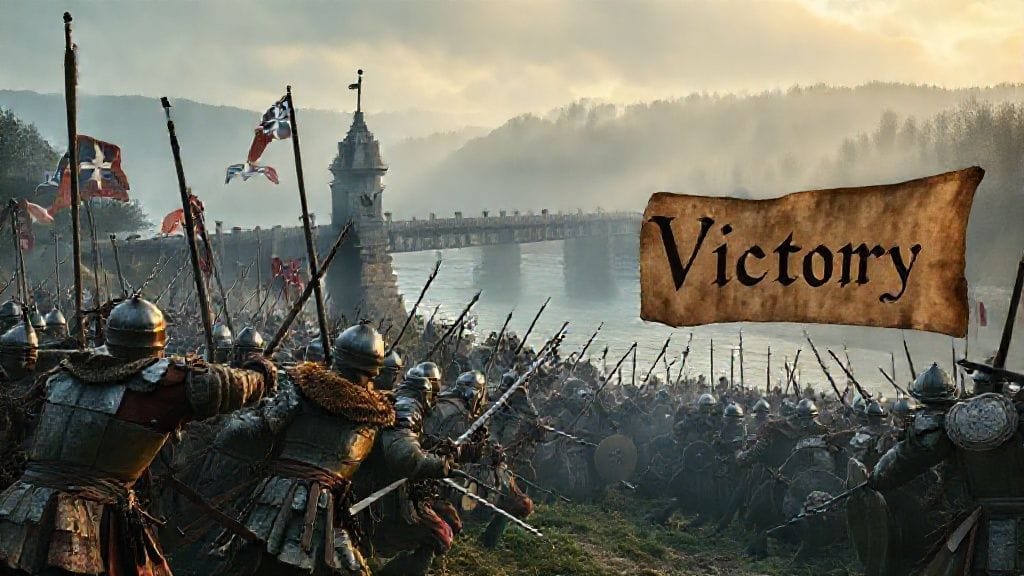
Table of Contents
- The Dawn of Defiance: Scotland on the Brink of Rebellion
- The Political Cauldron: Edward I’s Ambitions and Scottish Strife
- The Rising Tide of Scottish Nationalism
- William Wallace: From Obscurity to Leadership
- Stirling Bridge: Geography and Strategic Importance
- Gathering Storms: The Preludes to Battle
- September 11, 1297: The Day the Bridge Became a Battlefield
- The Tactical Genius of the Scots
- The English Army’s Fatal Miscalculations
- The Clash Unfolds: Chaos, Courage, and Carnage
- Aftermath on the Battlefield: Death, Captures, and Victory
- The Mythos of Wallace and Moray: Heroes Forged in Battle
- The Impact on Scottish Morale and Wider Rebellion
- England’s Response: Edward I’s Fury and Retaliation
- The Battle’s Place in the Wars of Scottish Independence
- The Cultural Legacy: From Ballads to Modern Memory
- Warfare and Strategy in the Late 13th Century
- Human Faces of Stirling: Stories of Warriors and Civilians
- Stirling Bridge in Political Propaganda and National Identity
- Reflection: What Stirling Bridge Tells Us About Power and Resistance
September 11, 1297. A chilly dawn broke over the narrow confines of the River Forth, near the town of Stirling, Scotland. The mist hung low, shrouding the ancient landscape with an eerie yet expectant calm. The air was thick with tension—a weight borne not just of the early morning fog, but of centuries of struggle, oppression, and an indomitable yearning for freedom. Along the banks, two armies faced each other: the well-armed and discipline-hardened English forces, led by John de Warenne and Hugh de Cressingham, and the fiercely resolute, though less equipped, Scottish fighters under the command of William Wallace and Andrew Moray. What was to unfold within hours would reverberate across centuries; a defining moment where the underdog triumphed against a seemingly invincible foe.
The Battle of Stirling Bridge is more than just a medieval skirmish. It is a narrative of rebellion and identity, of courage against overwhelming odds, and the birth of a nation’s enduring quest for sovereignty. This confrontation was not merely fought for territory or political control, but for the soul of Scotland itself.
To understand why this battle was so seminal requires a journey back into a turbulent era etched with dynastic disputes, imperial greed, and fractured loyalties. It requires that we meet the men who shaped history not with vast numbers or royal blood, but with cunning, valor, and an unyielding desire for liberation.
The Dawn of Defiance: Scotland on the Brink of Rebellion
The late 13th century saw Scotland shackled under the looming shadow of England’s King Edward I, the “Hammer of the Scots.” Scotland’s independence had long been tenuous, tangled in royal marriages, claims, and contestations. After the death of the infant Queen Margaret, known as the Maid of Norway, Scotland was thrown into a succession crisis. Amidst this vacuum of power, Edward I was invited to arbitrate, but instead found a pretext to impose English overlordship.
The Scots chafed under this subjugation, and whispers of revolt grew louder. Resentments caused by heavy taxation, placed garrisons, and violations of law festered. More than an external conflict, it was a deeply personal fight for the dignity and rights of a proud people.
The Political Cauldron: Edward I’s Ambitions and Scottish Strife
Edward I was a formidable monarch, a warrior king whose reputation rested on relentless campaigns in Wales and France. His vision was clear: a united Britain under the English crown. Scotland’s independence was an obstacle to this ambition.
To this end, Edward installed English administrators and sheriffs throughout Scotland, demanding fealty and tribute. His demand for Scottish nobles to swear unconditional allegiance created bitter divisions, and while some complied, many did so under duress or outright refused.
This environment bred distrust and desperation, setting the stage for open conflict.
The Rising Tide of Scottish Nationalism
Against this backdrop emerged leaders who refused to bow. One such figure was William Wallace, a relatively obscure knight whose life remains partly shrouded in mystery. Yet, his rise was rapid and fueled by outrage over English brutality, especially after the execution of certain Scottish nobles and the desecration of lands.
Wallace's guerrilla tactics and personal charisma galvanized peasants and nobles alike. Alongside Andrew Moray, who had been leading rebellion in the north, Wallace united disparate Scottish forces into a formidable insurgency.
William Wallace: From Obscurity to Leadership
We often imagine William Wallace as a towering hero—fierce, uncompromising, almost larger than life. However, the reality was more nuanced. Wallace was a man deeply embedded in his community, spurred by grief and a burning desire for justice after personal losses recorded in early chroniclers.
He understood the nuances of local loyalties, the challenging terrain, and the limitations of his men’s armaments. His leadership was not merely martial but symbolized an embodiment of Scottish resilience.
Stirling Bridge: Geography and Strategic Importance
The choice of Stirling Bridge as a battleground was no accident. The River Forth formed a natural barrier between the lowlands and Highlands, and the narrow wooden bridge was the only crossing point in the region—making it a crucial strategic choke point.
Controlling Stirling meant controlling access to the north and south, vital for supply lines and troop movements. For the Scots, defending Stirling was defending the heart of their homeland. For the English, capturing it would cement domination.
Gathering Storms: The Preludes to Battle
Throughout the summer of 1297, tension mounted. Wallace and Moray consolidated forces, controlling much of Scotland. The English garrison in Stirling, reinforced by John de Warenne and Hugh de Cressingham, awaited reinforcements from Edward.
Yet, communication faltered, supply lines strained, and confidence wavered. Wallace’s forces were smaller but intimate with the landscape; Cressingham’s arrogance would prove fatal.
September 11, 1297: The Day the Bridge Became a Battlefield
As dawn gave way, the English army prepared to cross Stirling Bridge. The bridge itself was narrow—barely wide enough for two horsemen abreast—and frail, a wooden plank suspended over a formidable river.
John de Warenne, divided between caution and impatience, allowed his forces to begin crossing in smaller groups rather than en masse. This blunder was the opening Wallace awaited.
With a signal whispered and glances exchanged, the Scots sprang from their concealed positions, attacking the English vanguard now trapped on the narrow bridge and the exposed shore beyond.
The Tactical Genius of the Scots
Wallace and Moray’s tactic was brilliant in its simplicity. By controlling the bridge, they neutralized the English advantage in numbers and cavalry.
The Scots’ archers and spearmen seized the narrow causeway, isolating segments of the English army, who found their momentum shattered and were mired in confusion.
Their knowledge of the terrain and timing was impeccable—turning a potential rout into a decisive victory.
The English Army’s Fatal Miscalculations
De Warenne and Cressingham underestimated both the Scots’ resolve and the geography that constrained their maneuvers. The English troopers crowded onto the bridge became easy targets—vulnerable and unable to deploy effectively.
Moreover, Cressingham’s reported arrogance extended to dismissing advice from subordinates, reflecting an overconfidence that spelled disaster.
As the bridge failed under weight and assault, many English soldiers plunged into the cold waters of the Forth; others were cut down.
The Clash Unfolds: Chaos, Courage, and Carnage
This was no orderly battle but a chaotic melee marked by desperate bravery. Contemporary chronicles speak of a torrent of steel and death in those hours, with soldiers fighting not just for victory but survival amid the crushing onslaught.
Wallace himself is said to have fought at the forefront, inspiring his men. Moray, wounded during the battle, continued to lead until later succumbing to injuries—a poignant reminder of the heavy human cost.
Aftermath on the Battlefield: Death, Captures, and Victory
The defeat was catastrophic for the English. Thousands were killed or captured, including the treasurer Hugh de Cressingham, whose death was particularly brutal—a testament to the Scots’ vengeance.
The victory at Stirling Bridge sent shockwaves through the British Isles. For the Scots, it was an improbable and morale-boosting triumph. For Edward I, a stark warning—and a promise of retribution.
The Mythos of Wallace and Moray: Heroes Forged in Battle
In the immediate aftermath, William Wallace’s stature soared from local rebel to national icon. Banners bore his image, ballads extolled his deeds, and his leadership became the rallying symbol of Scottish resistance.
Andrew Moray’s contributions, while initially overshadowed, have since gained recognition as foundational to the Scottish victory.
Their partnership embodies the unity and sacrifice required to resist tyranny.
The Impact on Scottish Morale and Wider Rebellion
Stirling Bridge was a spark that ignited rebellions across Scotland. Noblemen who had wavered now openly defied Edward; communities found renewed courage.
This battle allowed the Scots to reclaim key territories and galvanized a largely fragmented country into a coordinated struggle for independence.
England’s Response: Edward I’s Fury and Retaliation
Edward I could not ignore such a humiliating defeat. His wrath manifested in a massive military campaign initiated the following year aimed to crush the rebellion once and for all.
His later campaigns were brutal, systematic, incorporating sieges, scorched earth tactics, and attempts to isolate Wallace politically.
Nonetheless, Stirling Bridge had irrevocably changed the dynamics of Anglo-Scottish relations.
The Battle’s Place in the Wars of Scottish Independence
This engagement was one of several critical battles within the wider Wars of Scottish Independence—an era defined by fluctuating fortunes, political intrigue, and enduring resistance.
Stirling Bridge proved that a determined, well-led force could challenge even the most powerful empire of its day.
The Cultural Legacy: From Ballads to Modern Memory
Over centuries, the battle transcended its historical moment to become a cultural touchstone. It was immortalized in medieval chronicles, romanticized in poems like Blind Harry’s The Wallace, and reinterpreted through modern media—most notably the film Braveheart.
Stirling Bridge symbolizes not just military victory but the visceral human yearning for liberty and justice.
Warfare and Strategy in the Late 13th Century
The battle offers a window into medieval warfare—where terrain, morale, and leadership could outweigh sheer numbers or heavy armor.
It underscores the transition from feudal skirmishes to more organized military strategy, integrating infantry, archers, and cavalry tactically.
Human Faces of Stirling: Stories of Warriors and Civilians
Beyond commanders, Stirling Bridge was fought by ordinary men—farmers, craftsmen, and nobles—each with a story etched by fear, hope, and sacrifice.
Local civilians suffered the war’s ravages, caught between armies, their lives forever changed.
Stirling Bridge in Political Propaganda and National Identity
For Scotland, Stirling Bridge was and remains a potent symbol in national identity and political discourse—a reminder of sovereignty and the price of freedom.
In centuries of conflict and peace, it has been invoked to inspire unity and resilience.
Reflection: What Stirling Bridge Tells Us About Power and Resistance
Ultimately, the Battle of Stirling Bridge illustrates the timeless dynamics of power—how the underdog can unsettle empires through courage, insight, and unity.
It teaches us that history is not merely shaped by kings and generals but by the will of a people determined to define their destiny.
Conclusion
The Battle of Stirling Bridge stands as an enduring testament to the complexity and courage inherent in the struggle for freedom. On that misty September day in 1297, a ragtag assembly of Scots—led not by armies of a king, but by the impassioned will of men like William Wallace and Andrew Moray—shattered assumptions about power and invincibility. Their victory was immediate but also symbolic, forging Scotland’s national identity and challenging the empire of Edward I.
This battle reminds us that history is not written solely by might but also through determination, sacrifice, and the ability to seize a moment with resolve and strategy. Its echoes reach far beyond medieval fields; they resonate in all who pursue justice despite overwhelming odds.
In revisiting Stirling Bridge, we encounter not just a clash of swords, but the enduring human story of aspiration, community, and the fierce love of homeland. It invites us to remember that every epoch of resistance contains within it the seeds of future hope—and that even a narrow wooden bridge can become the proving ground of destiny.
FAQs
Q1: What caused the Battle of Stirling Bridge?
A1: The battle erupted from Scotland’s resistance to English domination under Edward I, sparked particularly by heavy-handed political control, taxation, and the imprisonment of Scottish nobles following a disputed succession crisis.
Q2: Who was William Wallace and why was he important?
A2: William Wallace was a Scottish knight who rose to prominence as a leader of rebellion against English occupation. His leadership at Stirling Bridge and beyond made him a symbol of Scottish freedom.
Q3: What was the strategic significance of Stirling Bridge?
A3: The bridge was a narrow crossing over the River Forth, controlling access between Scotland’s lowlands and Highlands, making it a crucial military and logistical chokepoint.
Q4: How did the Scots win despite being outnumbered?
A4: The Scots exploited terrain, surprise, and the bottleneck created by the narrow bridge, attacking fragmented English forces and preventing their cavalry and archers from effectively deploying.
Q5: What was Edward I’s reaction to the defeat?
A5: Edward I responded with military reprisals and a renewed campaign of invasion launched in 1298 aiming to reassert control over Scotland with overwhelming force.
Q6: How has the Battle of Stirling Bridge impacted Scottish identity?
A6: It remains a powerful symbol of resistance and national pride, commemorated in literature, folklore, and political discourse as a foundational moment in the Scottish struggle for independence.
Q7: What role did Andrew Moray play in the battle?
A7: Andrew Moray co-led the Scottish forces alongside Wallace. He was instrumental in the strategic planning and command but died of wounds sustained during the battle.
Q8: How is Stirling Bridge represented in popular culture today?
A8: Popular imagination often remembers it through dramatizations such as the film Braveheart, as well as in historical novels and Scottish festivals celebrating national heritage.

