Table of Contents
- Dawn over central Italy: The prelude to Taginae
- The decaying empire and the Gothic threat
- Narses: The eunuch general’s improbable command
- Totila: The warrior king of the Ostrogoths
- The stakes of 552: Rome’s fate hangs in the balance
- The march to Taginae: Armies converge in the Umbrian hills
- The battlefield unveiled: Terrain, tactics, and tension
- The day of reckoning: Clash of blades and wills
- The turning point: Narses’ masterstroke
- Totila’s final charge and fall
- Aftermath on the plains: The dust settles on Taginae
- The Gothic War’s closing chapter: What Taginae signified
- The legacy of Narses and the Eastern Empire’s triumph
- Totila remembered: Heroism, tragedy, and myth
- The impact on medieval Italy: A fractured peninsula
- Lessons from Taginae: War, leadership, and empire
- Voices from the past: Procopius’ eyewitness account
- Archaeological whispers: What remains of battle and soldiers
- The battle in historical memory and literature
- Taginae today: From battlefield to tranquil town
- Conclusion: Beyond the swords—A moment that shaped Italy and empire
- FAQs: Unraveling the mysteries of the Battle of Taginae
- External Resource
- Internal Link
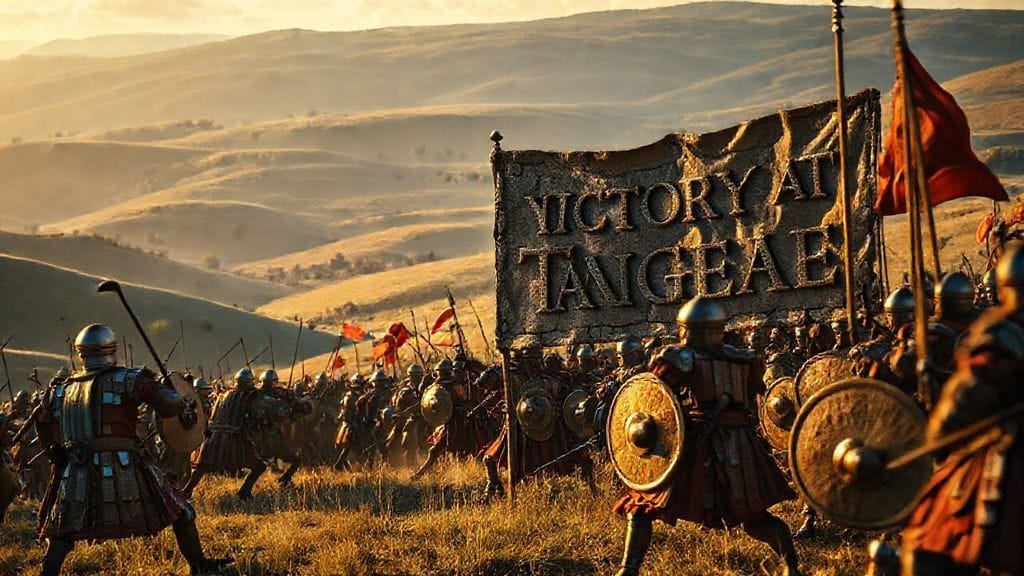
The morning sun stretched pale fingers over the rolling hills of Umbria, filtering through a restless mist, while the air hummed with the grim anticipation of war. Around the village of Taginae, two titans prepared to settle a brutal conflict that had raged across Italy for nearly two decades. The year was 552 AD — a turning point sealed in blood, steel, and indomitable will. On one side stood Narses, the formidable eunuch general of the Byzantine Empire, aged and battle-hardened, yet unyielding. On the other, Totila, the fierce and charismatic king of the Ostrogoths, a leader beloved by his people, fighting desperately to reclaim a shattered kingdom.
It was more than a battle; it was the fate of Italy writ large on a battlefield no larger than a few square miles, where the echoes of clashing swords would resound through history.
1. Dawn over Central Italy: The Prelude to Taginae
Italy in the mid-6th century was a land scarred by war and upheaval. The Eastern Roman (Byzantine) Empire, under Emperor Justinian I, sought to reclaim the lost western provinces of the Roman world. The Gothic War — a series of vicious campaigns against the Ostrogothic Kingdom — had ravaged the peninsula since 535 AD. Entire cities were razed, populations displaced, and the fertile fields of Italy lay fallow and bloodied.
By 552, the war had stagnated into a brutal stalemate. The Gothic forces, resilient and often victorious, had been led masterfully by their king Totila, a leader with the rare gift of rallying a fractured people. But just as Totila’s star seemed unassailable, the imperial generals had found in Narses a new hope—a man of sharp mind and rigorous discipline, ready to change the tide.
The conflict that would erupt at Taginae was not merely a collision of armies but a meeting of two worlds and wills — continuity of the fading Roman order against the emergent medieval kingdoms of Europe.
2. The Decaying Empire and the Gothic Threat
The Western Roman Empire’s fall in 476 AD left Italy in limbo — a prize sought by wavering forces. The Ostrogoths, under Theodoric the Great, had ruled Italy for decades with a fragile peace. However, Justinian’s vision extended beyond diplomacy; he dreamed of a restored Roman Empire, with control from Constantinople to Rome.
This dream collided brutally with the realities on the ground. The war unleashed in 535 was grueling: the Gothic kingdoms’ fierce resistance, shifting alliances with local Italian factions, and the draining resources of the Byzantine state. By mid-century, the war had become a consuming agony, slicing through families and fields alike.
Totila emerged in 541 as the new Gothic king after a bloody civil war. Unlike his predecessors, he was a warrior-king with a pulse on his people’s suffering and hopes. He welded a coalition from scattered Gothic remnants and Italic rebels, re-establishing Gothic dominance. His campaigns retook much of central and southern Italy, even threatening Rome itself.
3. Narses: The Eunuch General’s Improbable Command
Narses was no ordinary general. A eunuch from humble beginnings in Armenia, he rose in the Byzantine court to become one of Justinian’s most trusted advisers. Unlike the typical warlords, he wielded power through intellect, strategy, and an iron will rather than brute force. At an age when most warriors retire, Narses took command of the Byzantine forces in Italy in 551, replacing the less inspired generals before him.
He brought order and discipline to a demoralized army, blending the infantry legions with cavalry of Lombards, Franks, and other federates. His knowledge of terrain, supply logistics, and psychological warfare was unmatched. More importantly, Narses was patient; where others rushed headlong into battle, he waited for the perfect moment.
4. Totila: The Warrior King of the Ostrogoths
In contrast to Narses’ calculated coolness stood Totila — charismatic, bold, and beloved. Born as Baduila, Totila was a warrior molded by incessant war. His charisma rekindled Gothic pride and captured the hearts of Italians disillusioned by Byzantine excesses.
He governed not only through force but empathy, protecting the rural populations and restoring order where chaos once reigned. His military campaigns were daring — swift raids, bold sieges, and direct assaults that combined traditional Gothic cavalry rushes with serious tactical acumen.
Totila’s ultimate aim was to restore Ostrogothic supremacy in Italy. The loss at Taginae would seal his tragic legacy.
5. The Stakes of 552: Rome’s Fate Hangs in the Balance
For Justinian, Italy was the jewel to reclaim the glory of Rome’s ancient empire. For Totila, Italy was the home of his people and their last stand against extinction. Control over Italy meant wealth, strategic hold of the Mediterranean, and symbolic authority.
The Battle of Taginae was more than military; it was existential. The Eastern Roman Empire sought to crush the Gothic resistance once and for all; Totila fought for survival, for his kingdom, and perhaps for his very life.
6. The March to Taginae: Armies Converge in the Umbrian Hills
As spring turned into summer under the relentless Italian sun, Narses’ and Totila’s armies maneuvered carefully through the Umbrian landscape. The hills surrounding the modern town of Gualdo Tadino offered both strategic advantages and treacherous challenges.
Narses advanced with methodical precision — supply lines secured, reconnaissance well planned — while Totila relied on swift movements, hoping to catch the Byzantine forces unprepared. Yet, the aging general’s caution thwarted many Gothic guerrilla attempts, culminating in an inevitable confrontation near Taginae.
7. The Battlefield Unveiled: Terrain, Tactics, and Tension
The battleground’s gentle hills, intersected by streams and ridges, shaped the strategies of both commanders. Narses positioned his troops with care; his Byzantine infantry formed solid lines, protected by archers and cavalry ready to exploit any weakness.
Totila chose a confident offensive posture, with elite Gothic cavalry poised for a decisive charge and infantry ready to engage in close combat. The silence before clash was charged — the air thick with adrenaline and the scent of earth turned by marching thousands of men.
8. The Day of Reckoning: Clash of Blades and Wills
On the dawn of July 1st, 552, battle erupted with ferocity that stunned even seasoned chroniclers. The Goths launched a hammering charge, their cavalry crashing into Byzantine lines with thunderous impact. For hours, the fight raged fiercely with neither side yielding.
Narses, a master of battlefield psychology, held firm. His soldiers, disciplined and well-drilled, closed ranks and counterattacked when openings appeared. The battle’s rhythm swayed repeatedly but with a subtle advantage leaning toward Byzantine endurance.
9. The Turning Point: Narses’ Masterstroke
The moment of truth came in the late afternoon. Narses ordered a hidden contingent of elite infantry to flank the Gothic forces — a maneuver unseen by Totila’s commanders. This surprise strike shattered the cohesion of the Ostrogothic flank.
Caught off guard, Gothic troops faltered. Totila found himself increasingly isolated as command and control slipped away. Narses seized the opportunity to launch a final assault, crushing Gothic resistance under a withering Byzantine barrage.
10. Totila’s Final Charge and Fall
In a last act of defiance and courage, Totila led a desperate charge, rallying his men with cries that echoed the warrior code of his ancestors. Wounded and surrounded, the king fought until his final breath. His death on the field marked the disintegration of Gothic resistance.
According to Procopius, the Byzantine historian witnessing these events, Totila’s body was mutilated and identified only by a ring he wore — a somber footnote to the brutal realities of war.
11. Aftermath on the Plains: The Dust Settles on Taginae
The battle’s conclusion was both victory and tragedy. Approximately 6,000 Goths died; Byzantine losses were lower but none insignificant. Survivors fled, their hopes shattered. With Totila’s demise, the Gothic Kingdom’s resilience crumbled quickly.
For Narses and the Byzantines, Taginae was a triumph — yet even in victory, the cost was palpable. Italy was scarred, its cries for peace lingering long after the swords were sheathed.
12. The Gothic War’s Closing Chapter: What Taginae Signified
Taginae marked the effective end of major Gothic resistance. Shortly after, Byzantine forces quelled remaining opposition, and Italy entered a new phase under imperial control. But peace was tentative and fragile.
The war had devastated Italy’s infrastructure and population, uplifting no true victors, only survivors.
13. The Legacy of Narses and the Eastern Empire’s Triumph
Narses’ victory cemented his reputation as one of Byzantium’s greatest generals. His accomplishment at Taginae allowed Justinian’s empire to restore nominal control over Italy for decades.
Yet, the empire’s hold was costly and precarious, challenged by emerging powers like the Lombards who would soon descend upon the peninsula.
14. Totila Remembered: Heroism, Tragedy, and Myth
For the Goths and later generations, Totila became a tragic hero — the last stand against a fading world. His virtues of bravery, leadership, and compassion carried in oral traditions and medieval chronicles long after his fall.
15. The Impact on Medieval Italy: A Fractured Peninsula
The outcome left Italy divided, impoverished, and vulnerable. The centuries following saw repeated invasions and fragmented rule, as the Roman ideal gave way eventually to a mosaic of city-states and kingdoms.
16. Lessons from Taginae: War, Leadership, and Empire
Taginae offers timeless reflections: how leadership and strategy shape history; how empires rise and fall on narrow battles; how the cost of reclaiming old glories can be devastating.
17. Voices from the Past: Procopius’ Eyewitness Account
The historian Procopius, who chronicled Justinian’s wars, provides a vivid narrative of Taginae — the valor, horror, and human drama fused into a story that still captivates.
18. Archaeological Whispers: What Remains of Battle and Soldiers
Modern archaeology near Gualdo Tadino has uncovered remnants hinting at the battle — weapon fragments, burial sites — quiet witnesses to the brutality of 552.
19. The Battle in Historical Memory and Literature
Medieval and Renaissance writers revisited Totila and Narses’ duels, embedding Taginae in Italy’s cultural tapestry as a symbol of resistance and imperial aspiration.
20. Taginae Today: From Battlefield to Tranquil Town
Present-day Gualdo Tadino, green and peaceful, hides beneath its soil tales of bloodshed and valor — a testament to time’s power to heal even the deepest wounds.
Conclusion
The Battle of Taginae was more than a military encounter — it was a crucible where civilizations clashed and destinies were forged. In that single day, the future of Italy and the Roman legacy hung in delicate balance. The courage of Totila and the calculated resolve of Narses shaped an era and echoed through centuries.
Yet, amidst the carnage and politics, one is reminded that history is the story of human struggles — of hope, despair, bravery, and sacrifice. Taginae teaches us that even in the collapse of empires, the human spirit burns on.
FAQs
Q1: What were the main causes of the Battle of Taginae?
A: The battle was the climax of the Gothic War, rooted in Justinian’s ambition to reclaim Western Roman territories, countered by Totila's efforts to restore Gothic rule over Italy.
Q2: Who was Narses and why was his role so significant?
A: Narses was a Byzantine general and court eunuch, whose strategic brilliance and leadership turned the tide of the war in favor of the Eastern Roman Empire.
Q3: Why was Totila considered a remarkable leader?
A: Despite facing a collapsing Gothic state, Totila demonstrated exceptional military skill, charismatic leadership, and concern for his people’s welfare.
Q4: How did the terrain influence the Battle of Taginae?
A: The rolling hills of Umbria provided natural defensive advantages; Narses’ understanding of the terrain enabled him to orchestrate effective troop deployments and the decisive flank attack.
Q5: What were the wider consequences of the battle for Italy?
A: Taginae ended large-scale Gothic resistance but left Italy devastated, economically weakened, and politically fragmented for centuries.
Q6: How reliable are the historical sources on the battle?
A: Most detailed accounts come from Procopius, a Byzantine historian who provides a vivid yet potentially biased perspective; archaeology helps corroborate some details.
Q7: How is the Battle of Taginae remembered today?
A: It is seen as a pivotal moment in the transition from Antiquity to the Middle Ages, commemorated in history books and local heritage of Gualdo Tadino.
Q8: Did the Battle of Taginae end the Gothic War completely?
A: While it marked the defeat of Totila and the Gothic army, some resistance lingered briefly until the final quelling of Gothic forces.

