Table of Contents
- A Fateful Dawn: The Battle Opens in the Mist of Tagliacozzo
- The Last Stand of a Young King: Conradin’s Bold Gamble
- Charles of Anjou: The Ambitious Conqueror’s Strategy
- Italy’s Fragmented Stage: Between Empire and Papacy
- The Hohenstaufen Legacy: Crown and Curse
- The Road to Tagliacozzo: Political Intrigue and Military Maneuvers
- The Gathering Storm: Forces Assemble on the Abruzzo Hills
- Clash of Titans: The Battle in Real Time
- The Hidden Reserve: Charles’s Tactical Masterstroke
- The Crushing Defeat: Conradin’s Flight and Capture
- Execution and Aftermath: The Fall of the Last Hohenstaufen
- The End of an Era: How Tagliacozzo Reshaped Italy and Europe
- Papal Politics and the Rise of the Angevin Dynasty
- Memories in Stone and Song: The Battle’s Place in Cultural History
- Lessons in Power, Youth, and Fate from Tagliacozzo
A Fateful Dawn: The Battle Opens in the Mist of Tagliacozzo
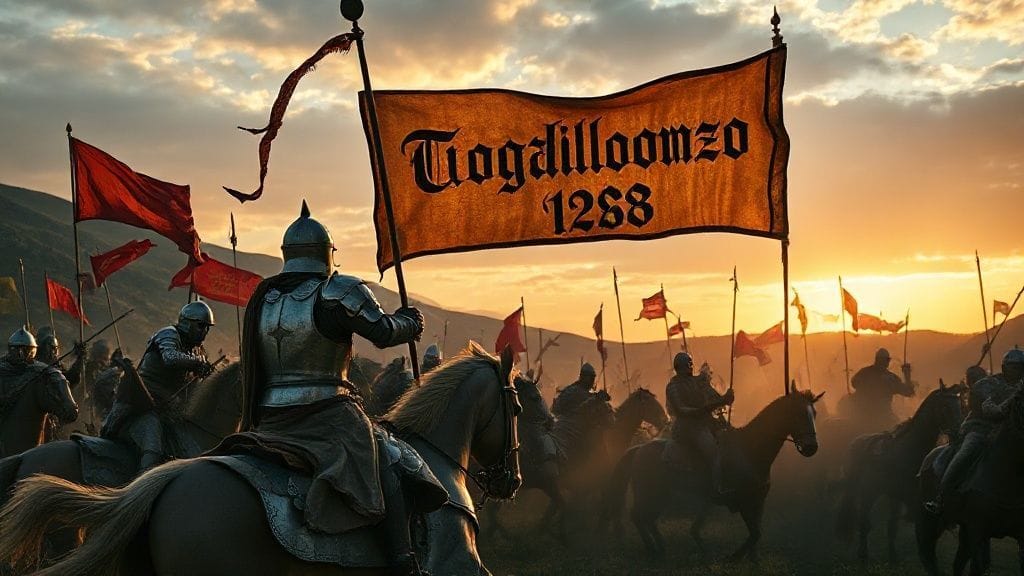
In the humid, early morning haze of August 23, 1268, the fields near Tagliacozzo in Italy’s rugged Abruzzo region awoke to the trembling echoes of war drums. The air was thick with tension, as two vastly different destinies prepared to collide. The sun was barely up, casting long shadows over the trembling armies arrayed on the hillsides, when the clangor of steel and the roar of battle burst forth. At the heart of this storm stood a young man of only sixteen, Conradin, last scion of the proud Hohenstaufen dynasty, fighting not only for a crown but for the survival of his family’s ancient legacy. Opposite him was the seasoned and calculating Charles of Anjou, a king whose ambitions stretched far beyond the hills of Tagliacozzo.
The battle that followed would come to mark the definitive turning point in the struggle for control over the Kingdom of Sicily and northern Italy, with ripples felt across medieval Europe. Yet, even in this certainty, the human cost – the dreams shattered, the generations ended – was a profound tragedy rarely captured by the cold hand of history.
The Last Stand of a Young King: Conradin’s Bold Gamble
Conradin, Duke of Swabia and last legitimate heir of the Hohenstaufen emperors, bore the heavy mantle of a fading dynasty with courage that belied his youth. Yet, his venture into Italy was fraught with peril from the start. Raised in the shadow of his forebears’ glories and failures, his campaign was as much about reclaiming lost honor as it was about handing the control of Sicily back from Angevin hands to his lineage.
Against all odds, Conradin managed to rally scattered Italian and German supporters loyal to his cause, creating a fragile coalition of Ghibellines determined to resist the rise of Charles, backed by the Papacy. But his army was lean and inexperienced, his commanders relatively unseasoned. Each step towards Tagliacozzo was laden with the weight of impending fate.
It’s hardly surprising, then, that historians often marvel at Conradin’s audacity—willing to face the formidable Charles—yet the youthful vigor masked the tragic inevitability that awaited him.
Charles of Anjou: The Ambitious Conqueror’s Strategy
Charles of Anjou, youngest brother of France’s King Louis IX, was no stranger to political ambition or military command by the time he faced Conradin. Installed as King of Sicily by Pope Urban IV, thanks in part to the Papacy’s long-standing opposition to Hohenstaufen rule, Charles had spent years consolidating power in southern Italy, pushing back remnants of imperial influence.
At Tagliacozzo, Charles displayed a cunning rarely seen in medieval warfare. His tactical finesse, particularly his use of a hidden reserve, would decisively shape the battle’s outcome. To Charles, the stakes were high: a victory would secure his dynasty’s claim and buy the Papacy a loyal protector at the strategic crossroads of the Mediterranean. The stakes were not only personal ambition but the broader geopolitical order of Italy and Europe.
Italy’s Fragmented Stage: Between Empire and Papacy
To understand Tagliacozzo, one must grasp the tumultuous landscape of 13th-century Italy—a patchwork of competing city-states, feudal lords, papal territories, and imperial ambitions. For decades, the Italian peninsula had been the chessboard for two opposing titans: the Holy Roman Empire, led during this era by the Hohenstaufen emperors, and the Papacy, seeking to assert spiritual and temporal sovereignty.
The tension was explosive: northern Italian cities often sided with the Empire’s Ghibelline faction, while central and southern regions oscillated in allegiance to the Papacy’s Guelph party. Sicily itself, rich and strategically vital, was the crown jewel in this contested arena. The decade preceding Tagliacozzo saw open conflict, secret pacts, and betrayals that set the stage for Conradin’s fateful incursion.
The Hohenstaufen Legacy: Crown and Curse
The Hohenstaufen dynasty was one of medieval Europe’s most powerful and controversial. From Frederick I Barbarossa to Frederick II, Holy Roman Emperors clashed with popes, expanded territories, and catalyzed cultural florescence. Yet their reign was also marked by relentless conflict with the Papacy, epitomizing the struggle between imperial secular power and spiritual authority.
By the mid-13th century, the Hohenstaufen name was tainted by rebellion and war. Conradin’s father had died in exile, and his uncle Manfred, once King of Sicily, was defeated and killed by Charles at the Battle of Benevento in 1266. Conradin's attempt to reclaim the throne was both the last flicker of the dynasty’s flame and the closing act of a nearly century-long struggle that altered Italy’s destiny.
The Road to Tagliacozzo: Political Intrigue and Military Maneuvers
In the wake of Manfred’s death, Charles of Anjou’s grip on Sicily tightened amid widespread dissatisfaction and pockets of resistance. Conradin’s march was a bold attempt to exploit this discontent. Gathering allies from German princes, loyal Ghibellines, and rebellious Sicilian nobles, he advanced southward, evading Charles’s forces and gathering momentum with every town that opened its gates.
Yet Charles was not caught off guard. His intelligence network and naval supremacy largely neutralized potential reinforcements, setting a trap in the hills near Tagliacozzo. Throughout July and early August 1268, both armies engaged in scouts’ skirmishes, psychological warfare, and diplomatic skirmishes—each vying for advantage, fully aware that the coming battle could not be lost.
The Gathering Storm: Forces Assemble on the Abruzzo Hills
On the morning of August 23, 1268, under a sky turbulent with the heat of summer and anxiety, Conradin’s forces numbered around 3,000 to 6,000 men, mostly knights and light infantry, hardened by previous skirmishes but inexperienced against the more seasoned Angevin army. Charles commanded roughly 3,500 infantry and cavalry, battle-hardened, well-equipped, and led by veteran captains.
The Abruzzo landscape, riddled with treacherous slopes, forests, and rocky outcrops, would shape tactics. Conradin’s initial movements showed resolve: he advanced in a confident open formation, pressing the offensive against the orderly ranks of Charles’s troops.
Clash of Titans: The Battle in Real Time
The battle opened violently as cavalry charges thundered and arrows darkened the skies. Conradin’s forces struck fiercely, pushing the Angevin front lines back. For a time, it seemed the youthful king might seize victory. The cries of “For the Hohenstaufen!” mingled with the rumble of hooves and clashing steel as the young army pressed forward.
But Charles had concealed a critical reserve force, hidden in the hills behind his main line—an elite contingent held back, waiting for the perfect moment. As Conradin’s troops pursued their apparent victory, this hidden army surged forward in a sudden counterattack, enveloping the exhausted rebels from the rear.
The moment was catastrophic. Chaos exploded through Conradin’s ranks; morale crumbled under the unexpected assault. He tried to rally his knights, but amidst the confusion, the noble youth was forced into retreat.
The Hidden Reserve: Charles’s Tactical Masterstroke
Charles’s use of a hidden reserve at Tagliacozzo is widely recognized as a pioneering medieval military tactic. By deliberately feigning retreat, his front lines enticed Conradin’s troops deep into terrain disadvantageous for them, while his concealed forces prepared an ambush that would decisively turn the tide.
This move demonstrated not only Charles’s cunning but also the importance of discipline and timing in medieval warfare. Despite Conradin’s bravery, his inexperience cost him dearly against the older king’s strategy. This clever maneuver was a reminder that battles were as much about wits and nerves as about swords and shields.
The Crushing Defeat: Conradin’s Flight and Capture
Following the collapse of his army, Conradin was forced into a desperate flight. Despite loyal attempts to protect him, he was soon captured near Soriano nel Cimino, betrayed by locals who feared Angevin reprisal. His capture was a devastating blow to the hopes of the Ghibellines and all those who resisted Angevin and Papal hegemony.
Held prisoner in Naples, Conradin was subjected to a swift and controversial trial ordered by Charles. Despite pleas for mercy from European nobles and clergy, the youthful claimant was executed in October 1268—a grim spectacle that shocked contemporaries and echoed as a dark stain on medieval justice.
Execution and Aftermath: The Fall of the Last Hohenstaufen
The execution of Conradin marked the definitive end of the Hohenstaufen line and the extinguishing of their claim to Sicily and the Holy Roman Empire. His death symbolized more than the loss of a dynasty; it was the ruthless closing of an era defined by emperors battling popes and kingdoms torn by factionalism.
Charles the Angevin’s hold over Sicily was solidified, but his brutal methods also sowed hatred that would flare in later revolutions and rebellions, including the devastating Sicilian Vespers of 1282. The immediate peace belied the tensions beneath, and the shadow of Conradin’s martyrdom haunted the collective memory of many Italians for centuries.
The End of an Era: How Tagliacozzo Reshaped Italy and Europe
The Battle of Tagliacozzo did more than decide a throne; it altered the political balance in Italy and Europe. With the Hohenstaufen claim extinguished, the Papacy enjoyed a decade of relative supremacy in Italian affairs, and the Angevin dynasty expanded their Mediterranean influence.
Yet this victory also intensified the factional divisions within Italy, perpetuating cycles of conflict. The battle underscored the fragility of medieval monarchies, where dynastic claims, papal interventions, and local allegiances intertwined unpredictably. The reverberations of Tagliacozzo shaped Italian politics well into the Renaissance.
Papal Politics and the Rise of the Angevin Dynasty
The battle cannot be understood without the Papacy’s role as kingmaker. The popes, locked in bitter rivalry with the Hohenstaufen emperors, viewed Charles of Anjou as a reliable ally who could protect and extend Papal interests. The victory at Tagliacozzo was as much a triumph of ecclesiastical strategy as it was military prowess.
Charles’s reign brought papal-backed reforms and reinforced the Church’s influence over southern Italy, yet his harsh rule alienated many. The controversial execution of Conradin displayed the collusion of secular and spiritual powers, a story repeated across medieval Europe’s tangled history of throne and altar.
Memories in Stone and Song: The Battle’s Place in Cultural History
Long after the battle, Tagliacozzo etched itself into Italian collective memory as a symbol of noble but doomed resistance. Medieval chroniclers lamented the youthful king’s fate; poets and troubadours recounted his bravery and tragic end. Even Dante Alighieri’s Divine Comedy references the brutal politics of the time, immortalizing these conflicts in literature and art.
In the region, monuments and annual commemorations recall the events, turning history into legend and a source of identity. The tale of Conradin’s last battle continues to fascinate historians and travelers alike, a haunting narrative about ambition, youth, and fate’s cruel game.
Lessons in Power, Youth, and Fate from Tagliacozzo
The Battle of Tagliacozzo offers timeless reflections. It exposes how youthful courage, however noble, must contend with the harsh realities of power and strategy. It reminds us that history is shaped not only by grand designs but also by moments of chance, betrayal, and human frailty.
Both Conradin and Charles were players in a vast medieval drama where dynasties rose and fell amid the tides of faith, politics, and war. For readers today, their story is a moving testament to the complexities of leadership and the costs borne by those caught in history’s tumultuous currents.
Conclusion
The Battle of Tagliacozzo was more than a clash of arms; it was a tragic turning point that sealed the fate of a dynasty and reshaped an entire continent’s political and spiritual landscape. The youthful hope embodied by Conradin met the unyielding storm of Charles’s ambition, and in that collision, echoes of medieval Europe’s struggles—between emperors and popes, youth and experience, fate and free will—resounded for centuries.
This pivotal moment invites us to reflect on the nature of power, the price of ambition, and the human stories often lost beneath the march of history. As the fields of Tagliacozzo bear silent witness, the lessons from 1268 continue to resonate, reminding us that history’s greatest tales are not just chronicles of war, but deeply human narratives of courage, loss, and legacy.
FAQs
1. What triggered the Battle of Tagliacozzo in 1268?
The battle was primarily triggered by Conradin’s attempt to reclaim the Kingdom of Sicily from Charles of Anjou, who had captured it after defeating Conradin’s uncle Manfred. This was rooted in the larger conflict between the Papacy supporting Charles and the Ghibelline faction backing the Hohenstaufen claim.
2. Who was Conradin, and why was his role significant?
Conradin was the last legitimate heir of the Hohenstaufen dynasty. His youth and determination symbolized the final hope to restore Hohenstaufen rule in Italy and Sicily. His defeat marked the end of his family’s imperial ambitions.
3. How did Charles of Anjou secure victory at Tagliacozzo?
Charles used superior tactics, most notably hiding a reserve force that launched a surprise attack on Conradin’s pursuing troops, turning an apparent defeat into a decisive victory.
4. What were the immediate consequences of the battle?
Conradin was captured and executed, extinguishing the Hohenstaufen line. Charles consolidated control over Sicily, strengthening the Angevin dynasty and Papal influence in southern Italy.
5. How did the battle affect the broader political landscape of Italy?
Tagliacozzo shifted power decisively towards the Papacy and the Angevins, but also deepened divisions in Italy, contributing to further conflicts like the Sicilian Vespers uprising.
6. Why is the Battle of Tagliacozzo remembered in cultural history?
The battle represents a poignant story of youthful heroism and tragic loss. It inspired poets, chroniclers, and later historians who saw in Conradin’s fate a reflection of the cyclical struggles for power in medieval Europe.
7. What role did the Papacy play in the conflict?
The Papacy supported Charles’s claim as a means to counter Hohenstaufen imperial authority, thereby ensuring its influence over Italian kingdoms and reinforcing the Church’s temporal power.
8. Are there any lasting monuments or commemorations of the battle?
Yes, in the Abruzzo region and beyond, memorials and annual references keep the memory of the battle alive, celebrating Conradin's brave but tragic stand.

