Table of Contents
- The Dawn of Conflict: Umayyad Expansion Meets Frankish Resistance
- The Stage Is Set: Political and Religious Turmoil in Early 8th Century Europe
- Abd al-Rahman’s Ambitions: The Umayyad Advance into Gaul
- Charles Martel: The Hammer Who Forged a Defense
- The Clash Near Tours: Prelude to One of History’s Defining Battles
- The Day of Battle: Tactics, Terrain, and the Turning Point
- The Role of Frankish Infantry and Cavalry: Discipline Against Momentum
- Umayyad Forces and Their Strategy: The Fast Ride to the Heart of Francia
- The Moment of Crisis: Martel’s Leadership Under Fire
- Aftermath on the Battlefield: Dead, Captives, and the Silence That Followed
- Political Ripples: Consolidation of Frankish Power and the Rise of the Carolingians
- Religious Undertones: Christian Europe’s Fight Against Islamic Expansion
- Modern Interpretations: Myth, Memory, and the Making of a “Holy War”
- Cultural and Societal Impact: Identity, Fear, and the Birth of Medieval Europe
- Long-Term Consequences: Europe’s Trajectory After Tours and Poitiers
- The Battle’s Place in Military History: Tactics and Legacy
- Charles Martel’s Lasting Influence: Shaping the Medieval West
- The Umayyad Caliphate’s Retreat: Limits of Expansion and Internal Struggles
- Rediscovering the Battle: Archaeological Finds and Historical Debates
- Conclusion: Why the Battle of Tours Continues to Resonate Today
- FAQs: Exploring the Battle’s Complexities and Legacy
- External Resource: Link to Wikipedia Article
- Internal Link: History Sphere
The early autumn sky over the rolling plains near Tours was heavy with tension. The air seemed still, as if nature herself held her breath. Two great armies—one bearing the crescent banners of the Umayyad Caliphate, the other emblazoned with the Christian crosses of the Frankish realm—stood poised on the threshold of destiny. The year was 732, and in this quiet corner of Gaul, a battle would be waged whose repercussions would echo across the centuries.
This was the Battle of Tours, or Poitiers, a titanic clash that halted the furious advance of the Umayyad forces deep into Western Europe. For the men who fought that harrowing day, and for the generations that followed, the stakes could not have been higher: the survival of a Christianized Europe, the fate of cultures, faiths, and empires hung in the balance. But the story is more nuanced than a simple contest of arms and beliefs. It is a tale of ambition, leadership, identity, and the fervent will to control the soul of a continent.
The Dawn of Conflict: Umayyad Expansion Meets Frankish Resistance
The early eighth century was a period of relentless movement and transformation. The Umayyad Caliphate, quickly carved out in the aftermath of Islam’s rapid rise in the Arabian Peninsula, was surging across North Africa and into the Iberian Peninsula. Their conquests were not merely territorial ambitions—they carried with them a religious and cultural dynamism that reshaped all they touched.
By 711, Tariq ibn Ziyad had famously crossed the Strait of Gibraltar, and within a few years, the Iberian Peninsula was largely under Umayyad control, governed by the Emirate of Córdoba. Yet, the calm of their newly won lands was deceptive. The Umayyads were restless; the prospect of further conquest into the rich lands of Frankish Gaul stirred appetites and strategic concerns.
The Franks themselves were warriors forged in a rough and tumultuous landscape. Their leader, Charles Martel, a man of iron will and tactical genius, faced the challenge of defending his realm amid a fractious European landscape where loyalties were shifting, and threats loomed unpredictably.
The Stage Is Set: Political and Religious Turmoil in Early 8th Century Europe
Europe in 732 was a patchwork of emerging kingdoms, tribal strongholds, and religious communities.
Christianity was by no means uncontested; pagan remnants yet clung to the forests and mountains, and the Eastern Roman (Byzantine) Empire struggled to maintain influence. The Papacy in Rome sought allies to fend off threats from Lombards and northern pagans, while the power struggle between minor kings shaped local politics.
Meanwhile, the Umayyads sought to stretch their caliphate beyond Iberia’s borders. Their raids into Septimania, a region in southern Gaul that once belonged to the Visigoths, set the stage for a full-scale confrontation.
Charles Martel’s growing power was a beacon for Frankish strength, but it also bred enemies—both internal and external. His rebellious nobles needed unification under a single banner, and the looming threat from the south was enough to forge that rare unity.
Abd al-Rahman’s Ambitions: The Umayyad Advance into Gaul
Abd al-Rahman al-Ghafiqi, the Umayyad governor of Al-Andalus, was an ambitious general with a reputation for both ruthless efficiency and remarkable bravery. Leading his forces northward, he intended not just to plunder, but to establish a foothold in Gaul—expanding the Islamic world into new territories rich in resources and strategic importance.
His army was a melting pot: Berber cavalry, Arab soldiers, and even professional skirmishers. They moved swiftly and with purpose, raiding villages and towns, gathering spoils, and pushing the Frankish forces back. Towns like Bordeaux and Angoulême fell in rapid succession, leaving shock and fear in their wake.
Yet, as the campaign progressed, the limits of supply lines, unfamiliar terrain, and the rising preparedness of Frankish forces began to slow Abd al-Rahman's momentum.
Charles Martel: The Hammer Who Forged a Defense
Charles Martel, nicknamed “The Hammer,” was no ordinary leader. Born into a tumultuous family feud and political chaos, he rose through sheer force of character and military prowess. His rule was marked by significant reform: reorganizing the Frankish army, integrating heavy infantry with cavalry, and most importantly, inspiring fierce loyalty among his men.
Martel’s reputation reached beyond Francia; the Papacy looked to him with hope, often viewing him as the protector of Christendom. His motivations were as much religious as political—a man convinced that the survival of his faith and his people depended on halting the Umayyad tide.
Equipped with a deep knowledge of his land’s rugged terrain, and aware of the threat posed by a cavalry-dominant enemy, Martel trained his forces to fight as a cohesive, disciplined block.
The Clash Near Tours: Prelude to One of History’s Defining Battles
In October 732, Abd al-Rahman’s forces moved northward toward the Loire River, penetrating the borderlands near Tours. Intelligence reached Martel swiftly; the Frankish leader mobilized his troops and chose the landscape around the village of Moussais-la-Bataille, near Tours, as the battleground.
The setting was well chosen: open enough to deploy infantry effectively, yet with woods nearby to disrupt cavalry charges. Both commanders understood that the upcoming encounter would be definitive.
The Frankish army, composed mainly of heavy infantry and supported by cavalry, prepared their formations. The Umayyads, confident in their previous victories, believed their cavalry would dominate as it had before.
The Day of Battle: Tactics, Terrain, and the Turning Point
The fighting reportedly lasted several days, but the decisive moments occurred in a brutal, relentless melee.
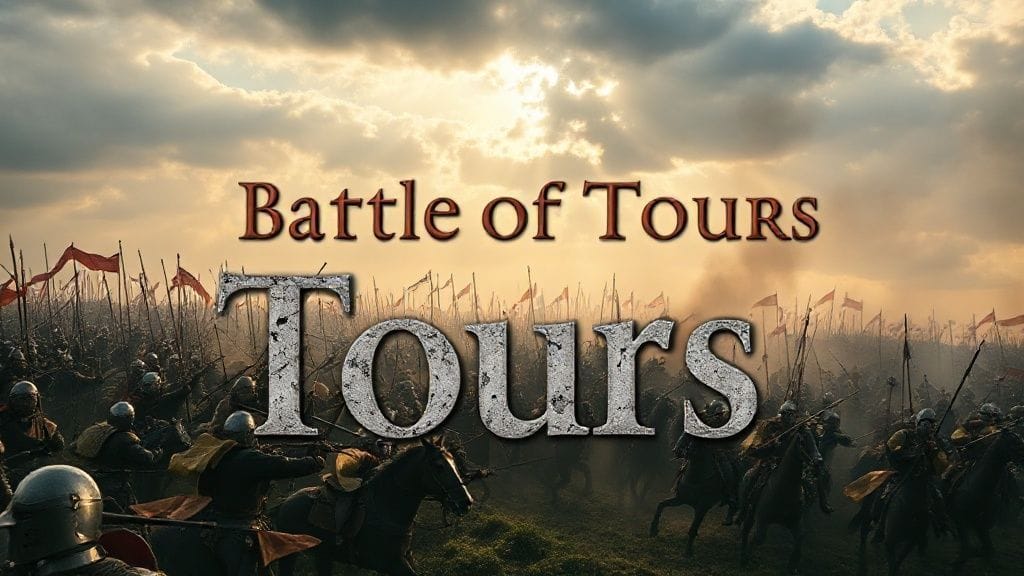
The Frankish infantry formed a tight shield wall, pushing back wave after wave of Umayyad cavalry charges. The discipline of Charles Martel’s men was exceptional—they held ground under pressure, waiting for the enemy to tire.
One telling moment described by chroniclers was the death of Abd al-Rahman himself, struck down amidst the chaos. Losing their commander sowed confusion and shattered morale among the Umayyad troops.
Martel refused to give an inch. His men, fueled by the stakes of their struggle, held fast until the retreat was sounded.
The Role of Frankish Infantry and Cavalry: Discipline Against Momentum
The battle’s outcome was not merely a product of numbers but of the adaptation of the Frankish military machine. Martel’s reliance on heavy infantry trained to resist cavalry charges made his forces exceptional for their time.
Unlike the cavalry-focused armies of the Umayyads, the Frankish strategy emphasized defense in depth and cohesion. Cavalry units were deployed to exploit weaknesses, but the real backbone of the army was its steadfast infantry.
This battle arguably heralded a shift in medieval warfare: the importance of infantry resilience in the face of mounted troops—a principle that would shape Europe’s battlefields for centuries.
Umayyad Forces and Their Strategy: The Fast Ride to the Heart of Francia
The Umayyads' push into Gaul was bold and aggressive. They successfully adapted rapid cavalry raids to strike deep into enemy territory, aiming to destabilize rather than hold land immediately.
Their reliance on speed and shock was tested, however, against a prepared and determined adversary. While their raids had instilled fear and disruption, they underestimated the resolve and tactical innovation of the Frankish defenders.
Their casualties at Tours were heavy, and the death of Abd al-Rahman marked a debilitating blow to their command and control.
The Moment of Crisis: Martel’s Leadership Under Fire
According to historical accounts, it was during the darkest hours of battle that Martel’s leadership proved decisive. Under severe pressure, when morale flagged and the enemy pressed hard, Martel moved through his ranks, rallying his men, strengthening resolve.
His presence on the battlefield was as much symbolic as strategic—a hammer pounding nails, unyielding and forceful.
Martel’s ability to hold the line under crushing assault frozen the Umayyad tide and transformed the Frankish army from a defensive force into victors.
Aftermath on the Battlefield: Dead, Captives, and the Silence That Followed
The field of Tours was strewn with the dead—Arab, Berber, Frank—testimonies to the ferocity of combat. The Frankish victory was hard-won but decisive.
Captives were taken, spoils collected, and the Umayyads' ambitions in Gaul were checked—at least for a time.
The silence that fell on the battlefield was a stark contrast to the chaos hours before; the sound of victory was the quiet of survival.
Political Ripples: Consolidation of Frankish Power and the Rise of the Carolingians
The victory elevated Charles Martel’s standing not merely as a military leader, but as a kingmaker. It laid the foundations for the Carolingian dynasty, culminating in the coronation of his grandson Charlemagne.
Frankish unity solidified, and Martel used the victory to reinforce his hold over various rebellious nobles, centralizing authority.
Europe’s political landscape shifted, setting the stage for a new era of consolidation and empire-building.
Religious Undertones: Christian Europe’s Fight Against Islamic Expansion
Although the battle was principally military, its religious symbolism was profound.
To many contemporary chroniclers, the victory was seen as divine intervention—a providential shield against the spread of Islam into Christian lands.
This infused the event with mythic significance, coloring centuries of Christian-Muslim relations, and feeding narratives of a “Clash of Civilizations” that still reverberate today.
Modern Interpretations: Myth, Memory, and the Making of a “Holy War”
Historians have debated the battle’s real significance—was it truly the “moment that saved Europe” as many suggest, or simply one episode among many in a longer conflict?
Some modern scholars caution against mythologizing the battle as a simplistic religious war, pointing instead to complex political, economic, and military factors.
Yet, the narrative endures, shaping identity and memory in Europe and beyond.
Cultural and Societal Impact: Identity, Fear, and the Birth of Medieval Europe
The psychological shock of the Umayyad advance and its halt left deep marks.
Europeans developed a heightened sense of identity, partly in opposition to the Islamic world, but also driven by internal consolidation.
This period saw the growth of feudalism, Christian missionary activity, and a renewed focus on fortifications and military readiness.
Long-Term Consequences: Europe’s Trajectory After Tours and Poitiers
In the long run, the battle contributed to the stabilizing of the Frankish realm and the eventual Carolingian Renaissance—a rebirth of art, learning, and governance.
While Islam spread elsewhere, its expansion into Western Europe was curtailed. The Umayyad Caliphate would succumb to internal strife, and the legacy of Tours would persist as a symbol of resistance.
The Battle’s Place in Military History: Tactics and Legacy
The Battle of Tours is a classic study in the importance of tactical positioning, leadership, and the evolution of medieval warfare.
It showcased the limitations of cavalry arrogance and the power of disciplined infantry—a lesson absorbed by many later commanders.
Charles Martel’s Lasting Influence: Shaping the Medieval West
Martel’s reforms and his victory created the conditions for the rise of medieval Europe under Carolingian domination.
His military restructuring influenced knightly traditions and the feudal order that would dominate Europe for centuries.
The Umayyad Caliphate’s Retreat: Limits of Expansion and Internal Struggles
The defeat halted the Umayyad push into Europe—but did not end their power.
Internal divisions, as well as the Abbasid revolution, would soon eclipse the Umayyads. Their retreat marked a geographical retraction but also a moment of reflection in Islamic history.
Rediscovering the Battle: Archaeological Finds and Historical Debates
Despite its fame, the exact location and scale of the Battle of Tours remain subjects of debate.
Recent archaeological efforts have uncovered traces of weapons and camps but have yet to resolve all mysteries.
Historians continue to revisit chronicles and materials, striving to separate fact from legend.
Conclusion
The Battle of Tours in October 732 was far more than a mere military engagement; it was a fulcrum upon which the destiny of Europe pivoted. Its reverberations formed the contours of medieval political structures, religious identities, and cultural memory.
Charles Martel’s victory was a testament to leadership, tactical innovation, and the forging of unity under immense pressure. But also, it reminds us how history is made as much by perception and myth as by facts.
As we look back, we see a world transformed—one in which the brave stand at crossroads, and where a single battle can echo through ages, shaping the future of continents and civilizations.
FAQs
Q1: Why was the Battle of Tours so pivotal in European history?
The battle halted the rapid Umayyad expansion into Western Europe, preventing the possible Islamization of large parts of the continent and facilitating the rise of the Carolingian dynasty, which shaped medieval Europe’s political and religious landscape.
Q2: Who was Charles Martel and why was he important?
Charles Martel, “The Hammer,” was the Frankish leader whose military reforms and leadership at Tours secured Frankish dominance and laid the foundation for the Carolingian Empire, influencing European history profoundly.
Q3: Did the battle constitute a religious crusade?
While religious motivations were significant, especially in Christian chroniclers' accounts, the battle also involved political, economic, and territorial considerations. The “holy war” narrative developed over time but may oversimplify the complex causes.
Q4: What happened to the Umayyad Caliphate after the battle?
The Umayyads maintained control in the Iberian Peninsula but faced internal conflict and, eventually, the Abbasid revolution. Their advance into Europe was halted, but Islamic civilization continued to flourish in other regions.
Q5: How reliable are the historical sources about the Battle of Tours?
Most accounts come from later Christian chroniclers and can be biased or mythologized. Archaeological evidence is sparse, and many details remain debated among historians.
Q6: How did the battle influence military tactics in Europe?
It emphasized the effectiveness of disciplined infantry formations against cavalry, shaping medieval European warfare and challenging the previous dominance of mounted troops.
Q7: Is the Battle of Tours remembered differently in Muslim and European histories?
Yes, European histories often highlight it as a key defensive victory, while Muslim histories tend to focus more on other aspects of Umayyad expansion. The battle’s significance varies with differing cultural perspectives.
Q8: What is the legacy of the Battle of Tours in modern times?
The battle remains a potent symbol of cultural and religious identity, often cited in discussions about East-West relations, the spread of Islam, and the formation of European civilization.

