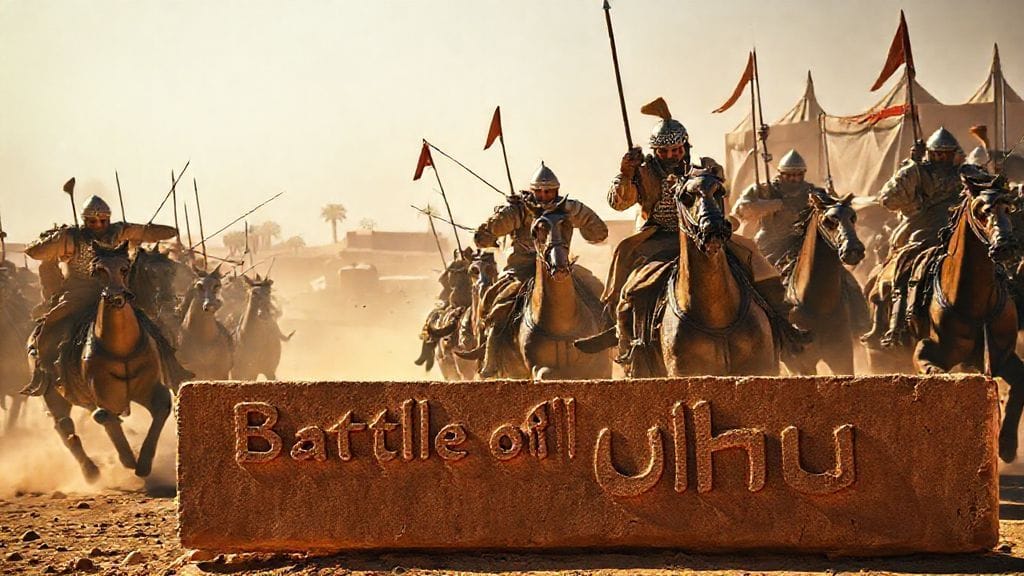
Table of Contents
- The Dawn Before the Storm: Medina on the Eve of Battle
- The Seeds of Conflict: Early Tensions Between Muhammad and Mecca
- Medina’s Fragile Peace: Political and Religious Underpinnings
- The Call to Arms: The Meccan March Towards Medina
- The Preparing Forces: Strategies and Expectations on Both Sides
- The Initial Clash: The Battle Ignites on the Plains of Uhud
- A Sudden Turn: The Archers’ Fateful Abandonment
- Chaos and Counterattack: Medina’s Forces Retreat
- The Death of Hamza: A Personal and Communal Tragedy
- The Prophet’s Steadfastness Amidst the Turmoil
- Aftermath on the Battlefield: Casualties, Capture, and Escape
- Medina’s Resilience: The Community Rebuilds and Reflects
- Political Repercussions: Realignment of Powers in Arabia
- The Battle’s Role in Shaping Islamic Doctrine and Identity
- Memory and Myth: The Battle of Uhud in Islamic Culture
- The Broader Geopolitical Context of 7th-century Arabia
- Lessons from Uhud: Faith, Leadership, and Human Frailty
- The Historical Debate: Sources, Biases, and Perspectives
- Uhud’s Place in the Narrative of Early Islamic Expansion
- The Legacy of the Battle in Modern Middle Eastern Consciousness
1. The Dawn Before the Storm: Medina on the Eve of Battle
As the first light of dawn crept softly across the rugged hills surrounding Medina, a guarded silence blanketed the city. The air carried a hint of desert chill—sharp, anticipatory, like the inhaled breath before a plunge into water. Families rose cautiously, aware that the quiet was brittle. Word had spread swiftly: the Meccan army was advancing, hungry for revenge and honor after their humiliating defeat at Badr only months earlier.
In the streets, men and women moved with a sense of purpose fused with apprehension—children clung to their mothers, elders whispered prayers, and warriors checked their weapons once more. The Battle of Uhud was about to erupt on these very plains, just a short distance away. This was no mere skirmish; it was a crucible, one that would not simply decide military dominance but the survival and soul of the nascent Islamic community.
Muhammad stood among his followers, resolute yet troubled. The scars from Badr had barely faded, and the lessons learned from that victory now applied a heavy caution. The moment was fraught with tension. Would Medina withstand the onslaught, or would the early dreams of a unified Ummah shatter under the Meccan clamor?
2. The Seeds of Conflict: Early Tensions Between Muhammad and Mecca
To grasp the Battle of Uhud's full significance, one must cast back to the bitter ice that had begun to fracture the relationship between the emergent Muslim community in Medina and the entrenched powers of Mecca. The Prophet Muhammad’s mission had, since its inception, threatened the religious and economic status quo upheld by the Quraysh tribe.
Mecca was a bustling commercial hub, home to the Kaaba and central to Arabian pagan worship. Muhammad’s message of monotheism—rejecting the gods worshipped by his own kin—was not only a spiritual revolution but a direct challenge to Mecca’s authority, wealth, and social order. As converts fled persecution in Mecca, Medina became a sanctuary, soon transformed into the political and military nucleus of Islam.
The growing split had erupted violently at Badr in 624 CE, where Muhammad’s smaller force triumphed against formidable odds, incurring heavy humiliation on the Quraysh. This defeat stoked a fierce desire for revenge and restoration of honor—a cultural imperative in the tribal society of the time.
3. Medina’s Fragile Peace: Political and Religious Underpinnings
Medina’s complex social fabric was a tenuous alliance of tribes, including the Aws and Khazraj, recent converts, Jewish clans, and Muslim immigrants (Muhajirun). The arrival of Muhammad had forged unprecedented unity, yet old rivalries simmered beneath the surface.
This was a society in flux—negotiating tribal loyalties, newly imposed religious laws, and the pressures of an external threat. Politically, Muhammad was not merely a prophet but a statesman, blending religious leadership with judicial and military command.
The Muslim community’s cohesion meant everything. It had to withstand both internal dissent and the looming Meccan hostility. Morale was fragile, faith tested, and resources limited. The impending battle would be a defining test of this delicate equilibrium.
4. The Call to Arms: The Meccan March Towards Medina
When news reached Medina that Abu Sufyan, leader of the Quraysh, was mobilizing a force of roughly 3,000 men—many heavily armored and equipped—against the city, the Muslim defenders knew earlier dreams of a swift peace were over.
Abu Sufyan’s motives were manifold: not merely seeking to avenge the humiliation at Badr but also to assert dominance over the pilgrims' city and to dissuade further defections to the Islamic cause.
The march was a show of strength and intent. The caravan-like army, a mixture of tribal levies and hardened Meccan elites, traversed the arid landscape under a blazing sun, stomped by the feet of camels and warriors alike. Their arrival was an ominous shadow over Medina’s already uncertain morning.
5. The Preparing Forces: Strategies and Expectations on Both Sides
Muhammad’s forces numbered around 700, outnumbered and less equipped, yet their resolve was formidable. The Prophet chose the slopes of Mount Uhud—a rugged range offering natural defensive advantages, although debated by some commanders.
A key tactical decision lay in the deployment of archers on a small hill guarding the rear flank, commanded by Abdullah ibn Jubayr. Their orders were explicit: hold position at all costs to prevent a cavalry encirclement.
The Meccan army’s strategy was to provoke the Muslims into battle in open terrain where their cavalry and numbers would dominate. Thus, both sides entered the conflict armed not just with weapons but with strategies and hopes—an intricate dance of warfare where a single misstep could be catastrophic.
6. The Initial Clash: The Battle Ignites on the Plains of Uhud
As the sun climbed higher, the two armies took their positions on the dusty plains near Mount Uhud. The air was thick with tension, cries of warriors sharpening into cries of battle as swords clashed, arrows flew, and horses stampeded.
For a time, Muhammad’s forces pushed back fiercely, the early phases of combat favoring the defenders whose knowledge of terrain aided their resistance. The Muslims pressed the Meccan left flank with fierce determination. It seemed, for a moment, that the outcome might echo Badr’s triumph.
However, the heat of battle soon demanded more than courage—discipline and strategic obedience would prove decisive.
7. A Sudden Turn: The Archers’ Fateful Abandonment
The tide of battle swayed dangerously when the archers atop the key hill disobeyed the Prophet’s commands to remain steadfast. Enticed by the apparent Muslim victory, many descended to collect spoils, leaving their post ungarrisoned.
Abu Sufyan seized the opportunity by sending a cavalry unit to circle behind the Muslim forces. This surprise rear attack disrupted lines, sowed confusion, and transformed victory into chaos.
The Muslim ranks, vulnerable without their archers, faced a punishing counterattack. What had seemed certain was unraveling within moments. The battle’s narrative shifted irrevocably from triumph to tragedy.
8. Chaos and Counterattack: Medina’s Forces Retreat
The Meccan cavalry’s sudden thundering charge shattered the Muslim formations. Many warriors fled or were cut down in the tumult. The psychological blow was immense: the disciplined defense shattered, panic spread.
Yet not all retreated. Muhammad remained resolute, rallying his followers and seeking to stem the rout. His presence was a beacon of hope amid the flood of crisis, embodying both leadership and personal sacrifice.
The battlefield became a desperate maze of skirmishes and survival, with deaths mounting and hopes dimming.
9. The Death of Hamza: A Personal and Communal Tragedy
Among the fallen was Hamza ibn Abdul-Muttalib, Muhammad’s uncle, known as the “Lion of Allah.” His death at the hands of a slave named Wahshi was a profound blow, both personally and to Muslim morale.
Hamza’s loss symbolized more than a military defeat—it was the shattering of familial bonds and the steep price of conflict. Muhammad’s grief was palpable, yet it steeled his determination to continue the struggle.
The death resonated deeply within the community, stirring emotions of mourning and resolve alike.
10. The Prophet’s Steadfastness Amidst the Turmoil
Despite injuries sustained during the battle, Muhammad’s courage never wavered. His efforts to reorganize his followers and prevent total collapse were instrumental in averting complete disaster.
His personal appeals, strategic direction, and spiritual fortitude under fire forged a narrative of resilience that would underpin Islamic identity.
This moment underscored the interwoven nature of faith and leadership in early Muslim society: victory was not merely measured by territorial gain but by adherence to divine mission.
11. Aftermath on the Battlefield: Casualties, Capture, and Escape
When the battle finally ceased, both sides assessed the heavy human cost. About 70 Muslims lay dead, including key companions, while the Meccans also suffered considerable losses.
Some prisoners were taken, others escaped amid the dusty hills. The battle had not settled the deeper conflicts but instead deepened wounds and hardened resolve on both sides.
Medina survived, but the scars were indelible. The immediate military situation was precarious, with the Muslims forced onto the defensive in the months to come.
12. Medina’s Resilience: The Community Rebuilds and Reflects
In the wake of Uhud, Medina’s nascent state was shaken but far from broken. The community quickly mobilized to care for the wounded, bury the dead, and shore up defenses.
Muhammad's leadership shone in these moments of rebuilding—calling on faith, communal solidarity, and preparation for inevitable future confrontations.
Psychologically, the defeat humbled the Muslim ranks and tempered overconfidence from Badr’s victory. It became a lesson in patience, obedience, and collective responsibility.
13. Political Repercussions: Realignment of Powers in Arabia
The Battle of Uhud’s outcome echoed across the Arabian Peninsula’s tribal landscape. The Quraysh regained some honor but failed to crush the Islamic state.
Many tribes began recalibrating their alliances, wary of siding definitively with either camp. The battlefield demonstrated that Islam was neither easily subdued nor invincible.
Politically, the engagement fortified Muhammad’s position in Medina but also underscored the fragile status quo. The conflict was far from over.
14. The Battle’s Role in Shaping Islamic Doctrine and Identity
Uhud occupies an essential place in Islamic consciousness, not only as a military engagement but as a moment of theological reflection.
Qur’anic revelations after the battle framed the defeat as a divine test for faith and obedience, emphasizing human fallibility and spiritual perseverance.
The battle’s events influenced teachings on discipline, reliance on God, and the nature of trials—forming part of the formative narrative that shapes Muslim ethos.
15. Memory and Myth: The Battle of Uhud in Islamic Culture
Over the centuries, the Battle of Uhud has been woven into religious sermons, poetry, and historiography, often presented alongside Badr as twin pillars of early Islamic struggle.
Its heroes—Hamza, Muhammad’s companions, and the archers’ tale—became symbols of valor, sacrifice, and caution.
These stories continue to resonate, influencing Muslim identities and collective memory to this day.
16. The Broader Geopolitical Context of 7th-century Arabia
Uhud did not occur in isolation. It was one episode in a volatile era marked by fragmented tribal confederacies, shifting alliances, and the waning influence of major power centers like Byzantium and Persia.
This geopolitical vacuum allowed Islam’s rapid emergence, with Uhud highlighting the fragile balance between nascent states and traditional tribal structures vying for supremacy.
Understanding this context deepens appreciation for the battle’s stakes beyond the immediate clash.
17. Lessons from Uhud: Faith, Leadership, and Human Frailty
The Battle of Uhud offers timeless lessons: the peril of disobedience, the price of pride, and the power of steadfast leadership.
Muhammad’s example exemplifies guiding through adversity, blending strategic acumen with spiritual resolve.
The event reminds us that even the mightiest face setbacks and that endurance shapes legacy more than fleeting triumphs.
18. The Historical Debate: Sources, Biases, and Perspectives
Historical reconstructions of Uhud rely heavily on early Islamic sources—Hadith collections, Sirah literature—with varying degrees of hagiography and political bias.
Western and non-Muslim historians attempt critical analyses, acknowledging potential exaggerations or interpretive slants embedded in the narratives.
Diverse perspectives enrich understanding, yet challenge us to sift fact from reverent storytelling carefully.
19. Uhud’s Place in the Narrative of Early Islamic Expansion
Though a tactical setback, Uhud did not slow Islam’s eventual advance. It marked a pivotal moment where faith and faction tested their mettle.
In the broader sweep, the battle exemplifies the resilience and adaptability that propelled Islam beyond the Arabian Peninsula in the decades following Muhammad’s death.
It was a chapter of trial en route to transformation.
20. The Legacy of the Battle in Modern Middle Eastern Consciousness
In contemporary times, Uhud remains a touchstone for identity, nationalism, and religious discourse in the Middle East.
It is commemorated in literature, commemorations, and educational curricula, serving as a symbol of perseverance against adversity.
Especially amid ongoing conflicts, Uhud’s memory invokes reflection on leadership, sacrifice, and the cost of ideological struggles.
Conclusion
The Battle of Uhud is far more than a clash of swords and arrows; it is a vivid tableau where faith, leadership, human error, and relentless hope intertwined in the dusty plains near Medina. It captures both the relentless fragility and resilience of a community forging its identity amidst hostility.
Muhammad’s followers learned that faith alone could not guarantee victory without discipline and unity—a lesson etched in both the scars of loss and the fire of resolve. The battle humanized a pivotal moment in Islamic history, revealing the profound costs paid on the path to spiritual and political ascendancy.
Today, Uhud resonates as a powerful narrative of endurance; a reminder that history’s meaning lies not only in triumph but in the courage to rise, to rebuild, and to believe again.
FAQs
Q: What triggered the Battle of Uhud?
A: The battle was sparked by Meccan desire to avenge the defeat at Badr and to suppress the rising influence of Muhammad’s Muslim community in Medina.
Q: How did the archers' actions affect the outcome?
A: The archers’ premature abandonment of their position allowed Meccan cavalry to flank the Muslim forces, turning an impending victory into a costly defeat.
Q: Who was Hamza, and why was his death significant?
A: Hamza was Muhammad’s uncle and a revered warrior; his death was a deep personal loss for Muhammad and symbolized the high sacrifices made.
Q: What were the immediate consequences for Medina?
A: Medina survived but with diminished morale and strategic vulnerability, prompting efforts to reinforce and reorganize for future conflicts.
Q: How does the Quran reference the Battle of Uhud?
A: The Quran refers to Uhud as a divine test emphasizing obedience and faith, teaching Muslims about trials and perseverance.
Q: How reliable are the historical accounts of the Battle?
A: While foundational Islamic sources provide detailed narratives, historians approach them critically to consider possible bias and hagiography.
Q: Did the Battle of Uhud end the Muslim-Meccan conflict?
A: No, it was a continuation of the broader struggle that culminated later in other key battles, including the eventual Muslim conquest of Mecca.
Q: How is the Battle of Uhud remembered today?
A: It remains a symbol of sacrifice and resilience in Islamic culture and is commemorated in religious teachings and cultural memory.

