Table of Contents
- Bohemia on the Brink: Europe Before the Battle of Usti nad Labem
- From Jan Hus to Holy War: The Making of the Hussite Revolution
- Crusaders and Heretics: The Road to Open Confrontation
- A City Between Worlds: Usti nad Labem on the Eve of Battle
- The Fourth Anti-Hussite Crusade: Papal Banners, Imperial Dreams
- The Hussite War Machine: Wagenburgs, War Hymns, and Firearms
- June 16, 1426: Morning on the Elbe, Tension in the Air
- Steel Meets Song: The Opening Clash at Usti nad Labem
- The Turning of the Tide: Hussite Counterattack and Crusader Collapse
- Flight, Slaughter, and Surrender: The Human Cost of Victory
- Echoes Across Christendom: Political Shockwaves of the Hussite Triumph
- Life After the Battle: Survivors, Refugees, and Ruined Towns
- Myths, Songs, and Chronicles: Remembering Usti nad Labem
- From Medieval Heresy to Modern Memory: Nationalism and the Hussites
- Military Innovation and the Long Shadow of the Wagenburg
- A Battlefield Without Footprints: Searching for Physical Traces
- Conclusion
- FAQs
- External Resource
- Internal Link
Article Summary: The battle of usti nad labem, fought on June 16, 1426, in northern Bohemia, was one of the most decisive victories of the radical Hussite movement over a coalition of Catholic powers. This article reconstructs the tense political, religious, and social world that produced the clash, tracing a line from the burning of Jan Hus to the thunder of cannons above the Elbe River. It follows crusaders and Hussite warriors alike, showing how the battle of usti nad labem shattered expectations in the courts of the Holy Roman Empire and in the curia of Rome. Along the way, it explores the innovative Hussite military system, the improvisation of peasant-soldiers behind wagon forts, and the bitter disillusion that spread among the defeated crusaders. Yet the story does not end on the field: the article delves into the ruined countryside, wandering refugees, and contested memories that followed. It shows how the battle of usti nad labem became a symbol, reused by later nationalists, reformers, and historians to tell very different stories about faith and identity. Drawing on chronicles, legends, and modern scholarship, it argues that this fight near a modest Bohemian town helped reshape late medieval warfare and the balance of religious authority in Central Europe. And it invites the reader to see in the cries and gun smoke of that day the beginning of a long European struggle over conscience, power, and belonging.
Bohemia on the Brink: Europe Before the Battle of Usti nad Labem
In the early fifteenth century, Central Europe was a region permanently on edge. The Holy Roman Empire was more a patchwork quilt than a unified state, its princes and bishops clutching local privileges while emperors tried, and often failed, to assert power. Germany, Poland, Hungary, and the Crown of Bohemia formed a dense web of alliances, rivalries, and dynastic claims. Over everything hung the weight of the Church: popes who levied crusades, bishops who held both croziers and swords, inquisitors who hunted dissent. By the time the battle of Usti nad Labem would be fought in 1426, decades of religious anxiety and political tension had already prepared the ground.
Bohemia itself, encompassing what is now much of the Czech Republic, was one of the most prosperous lands in the Empire. Silver mines at Kutná Hora poured wealth into royal coffers; Prague, with its university founded in 1348 by Charles IV, sparkled as a center of learning and debate. Yet prosperity and learning did not bring peace. Bohemia was divided linguistically and socially: Czech-speaking peasants and artisans often looked with suspicion at the German-speaking townsfolk and miners, who sometimes aligned themselves more closely with imperial and ecclesiastical authority. A slow-burning resentment about foreign influence, combined with genuine spiritual unrest, spread through parish churches, university lecture halls, and taverns alike.
Europe as a whole was still reeling from the scars of the Black Death, of the endless Anglo-French conflicts, and of papal schisms that had produced rival claimants to the throne of Saint Peter. Ordinary believers could see that high-ranking clergy lived richly, while sermons thundered about humility and poverty. Corruption, simony, and the selling of indulgences stung the conscience of many. In Bohemia, with its unusually literate urban population and argumentative intellectual culture, these tensions would burst spectacularly into the open. When the first Hussite militias began to form, they were not a sudden aberration but rather the most dramatic symptom of a wider European malaise.
On the northern fringes of this restless kingdom lay a town of modest size but significant strategic value: Ústí nad Labem—Aussig to German speakers—perched at a bend on the Elbe River, near mountain passes leading into Saxony and Lusatia. Long before the first war wagon rolled into view, lords and traders understood that whoever held Ústí controlled a vital artery for commerce and military movement. By 1426, that simple geographic fact would draw the town into the wider storm: combating faiths, contending armies, and a battle that would echo far beyond its hills.
From Jan Hus to Holy War: The Making of the Hussite Revolution
The spark that ignited Bohemia’s revolution was a priest and scholar with a resonant voice and a stubborn conscience: Jan Hus. Born around 1370, Hus rose from humble origins to become a university master and preacher at the Bethlehem Chapel in Prague. There, he delivered sermons in Czech, rather than Latin, to crowds of townspeople and students. Influenced by the English reformer John Wycliffe, Hus condemned clerical corruption and argued that the true Church was the community of the predestined faithful, not simply the hierarchy of bishops and popes. These were dangerous ideas, and Hus knew it.
In his pulpit, Hus took aim at the selling of indulgences and the political entanglements of the papacy. He insisted that a sinful pope could not be obeyed in matters contrary to the Gospel. To many in Prague—craftsmen tired of tithe burdens, students eager for intellectual rebellion, nobles irritated with foreign curial interference—Hus seemed less a heretic than a prophet. When the Council of Constance summoned him in 1414, promising safe conduct, he went in good faith, hoping to persuade. Instead he found himself tried and condemned. On July 6, 1415, he was burned at the stake, his ashes, according to later chroniclers, scattered into the Rhine, as if the Church could extinguish his influence along with his body.
The opposite happened. News of Hus’s execution struck Bohemia like a thunderclap. In towns and villages, people wore small chalice badges—symbols of the “utraquist” demand that laypeople receive Communion in both bread and wine. Nobles signed protest letters; university factions split; priests sympathetic to Hus’s teaching continued to preach a purified, vernacular Christianity. The crusading language used by Hus’s accusers was soon turned on its head: if Rome called Hussites heretics, Hussites called themselves defenders of Christ’s truth against a corrupt Babylon.
By 1419, the religious awakening had turned overtly political. In Prague, radical preachers and a furious crowd stormed the New Town Hall in the First Defenestration of Prague, hurling councillors down to their deaths. This was not a random outburst; it was a political message to a monarchy that seemed poised to suppress reform. King Wenceslas IV died shortly thereafter, and his brother Sigismund, King of Hungary and future Holy Roman Emperor, claimed the Bohemian crown. To many Hussites, Sigismund was the man who had failed to protect Hus at Constance. Accepting him as king felt like betrayal.
Bohemia fractured into armed religious communities, each with its own priorities and visions of reform. At Tábor in the south, a radical communal experiment took shape. In Prague and other cities, more moderate utraquists held sway. The line between religious conviction and social revolution blurred. Fields were fortified with wagons; church bells were melted into cannon. The country slid into full-scale war, not just between Bohemians and foreign crusaders, but also among Bohemians themselves. It is within this volatile crucible that the events leading to the battle of Usti nad Labem must be understood: not as an isolated clash, but as one chapter in an ongoing holy war over the soul of Bohemia.
Crusaders and Heretics: The Road to Open Confrontation
The papacy and much of Catholic Europe saw the Hussite movement as a scandalous affront, a heretical tumor within the body of Christendom. The response followed a familiar script: declare a crusade, grant indulgences, raise armies under the banner of orthodoxy. Between 1420 and 1431, several anti-Hussite crusades were proclaimed, drawing knights, mercenaries, and pious volunteers from across the Empire, Poland, Hungary, and beyond. They marched into Bohemia expecting a brief campaign, a quick purification of heresy. They found instead a determined, adaptable enemy willing to turn the tools of everyday life—plough horses, wagons, farmhands—into instruments of war.
Early encounters had already warned the crusaders that this was no ordinary rebellion. At the battles of Vítkov Hill (1420) and Vyšehrad, Hussite forces under the charismatic general Jan Žižka repelled superior crusader armies with a combination of ingenuity, discipline, and religious fervor. Žižka, blind in one eye and later in both, reorganized ragtag militias into a mobile defense system built around fortified wagon camps known as wagenburgs. Crossbowmen, handgunners, and flail-armed peasants worked together in surprisingly coordinated fashion. Crusader cavalry charges, once the terror of European battlefields, broke apart under volleys of shot and bolts and the stubborn timber wall of chained wagons.
With every failed crusade, the legend of the Hussite warriors grew. So did the anxiety in neighboring lands. Saxony, Lusatia, and Meissen—German regions bordering Bohemia—watched nervously as Hussite raiding parties conducted spanilé jízdy, “beautiful rides” or armed expeditions, across their frontiers. What began as defensive warfare evolved into strategic offensives, both to secure supplies and to pressure hostile princes into negotiation. Villages burned, monasteries were looted, and the sense that heresy was on the march deepened the determination of Catholic princes to crush it.
Yet every campaign against the Hussites was plagued by familiar problems: poor coordination, conflicting ambitions among princes, and underestimation of the enemy. German and Hungarian magnates sought glory, plunder, and local advantage as much as religious victory. Imperial politics further complicated matters. Sigismund needed to prove his worth as defender of the faith, but he could not always command full obedience from the fractious princes of the Empire. This tangle of motives and resentments shaped the coalition that would eventually mass near Usti nad Labem. The crusaders marching there carried papal blessings and stood under noble banners, but they also carried doubts. Stories of slaughtered knights and broken armies in previous campaigns cast long shadows over their new endeavor.
A City Between Worlds: Usti nad Labem on the Eve of Battle
Ústí nad Labem in the early fifteenth century was no grand capital. It was a middling town perched above the Elbe River, its wooden houses and stone church huddled within modest walls. Yet what it lacked in size it made up in strategic importance. The Elbe was a vital trade route, connecting the interior of Bohemia with the markets of Saxony and beyond. River barges carried grain, salt, cloth, beer, and ores; roads branching from Ústí linked to mountain passes and border forts. Whoever held this town could open or close the gates between Bohemia and the German lands.
Its population reflected this position at a crossroads. Czech and German speakers lived side by side, sometimes cooperatively, sometimes in simmering tension. Merchants from Saxony might have maintained counting-houses there, while local guilds—brewers, butchers, smiths—regulated everyday economic life. A parish church, perhaps enriched by river trade, presided over the town’s spiritual rhythms: masses, baptisms, processions on saints’ days. When rumors of Hussite preaching and iconoclasm spread through the region, some in Ústí feared for their altarpieces and relics; others may have whispered that the Church had grown rich and fat and that a cleansing wind was needed.
By 1426, war had already brushed the town more than once. Raiding bands, whether Hussite or Catholic, skirted its environs. Peasants in the surrounding countryside learned to hide their grain, to flee to forests at the first sign of approaching horsemen. The scars of earlier campaigns were visible: burned-out homesteads, abandoned fields, monasteries stripped of valuables. The town’s leaders, caught between fearing the “heretics” and fearing the devastation of open war, had to calculate endlessly—whom to appease, whom to resist, when to open the gates, and when to pray the storm would pass them by.
On the eve of the battle of Usti nad Labem, anxiety must have hung over the town like a mist rising from the Elbe. From the walls, watchmen could see movement on distant hills—banners in the wind, dust columns that marked the advance of large forces. Within days, the town’s role as a trading hub would be brutally transformed. Its hills would become killing fields; its river, a witness to screams and splintered armor. No one then could know that their modest community would lend its name to one of the most significant clashes of the Hussite Wars.
The Fourth Anti-Hussite Crusade: Papal Banners, Imperial Dreams
The battle of Usti nad Labem formed part of what is often called the fourth anti-Hussite crusade, an effort to break the stalemate through a concentrated northern offensive. By 1426, the earlier large-scale crusades had failed disastrously. Yet the papacy and the imperial court could not simply accept a heretical enclave in the heart of Europe. In councils and castles, men debated: more negotiation or renewed war? In the end, the old reflex prevailed. A new campaign would be mounted, this time focusing on breaking Hussite strength in northern Bohemia and regaining control of critical border towns like Ústí.
Recruitment took place in the bishoprics and principalities of Saxony, Meissen, and Lusatia, among others. Bishops exhorted the faithful from their pulpits: take the cross, defend the Church, stamp out the Hussite contagion. Indulgences were promised; sins would be remitted for those who fought. For some, this was a profoundly religious calling. For others, it was an opportunity for plunder and advancement. Younger sons of noble families, with limited inheritances, might enhance their fortunes through war. Town councils, especially in German centers nervous about Hussite raids, offered men and money.
The coalition that gathered was therefore a patchwork, united more by fear of Hussite expansion than by clear strategy. High nobles and local captains led contingents of knights and men-at-arms, supported by infantry, crossbowmen, and a motley assortment of mercenaries. Some chroniclers emphasize the presence of Silesian, Saxon, and Lusatian forces, along with a sprinkling of contingents from more distant regions. Armorers worked overtime to equip them. Supplies of grain, salted meat, and barrels of beer were assembled. Artillery, still relatively primitive, accompanied the expedition—heavy bombards that might be used to batter fortified towns if time allowed.
At the apex of this army’s imagined purpose stood Sigismund, though he was not physically present at every engagement. His authority, however embattled, gave the crusade imperial legitimacy. Behind him stood the pope, whose bulls denouncing Hussite errors were copied and preached throughout Catholic lands. Yet unity on parchment did not always translate into cohesion in the field. Rivalries among commanders, varying levels of training, and differing expectations about reward and risk all undermined the crusaders’ potential strength. They marched toward northern Bohemia confident in their cause but carrying within their ranks the seeds of their own undoing.
The Hussite War Machine: Wagenburgs, War Hymns, and Firearms
Facing this coalition was an army unlike any other in contemporary Europe. The Hussite forces that converged toward Usti nad Labem were not professional soldiers in the traditional sense, but a hybrid of peasant levies, urban militias, and hardened veterans welded together by faith, necessity, and the genius of commanders who understood their strengths and weaknesses. Their reputation at this point was formidable. The crusaders had learned the hard way that underestimating this “rabble of heretics” was a fatal mistake.
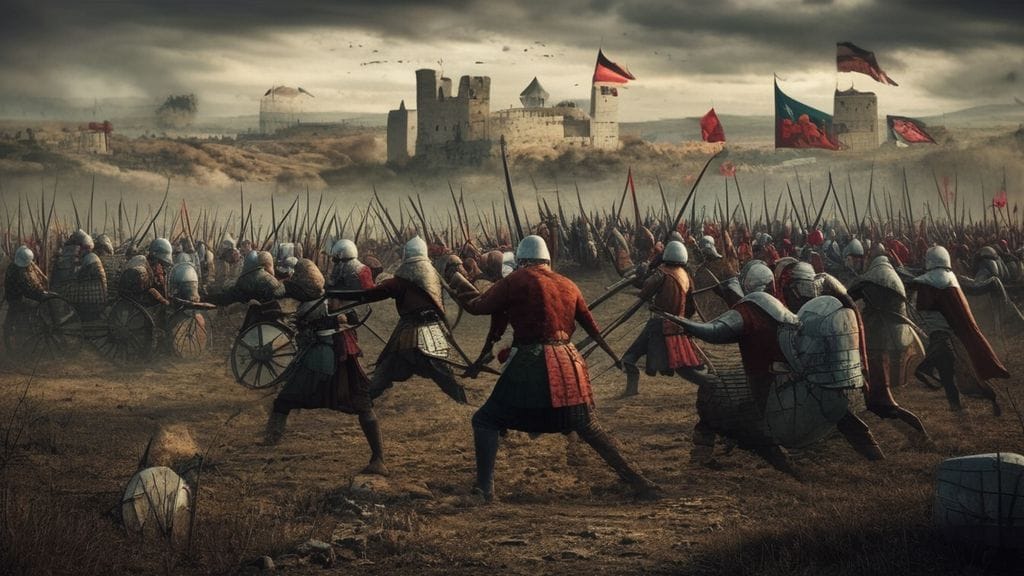
The heart of Hussite military power lay in the wagenburg, the wagon fortress. Farm wagons, reinforced with planks and sometimes iron fittings, were chained together in defensive rings or rectangles. Behind these rolling walls, crossbowmen and early handgunners—using píšťaly, primitive firearms that gave the later word “pistol”—could fire with relative safety. When the enemy approached, they met volleys of bolts and gunshot that disrupted formations before they could close to hand-to-hand range. If knights did manage to reach the wagons, they found themselves hacking at thick wood while men with flails, polearms, and maces struck back from above.
Organization was crucial. Hussite commanders divided forces into specialized groups: drivers, pikemen, gunners, shield-bearers. Signals were standardized; discipline within the wagon camp was stern. The movement of such a fortified convoy required planning and practice. Yet when positioned well—on a slope, near natural obstacles, or at choke points—wagons transformed vulnerable infantry into a lethal hedgehog against which heavy cavalry shattered. It is astonishing, isn’t it, how a simple object like a cart, repurposed creatively, could neutralize centuries of knightly dominance?
Equally important was morale, fueled by religious conviction. Hussite warriors sang hymns like “Ktož jsú boží bojovníci” (“Ye Who Are Warriors of God”) as they marched and fought, their voices blending with the rattle of chains and the crack of gunpowder. They believed, or at least many of them did, that they fought not only for their homes but for a purer Church and the right to receive the chalice. This did not mean they were saints. Like other medieval armies, they looted, killed prisoners, and committed atrocities. But their sense of chosenness, of being God’s embattled remnant, gave them a psychological edge.
By the time they advanced toward Usti nad Labem, Hussite commanders had learned from half a decade of war. They knew how to bait crusader armies into attacking unfavorable positions. They understood local terrain and supply routes. They had witnessed the panic that could overtake enemy troops when familiar tactics failed. At Usti, they would once again rely on these strengths—discipline behind the wagons, innovative use of firearms, and fervent communal resolve—to meet a numerically comparable or even superior enemy head on.
June 16, 1426: Morning on the Elbe, Tension in the Air
The dawn of June 16, 1426, slid slowly over the hills and river valleys around Usti nad Labem. Mist likely clung to the Elbe, softening the outlines of trees and rooftops, muffling the distant clatter of armor as two armies prepared for a confrontation that neither could any longer avoid. Whether from the town’s walls or from hilltop camps, men would have looked out over the landscape, trying to read the omens of the day in cloud formations and the cries of birds.
On the crusader side, tents and pavilions stood in rough order, banners lifting in the breeze: lions, eagles, crosses, the heraldic devices of Saxon lords and Lusatian towns. Squires tightened girths, polished mail, and adjusted visors. Priests moved among the men, blessing them, hearing confessions, reminding them of indulgences promised for those who died in this holy struggle. Some soldiers perhaps felt genuine serenity, convinced that martyrdom awaited them if they fell. Others chewed bread in nervous silence, staring at their boots, remembering rumors of previous battles where knights fled in panic or never returned at all.
Across the field, the Hussites arranged their wagons and troops with deliberation. Horses were hitched, wheels chocked, chains tested. Gunners checked powder and shot, crossbowmen twanged strings and tested mechanisms. The atmosphere in their camp was different: less pageantry, more workmanlike intensity. They had no illusions about the crusaders’ intentions. For them, this was a fight for survival in a world that regarded them as outcasts. Yet behind the dread lay also a familiar rhythm—they had been here before, in other valleys and under other skies, facing other crusader hosts who believed God would reward them with easy victory.
Some commanders on each side may have hoped for maneuver rather than immediate collision: perhaps to draw the foe into an ambush, or to secure a stronger position. But geography is a stubborn master. The hills and river near Usti created constraints, channeling movement into certain corridors. With both armies intent on controlling the approaches to the town and the surrounding region, contact was inevitable. Scouts would have ridden back with hurried reports: “They are here, and in force.” Orders were barked, drums or horns signaled formations to move. The battle of Usti nad Labem, until then a looming threat, became an imminent reality marked by the metallic clatter of men forming ranks and the whispered prayers of those who feared they would not live to see the next sunrise.
Steel Meets Song: The Opening Clash at Usti nad Labem
The first moments of actual combat on that June day remain clouded in the patchy record of medieval chroniclers, but a plausible picture emerges from the sources we have. The crusader commanders, confident in the striking power of their cavalry and the moral superiority of their cause, appear to have opted for a relatively frontal approach. Their goal was clear: break the Hussite position, shatter the wagon defenses, and roll up the “heretic” army before it could fully exploit its defensive formations.
The Hussites had prepared a formidable wagonburg on high ground overlooking approaches to Usti nad Labem, likely positioning themselves to use the terrain’s slopes and ravines to their advantage. As the crusader lines advanced, shields overlapping, lances leveled, the Hussites raised their war hymns. Witnesses later recounted the eerie power of those songs. “Ye who are warriors of God…” the voices rang out, not as a polished choir, but as a raw chorus of farmers, artisans, and veteran fighters. To some on the crusader side, this must have sounded like blasphemy—a holy language twisted by heretics. To others, it sounded unnervingly like conviction.
When the range was right, the Hussite gunners and crossbowmen opened fire. Thunder cracked across the field as small cannons and handguns spat lead and iron. Smoke billowed, mixing with dust thrown up by the hooves of charging horses. Arrows and bolts arced through the air. The initial crusader wave pressed on, their armor clanging under impacts. Some fell; others gritted their teeth and continued. But the attack’s cohesion, so vital for heavy cavalry, began to fray under the pummeling.
Attempts to storm the wagons proved costly. Knights who reached the wagon line found themselves grappling not with disorganized peasants but with disciplined defenders. Spears and hooked weapons dragged riders from horseback. Flails smashed at visors and joints in plate. When attackers tried to pry open gaps in the wagon chain, Hussite fighters surged to plug them, sometimes counterattacking in tightly organized sorties from behind the wooden barrier.
Crusader infantry, meant to support the cavalry, also faced relentless missile fire. The heavy armor that protected many knights became a burden under intense ranged attack and on broken ground. A sense of frustration set in. Why did these “heretics” not break, as rebels were supposed to when confronted with the shock of noble cavalry? Why did every forward surge seem to meet not confusion but prepared, orchestrated resistance? The opening phase of the battle of Usti nad Labem, which the crusaders had hoped would be the beginning of the end for the Hussite cause, instead began to look ominously like previous campaigns where brute force could not crack the wagon fortress.
The Turning of the Tide: Hussite Counterattack and Crusader Collapse
Medieval battles often hinged on moments of psychological as much as physical turning, and at Usti nad Labem that moment seems to have come when the Hussites, sensing the attackers’ loss of momentum, switched from defense to calculated offense. They had absorbed the crusaders’ initial fury. Now they intended to break them.
According to accounts preserved in later chronicles, once the crusader lines were sufficiently disordered and exhausted by repeated assaults against the wagonburg, Hussite commanders gave the signal for a coordinated counterattack. Wagon gates opened; fresh troops surged out in compact blocks, supported by flanking cavalry—lightly armored but highly mobile. Gunners advanced to closer range, intensifying their fire against any remaining cohesive enemy formations. The crusaders, expecting a purely defensive enemy, suddenly confronted an opponent that lunged forward with ferocious energy.
Here, the geography around Usti nad Labem likely contributed to the chaos. Slopes that had impeded crusader advance now worked against them in retreat. Narrow routes of withdrawal quickly clogged with panicked men and horses. As Hussite formations pushed downhill or outward from their positions, they exploited every breakdown in enemy order. Isolated groups of knights, their horses blowing and armor scratched and dented, found themselves surrounded. Some fought on grimly; others tried to find avenues of escape but discovered those paths already clogged with fugitives.
Rumor, always volatile on battlefields, did the rest. Perhaps a shout spread that a key banner had fallen, or that an important noble lay dead. Once men believed their leaders had been killed or fled, despair rippled through their ranks. What had begun as an organized crusading army started to dissolve into scattered, leaderless clusters. Hussite fighters, who had spent the early part of the day repelling assault after assault, now found themselves in the position of pursuers. Their songs, earlier barely audible over the crash of battle, now rose eerily as they advanced—victors’ music rather than defenders’ prayer.
The collapse, when it came, was devastating. In the end, the battlefield near Usti nad Labem was strewn with bodies, broken lances, abandoned banners. The crusader losses were heavy; many nobles fell, along with countless common soldiers. The Hussites, though not unscathed, had achieved a decisive victory. What was meant to be the hammer stroke crushing heresy had instead become another infamous disaster for the anti-Hussite coalition. In the words of one later German chronicler, quoted by modern historians, “the flower of many lands lay cut down in that Bohemian field,” an image that captures both the military and emotional weight of the defeat.
Flight, Slaughter, and Surrender: The Human Cost of Victory
Once an army broke in the fifteenth century, the line between battle and slaughter blurred. At Usti nad Labem, as the crusader resistance crumbled, individuals and small groups tried desperately to flee. Some raced for the river, hoping to swim or scramble across, only to be dragged under by the weight of their own armor or struck down by pursuing Hussites. Others abandoned helmets, shields, even breastplates in their haste, casting away hard-won equipment that moments before had symbolized status and security.
For Hussite fighters, the temptation to exact vengeance must have been intense. They had watched their lands invaded, their faith condemned, their own comrades mutilated or executed without mercy by earlier crusading forces. Now tables were turned. While some prisoners were taken—especially nobles who could be ransomed—many rank-and-file crusaders likely met brutal ends on the field or in the surrounding woods and ravines. Late medieval warfare was not governed by anything like modern international law. Mercy was personal, situational, and often scarce when fear and wrath ran high.
The townspeople of Usti nad Labem and nearby villages found themselves suddenly confronted with a transformed landscape. Where the day before there had been anxious waiting, now there were corpses to bury or strip, wounded men crying out in a babel of languages, horses wandering riderless. Some locals, if sympathetic to the crusaders, may have tried to hide fugitives, dressing their wounds in barns or cellars. Others, more aligned with Hussite sentiment or simply opportunistic, picked through the spoils on the dead: boots, belts, daggers, rings quietly removed from bloodied fingers.
Victorious Hussite leaders had decisions to make as well. How many prisoners to keep alive? How far to pursue fleeing enemies into neighboring territories? How to secure supplies from a region now littered with evidence of recent violence? Their men, exhausted and exhilarated, required food, rest, and pay—whether in coin or plunder. The battle of Usti nad Labem did not end when the last organized crusader resistance ceased; it bled into days and weeks of consequences: burned enemy encampments, negotiations over ransoms, the grim work of gathering weapons and armor that might be reused in future campaigns.
And for the families of those who had marched under crusading banners, the human cost unfolded slowly, through rumors and partial reports. A wife in Meissen or Leipzig listening as a rider told of a “great misfortune in Bohemia”; a mother in Lusatia clutching a rosary, waiting for a son who never returned. The victory songs of the Hussites were mirrored by the quiet, grief-choked prayers of those on the other side of the frontier. One field near a small Bohemian town had suddenly bound together the fates of people across a swathe of Central Europe, in joy for some, in mourning for many.
Echoes Across Christendom: Political Shockwaves of the Hussite Triumph
The immediate military result of the battle of Usti nad Labem was clear: another crusading army had been routed, leaving the Hussites stronger and their enemies reeling. But the political and ideological consequences rippled far beyond the Elbe valley. In princely courts and episcopal palaces across Central Europe, the news struck like a thunderbolt. How could the combined might of Saxon, Lusatian, and other Catholic forces have been so decisively beaten yet again?
For Sigismund, already chasing the elusive dream of consolidating his authority over the Holy Roman Empire, the defeat was a severe blow. He needed victories in Bohemia to legitimize his claim to its crown and to present himself as a defender of the faith worthy of obedience. Instead, Usti nad Labem joined a growing list of embarrassments. Each failed campaign undermined his authority in the eyes of princes who were already inclined to guard their autonomy jealously. In Rome and in the wider Church, questions whispered behind closed doors: Were their strategies fundamentally flawed? Was more negotiation, perhaps through the Council of Basel then being planned, now unavoidable?
Among the German principalities bordering Bohemia, the shock was even more visceral. The battle had cost them dearly in men and prestige. Town councils that had once clamored for punitive expeditions now counted the economic losses: dead burghers, disrupted trade, increased vulnerability to raids. Some became more cautious in supporting large-scale offensive campaigns. Others doubled down on defensive preparations—fortifying walls, stockpiling weapons, creating local alliances against potential Hussite incursions. The psychological landscape changed: heresy was no longer a distant theological danger; it was a competent military power capable of striking fear into the heart of Catholic Europe.
Inside Bohemia, the victory hardened positions. Radical Hussite factions read the outcome as divine confirmation of their cause. God, they believed, had once again placed His shield over the “true believers” and scattered the arrogant papal armies. Moderates, who sought a path to compromise with the Church while retaining key reforms like Communion in both kinds, gained bargaining power. They could argue that Rome must now come to terms with Bohemia as an equal negotiating partner, not as a rebellious province to be crushed. In this way, the battlefield at Usti nad Labem anticipated the eventual diplomatic settlements that would emerge in the 1430s.
More broadly, the defeat undermined the aura of inevitability that had long surrounded papally sanctioned crusades. If repeated calls to arms, backed by indulgences and solemn preaching, could be thwarted by a determined heretical minority, what did that say about the practical limits of papal power? The question was not yet framed in the vocabulary of the later Reformation, but some of its essential doubts had been planted. Usti nad Labem, alongside other Hussite victories, helped demonstrate that spiritual authority, once damaged, could not simply be restored by force of arms.
Life After the Battle: Survivors, Refugees, and Ruined Towns
While chroniclers tended to focus on commanders and army movements, the longer-term impact of the battle of Usti nad Labem was written in the lives of those who had no say in high strategy: peasants, artisans, widows, orphans, and displaced people drawn into the wake of war. Northern Bohemia in the months after 1426 presented a familiar but no less tragic tableau of late medieval conflict.
Fields near the battlefield may have gone untilled that season, or sown late, as villagers coped with the immediate aftermath. Some farmers never returned, their bodies lying unclaimed far from home. Others were crippled or traumatized, reducing the labor force needed for already precarious agricultural cycles. Food scarcity could easily follow, exacerbated by the demands of occupying forces or the requisitions of Hussite or Catholic garrisons seeking to feed themselves. Trade on the Elbe, temporarily disrupted by the presence of armies and the insecurity of roads, resumed only slowly. Merchants weighed the risk of transporting valuable goods through a region freshly scarred by bloodshed.
The town of Usti nad Labem itself had to navigate a treacherous political landscape. Having been the focal point of such a decisive engagement, it faced questions of allegiance from both sides. Hussite leaders might demand loyalty, supplies, or the removal of “idolatrous” religious imagery from churches. Catholic authorities, if they regained influence, could punish perceived collaboration with the “heretics.” Ordinary townsfolk thus lived with a nagging fear that whichever side they appeased today might be their persecutor tomorrow. This shifting of pressures is a reminder that wars of religion rarely split neatly along simple lines in lived experience.
Refugees, both from the defeated crusader ranks and from surrounding villages, moved through the countryside. Some crossed into Saxony and Lusatia, carrying tales of horror or exaggerating the savagery of the “Bohemian heretics” to make sense of their own flight. Hussite sympathizers fleeing retaliatory violence did the same in reverse. Communities already strained by economic and social pressures struggled to absorb these newcomers. Charity, when it appeared, jostled uncomfortably with suspicion of strangers and fear of contagion—whether literal disease or figurative heresy.
Yet, even amid devastation, life found ways to continue. Children were born in those years whose earliest memories included both the grim stories of Usti nad Labem and the more ordinary rhythms of market days and church festivals. People married, sowed crops, brewed beer, settled quarrels. War never fully extinguished the everyday striving for stability. But the memory of the battle lingered, a constant reference point in conversations about risk and fate: “Let us not forget what happened when they came here last time,” an elder might say when rumors of new campaigns arose. Usti nad Labem became not only a physical place but a cautionary tale etched into regional consciousness.
Myths, Songs, and Chronicles: Remembering Usti nad Labem
Memory is rarely a simple recording of events; it is a perpetual act of interpretation. The battle of Usti nad Labem, like other landmark clashes of the Hussite Wars, quickly accumulated layers of meaning through chronicles, songs, and oral tradition. Each retelling emphasized different aspects depending on the audience: divine justice, tragic folly, heroic endurance, or senseless slaughter.
On the Hussite side, chroniclers and preachers seized on the victory as proof that God favored their cause. The pattern of earlier triumphs—Vítkov, Sudoměř, Malešov—was extended to include Usti, each presented as an episode in a providential narrative where a small, righteous people defended God’s truth against overbearing oppressors. Hussite war songs, some of which survive in later manuscripts, likely alluded to the battle, if not by name then by evoking the theme of enemies cast down on Bohemian soil. These songs were not neutral reportage; they were tools of identity-building, teaching new generations to see themselves as heirs of victorious “warriors of God.”
German and Catholic accounts reacted differently. Some emphasized the treachery or cunning of the Hussites, portraying them as unscrupulous foes who used unknightly tactics—ambushes, wagon forts, firearms—to defeat honorable knights. Others turned their criticism inward, blaming the defeat on the sins, disunity, or incompetence of their own leaders. In certain chronicles from Saxony and Meissen, Usti nad Labem appears as a bitter milestone in a tragic series of failed attempts to subdue heresy, a reason for repentance and renewed, more cautious resolve. One chronicler, cited in a modern study by historian František Šmahel, described the fallen knights as “a field of withered blossoms,” capturing the sense of squandered nobility.
Over time, as the immediate religious stakes faded, the battle slipped into broader national and regional narratives. Czech historians and writers in the nineteenth century, during the national revival, rediscovered Hussite history as a wellspring of patriotic pride. Usti nad Labem, along with more famous engagements, was recast in this light as a moment when Czech-speaking Bohemians resisted German and papal domination. The religious complexity of the fifteenth century receded behind the simpler lines of national struggle. Germans, in turn, sometimes remembered the battle as part of a narrative of suffering at the hands of fanatical neighbors.
Modern scholarship has tried to peel back these layers, sifting propaganda from plausible fact. Critical editions of chronicles and detailed studies of Hussite warfare have enriched our understanding, even while acknowledging what cannot be known with certainty. Yet the myths and songs still matter. They show how the battle of Usti nad Labem continued to live in the cultural imagination long after the last rusting helmet had crumbled into the soil.
From Medieval Heresy to Modern Memory: Nationalism and the Hussites
By the time modern nationalism emerged in Central Europe in the nineteenth century, the Hussite Wars had become a treasure trove of usable history. The battle of Usti nad Labem, though less renowned than some other victories, fit neatly into the overarching story many Czech intellectuals and activists wanted to tell: a small nation, deeply rooted in its land and language, standing bravely against foreign oppression.
Figures like František Palacký, often called the “father of Czech historiography,” reinterpreted Hussitism as a forerunner of modern Czech national consciousness. In his grand narrative of Bohemian history, battles like Usti nad Labem were no longer just episodes in a medieval religious conflict; they were early expressions of a people defending its rights and identity. Catholic versus heretic gave way, in these tellings, to Czech versus German, local versus imperial. The complexities of Hussite theology or internal Bohemian divisions were often downplayed in favor of a coherent line of heroic resistance.
This reframing had real political impact. In the Habsburg Empire, where Czech speakers sought greater recognition and autonomy, evoking the Hussite past was a way of asserting that their demands were not new or capricious but part of a long historical trajectory. Statues of Hussite leaders were erected; street names and public commemorations drew on Hussite symbols. School textbooks repeated stories of battles where brave ancestors, armed with wagon forts and faith, had humbled powerful foes. Even those who knew little of the specific details of the battle of Usti nad Labem absorbed its basic message through this broader tradition: we have resisted before; we can resist again.
On the German side, especially in regions bordering Bohemia, memory moved in a more ambivalent direction. Nineteenth-century German historians sometimes portrayed the Hussites as early revolutionaries whose violent excesses warned against uncontrolled popular movements. In this light, Usti nad Labem was less a noble national stand than an eruption of fanaticism that had destabilized a fragile medieval order. These competing memories illustrate how the same event can be woven into very different moral and political lessons.
In the twentieth century, as borders shifted and ideologies clashed, the Hussite legacy continued to be repurposed. Under communist rule in Czechoslovakia, elements of the Hussite story—communal property, peasant armies, defiance against “feudal” lords—were highlighted as precursors of class struggle. The religious dimension receded; the social-revolutionary aspect took center stage. The battle of Usti nad Labem became one tile in a mosaic representing centuries of popular resistance. Today, in a more pluralistic historical culture, scholars and the public alike grapple with these layers of reinterpretation, trying to see past the projections of later centuries to understand what the battle meant in its own time.
Military Innovation and the Long Shadow of the Wagenburg
Beyond its political and religious implications, the battle of Usti nad Labem stands as a potent example of a deeper shift in European warfare. The Hussites did not invent gunpowder or wagons, but they combined existing technologies and social resources in ways that undermined the long-standing dominance of the heavily armored knight. Usti, along with other Hussite victories, demonstrated to observers across Europe that new tactical systems could overturn older hierarchies of force.
The wagenburg concept fascinated contemporaries. Some neighboring powers attempted to copy it, with varying success. But imitation required more than physical wagons; it demanded the training, discipline, and doctrinal clarity that Hussite commanders had painstakingly developed. European generals took note of several key lessons apparent at Usti nad Labem: the power of integrated arms (infantry, firearms, and field fortifications working together), the vulnerability of traditional cavalry charges when deprived of surprise and momentum, and the importance of morale anchored in strong ideological or religious conviction.
Historians have often seen the Hussite wars as a precursor to the “Military Revolution” of the early modern period, when gunpowder weapons and massed infantry formations slowly supplanted feudal levies and knightly elites. While the term “revolution” can be debated, battles like Usti nad Labem undoubtedly accelerated awareness of changing realities. In subsequent decades, princes and urban governments across Europe invested more systematically in handgunners, artillery, and disciplined foot soldiers, recognizing that armies of armored nobles alone could no longer guarantee battlefield dominance.
Even culturally, the image of nobility shifted. Chivalric literature had long celebrated the lone knight engaging in heroic feats at close quarters. The Hussite battlefield, by contrast, was an arena of collective effort, where the individual prowess of a single noble was far less significant than the coordinated functioning of wagon crews, gunners, and infantry blocks. At Usti, anonymous peasants armed with flails played as crucial a role in determining the day’s outcome as any baron under a gilded helmet.
Later military thinkers, reading chronicles and second-hand accounts, recognized this. To them, the battle of Usti nad Labem was not only a dramatic story of heretics and crusaders; it was a case study in the strategic value of defense-in-depth, flexible response, and the harnessing of social energy for war. The wagons eventually vanished from European battlefields, replaced by more permanent fortifications and line infantry, but the underlying insight—that technology, organization, and belief could together level the field against older forms of power—cast a long shadow.
A Battlefield Without Footprints: Searching for Physical Traces
Today, visitors to Ústí nad Labem encounter a modern industrial city layered with centuries of change: factories, bridges, residential blocks, and the scars of twentieth-century conflicts and border shifts. The precise ground on which the 1426 battle unfolded is difficult to pinpoint; the landscape has been reshaped by human activity, the river’s course adjusted, hills built upon or quarried. Unlike some famous battlefields preserved as open fields or marked by grand monuments, Usti’s medieval clash survives more in text and memory than in obvious physical remains.
Archaeologists and local historians have nonetheless sought traces. Scattered finds—weapon fragments, bits of armor, horseshoes—occasionally emerge from the soil, though assigning them definitively to the battle of Usti nad Labem rather than to other episodes of violence or everyday life is often challenging. Documentary clues help narrow down likely areas: references in chronicles to certain hills or roads, mentions of distances from the town walls, or notes about where the dead were buried. But ambiguity persists, a reminder of how much of the medieval past lies just beyond our empirical reach.
This absence has its own poignancy. Standing on a hillside overlooking the Elbe, one might see only traffic on modern roads and barges gliding along the river. Somewhere beneath, perhaps within a few spade-lengths of earth, lie the corroded remnants of swords, buckles, or arrowheads that once flashed in the morning sun of June 16, 1426. Bones of unknown soldiers, Hussite or crusader, may rest in unmarked graves plowed over countless times. The silence of the landscape contrasts starkly with the noise and terror described in written accounts.
Local museums sometimes try to bridge this gap, displaying finds attributed to the Hussite era, reproducing maps of likely troop movements, and telling visitors about the town’s dramatic medieval episode. School groups file past, absorbing a sense that where they live once stood at a fault line of European history. For many residents, the battle is a distant echo, overshadowed by more recent upheavals: the Austro-Prussian War, the World Wars, population transfers after 1945. Yet, for those who look closely, the story of Usti nad Labem in 1426 offers a longer view, reminding them that the city’s identity has always been shaped by the push and pull of larger forces.
In this way, the battle remains both present and absent. No intact walls riddled with arrow holes survive; no mass graves marked by stone crosses advertise the carnage. But in archives, libraries, and the work of patient historians, the outlines of that day are kept alive. To walk the streets of Ústí today with this knowledge is to overlay two maps in one’s mind: a modern city of asphalt and glass resting atop a ghostly camp of wagons, banners, and men who once believed that what happened there would decide nothing less than the fate of Christendom.
Conclusion
The battle of usti nad labem, fought on a June day in 1426 near a modest Bohemian town, was at once a local struggle and a continental event. Local, because its immediate stakes concerned who controlled the approaches to northern Bohemia, the safety of Usti’s inhabitants, and the fates of men drawn from nearby principalities. Continental, because the battle formed part of a larger confrontation between a reforming religious movement and the institutional Church, between old forms of feudal and knightly power and emerging models of mass, ideologically driven warfare. Its reverberations extended from peasant huts on the Elbe to princely courts and the curia in Rome.
By analyzing its context, conduct, and consequences, we see Usti nad Labem not as an isolated spectacle of medieval violence but as a hinge in the history of late medieval Europe. It confirmed the Hussites’ capacity to withstand and defeat repeated crusades; it further eroded the unquestioned authority of papally backed arms; and it contributed to an evolving understanding of how technology and organization could empower non-knightly forces. Above all, it revealed how profoundly religious conviction—on both sides—could mobilize ordinary people to fight, suffer, and die for causes that promised salvation, justice, or simply survival.
In the centuries that followed, the memory of the battle was reshaped and redeployed, serving Czech national pride, German cautionary tales, and later ideological projects. Yet if we strip away these later layers, what remains is something simpler and more human: the story of communities caught up in currents they could not fully control, improvising strategies of resistance and domination, seeking to make sense of loss and victory through songs, chronicles, and prayer. The field near Usti reminds us that history is made not only in capitals and councils but also in places that, on most days, are just modest towns on a river.
Today, when we revisit the battle of Usti nad Labem through scholarship and imagination, we are invited to reflect on enduring questions: How do societies respond to internal calls for reform? When does force extinguish dissent, and when does it inflame it? How do new technologies reorganize power, and how are those changes experienced by people at every level of society? The wagons have long since rotted, the cannons fallen silent, but the dilemmas that once echoed over the Elbe continue to resonate in our own age of contested authority and rapid transformation.
FAQs
- What was the battle of Usti nad Labem?
The battle of Usti nad Labem was a major engagement of the Hussite Wars, fought on June 16, 1426, near the town of Ústí nad Labem in northern Bohemia. Hussite forces, using their characteristic wagon fort tactics and early firearms, defeated a large coalition army raised from neighboring Catholic principalities. - Why did the battle take place near Usti nad Labem?
The town of Ústí nad Labem sat at a strategic crossroads on the Elbe River, controlling important trade and military routes between Bohemia and the German lands. Both Hussites and their enemies understood that dominance in this region was crucial for securing borders and influencing the wider course of the war. - Who fought in the battle?
On one side were Hussite forces drawn from various Bohemian factions, organized around fortified wagon camps and led by experienced commanders shaped by years of religious war. On the other side was a crusading coalition consisting largely of Saxon, Lusatian, and other regional troops fighting under papal and imperial banners to suppress what they regarded as dangerous heresy. - What tactics gave the Hussites an advantage?
The Hussites relied heavily on the wagenburg, a mobile fortification made of chained-together wagons that protected infantry, crossbowmen, and handgunners. From behind this barrier, they delivered disciplined volleys of shot and bolts, blunting cavalry charges before launching well-timed counterattacks. Their integration of firearms, field fortifications, and motivated infantry was unusually effective for the period. - What were the immediate consequences of the battle?
The crusader army suffered a severe defeat, losing many knights and soldiers, along with prestige and confidence. The Hussites emerged militarily strengthened and politically emboldened, reinforcing their position within Bohemia and compelling neighboring powers to reconsider large-scale offensive campaigns against them, at least in the short term. - How did the battle influence later European warfare?
Usti nad Labem, along with other Hussite victories, demonstrated the declining dominance of heavy cavalry when confronted by disciplined infantry supported by firearms and field defenses. Observers across Europe learned that new tactical combinations could overturn traditional hierarchies, contributing to longer-term trends that favored gunpowder weapons and organized foot soldiers. - Is the exact location of the battlefield known today?
The precise battlefield location is not definitively known, partly because the landscape has changed significantly over six centuries due to urban development and industrialization. Scholars use a combination of written sources and limited archaeological evidence to propose likely areas, but no single, universally accepted site has been established. - How is the battle remembered in Czech history?
In Czech historical memory, especially since the nineteenth-century national revival, the battle of Usti nad Labem has been framed as part of a broader narrative of Hussite resistance against foreign domination. While not as famous as some other Hussite victories, it contributes to the image of Bohemians as a people who have repeatedly defended their faith and autonomy against larger outside forces. - Did the battle end the Hussite Wars?
No, the battle of Usti nad Labem did not end the Hussite Wars. The conflict continued for several more years, with additional campaigns, internal Bohemian disputes, and diplomatic efforts such as the Council of Basel. However, the battle was a key turning point that weakened the appetite for further large-scale crusades against Bohemia and strengthened the Hussites’ bargaining position. - What sources describe the battle?
Information about the battle comes from a mix of contemporary and near-contemporary chronicles from both Hussite and Catholic perspectives, as well as later early modern and modern historical studies. These sources vary in reliability and bias, requiring careful comparison. Modern historians such as František Šmahel and Howard Kaminsky have analyzed these texts to reconstruct the most plausible sequence of events.
External Resource
Internal Link
Other Resources
- Encyclopaedia Britannica – general search for the exact subject
- Google Scholar – academic search for the exact subject
- Internet Archive – digital library search for the exact subject

