Table of Contents
- The Fateful Dawn of August 636: Voices of an Epoch
- The Levant on the Verge: A Clash of Civilizations
- The Byzantine Empire at a Crossroads
- The Rise of the Rashidun Caliphate: Faith, Ambition, and Momentum
- Prelude to Battle: Gathering Storms near the Yarmouk River
- Commanders and Armies: Khalid ibn al-Walid and Heraclius in Focus
- The Landscape and its Strategic Importance
- The First Skirmishes: Testing the Strength of Foes
- The Crescendo of Conflict: Troops Locked in Ferocious Struggle
- Turning the Tide: The Decisive Maneuvers of Khalid ibn al-Walid
- The Collapse of Byzantine Resistance: From Order to Chaos
- Casualties, Captives, and Consequences on the Battlefield
- Aftermath: The Fall of Byzantine Dominance in the Levant
- The Rashidun Caliphate’s New Dawn: Consolidation and Expansion
- Cultural and Religious Reverberations across the Region
- Echoes in History: The Battle’s Place in World Memory
- Lessons and Myths: How Yarmouk Shaped Military Strategy
- Comparisons and Contrasts: Yarmouk and Other Epic Battles
- The Archaeological Quest: Tracing Yarmouk’s Footsteps Today
- Historiographical Debates: Perception through the Centuries
- Voices from the Sands: Anecdotes of Valor and Tragedy
- The Battle of Yarmouk in Literature and Media
- Conclusion: A Turning Point Written in Blood and Faith
- FAQs about the Battle of Yarmouk
- External Resource
- Internal Link
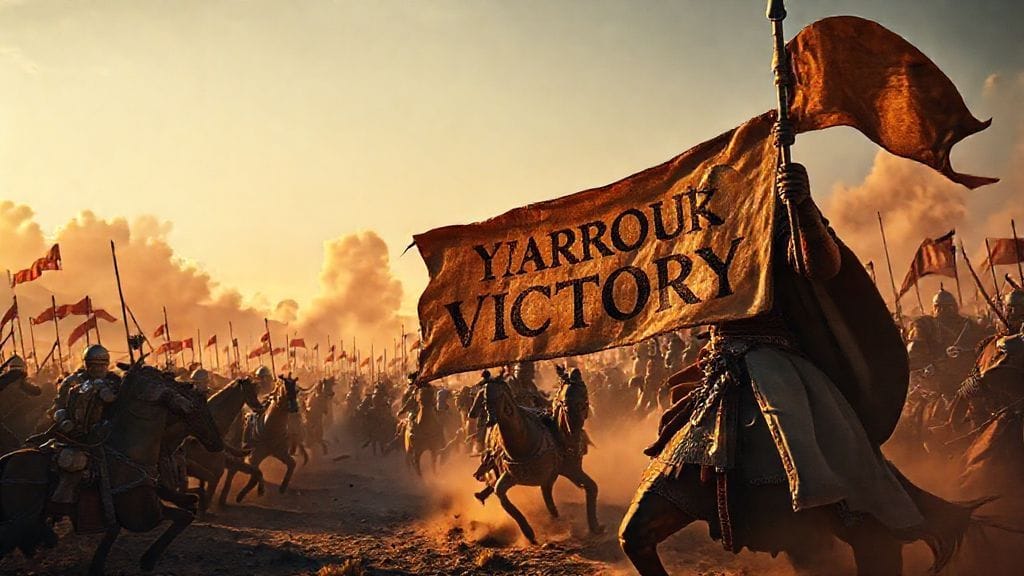
August 20, 636, dawned dry and tense over the dusty plains near the Yarmouk River, a tributary threading the eastern fringe of the Levant. The ancient landscape, scarred by history, now bore witness to a colossal confrontation. In the early morning haze, thousands of battle-hardened warriors arrayed on both sides—Byzantine legions in shimmering armor juxtaposed against a determined force of Rashidun soldiers, driven by religious conviction and swift tactical brilliance. The air was thick with anticipation, tension palpable not just in the heat but in every drawn breath. Battle cries echoed, stamping the earth as the ancient world stood on a precarious cusp.
This was no ordinary fight; it represented a collision of empires, ideologies, and futures that would redraw the map of the Middle East and affect the course of world history. The Battle of Yarmouk was more than a military engagement — it was a moment where faith, strategy, and the will to survive converged under a blistering sun. The Byzantine forces, the holdover power of classical Christendom, faced the meteoric force of the early Islamic caliphate. Few would imagine that within days, the outcome of this battle would seal the fate of Byzantine dominance in the Levant forever.
The Levant at the time was a crossroads of culture and commerce, a patchwork of urban centers, rural lands, and ancient pilgrimage routes. Since Roman times, this region had been a contested prize, a mosaic of ethnicities and beliefs. The Byzantines held sway here for centuries, yet their power was waning—empires exhaust themselves. Opposing them was a charismatic, rapidly expanding empire that had sprung from the Arabian deserts, united under the banner of Islam and propelled by a wave of fervor and military discipline.
The origins of this historical event stretch deeper than a clash of swords and shields; they emerge from decades of shifting alliances, failed sieges, theological disputes, and the ambition of men like Emperor Heraclius, determined to restore glory to a beleaguered empire. Meanwhile, the Rashidun Caliphate, recently formed after the death of Prophet Muhammad, sought not just conquests but the establishment of a new social and religious order. These forces set the stage for a monumental battle that would extinguish an ancient hegemony and ignite a new era.
The internal tensions within the Byzantine Empire were profound: stretching resources thin, managing diverse populations, and guarding against Persian incursions to the east. At the same time, the Rashidun commanders were no less concerned, surveying unfamiliar terrains and facing an enemy skilled in conventional warfare. Yet, the Rashidun soldiers had a sense of destiny, a divine imperative that pushed them forward, imbued by leaders embodying both religious authority and military genius.
The clash near the Yarmouk River was thus the summit of ideological and political tensions, a struggle that combined strategic genius with the raw brutality of hand-to-hand combat. Khalid ibn al-Walid, the "Sword of Allah," emerged as the emblematic figure of Muslim heroism and tactical ingenuity. On the other side stood Byzantine generals, veterans of many battles, defenders of a fading empire, their armor glinting under the Levantine sun.
The battle unfolded across rugged terrain of rocky outcrops, sand-strewn plains, and the twisting courses of the Yarmouk River. Control over the river’s crossings meant not only tactical advantage but the possibility of cutting off enemy retreats. Khalid's forces, though outnumbered, capitalized on speed and flexibility. The Byzantines, numbering perhaps upwards of 80,000 men, had a heterogeneous composition—Syrians, Georgians, Armenians among their ranks, reflecting the empire’s vast diversity.
Skirmishes escalated quickly as small cavalry units clashed amidst the dry fields, testing the enemy’s formations. The Rashidun army displayed remarkable coordination, with cavalry units harassing the Byzantine flanks and disrupting supply lines. As the sun climbed high, the fighting turned merciless, with shield against sword, lance against spear, as the dust rose thickly around the combatants.
Strategic brilliance became evident in the battle’s crescendo—Khalid’s famous double envelopment maneuver, a bold move where his troops surrounded the Byzantine wings, trapping them in a vice of death and confusion. It was a critical moment that turned the course of the battle irrevocably. Byzantine soldiers, unused to such rapid and flexible tactics, began to crumble, retreat turning into rout. Emperor Heraclius watched helplessly as centuries of Eastern Roman rule began to slip through his grasp.
The aftermath was brutal and transformative. Byzantine losses were staggering—with possibly tens of thousands dead or captured—and the caliphate took control of the Levantine heartlands. The victory was also a moral triumph, galvanizing Muslim solidarity and providing a launchpad for subsequent conquests in Egypt and beyond. The battle shattered the myth of Byzantine invincibility and signaled the irreversible shift of power towards the Islamic world.
For the inhabitants of the Levant, the battle meant upheaval and change on a personal scale as well—new rulers, new faiths, and new social orders. Christian communities now found themselves under Muslim rule, where Dhimmi status offered protection but signified second-class citizenship. Nevertheless, for all the war’s destruction, new cultural and religious syntheses emerged, knitting together the complex fabric of the Middle East.
The Battle of Yarmouk remains a towering symbol of transition—from antiquity to the medieval Islamic era, from empire to caliphate, from one faith to another’s rising tide. Its legacy is seen not only in history books but on the land itself, in the traditions, languages, and identities of millions across centuries.
In the centuries that followed, historians and strategists alike have combed through the battle’s details, debating numbers, motivations, and maneuvers. Some see it as a case study in brilliant leadership, others a testimony to deep-rooted structural weaknesses of empires overstretched. Archaeological investigations continue to uncover traces of mass graves and weaponry, shedding light on the human cost of the battle.
The tales of individual heroism—like the swift charges of Khalid’s cavalry or the steadfast stands of Byzantine infantry—have permeated Muslim and Christian folklore alike, becoming part of the collective memory and identity. The battle also inspired poets, chroniclers, and modern filmmakers, eager to capture its drama and significance.
What does Yarmouk teach us today? Perhaps that history’s turning points hinge not just on numbers but on the spirit and ideas driving men into conflict, that a single day of courage and calculation can change the destiny of nations.
Conclusion
The Battle of Yarmouk stands as a defining moment in world history, a fierce and bloody confrontation that ended centuries of Byzantine dominion in the Levant and heralded the unstoppable expansion of the Islamic Caliphate. It reminds us that history is alive: shaped not only by armies and commanders but by human hopes, fears, and ideals. In the dust and heat of that August day in 636, the ancient world realigned, futures were rewritten, and a new chapter opened—full of promise and peril alike.
Understanding Yarmouk allows us a window into the complexity of cultural encounters, the fragile balances of power, and the ever-renewing human quest for meaning and victory. Its lessons ring through the ages, calling upon us to recognize that behind every battle lies a story—not just of conquest, but of humanity.
FAQs about the Battle of Yarmouk
1. What were the main causes leading to the Battle of Yarmouk?
The battle resulted from the rapid expansion of the Rashidun Caliphate into Byzantine territory, coupled with Byzantine attempts to defend their eastern provinces and halt the Muslim advance after earlier losses.
2. Who were the principal commanders at Yarmouk?
On the Muslim side, Khalid ibn al-Walid led the Rashidun forces with great tactical skill. The Byzantine army was commanded collectively by a council of generals, as Emperor Heraclius did not personally attend.
3. Why was the battle decisive for the Rashidun Caliphate?
It ended Byzantine dominance in the Levant, allowing the caliphate control over pivotal regions like Syria and Palestine, facilitating further expansions into Egypt and North Africa.
4. How reliable are the historical sources regarding the battle’s size and casualties?
Sources vary significantly in reported numbers, often influenced by later political or religious agendas. Modern historians tend to estimate tens of thousands on both sides but caution against exact figures.
5. What was the cultural impact of the Rashidun victory on the Levant?
The battle shifted the religious and political landscape, establishing Muslim rule, but allowed Christian and Jewish communities to maintain certain freedoms as protected peoples.
6. Are there any existing archaeological sites related to the battle?
Archaeological efforts near the Yarmouk tributaries have uncovered artifacts and mass graves, though many sites remain unexcavated and debated.
7. How is the Battle of Yarmouk remembered in modern countries of the Levant?
It is often seen as a foundational event in Islamic history and the genesis of Arab identity, celebrated in various cultural memories and historical commemorations.
8. Did the battle influence subsequent military tactics?
Yes. Khalid’s use of mobility and encirclement tactics influenced future commanders both within and beyond the Islamic world.

