Table of Contents
- A Morning of Uncertainty in the Ottoman Heartland
- The World Mehmed II Left Behind
- Two Brothers, Two Visions: Bayezid and Cem
- Death of a Conqueror and the Race to the Throne
- Courts, Janissaries, and Grand Viziers: The Political Chessboard
- Marching Toward Yenişehir: Roads Filled with Rumors
- Eve of Clash: Camps Divided by Faith, Loyalty, and Fear
- The Battle of Yenişehir 1481: Dawn of Steel and Smoke
- Turning Points on the Field: From Hope to Rout
- Aftermath on the Battlefield: Counting the Cost in Blood
- Cem Sultan on the Run: Exile, Intrigue, and European Chess Games
- Bayezid II’s Shaky Throne: Consolidation Through Caution
- Ottoman Society in the Shadow of Civil War
- Faith, Legitimacy, and the Story the Empire Told Itself
- Echoes in Europe: How a Fraternal War Became a Diplomatic Weapon
- Historians, Chronicles, and Competing Memories of Yenişehir
- From Bursa to the Wider Empire: Long-Term Consequences
- The Emotional Legacy: Brothers, Betrayal, and the Human Heart
- Conclusion
- FAQs
- External Resource
- Internal Link
Article Summary: On a June morning in 1481, in the fields near Yenişehir close to Bursa, the Ottoman Empire paused between past and future as two brothers, Bayezid II and Cem Sultan, prepared to settle their claim to the throne by force. The battle of yenisehir 1481 was more than a mere clash of armies; it was the violent punctuation mark at the end of Sultan Mehmed II’s age of conquest and the uncertain beginning of a new chapter. This article traces the world Mehmed left behind, the rival characters of Bayezid and Cem, and the political intrigues that brought them face-to-face on that fateful day. It follows the march of troops, the anxious whispers in both camps, and the chaos of battle as loyalty, faith, and ambition collided in the dust. Beyond the field itself, it explores the exile of Cem Sultan and how European powers exploited him as a pawn against his own empire. It also examines how Bayezid II, scarred by the specter of civil war, reshaped Ottoman rule with caution and compromise. Throughout, the narrative returns to the human dimension: families divided, soldiers’ fears, and a dynasty forever marked by the memory of fratricidal struggle. By the end, the battle of yenisehir 1481 stands revealed not as an isolated event, but as a turning point whose echoes lingered from Bursa to Rome and beyond.
A Morning of Uncertainty in the Ottoman Heartland
In the soft light of early June 20, 1481, mist hung low over the fertile plains near Yenişehir, a modest town lying between Bursa and İznik in the Ottoman heartland. Farmers who once measured their days by the rising of the sun and the ripening of grain now measured them by the distant roll of drums and the harsh blast of military horns. For them, this was not merely another day in the long story of the empire. It was a day when the winds carried rumors rather than birdsong: rumors that two sons of the late sultan marched toward one another, each escorted by thousands of armed men.
The townspeople had seen soldiers before—this was, after all, the hinterland of a conquering power that stretched from the Balkans to Anatolia. But there was something different now. The banners that fluttered in the distance bore not the symbols of foreign campaigns but the colors of rival princes. Men whispered that the younger, more charismatic Cem Sultan had won hearts in Anatolia, while his elder brother Bayezid, more reserved but backed by powerful officials, had already been saluted as sultan in some corners of the empire. No one could say with certainty who truly ruled; the empire seemed to be holding its breath.
Children clung to their mothers’ robes as columns of cavalry disappeared over the horizon. Some villagers prayed that Allah would quickly grant victory to one brother, any brother, if only it would spare the land from a prolonged and bloody civil war. Others remembered older tales of fraternal strife and knew that when princes fought, it was seldom royal blood alone that stained the soil. The battle of yenisehir 1481, still unnamed for those living it, was about to determine not just which sultan would wear the turban, but whether the empire would stand united or begin to crack along the fault lines of ambition and fear.
On the edges of the forming battlefield, the ground already bore the scars of preparation: trenches dug, wagons positioned, artillery limbered and ready. The convergence of forces here was no accident. Yenişehir lay near Bursa, the old Ottoman capital, a symbolic pivot between past and future. To the west lay Europe and the memory of Constantinople’s fall; to the east stretched the vast and restless plateau of Anatolia. It was here, on this crossroads of geography and memory, that the fate of Mehmed II’s legacy would be tested by his own blood.
The World Mehmed II Left Behind
To understand why this field near Yenişehir became the stage of destiny, one must look back to the world created by Mehmed II, known to posterity as Mehmed the Conqueror. When he died in 1481, he left behind a realm that ranged from Bosnia to the Black Sea, from the Danube to central Anatolia. The conquest of Constantinople in 1453 had transformed the Ottomans from ambitious frontier beylik into a true empire. Yet empires forged in relentless conquest often carry within them a paradox: their greatest strength is also a source of profound instability.
Mehmed was a man of iron will and relentless curiosity. He cultivated scholars, poets, and engineers, yet was feared for his ruthlessness and implacable ambition. He reorganized the army, strengthened the Janissary corps, and developed artillery into a fearsome arm of state power. Under his rule, the Ottoman administrative system grew more complex—lands were registered, timar fiefs assigned, and legal codes refined. But as his realm expanded, so too did the number of interests that had to be balanced: frontier warriors, devshirme elites, old Turkish aristocracy, Christian subjects, and a growing class of urban merchants and artisans.
In this turbulent world, succession was perpetually uncertain. Unlike some European monarchies with established rules of primogeniture, the Ottoman tradition did not strictly fix the throne to the eldest son. Instead, any male member of the dynasty could, in principle, claim the right to rule, so long as he could secure the support of powerful factions and, critically, the army. Mehmed himself had ascended only after strife and maneuvering, and he knew all too well that upon his death the empire could quickly plunge into chaos. His attempt to manage this problem was often blunt: chroniclers and modern historians alike recount that Mehmed endorsed the grim practice of fratricide as a means of stabilizing succession, allowing a new sultan to eliminate his brothers in order to secure the realm (as later codified by his grandson Mehmed III).
Yet in 1481, that harsh solution had not yet been fully institutionalized, and the empire still stood on the threshold of its most dramatic debates over succession. Mehmed’s court had become a world where rival factions jockeyed for influence over his sons. His death did not simply leave a vacant throne; it opened a gaping wound in the political body, a wound into which Bayezid and Cem would be thrust. The battle of yenisehir 1481 would become the most visible symptom of this deeper instability—a crisis rooted in a world Mehmed had magnificently built but never fully tamed.
Two Brothers, Two Visions: Bayezid and Cem
In the chronicles of the period, Bayezid and Cem appear almost as opposite poles of the same star, two very different interpretations of what it meant to be the heir of Mehmed the Conqueror. Bayezid, the elder by several years, had been groomed in the traditional manner for rule. As a provincial governor in Amasya, he oversaw a region that was both strategically important and culturally rich, a cradle of scholars and Sufi mystics. He earned a reputation for piety, sobriety, and a certain cautiousness that contrasted with his father’s flamboyant ambition. Stories circulated about his patronage of religious foundations and his personal devotion, painting him as a sultan who might restore a sense of moral order to an empire fatigued by endless war.
Cem, by contrast, dazzled many of those who met him. Assigned to govern in Karaman, the central Anatolian region that had long been a focus of Ottoman expansion, he projected vigor and charm. Some sources emphasize his bravery and military abilities; others his eloquence and generosity. He moved comfortably among the notables of Anatolia, forging bonds with local elites who often felt overshadowed by the powerful central administration in Istanbul. To them, Cem seemed a prince who might champion their interests and counterbalance the influence of the devshirme class and the Janissaries, who tended to favor the more established Bayezid.
The two brothers, raised in different provinces, also absorbed different visions of the empire. Bayezid’s world in Amasya inclined him toward the cultivated, inward-looking aspects of Ottoman governance—scholarship, law, and religious life. Cem’s Karaman, a region with a history of resistance and semi-autonomy, encouraged a more martial, dynamic style of leadership that resonated with traditional Turkish aristocrats and frontier warriors. Each brother, in his own camp, embodied a particular coalition of forces within the empire, and each could plausibly claim the mantle of legitimate rule.
It is astonishing, isn’t it, that such profound differences could emerge within the same royal household? Yet behind the palace walls, personal temperament intersected with structural forces. Even in their youth, Bayezid’s deliberate manner and Cem’s impetuous energy risked collision. Biography and politics fused into a combustible mixture; as soon as Mehmed II died, the empire would become the arena in which these two contrasting visions clashed. The battle of yenisehir 1481 was not merely a scuffle between siblings—it was the physical embodiment of two competing answers to the question: What should the Ottoman Empire become after Mehmed the Conqueror?
Death of a Conqueror and the Race to the Throne
When Mehmed II suddenly fell ill and died in early May 1481, near Gebze on the Asian side of the Bosporus, the news did not immediately spread in a clear or orderly fashion. Instead, it filtered outward in fragments and whispers. High officials in the capital moved quickly to control the narrative, for they knew that the first hours and days after a sultan’s death could decide the fate of the empire. According to the chronicler Tursun Bey, the body of Mehmed was brought back to Istanbul under a shroud of secrecy, while the elite debated their next move.
There was no question that a son of Mehmed would rule, but which one—and under whose guidance? Some influential figures, particularly in the Janissary corps and among the central administration, favored Bayezid, whose age and experience made him a safer choice. Others, including potentates in Anatolia and elements of the old Turkish military aristocracy, leaned toward Cem, whose charisma and local alliances seemed promising. The empire, in effect, became a map of competing loyalties. Messages flew across mountains and rivers, carried by fast riders: “The Padishah has died. Come at once. Take the throne before your brother does.”
Bayezid, in Amasya, reacted methodically. He understood that to rule, he must first control the capital and the Janissaries, the hardened infantry who had become the backbone of imperial power. He set out toward Istanbul with deliberate speed, mindful that rashness could cost him dearly. Meanwhile, in Karaman, Cem read the same fateful news and came to a different conclusion. Rather than racing straight for the capital—a path that would expose him to the full force of Bayezid’s faction—he turned toward Bursa, the old Ottoman capital and the symbolic heart of the dynasty in Anatolia.
By seizing Bursa, Cem hoped to claim legitimacy among the Anatolian notables and perhaps to gain recognition as sultan in his own right. In his mind, the empire might be divided between brothers, with one ruling in Europe and the other in Asia. Such a scheme was not unprecedented in Turkish political culture, but it collided directly with the more centralized vision favored by Bayezid’s supporters. Before the two princes even sighted each other across the field at Yenişehir, their divergent strategies had already drawn lines in the sand.
As days passed, envoys shuttled back and forth, some seeking compromise, others urging decisive action. But this was only the beginning. Careers and fortunes had been wagered on each prince, and the language of negotiation began to give way to the growl of mobilizing armies. The route from Bursa to Yenişehir filled with troops, flags, and cannon. In that charged atmosphere, the battle of yenisehir 1481 became less an option and more an inevitability: a grim resolution to a race that had begun the moment Mehmed’s pulse stilled.
Courts, Janissaries, and Grand Viziers: The Political Chessboard
Behind every Ottoman prince stood a shadowy array of advisors, patrons, and powerbrokers. The contest between Bayezid and Cem was not simply a personal rivalry; it was the outward expression of a fierce struggle within the ruling elite. At the heart of that struggle lay the Janissaries and the high officials of the imperial court, many of whom had risen through the devshirme system, taken as Christian youths, converted to Islam, and trained for service.
The Janissaries, stationed primarily in and around Istanbul, had developed a corporate identity and a keen sense of their own political leverage. Their salaries, privileges, and very survival depended on a stable central authority that valued their role. For them, Bayezid, who already enjoyed standing among the capital’s establishment, appeared the safer bet. Some commanders worried that Cem’s power base in Anatolia might embolden other military elements at their expense. Moreover, the current grand vizier, Karamanlı Mehmed Pasha, found himself caught in a dangerous web: accused by some of favoring Cem, distrusted by others as a potential kingmaker.
In the tense days following Mehmed II’s death, the Janissaries staged riots in the capital, demanding their overdue pay and making clear their central place in the succession drama. Such disturbances were not unprecedented, but their timing gave them extraordinary significance. The message to any aspiring sultan was unmistakable: rule with us, not against us. Bayezid’s envoys, understanding this perfectly, promised the corps not only payment but also respect for their entrenched role in governance. Cem’s supporters, more distant from the capital, struggled to match that immediacy.
Yet the Anatolian elite, the beylerbeys and timariot sipahis who dominated provincial cavalry forces, viewed the situation differently. Many of them had chafed under Mehmed’s centralizing measures and the growing dominance of devshirme officials. They saw in Cem a prince who might restore their influence and lighten the hand of the capital. To them, the Janissaries were not heroic guardians of the state but a privileged guard whose interests did not always align with the broader military aristocracy.
Thus, when armies formed and banners were raised, each side represented more than a man. Bayezid stood for the continuity of centralized, bureaucratic, capital-centered power. Cem embodied the hopes of those who longed for a more regionally balanced order. The battle of yenisehir 1481, in this light, can be read as the violent resolution of a complex political chess game in which Janissaries, grand viziers, and provincial magnates all placed their pieces and waited to see who would emerge as the empire’s undisputed master.
Marching Toward Yenişehir: Roads Filled with Rumors
As spring ripened into early summer, the roads of northwestern Anatolia filled with marching men and the clatter of hoofbeats. Bayezid’s forces, advancing from the northeast, cut across familiar territories where loyalty to the dynasty ran deep but the memory of recent campaigns still lingered as an ache. Cem’s army, gathering around Bursa and beyond, moved with a sense of urgency tinged with optimism. For both sides, Yenişehir seemed a natural meeting point—a junction of routes, a staging ground near the old capital, and a field broad enough to hold two armies and their clashing destinies.
The march itself was a theater of uncertainty. Soldiers cooked hurried meals over smoky fires, listening to messengers describe their opponents in tones that ranged from fearful respect to contempt. Rumor, as always in wartime, became a powerful weapon. Stories spread that Bayezid possessed superior artillery and had secured the unwavering loyalty of the Janissaries. Counterrumors emphasized Cem’s valiant cavalry and the fervor of his Anatolian supporters. Some claimed that divine signs—unusual patterns in the flight of birds, ominous dreams—favored one side or the other.
In villages along the way, people watched the columns pass, their expressions a mixture of awe and dread. They supplied food when ordered, sometimes voluntarily, often under compulsion; their oxen dragged cannons, their wells slaked the thirst of both men and horses. They could not know that their fields would soon lie within earshot of cannon blasts and battle cries, that the battle of yenisehir 1481 would mark their lands in memory as well as in blood.
The princes did not march alone. With Bayezid rode advisors versed in law and administration, men who envisioned a postwar empire governed by treaties, decrees, and carefully balanced budgets. With Cem traveled warriors whose ancestors had carved the early Ottoman state from the borderlands through ghaza, holy war, and raiding. Each camp carried its own stories of the dynasty and its own sense of destiny. In the songs sung by Bayezid’s men at night, one hears hints of order and continuity; in the laments and boasts of Cem’s soldiers, one senses a yearning for renewed martial glory.
And always, above the clamor of boots and hooves, hung the fearful question: Would this be decided in one swift clash, or would a bloody stalemate plunge the empire into prolonged civil war? As the distance between the two armies narrowed, that question pressed more heavily on every mind, from prince to peasant. Whatever the answer, the march to Yenişehir could not be undone.
Eve of Clash: Camps Divided by Faith, Loyalty, and Fear
The night before the armies fully faced each other near Yenişehir, the air carried a tense quiet broken only by the low murmur of prayers and the occasional neigh of anxious horses. Campfires flickered like scattered stars across the darkened countryside, each knot of light a small world of hope, bravado, and dread. On one side, Bayezid’s soldiers tightened straps, checked musket flints and sword edges, and tried to sleep beneath the reassuring presence of their veteran officers. On the other, Cem’s men whispered of their prince’s courage and the righteousness of his cause.
In Bayezid’s tent, the mood mixed gravity with cautious confidence. Advisors unrolled maps of the surrounding terrain, tracing the likely movements of Cem’s cavalry and estimating the range of their own artillery. Clerics recited verses reminding the prince that justice and stability were sacred duties, that a ruler must sometimes act harshly to preserve the greater good. Bayezid is said to have listened in silence, aware that any sign of hesitation might ripple outward through the command structure. He had to project certainty, even if privately he feared the prospect of fratricide and the moral stain it might leave upon his soul.
Cem’s pavilion, miles away yet psychologically close, hummed with a different energy. Many of his supporters believed that momentum was on their side; they had rallied quickly, seized Bursa, and advanced with impressive speed. Some argued that the people of Anatolia favored their prince, that the very soil beneath their feet would rise in support. Others, more worldly, knew that the Janissaries and the capital elite aligned with Bayezid, and that any victory at Yenişehir would need to be decisive to overturn that crucial advantage. Cem, caught between enthusiasm and realism, prepared for battle with an intensity that left little room for sleep.
Across both camps, faith served as solace and spur. Imams led collective prayers, calling down divine favor on each army’s banner. Yet behind the religious language lay very human anxieties. Veterans who had fought in Mehmed II’s campaigns remembered sieges in distant lands; now they faced the unsettling prospect of slaying men who spoke their language and honored the same sultan’s memory. The thought that they might soon cross blades with old comrades who had chosen the “wrong” prince weighed heavily on some hearts.
As the hours passed, individuals wrote hurried letters to families, confessing fears they could not show aloud. A few tried to desert, slipping away into the darkness, only to be caught and dragged back as examples. There was no escape from history now. With every tick of the unseen night, the battle of yenisehir 1481 drew nearer, promising to turn private loyalties and misgivings into public, irrevocable action at sunrise.
The Battle of Yenişehir 1481: Dawn of Steel and Smoke
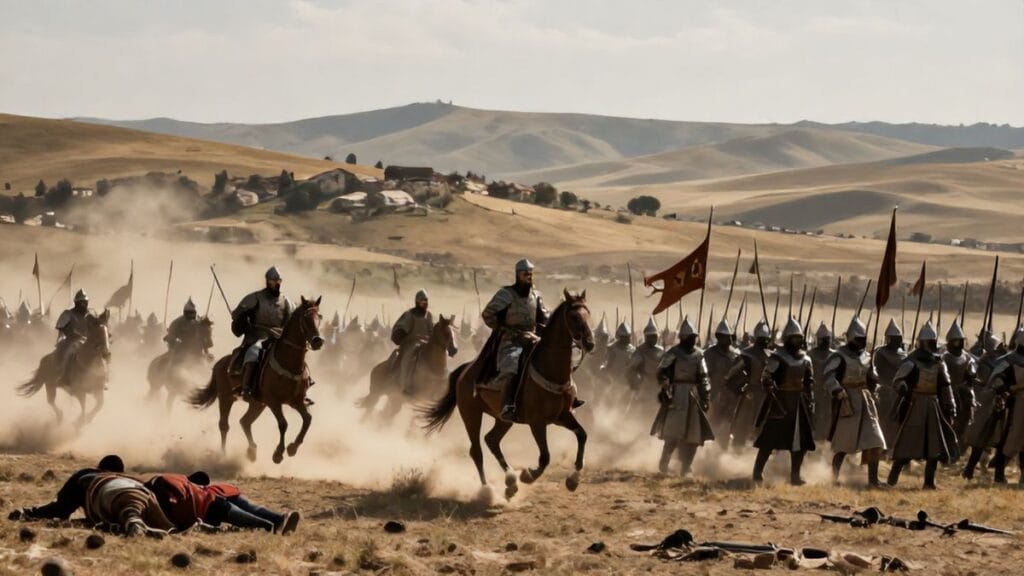
Dawn broke pale and merciless over the plains near Yenişehir. A thin mist clung to the low ground, veiling the formations only partially, enough to add a ghostly edge to the shapes of men and horses assembling for the day’s grim work. The battle of yenisehir 1481 began not with a heroic trumpet blast but with the coarse, practical shouts of officers aligning ranks, the grinding of wheels as artillery was hauled into position, the clatter of armor and harness.
Bayezid’s forces, according to several accounts, deployed with disciplined care. The Janissaries, those hardened infantry who had long been the spearhead of Ottoman campaigns, were placed at the center, bolstered by artillery pieces whose thunder had come to symbolize the empire’s modern might. On the flanks waited sipahi cavalry, ready to wheel and charge as needed. Bayezid himself, protected by his guard, took a position where he could observe and issue orders, aware that his very presence could steady his troops.
Cem’s army drew up in response, anchored by the fierce Anatolian cavalry who had long traditions of mobile warfare. His strategy relied on speed, shock, and the hope that a determined attack could break Bayezid’s line before discipline and artillery could fully assert themselves. The younger prince, resplendent in armor that gleamed dully in the morning light, rode along his lines, calling out to men by name where he could, reminding them of past campaigns and shared dangers. His voice, carried by the cool air, tried to weave courage into the fabric of the army.
The first exchanges came in the form of artillery fire and archery volleys. Cannon roared, sending plumes of smoke skyward and iron shot hurtling across the field, tearing through ranks and disrupting formations. Arrows and musket balls hissed back in response, invisible messengers of death. For long moments, the field became a landscape of sound—explosions, shouts, the screams of wounded men and horses. Then, as both sides probed for weakness, the clash of steel grew louder: cavalry charges tested flanks, lines surged forward and back in bloody oscillation.
Eyewitness accounts are scarce and sometimes contradictory, but a consistent theme emerges: Bayezid’s side benefitted more effectively from the integration of artillery and disciplined infantry. One chronicler describes how a concerted assault by Cem’s horsemen initially scattered portions of Bayezid’s right wing, only to be met by concentrated fire from Janissary arquebusiers and field guns, shredding their momentum. Cem, seeing this, is said to have personally led reinforcements into the fray, his standard visible amid dust and chaos—a living banner urging persistence where reason might have counseled retreat.
Yet as hours wore on, the balance began to tilt. While Cem’s troops fought with undeniable valor, they lacked the cohesive backbone that the Janissaries and imperial artillery provided Bayezid. The center of Cem’s line, battered repeatedly, started to show signs of strain. Gaps appeared where men had fallen or slipped away; signals became confused in the din. The battle of yenisehir 1481 turned slowly, almost imperceptibly at first, from contest to crisis for the younger prince’s cause.
Turning Points on the Field: From Hope to Rout
Every battle has moments when its future history hangs in the balance, when a single decision or stroke of luck can redirect the tide. At Yenişehir, such turning points emerged under the choking clouds of powder smoke and dust. One oft-cited episode involves a bold cavalry maneuver orchestrated by Cem’s commanders against Bayezid’s left flank. At first, it appeared brilliantly executed: a wedge of Anatolian horsemen punched into the enemy line, scattering lesser units and sowing panic. For a heartbeat, the hope that Cem might snatch victory from the jaws of superior firepower felt tangible.
But this was only the beginning of the day’s decisive drama. Bayezid’s officers, drawing on hard-earned experience from Mehmed II’s campaigns, rallied reserves and counterattacked with disciplined coordination. Rather than collapsing under pressure, the left flank bent, absorbed the shock, and then snapped back with fresh troops, pinning Cem’s horsemen in a deadly crossfire. The Janissaries, holding the center, advanced methodically, their musket volleys opening ragged gaps in opposition ranks that could not be easily closed.
For Cem, the sight must have been harrowing. From his vantage point, he could see pockets of bravery failing against an enemy that refused to break. Messengers galloped toward him, some with encouraging reports, others stammering out tales of disarray. One by one, his options narrowed. Should he commit his remaining reserves to a final, all-or-nothing assault, risking annihilation? Or should he begin an orderly withdrawal, preserving as much of his force as possible for a future attempt?
Fate, and perhaps emotion, intervened. Accounts suggest that Cem chose renewed offense, unwilling to concede the day while there remained a chance—however slim—of turning it. But exhaustion, casualties, and fraying coordination undermined the effort. Somewhere in the melee, a key unit broke, then another; shouts of encouragement gave way to rumors of defeat. Once a critical mass of soldiers believed the battle lost, panic spread like fire through dry grass. What had been bravely contested ground transformed into a landscape of chaotic retreat.
Bayezid’s forces, sensing victory, pressed forward. Cavalry rode down stragglers; archers and musketeers picked off fleeing men. The field at Yenişehir, by late afternoon, bore the terrible marks of rout: abandoned standards, overturned carts, bodies lying alone or heaped in grisly clusters. For Cem’s cause, the battle of yenisehir 1481 had moved irremediably from hopeful gamble to crushing defeat. What remained was not to salvage victory, but to escape ruin.
Aftermath on the Battlefield: Counting the Cost in Blood
When the noise of battle faded to a low, dreadful murmur of groans and crackling fires, the full cost of Yenişehir began to emerge. The haze of smoke lifted to reveal a field littered with the dead and dying. Armor glinted dully amid trampled grass; horses lay motionless, their once-proud forms now obstacles for those picking their way among the fallen. Survivors moved through this landscape with a mixture of relief and numb horror, searching for friends, looting the dead, or simply staring in stunned disbelief.
Victors and vanquished alike felt the weight of the day. Bayezid’s soldiers, though triumphant, understood that they had not faced a foreign enemy but their own countrymen. Many recognized familiar faces among the corpses—men they had once camped beside during Mehmed II’s distant campaigns, now transformed into foes by the cruel arithmetic of dynastic politics. The air was heavy with the metallic scent of blood and the quieter, almost inaudible sound of political destiny shifting underfoot.
Estimates of casualties vary, and exact numbers are lost to time. Yet it is clear that both sides suffered heavily. Cem’s army, having borne the brunt of defeat, lost not only soldiers but also prestige, cohesion, and the confidence of many would-be allies. Bayezid’s forces, though still intact, carried scars that would not quickly fade. Commanders counted their losses and weighed them against the apparent gain: a rival broken, a throne more secure. But victory came at the cost of deepening a tradition of fratricidal resolution that would haunt the dynasty for generations.
Amid the carnage, practical matters demanded attention. Wounded men cried out for water, some calling on God, others on mothers far away. Field surgeons and camp followers did what they could, binding wounds, setting bones, or delivering the mercy of a quick death where nothing else remained. Corpses were gathered into mass graves, their identities often lost in the haste to cleanse the battlefield before disease could spread. Prayer leaders recited verses for the souls of the fallen, though the question of whose side had enjoyed God’s favor remained a matter of perspective.
As evening fell, Bayezid’s banner still flew over a field reclaimed at such a cost. The battle of yenisehir 1481 had ended with a clear victor in military terms, yet the moral and emotional reckoning had just begun. For every family that rejoiced at a son’s survival, another plunged into mourning. The empire as a whole had passed through a crucible. From this field of sorrow, a sultan would rise—and a prince would begin the long, lonely path into exile.
Cem Sultan on the Run: Exile, Intrigue, and European Chess Games
For Cem Sultan, defeat at Yenişehir marked not the end of his story but the beginning of an odyssey that would carry his name far beyond the borders of the empire he had sought to rule. In the immediate aftermath, he faced a stark choice: submit to Bayezid’s authority and risk imprisonment or worse, or flee and seek allies in hopes of mounting a future challenge. The brutal realities of Ottoman succession left little room for trust between victorious and defeated brothers. Cem chose the road—and with it, a precarious life in the margins of empire and Christendom.
His first refuge lay with the Mamluks of Egypt, long-time rivals of the Ottomans in the eastern Mediterranean. There, Cem tried to fashion himself as a legitimate alternative sultan, appealing to those who feared the growing might of Bayezid’s regime. But sustaining such a claim required resources and territory, and neither the Mamluks nor other regional powers were eager to risk open war with a newly confirmed Ottoman ruler. Cem’s status soon slipped from formidable rival to valuable bargaining chip.
Desperate for a more powerful patron, Cem turned toward the Christian West. He entered Rhodes, stronghold of the Knights Hospitaller, under terms that promised him shelter and the possibility of support. Instead, he found himself transformed into a political prisoner cloaked in courtly hospitality. European powers recognized at once the value of hosting a pretender to the Ottoman throne. As scholars such as Halil İnalcık have noted, Cem became a pawn on a much larger chessboard, cited in letters and negotiations between popes, kings, and princes who dreamed of turning his name into leverage against Bayezid II.
Over the years, Cem moved from Rhodes to France and eventually to Rome, where successive popes paraded him as both exotic trophy and bargaining tool. He was wined and dined, portrayed in paintings, and feted at courts fascinated by the idea of a Muslim prince in their midst. Yet beneath the glitter lay confinement. He could not simply walk free, could not return home without risking death, could not truly affect the politics of the empire he still called his own. The battle of yenisehir 1481 had cast him into a role he had never sought: that of the eternal exile, the prince whose true realm consisted only of memories and regrets.
In 1495, far from Yenişehir and Bursa, Cem died in Naples under the watchful eyes of his Christian custodians. By then, he had spent nearly half his life far from his homeland, his presence a constant reminder to Bayezid and to Europe that the Ottoman throne had been contested by more than cannon and decree. His fate, shaped decisively by the result of a single battle, illustrates the cruel irony of dynastic politics: a prince raised to rule ends his days as a symbol, his body ultimately returned to Ottoman lands to be buried by the brother whose armies had shattered his hopes on an Anatolian plain.
Bayezid II’s Shaky Throne: Consolidation Through Caution
For Bayezid II, victory at Yenişehir opened the doors to the imperial palace, but those doors led into rooms filled with shadows. He had secured the throne, yet he knew that the very methods by which he had triumphed—military force, alignment with powerful factions, the implicit threat to rival kin—could one day be turned against him or his heirs. The next years of his reign therefore bore the marks of a cautious ruler determined to consolidate authority without provoking new storms.
One of Bayezid’s first priorities was to neutralize any remaining support for Cem in Anatolia and beyond. Amnesty and repression mixed uneasily: some former supporters were forgiven, reassigned, or quietly sidelined; others faced execution or confiscation of lands. The goal was not revenge for its own sake but the weaving of a more coherent network of loyalty around the sultan’s person. The memory of the battle of yenisehir 1481 hovered over these decisions like a specter, a reminder of what could happen if factions were allowed to grow too bold.
At the same time, Bayezid sought to reassure the Janissaries and central bureaucracy that their privileges and influence were secure. He paid arrears, confirmed appointments, and signaled continuity with the centralizing policies of his father—albeit tempered by a more conservative approach to expansion. While Mehmed II had pushed aggressively into new territories, Bayezid often favored diplomacy, consolidation, and patronage of religious and educational institutions. His reign saw the construction of mosques, madrasas, and charitable complexes that embodied a vision of pious, orderly rule.
Yet stability was never absolute. Bayezid’s reluctance to embark on risky foreign campaigns sometimes drew criticism from those who had grown accustomed to the spoils of conquest. Conflicts with Venice, Hungary, and the Mamluks flared nonetheless, testing the limits of his caution. Meanwhile, the unresolved tensions exposed by the civil struggle with Cem—between center and periphery, old military aristocracy and new bureaucratic elites—required constant management. The lesson of Yenişehir was clear: a divided dynasty invited disaster; a strong sultan must both command and conciliate.
Over time, Bayezid’s image crystallized as that of a stabilizer rather than a conqueror. Compared to the legendary Mehmed or his own son Selim I, famed for dramatic conquests, Bayezid’s legacy may appear subdued. But it was his careful hand that guided the empire through a perilous post-Mehmed transition. Had he failed to secure his position in 1481, the Ottoman story might have fragmented into rival states and lingering civil war. His reign, anchored in part by the bloody proof of Yenişehir, provided the bridge from the age of conquest to the even greater expansions that would follow under his successors.
Ottoman Society in the Shadow of Civil War
While princes and viziers measured the outcome of Yenişehir in terms of thrones and treaties, ordinary people experienced the conflict in more intimate, painful ways. In the villages and towns of Anatolia, the aftermath of the battle revealed itself in empty chairs at family tables, widows in black, and children trying to understand why their fathers had never returned. Civil war, even when brief, leaves marks that persist for generations, echoing in local legends, family stories, and the quiet resentment that can simmer against distant rulers.
In regions that had strongly supported Cem, suspicion from central authorities often translated into increased scrutiny and, at times, heavier taxation or the displacement of local notables. Communities that had thrown their weight behind the losing side were encouraged—sometimes gently, sometimes harshly—to demonstrate renewed loyalty to Bayezid. In these places, the battle of yenisehir 1481 was remembered not just as a distant military event but as a turning point that reshaped local power structures. Old patrons fell; new ones rose.
The Janissaries, whose backing had been crucial to Bayezid’s victory, asserted themselves more openly in social life. Their presence in cities like Istanbul, Edirne, and Bursa was felt not only on the parade ground but also in markets, guild organizations, and urban neighborhoods. Some citizens welcomed them as guardians of order; others resented their privileges and occasional abuses. The perception that the throne owed its stability to the Janissaries strengthened their hand, setting the stage for future confrontations between corps and crown.
Religious life, too, bore the imprint of the conflict. Preachers in mosques interpreted the outcome of Yenişehir in theological terms, presenting Bayezid’s victory as a sign of divine favor and Cem’s defeat as proof that rebellion against legitimate authority was doomed. Yet beneath such official narratives, more nuanced feelings persisted. Sufi lodges and local religious leaders often retained more personal memories of the princes, recalling Cem’s generosity or Bayezid’s piety in stories that complicated blunt propaganda.
Even in distant European and Balkan provinces, far from the immediate theater of the battle, rumors of the succession struggle stirred anxieties. Would the empire’s difficulties encourage uprisings among subject populations or invite foreign invasion? In many cases, the answer was no—Ottoman administrative structures proved resilient enough to withstand the shock. But the impression that the dynasty itself had been vulnerable seeped into the collective consciousness. For an empire that claimed divine sanction and historical inevitability, the fleeting chaos of 1481 left a subtle yet significant crack in the illusion of unshakable destiny.
Faith, Legitimacy, and the Story the Empire Told Itself
In the years following Yenişehir, a crucial battle unfolded not on open fields but in the realm of memory and meaning. To secure their rule, Ottoman sultans needed more than armies; they required a convincing story of legitimacy that reconciled the harsh realities of succession struggles with ideals of justice and divine order. The battle of yenisehir 1481, with its spectacle of Muslim brothers clashing in the heartland, posed a special challenge to that narrative.
Court historians and chroniclers set to work shaping events into a coherent tale. In their accounts, Bayezid emerged as the rightful heir, favored by God and recognized by key institutions of the empire. Cem, by contrast, was often portrayed as a misguided, if valiant, challenger whose persistence threatened unity and thus contravened the higher good of the community. Works such as those by Tursun Bey and later chroniclers subtly emphasized the necessity of Bayezid’s victory, casting the bloody clash as a tragic but ultimately providential episode.
Religious scholars played their part in this interpretation. Drawing on Islamic legal and ethical traditions, many argued that fitna—sedition or civil strife—was a grave danger to the umma, the community of believers. From this perspective, a swift resolution in favor of one ruler, even at high cost, was preferable to prolonged uncertainty or fragmentation. The story the empire told itself framed Yenişehir as the moment when God, through the instrument of Bayezid, had preserved unity and prevented greater evils.
Yet such official narratives never went uncontested. Among some circles, particularly those sympathetic to Cem or critical of the centralization of power, alternative stories persisted. In these, Cem appeared as a noble figure betrayed by circumstances and foreign meddling, a prince whose exile in Europe highlighted the moral ambiguities of both Christian and Muslim rulers. Letters, poems, and oral traditions circulated that mourned his fate, transforming him into a symbol of lost possibility.
This tension between official and unofficial memory reveals the complexity of Ottoman political culture. The empire was not a monolith; its people debated, whispered, and reinterpreted events in ways that did not always align with the palace’s preferred version. The battle of yenisehir 1481 thus lived on in sermons, chronicles, and fireside stories as a multifaceted event: at once necessary and tragic, divinely guided and humanly flawed, a source of pride in the endurance of the state and sorrow over the blood price paid for that endurance.
Echoes in Europe: How a Fraternal War Became a Diplomatic Weapon
While the dust of Yenişehir settled over Anatolian fields, the ripples of the conflict reached far across the Mediterranean and into the courts of Europe. To kings, popes, and princes who had long regarded the Ottomans as a formidable, unified threat, the struggle between Bayezid and Cem appeared as an unexpected opportunity. Here, at last, was proof that even the mighty empire of Mehmed the Conqueror could be shaken by internal strife.
European diplomats quickly recognized the value of information about the succession. Reports filtered in from merchants, spies, and ambassadors: details of the battle, estimates of casualties, assessments of each prince’s support. In Venice, Rome, and Buda, statesmen debated how best to exploit the situation. Should they launch new campaigns while the Ottomans were distracted? Should they court one brother against the other, offering support in exchange for territorial concessions or trade privileges?
Ultimately, Cem himself became the most potent symbol of these calculations. His presence in Rhodes, then France and Italy, turned a domestic Ottoman conflict into a European diplomatic asset. The Knights Hospitaller leveraged his person to negotiate from a position of strength with Bayezid, extracting payments in return for keeping Cem safely distant from Ottoman borders. Popes welcomed Cem as both curiosity and tool, imagining that he might serve as a rallying point for a new crusade—or at least as a bargaining chip to secure better terms from an anxious Bayezid.
Yet Europe’s dreams of using Cem to overturn Ottoman power never fully materialized. Internal rivalries among Christian states, logistical challenges, and the cautious policies of Bayezid combined to prevent any grand anti-Ottoman coalition from cohering around the exiled prince. Cem’s value in practice proved more financial and symbolic than strategic: a reminder that even the sultans could know fraternal strife, but not the key to unraveling their empire.
Nevertheless, the episode left its mark. European chronicles and diplomatic correspondence retained lively interest in the story of the two brothers and the battle that had set them on divergent paths. For decades, the memory of Yenişehir and Cem’s subsequent wanderings colored Western perceptions of the Ottoman world, feeding both hope and fear. The empire, once imagined as a monolithic juggernaut, now appeared as a more human, more vulnerable polity—capable of greatness, but also of the same internal fractures that had weakened so many other dynasties.
Historians, Chronicles, and Competing Memories of Yenişehir
Centuries after the cannons fell silent near Yenişehir, historians have continued to argue over the meaning and details of that fateful day. Contemporary Ottoman chronicles, often written under the patronage of Bayezid or his successors, naturally slant toward legitimizing his victory. Later scholars, both Ottoman and European, have reexamined these accounts, sometimes challenging their numbers, motives, and interpretations. As with so many episodes of civil conflict, the battle of yenisehir 1481 survives in a patchwork of testimony where truth, propaganda, and memory intertwine.
Primary sources such as Tursun Bey’s chronicle or later works by historians in the sixteenth and seventeenth centuries provide some of the foundational narratives. They detail the sequence of events leading up to the battle, the alignments of major figures, and the moral lessons drawn from the outcome. Yet they are often silent on the experiences of ordinary participants, and they frequently underplay the brutality and moral ambiguity of fratricidal war. Modern historians, reading these texts critically, have sought to reconstruct the broader social and political context, asking what Yenişehir reveals about the structure of Ottoman power.
In the twentieth century, scholars like Halil İnalcık and Stanford J. Shaw, among others, placed the conflict within the longer trajectory of Ottoman state formation. Rather than treating Yenişehir as an isolated event, they examined it as a key moment in the consolidation of a more centralized, bureaucratic empire. Archival documents, tax registers, and diplomatic correspondence have been used to flesh out the picture, revealing the ways in which provincial elites, religious figures, and foreign powers responded to the succession crisis.
Even today, debates continue. Some historians emphasize Cem’s potential as a reforming or decentralizing ruler, suggesting that his victory might have led to a different balance between center and periphery. Others argue that his reliance on external powers during exile would have undermined his legitimacy even had he somehow reclaimed the throne. The precise scale of the battle, the composition of the armies, and the motivations of specific commanders remain subjects of scholarly interpretation rather than settled fact.
What is clear is that Yenişehir has become a touchstone for broader questions about Ottoman governance, culture, and identity. It compels historians to grapple with the tension between idealized images of Islamic monarchy and the harsh realities of dynastic competition. It also reminds us that even an empire as formidable as the Ottomans was shaped by fragile human relationships—between fathers and sons, brothers and rivals, rulers and subjects—played out on stages as grand as Constantinople and as seemingly modest as a field near Bursa.
From Bursa to the Wider Empire: Long-Term Consequences
The shockwaves from Yenişehir did not stop at the city gates of Bursa or the provincial roads of Anatolia. Over the ensuing decades, the battle’s consequences rippled outward through the political, military, and cultural life of the Ottoman Empire. Some effects were immediate and obvious, such as the affirmation of Bayezid II’s rule and the marginalization of Cem’s supporters. Others unfolded more gradually, subtly altering the trajectory of an empire destined for even greater heights under future sultans.
Politically, Yenişehir reinforced the principle that succession would be decided by force when necessary—and that a clear, decisive victor was preferable to prolonged contention. This grim logic fed into the later legal and customary acceptance of fratricide as a tool of stabilization, a policy that would horrify modern sensibilities but which contemporaries often defended as a lesser evil. The memory of Cem’s challenge and exile served as a cautionary tale: a rival left alive and at large could become a magnet for internal dissent and foreign manipulation.
Militarily, the battle underlined the critical role of the Janissaries and artillery in Ottoman warfare. Their performance at Yenişehir, combining discipline with firepower, validated Mehmed II’s earlier investments and encouraged further development of such forces. In later campaigns—from the Balkans to the Middle East—these elements would remain central to Ottoman successes. At the same time, the relative failure of Cem’s more traditional cavalry-dominated army signaled a shift away from older models of frontier warfare toward more centrally directed, technologically integrated operations.
Administratively, Bayezid’s postwar emphasis on consolidation, record-keeping, and religious endowments helped entrench a style of rule that valued continuity and pious legitimacy. The empire that emerged from the turmoil of 1481 was, in many respects, more tightly knit than its predecessor, even if tensions remained. The ability of the Ottoman state to withstand future crises—rebellions, succession disputes, financial strains—owed much to the institutional strengthening that occurred in the wake of the Bayezid-Cem struggle.
Perhaps most intriguingly, Yenişehir left its mark on the Ottoman imagination. The notion of the sultanate as a heavy, perilous burden—one that might require terrible sacrifices, including the suppression or elimination of kin—gained further resonance. Later rulers like Selim I and Süleyman the Magnificent would navigate their own succession dramas with Yenişehir and its aftermath in mind, consciously or not. The battle near Bursa thus formed one chapter in a longer story of how the Ottomans reconciled their ideals of just kingship with the brutal necessities of dynastic survival.
The Emotional Legacy: Brothers, Betrayal, and the Human Heart
Amid chronicles of troop movements and political maneuvers, it is easy to forget that Yenişehir was, at its core, a deeply human tragedy. Two brothers, raised within the same palace walls, taught by many of the same tutors, shaped by the same father’s towering presence, found themselves leading armies against one another. Whatever else can be said about Ottoman realpolitik, the emotional weight of that fact lingers like a shadow over the narrative.
We do not have private letters in which Bayezid or Cem lay bare their innermost thoughts about the battle. Yet we can infer much from the cultural and religious milieu in which they lived. Islamic tradition, like many religious traditions, places immense value on kinship ties while also recognizing the harsh demands of political authority. Stories of past dynasties—Abbasid, Seljuk, and others—were filled with cautionary tales of brothers at war. Bayezid and Cem would have known these stories, perhaps even discussed them as young men. To become characters in a similar tale must have carried a bitter sting.
For Bayezid, the victory he won came encrusted with grief. Even if he believed that his assumption of the throne was necessary for the stability of the empire, and even if he later saw Cem’s continued claims as dangerous to that stability, he could hardly have been indifferent to the knowledge that his brother’s defeat at Yenişehir had set him on the path of endless exile. Legends—some likely embroidered over time—suggest that Bayezid expressed sorrow upon hearing of Cem’s death in Europe, acknowledging the painful cost of their rivalry.
Cem’s emotional journey must have been still more acute. Defeated but not killed at Yenişehir, he survived to experience the peculiar torment of the dispossessed heir: always close to power, yet never again able to grasp it. In European courts, he was treated as a guest and a prisoner, flattered and confined. He had time to reflect on the choices that led him from the hopeful days of mustering troops near Bursa to the alien streets of Rhodes, Paris, and Rome. How often, in those distant lands, did his mind drift back to the morning mist at Yenişehir, to the faces of men who had followed him into battle and never returned?
Beyond the brothers themselves, the emotional legacy extended to countless unnamed individuals. Mothers who lost sons, comrades who buried friends, local inhabitants whose fields became graveyards—all carried memories that no official chronicle could fully capture. Oral traditions, lullabies, and cautionary anecdotes preserved some of this anguish, embedding Yenişehir into the quiet, persistent sorrow that accompanies all civil wars. In this sense, the battle of yenisehir 1481 belongs not only to the grand narrative of empire but also to the intimate history of grief.
Conclusion
Viewed from a distance of more than five centuries, the Battle of Yenişehir appears as both a sharp, singular event and a densely woven knot of larger historical forces. On June 20, 1481, near a modest Anatolian town not far from Bursa, the Ottoman Empire confronted the stark reality that even its own ruling family was not immune to the centrifugal pull of ambition, faction, and fear. Bayezid II and Cem Sultan, embodying competing coalitions and visions of imperial rule, led their armies into a confrontation that would determine the shape of Ottoman power for decades to come.
The battle of yenisehir 1481 did more than elevate one brother and cast the other into exile. It confirmed the central role of the Janissaries and artillery in Ottoman warfare, reinforced the trend toward a more centralized and bureaucratic state, and inserted a deep strand of caution into the political culture of the dynasty. For Bayezid, victory enabled a reign characterized by consolidation, piety, and measured expansion. For Cem, defeat initiated a tragic journey across the courts of Europe, transforming him into a symbol of both Ottoman vulnerability and the ruthless demands of dynastic stability.
At the same time, Yenişehir laid bare the human cost of such struggles. Beneath the rhetoric of legitimacy and the calculations of high politics lay fields soaked in blood, families torn apart, and a society compelled to reconcile ideals of brotherhood and justice with the harsh arithmetic of survival. The official story cast Bayezid as the rightful guardian of unity and portrayed Cem’s challenge as a dangerous fitna, yet alternative memories persisted, honoring Cem’s charisma and mourning the choices that led to fraternal war.
In tracing the road to Yenişehir, the clash itself, and its long aftermath, we see an empire both powerful and precarious, capable of absorbing internal shocks yet forever marked by them. The echoes of that day in 1481 resounded in later Ottoman policies on succession, in European diplomatic maneuvers, and in the cultural imagination of subjects from Bursa to Rome. Ultimately, the Battle of Yenişehir stands as a poignant reminder that the grand arcs of imperial history are often bent—and sometimes broken—by encounters between individuals whose love, envy, fear, and ambition play out on stages far larger than themselves.
FAQs
- What was the Battle of Yenişehir in 1481?
The Battle of Yenişehir in 1481 was a decisive military clash between two Ottoman princes, Bayezid (later Bayezid II) and his younger brother Cem Sultan, fought near the town of Yenişehir close to Bursa. It arose from a succession crisis following the death of Sultan Mehmed II, as both brothers sought to secure the Ottoman throne. Bayezid’s victory confirmed him as sultan and effectively ended Cem’s immediate hopes of ruling the empire. - Why did Bayezid II and Cem Sultan fight each other?
The two brothers fought because Ottoman succession practices did not rigidly enforce primogeniture, allowing multiple princes to claim the right to rule. After Mehmed II died, Bayezid and Cem each mobilized supporters among different factions of the elite and the army. Their conflicting claims, combined with the ambitions of powerful backers such as the Janissaries and provincial notables, made armed confrontation at Yenişehir almost inevitable. - Where exactly did the battle take place?
The battle took place near the town of Yenişehir, located between Bursa and İznik in northwestern Anatolia, within the core lands of the Ottoman Empire. This area, close to the former capital Bursa, held symbolic importance as a cradle of Ottoman power, making it a fitting—if tragic—stage for a decisive struggle over the throne. - Who won the Battle of Yenişehir 1481, and how?
Bayezid emerged as the clear victor. His success rested on the disciplined performance of the Janissaries, the effective use of artillery, and the support of key figures in the central administration. Cem’s army, though courageous and bolstered by Anatolian cavalry, eventually faltered under sustained pressure and superior firepower, leading to a rout that shattered his immediate bid for the sultanate. - What happened to Cem Sultan after his defeat?
After his defeat at Yenişehir, Cem Sultan fled first to regions still open to his influence in Anatolia and then sought refuge with the Mamluks in Egypt. When he failed to gain sufficient support to continue the struggle, he turned to the Christian West, entering the custody of the Knights Hospitaller in Rhodes. From there he was moved between European courts—including France and Rome—where he lived as a political pawn and semi-prisoner until his death in Naples in 1495. - How did the battle affect Bayezid II’s reign?
Yenişehir secured Bayezid’s position as sultan and allowed him to focus on consolidating the empire rather than fighting a prolonged civil war. His reign thereafter emphasized stability, religious patronage, and careful diplomacy. The memory of the conflict and the ongoing existence of Cem as an exiled pretender, however, reinforced Bayezid’s cautious approach and contributed to later Ottoman acceptance of harsh succession practices as a way to avoid similar crises. - Did the Battle of Yenişehir weaken the Ottoman Empire?
In the short term, the battle and the succession crisis created instability and inflicted significant casualties, but the empire’s core institutions remained intact. Bayezid’s subsequent efforts at consolidation arguably strengthened the state in the medium term. In the longer view, however, Yenişehir highlighted the dangers of dynastic rivalry and contributed to a political culture that accepted extreme measures, such as fratricide, in the name of preventing civil war. - How did European powers react to the conflict between Bayezid and Cem?
European powers viewed the struggle with a mixture of hope and opportunism. They saw in Cem Sultan, especially after his exile, a potential tool to pressure Bayezid II and destabilize the Ottomans. The Knights Hospitaller, the Papacy, and various monarchs hosted Cem and used his presence to extract payments or diplomatic concessions from Bayezid. Nonetheless, no large-scale, successful anti-Ottoman coalition emerged directly from his plight. - What role did the Janissaries play in the battle and its outcome?
The Janissaries were critical to Bayezid’s success both before and during the battle. Politically, their support in the capital helped legitimize his claim to the throne. Militarily, their disciplined infantry tactics and use of firearms at Yenişehir provided a sturdy backbone to Bayezid’s forces, enabling them to withstand and ultimately repel Cem’s cavalry-heavy assaults. Their importance in the victory further solidified their central role in Ottoman politics and warfare. - Why is the Battle of Yenişehir 1481 historically significant today?
The battle is significant because it encapsulates key themes in early Ottoman history: contested succession, the rise of centralized institutions, the integration of gunpowder weapons, and the interplay between domestic politics and international diplomacy. It marks the transition from Mehmed II’s age of conquest to Bayezid II’s era of consolidation, while also illuminating the human costs of dynastic ambition. Modern historians continue to study Yenişehir to better understand how empires navigate moments of internal crisis.
External Resource
Internal Link
Other Resources
- Encyclopaedia Britannica – general search for the exact subject
- Google Scholar – academic search for the exact subject
- Internet Archive – digital library search for the exact subject

