Table of Contents
- A Quiet Dawn over Beirut before the Catastrophe
- Lebanon in Flames: The Long Road to October 1983
- The Multinational Force: Peacekeepers in a Fractured City
- Life inside the Barracks: Routine on the Edge of War
- The Approach of the Truck: Minutes before Impact
- The First Explosion: The U.S. Marine Barracks Shattered
- The Second Blast: The French Paratroopers’ Tragedy
- Chaos, Dust, and Silence: The Immediate Aftermath
- Rescue amid Ruin: Digging through the Rubble
- Counting the Dead: The Human Toll of the Beirut Barracks Bombing
- Grief across Oceans: Families, Funerals, and National Mourning
- Searching for Responsibility: Intelligence, Warnings, and Failures
- Hezbollah, Iran, and Syria: The Shadowy Architects of Violence
- From Intervention to Withdrawal: Shifting U.S. and French Policy
- International Law, Terrorism, and the Changing Nature of War
- Memory and Memorials: How Nations Remember the 1983 Attack
- Echoes in Later Conflicts: From Beirut to 9/11 and Beyond
- Narratives, Myths, and the Battle over Historical Meaning
- Lessons from Beirut: Strategy, Security, and Human Fragility
- Conclusion
- FAQs
- External Resource
- Internal Link
Article Summary: On October 23, 1983, two devastating truck bombs tore through the U.S. Marine and French paratrooper barracks in Beirut, Lebanon, in what came to be known as the beirut barracks bombing. This article traces the journey to that bloody morning, from Lebanon’s civil war and foreign interventions to the fragile mandate of the Multinational Force. It reconstructs the hours and seconds leading to the explosions, the human terror and courage in their aftermath, and the immense political shockwaves that rippled from Beirut to Washington and Paris. The narrative explores who planned the attacks, why intelligence warnings went unheeded, and how the event reshaped Western military doctrine and counterterrorism thinking. It follows families as they navigated grief, governments as they recalculated strategy, and survivors as they carried invisible scars. The article also connects the beirut barracks bombing to later acts of mass terrorism, highlighting it as a grim precursor to attacks on U.S. targets in the 1990s and the 9/11 attacks. Finally, it reflects on how memory, monuments, and contested histories keep the story alive, and what this tragedy still teaches about the limits of force, the complexity of the Middle East, and the vulnerability of those sent to “keep the peace.”
A Quiet Dawn over Beirut before the Catastrophe
In the gray stillness of early morning on October 23, 1983, Beirut’s air held a deceptive calm. The Mediterranean, just beyond the tangled sprawl of the city, glimmered faintly under a sky beginning to pale. Seagulls wheeled above the port. On the western edge of the Lebanese capital, near the airport, U.S. Marines in rust-streaked concrete barracks stirred from uneasy sleep. Some wrote letters home, others pulled on boots for another day of guard duty in a war they were supposedly sent to calm, not to fight.
Inside the four-story building serving as the headquarters and residence for the 1st Battalion, 8th Marines, a few men joked quietly, their voices echoing down bare hallways. The structure, once an unfinished airport terminal, had been refitted in a rudimentary way—cots, makeshift partitions, sandbags, metal bars welded over the entrances in a pattern the Marines sardonically called “super barriers.” Nearby, French paratroopers with the 1er Régiment de Chasseurs Parachutistes occupied a nine-story building called the Drakkar, its concrete balconies chipped by stray gunfire accumulated over months.
Though the city had grown accustomed to the sounds of artillery and sniper fire, that particular morning seemed almost gentle. A few distant thuds from the mountains barely disturbed the sleepy encampments. The Marines’ mission, at least on paper, was straightforward: serve as part of a Multinational Force invited to stabilize a fragile Lebanese government after the Israeli invasion of 1982. But beneath the surface, in the twisted streets of West Beirut, in the crowded alleys of the southern suburbs, and in the corridors of foreign embassies, resentments and plans were ripening.
Some Marines, writing in their journals or speaking to comrades, would later recall a sense of foreboding, a faint feeling that something was building, something just out of sight. Yet others concentrated on more immediate concerns: duty rotations, care packages rumored to be on the way, the stifling heat inside the concrete shell that passed for home. For the French troops at Drakkar, it was similar—a morning like any other in a city at war, that peculiar blend of boredom and danger familiar to peacekeepers worldwide.
At that hour, a truck sat somewhere within the labyrinth of Beirut’s streets. It was heavy with an invisible cargo—explosives in quantities rarely seen outside of state arsenals. The man behind the wheel, whose name history would never conclusively record, had a mission that would change the course of Western military involvement in the Middle East. As the sun inched higher above the horizon, the outlines of the beirut barracks bombing began to take form, though no one in those barracks yet knew that their lives would soon be measured in minutes, then seconds, then splinters of shattered concrete and light.
But this was only the beginning, the quiet before a blast so powerful it would be felt thousands of kilometers away in the chambers of Congress, the Élysée Palace, and more distantly, in the evolving strategies of those who studied how to strike the world’s superpower at its most vulnerable points.
Lebanon in Flames: The Long Road to October 1983
To understand that morning, one has to step back from the barracks and see the map of Lebanon in the early 1980s—a small country suffocated under the weight of regional rivalries and internal fractures. Since 1975, Lebanon had been gripped by a civil war that began as a clash between Christian militias and Palestinian factions allied with leftist Muslim groups. Over time, it grew into a complex and brutal conflict drawing in Syria, Israel, Iran, and, eventually, Western powers.
The Palestine Liberation Organization (PLO), driven from Jordan after Black September in 1970, had established bases in Lebanon. Cross-border attacks into northern Israel prompted Israeli retaliation. The Lebanese state, paralyzed by sectarian divisions and a fragile confessional system dividing power between Christians, Sunni Muslims, Shiites, and Druze, lost control over large parts of its territory. Militias substituted for government, and neighborhoods became fiefdoms.
By 1982, Israel launched “Operation Peace for Galilee,” invading southern Lebanon to push the PLO away from its borders and, as many historians argue, to reshape Lebanon’s political order. Israeli forces swept northward, reaching the outskirts of Beirut. Under intense international pressure, an agreement was brokered: a Multinational Force (MNF), composed mainly of U.S., French, Italian, and later British troops, would oversee the evacuation of PLO fighters from Beirut and try to stabilize the capital.
Initially, the MNF’s presence seemed to promise a respite from the chaos. In August 1982, U.S. Marines marched down Beirut’s streets, greeted by some with flowers and applause. Yet behind the celebrations, deep skepticism simmered. To many in Lebanon’s fractured landscape, foreign boots on the ground—even under the banner of peacekeeping—signaled new players in an old game of power and influence.
The fragile calm shattered in September 1982 after the assassination of Lebanon’s newly elected president, Bashir Gemayel, a Maronite Christian leader closely aligned with Israel. In the days that followed, the world watched in horror as Christian militias, with Israeli forces encircling the area, massacred hundreds, perhaps thousands, of Palestinian refugees in the Sabra and Shatila camps. The United States and its allies were accused—directly or indirectly—of enabling an occupation that led to atrocity.
In the eyes of many Lebanese, particularly within the rapidly mobilizing Shiite community of the south and the Beirut suburbs, the Western presence was no longer neutral. It was associated with Israel’s invasion, with a political order that marginalized them, and with the broader struggle against what Iran, in the wake of its 1979 Revolution, called “Western aggression.” The Shiite neighborhoods of West Beirut and the south, suffering under Israeli military operations and internal upheaval, became fertile ground for new, radical organizations.
It is astonishing, isn’t it, how quickly labels like “peacekeeper” can lose their shine once the perceptions on the ground change? By 1983, the MNF’s mandate had blurred. U.S. forces, in particular, became more visibly aligned with Lebanon’s central government and, by extension, with factions seen as adversaries by Shiite militias and others. Shelling and firefights drew the Marines into the conflict they had been deployed to prevent.
Amid this escalating tension, a new actor emerged in the Shiite landscape: a constellation of religiously inspired militants influenced by Iran’s Revolutionary Guard Corps, operating from the Bekaa Valley and Beirut’s southern suburbs. The group that would eventually be known as Hezbollah coalesced during this period, blending theology, political ideology, and armed struggle. These militants, backed by Iranian and, to a degree, Syrian support, watched the Multinational Force and saw not peacekeepers, but occupiers, and above all, vulnerable targets.
The Multinational Force: Peacekeepers in a Fractured City
The Multinational Force returned to Beirut in September 1982 with an inherently contradictory mission: to be both armed and impartial in a civil war where every faction demanded loyalty and suspected betrayal. U.S. Marines landed once again on Lebanon’s shores; alongside them were French paratroopers, Italian bersaglieri, and later a small British contingent. The sight was evocative of an earlier era of Western troops in the Levant, and many Lebanese could not help but remember the French mandate that had ruled the country between the world wars.
On paper, the MNF was there to support the Lebanese Armed Forces (LAF), ensure the safety of civilians, and back the authority of the central government in Beirut. In practice, each nation carried its own historical baggage and strategic interests. The United States, keen to reinforce its influence in the Middle East and limit Soviet and Syrian sway, saw Lebanon as a testing ground for a more assertive policy. France, with its colonial-era ties and a large Lebanese diaspora, viewed its role partly through the lens of honor and historical responsibility.
From the very start, the MNF’s neutrality was questioned. When American and French naval forces began shelling Druze and Shiite positions in the mountains during clashes with Lebanese government troops, many locals concluded that these supposed peacekeepers were, in effect, combatants. Scholars like Augustus Richard Norton later argued that the MNF had “slid from impartial peacekeeping into partisanship,” a slide that would prove deadly.
Inside the U.S. command, there was persistent tension over what the Marines were allowed to do. Their rules of engagement were heavily constrained. Sent under a “presence mission,” they were discouraged from fortifying their positions too heavily or behaving like an occupying army. Machine guns on towers were often left unloaded, ammunition stored separately. Outposts were visible, not hidden; sentries were told to be firm but not provocative. For the Marines, veterans of Vietnam and younger men alike, the contradiction was deeply felt: they were in a war zone, yet officially not at war.
The French faced their own complications. Their barracks at Drakkar overlooked contested areas. French patrols took fire. French units responded with force, and in turn, they were viewed as legitimate enemies by some militias. The more the MNF reacted to attacks, the more it was pulled into the vortex of Lebanon’s conflicts. Behind every skirmish, regional power plays loomed: Syria sought to maintain dominance; Iran sought to export its revolution; Israel wished to control its northern border and influence Lebanon’s government.
As 1983 progressed, a pattern emerged. Targets associated with Western presence and influence began to explode. In April, the U.S. Embassy in Beirut was devastated by a massive car bomb, killing 63 people, including 17 Americans. The blast tore the façade from the building and announced to the world that a new kind of warfare—a blend of suicide terrorism and asymmetrical attack—was taking hold in Lebanon. The beirut barracks bombing, when it came in October, would be the deadliest chapter of this pattern, but it was not the first warning.
Yet within the MNF, the embassy bombing did not fully reset security assumptions. Some stronger measures were introduced, but the core sense remained: the Marines were not there to dig in like an army at war. They were there, as President Ronald Reagan liked to say, because “we Americans are a peace-loving people,” committed to preventing Lebanon from slipping further into chaos. It was a noble ideal, but in the streets of Beirut, where allegiances could shift overnight, it was also dangerously naive.
Life inside the Barracks: Routine on the Edge of War
On the sandy, rubble-strewn grounds near Beirut International Airport, the Marines tried to carve out a semblance of normal military life. The four-story barracks building, with about 350 men inside on October 23, served as sleeping quarters, command center, and social hub. Cots lined long rooms, personal items tucked underneath: letters from home, cassette tapes, snapshots of girlfriends and spouses taped to the walls. The smell of sweat, cigarette smoke, and fuel permeated the air.
Daily routine was a blend of guard duty, patrols, equipment maintenance, and occasional joint activities with the Lebanese Army. Some Marines ran along the perimeter fence for exercise, their boots kicking up dust. Others watched the skyline through binoculars, tracking the flash of artillery on distant hills, mentally mapping where each militia’s territory began and ended. Helicopters from offshore carriers thumped overhead, a reminder that, just beyond the horizon, the might of the U.S. military floated in steel hulls.
Morale fluctuated. For some, the mission felt pointless: they were targets in a conflict few fully understood, their presence hedged in by legal and political restrictions. For others, there was pride in serving as peacekeepers, in representing the United States in a troubled part of the world. Letters home often carried the same refrain: “Don’t worry, Mom. We’re just here to keep the peace.”
Security procedures governed the barracks, but they were shaped as much by political optics as by battlefield necessity. Defensive fortifications—barbed wire, sandbags, concrete barriers—were present, yet the posture was still relatively open. Sentries stood guard at entrances, often behind lightly reinforced gates. Trucks and cars approached through checkpoints, but the Americans had grown accustomed to the flow of local traffic: water deliveries, supply trucks, vehicles linked to the nearby airport operations.
The French at Drakkar lived a similar double life of boredom and fear. Their building, towering over its surroundings, afforded good observation but also made them conspicuous. French paratroopers hung their camouflage jackets on balcony railings, smoked, joked in the hallways, and shared news from home. Some had been in Lebanon long enough to pick up phrases of Arabic, to recognize the local shopkeepers, to sense shifts in the mood of nearby neighborhoods.
Yet behind these small routines lurked a constant unease. A Marine standing watch at the perimeter could not forget that the U.S. Embassy had been reduced to ruins only months earlier. French officers knew that their troops had come under rocket and mortar fire. Sporadic sniping, occasional explosions in the city, and whispered intelligence reports reminded all that Beirut was still a battlefield. Still, in the early hours of October 23, fatigue and familiarity dulled the sharpest edges of fear. Patterns had set in; the extraordinary had become ordinary. And somewhere, men who studied these patterns were preparing to exploit them.
The Approach of the Truck: Minutes before Impact
Shortly after 6 a.m. on that Sunday morning, a yellow Mercedes truck rolled through the streets of West Beirut. Its suspension sagged under the massive load hidden within—an estimated 12,000 pounds (over 5,000 kilograms) of explosives, making it one of the largest non-nuclear blasts ever directed at a U.S. military target. The driver’s identity remains a matter of debate, though U.S. and later court findings pointed toward a suicide operative linked to groups that would eventually coalesce under the Hezbollah umbrella, with Iranian support.
The truck’s route was not random. It had been scouted. Observers had studied the Marines’ routines for weeks, possibly months. They noted the timing of sentry rotations, the posture at the gates, the way barriers were configured. One of the most devastating ironies of the beirut barracks bombing is that the attackers understood the Marines’ security better than the Marines understood the attackers’ intentions.
Around the perimeter of the Marine compound, barbed wire, earthen berms, and guard posts formed a boundary. At the main vehicle entrance, a sentry stood watch. It was a quiet time of day, the low hum of the waking city just beginning to rise. As the Mercedes approached, it passed through a Lebanese checkpoint, where, according to accounts, it aroused little suspicion—perhaps due to familiarity, bribery, or simple complacency.
The final approach happened quickly. The truck gained speed as it turned toward the compound, its engine growling. A Marine sentry saw it, perhaps noticing that it was moving faster than normal traffic. He raised his weapon, shouting and motioning for the vehicle to halt. For crucial seconds, confusion reigned. Was this a panicked local driver? A delivery gone wrong? Or something far more sinister?
The truck did not stop. It crashed through a gate, plowed over concertina wire, and headed straight for the barracks’ ground floor. Another Marine tried to fire his weapon, but according to testimony and later investigation, his rifle was not loaded, in keeping with standing orders that sought to balance readiness with a low-profile posture. Ammunition was close at hand—but not close enough.
In that final instant, some Marines inside the building may have felt the vibration of the truck hitting the structure, a deep, unnatural thud. Then, for a fraction of a second, there was silence—a drawn breath in the lungs of history, about to be released in a roar that would flatten concrete and alter the language of terrorism forever.
The First Explosion: The U.S. Marine Barracks Shattered
At approximately 6:22 a.m., the world inside the Marine barracks turned to fire, dust, and weightless horror. The explosives in the Mercedes detonated in a cataclysmic blast, equivalent by some estimates to several tons of TNT. The entire four-story structure was effectively lifted off its foundations and then collapsed in on itself, pancaking in seconds. Witnesses described a “giant mushroom cloud” rising over the compound.
Men sleeping in their bunks never even had time to open their eyes. Others were flung across rooms, crushed under collapsing ceilings, or buried under slabs of concrete and twisted rebar. Those who survived the initial blast often did so by sheer chance: a slight difference in where they lay, a protective beam, a wall that folded, rather than shattered.
Outside, Marines on guard were thrown to the ground, ears ringing, lungs stunned by the shockwave. One later recalled thinking that the sky itself had exploded. The noise rolled across the airport and onward into the city, windows shattering blocks away. For a moment, no one fully understood what had happened. Then the screams began: cries for help, frantic shouts for medics, the guttural sounds of men trying to free themselves from tons of crushing debris.
Dust filled the air so thickly that it was hard to breathe. The building that had housed hundreds of Marines was gone, reduced to a mountain of rubble maybe two stories high. Concrete slabs lay atop each other like a collapsed layer cake, each layer containing human beings, some alive, most not. Pieces of furniture, military gear, personal belongings, and human remains were scattered in grotesque profusion.
The violence of the blast stunned even seasoned combat veterans. It was not a shell, not a rocket—it was something qualitatively different. In that moment, the beirut barracks bombing ceased to be just another attack in a long war; it became, in the words of one later analyst, “a strategic message wrapped in explosive force.” The message was brutal: even the world’s most powerful military could be struck a crippling blow by a single, well-planned act of suicidal violence.
Within minutes, radio calls crackled through the chaos, summoning medics, calling for evacuation helicopters, alerting naval forces offshore. But as the dust slowly settled around the crater and the ruins, a second, nearly simultaneous catastrophe was unfolding across the city, aimed at America’s closest ally on the ground in Beirut—the French.
The Second Blast: The French Paratroopers’ Tragedy
Roughly two minutes after the Marine barracks were destroyed, another explosion ripped apart the morning quiet in the Ashrafieh district of Beirut. A similar truck, this one targeting the French paratroopers’ Drakkar building, detonated with immense force. As with the American compound, the French position had been surveyed and selected for maximum impact.
The Drakkar building, nine stories high, housed soldiers from the 1er RCP and 9e RCP regiments. It had been fortified to an extent, but like the Marine barracks, it was never intended to withstand a blast of such magnitude. When the bomb went off, the structure partially collapsed; floors caved in, walls crumbled outward. The explosion killed 58 French paratroopers, many of them trapped in their sleep, crushed under concrete and twisted steel.
French soldiers who survived staggered through the rubble, dazed and bleeding, calling out the names of missing comrades. Neighbors from the surrounding area rushed forward, some helping, others simply staring in stunned silence at the carnage. The dual nature of the attack—two strikes in quick succession against two pillars of the Multinational Force—was clearly deliberate, designed not just to kill, but to send a coordinated political message.
For the French, the loss was staggering. France had maintained a special relationship with Lebanon for decades, shaped by language, religion, and history. Now, in a single morning, it had suffered its deadliest military loss since the Algerian War. President François Mitterrand would soon fly to Beirut to walk through the ruins of Drakkar, his face set, voice low, grappling with the enormity of what had taken place.
The double blow—first the Marines, then the paratroopers—rendered any remaining illusions about the MNF’s perceived neutrality untenable. Whoever planned these attacks had studied the vulnerabilities, chosen the targets, synchronized the timings, and executed with chilling precision. They understood that striking both American and French forces would reverberate not just in Lebanon, but across NATO capitals, challenging both nations’ resolve in the Middle East.
In those moments, the beirut barracks bombing evolved from a local tragedy into a global event. Television cameras would soon arrive; newspaper correspondents would wire back reports of a devastated airport compound and a shattered high-rise. For now, though, the story existed primarily as a series of frantic efforts: to save the living, to tally the dead, and to understand how such a disaster had been possible.
Chaos, Dust, and Silence: The Immediate Aftermath
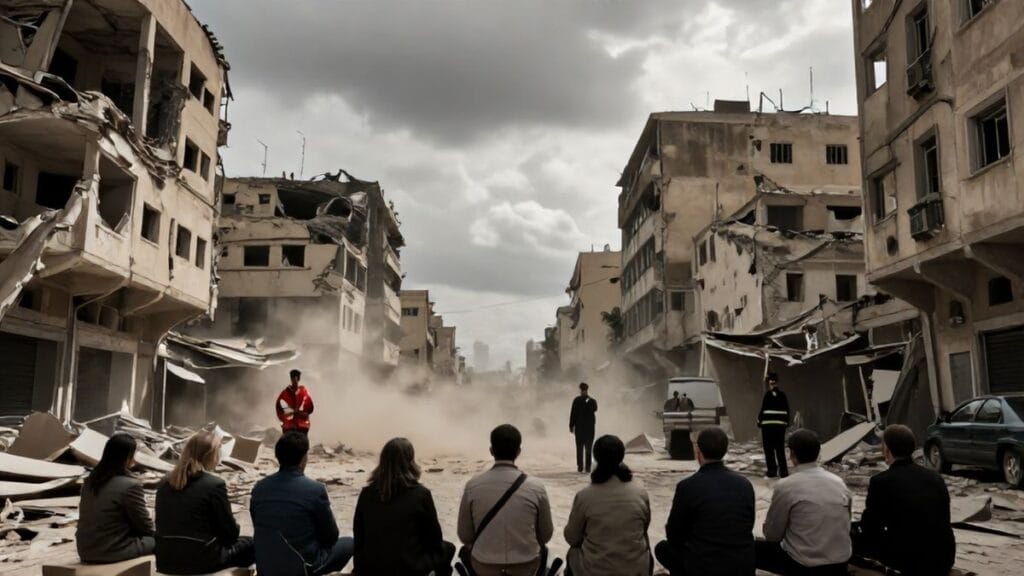
In the minutes after the blasts, the Marine compound resembled a battlefield from some apocalyptic vision. Dust hung like a fog, muting colors into a monochrome of gray and brown. Men stumbled through it, coughing, eyes streaming, ears ringing with the aftershock. Then came the dawning realization: the barracks was gone. The place that had been a sprawling, noisy hive of military life was now a compressed ruin with only the jagged outline of the building faintly visible.
Officers barked orders, trying to regain some semblance of structure. Corpsmen grabbed their medical kits and sprinted toward the rubble. Those who could still move began clawing at debris with bare hands—lifting chunks of concrete, tossing aside rebar, pulling at anything that might conceal a trapped comrade. Some survivors emerged, coated in dust and blood, faces blank with shock.
Nearby, vehicles burned, black smoke rising in columns. Equipment lay shattered: radios, rifles, helmets, personal gear mixed with torn fabric and flesh. The air was filled with a jumble of sounds: the groan of settling debris, the shouts of rescuers, the moans of the injured, the distant wail of sirens responding from across the city. In the chaos, time seemed to stretch and contract. Five minutes felt like an hour; an hour vanished in a blur.
Communications were initially fragmented. Reports to higher command came in as broken fragments: “Explosion… barracks hit… mass casualties.” On ships off the coast, U.S. Navy officers strained to piece together what had happened. In Washington and Paris, early morning or late-night staffers were jolted awake by phone calls that began with some version of: “There has been a major incident in Beirut.”
At the French site, the scene was equally harrowing. The Drakkar building’s remains leaned at grotesque angles, as if frozen mid-collapse. Firefighters, soldiers, and civilians converged, some digging with shovels, others with anything they could find. Occasionally, a voice would be heard under the rubble, a faint tapping, a muffled cry. Every sound like this injected a shot of adrenaline into rescuers, who redoubled their efforts in those spots.
And yet, amid this frenzy, there were moments of stunned silence: a rescuer pausing, staring at a crushed helmet; a Marine looking at the space where his friend’s bunk had been and seeing only rubble; a French officer standing on a broken stairway, eyes scanning the ruin, knowing with a soldier’s grim intuition that most of his men were already beyond saving. The enormity of the loss sank in slowly, like a dark tide.
The world beyond Beirut learned of the attack within hours. Television networks broke into regular programming with bulletin banners. In living rooms across the United States and France, families watched grainy images of mangled concrete and burning vehicles. Many had sons, brothers, husbands serving in Lebanon. As footage of the devastation aired, telephones in military households began to ring, each call a possible harbinger of the worst news a family could receive.
Rescue amid Ruin: Digging through the Rubble
As the initial shock subsided, the rescue operation became more organized, though no less desperate. Heavy equipment was brought in—cranes, bulldozers, cutting tools. The danger remained immense. Any shift in the rubble could crush survivors or kill rescuers. Yet they pressed on. For the Marines, it became a grim, exhausting race against time, fueled by adrenaline, loyalty, and the simple refusal to abandon hope.
Marines worked shoulder to shoulder with Lebanese volunteers and, eventually, with specialized teams. They dug with shovels, with gloved hands, sometimes even with bare fingers when tools were unavailable or too slow. Each piece of concrete removed revealed another layer: twisted bed frames, rucksacks, fragments of walls, and sometimes, mercifully, a living man, pinned but breathing.
Rescuers called out names, banged on surfaces, listened for any sound in reply. When they found a survivor, the process of extraction was delicate and nerve-wracking. A wrong move could bring down more debris. In some cases, men were given morphine, reassured, their hands held by comrades as engineers carefully cut through obstacles. Hours blurred into days. The rescue effort did not stop when night fell; floodlights were set up, casting a stark, artificial glow over the ruin.
The psychological toll on the rescuers was immense. Many later spoke of the haunting combination of hope and dread each time they dug into a new pocket of rubble. A voice might be heard—then go silent. A hand might be seen protruding, only for them to realize its owner had long since died. One Marine recalled the particular horror of recognizing pieces of his friends by their dog tags, their tattoos, or some familiar item they had carried.
At the French Drakkar site, the situation was similarly grueling. French troops, some weeping openly, labored to free their comrades. President Mitterrand’s visit to the scene, less than 24 hours after the blast, provided a brief moment of symbolic solidarity, but it could not lessen the weight of the concrete or the cruelty of the physics that had crushed so many lives. The French rescue effort, like the American, quickly turned from search and rescue to recovery of bodies.
By the end of the operations, the numbers were devastating. The beirut barracks bombing had killed 241 U.S. service members—220 Marines, 18 sailors, and 3 soldiers—along with 58 French paratroopers. Dozens more were severely wounded, many with life-altering injuries: crushed limbs, traumatic brain injuries, burns, and psychological scars that no medical diagnostic could fully capture.
It was not just the scale of death that shocked the rescuers and the watching world; it was the way it had happened. A single truck, a single explosion, had undone hardened soldiers as if they had been no more protected than civilians in a fragile house. This asymmetry—between the simplicity of the attack and the magnitude of its effect—would imprint itself deeply on military planners for decades to come.
Counting the Dead: The Human Toll of the Beirut Barracks Bombing
Once the last survivor was pulled from the rubble and the last body bag zipped, the cold mathematics of the tragedy began to be recorded. Official tallies would list 241 American service members dead, making it the deadliest single day for the U.S. Marine Corps since the Battle of Iwo Jima in 1945. For France, the 58 paratroopers killed at Drakkar represented the heaviest combat loss in a generation.
Yet, behind every number was a person with a story interrupted mid-sentence. Many of the Marines were in their late teens or early twenties, sons of small towns in Ohio, Texas, California, and dozens of other places that had seemed very far from Beirut. Some had joined the Corps seeking adventure, others to pay for college, some to follow family tradition. Photographs published in American newspapers in the weeks after the attack show an array of youthful faces, some grinning in dress uniform, others captured candidly with friends or girlfriends, utterly unaware of the fate awaiting them.
The same was true for the French dead. They came from cities and villages across France, from Normandy to Marseille. Many were part of elite airborne units, proud of their regimental history. For their families, Lebanon had been a distant deployment—a dangerous one, yes, but enveloped in the reassuring rhetoric of “maintaining peace.”
The official casualty lists included not only the dead but also the wounded, whose injuries ranged from broken bones to massive internal trauma. Some lost limbs. Others lost hearing or sight. Many suffered from what today would be recognized as severe post-traumatic stress disorder (PTSD). In the 1980s, the full understanding and treatment of such psychological wounds were still limited. Some survivors would carry invisible scars into the rest of their lives, haunted by nightmares of the explosion, by the faces of friends they could not save, by the sound of concrete grinding as it collapsed around them.
The human toll extended far beyond the military ranks. Lebanese civilians living near the blast sites were killed or injured. Families were displaced again in a city already shredded by conflict. Shopkeepers who had grown used to the Marines’ presence suddenly found themselves near the epicenter of a global news event. For them, the beirut barracks bombing was not just a foreign tragedy; it was another day when their streets became a battlefield.
Years later, survivors and relatives would testify in court cases and public inquiries, trying to give shape to their loss. One mother described in a hearing how her son had written that he would be home by Christmas. Another Marine, recalling the bombing decades later, said that every time he heard a truck backfire, his muscles tensed and his mind flashed back to that October morning. History often deals in aggregates—241 dead, 58 dead—but the lived reality is granular, each grief a separate world.
Grief across Oceans: Families, Funerals, and National Mourning
As the bodies were flown home, the tragedy unfolded in parallel in two worlds: Beirut’s ravaged neighborhoods and the quiet suburbs and towns of America and France. In the United States, long rows of flag-draped coffins arrived at Dover Air Force Base. On television screens, viewers saw scenes that recalled earlier wars: the solemn unloading, the precision of military honors, the palpable sorrow that clung to every movement.
Families waited for official notifications, some already fearing the worst after seeing the news. Uniformed officers arrived at front doors, their presence instantly understood. Kitchens fell into hushed silence. Mothers, fathers, spouses, siblings gathered to hear the phrases that military protocol required but human hearts dreaded: “We regret to inform you…” In many homes, the beirut barracks bombing became a fissure line—before and after—separating one life from the next.
Funerals took place across the country. In small churches and large cathedrals, ministers and priests spoke of sacrifice, of service, of the complexities of a distant conflict. The Marine Corps presence at these ceremonies was striking: caskets carried by fellow Marines, the sound of “Taps” played at gravesides, rifles fired in salute. American flags were folded with meticulous care and handed to next of kin with the words, “On behalf of a grateful nation.” Sometimes those receiving the flags gripped them tightly; others seemed unable to look at the symbol of what they had lost.
In France, similar ceremonies took place. The coffins of the paratroopers were lined up in military courtyards, draped in the Tricolore. President Mitterrand spoke of honor, of fidelity to commitments abroad, even as debates swirled quietly among politicians and the public about the price France had paid in Lebanon. The funerals were drenched in ritual—a nation’s attempt to impose a sense of order and meaning on the brutality of their deaths.
For many families, questions lingered. Why were their sons in Beirut? Were they properly protected? Could this have been prevented? Some channeled their grief into activism, pushing for investigations, demanding accountability. Others retreated into private remembrance, keeping photographs on mantels, medals in velvet-lined boxes, letters in drawers that would be opened and reread on anniversaries or sleepless nights.
National mourning had its own rhythm. In the United States, President Reagan addressed the nation from the Oval Office, speaking in somber tones about the Marines who had died “in a noble cause.” He invoked the language of duty and valor, comparing their sacrifice to that of Marines in past wars. Yet behind the carefully crafted words, there was a fierce political storm brewing, one that would question not the courage of the fallen, but the policy that had sent them into harm’s way under such vulnerable conditions.
Searching for Responsibility: Intelligence, Warnings, and Failures
Almost from the moment the smoke cleared, questions began to surface: How could this have happened? Was it truly unforeseeable, or had warnings been missed? Investigations in the months and years after the beirut barracks bombing revealed a troubling picture of intelligence gaps, bureaucratic inertia, and flawed assumptions.
Intelligence reports before October 23 had indicated a rising threat level. There were indications that hostile groups were surveilling MNF facilities, that suicide attacks were being contemplated. The April 1983 bombing of the U.S. Embassy in Beirut itself should have underscored the seriousness of the threat. Yet the full implications of that attack were not integrated into a comprehensive overhaul of security at the Marine compound.
Several constraints contributed to this failure. The Marines’ rules of engagement and posture had been shaped by diplomatic concerns—Washington did not want them to appear as an occupying force. Requests by field commanders for more robust defensive measures, such as moving troops into smaller, more dispersed positions, were not always accepted. One later inquiry, the Long Commission in the United States, concluded that the chain of command had failed to provide the necessary support for the Marines’ security.
There were also issues of coordination between intelligence agencies. Information about potential threats circulated among embassies, military commands, and headquarters in Washington and Europe, but often in fragmented ways. The concept of a massive suicide truck bomb as a tactical weapon against hardened military targets was still relatively new. Some analysts warned of it; others dismissed it as unlikely.
In congressional hearings, Marine commanders testified, sometimes in emotion-laden voices, about the constraints they faced. They had been ordered to keep weapons unloaded in certain positions, to maintain a visible but non-aggressive stance. After the attack, critics argued that these restrictions had turned the Marines into “sitting ducks.” Defenders countered that hindsight made it easy to judge decisions made in a complex and politically sensitive environment.
French investigations reached similar conclusions about the need for improved intelligence and fortified positions. Both countries eventually acknowledged that the attacks had revealed a critical vulnerability in their forces’ understanding of and preparedness for suicide terrorism. As one later analyst wrote in a defense journal, “Beirut was a classroom in which the lesson was taught in blood.”
The search for responsibility extended beyond tactical failures to the larger question of policy. Why had Western troops been placed at the heart of a conflict they did not control, among factions whose loyalties were opaque, in a region where symbols mattered as much as actions? Answering these questions would require looking beyond barracks and bomb craters to the darker tangle of regional politics and militant networks.
Hezbollah, Iran, and Syria: The Shadowy Architects of Violence
The question of who carried out the beirut barracks bombing has been the subject of extensive investigation and debate. While no group claimed immediate responsibility in the chaotic aftermath—a hallmark of covert operations at the time—evidence gradually pointed toward a constellation of actors tied to Iran’s Islamic Revolutionary Guard Corps (IRGC) and to the emerging Shiite militant group that would later be known as Hezbollah.
In the early 1980s, the IRGC’s Quds Force had established a presence in Lebanon’s Bekaa Valley, working with local Shiite militants disillusioned by the marginalization of their community and enraged by the Israeli invasion and the perceived complicity of Western powers. The Iranian leadership, having recently emerged from its own revolution and embroiled in a brutal war with Iraq, saw attacks on U.S. and French forces in Lebanon as a way to weaken Western influence and demonstrate the potency of its revolutionary ideology.
Syrian intelligence, too, played a complex role. Syria under Hafez al-Assad viewed Lebanon as part of its vital sphere of influence. Damascus opposed the presence of foreign troops, particularly those aligned with Israel’s goals or with a Lebanese government it could not control. While the full extent of Syrian coordination remains debated, there is little doubt that Syria’s permissive environment and intelligence networks provided crucial support for the militants operating in Lebanon.
Over time, Western intelligence and legal investigations converged on the conclusion that a group calling itself Islamic Jihad Organization (IJO)—widely considered a precursor or early alias for Hezbollah—carried out the attacks with Iranian backing. U.S. federal court cases in later decades, including the 2003 ruling in Peterson v. Islamic Republic of Iran, held Iran legally responsible for supporting the bombing, citing testimony from former intelligence officers and defectors. The court noted that the attack had been “planned, funded, and directed” by Iranian officials in conjunction with local operatives.
Hezbollah, for its part, has never officially claimed responsibility for the 1983 barracks bombings, maintaining an ambiguous silence consistent with its early clandestine operations. Yet many specialists consider the attack a formative moment for the organization, demonstrating the effectiveness of suicide bombings as a strategic tool. As one scholar, Magnus Ranstorp, observed in his study of Hezbollah, the Beirut bombings “marked the arrival of a qualitatively new phenomenon in modern conflict: the purposeful, politically directed use of martyrdom operations against hardened military targets.”
The interplay of Iranian ideology, Syrian regional strategy, and Lebanese sectarian grievances produced a potent cocktail. For the militant planners, the presence of Western troops on Lebanese soil—troops perceived as siding with their enemies—offered both motive and opportunity. The attacks were not random explosions of rage; they were calculated moves in a larger contest over the future of Lebanon and the balance of power in the Middle East.
From Intervention to Withdrawal: Shifting U.S. and French Policy
In the halls of power in Washington and Paris, the beirut barracks bombing prompted immediate soul-searching and longer-term strategic recalibration. In Washington, President Reagan convened his national security team, confronted with the grim combination of a massive loss of life and an ambiguous mission in a chaotic war. Publicly, Reagan spoke of “redoubling” U.S. commitment, insisting that the terrorists would not “drive us out of Lebanon.” Privately, doubts were growing.
Political pressure mounted quickly. Members of Congress questioned why U.S. Marines had been deployed with such limited authority to defend themselves and such unclear strategic objectives. Families of the dead asked what their sons had died for. Opinion polls reflected a growing unease with American entanglement in Lebanon’s civil war. The memory of Vietnam lingered in the background, a cautionary tale of incremental escalation without clear victory.
The Long Commission, formally known as the Department of Defense Commission on Beirut International Airport Terrorist Act, investigated the bombing and delivered a blunt assessment. It found that the chain of command had failed to provide the Marines with adequate security measures and intelligence. The report recommended changes in deployment practices, force protection standards, and intelligence coordination. These recommendations would echo through U.S. military doctrine for decades.
By early 1984, the political calculus shifted decisively. The administration quietly began planning a withdrawal. Under increasing fire from various militias and with no clear path toward stabilizing Lebanon, the costs of staying seemed to outweigh the benefits. In February 1984, U.S. Marines began to pull out, re-embarking on ships offshore. Reagan framed the move not as a retreat but as a “redeployment,” yet the symbolism was clear: the United States had been bloodied and pushed out of Lebanon by a combination of local forces and their foreign backers.
France also reevaluated its role. While it maintained a military presence in Lebanon slightly longer than the Americans, domestic pressure and strategic reassessment led to a gradual drawdown. The loss at Drakkar weighed heavily on French policymakers, reinforcing a more cautious approach to large-scale ground deployments in volatile civil conflicts.
For the militants and their sponsors, the withdrawals were celebrated as a victory. The message was simple and, from their perspective, vindicating: carefully targeted, high-impact attacks could impose unbearable political costs on powerful adversaries, compelling them to abandon positions far from home. It was a lesson that would not be forgotten—in Beirut, in Tehran, in Damascus, or in the shadowy training camps where future militants studied past operations.
International Law, Terrorism, and the Changing Nature of War
The beirut barracks bombing also forced governments, jurists, and scholars to confront the evolving nature of warfare and terrorism. At the time, international law had few clear answers for attacks by non-state actors against military targets stationed abroad under ambiguous legal mandates. Were the bombings acts of war? Crimes? Terrorism? All of the above?
On one level, the targets were plainly military. The victims were uniformed soldiers, housed in barracks, on a mission sanctioned, at least in part, by agreements with the Lebanese government. Under traditional laws of war, attacks on military targets were permissible—if carried out by recognized belligerents, in accordance with certain rules. But the attackers in Beirut were not conventional belligerents. They claimed no uniforms, flew no flag, and answered to no state in any formal sense, even as they enjoyed the support of Iran and Syria.
Moreover, the method of attack—a suicide truck bomb disguised as a civilian vehicle—blurred the line between combatant and non-combatant, between battlefield and city street. It exploited the openness of urban life and the relative vulnerability of peacekeeping deployments. As legal scholar Michael Schmitt would later note, Beirut was an early harbinger of “the postmodern battlefield,” in which state militaries and non-state networks clashed in spaces that were neither fully war zones nor fully at peace.
In subsequent years, U.S. courts, particularly in civil cases brought by victims’ families, used domestic statutes like the Foreign Sovereign Immunities Act (FSIA) and its terrorism exceptions to hold Iran financially liable for supporting the attacks. These rulings carried both symbolic and practical implications, affirming that states which “sponsor” terrorism could be held responsible even if they did not carry out attacks directly.
Internationally, the Beirut bombings became a reference point in debates about how to define terrorism: Was it the nature of the target, the method, the political goal, or some combination of all three? Many governments classified the attacks as terrorism due to their clandestine nature, the suicidal method, and the broader intent to coerce political change through shock and fear. Yet in militant circles, the operations were portrayed as legitimate “resistance” against occupation.
This clash of narratives underscored a deeper shift: the era when wars were fought primarily between national armies on defined fronts was receding. In its place emerged a world where “wars of the weak” would increasingly be waged with car bombs, hijackings, suicide vests, and later, cyber tools—methods designed to exploit the vulnerabilities of open societies and conventional militaries.
Memory and Memorials: How Nations Remember the 1983 Attack
As the years passed, the physical ruins in Beirut were cleared, but the memory of October 23, 1983, remained etched in stone and ceremony. In the United States, memorials to the fallen Marines, sailors, and soldiers were erected at various sites: at Camp Lejeune in North Carolina, the home base of the 24th Marine Amphibious Unit; at Arlington National Cemetery; and in the hometowns of those who died. Annual ceremonies mark the anniversary of the bombing, with wreath-laying, roll calls of the dead, and speeches that reaffirm the Corps’ commitment to remembering its own.
For the Marine Corps, the beirut barracks bombing became a defining chapter in its modern history. Training manuals, lectures at staff colleges, and informal storytelling among Marines all invoke Beirut as a cautionary tale about force protection, mission clarity, and the unpredictability of deployments in unstable regions. The phrase “Remember Beirut” holds a particular resonance among those who study and practice expeditionary warfare.
In France, the memory of Drakkar also persists. Monuments and plaques bear the names of the 58 paratroopers killed. Military ceremonies in France often include references to Lebanon alongside other foreign deployments where lives were lost. For the French airborne community, Drakkar sits alongside battles in Indochina and Algeria as a symbol of sacrifice in complex, far-from-home conflicts.
In Lebanon, the memory is more ambiguous and fragmented. For many Lebanese, the bombings are one episode among countless traumas: the Sabra and Shatila massacre, the shelling of neighborhoods, kidnappings, and other bombings that scarred the civil war years. Some remember the Marines and French as protectors; others as occupiers; still others as distant actors in a war that was ultimately decided by Lebanese militias and their regional patrons.
Yet, some shared commemorations do occur. American and French delegations occasionally visit Beirut to lay wreaths and meet with Lebanese officials, gestures that both acknowledge the past and gesture toward cooperation in the present. The physical sites of the bombings have been transformed by time and urban change, but those who know where to look can still trace the outlines of the tragedy.
Memory is never neutral. It is shaped by politics, by personal need, by the desire to find meaning in loss. For the families of the dead, the beirut barracks bombing is not a case study or a footnote in the history of terrorism; it is the day their son, father, or brother vanished from the world. Their living memorials are quieter: a chair that remains empty at family gatherings, a gravestone visited on birthdays, a folded flag that is occasionally taken out of its case and held, as if some trace of the loved one might be felt through the fabric.
Echoes in Later Conflicts: From Beirut to 9/11 and Beyond
In the decades that followed, analysts and policymakers came to view the beirut barracks bombing as a grim precursor to later attacks on U.S. and Western targets. The model it showcased—large-scale, coordinated suicide bombings against symbolic or high-value targets—would be echoed in the 1996 Khobar Towers bombing in Saudi Arabia, the 1998 U.S. embassy bombings in Kenya and Tanzania, the 2000 USS Cole attack in Yemen, and, on a vastly more devastating scale, the September 11, 2001, attacks on New York and Washington.
Each of these later incidents prompted observers to look back at Beirut and ask: What lessons had been learned, and which had been ignored? One recurrent theme was the challenge of translating tactical awareness into strategic change. After Beirut, U.S. military doctrine did evolve. Force protection became a central concern. Perimeter defenses were strengthened, intelligence fusion improved, and commanders were given more leeway to adjust defensive postures based on local threats.
Yet the basic asymmetry that Beirut exposed remained: states with large, conspicuous assets—embassies, ships, barracks—operate in environments where small, determined groups can still find ways to circumvent defenses. The allure of “spectaculars,” as high-casualty, high-visibility attacks came to be known among militants, grew as they saw how such operations could reshape the strategic calculations of powerful adversaries.
Al-Qaeda’s leaders, for instance, studied prior attacks closely. Osama bin Laden himself referred more than once to the impact of the U.S. withdrawal from Lebanon after the bombing, seeing it as proof that the United States could be compelled to retreat through sustained casualties. This reading, whether accurate or oversimplified, influenced the group’s conviction that dramatic attacks could shift global power balances.
In Iraq after 2003 and in Afghanistan, Western forces once again faced suicide bombings, vehicle-borne improvised explosive devices (VBIEDs), and complex assaults on bases. Many military officers, briefing younger troops, invoked Beirut as an early case in this evolving kind of warfare. The images of the collapsed barracks in 1983 thus informed rooftop guard posts and blast walls thousands of kilometers and decades away.
The echoes of Beirut are not only heard in battlefields and intelligence reports; they reverberate in the ethical debates about intervention, occupation, and the responsibility to protect civilians. Each time Western governments consider sending troops into an unstable region, the ghosts of Lebanon hover in the background: What mission will they have? How clearly defined is the end state? How will they be protected? And at what point will the costs—measured in lives—outweigh the goals?
Narratives, Myths, and the Battle over Historical Meaning
History is not just a record of events; it is a contest over how those events are understood. The beirut barracks bombing has generated multiple narratives, often in tension with one another. For many Americans and French, it is a story of brave servicemen killed while trying to bring peace to a violent land. For some Lebanese, it is entwined in a broader saga of foreign interference, local resistance, and the tragic costs borne by civilians.
Militant groups, especially those aligned with Iran’s “Axis of Resistance,” have sometimes framed the bombings as heroic acts of self-defense against imperial powers. In certain speeches and publications, the 1983 attacks are cited as proof that “faith and sacrifice” can defeat technologically superior enemies. This narrative, transmitted in clandestine literature and oral lore, serves to legitimize ongoing struggles against what they see as Western occupation or aggression in the region.
On the other hand, Western governments and many international observers classify the bombings unequivocally as acts of terrorism—illegitimate, immoral, and criminal, regardless of political grievances. For them, the use of suicide bombers and massive explosives against troops deployed under a peacekeeping rubric crosses a moral and legal line. These competing interpretations influence everything from school curricula to commemorative speeches.
Within Lebanon itself, the story is even more complex. Some Lebanese who lived through the civil war view all foreign forces—Syrian, Israeli, American, French—with skepticism, seeing the bombings as part of a ruthlessly pragmatic conflict in which no actor’s hands were clean. Others remember the Marines handing out food or the French patrolling streets where local security forces had collapsed, fostering a more sympathetic view of the MNF’s presence.
Historians, working with archives, testimonies, and declassified documents, have sought to cut through these layers of myth. They analyze speeches, orders, intercepted communications, and field reports. One widely cited academic study by historian Robert Fisk, who was reporting from Beirut at the time, underscores the way symbolic acts of violence in Lebanon have often been interpreted differently depending on the vantage point of the observer. Beirut, he argues, is “a city whose every bullet fired demands an interpretation.”
The battle over the meaning of the beirut barracks bombing is not merely academic. It shapes contemporary policy decisions. If the attack is seen primarily as a response to occupation, then future interventions may be approached with more caution. If it is framed as unprovoked terrorism that punished benevolent peacekeeping, then the argument for assertive, preemptive action against similar groups gains force. Navigating between these interpretations requires both empathy for the victims and clear-eyed analysis of the political context.
Lessons from Beirut: Strategy, Security, and Human Fragility
Four decades on, the beirut barracks bombing continues to function as a tragic case study in the interplay of strategy, vulnerability, and human courage. Military academies dissect it for lessons about force protection, intelligence coordination, and mission design. Diplomats reference it when discussing the risks of deploying peacekeepers into active war zones. Families of the dead hold private commemorations, reminding the world that behind the theory lie lives forever altered.
One of the clearest lessons is the danger of deploying forces with ambiguous mandates into environments where they are both symbolically and physically exposed. In Beirut, U.S. and French troops were tasked with stabilizing a country in the midst of civil war without being fully empowered to impose security or choose the terms of engagement. They became, in effect, highly visible political signals—proclaiming Western commitment—without corresponding control over their environment.
Another lesson lies in the need to anticipate and adapt to emerging tactics. In 1983, suicide truck bombings against hardened military targets were relatively novel. Today, they are part of the grim repertoire of asymmetric warfare. Beirut showed how innovators in violence could exploit the gap between political constraints and operational security. Modern militaries now train specifically for threats that were once dismissed as unlikely or too “extreme” to be taken seriously.
Yet, beyond the strategic and tactical insights, there is a more intimate lesson about human fragility. The Marines and paratroopers in Beirut were young, competent, and committed. They did what they were ordered to do, under conditions they did not choose. Their deaths remind us that decisions taken in distant capitals—about where to deploy, under what rules, with what objectives—have direct, irreversible consequences for individuals who bear the brunt of those choices.
The bombing also offers a sobering reflection on the limits of military power in resolving deeply rooted political conflicts. No amount of firepower, no sophistication of technology, can compensate for an unclear political strategy or a failure to understand local dynamics. In Lebanon, Western forces were operating in a landscape shaped by decades of sectarian tension, regional rivalries, and recent atrocities. A few battalions of foreign troops, however brave, could not recalibrate that balance on their own.
Finally, the legacy of the beirut barracks bombing is a call for humility in the face of history. It challenges leaders and citizens alike to ask hard questions before troops are sent abroad: What is the mission? How will we protect them? How will we know when it is time to leave? And what responsibilities do we bear, not just to our own forces, but to the people in whose lands we intervene?
Conclusion
On that October morning in 1983, as the dust settled over the ruins of the barracks in Beirut, the future seemed uncertain, shrouded in smoke and grief. Yet from that moment forward, the world could no longer ignore the power of a new kind of violence: asymmetrical, ideologically driven, and willing to expend human lives—both of attackers and their victims—for strategic effect. The beirut barracks bombing was not the first such act, nor would it be the last, but it crystallized the vulnerabilities that come with wielding immense power in a world of determined, agile adversaries.
In the years since, militaries have hardened bases, refined intelligence, and rewritten doctrines. Politicians and diplomats have argued bitterly over when and where to deploy forces, invoking Beirut as either a warning against overreach or a lesson in the costs of underestimating one’s enemies. Families have aged, carrying photographs of sons who never had the chance to become fathers, husbands, or old men with stories to tell. Lebanese citizens, too, have carried the memory as one among many in a long succession of civil war traumas.
The story of the beirut barracks bombing, when told fully, is not just one of explosions and casualties. It is a narrative about how ideology, strategy, and human frailty intersect; how decisions at the highest levels ripple outward to shape the fates of ordinary soldiers and civilians; how memory and interpretation can turn the same event into a symbol of martyrdom, aggression, heroism, or folly, depending on who is speaking.
To walk through the history of that day is to feel the weight of all these layers: the tension in the pre-dawn stillness, the blinding flash of the blasts, the dust-choked rescue efforts, the funerals back home, the policy debates in distant capitals, and the quiet persistence of grief. It is to recognize that, even in the age of satellites and drones, a single truck driven by a determined man can still alter the trajectory of nations.
If there is a single enduring lesson, it may be this: that power without understanding is fragile, that intervention without clarity is perilous, and that the lives of those we send into harm’s way demand more than slogans about peace or strength. They demand careful thought, honest reckoning, and a willingness to remember—not just on anniversaries, but whenever we find ourselves tempted to believe that force alone can untangle the knotted threads of history.
FAQs
- What was the Beirut Barracks Bombing?
The Beirut Barracks Bombing refers to the coordinated suicide truck bomb attacks on October 23, 1983, that destroyed the U.S. Marine barracks near Beirut International Airport and the French paratrooper barracks at the Drakkar building, killing 241 American service members and 58 French paratroopers. It was one of the deadliest attacks on Western military forces since World War II and marked a turning point in the use of large-scale suicide bombings by non-state actors. - Who carried out the attacks?
No group claimed immediate responsibility, but subsequent investigations by U.S. intelligence, Western governments, and courts concluded that the attacks were planned and executed by militants associated with the Islamic Jihad Organization, widely considered an early operational name for Hezbollah, with substantial support and direction from Iran’s Islamic Revolutionary Guard Corps and tacit backing from elements within Syria. - Why were U.S. and French troops in Beirut at the time?
U.S. and French forces were part of a Multinational Force deployed to Lebanon in 1982 to help stabilize Beirut following the Israeli invasion and the evacuation of PLO fighters. Their mission was officially peacekeeping—supporting the Lebanese government and military, protecting civilians, and trying to prevent further escalation of the civil war—though over time their presence came to be seen by some local factions as taking sides in the conflict. - Could the Beirut Barracks Bombing have been prevented?
Investigations after the attack revealed missed warning signs and significant security shortcomings, including limited defensive fortifications and restrictive rules of engagement that left guards with unloaded weapons. While it is impossible to say with certainty that the bombing could have been fully prevented, many analysts and official inquiries, such as the U.S. Long Commission, concluded that better intelligence integration, stronger physical defenses, and more flexible security policies might have reduced the attack’s impact or deterred it altogether. - How did the bombing affect U.S. and French policy in Lebanon?
The bombing accelerated political and public pressure in both countries to reassess their involvement in Lebanon. Within months, the United States began withdrawing its Marines, framing the move as a “redeployment” but effectively ending its ground presence in Beirut. France also scaled back its deployment. For militant groups and their state sponsors, these withdrawals were interpreted as victories that reinforced the perception that high-casualty attacks could force Western powers to retreat. - What impact did the attack have on future counterterrorism and military doctrine?
The attack spurred significant changes in force protection, intelligence sharing, and base security for Western militaries. It highlighted the threat posed by suicide vehicle-borne improvised explosive devices and influenced later responses to terrorism, from the Khobar Towers bombing to the 9/11 attacks. Training, doctrine, and infrastructure were all modified in light of the vulnerabilities exposed in Beirut. - How is the Beirut Barracks Bombing remembered today?
The bombing is commemorated annually in the United States and France through ceremonies, memorial services, and educational events. Monuments and plaques honor the fallen in military bases, cemeteries, and hometowns. Among military professionals and historians, it remains a major reference point for discussions about intervention, asymmetric warfare, and the ethics of deploying troops into civil conflicts under constrained mandates. - What larger lessons does the Beirut Barracks Bombing offer?
The bombing underscores the importance of clear political objectives, realistic threat assessments, and robust protection for deployed forces. It illustrates how non-state actors can leverage relatively simple tools to achieve strategic effects, and how misreading local dynamics can place peacekeepers in the crosshairs of complex regional struggles. Above all, it serves as a reminder that the costs of intervention are borne most directly by the soldiers and civilians on the ground, whose lives depend on the wisdom—or folly—of distant decision-makers.
External Resource
Internal Link
Other Resources
- Encyclopaedia Britannica – general search for the exact subject
- Google Scholar – academic search for the exact subject
- Internet Archive – digital library search for the exact subject