Table of Contents
- The Spark Ignites: Brussels on August 25, 1830
- A City on Edge: The Social Fabric of Early 19th Century Belgium
- The United Kingdom of the Netherlands: A Fractured Union
- The Weight of Religion and Language: Seeds of Discord
- The July Revolution in France: A Catalytic Flame
- Theatres as Incubators of Revolution: La Monnaie’s Fateful Night
- The Uprising Explodes: Citizens Take the Streets
- The Slow Collapse of Dutch Authority in Brussels
- From Riots to Revolution: Spreading Flames Across Belgium
- Key Figures: Rebels, Leaders, and Luminaries of the Revolution
- Violence and Restraint: The Complex Nature of the Revolt
- The Role of the Press and Public Opinion in Mobilization
- International Reactions: Europe Watches With Concern
- The Siege of Antwerp: The Last Dutch Stand
- Proclamation of Independence: Belgium Emerges from the Ashes
- Legacy of the Revolution: Institutional and Cultural Rebirth
- The Belgian Constitution: Foundations of a New Nation
- Economic Transformation: From Turmoil to Prosperity
- Belgian Identity: Language, Religion, and Unity Reimagined
- The European Balance of Power and Belgium’s Place
- Memory and Commemoration: How the Revolution Lives Today
- Conclusion: The Birth Pangs of a Nation
- FAQs about the Belgian Revolution
- External Resource
- Internal Link
1. The Spark Ignites: Brussels on August 25, 1830
The night of August 25, 1830, in the heart of Brussels was thick with anticipation, tension, and a murmur of defiance. The city's narrow streets cradled a restless crowd gathered outside Théâtre de la Monnaie, where an opera performance was about to unfold—a performance that would ripple far beyond mere entertainment. For weeks, the air had been dense with political friction, economic hardship, and cultural grievances, but no one could quite predict that a musical drama would ignite the flames of revolution.
The audience, a mosaic of social classes from passionate youth to weary merchants and intellectuals, had come to witness La Muette de Portici, a patriotic opera about a Neapolitan revolt against Spanish rule. As the stirring aria “Amour sacré de la patrie” echoed through the gilded hall, an electric fervor surged through those listening. Suddenly, the crowd erupted into cheers and cries, hunger for liberty reflected in their voices. What began as inspiration soon morphed into organized rebellion. The night that had started in artistic celebration swiftly descended into chaos—walls reverberated with gunfire, and barricades sprang up in the streets.
Thus began the Belgian Revolution, a defining chapter in Belgium’s journey to sovereign statehood, and a moment that captured the heart and soul of a people yearning to break from the shackles of a reluctant union.
2. A City on Edge: The Social Fabric of Early 19th Century Belgium
Brussels in 1830 was a cauldron of contrasts and contradictions. The city was a political and cultural crossroads, home to a population deeply divided by class, language, and economic fate. The region constituting modern-day Belgium had been annexed to the United Kingdom of the Netherlands under the 1815 Congress of Vienna, after over two decades of Napoleonic upheaval. But the union was brittle, seen by many in the southern provinces as a forced marriage between incompatible partners.
The industrializing southern cities—Brussels, Liège, and Ghent—bristled with a burgeoning working class and middle class, yet poverty, unemployment, and economic stagnation gnawed at many. Taxes were heavy, and cultural policies emanating from The Hague often felt like an imposition rather than governance. The elite, comprising mainly Flemish and Dutch-speaking Protestants, controlled political power, while the majority southern population was predominantly French-speaking and Catholic.
Sounds of resentment simmered below the surface, in taverns, marketplaces, and cafés—a sense that the region’s cultural and economic aspirations were suffocated by a disconnected monarchy and government. The city, ever vibrant, stood precariously balanced on the edge of upheaval.
3. The United Kingdom of the Netherlands: A Fractured Union
The Union forged in 1815 by the Congress of Vienna stitched together the Protestant Dutch-speaking North (today’s Netherlands) with the Catholic and French-speaking South (Belgium). This was a political gambit aimed at preventing the rise of French power and creating a buffer state in northwest Europe.
But the union was marred from the start by glaring disparities. The North was more commercially and administratively dominant with King William I overseeing a centralized regime keen on standardizing laws, education, and even language—often at the expense of southern autonomy. The South felt marginalized, culturally oppressed, and economically exploited. While industrial centers thrived in the South, the Dutch government’s tariff policies were seen as favoring northern trade.
Furthermore, the religious divide deepened tensions. The North embraced Protestant Calvinism while the South counted an overwhelming Catholic majority, whose Church wielded significant social influence. Conflicts in education policy, state funding, and religious freedoms fanned the flames of dissent.
This uneasy arrangement contained the seeds of revolt, with southern elites quietly plotting greater sovereignty and workers yearning for political inclusion.
4. The Weight of Religion and Language: Seeds of Discord
Religion and language were not mere cultural markers; they were weapons and symbols in a war over identity and power. The French language dominated the southern aristocracy and bourgeoisie, serving as the medium of politics, law, and high culture—even though the majority of the Flemish population spoke a Dutch dialect.
This linguistic dominance alienated many and became a rallying cry for reformers and revolutionaries. The Catholic Church was equally embattled, resisting Dutch attempts to control its influence on education and daily life. For many Belgians, preserving their faith and language was intertwined with the fight for political freedom.
The Dutch authorities’ failure to accommodate or respect these cultural realities created a sense of cultural colonization. Belgian distrust toward the northern regime only intensified, transforming cultural grievances into outright political opposition.
5. The July Revolution in France: A Catalytic Flame
Revolutions rarely happen in isolation, and the Belgian uprising of 1830 was deeply inspired by dramatic events a few weeks earlier in Paris. The July Revolution of 1830 saw the overthrow of King Charles X, replaced by the more liberal Louis-Philippe, the “Citizen King.”
News of barricades in Paris, raucous crowds chanting for liberty, and the fall of an absolutist monarchy electrified Brussels and other Belgian cities. French newspapers smuggled in revolutionary pamphlets and ideas, while exiled Belgian dissidents found refuge and support in Paris.
The Belgian people saw in France’s uprising not just hope, but a model to emulate. The idea that a people could seize their destiny from the grasp of repressive authority galvanized action. By mid-August, meetings, petitions, and secret assemblies began coalescing into open rebellion.
6. Theatres as Incubators of Revolution: La Monnaie’s Fateful Night
On August 25, the Théâtre de la Monnaie was more than a venue for entertainment—it was a crucible where culture fused with politics. The choice of La Muette de Portici was no accident; the opera’s story of insurgency and patriotism resonated deeply.
As the final chorus of "Amour sacré de la patrie" echoed, thousands of spectators rose to their feet, emotions spilling onto the streets. Clashes erupted immediately as police attempted to quell the swelling turmoil. Theaters quickly morphed into revolutionary platforms where words became weapons, and songs a battle cry.
This night marked not just a cultural awakening but the first organized public act of defiance. The revolution’s human face emerged here—young students, artisans, and even disenchanted soldiers coalescing into a defiant force.
7. The Uprising Explodes: Citizens Take the Streets
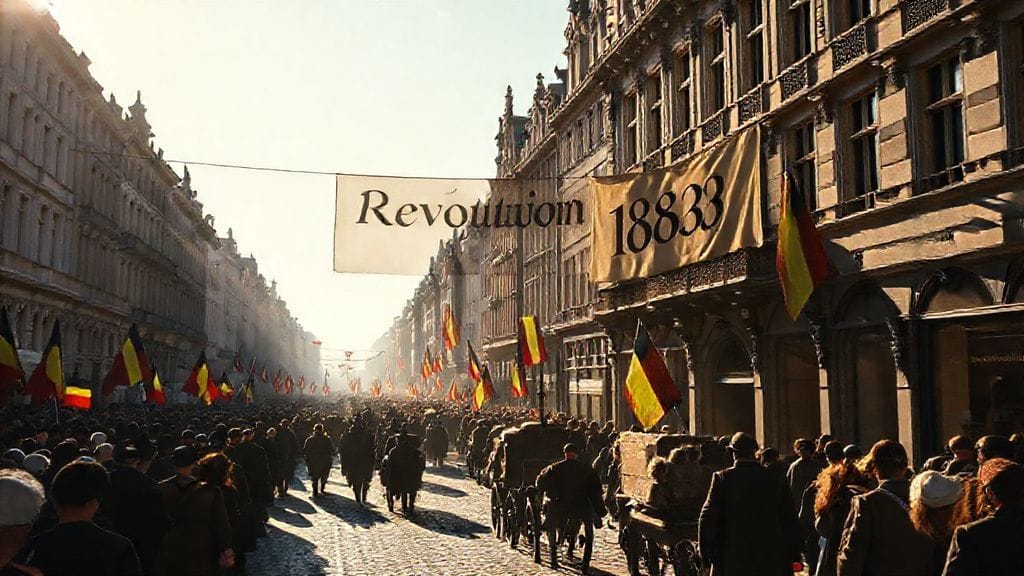
Following the opera night, Brussels transformed overnight. Citizens armed with sticks, farming tools, and whatever weapons they could find erected barricades, challenged Dutch soldiers, and seized public buildings.
The insurrection was spontaneous but brutal, involving street fighting that echoed Parisian revolutions with its chaotic energy. Dutch troops, often outnumbered and demoralized, struggled to maintain control.
Ordinary people—vendors, clerks, laborers—became revolutionaries. The cityscape changed as cobblestone streets were uprooted for barricades, and homes turned into fortresses. Flames lit the night sky, smoke billowed from government offices, and the sense of inevitability hung thick in the air.
8. The Slow Collapse of Dutch Authority in Brussels
King William I’s forces faced formidable challenges. Commanders hesitated to brutally suppress what many considered a civil dispute; troops sympathized with fellow Belgians; and communication delays hampered coordinated response.
Authorities attempted negotiation but found themselves ignored. Public buildings fell to rebels; city administration faltered as officials fled or switched allegiance. The symbolically and strategically vital city of Brussels slipped through Dutch fingers with painful slowness.
By early September, Dutch military presence was effectively neutralized in Brussels, signaling a de facto transfer of power—a dangerous precedent in a kingdom still refusing to acknowledge southern aspirations.
9. From Riots to Revolution: Spreading Flames Across Belgium
The rebellion in Brussels was the spark for wider unrest. Cities such as Liège, Ghent, and Namur witnessed their own uprisings, feeding on and fueling revolutionary zeal. Artisans and intellectuals formed provisional committees; peasants voiced demands for justice.
The revolution grew to encompass demands not just for independence but ideas reflecting liberal constitutionalism, workers’ rights, and national self-determination. Loyalist resistance existed, especially among Dutch officials, but momentum was unstoppable.
The revolution was not a single event but an unfolding drama stretching over months, where spontaneous revolt became organized political movement.
10. Key Figures: Rebels, Leaders, and Luminaries of the Revolution
Among the crowd were figures destined to shape Belgium's future. Charles Rogier, a fiery journalist, helped mobilize public opinion through his writings. Alexandre Gendebien, a lawyer and politician, used his influence to guide the movement’s political aims. Étienne de Gerlache and Sylvain Van de Weyer embodied the liberal aspirations seeking constitutional monarchy.
On the other side, King William I embodied the failed unifying monarchy, whose distant and stern rule alienated his subjects.
Soldiers like Lieutenant-General Daine fought bitterly, while local volunteer militias took up arms. These human elements provided texture to the revolution—passionate, flawed, courageous.
11. Violence and Restraint: The Complex Nature of the Revolt
While the revolution has been remembered as a relatively bloodless quest for freedom, it bore the marks of violence, fear, and moral ambiguity. Buildings were burned, property destroyed, and lives lost. Families were torn apart between loyalties.
Yet there were also moments of restraint; groups of civilians protected vulnerable citizens, churches opened their doors to mediate, and some combatants showed mercy. The revolution was a human story, full of contradictions—hope mingling with despair, idealism shadowed by brutality.
12. The Role of the Press and Public Opinion in Mobilization
Print media proved indispensable to the revolutionary cause. Newspapers and pamphlets, often clandestinely distributed, shaped public discourse, challenged the legitimacy of the Dutch government, and broadcast revolutionary ideals.
The press became an arena for debate and mobilization, where writers like Louis De Potter became heroes of national awakening. Public opinion, once fragmented and localized, united under a common narrative of justice and emancipation.
13. International Reactions: Europe Watches With Concern
European powers found themselves at a crossroads. Britain, France, Austria, Prussia, and Russia, all major players in the post-Napoleonic order, weighed the implications of Belgian independence on the fragile balance of power.
While some feared revolutionary contagion, others sympathized with Belgian grievances. France leaned toward tacit support, Britain advocated for Belgian neutrality and independence to maintain a buffer state.
The revolution was not only national but a geopolitical event, with delicate diplomacy unfolding behind the scenes.
14. The Siege of Antwerp: The Last Dutch Stand
Antwerp, Belgium’s vital port city, became the final bastion of Dutch resistance. After Brussels fell, Dutch forces retreated to Antwerp, fortifying the city.
For months, a tense siege ensued, with Belgian forces and volunteers blockading Dutch troops. International mediation ultimately forced a Dutch surrender in late 1832.
The siege symbolized the final quelling of Dutch control, securing Belgium’s territorial integrity and sovereignty.
15. Proclamation of Independence: Belgium Emerges from the Ashes
On October 4, 1830, a provisional government declared Belgian independence, signaling a new chapter not just for the nation but for Europe.
The declaration was revolutionary and cautious—Belgium aimed for a constitutional monarchy, balancing popular sovereignty with stability. The move sent shockwaves through Europe, prompting debates on legitimacy, sovereignty, and national rights.
16. Legacy of the Revolution: Institutional and Cultural Rebirth
Belgium’s birth was more than political—it was a cultural renaissance. Institutions were rebuilt to reflect Belgian priorities, from legal frameworks to educational reforms embedding national identity.
The revolution instilled a pride that persists. Artistic and literary movements blossomed in its wake, celebrating Belgian heroes and the idea of freedom.
17. The Belgian Constitution: Foundations of a New Nation
The Belgian Constitution of 1831 stands as a testament to enlightened liberalism and compromise. It enshrined freedom of religion, press, and association; separated powers; and established a constitutional monarchy under King Leopold I.
The document was a beacon in Europe, influencing liberal movements elsewhere and emphasizing civil liberties long before many of its neighbors.
18. Economic Transformation: From Turmoil to Prosperity
Post-revolution Belgium rapidly industrialized, leveraging its rich coal and iron resources. Infrastructure projects like railways connected cities, fostering trade and innovation.
The revolution dismantled some old restrictions, enabling economic diversification and growth. Belgium soon emerged as a European industrial powerhouse.
19. Belgian Identity: Language, Religion, and Unity Reimagined
The revolution forced Belgium to confront its diversity. French remained dominant in governance for decades, but Flemish cultural revival movements grew. The Catholic Church regained influence, but secularism also gained ground.
Belgium’s identity became a delicate balance of linguistic and religious communities, a reality still negotiated today.
20. The European Balance of Power and Belgium’s Place
Belgium’s independence reshaped European geopolitics. It was a buffer between France and Germany, a new player fostering liberal constitutionalism amidst monarchies and empires.
The 1839 Treaty of London codified its neutrality but embedded Belgium in great power diplomacy throughout the 19th and 20th centuries.
21. Memory and Commemoration: How the Revolution Lives Today
Every year, Belgians remember the 1830 Revolution with ceremonies, parades, and educational programs. Statues, museums, and historical narratives keep the spirit alive.
The revolution remains a source of national pride but also reflection on enduring questions of unity and diversity.
Conclusion
The Belgian Revolution of August 1830 wasn’t merely an urban uprising or fleeting disturbance—it was the birth cry of a nation. From the electric charged crowd in a theater in Brussels to smoky barricades across its cities, ordinary people transformed despair into hope, oppression into freedom. It remains a story of courage amid uncertainty, a reminder that identity and self-determination are powerful forces capable of reshaping history.
Belgium emerged from the chaos as a new entity—a kingdom with a liberal constitution, a nation defined by compromise and diversity. The reverberations of that revolution echo far beyond its borders, inspiring struggles for liberty worldwide and underscoring the perennial power of a people's will.
FAQs
Q1: What were the main causes behind the Belgian Revolution?
A1: The revolution stemmed from political marginalization under Dutch rule, cultural and linguistic oppression, religious tensions, economic grievances, and inspiration from liberal revolutions like France’s July 1830 uprising.
**Q2: Why was the opera La Muette de Portici so significant on August 25, 1830?**
A2: The opera’s themes of rebellion and patriotism resonated with Belgian audiences, catalyzing emotions that spilled into real-world revolt. It transformed a cultural event into a political spark.
Q3: Who were the key leaders of the revolution?
A3: Figures such as Charles Rogier, Alexandre Gendebien, Étienne de Gerlache, and Sylvain Van de Weyer played leading roles in political guidance and mobilization.
Q4: How did the European powers react to Belgian independence?
A4: They reacted cautiously; Britain advocated neutrality, France was sympathetic, and other powers balanced fears of revolution with diplomatic solutions. The 1839 Treaty of London formalized Belgium’s independence and neutrality.
Q5: What impact did the revolution have on Belgium’s political system?
A5: It led to the establishment of a constitutional monarchy grounded in liberal values, emphasizing civil rights, separation of powers, and national sovereignty.
Q6: How is the revolution remembered in Belgium today?
A6: It is commemorated through national holidays, monuments, educational curricula, and public discourse as the foundational moment of Belgian nationhood.
Q7: Did the revolution involve significant violence?
A7: Yes, the uprising involved street fighting, barricades, and loss of life. However, it was relatively restrained compared to many European revolutions, with notable acts of protection and negotiation.
Q8: How did the revolution affect the linguistic makeup of Belgium?
A8: While French remained politically dominant initially, the revolution raised awareness of linguistic diversity and eventually spurred Flemish cultural and political movements.