Table of Contents
- From the Balcony to the Firing Line: The Arc of Mussolini’s Fall
- Italy in Ruins: The War-Torn Stage of 1945
- The Birth of a Dictator: Promise, Violence, and Cult of Personality
- Allies and Illusions: Mussolini’s Fatal Embrace of Hitler
- Occupation, Resistance, and the Long Italian Civil War
- The Collapse of Fascist Power and the Road to Lake Como
- Disguise, Flight, and Betrayal: Mussolini’s Final Journey North
- Capture at Dongo: When the Duce’s Destiny Closed In
- The Night of Decisions: Partisan Debates over Justice and Vengeance
- Benito Mussolini Executed: The Shooting at Giulino di Mezzegra
- Bodies in Milan: The Grisly Spectacle at Piazzale Loreto
- Law, Revenge, or Necessity? The Controversy over the Execution
- Echoes in Italian Memory: Silence, Division, and Commemoration
- The Fate of Fascism After the Duce: Trials, Amnesties, and Neo-Fascists
- Representing the End: Films, Photographs, and the Power of Images
- Mussolini’s Death in the Shadow of Nuremberg
- Historians, Myths, and the Search for the ‘Real’ Last Days
- Legacies of Violence: What Mussolini’s Execution Tells Us About Civil Wars
- From Mezzegra to Modern Italy: Democracy Built on a Corpse of Dictatorship
- Conclusion
- FAQs
- External Resource
- Internal Link
Article Summary: On 28 April 1945, along a quiet lakeside road near Mezzegra, Italy, benito mussolini executed by partisans marked the violent epilogue of two decades of fascist rule. This article traces how a journalist-turned-demagogue rose to power, plunged his nation into dictatorship and war, and finally tried to flee in a German convoy as his regime collapsed. It follows the dramatic capture at Dongo, the tense partisan discussions about his fate, and the moment when Mussolini and his companion Clara Petacci were shot against a stone wall. From there, the narrative moves to Milan’s Piazzale Loreto, where their bodies were displayed and desecrated by a furious crowd, turning private execution into a public ritual of reckoning. The story explores the political debates surrounding this act—was it justice, revenge, or necessity?—and examines how Italians have remembered, reinterpreted, and sometimes distorted the event. By weaving together eyewitness accounts, historiography, and cultural representations, the article shows how the fact of benito mussolini executed shaped postwar trials, Italy’s fragile democracy, and later far-right movements. It also asks what this ending, so theatrical and brutal, reveals about the end of dictatorships more broadly, and why the images of that day still haunt European memory. In the end, the reader is left with an unsettling question: can a single burst of gunfire ever truly close the book on a regime built on violence?
From the Balcony to the Firing Line: The Arc of Mussolini’s Fall
On a cold April morning in 1945, the man who had once mesmerized crowds from the marble balconies of Rome stood on a narrow rural road near the village of Giulino di Mezzegra, shoulders hunched, eyes opaque, waiting for bullets he could no longer command. It was here, with the quiet lapping of Lake Como not far away and the war’s final thunder rolling in the distance, that benito mussolini executed by partisans became not just an episode of retribution but the closing symbol of an era. The journey from balcony to firing line had taken little more than two decades, yet it felt like an entire century compressed into a single life: the ecstatic rallies, the black-shirt terror, the idolization, the catastrophic wars, the Nazi alliance, and, finally, the crumbling of the fascist edifice under both foreign invasion and internal revolt.
This story does not begin at Mezzegra; it begins in the fervor of post–World War I Italy, in the frustrated hopes of veterans and workers, in the fear of Bolshevism and the inertia of liberal elites. To understand why benito mussolini executed at the roadside seemed to many Italians not only acceptable but inevitable, one must first understand how he became the arbiter of life and death for so many others. The same man who now stood in a shabby German greatcoat, trying unsuccessfully to pass as a minor soldier, had once played the role of Caesar, deciding who would be beaten, imprisoned, exiled, or shot in the name of the “nation.”
Yet behind the theatrical ending lies a simple, human truth: by April 1945, Mussolini was a defeated, exhausted man whose world had collapsed. His empire was gone, his German protectors were in disarray, his mistress refused to abandon him, and his enemies, long forced underground, now moved in broad daylight with weapons in hand. The story that leads us to that shooting in Mezzegra must therefore be told as both political and deeply personal: a narrative of power and ruin, of ideology and fear, of a dictator gradually losing control of the machinery he had forged. Only then does the decision to execute him without trial, in the final chaotic days of the war, become intelligible in all its bitterness and ambiguity.
As we follow the chronology—from the rise of fascism and the Duce’s alliance with Hitler, through the German occupation and the civil war, to Mussolini’s capture at Dongo and the moment when he faced the firing squad—we are also tracing the transformation of Italy itself. The Italy that watched benito mussolini executed in 1945 was not simply celebrating the death of a man; it was violently trying to bury a past it did not fully dare to confront. Yet, astonishingly, the ghost of that moment has never quite left the country, resurfacing in political debates, films, graffiti, and heated arguments in villages and parliament alike.
Italy in Ruins: The War-Torn Stage of 1945
By early 1945, Italy was a country staggering under the weight of war, occupation, and internal conflict. The Allied advance from the south had begun back in 1943, but the campaign through the peninsula was slow and costly. German forces, supported by fascist loyalists of the Italian Social Republic (Repubblica Sociale Italiana, RSI), clung fiercely to defensive lines like the Gustav and then the Gothic, turning mountains, rivers, and small villages into scenes of carnage. Cities such as Rome, Florence, and Bologna had already seen the arrival of Allied troops, but in the north, the Nazi war machine still held sway, its strength waning but its capacity for brutality undiminished.
Economically, northern Italy was gutted. Bombing raids had wrecked factories, bridges, and railroads. Food was scarce; in many towns, people lived off ration cards, black market deals, and the charity—or exploitation—of those with something left to sell. Social structures were breaking down. The power of the fascist state had dissolved into a patchwork of German military command, local fascist bosses, and partisan control in the mountains. Law as a stable concept had largely vanished. In some places, the only authority that mattered was the group of armed men who arrived at your door at midnight, whether they wore German uniforms, RSI badges, or the red scarves of Communist partisans.
This was the landscape in which the final chapter of Mussolini’s life unfolded: a fractured nation where revenge and fear mixed with hopes for liberation. The “civil war within a world war,” as historians have called it, meant that Italians were killing Italians, sometimes neighbors and relatives, over politics, survival, and old grudges. The fascist regime, once so monolithic and imposing, had dissolved into rogue militias and death squads. The partisan movement, meanwhile, was a rough alliance of Communists, socialists, Action Party members, Christian Democrats, and monarchists, united mainly in their desire to defeat fascism, but divided in their visions of what should follow.
In such a context, the idea of capturing Mussolini and sending him calmly to a neutral court for a long, carefully staged trial did not match the realities on the ground. The Allies were still negotiating with monarchists and conservative elites; the new Italian government in the south was fragile. The northern resistance leadership, especially the Committee of National Liberation for Upper Italy (CLNAI), feared that if Mussolini fell into Allied or monarchist hands, he might be used as a bargaining chip or shielded from the full moral condemnation they believed he deserved. Added to this were raw memories: massacres like those at the Ardeatine Caves, Fosse Ardeatine, where 335 Italians had been executed by German troops and Italian collaborators in 1944, and smaller but relentless reprisals across the countryside.
In the spring of 1945, word spread rapidly that the Germans were preparing a retreat from northern Italy. The partisans went on the offensive; uprisings broke out in cities like Milan, Genoa, and Turin. Posters and proclamations called for insurrection, for the final liberation from both Nazi occupiers and their Italian fascist auxiliaries. In those days, the question whispered in bars, whispered in farmhouses, whispered among comrades in the mountains was simple and electric: where is Mussolini, and how will his story end?
The Birth of a Dictator: Promise, Violence, and Cult of Personality
To grasp why so many insisted that benito mussolini executed was a necessary precondition for a new Italy, it is essential to revisit how he built his power. Born in 1883 in Predappio, Emilia-Romagna, to a blacksmith father and a schoolteacher mother, Mussolini’s early life was shaped by poverty, restlessness, and rebellion. As a young man, he embraced socialism, edited radical newspapers, and cultivated a reputation for fiery oratory and impulsive violence. He spent time in Switzerland, flirted with anarchism, and feuded with party elders. Yet from the start, there was a tension between his ideological postures and his thirst for personal power.
World War I became the decisive turning point. Initially a socialist pacifist, Mussolini switched sides, advocating Italy’s intervention and glorifying war as a cleansing force. Expelled from the Socialist Party, he founded his own newspaper, Il Popolo d’Italia, and soon gathered around him a motley band of war veterans, nationalists, and street fighters. In March 1919, in Milan, he created the Fasci di Combattimento—an organization that would become the nucleus of Italian fascism. Its early program was a confused mixture of radical nationalism, social demagoguery, and promises of order amid chaos.
Italy after 1918 was fertile ground for someone like Mussolini. The country had suffered enormous casualties and gained less territory than nationalists had expected, producing the myth of a “mutilated victory.” Economic hardship, strikes, and peasant land occupations frightened the middle classes and landowners, who saw in socialism the specter of Bolshevik revolution. Liberal governments, fragmented and indecisive, seemed unable to restore stability. Mussolini and his black-shirt squads exploited this fear, attacking socialist offices, unions, and cooperatives, often with impunity. The state, instead of defending its citizens from violence, often looked the other way—or quietly encouraged fascist “vigilantism.”
In October 1922, Mussolini staged his famous March on Rome. The event was more political theatre than genuine military threat; the king, Victor Emmanuel III, could likely have crushed it with loyal troops. Instead, he capitulated, inviting Mussolini to form a government. What followed was the gradual but relentless dismantling of democracy: the Acerbo Law that ensured fascist electoral dominance, the murder of socialist deputy Giacomo Matteotti in 1924, the outlawing of opposition parties, press censorship, and the creation of a dictatorship by 1925–1926. The Duce cultivated an image of infallibility: photographed harvesting wheat, piloting planes, bare-chested, and surrounded by adoring crowds, he projected virility and modernity, a “new man” guiding Italy into greatness.
The repressive apparatus grew steadily. The secret police (OVRA), special tribunals, internal exile (confino) for dissidents, and a network of informers built a climate of fear. While the fascist regime never matched the bureaucratic terror of Nazi Germany or Stalin’s Soviet Union, it exerted suffocating control over public life and systematically persecuted opponents, including liberals, Catholics, and especially socialists and communists. The Lateran Accords of 1929 with the Catholic Church bolstered Mussolini’s prestige, as did large-scale public works, propaganda exhibitions, and imperial ambitions.
When we speak of benito mussolini executed in 1945, we are speaking of the man who had normalized violence as a political tool. Thousands had been beaten, imprisoned, or forced into exile under his rule; political murders and “accidents” dotted the landscape of his governance. The execution at Mezzegra was, in a sense, the mirror held up to a regime that had, from its birth, wedded politics to the gun and the truncheon.
Allies and Illusions: Mussolini’s Fatal Embrace of Hitler
Mussolini’s decision to tie Italy’s fate to Adolf Hitler’s Germany was both ideological and deeply personal. In the 1920s, fascist Italy had actually seemed wary of the rising Nazi movement in Germany, viewing it as a potential rival. Mussolini even mocked Hitler in private and spoke of him disparagingly. But by the mid-1930s, the balance shifted. Facing international criticism for his brutal invasion of Ethiopia and subsequent war crimes there, Mussolini found himself isolated by League of Nations sanctions. Nazi Germany, meanwhile, offered diplomatic support, economic cooperation, and admiration for Italian fascist “pioneering.”
The Rome–Berlin Axis, proclaimed in 1936, cemented this partnership. The Spanish Civil War became a testing ground for cooperation, with Italian and German forces aiding General Franco’s rebellion. At home, Mussolini radicalized his regime further, introducing racial laws in 1938 that stripped Italian Jews of rights and dignity. These laws, inspired in part by Nazi ideology, contradicted the earlier Italian self-image of moderation but revealed the regime’s capacity for cruelty and opportunism.
Strategically, Mussolini overestimated Italy’s military readiness. Seduced by dreams of empire and prestige, he chose to enter World War II in June 1940, once France appeared beaten, hoping for quick gains. Instead, Italy’s armed forces, poorly equipped and often badly led, stumbled from one disaster to another in Greece, North Africa, and the Soviet Union. German “rescue” operations repeatedly saved Italian armies from collapse, deepening Mussolini’s dependence on Hitler. By 1943, Allied bombing was devastating Italian cities, and the war’s cost—economic, human, and moral—was unbearable.
This alliance sealed Mussolini’s fate. When the Axis began to crumble, his persona as the Duce of a resurgent empire became a grotesque contrast to reality: a country occupied, hungry, fragmented. The connection with Nazi Germany meant that, in the eyes of many Italians, Mussolini was not merely a failed leader but a collaborator in foreign domination and in crimes now associated with Hitler’s name—deportation of Jews, massacres, and scorched earth tactics. When benito mussolini executed by partisans finally occurred, it was not simply an Italian affair; it was also an act embedded in the broader European reckoning with Nazism and fascism. His death was read as the local echo of the fall of Berlin, the suicide of Hitler, and the disintegration of the Axis order.
Occupation, Resistance, and the Long Italian Civil War
The true prelude to the execution at Mezzegra came in 1943, with the dramatic unraveling of Mussolini’s regime. On 25 July 1943, after military defeats and growing popular discontent, the Fascist Grand Council turned on its own creator. King Victor Emmanuel III dismissed Mussolini and had him arrested, appointing Marshal Pietro Badoglio as prime minister. Many Italians poured into the streets, believing fascism ended and peace imminent. But this moment of euphoria was short-lived and deceptive.
On 8 September 1943, the Italian government announced an armistice with the Allies. The communication was chaotic; soldiers were not properly informed; commanders received conflicting orders. The German response was swift and ruthless: they disarmed Italian units, occupied central and northern Italy, and freed Mussolini in a daring commando raid at Gran Sasso. Under German protection, he became the head of a new puppet regime in the north—the Italian Social Republic, with its capital at Salò on Lake Garda. Thus began a period that historian Claudio Pavone famously defined as a “civil war,” pitting Italians against Italians in a struggle laced with ideology, vengeance, and survival.
The RSI, though weak and dependent on Berlin, still wielded deadly power. Its militias and special police units, such as the infamous “Black Brigades,” hunted partisans, conducted reprisals, and assisted the Germans in deporting Jews and political opponents. Entire villages suspected of aiding the resistance were razed; hostages were executed. The Ardeatine massacre in March 1944, perpetrated by the Germans with Italian collaboration, became a symbol of this escalating violence. In turn, partisan attacks increased, targeting German troops, RSI officials, and infrastructure. The mountains of the Apennines and the Alps, as well as forests, valleys, and remote hamlets, became the theaters of a guerrilla war whose lines were as moral as they were military.
Partisan formations were varied: Communist Garibaldi Brigades, Justice and Freedom (Giustizia e Libertà) units aligned with the liberal Action Party, Catholic and monarchist groups. They were often poorly armed but benefited from local support, Allied airdrops, and the growing collapse of fascist authority. As they gained strength, they developed political agendas for the future Italy—republican, socially just, and democratic, at least in their aspirations. Yet in the heat of war, these political ideals mixed with local feuds and moments of brutal reprisal. Executions of captured fascists or suspected collaborators were not uncommon; the boundaries between justice and revenge blurred.
This was the world in which the decision about Mussolini’s fate would be made. For many partisans, the idea that the man who had overseen repression and then presided over the RSI could be allowed to survive, perhaps to speak on a courtroom stage or find refuge under Allied custody, was intolerable. The war had taught them that mercy was rarely reciprocated and that symbols mattered. To see benito mussolini executed by those who had risked their lives fighting his regime would be, in their eyes, the final proof that fascism was truly dead.
The Collapse of Fascist Power and the Road to Lake Como
By April 1945, the Italian Social Republic was in free fall. Allied offensives in the Po Valley shattered the last German defensive lines; partisan uprisings erupted in major cities. In Milan, the Committee of National Liberation proclaimed a general insurrection, urging citizens to seize factories, police stations, and train yards. German units began a disorganized retreat toward the Alps, aiming either to fight a last stand or surrender to Western rather than Soviet forces. RSI officials tried to destroy incriminating documents, loot whatever valuables they could, and prepare escape routes.
Mussolini, physically weakened and politically isolated, oscillated between fatalism and delusion. He still harbored vague fantasies of retreating to a fortress in the Valtellina, where die-hard fascists would make a final, symbolic stand. Few believed in this plan; most sought only to save themselves. Clara Petacci, his long-time mistress, refused to leave his side. Meanwhile, his ministers and military commanders argued about whether to negotiate with the partisans, surrender to the Allies, or flee with the Germans toward Austria or Switzerland.
On 25 April, as insurrections spread, Mussolini left Milan in a convoy, heading north. With him traveled fascist loyalists, ministers, and family members, along with German troops. Their convoy snaked along the lakeshore roads, passing villages where people watched in sullen silence or cautious curiosity. The once omnipotent Duce was now a passenger among many, dependent on the goodwill and protection of a collapsing German army.
Mussolini carried with him personal baggage and political secrets. There were suitcases supposedly filled with documents—correspondence with Hitler, records that might have embarrassed both Axis and some Allied figures. Myths later grew around these files, suggesting that their contents might explain certain Allied decisions or reveal negotiations. Whether such dossiers truly existed in the explosive form suggested by rumor or not, their imagined presence added an aura of intrigue to the final journey. When people later spoke of benito mussolini executed by partisans, some wondered whether these partisans, or others behind them, had also been interested in silencing what the dictator might reveal.
As the convoy moved closer to Lake Como, the roads grew more dangerous. Partisan units controlled mountain passes and small towns; skirmishes broke out. On 26–27 April, Mussolini and his entourage spent a tense night in Menaggio. The Duce, exhausted and grim, reportedly spoke little. Witnesses described a man whose grandiose self-image was at war with the evident disaster outside his window. He had lost control over events. The last card to play, as he likely saw it, was to reach the Germans moving north and hope to cross into a safer zone, perhaps even negotiate with the Allies through them. But this was only the beginning of his final ordeal.
Disguise, Flight, and Betrayal: Mussolini’s Final Journey North
On 27 April, Mussolini’s column joined a larger retreating German convoy near the town of Musso on Lake Como’s western shore. The chaotic mixture of Wehrmacht trucks, SS vehicles, RSI cars, and civilian transport was a visible sign of collapsing authority. The Germans wanted to avoid direct clashes with partisans whenever possible. Many of them simply wished to get home alive. But the partisans, particularly those of the 52nd Garibaldi Brigade and other units operating in the area, had explicit orders: capture Mussolini if he tried to flee through their territory.
It was at this point that Mussolini attempted disguise. Historical accounts, including those analyzed by historians like Renzo De Felice and Emilio Gentile, describe him donning a German greatcoat and helmet, trying to blend into a column of German soldiers. His once carefully tailored uniforms, the medals, the theatrical gestures—all were gone. He was now hiding among the very foreign troops whose presence on Italian soil had become synonymous with occupation and oppression. It’s astonishing, isn’t it, how swiftly the trappings of power can be shed when survival is at stake.
At about midday, near the small town of Dongo, partisans stopped the convoy at a roadblock. They demanded to search for Italians trying to flee. German officers protested but soon realized their bargaining position was weak. A compromise of sorts was reached: the partisans would inspect the vehicles for Italians; the Germans could continue north. One by one, people were pulled from trucks and buses, interrogated, identified. Fear hung heavy in the air. Names like Alessandro Pavolini, head of the Party, and other high-ranking RSI officials were recognized. They were taken into custody, their fate as yet uncertain but hardly promising.
Then came the moment when Mussolini himself was discovered. Accounts vary in detail, but the essence is consistent: a partisan recognized him despite the helmet and rough coat. Some say it was the jawline, others the eyes, others the unmistakable aura of the figure they had seen one thousand times in newspapers and newsreels. The Duce was ordered out of the truck. Witnesses recalled that he did not resist, that he seemed almost relieved the flight was over. “No theatrics, no arrogance,” one later recounted—only a tired, silent man.
Mussolini and Clara Petacci, along with other fascist leaders, were taken to Dongo and held under guard. The Germans were allowed to go, having relinquished their famous passenger. In that instant, a decisive transfer of power occurred: the dictator who had once controlled life and death through decrees and police orders now stood at the mercy of young partisans, some barely in their twenties, whose authority came from weapons and the moral conviction that fascism must end, at whatever cost. It was along this thread that the story of benito mussolini executed began to tighten around its main actor, like a noose slowly drawn.
Capture at Dongo: When the Duce’s Destiny Closed In
The village of Dongo, perched on the lake’s edge amid steep slopes, became overnight the unlikely prison of the man who had ruled Italy for over twenty years. Word of Mussolini’s capture spread rapidly among the local population and nearby partisan units, carried by whispers and excited gestures. Men and women peered from windows, gathered in small knots outside the buildings where the prisoners were kept, and tried to glimpse the legendary figure who now appeared to them not on a balcony but behind a guard’s rifle.
Mussolini’s behavior in Dongo has fascinated historians and witnesses alike. Reports suggest he was mostly silent, withdrawn, staring straight ahead with a fixed, empty gaze. The bombast that had filled piazzas was gone. Perhaps he understood that there would be no second rescue by German commandos, no royal intervention, no last-minute miracle. Perhaps he still believed that some negotiation might save him, that the Allies or the monarchy would insist on his transfer for trial. What is clear is that his captors viewed him through a lens forged by years of oppression and months of bloody civil war.
The partisan commanders now faced a question whose implications went far beyond the walls of Dongo: what to do with Mussolini and the high-ranking fascists captured with him. They knew that the CLNAI in Milan, heavily influenced by Communist leaders but containing other currents as well, had spoken publicly of punishing fascist leaders. They also knew that Allied authorities preferred regular trials, worried about extrajudicial killings that might tarnish the postwar settlement. In this charged moment, the fate of benito mussolini executed or spared was no mere legal matter; it was a nodal point where justice, politics, and vengeance intersected.
Some partisans interrogated the prisoners, searching for information, hidden money, weapons, and documents. Stories later emerged of secret funds and gold taken from RSI coffers, of suitcases that disappeared, of bargaining attempts. The truth is difficult to disentangle from rumor. What remains undeniable is that the captors were under intense pressure. Nearby units demanded a say; local populations who had suffered under fascism clamored for retribution. Meanwhile, German units still roamed not far away, and no one could predict whether they might launch a rescue attempt.
In Dongo, Mussolini’s power finally imploded into something almost banal: a man sitting on a chair, guarded, occasionally asked a question, waiting. The distance from the crowded balcony of Palazzo Venezia in Rome, where he had declared war and addressed tens of thousands, was not merely geographical. It was moral and existential. For many of those who saw him now, the only fitting closure was that benito mussolini executed by the very movement he had sought to annihilate—a resistance forged in clandestine meetings, mountain skirmishes, and acts of terror and courage.
The Night of Decisions: Partisan Debates over Justice and Vengeance
On the night between 27 and 28 April, decisions were made in hurried meetings, secretive phone calls, and whispered conversations that would determine Mussolini’s fate. In Milan, the CLNAI, whose leaders included key Communist figures like Luigi Longo and socialists and liberals such as Sandro Pertini, debated what to do with the captured dictator. They feared that if Mussolini were delivered to Allied or royal authorities, he might be shielded, or worse, used to compromise the radical aims of the resistance. Memories of the leniency shown to reactionary forces after World War I weighed heavily on their minds.
There is evidence that the CLNAI, on 25 April, had already declared that fascist leaders guilty of grave crimes should be punished with death. This was framed as revolutionary justice, a way to ensure that fascism could not disguise itself and re-enter politics under another guise. Historian Claudio Pavone, in his seminal work on the Italian civil war, notes that the resistance leadership saw itself not only as a military force but as a temporarily sovereign power asserting a new legitimacy. Within this logic, the question was not whether Mussolini deserved to die—they believed he did—but whether to arrange a formal trial or to act swiftly.
Speed carried its own rationale. The front lines were moving; Allied troops were still days away from fully securing the region. German units, though fleeing, remained dangerous. The fragile networks of the resistance could be disrupted by last-minute rescues or political deals. Moreover, emotions ran hot. Partisans and civilians alike thought of friends tortured in fascist jails, of villages burned, of bodies hanging from trees as warnings. In that atmosphere, the idea of parading Mussolini through a long legal process seemed, to many, both impractical and morally insufficient.
Thus, during that tense night, the order crystallized: Mussolini and senior fascist officials were to be executed. The details of who issued the specific operational command remain debated, with names such as Walter Audisio (code name “Colonel Valerio”), a Communist partisan, prominently involved. According to Audisio’s later account, he arrived in Dongo on 28 April with instructions from the CLNAI to carry out the sentence. Whether others, including Palmiro Togliatti, head of the Italian Communist Party, or Soviet agents, had prior knowledge or influence is a matter historians still discuss, but concrete evidence remains elusive.
It is in this shadowy space between formal authority and revolutionary spontaneity that the choice to see benito mussolini executed took final form. It was not a tribunal deliberating with transcripts and legal counsel; it was a wartime command structure, infused with ideology and raw experience, responding to a fleeting window of opportunity. The partisans convinced themselves that by killing the Duce swiftly they would prevent any future ambiguity about the moral collapse of fascism. Whether they were right remains a question that continues to haunt discussions of transitional justice.
Benito Mussolini Executed: The Shooting at Giulino di Mezzegra
On the morning of 28 April 1945, Mussolini and Clara Petacci were taken from Dongo toward the small hamlet of Giulino di Mezzegra, along the road that skirts Lake Como. The journey was short but momentous. They traveled in a car with their escort, including Walter Audisio and other partisans. Silence dominated. The countryside, after days of turmoil, seemed deceptively calm, as if holding its breath.
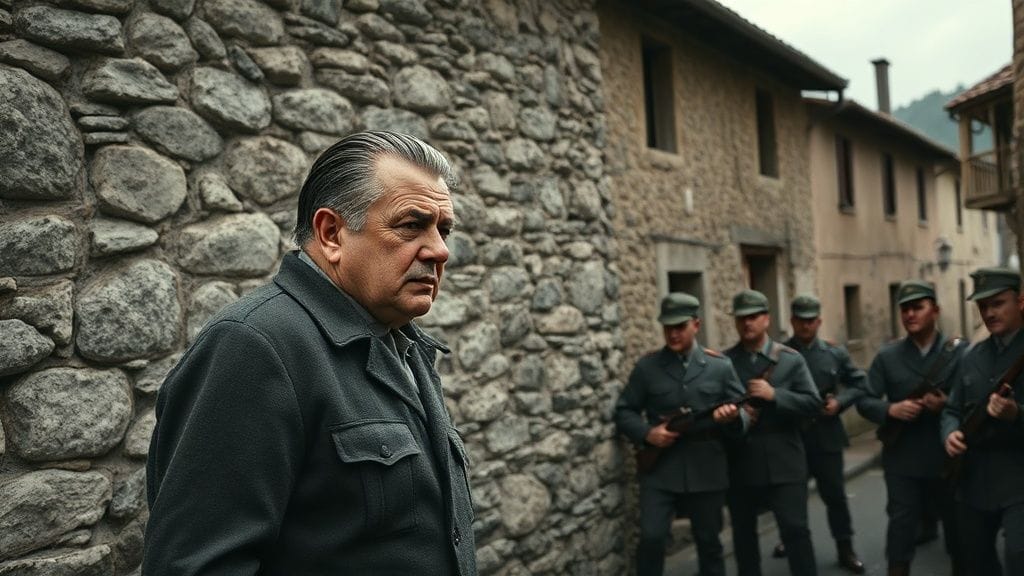
Mezzegra was chosen partly for its relative isolation. The exact sequence of events that followed has been recounted with variations, colored by memory, politics, and the need to justify or condemn. Yet certain core elements recur. The car stopped near the entrance gate of Villa Belmonte, a house surrounded by a low wall. Mussolini and Petacci were ordered out. The Duce, heavyset, now visibly aged and defeated, stepped onto the gravel. Petacci clung to him, reportedly begging to die by his side. According to Audisio’s version, he separated them briefly but, facing her desperate insistence, finally allowed her to stand next to Mussolini.
The partisans positioned the two prisoners against a stone wall by the roadside. It was an unceremonious setting for a man who had staged political life as spectacle. No specially built gallows, no public square filled with banners—only a dirty rural lane, a wall, a gate, a handful of armed men. Audisio read a brief statement declaring Mussolini condemned to death “in the name of the Italian people” for his crimes against the nation. Whether Mussolini replied is contested: some say he remained silent; others recall a muttered phrase, perhaps “aim at my chest,” a last vestige of the theatrical bravado he once cherished.
Then came the gunfire. Audisio, according to his own narrative, fired first, his automatic weapon jamming, then switching to another and completing the execution. Bullets struck Mussolini and Petacci, throwing them against the wall, then to the ground. The man who had ordered so many others shot or hanged now died in a burst of chaotic fire, his body crumpling on a spot that, until that moment, had no particular meaning in Italian history. With this act, benito mussolini executed became not merely an event but a future point of pilgrimage, controversy, and contested memory.
In the immediate aftermath, the partisans checked that Mussolini and Petacci were dead. Their bodies were loaded onto a truck, along with those of other fascist leaders executed nearby later that day. The scene was grim but efficient; there was no prolonged ceremony. The urgency was to take the corpses to Milan, the great northern city where fascism had been born as a mass movement and where its death, in the eyes of the resistance leadership, had to be proclaimed unmistakably. The road now led from Mezzegra to Piazzale Loreto, from the intimate violence of a roadside shooting to the public theater of retribution before thousands of eyes.
Bodies in Milan: The Grisly Spectacle at Piazzale Loreto
The truck carrying Mussolini, Petacci, and other executed fascist officials rumbled south toward Milan. In previous years, Mussolini had traveled to the city as a triumphant leader, greeted by orchestrated crowds and surrounded by layers of security. Now he returned as a corpse rolling in the back of a vehicle, his body jostled with others, the once carefully tended appearance ruined by blood and dust. For the partisans accompanying the convoy, there was a sense not only of duty fulfilled but of symbolic choreography: the site chosen for the display was not arbitrary.
Piazzale Loreto, a large square in Milan, had already seared itself into the city’s memory. In August 1944, fifteen partisans had been executed there by fascist and German forces, their bodies left on display for hours as a warning. The area became known among resistance circles as a place of martyrdom and shame. Returning to that same square with the bodies of those who had given the orders or embodied the regime that committed such atrocities was, for many, an act of deliberate reversal—a turning of the tables.
On 29 April 1945, Mussolini’s and Petacci’s corpses, along with those of other fascist leaders, were unloaded into the square. At first, they were dumped roughly on the ground. Crowds quickly gathered, drawn by rumors and the shocking sight of the dead dictator. People shouted, pushed forward, tried to get closer. Some recognized Mussolini’s face; others saw only a mutilated head, swollen and bruised. The atmosphere rapidly turned from stunned curiosity to furious catharsis.
People spat on the bodies, kicked them, hurled insults. Women who had lost husbands or sons in war or to fascist repression aimed particular venom at Mussolini and Petacci. There were attempts to shoot the corpses, to strike them with sticks. The situation risked spiraling into a riot. To control the crowd and to make the display more visible, the partisans and local authorities decided to hang the bodies upside down from the metal girders of a nearby petrol station canopy. Cables were slung around the ankles; the corpses dangled above the seething crowd.
This grisly tableau has become one of the most enduring images of the end of European fascism. The photograph of Mussolini, Petacci, and others hanging upside down—faces swollen, clothes disarrayed, surrounded by a mixture of exultant and horrified onlookers—circulated widely. It was, at once, a symbol of liberation and a disturbing spectacle of desecration. For some, it represented the just humiliation of a tyrant; for others, even among anti-fascists, it raised uncomfortable questions about how easily the oppressed could adopt the gestures of cruelty.
Yet from the viewpoint of many Milanese in that moment, the scene at Piazzale Loreto felt like an inversion of terror. It was there, in 1944, that fascists had displayed partisan dead as trophies. Now, the tyrant and his closest associates hung where their victims had once lain. Mussolini’s body, drained of speech and power, became a mute canvas on which a battered population projected years of fear, hunger, and rage. The reality of benito mussolini executed by partisans, though decided in relative privacy at Mezzegra, was concluded here, in a square where the public was invited to look and to remember.
Law, Revenge, or Necessity? The Controversy over the Execution
Almost immediately, the manner of Mussolini’s death and the treatment of his corpse provoked debate, both within Italy and abroad. Supporters of the resistance argued that no other outcome was possible. For them, Mussolini was not merely a defeated political leader but the architect of a dictatorship, responsible for war, repression, and the delivery of Italy into Nazi hands. In their eyes, executing him swiftly was a form of revolutionary justice, preventing any possibility of escape, rescue, or political manipulation of his trial.
Critics, including some anti-fascists and foreign observers, lamented the lack of due process. They argued that a public trial, similar to the one later held for Nazi leaders at Nuremberg, would have exposed the full extent of fascist crimes to the world and allowed Italians to confront their complicity and resistance more openly. By shooting Mussolini and mutilating his body in Piazzale Loreto, they contended, the resistance risked turning him into a martyr for future extremists, a figure who could be romanticized as a victim of vengeance rather than condemned by a thorough judicial record.
The legal status of the execution was ambiguous. The CLNAI presented itself as the legitimate authority in northern Italy during the power vacuum at the war’s end, acting in the name of the Italian people. In that capacity, it claimed the right to pass and carry out sentences against major war criminals. Yet seen from the perspective of classic constitutional law, this was a revolutionary act, outside the established legal framework. Historians such as Mimmo Franzinelli and others have noted that the resistance’s notion of “justice” was inseparable from the broader context of civil war and occupation, where formal institutions had disintegrated.
The controversy also intersected with Cold War politics. As tensions grew between the Western Allies and the Soviet Union, the role of the Italian Communist Party in the resistance and in decisions like Mussolini’s execution became a subject of suspicion and propaganda. Some suggested, with little concrete evidence, that Soviet agents had pushed for the immediate killing to prevent Mussolini from revealing compromising contacts with the Western Allies. Others claimed that the murder was meant to erase traces of financial dealings or secret files. These theories, while often speculative, show how the simple fact of benito mussolini executed resonated in a geopolitical context where narratives were weapons.
Despite these debates, no realistic movement ever emerged in postwar Italy to overturn the moral verdict that Mussolini had to be held accountable for his crimes. The argument centered more on methods than on guilt. The enduring discomfort stems from a deeper tension inherent in periods of transition: how to balance the demands of justice, the thirst for revenge, and the fragile requirements of building a peaceful future. The wall at Mezzegra and the petrol station in Piazzale Loreto became, in this sense, more than physical locations—they were embodiments of an unresolved ethical argument.
Echoes in Italian Memory: Silence, Division, and Commemoration
In the decades that followed 1945, Italians lived with the memory of Mussolini’s end in complex, often contradictory ways. On the surface, the new Republic, founded in 1946 after a referendum abolished the monarchy, embraced anti-fascism as a core part of its identity. Schoolbooks condemned the regime; official ceremonies honored the resistance. Sites like Piazzale Loreto and the Ardeatine Caves became places of state-sponsored remembrance. Yet beneath these rituals, individual and familial memories often diverged from the official narrative.
In many villages, people remembered specific fascists not only as oppressors but as neighbors, relatives, or figures who had, at times, brought order or employment. Some families bore the stigma of having had members executed or humiliated as collaborators. Others quietly cherished the memory of Mussolini, separating their admiration for his early achievements—or what they perceived as such—from condemnation of later crimes. The bodies hanging upside down in Milan’s square haunted not just the relatives of the dead but anyone who wondered how close they themselves might have come to that fate if events had turned differently.
For survivors of fascist prisons and concentration camps, however, the image of benito mussolini executed remained a sort of grim consolation. They had endured torture, deportation, or years of internal exile. To see their tormentor die at the hands of those he had tried to annihilate confirmed a moral order they desperately needed to believe in. Yet their voices did not always dominate the public sphere, especially as postwar politics required compromises with conservative and even ex-fascist elements to stabilize the country and integrate it into the Western bloc.
Over time, commemorations at Mezzegra and Dongo took on a ritualized form. Plaques were placed; ceremonies were held on anniversaries. Historians, journalists, and curious tourists visited the sites. The stone wall where Mussolini and Petacci had been shot became both a shrine for anti-fascists and, uncomfortably, an occasional pilgrimage point for neo-fascists, who would leave flowers in defiance of the mainstream narrative. The government often tried to manage these tensions quietly, discouraging overt glorification of the Duce while maintaining the right to free expression.
Italian cinema and literature also played a role in shaping memory. Films by directors such as Roberto Rossellini and later works by others explored the resistance, the war, and the end of fascism. Some portrayed Mussolini as a grotesque figure, others as a tragic, almost pathetic character. This ambivalence reflected a society where, as one scholar put it, “everyone had been, or claimed to have been, anti-fascist,” yet many had accommodated or even cheered the regime in earlier years. The simplicity of the formula—benito mussolini executed, fascism dead—clashed with the more complicated reality of a nation negotiating with its past.
The Fate of Fascism After the Duce: Trials, Amnesties, and Neo-Fascists
While Mussolini’s life ended abruptly at Mezzegra, fascism as a political and cultural force did not vanish overnight. In the immediate postwar years, Italy conducted a series of “epurazione” (purge) processes and trials targeting collaborators, RSI officials, and those involved in war crimes. Special courts were established; some sentences were severe. Yet as the Cold War intensified, priorities shifted. Fear of Communist influence prompted many centrist and conservative politicians to favor national reconciliation over extensive retribution.
An amnesty issued in 1946 by Justice Minister Palmiro Togliatti—himself the leader of the Communist Party—ironically facilitated the reintegration of many former fascists into public life. Intended as a gesture of national healing, the amnesty reduced or canceled sentences for a wide range of political crimes committed during the fascist era and the civil war. As a result, individuals who had served the regime at various levels found ways back into administration, business, and even politics. This complicated the notion that the execution of Mussolini had decisively closed the fascist chapter.
At the same time, a new political force emerged: the Italian Social Movement (Movimento Sociale Italiano, MSI), founded in 1946 by former fascists. Though it accepted the framework of parliamentary democracy, it kept alive the memory and some symbols of the past. For its militants, Mussolini often appeared not as a criminal but as a misunderstood or betrayed leader. The fact of benito mussolini executed by partisans, in their retelling, became a story of heroism spurned, of a chief abandoned by cowardly elites and murdered without trial. This counter-memory thrived on the unresolved aspects of the postwar settlement.
Italian democracy nonetheless consolidated itself, anchored by the Christian Democrats and supported by the United States within the NATO framework. The constitution, adopted in 1948, contained strong anti-fascist provisions. Yet tensions persisted, especially around freedom of expression and the open display of fascist symbols. Court cases over the decades debated whether praising Mussolini constituted a crime or a protected opinion. Meanwhile, far-right terrorism in the 1960s and 1970s—what some call the “strategy of tension”—fueled suspicions that certain state elements remained lenient toward neo-fascist violence.
Through all this, the execution at Mezzegra remained both a historical anchor and a lightning rod. For anti-fascists, it was the necessary beheading of a poisonous movement. For fascist nostalgists, it was a foundational trauma and a rallying myth. In between stood the majority of Italians, who navigated daily life, elections, and economic changes with varying degrees of engagement with this abrasive past. The Duce was dead, but the arguments about him—and about what his death meant—were very much alive.
Representing the End: Films, Photographs, and the Power of Images
The visual record of Mussolini’s last days has played a major role in shaping global perceptions of his downfall. The photographs of Piazzale Loreto, in particular, became iconic. Published in newspapers and magazines around the world, they offered a stark message: dictators can end not in palaces or heroic last stands, but hanging upside down, surrounded by the people they once claimed to protect. These images haunted contemporaries and continue to surface in history books, documentaries, and exhibitions.
Italian neorealist cinema, emerging in the immediate postwar period, addressed the broader context of occupation and resistance. Roberto Rossellini’s “Roma Città Aperta” (Rome, Open City, 1945) and “Paisà” (1946) portrayed the struggles of ordinary Italians under Nazi-fascist oppression. While not focusing directly on Mussolini’s death, such films communicated the emotional climate that made benito mussolini executed at the hands of partisans comprehensible, even cathartic, to domestic audiences. Later films and television series tackled the Duce more explicitly, sometimes humanizing him, sometimes caricaturing him, often reflecting contemporary political debates about fascism’s legacy.
Postwar literature and memoirs, by partisans, RSI veterans, and civilians, added layers of nuance. Some partisans described the execution in stark, matter-of-fact terms, viewing it as an unpleasant but necessary act. Others, writing decades later, expressed doubt or discomfort, acknowledging the thin line between justice and vengeance in the heat of conflict. RSI sympathizers wrote bitterly of betrayal, defeat, and humiliation, occasionally echoing the pathos of a fallen leader who, in their narrative, had tried to save Italy from chaos.
Internationally, Mussolini’s end entered the broader repertoire of stories about the collapse of dictatorships. In comparison with Hitler’s suicide in his Berlin bunker or the later televised trials of Eastern European leaders, the Italian case seemed almost medieval in its brutality—no courtroom, no suicide, but an execution by irregular forces and a public display of the body. Scholars of political violence have since examined these images as forms of symbolic communication: they demonstrate the reversal of power, deterrence, and the satisfaction of communal anger, but also risk normalizing extreme violence.
Today, the places associated with Mussolini’s last hours are sometimes visited by tourists guided by books or documentaries. At Mezzegra, plaques and modest markers attempt to contextualize the site, to explain how and why the Duce died there. At Piazza Loreto (now Piazza Loreto, with some urban transformations), subtle commemorations coexist with the daily traffic of a modern metropolis. The fact that shoppers can stroll past the area where the bodies once hung is a reminder of history’s strange layering: atrocities and reckonings leave traces, but life goes on, and memory must be actively cultivated if it is not to fade.
Mussolini’s Death in the Shadow of Nuremberg
The execution of Mussolini preceded the famous Nuremberg Trials, which began in November 1945 and tried leading Nazi officials for war crimes, crimes against peace, and crimes against humanity. In retrospect, some observers have asked whether a similar international tribunal for fascist leaders in Italy might have served justice better than summary executions. Yet, at the time, the concept of international criminal law was in its infancy, and the immediate context of Italian liberation was chaotic.
At Nuremberg, the Allies sought to establish a legal precedent that would show the world that even statesmen and generals could be held personally accountable for atrocities. The trials were meticulously documented, with extensive evidence, witness testimony, and defense arguments. In contrast, benito mussolini executed at Mezzegra left no comparable judicial archive. The judgment was political and moral, carried out by a movement that, while representing a significant portion of the Italian population, did not embody the procedural traditions of an established court.
Some legal scholars argue that the absence of a trial for Mussolini deprived Italy of an opportunity to publicly expose not only the dictator’s guilt but also the wider networks of complicity—industrialists, bureaucrats, military officers, and even segments of the population that had benefited from or supported fascism. A trial, they contend, could have forced a more thorough reckoning, making it harder for postwar elites with ambiguous pasts to blend seamlessly into the new democratic order.
On the other hand, others note that the Nuremberg Trials themselves faced criticism as “victors’ justice,” irregular in terms of retroactive law and selective in scope. In this view, the moral clarity that many Italians felt when they heard of benito mussolini executed by partisans—a man killed by those he had tried to crush—has a power that an extended legal process might have diluted amid procedural arguments and the theatrics of self-justifying speeches.
Moreover, the geopolitical landscape of 1945 did not favor broad, unified approaches to justice. The different Allied powers had divergent priorities in Italy. Britain and the United States were wary of empowering the Communist Party too much; the Soviet Union sought to highlight fascist crimes while also maneuvering for influence. Within this complex chessboard, the swift elimination of Mussolini removed a volatile piece whose presence on trial could have complicated already delicate negotiations.
Historians, Myths, and the Search for the ‘Real’ Last Days
Over the years, the circumstances of Mussolini’s capture and execution have attracted a web of myths, conspiracy theories, and revisionist claims. Some revolve around the identity of the actual shooter. While Walter Audisio’s official account, embraced by much of the postwar Communist narrative, presents him as the central executioner, other partisans and later writers have suggested that different individuals fired the fatal shots or that Audisio embellished his role for political reasons. Competing testimonies, sometimes clouded by age or personal agendas, have made definitive reconstruction difficult.
Another cluster of myths centers on the supposed “missing documents” Mussolini carried with him, sometimes called the “Dongo papers.” These were rumored to include letters from Churchill or other Allied leaders, proposals for separate peace, or compromising evidence about foreign support for fascism. According to some narratives, partisans or others seized and suppressed these documents to protect certain reputations. Serious academic work, such as that found in the journals of modern European history, has largely debunked the more extravagant claims, but the allure of hidden archives persists in popular imagination.
Historians like Renzo De Felice, in his multi-volume biography of Mussolini, and other scholars have painstakingly sifted through available sources—partisan reports, Allied intelligence files, diaries, interviews with survivors—to piece together as accurate an account as possible. Their work shows that while some details will remain forever uncertain, the broad outline is firm: Mussolini attempted to flee with German forces, was captured at Dongo, and was executed near Mezzegra on 28 April by partisans following orders from the CLNAI. The fundamental fact of benito mussolini executed is not in doubt; what remains contested are motives, minor events, and the subsequent narration.
These historiographical debates are not purely antiquarian. They often reflect contemporary political stakes. In times when far-right movements gain strength, attempts to relativize Mussolini’s crimes or to portray his death as purely a Communist vendetta gain more public visibility. Conversely, moments of renewed anti-fascist mobilization, such as protests against racist violence or authoritarian rhetoric, bring the memory of Mussolini’s fall back into sharper focus, highlighting the dangers of forgetting or trivializing dictatorship.
The continuing production of books, documentaries, and academic articles on Mussolini’s last days indicates that the subject holds enduring fascination. It is a story that combines high politics with human drama, ideological conflict with the raw unpredictability of war. It also offers a cautionary tale about how quickly democracies can unravel and how difficult it is, once violence has been normalized, to return to peaceful, lawful conflict resolution.
Legacies of Violence: What Mussolini’s Execution Tells Us About Civil Wars
The execution at Mezzegra is more than an Italian episode; it is a case study in how civil wars end and how societies attempt to reckon with internal enemies. In conflicts where neighbors kill neighbors and legitimacy is deeply contested, the end rarely arrives with a clean, ceremonious handshake. Instead, as in Italy in 1945, it often involves improvised justice, acts of vengeance, and subsequent debates about what should have been done differently.
In such contexts, the line between criminal and combatant can blur. Mussolini was both a head of state and a leader of a faction in a civil war. His followers saw themselves as defending a vision of Italy against internal traitors and foreign invaders; his enemies saw him as a tyrant serving a foreign occupier. When the balance of power shifted, so did the capacity to define who was legitimate. The fact that benito mussolini executed by partisans was later widely accepted, even by many who regretted the lack of a trial, illustrates how moral judgments in civil wars often follow the victors’ narratives while still leaving spaces of dissent and nostalgia.
The Mezzegra moment also shows how violence can be both an end and a beginning. The bullets that killed Mussolini and Petacci ended their personal stories and symbolically beheaded the fascist regime. But they did not automatically resolve the underlying fractures in Italian society. The subsequent need for amnesties, the persistence of extremist nostalgia, and the periodic flare-ups of political violence suggest that, while killing a dictator can close one chapter, it does not write the next. That task requires institutions, education, public conversation, and time.
Comparative studies of transitional justice, from South Africa’s Truth and Reconciliation Commission to the trials in Latin American countries after military dictatorships, have underscored the importance of both accountability and narrative. Italy’s path, with its mixture of summary executions, limited trials, amnesties, and a strong but sometimes rhetorical anti-fascist identity, offers another model—imperfect, revealing, and instructive. It invites reflection on whether a society can fully democratize without exhaustive legal reckonings, or whether, as some argue, too much judicialization risks freezing politics instead of transforming it.
Ultimately, the image of Mussolini on that roadside in Mezzegra, cornered and powerless, speaks to a recurring pattern in modern history: dictators who rise by harnessing fear and violence often fall through the same instruments. The choices made by those who confront them—whether to execute, try, exile, or reconcile—have long shadows. In Italy’s case, those shadows still stretch from 1945 into the present.
From Mezzegra to Modern Italy: Democracy Built on a Corpse of Dictatorship
Today’s Italy, a democratic republic embedded in the European Union, traces some of its founding myths directly to the resistance and the downfall of fascism. The constitution, with its strong protections for civil liberties and explicit rejection of totalitarianism, was drafted by people for whom the memory of Mussolini’s rule and its violent end was fresh. Streets and squares across the country bear names of partisans, 25 April is celebrated as Liberation Day, and official speeches annually evoke the struggles that culminated in those decisive spring days of 1945.
Yet the relationship between the democratic present and the fascist past remains ambivalent. Political parties on the right have at times flirted with, or struggled to distance themselves from, the symbols and rhetoric of Mussolini’s era. Debates flare up when monuments from the fascist period are reassessed, when politicians praise Mussolini’s alleged “efficiency,” or when extremist groups stage commemorations. For many Italians, the question of how to remember benito mussolini executed and what it signifies for national identity is not simply academic—it is intertwined with current struggles over migration, nationalism, and the boundaries of acceptable political discourse.
In schools, textbooks commonly depict Mussolini’s life as a cautionary tale: how charismatic leadership, propaganda, and the exploitation of fear can erode democratic institutions, and how hard it is to rebuild them once trust is lost. Teachers may show images of Piazzale Loreto, not to revel in violence, but to demonstrate the intensity of the historical rupture and to underline that collective fury, even when understandable, can take forms that raise ethical questions. The challenge is to foster an anti-fascist culture that is not based solely on demonizing a single man but on understanding the conditions that allowed him to rise.
Local communities near Lake Como and in Lombardy continue to negotiate their relationship to the sites of Mussolini’s last days. There are museums, plaques, guided tours, and sometimes protests by those who feel these places are either glorified or neglected. Scholarship, commemorative practices, and activism intersect in this landscape. The story of benito mussolini executed by partisans remains a living subject of dialogue, as new generations inherit a past they did not experience but that shapes the world they inhabit.
Ultimately, modern Italy stands as a testament to the possibility of constructing a functioning democracy after dictatorship and civil war, but also as a reminder of the fragility of that achievement. The stones of Mezzegra’s wall and the asphalt of Piazzale Loreto have witnessed both the darkest aspects of human behavior and the fierce yearning for freedom. Whether these lessons endure depends on continuous, honest engagement with history, not on the comforting illusion that a single execution, however dramatic, could erase the roots of authoritarianism once and for all.
Conclusion
On 28 April 1945, along a quiet road near Mezzegra, Italy, the story of Benito Mussolini reached its violent conclusion. The man who had promised national rebirth, built a cult of personality, and dragged Italy into catastrophic wars faced a firing squad of young partisans, representatives of the very people he had sought to subdue. His execution and the subsequent public display of his body in Milan’s Piazzale Loreto became enduring symbols: for some, the necessary and just end of a tyrant; for others, a troubling mirror of the brutality he had normalized.
To follow the path that led to that wall—from post–World War I turmoil, through the rise of fascism, the alliance with Hitler, the occupation, and the bitter Italian civil war—is to see how societies can slide into dictatorship and how they struggle, unevenly, to emerge from it. The decision by partisans and the CLNAI to see benito mussolini executed without trial reflected wartime urgency, ideological convictions, and raw memories of fascist terror. It also generated long-lasting debates about law, revenge, and the ethics of transitional justice, debates deepened by later examples such as the Nuremberg Trials.
In the decades since, historians have sifted through testimony and documents, dismantling myths while acknowledging that some uncertainties will persist. Their work, along with films, literature, and public commemorations, has ensured that the final days of Mussolini remain part of a broader conversation about memory, responsibility, and democracy. Modern Italy, for all its contradictions, stands as a democratic republic born in part from that moment when the Duce’s body fell to the ground in Mezzegra and later swung upside down in Milan.
The story of benito mussolini executed by partisans thus resonates far beyond Italy’s borders. It offers a stark reminder that dictatorships often end not with neat resolutions but with messy, contested acts of violence. It challenges us to consider how we would react when faced with similar choices and to recognize that the struggle against authoritarianism does not end with the fall of a single leader. It continues in the institutions we build, the histories we tell, and the vigilance we maintain against the seductions of power and fear.
FAQs
- Why was Benito Mussolini executed without a formal trial?
The partisan leadership in northern Italy believed that a swift execution was necessary to prevent rescue attempts, avoid political manipulation of a trial, and assert the authority of the resistance at a moment when state institutions had collapsed. They saw Mussolini as responsible for dictatorship, war, and collaboration with Nazi Germany, and judged that revolutionary justice required immediate action rather than a prolonged legal process. - Who actually carried out the execution at Mezzegra?
The most widely accepted account credits Walter Audisio, a Communist partisan using the alias “Colonel Valerio,” with carrying out the shooting on 28 April 1945, assisted by other partisans. Some later testimonies and interpretations contest details or suggest that others may have fired as well, but historians generally agree that a small partisan group under orders from the CLNAI conducted the execution. - Why were Mussolini’s and Clara Petacci’s bodies hung upside down in Milan?
The bodies were displayed in Piazzale Loreto, a square where partisans had been executed the previous year, as a symbolic reversal of fascist terror and a warning that the regime was definitively over. Hanging them upside down from a petrol station canopy both controlled the crowd, which was trying to attack the corpses, and created a powerful, if disturbing, public spectacle of retribution. - What happened to other fascist leaders captured with Mussolini?
Several high-ranking RSI officials seized near Dongo were executed by partisans on 28 April 1945, and their bodies were also taken to Piazzale Loreto. Others were later tried in postwar courts, receiving sentences that were sometimes severe but also frequently reduced by amnesties and changing political priorities in the early years of the Republic. - Did Mussolini carry secret documents when he was captured?
Rumors have long circulated that Mussolini had with him a cache of sensitive documents, sometimes called the “Dongo papers,” including alleged correspondence with Allied leaders. While some documents were indeed recovered, most historians find no solid evidence that they contained explosive revelations capable of reshaping our understanding of the war, and many conspiracy theories about them remain speculative. - How is Mussolini’s execution remembered in Italy today?
Officially, the event is framed as part of the liberation from fascism and is tied to broader commemorations of the resistance and the birth of the Republic. At the same time, memory remains contested: anti-fascists view it as necessary justice, while small neo-fascist groups sometimes portray Mussolini as a martyr. Public debate continues over how best to teach and commemorate this chapter of history. - Did Mussolini’s death end fascism in Italy?
His death decisively ended the fascist regime he led, but fascist ideas and symbols did not disappear completely. Former fascists formed new parties such as the MSI, and certain authoritarian and nationalist currents persisted. However, the postwar Italian Republic, its constitution, and its political culture were fundamentally shaped by anti-fascist principles that continue to act as a barrier against a full-scale return to such a regime.