Table of Contents
- Dawn over Kamchatka: The Silent Giant Awakens
- The Land of Fire and Ice: Setting the Scene
- An Ancient Volcano’s Fury: Bezymianny’s Past Eruptions
- Early Warnings: Small Tremors and Signs in Early 1956
- The Crisis Unfolds: March 30, 1956
- The Cataclysmic Blast: Witnessing the Bezymianny Paroxysm
- The Pyroclastic Flow: Death and Destruction at the Foot of the Mountain
- Ash and Darkness: The Aftermath Over Kamchatka's Skies
- Scientific Eyes on the Crisis: Soviet Observatories Mobilize
- Survival and Stories: Eyewitnesses Tell Their Tales
- The Role of Geophysics and Volcanology During the Soviet Era
- The Environmental Impact: Shaping Kamchatka’s Landscape
- Global Reverberations: What Bezymianny Meant for Volcanology
- The Unseen Toll: Human Cost and Displacement
- Lessons Engraved in Rock: The Legacy of the 1956 Eruption
- Bezymianny’s Resurgence in the 21st Century: A Volcano Forever Watching
- Conclusion: The Indomitable Power of Nature and Memory
- FAQs: Unveiling the Mysteries of Bezymianny
- External Resource
- Internal Link
1. Dawn over Kamchatka: The Silent Giant Awakens
It was an early spring morning in late March 1956, when a searing rumble shattered the fragile silence that blankets the remote Kamchatka Peninsula. In the pale light of dawn, the sky above the jagged spine of Russia's Far East flickered ominously. The great Bezymianny Volcano, long regarded as dormant and unassuming, suddenly roared back to life with an intensity that was both awe-inspiring and terrifying. A colossal explosion tore through the stillness, releasing a cloud of ash so vast it blotted out the sun, turning day into a suffocating twilight. The earth beneath trembled violently, and molten rock surged in rivers of fire down the steep flanks.
For the communities nestled in the shadow of this sleeping giant, life was forever altered in the course of a single terrifying moment. This eruption marked one of the most dramatic volcanic events of the 20th century, re-shaping not only the physical landscape but also the scientific understanding of volcanic explosions. But to truly grasp the magnitude of the Bezymianny eruption, we must first journey back into the fire-hardened ground of Kamchatka, a land both wild and ancient.
2. The Land of Fire and Ice: Setting the Scene
Kamchatka, a peninsula jutting into the North Pacific, is a realm of extremes. Its volcanic peaks—over 160 active volcanoes—tower above rugged tundra, steaming geysers, glacier-carved valleys, and dense boreal forests. The region’s very name evokes mystery and myth for those who live far beyond its frozen shores. The indigenous Koryak and Itelmen peoples have for millennia woven tales of fiery mountains, yet even for Soviet scientists in the mid-20th century, Kamchatka was still a frontier at the edge of the known world.
Among these giants of stone and fire stood Bezymianny—unremarkable at first glance, and whose name, ironically, means “nameless” or “unsignificant.” Before 1956, Bezymianny’s eruptions were largely peaceful, with modest lava flows and fumarolic activity. Its placid demeanor hid a potential for violent transformation that would send shockwaves through the volcanic community and the geopolitical landscape of the Cold War era.
3. An Ancient Volcano’s Fury: Bezymianny’s Past Eruptions
Though Bezymianny had been relatively quiescent, it was no stranger to volcanic awakenings. Geological evidence suggested prior eruptions, but none had matched the scale or violence that would soon rupture its slopes. The volcano’s structure hinted at a classic stratovolcano makeup—layers of hardened lava, pumice, and ash, built over thousands of years. Subglacial and subaqueous influences carved much of the Kamchatkan environment, tempering eruptions with icy interactions that complicated prediction efforts.
Notably, Bezymianny had undergone a catastrophic collapse approximately a millennium before 1956, which left behind a horseshoe-shaped crater similar to the infamous Mount St. Helens in 1980—a harbinger of the kind of explosive power stored beneath its rocky facade.
4. Early Warnings: Small Tremors and Signs in Early 1956
As winter resigned to spring, seismic instruments in the sparsely staffed Kamchatka observatories began to record a subtle but persistent vibration beneath Bezymianny. These deep rumblings, often too faint or scattered to cause alarm, marked the restless stirring of magma seeking an escape. Across the frozen landscape, isolated scientific teams monitored these changes with a mixture of eagerness and dread, aware that volcanoes often broadcast their intentions in whispers before roaring into fury.
Local herders and hunters, attuned to the subtle cues of their environment, reported an increase in earthquake tremors and unusual steam plumes venting from the summit. Yet, communication delays and the remote nature of the region slowed any coordinated response.
5. The Crisis Unfolds: March 30, 1956
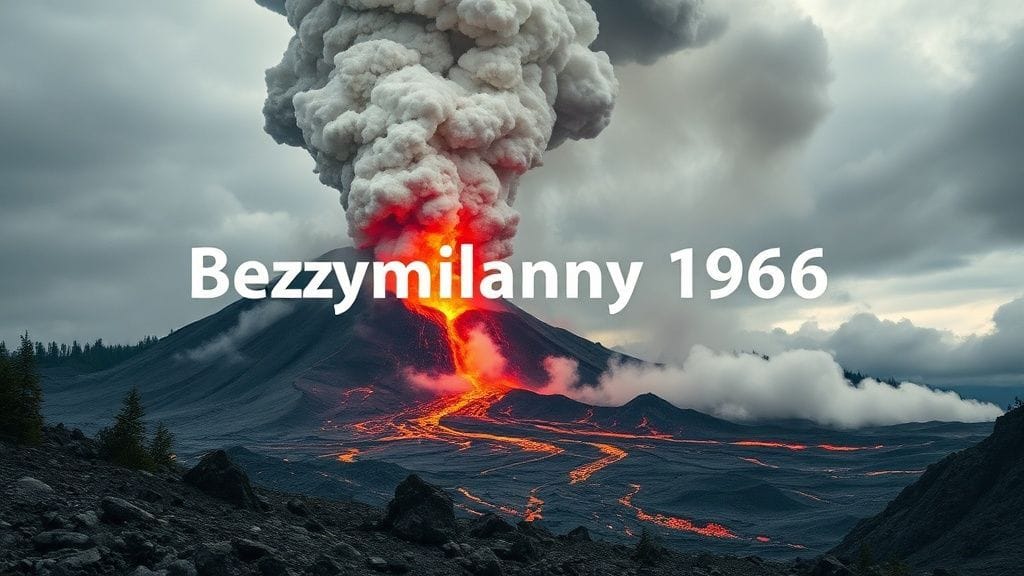
In the final hours before catastrophe, a series of increasingly strong earthquakes accelerated the onset of eruption. On the cold morning of March 30, 1956, a massive explosive event rocked Bezymianny. The volcano’s summit dome, a brittle and unstable mass of viscous lava, fractured spectacularly. In moments, the built-up pressure unleashed a colossal lateral blast, ripping through the northwestern flank with seismic violence.
The massive explosion generated a plume of gas, ash, and pyroclastic material reaching tens of kilometers into the stratosphere. Volcanic bombs and rock debris streamed down the mountainside at unimaginable speeds, destroying ecosystems and obliterating everything in their path.
6. The Cataclysmic Blast: Witnessing the Bezymianny Paroxysm
Eyewitnesses were few, and even those far from the volcano were struck by the enormity of the blast. A Soviet pilot flying over Kamchatka described how “the sky seemed to rupture with fire, and an endless cloud of ash swallowed the horizon.” For the indigenous communities and scattered settlements beneath Bezymianny, survival depended on split-second decisions.
Unlike the symmetrical vertical plume typical in many eruptions, Bezymianny’s lateral blast sent pyroclastic flows hurtling sideways—an unexpected and far deadlier consequence. This directional blast scoured the landscape, laying waste to a vast swath of forest and terrain in mere minutes.
7. The Pyroclastic Flow: Death and Destruction at the Foot of the Mountain
Pyroclastic flows—blazing avalanches of gas, ash, and volcanic rock—are among the deadliest volcanic phenomena. In the case of Bezymianny, these flows raced at speeds exceeding 150 kilometers per hour, incinerating life and flattening trees, leaving behind a skeletonized wasteland. The intense heat, over 800°C, annihilated nearly every organic remnant.
Such destruction was compounded by lahar flows—melted ice and ash mixing into torrents racing down river valleys—which threatened distant villages with flooding and burial under volcanic sediment.
8. Ash and Darkness: The Aftermath Over Kamchatka's Skies
In the hours and days that followed, ash clouds blotted out the sun across Kamchatka, coating roofs, fields, and rivers in gray powder. The skies turned a haunting shade of orange and grey, and breathable air became scarce. Farmers who relied on fishing and reindeer herding found their livelihoods disrupted as landscapes shifted beneath layers of ash.
On a global scale, Bezymianny’s eruption briefly influenced weather patterns, injecting aerosols into the upper atmosphere and reminding the world of the subtle but profound influence volcanic activity can wield upon climate.
9. Scientific Eyes on the Crisis: Soviet Observatories Mobilize
Despite the remoteness of Kamchatka, the Soviet scientific establishment swiftly mobilized. Dedicated volcanologists and geophysicists from the USSR Academy of Sciences braved the harsh conditions to survey Bezymianny’s transformation. Their detailed studies advanced understanding of dome-forming eruptions, lateral blasts, and collapse events—the phenomenon that would become a focus of volcanology worldwide.
The eruption attracted international interest despite Cold War tensions, with researchers translating and exchanging data that would shape the field for decades.
10. Survival and Stories: Eyewitnesses Tell Their Tales
Local residents who survived the catastrophe offered poignant accounts of near misses and harrowing escapes. Tales of children pulled from ash-laden forests, of hunters caught in sudden darkness, of communities rallying to rebuild were passed orally and later recorded.
One elder described how “the mountain screamed like thunder, and the earth shook like it was alive… we watched as the sky burned and ran to find shelter.” These human stories provide a powerful counterpoint to the cold scientific data, reminding us that history is lived through experience and memory.
11. The Role of Geophysics and Volcanology During the Soviet Era
The Bezymianny eruption occurred during a zenith of Soviet scientific ambition. The USSR prided itself on conquering nature through study and technology, and volcanology was no exception. The eruption galvanized efforts to develop early warning systems, seismic monitoring networks, and remote sensing.
Research from Kamchatka helped refine models of volcanic hazards, influencing not only domestic civil defense but contributing globally to volcanic hazard mitigation strategies.
12. The Environmental Impact: Shaping Kamchatka’s Landscape
The eruption permanently altered the geology of Kamchatka’s eastern flank. The massive sector collapse left a spectacular horseshoe-shaped crater, or amphitheater, into which fresh lava domes formed in subsequent years. Vegetation was incinerated, but over decades, pioneering plants recolonized the ashen soils, turning the wasteland gradually back to fragile life.
The Bezymianny eruption thus joined nature’s cycle of destruction and renewal, where volcanic fury sows the seeds of future ecosystems.
13. Global Reverberations: What Bezymianny Meant for Volcanology
Bezymianny became a benchmark eruption in the study of explosive volcanism. It provided the first well-documented example of a large-scale lateral blast, a form of eruption previously unappreciated. This new knowledge transformed hazard assessments worldwide, contributing directly to studies of later catastrophes such as Mount St. Helens in 1980.
Volcanologists learned that eruption styles can be unexpectedly complex and destructive, with topography and dome instability playing critical roles.
14. The Unseen Toll: Human Cost and Displacement
While Kamchatka was sparsely populated, the human cost was nonetheless severe—families lost homes, livelihoods, and even lives. Soviet authorities undertook evacuation measures, but the sparse infrastructure limited their reach. Many indigenous communities faced the challenge of rebuilding in a harshly altered environment.
These disruptions echoed through generations, as survivors and descendants grappled with trauma and adaptation in the shadow of Bezymianny.
15. Lessons Engraved in Rock: The Legacy of the 1956 Eruption
Beyond the immediate devastation, Bezymianny’s 1956 eruption instilled hard lessons in geological vigilance and respect for nature’s unpredictability. It compelled the Soviet scientific community to refine monitoring techniques and emergency preparedness, paving the way for modern volcanic hazard assessment.
Furthermore, the eruption inspired a deeper appreciation for Kamchatka’s fragile yet magnificent environment—an interplay of fire, ice, and life that continues to captivate.
16. Bezymianny’s Resurgence in the 21st Century: A Volcano Forever Watching
Bezymianny has remained active, with eruptions recorded sporadically in recent decades. Lava dome growth, ash emissions, and minor explosive events remind observers that this nameless giant is far from dormant. Modern satellite monitoring and international cooperation have transformed how scientists study and predict its behavior.
Today, Bezymianny stands as both a warning and a wonder—a sentinel witness to Earth’s restless inner workings.
Conclusion
The eruption of Bezymianny in March 1956 was more than a geological event; it was a vivid testament to our planet’s majestic and terrible power. In a sweep of fiery destruction, it reshaped the physical world and human narratives that tie people to their land. Beyond the charred forests and ash-choked skies lie stories of resilience, curiosity, and the enduring human quest to understand nature’s profound mysteries.
This singular eruption sits at the confluence of science, history, and memory—a reminder that even the quietest giants may suddenly awaken, challenging us to adapt and learn with humility. Kamchatka’s "nameless" volcano earned a place in both geological annals and the hearts of those who witnessed its awesome display, forever engraving in stone the untamable spirit of fire.
FAQs
Q1: What caused the sudden violent eruption of Bezymianny in 1956?
A1: The eruption was triggered by magma rising beneath the volcano, leading to pressure build-up. A critical factor was the collapse of the unstable lava dome, which caused a lateral blast, releasing energy explosively.
Q2: How significant was the Bezymianny eruption compared to other 20th-century eruptions?
A2: While not as globally famous as Mt. St. Helens (1980) or Krakatoa (1883), Bezymianny's eruption was one of the largest explosive eruptions in the 20th century, notable for pioneering the understanding of lateral blasts.
Q3: Were there any fatalities caused by the eruption?
A3: Due to the remote location and sparse population, fatalities were limited but did occur, particularly among indigenous communities and locals close to the volcano who were unable to evacuate in time.
Q4: How did the Soviet scientific community respond to the eruption?
A4: Soviet volcanologists quickly conducted detailed studies, refined seismic monitoring, and improved early warning systems, which laid groundwork for modern volcanology in Russia and worldwide.
Q5: What impact did the eruption have on the environment?
A5: The eruption caused severe deforestation, ash fallout, and reshaped the topography. Over the years, ecosystems have slowly regenerated, illustrating nature’s resilience.
Q6: Has Bezymianny erupted since 1956?
A6: Yes. The volcano has been intermittently active, with dome-building eruptions and ash emissions continuing into the 21st century, monitored closely via satellite and modern instrumentation.
Q7: Why is Bezymianny less well-known internationally compared to other volcanoes?
A7: Its remote location in Siberia and geopolitical isolation during the Cold War limited international media coverage and scientific exchange at the time, though its importance is well-recognized among volcanologists.
Q8: How did the eruption influence future volcanic hazard assessments globally?
A8: Bezymianny’s lateral blast phenomenon expanded understanding of eruption dynamics, leading to improved hazard models and evacuation protocols worldwide.

