Table of Contents
- A Child Is Born Above a City of Ruins: Antioch in 495
- Antioch Between Earthquake and Empire: The World That Shaped Simeon
- Parents, Portents, and Prayers: The Family Origins of Simeon Stylites the Younger
- A Childhood Among Ruined Walls and Resounding Hymns
- The Lure of the Pillar: Hearing of the First Stylites
- Fleeing the City: Simeon’s First Steps into the Wilderness
- Novice of the Heights: Formation in the Monastic World
- Climbing Toward Heaven: The First Pillar of Simeon Stylites the Younger
- Daily Life on a Disc of Stone: Prayer, Pain, and Public Expectation
- Miracles, Cures, and the Crowd: How a Hermit Became a Public Figure
- Doctrines in the Dust: Simeon and the Battles Over Christ’s Nature
- Emperors, Envoys, and Letters from Constantinople
- Earthquakes, Wars, and Famine: A Holy Man in an Age of Crisis
- The Making of a Shrine: Monks, Pilgrims, and the Stylite’s Legacy in Life
- Last Days on the Pillar and the Descent into Memory
- From Desert to Empire: How Simeon’s Cult Spread After His Death
- Reading the Sources: Hagiography, History, and the Problem of Truth
- From Antioch to the Modern World: Reassessing Simeon Stylites the Younger
- Conclusion
- FAQs
- External Resource
- Internal Link
Article Summary: In the spring of 495, within the shaken yet still glittering city of Antioch, a child was born who would one day abandon the ground altogether: simeon stylites the younger. This article traces the world into which he arrived, a late Roman metropolis in crisis, rattled by earthquakes, theological conflict, and imperial politics. We follow his path from a family house near the Orontes River to the windswept heights of his pillar in the hills north of the city. Along the way, we examine why his strange choice—to live for decades atop a column—made deep emotional and political sense to people of his time. The narrative moves chronologically through his childhood, his retreat into asceticism, his rise as miracle‑worker and adviser of emperors, and his final years spent between fierce solitude and overwhelming devotion from the crowds below. Throughout, we place simeon stylites the younger in the broader networks of monastic life, doctrinal conflict, and social anxiety that defined the late fifth and early sixth centuries. In closing, the article reflects on the durability of his memory and what this pillar‑dwelling saint reveals about the human longing to reach for heaven while standing—quite literally—on the fragile stones of this world.
A Child Is Born Above a City of Ruins: Antioch in 495
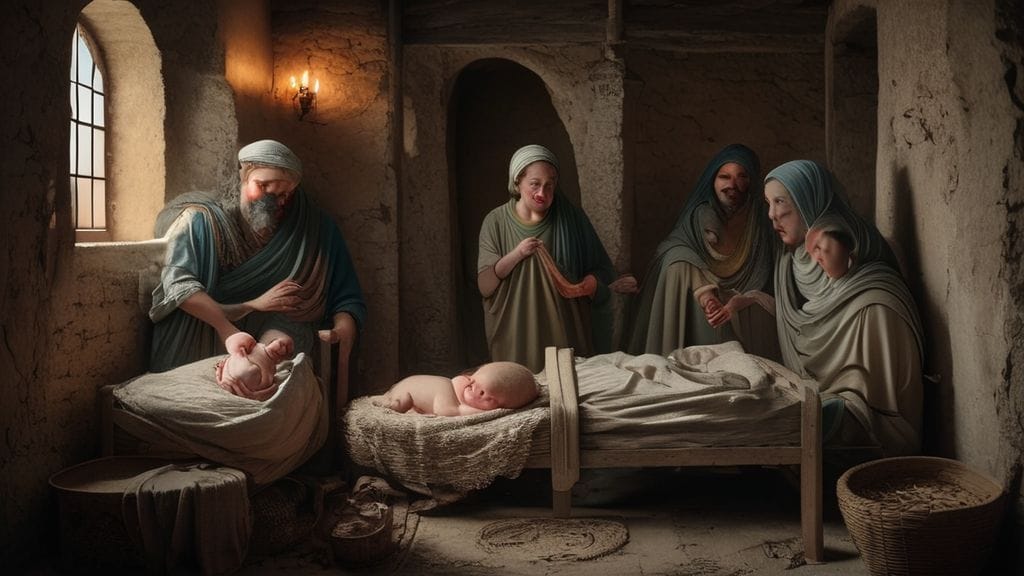
Antioch in the year 495 was a city that had learned to live with disaster. The Orontes River curled around its walls like a dark green ribbon, glinting beneath the pale Levantine sun, and above its waters stood colonnaded streets, public baths, theaters, and churches rebuilt more than once from rubble. A generation earlier, in 459, a terrifying earthquake had shaken the city to its bones. Many who walked the streets in 495 still carried memories of that night—the roar, the falling stones, the cries from buried neighbors. Yet the city endured. It remained one of the great jewels of the Eastern Roman Empire, a place where imperial decrees arrived with the same regularity as consignments of wine and wheat.
In a modest home somewhere in the outer districts, perhaps not far from the road that ran toward the hills, an infant first uttered his thin cries into this uneasy world. Later writers would place prophecies around his birth: dreams of pillars touching heaven, visions of flames rising yet not burning, strange lights above the house at night. Such stories, carefully embroidered by hagiographers, were meant to reassure later readers that from the very first breath, this child, later known as simeon stylites the younger, was marked out for a destiny that rose above the city’s dust and fear. Whether or not those omens truly occurred, the world into which he was born made the decision he would later take—to flee the city and live on a pillar—far more comprehensible than it might at first appear.
Antioch in 495 was officially Christian, studded with churches and echoing with psalms at dawn and dusk. But beneath the hymns lay deeper tremors. The empire was still torn over how to describe Christ: one person, two natures, one nature made flesh. Bishops clashed with monks; imperial edicts condemned some formulas and promoted others. In the bazaars and bathhouses, people took sides, whispering the names “Chalcedonian” and “Monophysite” with the same intensity they once gave to the chariot teams of the Hippodrome. Above them, in the far‑off Great Palace at Constantinople, emperors weighed not only the language of councils but the raw political risk of alienating half their subjects.
Into this charged atmosphere, the birth of one more child, to parents of modest standing, would have gone entirely unnoticed by chroniclers. No imperial record marks the event, no city inscription carries his infant name. Only much later, when the boy had turned himself into a living pillar of stone and flesh, did scribes look back and begin their stories with the quiet, almost cinematic image of a newborn cradled in a city that did not yet know what he would become. Yet this was only the beginning, and the first years of his life were as firmly planted in Antioch’s soil as his later career would be, paradoxically, detached from it.
Antioch Between Earthquake and Empire: The World That Shaped Simeon
To understand the significance of the birth of simeon stylites the younger in 495, one must feel the texture of Antioch at the turn of the sixth century. The city had once been the proud capital of the Seleucid kings; by the fifth century it was the third or fourth metropolis of the Roman world, after Rome and Constantinople, perhaps rivaled only by Alexandria. Its population likely hovered in the hundreds of thousands before the earthquakes, though by Simeon’s birth it had shrunk and shifted, neighborhoods rebuilt in hasty brick where marble once stood.
Politically, Antioch served as the empire’s key eastern bulwark, a staging ground for campaigns against the Sasanian Persians and a nerve center for imperial administration. Great magistrates moved through its streets: governors, generals, envoys bearing messages sealed with purple ribbons. Yet the city’s political importance also made it vulnerable. When taxes rose to pay for distant wars, Antioch felt the squeeze first. When doctrinal experiments like the Henotikon—Emperor Zeno’s attempt to bridge theological divides—went wrong, riots broke out not in some abstract hinterland but in the colonnaded squares where Simeon’s parents bought bread and oil.
Socially, Antioch was a mosaic. Greek-speaking elites presided over city councils; Syriac and Aramaic rang out in poorer quarters and the surrounding countryside. Jews maintained their own community; former pagans moved uneasily within the triumphantly Christian public culture, their festivals rebranded or suppressed. Monks from the nearby hills, fierce-eyed and leathery-skinned, ventured into town to preach against luxury, corrupt bishops, or lax morals. The city had seen all this before. It was in Antioch that John Chrysostom, a century earlier, had denounced the rich for their gilded carriage wheels and multicolored robes, his words echoing amid porticoes heavy with incense and gossip.
And layered over everything was the anxiety of the ground itself. Antioch sat in a seismically active region; tremors were a part of life. Each quake was read not merely as a physical shock but as a moral message. When walls cracked, sermons spoke of God’s anger; when the city survived, sermons spoke of mercy. A child growing up in such a place would learn early to live between terror and hope, between the fear that the earth might open and the faith that heaven might still answer prayers. For someone like simeon stylites the younger, born into this landscape of trembling stones and doctrinal storms, the idea of seeking stability not in the ground but above it—on a pillar—held a strange, inner logic.
Parents, Portents, and Prayers: The Family Origins of Simeon Stylites the Younger
The sources for Simeon’s early life are thin, woven primarily from later hagiographic accounts. Yet even filtered through the conventions of saintly biography, they reveal something about the family world in which he opened his eyes. His parents are typically presented as pious but not noble, Christians who had survived hardship and clung to their faith as to a lifeline. There is no hint of senatorial rank or vast estates; instead we glimpse a household whose wealth lay in its capacity for prayer and endurance.
Later writers like the anonymous author of his Life emphasize that his parents had long been childless and that his birth came after fervent supplication. Whether literal fact or a narrative motif, the image itself is telling. A late antique family, anxious about the future and perhaps about its name fading, begs God for an heir. When the child finally arrives, each cough, each fever, each tiny hand grasping at air carries a weight of promise. In such circumstances, dedicating a child to God’s service appears less like a sacrifice and more like a covenant: we received him by miracle; we will not stand in the way if he is called back in a special way.
Stories of portents accompanied this dedication. Neighbors, they say, saw a column of light above the family house. A local priest dreamt of a tall pillar crowned with a flame. The infant, sleeping, appeared to smile at empty corners of the room as if seeing invisible visitors. Modern historians treat such episodes with understandable skepticism, but to dismiss them entirely would be to overlook their functional role. They signal how later communities understood simeon stylites the younger: his life, for them, was not merely an individual’s eccentric choice but part of a cosmic drama in which even his first cry had theological resonance.
Yet behind the embroidered tales of visions, an everyday rhythm must have shaped his parents’ lives. His mother would have stood in line to draw water, gossiping with other women about price rises and the latest sermon. His father, if a craftsman or small landholder as many suggest, might have spent long days negotiating with tax collectors, fearing that a miscalculation could mean confiscation or ruin. At night, lamplight would flicker against walls that still bore cracks from past tremors, a constant reminder that the material world was fragile. In that dim glow, prayers were whispered over the sleeping child—a child whose future lay far beyond the family courtyard, on heights no parent could have imagined.
A Childhood Among Ruined Walls and Resounding Hymns
Childhood in late antique Antioch was both precarious and intensely communal. Infant mortality remained high; disease spread easily in crowded city quarters. Yet children were also everywhere—in the markets, in the streets, even in the forecourts of churches. Simeon’s first memories may have been of barefoot games in narrow alleys, the cries of vendors selling figs and olives, the smell of dust after a passing horse kicked up the hard-packed earth.
Christianity structured the child’s week. Sundays and feast days were marked by processions; on major occasions, bishops and clergy paraded relics through the streets while crowds chanted psalms. Little Simeon might have clung to his mother’s hem in the press of bodies, staring wide-eyed at gilded crosses glinting in the sun. Vivid icons, lamps, and the sweet, suffocating smell of incense filled his senses. Religious language seeped into him not as abstract dogma but as color, sound, and bodily memory—traces that would later reappear in the intense, almost theatrical forms of devotion he enacted on his pillar.
Antioch’s physical scars also formed his imagination. Children tend to explore ruins more eagerly than tidy squares, and there were ruins aplenty: collapsed porticoes from past quakes, derelict homes abandoned by families ruined by taxes or flight. Amid broken capitals and tumbled stones, Simeon and his companions would have invented stories—of giants, of past heroes, of angry gods hidden beneath the earth. At home, adults added their own layers of explanation: “That was the bathhouse that fell in the great quake… This was once the house of a proud man whom God humbled…” Such tales turned the city into a living moral map, a series of warnings and promises etched into stone.
It is astonishing, isn’t it, how silently an idea can take root? A boy, walking past a toppled column, might pause and look up at the still-standing ones, silhouettes against a blazing sky. Columns meant power and grandeur—the sign of temples and palaces—but they also suggested something else in a Christian imagination: the link between earth and heaven, between the trembling ground and a vault that promised stability. Around that time, the stories of an earlier wonder-worker, Simeon Stylites the Elder, were already circulating widely. The boy’s name, bearing that same “Simeon,” would one day be interpreted as fate rather than coincidence.
Simeon’s early years likely included basic instruction in reading, or at least in memorizing Scripture and hymns. Antioch boasted schools for the well-to-do and simpler forms of catechesis for the poor. Even if books were scarce in his house, the liturgy itself was a school: psalms sung repeatedly carved their words into his memory. Later sources note his familiarity with Scripture and with the patterns of church services. The desert ascetic, often imagined as entirely cut off from urban learning, was in truth formed by a city saturated with texts, whether spoken or written. The child would one day renounce the city, but he would carry its Bible‑drenched speech and its rhetoric of catastrophe with him to the heights.
The Lure of the Pillar: Hearing of the First Stylites
Long before the boy Simeon climbed his own pillar, tales of an earlier saint had begun to cast their long shadow over the Christian imagination. Simeon Stylites the Elder, who had died in 459—the very year of Antioch’s devastating earthquake—had spent decades atop a column in the wilderness north of the city. His fame had spread from Syria to Rome and even to distant Gaul. Pilgrims, bishops, and imperial officials had all made the journey to stand at the foot of his column and crane their necks upward toward a man who seemed to be halfway between earth and heaven.
By 495, the year of the younger Simeon’s birth, the elder’s story had already solidified into a powerful legend. Sermons in Antioch spoke of his miracles, his endurance in winter’s freezing winds and summer’s hammering sun, his ability to reconcile enemies and rebuke emperors. Mothers repeated these stories as cautionary or inspirational tales to their children: look what holiness can do; look how far one can go for God. In the noisy, anxious city, the image of a solitary figure on a column offered a strangely compelling alternative to crowded streets and unending disputes.
We cannot know the exact moment when the younger boy first heard of his famous predecessor, but it is difficult to imagine that he grew up oblivious to the story. Perhaps a wandering monk, receiving alms at his parents’ door, spoke of the great stylite; perhaps a homily on a saint’s feast day painted the image in fiery colors. The effect was cumulative. Year by year, the figure of Simeon the Elder became a kind of living question mark hovering above the city: is such extremity madness or pure faith? Is the one who abandons the world a coward fleeing responsibility—or a hero fighting evil from a different front?
For someone like simeon stylites the younger, whose temperament sources portray as unusually serious and contemplative even from a young age, such stories must have worked like a powerful magnet. The pillar became more than a physical structure; it was a symbol of absolute commitment, of a life stripped of compromise. In a city where adults were forced to negotiate constantly with tax collectors, doctrinal edicts, and shifting political winds, the notion of a single, unwavering vertical path toward God had its own austere beauty. The boy who wandered among Antioch’s ruins would one day seek his own pillar in the hills—but first, as so often in the lives of saints, came a period of restless searching.
Fleeing the City: Simeon’s First Steps into the Wilderness
The decision to leave home is always an act of rupture, but in late antique hagiography it is depicted as the chief test of a holy life: can the would-be saint break the tightest bonds—family, property, familiar streets—in order to follow a calling that others scarcely understand? The Life of Simeon Stylites the Younger presents his departure as a response to an inner voice and a deepening disgust with urban life. The boy, now an adolescent, is said to have grown increasingly uncomfortable with the city’s luxuries, its entertainments, its quarrels. The theaters and races that delighted his peers left him cold. Antioch’s splendid churches, once a source of awe, began to feel crowded and noisy, their rituals diluted by distraction.
One can overlay this spiritual narrative with social context. By the early sixth century, as doctrinal battles sharpened and anti-imperial resentments smoldered, Antioch’s public life could turn quickly from celebration to riot. Fights broke out over the appointment of bishops, over imperial tax policies, over disputed theological phrases. Small traders and artisans bore the brunt of instability. If Simeon’s family had indeed modest means, their world may have been one of constant precariousness: debts, fear of illness, fear of another quake, fear of sudden political reprisal. For a sensitive youth convinced that God demanded purity and undivided attention, the city’s clamor could seem not merely distracting but spiritually lethal.
And so, sometime in his youth—sources propose varying ages, but we may imagine him in his mid-teens—Simeon left. In typical hagiographic fashion, the Life dramatizes the departure: stealth at dawn, a tearful mother, a father torn between pride and grief, and a final blessing that turns reluctant consent into sacred commissioning. The young man joined the stream of aspiring monks heading into the nearby hills, where communities of ascetics had taken root around earlier hermits’ caves and pillars. What to others looked like barren scrubland, dotted with thornbushes and scattered stones, appeared to him as the threshold of a new world.
Yet behind the pious rhetoric, there is a profoundly human story. Many late antique youths, as Peter Brown and others have shown, turned to monasticism partly as an escape from social pressures—arranged marriages, military service, or inherited debts.¹ Simeon’s flight from Antioch may equally be read as a protest against the cramped roles available to him as a lower-status city dweller. On the hillside, clad in rough wool, sleeping on the bare earth, he would paradoxically gain access to a wider world of spiritual authority and influence than any local artisan could have dreamed. The road out of Antioch, dusty under his feet, was thus both a retreat and an advance, a move away from the city and toward a different kind of center.
Novice of the Heights: Formation in the Monastic World
The wilderness beyond Antioch was not empty. By the late fifth and early sixth centuries, northern Syria had become a dense landscape of ascetic experimentation. Caves housed solitary hermits; small clusters of huts formed semi-organized communities; more formal monasteries mixed agricultural labor with chant and scriptural study. For a newcomer like Simeon, the first task was not to climb a pillar but to learn obedience on the ground.
Under the guidance of elder monks, he would have adopted a regimen of fasting, night vigils, and manual work. The Life insists that he embraced these disciplines with fervor beyond his years, outstripping even seasoned ascetics. Whether or not we accept such hyperbole, it is clear that life in the monastic milieu shaped his body and mind for the extremes ahead. Sleeplessness, exposure to cold, and sparse rations reconfigured his sense of what was possible. The city’s comforts faded into distant memory; the rhythm of bells and birdsong, of psalms and silence, became his new measure of time.
Monastic communities in this region also functioned as hubs of information and debate. Hermits who seemed utterly cut off from the world might, in reality, be better informed about imperial politics and doctrinal shifts than many urban dwellers. Pilgrims brought news; messengers from bishops arrived with letters requesting prayers or support. In this environment, Simeon’s asceticism was never purely private. Already, as a novice, he was being formed to play a role in a larger drama, one in which holy men were expected to intervene in crises, arbitrate disputes, and embody orthodoxy in flesh as much as in words.
It is here, in this liminal stage, that we begin to glimpse the transition from ordinary monk to stylite. The pillar, after all, was not the only available path. Simeon could have remained a cenobitic monk or retreated into a cave as an anchorite. That he did not suggests both a personal attraction to the radical form pioneered by his namesake and the pressure of local expectations. Surrounding villages and city dwellers had already seen what a stylite could do for them: bring rain in drought, heal the sick, even broker peace with distant emperors. A new Simeon, drawn from the same region and bearing the same name, naturally attracted hopes—and projections. Gradually, his own inner desire for more extreme separation and the desires of the crowd for a new pillar-saint began to align.
Climbing Toward Heaven: The First Pillar of Simeon Stylites the Younger
The moment when Simeon first mounted a pillar marked a decisive threshold. According to the traditional chronology, he began his stylite life very young, perhaps in his twenties, initially on a low column and later on ever higher ones as his reputation grew. The scene, described with dramatic flair in his Life, reads almost like a liturgical rite: a small crowd gathered, fellow monks chanting psalms, a makeshift ladder leaned against roughly hewn stone, and the thin, determined figure of the ascetic ascending rung by rung into a future that would never again know the feel of ordinary earth beneath his feet.
The pillar itself was both utterly prosaic and deeply symbolic. Built from local stone, perhaps repurposed from earlier ruins, it rose in stages—a foundation sunk into the hillside, a cylindrical shaft or stacked drums, and at the top a tiny platform just wide enough to stand, sit, or lie curled on one side. An iron railing might offer minimal support; a small roof or hood could provide some shelter from sun and rain, though many accounts emphasize Simeon’s exposure to the elements as proof of his endurance. From below, to villagers and pilgrims craning their necks, the column must have looked shockingly narrow, the human figure on top more precarious than any bird’s nest.
For simeon stylites the younger, however, the pillar was not a stunt; it was a theological statement made with his body. By limiting his physical space to a disc of stone a few feet across, he dramatized the claim that God alone was his horizon. The verticality of the column signaled constant prayer—hands raised toward heaven, eyes turned upward—while the distance from the ground represented a renunciation of the world’s entanglements. At the same time, paradoxically, the pillar ensured that he could never fully escape the world’s gaze. The higher he went, the more visible he became, a living exclamation point on the skyline.
The early days were surely filled with both exultation and doubt. Night winds in the hills can be brutally cold; the body, deprived of sleep and comfort, rebels. The young stylite must at times have questioned whether he had mistaken pride for piety, spectacle for sanctity. But below his column, the first pilgrims were already arriving. A lame shepherd, brought by neighbors, claimed to walk more steadily after Simeon’s blessing. A mother, holding a feverish child aloft, wept with relief when the temperature broke days after the stylite’s prayers. Each such story, whether coincidence or not, wove another strand into the fabric binding the man on the pillar to the people below—and made descent more unthinkable with every passing season.
Daily Life on a Disc of Stone: Prayer, Pain, and Public Expectation
What did it mean to live day and night on a small stone platform, year after year? The Life gives us hints, and comparative studies of other stylites fill in the picture. Simeon’s day was structured by prayer. Standing for hours, arms raised in the “orans” posture, he recited psalms until his voice was hoarse, then continued silently when words failed. He observed the canonical hours, marking dawn, midmorning, midday, evening, and night with specific chants and petitions. At times he performed long cycles of prostrations, bending and touching his forehead to the platform over and over—a practice that, on such a confined space, must have required both balance and grim determination.
Food and water were hauled up in small baskets on ropes, usually once a day or even less often during fasts. His diet, like that of many ascetics, seems to have consisted mainly of bread, pulses, and a little oil, perhaps occasionally vegetables or fruit from nearby gardens. Absence of shelter meant constant exposure: burning heat in summer, sudden storms sweeping in from the hills, icy winds in winter that cut through his thin garments. Chronic pain—swollen feet, aching joints, sun-cracked skin—became part of the texture of his existence.
But pain was not the only feature of his life. The pillar was also a pulpit. Crowds gathered below, some local, others drawn from distant provinces. They shouted up questions about illness, family conflicts, business ventures, even imperial policies. Simeon answered in a loud, carrying voice or through intermediaries—disciples who repeated his words to those further back. He gave short homilies, urged repentance, rebuked greed, and instructed the faithful to care for widows and orphans. The man who had fled Antioch’s noise now presided over his own open-air forum, with nature as his vault and a swirl of human drama at his feet.
Public expectation weighed heavily. Once a stylite became renowned, crowds expected constant availability, miracles, and firm guidance. Any sign of wavering could be interpreted as spiritual decline. For simeon stylites the younger, the pressure was twofold: he was compared not only to an ideal of sanctity but specifically to his illustrious predecessor. If the elder Simeon had braved forty years on his column, the younger was expected to match or surpass him. In such a context, perseverance became not only an inner discipline but a public performance—a test that bound the stylite as securely as any chain.
Miracles, Cures, and the Crowd: How a Hermit Became a Public Figure
In late antique Christianity, miracles were not mere decorations on a saint’s life; they were the primary currency of credibility. Pilgrims did not trek for days across rough terrain to hear refined theology; they came because they believed that at the foot of a holy man’s pillar, the impossible might become possible. The Life of Simeon Stylites the Younger, like many hagiographies, abounds with accounts of healings and wonders. The blind regain their sight, the paralyzed take tentative steps and then walk, fever breaks after months of agony, barren couples conceive, and demons shriek as they are driven from the possessed.
Historians approach such stories cautiously, wary of swallowing legend wholesale yet attentive to the social needs they express. In an age with rudimentary medicine and high mortality, the desire for cures was both intensely physical and deeply spiritual. An illness could ruin not only a body but an entire household economy. The stylite, perched above, offered something physicians could not: the promise that suffering had meaning and that God’s attention could be tangibly secured. Whether a cure came or not, the very act of pilgrimage—to travel, to pray, to be anointed with oil blessed by the holy man—reframed the sufferer’s experience.
Miracles also extended beyond the body to the political realm. Simeon’s prayers were credited with averting droughts, ending plagues, and protecting the region from marauding bands. When peace treaties held or battles ended favorably, some credited the intercession of the stylite as much as the strategies of generals. Such attributions served a dual purpose: they underscored the saint’s cosmic importance and, at times, allowed communities to reinterpret frightening events in terms of divine favor or wrath. A failed harvest might be explained as punishment for lax morals; a sudden relief as a response to communal repentance spurred by the stylite’s preaching.
As reports of wonders spread, so did Simeon’s fame. Merchants returning to Antioch brought stories of cures; monks visiting other monasteries carried his reputation further afield. Soon the hills around his pillar buzzed with constant traffic. Local villagers set up stalls to sell bread, cheese, and lamp oil to pilgrims. A small settlement of disciples and caretakers grew up near the column, managing crowds, preserving order, and, inevitably, shaping access to the holy man. The once-solitary ascetic became at the same time a public figure, a focal point of economic activity and a source of authority to which both peasants and nobles increasingly deferred.
Doctrines in the Dust: Simeon and the Battles Over Christ’s Nature
While Simeon stood on his pillar, the empire continued to roil with theological conflict. The Council of Chalcedon in 451 had declared that Christ existed “in two natures,” fully divine and fully human, “without confusion, change, division, or separation.” Yet large swaths of the Christian East rejected or reshaped this formula, insisting instead on a single, united nature of the incarnate Word. These debates were no sterile scholastic exercise; they mapped onto regional, ethnic, and political loyalties. Cities like Antioch, Alexandria, and Constantinople became strongholds for different positions. Emperors like Anastasius, Justin I, and Justinian I shifted between conciliation and enforcement, sometimes alienating one faction even as they sought to appease another.
In this fraught climate, figures like simeon stylites the younger were precious assets. A stylite was seen as above worldly interests, his suffering body a guarantee of sincerity. When such a man publicly backed a given doctrinal stance—or a given bishop—his authority could sway thousands. Sources indicate that Simeon took positions on key controversies of his day, aligning himself with what would later be recognized as Chalcedonian orthodoxy, though in his own time the boundaries were not always clear. He was consulted on episcopal appointments; his letters or verbal messages to church councils carried significant weight.
A famous anecdote, preserved in modified form in later chronicles, tells of a heated dispute over a Christological phrase erupting in a nearby city. Delegates, unable to agree, proposed sending representatives to Simeon’s pillar to seek his judgment. The scene, as imagined by medieval copyists, is almost theatrical: dusty envoys arriving under the hot sun, squinting upward as the stylite listens, then delivering a concise, Scripture‑laden verdict that sends them back down the hill with renewed certainty. Whether precisely factual or not, such stories capture a real dynamic: doctrinal battles, fought in distant councils and imperial edicts, were also waged in the dust at the foot of a Syrian pillar.
For Simeon himself, the stakes were high. To be seen as wavering or heretical would not only have endangered his own reputation but threatened to fracture the fragile unity of his cult. Pilgrims came from various doctrinal backgrounds; they needed to believe that the man on the pillar stood firmly under the broad umbrella of orthodoxy as they understood it. The stylite’s public pronouncements thus had to balance conviction with wide appeal, clarity with pastoral sensitivity. In this way, the thin figure silhouetted against the sky functioned not merely as a symbol of ascetic extremity but as a living hinge between theology, politics, and popular faith.
Emperors, Envoys, and Letters from Constantinople
Even from his remote perch, Simeon could not escape the gravitational pull of Constantinople. The Eastern Roman Empire in his time was governed by emperors who understood the value of holy men to imperial legitimacy. Justinian I, who reigned from 527 to 565, and his successors looked to monastic leaders and stylites as barometers of divine favor. A supportive statement from a figure like simeon stylites the younger could lend heaven’s luster to controversial policies; a scathing criticism could stir unrest far from the capital’s walls.
Letters traveled between pillar and palace. While most are lost, some are echoed in later accounts. Monks acted as couriers, bearing tablets or parchments up and down ladders: from Simeon to the emperor, urging mercy for a province overburdened by taxes; from the Empress Theodora or later empresses, requesting prayer for a troubled pregnancy or a military campaign on the edge of collapse. For the emperor, such correspondence offered symbolic capital: to be seen as humble enough to seek a holy man’s intercession was to demonstrate piety. For Simeon, the exchange cemented his status as more than a local wonder-worker; he became, in effect, an unofficial adviser of the throne.
Some envoys came not only with letters but in person. Imagining the scene: a richly dressed imperial representative, horse tethered below, ascending the hill surrounded by a modest entourage. The villagers stare; the monks stand aside with a mixture of suspicion and awe. At the pillar’s base, the envoy calls up formal greetings and perhaps reads out a rescript in the emperor’s name. Above, on his narrow platform, Simeon listens, then responds with directness that courtiers in the capital seldom dared. Hagiographers relish these episodes, portraying the stylite as fearlessly confronting imperial pride, reminding emperors that they too would stand naked before God’s judgment seat.
Of course, the relationship was not uniformly antagonistic. Simeon often endorsed imperial campaigns against perceived heresy or moral corruption, reinforcing the empire’s self-presentation as God’s chosen instrument. When cities were rebuilt after disasters, or churches endowed with new mosaics and relics, imperial propaganda and the stylite’s blessing could operate in tandem, weaving together images of earthly and heavenly power. Thus, the boy born in an anxious, medium-status household in Antioch ended up, by virtue of his pillar, participating in the grand choreography of empire, his thin voice—both literally and metaphorically—carrying across vast distances.
Earthquakes, Wars, and Famine: A Holy Man in an Age of Crisis
The decades of Simeon’s stylite career were not peaceful. The sixth century witnessed renewed wars with the Sasanian Persians, outbreaks of disease, and natural disasters that seemed to confirm apocalyptic fears. In 526 and 528, catastrophic earthquakes again struck Antioch, leveling much of the city and killing tens of thousands. Chroniclers wrote of buildings collapsing “like houses of cards,” of entire families crushed in an instant. Fires broke out amid the rubble, burning for days. The parallels with the earlier quake of 459, the year of the elder Simeon’s death, were not lost on contemporaries.
From his pillar, simeon stylites the younger became a focal point for collective anguish. Survivors streamed into the countryside, many half-mad with grief, seeking answers. Why had God allowed such devastation? Was it punishment for sin, a test of faith, or simply inscrutable? Simeon responded with sermons that combined stern calls to repentance with tender consolation. According to one account, he urged the homeless to refrain from looting, commanded local landowners to open their granaries, and organized his disciples to coordinate aid for refugees. His hilltop site, once merely a place of pilgrimage, now served as a logistical and spiritual hub in a time of catastrophe.
War brought its own stream of supplicants. When Persian armies advanced, residents of frontier towns begged for his prayers. Soldiers, passing near his shrine en route to campaign, left tokens—helmets, belts, votive lamps—asking for protection. Victories and defeats alike were filtered through the lens of his intercession: success proved that God listened to his stylite; failure was read either as a sign that the people had not heeded his warnings or that darker, more mysterious purposes were at work. This interpretive framework did not remove suffering, but it did embed it in a cosmic story where human choices and divine judgment intertwined.
Famine and disease sharpened this drama further. When harvests failed, Simeon urged those with surplus to feed the poor, castigating hoarders with language reminiscent of the fiery homilies of John Chrysostom a century earlier. During epidemics—perhaps precursors or local manifestations of the great Plague of Justinian that would ravage the empire after 541—his pillar became encircled with the sick and dying. Some recovered; many did not. The tension between faith in miracles and the implacable reality of mass mortality must have weighed heavily on both the pilgrims and the stylite himself. If he asked, in the solitude of night, why God did not respond more generously, no source records his doubts. We glimpse only the public face: a man who, despite the rolling waves of crisis, remained literally and figuratively steadfast.
The Making of a Shrine: Monks, Pilgrims, and the Stylite’s Legacy in Life
Over time, the area around Simeon’s pillar transformed from a rough hillside into an organized religious complex. Archaeological evidence and later descriptions of similar shrines allow us to imagine the process. At first, only a few shelters appeared—huts for disciples, a small chapel where the Eucharist could be celebrated, perhaps a cistern to collect rainwater. As Simeon’s fame grew, more permanent structures were erected: guesthouses for pilgrims, storerooms, workshops, and a larger church oriented so that worshipers could see the pillar through its doors or windows.
Donations poured in. Wealthy patrons, eager to associate themselves with the holy man, endowed the site with land, money, and liturgical vessels. Local villagers, whose modest offerings were no less significant in aggregate, contributed labor and grain. A community of monks formed around the shrine, developing its own rules and hierarchies. Abbot, stewards, and deacons handled the daily flow of people and resources, freeing Simeon to focus—at least in theory—on prayer and counsel. In practice, his decisions and preferences continued to shape the community’s life; even at a distance of several meters, the stylite’s will was law.
The shrine functioned as both a sacred space and a small economic engine. Pilgrims needed food and lodging; they bought lamps to burn before the saint’s pillar, paid scribes to write down vows and thanksgiving inscriptions, and purchased tiny flasks of oil or dust associated with the site. Local economies adjusted accordingly. Farmers might time their market days to coincide with peak pilgrimage periods; artisans specialized in metal crosses or clay tokens bearing images of the stylite. For nearby villages, the presence of simeon stylites the younger was a mixed blessing: an honor that brought increased revenue but also strains on resources and periodic tensions over control and profit.
Liturgically, the shrine developed its own calendar. Simeon’s birthday, the anniversary of his ascent to the pillar, and later the date of his death became feast days, marked by all-night vigils, processions, and special hymns. Choirs practiced compositions that wove his name into biblical imagery: a “pillar of fire” in the wilderness, a “tower set upon a hill.” The man who had sought to disappear into anonymity now found his identity chanted, painted, and carved in stone while he was still alive. For contemporaries, this was not a contradiction but a sign of God’s generosity: he had raised up, in their own generation, a living saint whose shrine they could visit without crossing the sea.
Last Days on the Pillar and the Descent into Memory
Every human body, no matter how disciplined, eventually fails. After decades exposed to wind, sun, and cold, Simeon’s health began to decline. The Life describes illnesses, perhaps infections worsened by malnutrition and constant strain. His legs, which had supported him through countless hours of standing, grew weak; his voice, once strong enough to carry across fields, became, at times, a hoarse whisper. Disciples nudged food and water up more frequently, anxious eyes scanning his thin frame for signs of impending collapse.
Yet even as physical strength ebbed, Simeon’s symbolic power intensified. Pilgrims who came in his final years spoke of a palpable sense of urgency, as if history itself were reaching a climax. His words, rarer now and more carefully measured, were treasured and repeated. The stylite, aware that his time was short, redoubled his calls to repentance and reconciliation. He urged his followers to maintain unity, warned against ambition and factionalism, and emphasized that the true test of their devotion would come after his death, when no living pillar stood to hold them together.
The actual moment of his passing, as recorded in hagiographic style, is soaked in light and symbolism: a final blessing, perhaps the celebration of the Eucharist beneath his column, a gaze lifted skyward, and then a quiet cessation of breath. Some versions speak of miraculous signs—fragrant odors, voices in the air, a star lingering above the pillar. Whether or not such phenomena occurred, what is certain is that grief swept the gathered community with a force nearly equal to the earthquakes that had shaken Antioch years before. The man whose presence had become a constant—an unchanging point on the horizon—was gone.
His body, carefully lowered from the pillar for the first and last time, became an object of intense veneration. Relics were distributed sparingly; his main burial site, likely within a church near the column, immediately attracted waves of pilgrims. The empty pillar itself stood as a silent witness, its top now bare, its meaning transformed. Where once a living man had prayed and spoken, now absence spoke louder than words. Already, the process of turning Simeon from a contemporary holy man into a figure of memory, a saint woven into liturgy and legend, had begun.
From Desert to Empire: How Simeon’s Cult Spread After His Death
Death did not end Simeon’s influence; in many ways, it amplified it. Freed from the constraints of a single body on a single pillar, his cult could travel. Monks who had lived near him moved to other monasteries, carrying first-hand stories. Pilgrims returned home with relics as small as a thread from a garment or a pinch of dust taken from near his column, convinced that the saint’s power was concentrated in these tangible fragments. Churches in Antioch and farther afield dedicated altars or chapels in his name. Over time, entire buildings were consecrated to “Saint Simeon the Younger,” their walls adorned with frescoes depicting his life.
Liturgical texts solidified his memory. Hymnographers composed troparia and kontakia—short chants inserted into services—that summarized his life as a sequence of images: the child of Antioch, the desert novice, the man of the pillar, the intercessor for cities in danger. In the Byzantine tradition, such hymns functioned as concise theological interpretations, ensuring that even worshipers who knew little historical detail would absorb a particular reading of his sanctity. Icons, too, standardized his appearance: a thin, bearded man standing atop a column, often with hands raised in prayer and a small ladder leaning against the shaft as if to invite spiritual ascent.
The geographic spread of his cult mirrored existing networks of trade and pilgrimage. Syrian, Palestinian, and Anatolian monasteries mentioned him in their calendars. In coastal cities, sailors invoked his protection alongside older maritime saints. It is difficult to measure exactly how far his name traveled, but traces in Greek and Syriac manuscripts suggest that, while perhaps never achieving the pan-Mediterranean fame of his elder namesake, he nonetheless remained a significant regional figure for centuries. In some places, local stylites or ascetics were explicitly compared to him, their hagiographers presenting them as heirs of the “second Simeon.”
Yet behind this expansion lay fragility. The same region that had nurtured his cult would, in later centuries, fall under new political and religious configurations. The Arab conquests of the seventh century transformed the context of Christian pilgrimage; some shrines fell into disuse, others adapted to changed realities. Wars, economic shifts, and natural decay gradually eroded physical remains. Still, the memory of simeon stylites the younger persisted in liturgical books and monastic libraries, surviving storms that toppled far more substantial stones than the narrow column on which he once stood.
Reading the Sources: Hagiography, History, and the Problem of Truth
For the modern historian, reconstructing the life of Simeon from fragmentary and tendentious sources is a delicate task. Our main information comes from his Greek Life and related texts—hagiographies written with clear theological and pastoral agendas. These works aim less to provide a neutral biography than to present him as a model of virtue, a defender of orthodoxy, and a conduit of miracles. They employ set narrative patterns: miraculous birth, early piety, trials and temptations, decisive renunciation, public recognition, and triumphant death. Many episodes echo motifs used in the Lives of other saints, including Simeon the Elder, Athanasius’s Life of Antony, and the Apophthegmata Patrum.
Yet to dismiss these sources as mere fiction would be to lose invaluable insight into the mental and spiritual world of late antique Christians. Hagiography, as scholars like Hippolyte Delehaye and, more recently, Derek Krueger have argued, tells us not only—or not primarily—what saints did, but what communities believed holiness to be.² The stories woven around simeon stylites the younger reveal the anxieties and hopes of those who venerated him: fears of earthquakes and famine, suspicion of imperial overreach, hunger for unambiguous spiritual authority, and a longing to see God’s power manifested in human weakness.
Historical reconstruction proceeds, therefore, by careful triangulation. We compare his Life with other contemporary sources—chronicles, letters, conciliar records, and archaeological findings. When multiple independent witnesses converge on an event—the Antioch earthquakes, for example—we gain firmer ground. When a miracle story fits a common hagiographic template but lacks external corroboration, we may treat it more cautiously, seeking its symbolic meaning rather than its factual precision. Inscriptions or architectural remains near the supposed site of his pillar strengthen the plausibility of the cultic landscape described.
Even the most extravagant narratives, however, carry kernels of social reality. A story about Simeon rebuking a corrupt official suggests that people expected holy men to challenge injustice. An account of his intervention in a doctrinal dispute indicates that stylites were indeed drawn into theological debates. The sheer persistence of references to his interaction with emperors, even if overdramatized, confirms that communication between monasteries and the court was a regular feature of Byzantine religious life. Thus, by reading hagiography both sympathetically and critically, we can let the texts speak in their own language while asking historically precise questions.
From Antioch to the Modern World: Reassessing Simeon Stylites the Younger
Viewed from the twenty-first century, the idea of a man spending decades atop a pillar can seem at best incomprehensible, at worst pathological. Modern readers, shaped by psychological and secular frameworks, are tempted to explain simeon stylites the younger in terms of trauma, obsession, or social dysfunction. Yet such judgments, while perhaps offering partial insights, risk flattening the complex cultural matrix that made stylitism both intelligible and compelling in its own time.
To late antique Christians, Simeon’s life dramatized themes central to their faith: the imitation of Christ’s suffering, the radical renunciation of worldly attachments, the conviction that prayer could alter the course of history. His body, fragile yet publicly exposed, became a living icon of self-giving. In a world where power was often wielded through violence and wealth, the spectacle of a poor, unarmed man whose words could move emperors challenged conventional hierarchies. For peasants and artisans, he embodied the hope that God could raise the lowly; for elites, he offered both reassurance and rebuke—a reminder that their status was provisional before the judgment of heaven.
At the same time, Simeon’s story invites contemporary reflection on the ambiguous nature of religious charisma. His pillar magnified his virtues but also risked magnifying his flaws, had he yielded to pride or manipulation. The communities around him navigated a delicate balance between sincere devotion and the institutionalization of sanctity in the form of shrines, endowments, and power networks. These dynamics are not confined to the sixth century; variations of them recur whenever a charismatic figure becomes a focus of mass attention, whether in religious, political, or cultural spheres.
Finally, his life raises perennial questions about the human desire to escape the world while still serving it. Simeon fled Antioch’s noise to seek God in solitude, yet crowds followed him, and his isolation became the stage for a new kind of public engagement. His pillar was both a retreat and a vantage point, a separation and a meeting place. In that tension between distance and involvement, we can discern a broader human struggle: how to remain spiritually honest and ethically responsible amid the pressures of society. The boy born in 495, amidst the shattered stones of Antioch, attempted one extreme answer. Whether we admire or recoil from it, his ascent continues to provoke thought, inviting us to ask what it means, in any age, to stand firm when the ground itself is shaking.
Conclusion
The birth of Simeon in Antioch around 495, seemingly insignificant at the time, unfolded into a life that bridged city and wilderness, earth and sky, private longing and public responsibility. He emerged from a world riddled with earthquakes, theological battles, and imperial anxieties, and chose to respond not by seizing office or leading armies, but by climbing a narrow column of stone and refusing to come down. From that unlikely vantage point, simeon stylites the younger helped shape the spiritual and political landscape of his age, speaking into crises of famine, war, and doctrinal division with the authority of one who had staked everything on God’s reality.
His story cannot be peeled free of legend, nor should it be; the hagiographic embroidery itself reveals the emotional and theological needs of the communities that venerated him. Yet at its core stands a real person whose persistent, embodied prayer drew countless others into a reimagined understanding of holiness and power. The shrine that grew around his pillar, the miracles ascribed to his intercession, and the letters linking him to emperors testify to the enduring human hunger for figures who seem to stand above the ordinary fray, even as they remain deeply implicated in it.
From the vantage point of modernity, his stylite life may appear alien, even unsettling, but it also exposes continuities: our own era, like his, wrestles with uncertainty, catastrophe, and contested truths. Simeon’s extreme response—abandoning the ground itself—forces a probing question about how far one might go in pursuit of integrity and transcendence. His column has long since crumbled or been swallowed by earth, his city transformed beyond recognition, but the outlines of his choice remain sharply etched in the historical imagination. In remembering the child of Antioch who grew to stand between heaven and earth, we are reminded that history is not only a record of empires and wars, but of singular, stubborn lives that insist, against all odds, that there is more to be seen if we dare to look up.
FAQs
- Who was Simeon Stylites the Younger?
Simeon Stylites the Younger was a sixth-century Christian ascetic, born in Antioch around 495, who became famous for living for decades atop a pillar in the hills north of the city. He followed and in some ways replicated the example of Simeon Stylites the Elder, using his pillar as a place of continual prayer, public preaching, and intervention in the religious and political affairs of the Eastern Roman Empire. - Why did he choose to live on a pillar?
Living on a pillar was understood as a radical expression of devotion, symbolizing complete separation from worldly distractions and unceasing orientation toward God. In Simeon’s world, marked by earthquakes, conflicts, and moral anxiety, the pillar became both a literal and symbolic height from which he could pray for the world while remaining visibly distinct from its compromises. - How is Simeon Stylites the Younger different from Simeon Stylites the Elder?
The Elder, who died in 459, pioneered the practice of stylitism and gained empire-wide fame earlier in the fifth century. The Younger, born decades later near Antioch, lived in the shadow of that precedent but developed his own cult, engaged more directly in the Christological controversies of the sixth century, and interacted with emperors like Justinian through letters and envoys. - What role did he play in theological disputes of his time?
Simeon was regarded as an authoritative supporter of what came to be recognized as Chalcedonian orthodoxy, and he was consulted on disputes over Christ’s nature and on episcopal appointments. Delegations visited his pillar to seek his judgment, and his endorsements or condemnations could sway local opinion and bolster imperial religious policies. - Did Simeon have political influence?
Yes, though he held no official office, his reputation for holiness gave him significant informal influence. Emperors and governors sought his prayers and advice; letters traveled between his shrine and Constantinople; and his public pronouncements could encourage obedience to imperial edicts or, conversely, chastise authorities for injustice or excessive taxation. - What kinds of miracles were attributed to him?
Sources attribute a wide range of miracles to Simeon Stylites the Younger, including healings of blindness and paralysis, exorcisms, the alleviation of drought and famine, and protection of cities from invasion or natural disaster. Whether historically verifiable or not, these stories demonstrate how people in his time understood suffering and divine intervention. - How did his cult develop after his death?
After his death, his burial site and pillar became a major shrine, attracting pilgrims who sought his intercession. Monasteries preserved his memory through liturgy, icons, and copies of his Life, and devotion to him spread across parts of Syria, Palestine, and Anatolia, though it remained more regional than the cult of his elder namesake. - What can modern readers learn from Simeon’s life?
While his extreme asceticism may seem alien today, Simeon’s life illuminates how communities seek meaning amid crisis, how religious charisma can challenge and support political power, and how individuals negotiate the tension between withdrawal from the world and engagement with it. His story invites reflection on the costs and possibilities of radical commitment in any age.
External Resource
Internal Link
Other Resources
- Encyclopaedia Britannica – general search for the exact subject
- Google Scholar – academic search for the exact subject
- Internet Archive – digital library search for the exact subject

