Table of Contents
- A Silent Horror Beneath the Waves: The Black Sea Tsunami of September 11, 1927
- The Calm Before the Storm: Yalta and the Crimean Coast in the 1920s
- Geological Whispers: Understanding the Black Sea’s Tectonic Secrets
- The Unseen Trigger: What Caused the 1927 Earthquake?
- Morning of Destruction: How the Tsunami Unfolded Along the Crimean Shores
- Chaos in Yalta: Eyewitness Accounts and Human Stories
- Waves of Devastation: The Tsunami's Impact on Coastal Villages
- Immediate Aftermath: Rescue, Relief, and the Struggle for Survival
- Soviet Silence: Political Context and Information Suppression
- Scientific Investigations: How Researchers Pieced Together the Disaster
- Legacy in Stone and Memory: The Tsunami’s Long-Term Physical Imprint
- The Forgotten Disaster: Why the Black Sea Tsunami Remains Little Known
- Comparing Tsunamis: The Black Sea Event in Global Context
- Lessons from the Deep: How 1927 Informs Modern Disaster Preparedness
- Renewed Awareness: Recent Studies and Commemorations
- Conclusion: Echoes from the Black Sea’s Dark Waters
- FAQs: Understanding the 1927 Black Sea Tsunami
- External Resource
- Internal Link
1. A Silent Horror Beneath the Waves: The Black Sea Tsunami of September 11, 1927
The morning of September 11, 1927, dawned with a deceptive calm along the serene Crimean coast. Yalta’s bustling promenades welcomed locals and visitors alike, unaware that beneath the placid Black Sea, an invisible terror was gathering strength. Then, suddenly, the earth trembled—a violent earthquake rocked the seabed—and the water withdrew, as if scared. Moments later, a towering wall of water crashed ashore, swallowing homes, lives, and dreams in a terrifying instant. This was the Black Sea tsunami of 1927, a natural catastrophe that struck without warning, leaving devastation etched into the memories of those who witnessed it.
But this was not an ordinary wave — it was a rare and poorly understood disaster in a region not typically associated with such fury. Yet its impact was profound, shaking geological assumptions, ravaging a renowned resort area, and haunting the region’s collective memory for decades.
2. The Calm Before the Storm: Yalta and the Crimean Coast in the 1920s
To fully grasp the shock of the tsunami, one must picture Yalta as it was in the 1920s: a jewel of the Crimean Peninsula, cherished for its mild climate and stunning landscapes. Nestled on terraced hillsides overlooking the Black Sea, it was a magnet for poets, politicians, and aristocrats—each lured by its fragrant citrus groves and whispered promises of respite from the harsher realities of Soviet politics.
The Soviet Union, though still reeling from revolution and civil war, invested in the city as a prominent seaside resort. Its embankments were lively, the cafes filled with chatter, and the literary salons breathed new life into the air. Fishing boats bobbed gently on the waves, and fishermen greeted the dawn with hopeful anticipation.
Few imagined that this tranquil setting would soon be ruptured by nature's most violent expressions: tremors from the earth’s depths, followed by a liquid deluge that would irreversibly alter lives and landscapes.
3. Geological Whispers: Understanding the Black Sea’s Tectonic Secrets
Unlike the Pacific’s famed “Ring of Fire,” the Black Sea is not famed for frequent or catastrophic tsunamis. Its basin, bounded by diverse geological plates, seems calmer, more stable. Yet beneath its opaque waters, tectonic forces stir restless energies. The region straddles the complex interaction between the Eurasian plate and smaller microplates, including the Anatolian and Scythian plates. Fault lines traverse the seabed, especially near the Crimean coast, holding the potential for seismic upheavals.
Before 1927, scientific understanding of these risks was embryonic. The Black Sea had largely been considered immune to major seismic events or tsunamis, barring rare exceptions. However, subtle evidence—like underwater landslides and sediment disruptions—hinted at a more turbulent geological narrative.
Could an underwater quake here generate tsunami waves strong enough to reach and devastate the coast? For generations, authorities and scientists doubted it. They would soon be proven spectacularly wrong.
4. The Unseen Trigger: What Caused the 1927 Earthquake?
In the pre-dawn hours of September 11, a powerful earthquake jolted the southern coast of Crimea. Recorded at a magnitude estimated between 6.0 and 7.0 on the Richter scale, the tremor was centered near the Yalta coast, directly beneath the shifting seabed.
Seismographs in nearby Kharkiv and Odessa registered the event, but communications were limited, and the full extent of the quake was not immediately understood. The underwater movement destabilized a portion of the continental shelf, triggering an enormous underwater landslide—a colossal shift of sediment and debris cascading down the submerged slopes.
This submarine avalanche displaced enormous volumes of water, setting off the tsunami. Unlike earthquakes on land where tremors spread devastating shockwaves, here was an event that translated the earth’s fury into a watery force, a wall of death moving swiftly towards the coast.
5. Morning of Destruction: How the Tsunami Unfolded Along the Crimean Shores
Witnesses later described the sea behaving strangely just minutes after the quake. Fishermen noted an unnatural recession of water—coastal waters retreating far beyond the usual tides, revealing fish and sea creatures stranded on the bare seabed. This eerie ebb, often a prelude to tsunami waves, sent a fleeting warning few heeded.
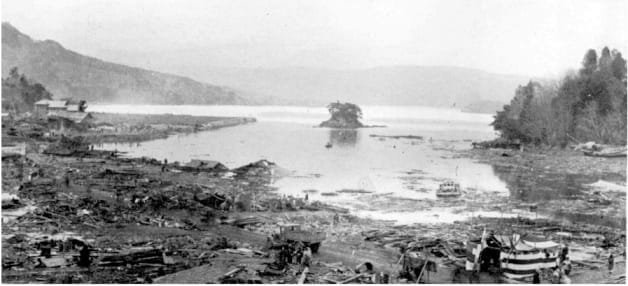
Then, without hesitation, wave after wave slammed into the shore with devastating power. Homes along the waterfront shattered against the relentless impact. Boats were tossed against rocks or hurled inland. The tsunami’s height exceeded several meters, timing waves to crush the coast in roaring succession.
In Yalta, the luxury resorts and modest houses alike suffered. Entire neighborhoods vanished under the brine, and scores of people became trapped, their screams swallowed by the roar of the Black Sea’s vengeful waters.
6. Chaos in Yalta: Eyewitness Accounts and Human Stories
The human toll was staggering. Elena Ivanovna, a local schoolteacher, recounted years later: “It was like the sea had gone mad. One moment it was calm, the next a monstrous wall was upon us. My children clung to me as we fled up the hills, behind us, our village falling apart.”
Another eyewitness, Mikhail Petrov, a fisherman, described the ephemeral calm before chaos: “The water pulled back so far I could walk on the seabed… Then the earth shook under my feet—my boat snapped in two, and the wave came, taller than a house.”
Families were torn apart, infrastructure destroyed, and essential supplies swept away. The suddenness allowed little time for preparation; panic reigned, and many sought refuge on higher ground, some finding salvation, others only despair.
7. Waves of Devastation: The Tsunami's Impact on Coastal Villages
Beyond Yalta, smaller fishing communities—like Alupka and Gurzuf—bore the tsunami’s brunt. These villages, tightly knit and dependent on the sea, witnessed boats smashed, docks obliterated, and fields submerged under saltwater.
The tsunami destroyed orchards and agricultural plots, compounding the disaster’s impact. Loss of livestock was widespread. Livelihoods vanished overnight, and the fragile economies of these communities faced an uncertain future.
The damage was not only physical but psychological—an entire way of life had been violently suspended, as if nature had reached out to warn humanity of its fragile hold on the land.
8. Immediate Aftermath: Rescue, Relief, and the Struggle for Survival
In the hours and days following the disaster, survivors gathered on the hillsides, sheltered from the encroaching waters but exposed to the elements. The Soviet authorities dispatched relief teams, though logistical challenges and political priorities slowed aid efforts.
Medical care was urgently needed; disease and injury threatened the weakened population. Food and clean water shortages worsened suffering, while makeshift shelters struggled against the approaching autumn rains.
Local peasants and workers spontaneously organized rescue missions, their acts of heroism marking the human spirit’s refusal to be submerged beneath despair.
9. Soviet Silence: Political Context and Information Suppression
The Soviet government at the time viewed natural disasters through a prism of propaganda and control. Acknowledging widespread devastation risked undermining the narrative of socialist progress and favoring enemies’ criticisms.
Thus, official reports were sparse and often minimized the tragedy’s scale. News coverage was tightly controlled; foreign press was largely barred, and much of the public was left unaware or only partially informed.
This political silence contributed to the tsunami becoming a “forgotten disaster,” obscured behind the broader upheavals of Soviet transformation and global turmoil between the wars.
10. Scientific Investigations: How Researchers Pieced Together the Disaster
Despite initial suppression, scientists within the USSR and abroad took interest in the 1927 event. Early geologists examined sediment layers and coastal deposits, identifying signs of sudden inundation.
Seismologists compiled data from limited stations, reconstructing the underwater earthquake’s parameters. Studies of local eyewitness testimonies helped build a narrative of the tsunami’s timing and effects.
International research later confirmed that the Black Sea, though small and enclosed, was vulnerable to undersea landslides producing destructive waves. The 1927 event thus became a critical case study in understanding inland sea tsunamis.
11. Legacy in Stone and Memory: The Tsunami’s Long-Term Physical Imprint
Decades after the disaster, physical scars remained visible along the coast. Stripped vegetation, scarred cliffs, and altered shorelines bore silent testimony to the wave’s ferocity.
In some villages, certain buildings were never rebuilt, and ruins stood as monuments to loss. Oral traditions passed down stories of the “great flood,” embedding the tsunami in local folklore.
Yet, without widespread documentation, formal memorials were rare, and the event receded from public consciousness.
12. The Forgotten Disaster: Why the Black Sea Tsunami Remains Little Known
Unlike the catastrophic tsunamis of the Pacific or Indian Oceans, the 1927 Black Sea tsunami is largely absent from global historical narratives. Its small geographical scale, lower death toll relative to other disasters, and Soviet-era censorship all contributed to this obscurity.
Moreover, the Black Sea region’s geopolitical volatility throughout the 20th century—wartime occupations, shifting borders, and Cold War isolation—meant that public memory was fragmented.
This neglect prevents wider acknowledgment of the region’s unique geophysical vulnerabilities and communal histories.
13. Comparing Tsunamis: The Black Sea Event in Global Context
Globally, tsunamis like those in Krakatoa (1883), Chile (1960), and the Indian Ocean (2004) dominate public awareness due to their sheer scale and media coverage. The 1927 Black Sea tsunami, though smaller, shares key characteristics—an underwater trigger, rapid onset, and community disaster.
Its study challenges assumptions that tsunamis are restricted to oceanic coasts, highlighting the risks along inland seas and enclosed bays. This has urged a broader approach in tsunami science and hazard mapping.
14. Lessons from the Deep: How 1927 Informs Modern Disaster Preparedness
Modern science benefits from lessons encoded in the 1927 event. Advances in seismic monitoring, early-warning systems, and community preparedness draw on historical precedents, emphasizing readiness even in areas with historically low tsunami risk.
Emergency planning now recognizes the subtle tectonic dangers of the Black Sea region. Public education and infrastructure resilience have improved, reducing vulnerability to future, potentially more devastating incidents.
15. Renewed Awareness: Recent Studies and Commemorations
In recent years, Ukrainian and Russian researchers, along with international scientists, have revisited the 1927 tsunami’s history and geology. New underwater mapping technologies revealed sediment patterns consistent with the landslide.
Local governments have begun to acknowledge the event through museums, plaques, and educational programs, seeking to reclaim a suppressed chapter of their heritage. The Black Sea tsunami now stands as not only a warning from the past but a symbol of resilience in the present.
16. Conclusion: Echoes from the Black Sea’s Dark Waters
The Black Sea tsunami of September 11, 1927, was a catastrophe born from the depths, a sudden and ruthless reminder of nature’s unpredictable forces. It shattered the tranquility of Yalta and the Crimean coast, inflicted human suffering, and challenged geological assumptions.
Yet, for too long, it lingered in shadow—forgotten by official histories, obscured by politics, and buried beneath waves of time. Today, revisiting its story is an act of recovery: honoring the lives lost, learning from the earth’s movements, and ensuring that the silent horror beneath the Black Sea will no longer be overlooked.
In remembering the tsunami, we confront the fragile dance between humanity and nature—an eternal struggle marked by tragedy, hope, and the enduring will to survive.
Conclusion
The story of the 1927 Black Sea tsunami is one of unexpected devastation and quiet resilience. It underscores how even regions perceived as safe havens can harbor hidden dangers beneath their peaceful surfaces. Through human stories, geological insights, and renewed scholarship, this event rises from obscurity to claim its rightful place in history.
The waves may have receded, but their echoes continue to inform and inspire. As humanity faces growing environmental uncertainties, the lessons from Yalta’s dark day remind us to remain vigilant, compassionate, and united in the face of nature’s might.
FAQs
Q1: What triggered the 1927 Black Sea tsunami?
A powerful underwater earthquake near the Crimean coast caused a massive submarine landslide, which displaced water and generated the tsunami waves.
Q2: Why are tsunamis rare in the Black Sea?
The Black Sea is a relatively enclosed basin with fewer tectonic activities compared to oceans like the Pacific. Its geology is less prone to large-scale seismic events causing tsunamis, making such disasters unusual but not impossible.
Q3: How many people were affected by the tsunami?
Exact figures are hard to determine due to limited records and Soviet-era censorship. Hundreds were killed or injured, with many more displaced in Yalta and surrounding villages.
Q4: Why is the 1927 tsunami not widely known today?
Political suppression, geographical scale, and overshadowing by larger global events contributed to its obscurity, especially during the Soviet period when information was tightly controlled.
Q5: What lessons were learned from the disaster?
It highlighted the need for seismic monitoring in the Black Sea region, awareness of tsunami risks even in enclosed seas, and better disaster preparedness for coastal communities.
Q6: Are there memorials commemorating the 1927 tsunami?
Only recently have some local efforts begun to acknowledge the disaster through plaques and museum exhibitions, aiming to preserve its memory.
Q7: Could a similar tsunami happen again in the Black Sea?
While rare, ongoing tectonic activity means that tsunamis remain possible, particularly if submarine landslides are triggered by new earthquakes or geological shifts.
Q8: How does the 1927 event compare to other historic tsunamis?
Though smaller in scale, it shares common features with famous tsunamis and importantly expands understanding to include risks in inland or enclosed seas.