Table of Contents
- The Final Twilight of a Philosopher: Boethius’s Last Day in Pavia
- The World of Late Antiquity: Italy on the Brink of Change
- Boethius’s Early Life: From Noble Birth to Intellectual Ascendancy
- The Political Turmoil of Theodoric’s Italy: Shadows and Panics
- Boethius the Statesman: Power and Influence at the Ostrogothic Court
- The Charges of Treason: A Turning Point in Boethius’s Life
- Imprisonment in Pavia: A Cell for the Mind and Soul
- The Consolation of Philosophy: Birth of a Timeless Work
- The Imminent Execution: Fate Sealed at Dawn
- The Method of Execution and its Historical Context
- The End of Boethius: Death of a Philosopher in a Dark Age
- The Immediate Reactions: Shockwaves Through Italy and Beyond
- The Consolation’s Journey: Influence Through the Centuries
- Rediscovery in the Middle Ages: Boethius as a Medieval Authority
- Boethius’s Legacy in Philosophy and Politics
- The Symbolism of Boethius’s Death in Modern Historical Memory
- Reflections on Justice, Power, and Intellectual Freedom
- Boethius Today: Why His Story Endures
- Frequently Asked Questions
- External Resource
- Internal Link
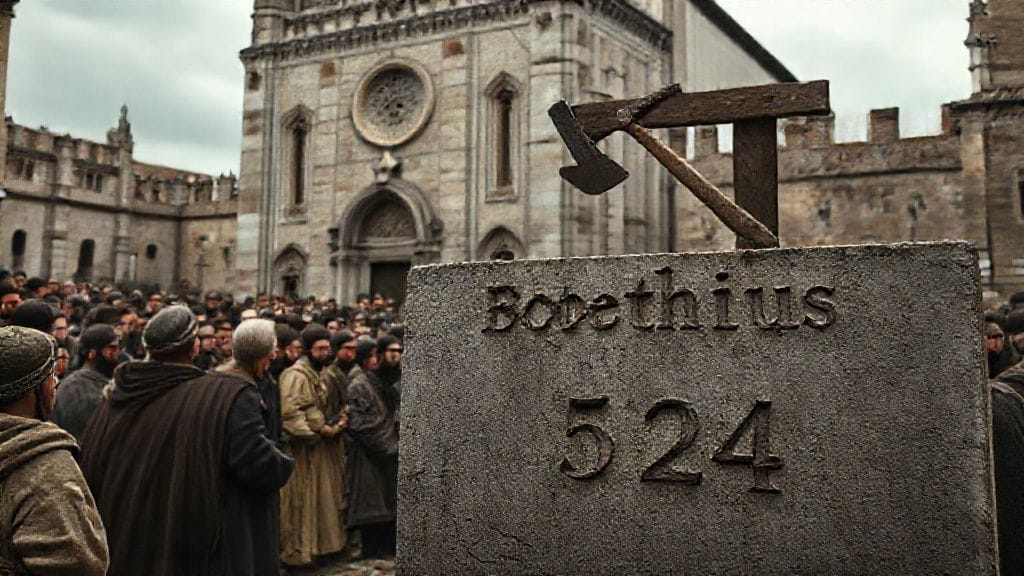
The final twilight of a philosopher was dim and damp, the heavy stones of a Pavia prison cell closing in around a man whose mind still roamed the heavens. It was approximately 524 AD when Anicius Manlius Severinus Boethius, the Roman senator and philosopher, met his tragic fate: execution under the orders of Theodoric the Great, king of the Ostrogoths. The cold, grey light of that morning bore witness not to the fall of a rebel but to the silencing of one of Late Antiquity’s greatest intellectuals.
His death was not a simple political assassination; it was a profound collision of power and thought, a symbol of an era in flux where classical knowledge was caught between fading Rome and rising barbarian kingdoms. To understand Boethius’s execution is to dive deep into the ripples of empire, philosophy, and personal tragedy. His life, marked by brilliance and service, ended at the crossroads of loyalty and suspicion—a human drama still echoing across the corridors of history.
The World of Late Antiquity: Italy on the Brink of Change
The Italy of Boethius’s time was a land scarred by the collapse of imperial order but still grappling with Roman identity. The Western Roman Empire had fallen decades earlier, and Ostrogothic kings, led by Theodoric the Great, ruled from Ravenna, striving to maintain Roman traditions while asserting Gothic dominance. This uneasy coexistence was riddled with political tension, cultural shifts, and religious conflict between Arian Christians and the Catholic majority.
Within this fragile balance, the old Roman aristocracy sought to retain their privileged status. Boethius belonged to this senatorial class, steeped in tradition and classical education. Intellectual life was paradoxically flourishing and threatened. The collapse of centralized power had left a vacuum that bred anxiety and opportunism, a proving ground where loyalty was suspect and survival precarious.
Boethius’s Early Life: From Noble Birth to Intellectual Ascendancy
Born into a distinguished Roman family around 477 AD, Boethius inherited a legacy of intellectual prestige. His family was intertwined with the highest echelons of government and society. Boethius’s education was rooted in the classical Greek and Latin traditions; he mastered philosophy, logic, and theology, and developed a deep admiration for Plato and Aristotle, whose works he translated and commented upon.
Rising through the ranks, Boethius became Consul in 510 AD, holding one of the highest offices in the Ostrogothic kingdom. His career was that of a man bridging worlds—Roman aristocrat and Gothic official, pagan-influenced scholar and Christian devotee. His intellect and administrative skills brought him close to Theodoric, who trusted him with key diplomatic missions.
The Political Turmoil of Theodoric’s Italy: Shadows and Panics
Theodoric’s reign aimed for stability but was riddled with undercurrents of suspicion. Theodoric, educated in Constantinople and ruling a majority Latin Catholic population with a Gothic Arian minority, walked a political tightrope. His paranoia grew over supposed Byzantine plots and Catholic conspiracies.
Boethius, despite his loyalty, found himself ensnared in this web of mistrust. Theodoric’s regime was marked by occasional purges; previous Roman officials had been executed on questionable grounds. And yet, Boethius was renowned for his impartiality and moderation, making his downfall all the more poignant and emblematic of the era’s chaos.
Boethius the Statesman: Power and Influence at the Ostrogothic Court
Before his fall from grace, Boethius was a man at the height of political influence. As magister officiorum, he directed the administration and justice system, acting as a linchpin between the Roman elite and Gothic rulers. His diplomatic missions to the Eastern Roman Empire underscored his importance in maintaining delicate ties across borders.
Boethius’s attempts to weave Roman legal traditions into Gothic governance demonstrated his commitment to preserving classical civilization’s principles within a transformed political landscape. Yet, this bridge-building became a double-edged sword, arousing suspicion that his loyalties might not fully lie with the Gothic king.
The Charges of Treason: A Turning Point in Boethius’s Life
Theodoric’s accusations against Boethius were grave: conspiracy with the Byzantine Empire and treason against the Ostrogothic crown. What precisely Boethius was alleged to have done remains debated by historians, but likely the charges were fueled by court intrigues, religious tensions, and Theodoric’s increasing distrust.
Arrested in Pavia, Boethius faced a swift trial, undermined by political expediency. Despite his status and previous service, he was condemned to death—a stark reminder of how precarious power was in this volatile era. The loss was not just political but intellectual: the silencing of a mind who sought harmony amid discord.
Imprisonment in Pavia: A Cell for the Mind and Soul
Boethius’s imprisonment was characterized less by physical hardship than by profound intellectual and spiritual struggle. Locked away in a bleak chamber, the future philosopher found refuge not in despair but in thought. The human capacity to turn inward became his sanctuary.
It was during this confinement that Boethius composed "The Consolation of Philosophy," his magnum opus written as a dialogue between himself and Lady Philosophy. This work would forever immortalize his voice and thoughts, a luminous beacon in the darkness encroaching upon Western civilization.
The Consolation of Philosophy: Birth of a Timeless Work
Crafted in the solitude of prison, "The Consolation of Philosophy" interweaves prose and poetry, blending classical philosophy with personal lament. Boethius grapples with fortune's fickleness, the problem of evil, and the anticipation of death—yet ultimately affirms the immortality of the soul and divine justice.
This work is more than a reflection on grief; it stands as a masterpiece of philosophical resilience, a testament to the power of the human spirit to seek meaning even at the brink of oblivion. For centuries, it would provide solace to those confronting misfortune.
The Imminent Execution: Fate Sealed at Dawn
Boethius’s final hours were marked by a poignant awareness of mortality. Though historical records provide limited detail, contemporary and later sources evoke a man composed in the face of death, steadfast in his faith and philosophy.
His execution, likely carried out at dawn to avoid public disorder, signaled the abrupt end of a life devoted to reason and service. Yet, paradoxically, his death would ensure an enduring legacy far beyond the limits of that grim morning.
The Method of Execution and Its Historical Context
In the early 6th century, executions of high-ranking prisoners were often conducted by beheading, a swift method contrary to the torture common in lower classes. While records do not specify with certainty, Boethius was probably decapitated, symbolically severing the connection between mind and body.
This act was not a mere punishment but a message: the extinction of a political threat and, implicitly, of a competing intellectual voice. Theodoric’s regime, striving for security amid instability, chose to extinguish rather than debate dissent.
The End of Boethius: Death of a Philosopher in a Dark Age
Boethius’s execution represents a critical juncture in Late Antiquity—between classical antiquity's fading light and the dawning complexity of medieval Europe. It marked the silencing of one of the last great Roman philosophers and lawmakers in an era increasingly dominated by tribal kings and religious dogma.
His death embodies the tension between reason and power, culture and survival. It is a moment when intellectual courage faced political cruelty, and history took a somber turn.
The Immediate Reactions: Shockwaves Through Italy and Beyond
News of Boethius’s death spread with a mixture of fear and sorrow. Among the Roman aristocracy, it confirmed the dangers of political ambition and Gothic suspicion. To many, Boethius became a martyr of intellect, a symbol of eroding freedoms under foreign rule.
The Gothic court maintained a façade of stability, but beneath simmered unease. Byzantine observers, wary of Theodoric, likely saw this as evidence supporting their mistrust. Boethius’s execution thus reverberated beyond Italy, a warning to thinkers and statesmen alike.
The Consolation’s Journey: Influence Through the Centuries
Despite his brutal end, Boethius’s ideas survived—and thrived. "The Consolation of Philosophy" became a foundational text in medieval education, translated into numerous languages and studied by theologians, kings, and scholars.
Its influence touched figures as varied as Thomas Aquinas, Dante Alighieri, and Queen Elizabeth I. The text bridged pagan philosophy and Christian theology, epitomizing the transmission of classical wisdom into later ages.
Rediscovery in the Middle Ages: Boethius as a Medieval Authority
The Middle Ages recast Boethius as a saintly scholar, a beacon of wisdom amid darkness. His blending of Platonic and Aristotelian ideas with Christian thought provided a framework for medieval philosophers wrestling with questions of knowledge, fate, and divine providence.
Universities across Europe taught his works, which shaped doctrines of natural law and ethics. Boethius became less a fallen politician and more an emblematic intellectual martyr whose execution accentuated his authority.
Boethius’s Legacy in Philosophy and Politics
Philosophically, Boethius contributed to the preservation and dissemination of classical thought at a crucial historical threshold. Politically, his life warned of the fragility of statesmanship amidst authoritarian fears and cultural upheaval.
His reflections on fortune, free will, and divine justice continue to resonate in modern discourse, reminding us of the eternal conflict between human ambition and cosmic order.
The Symbolism of Boethius’s Death in Modern Historical Memory
In modern historiography, Boethius’s death epitomizes the tragic intersection of intellect and autocracy. His fate has been invoked as a symbol of wisdom oppressed by tyranny, often romanticized as the “last great Roman” silenced by barbarian rule.
His story invites reflection on the precariousness of freedom and the enduring power of ideas to outlive their authors.
Reflections on Justice, Power, and Intellectual Freedom
Boethius’s ordeal underscores the timeless dilemmas involved when authority confronts conscience. His writings wrestle with the paradox of justice denied and freedom constrained, while maintaining hope in ultimate moral order.
His life and death challenge us to consider the price of speaking truth to power and the resilience of the human spirit in facing injustice.
Boethius Today: Why His Story Endures
Today, Boethius remains an essential figure for scholars and readers interested in the transmission of classical wisdom, the foundations of Western philosophy, and the human capacity for hope in adversity.
His story is a bridge linking ancient legacies to contemporary struggles for justice and intellectual freedom—a testament to the enduring relevance of history’s philosophers.
Conclusion
Boethius’s execution in Pavia around 524 AD was more than a political act—it was the silencing of a luminous mind poised between two worlds. Amidst turmoil and suspicion, power chose elimination over dialogue, and yet, the philosopher’s voice was far from extinguished. Through his magnum opus, "The Consolation of Philosophy," Boethius transcended fate and time, offering a legacy of courage, reflection, and hope that continues to inspire.
His life and death illuminate the delicate dance of politics and intellect, reminding us of the perennial need to balance authority with justice, fear with trust, and power with wisdom. Boethius’s tragedy is ultimately a celebration of the enduring human spirit, capable of finding solace and meaning even in the shadow of its demise.
FAQs
Q1: Who was Boethius and why was he important?
A1: Boethius was a Roman senator, philosopher, and statesman during the early 6th century. He played a key role in preserving and interpreting classical philosophy, especially through his work "The Consolation of Philosophy," and was a vital link between the ancient and medieval worlds.
Q2: What were the main reasons for Boethius’s execution?
A2: Boethius was accused of treason and conspiracy against Theodoric the Great, likely due to political intrigue, religious tensions, and Theodoric’s growing paranoia. The precise details remain debated, but suspicion of collaboration with the Byzantine Empire was central.
Q3: What is "The Consolation of Philosophy" about?
A3: Written during his imprisonment, the work explores themes like the fickleness of fortune, free will, the nature of happiness, and divine justice—expressed through a dialogue between Boethius and Lady Philosophy.
Q4: How did Boethius’s death affect his contemporaries?
A4: His execution shocked the Roman aristocracy and intellectual circles, signaling the dangers of political life under Gothic rule and becoming a potent symbol of lost freedoms and the clash of cultures.
Q5: What influence did Boethius have on medieval thought?
A5: His writings became central to medieval education, theology, and philosophy, influencing figures from Thomas Aquinas to Dante, helping transmit classical knowledge through the Middle Ages.
Q6: Why is Boethius’s story still relevant today?
A6: His experience highlights enduring themes of justice, political power, and intellectual freedom, inspiring ongoing reflection on the role of philosophy in confronting adversity and the resilience of human hope.
Q7: What does Boethius’s execution tell us about Late Antiquity?
A7: It reveals the volatile nature of the period marked by shifting powers, cultural conflicts, and the precarious survival of Roman intellectual traditions under barbarian rulers.
Q8: Where can I learn more about Boethius’s life and work?
A8: A comprehensive overview is available on his Wikipedia page.

