Table of Contents
- Storm Gathering Over Britannia: Setting the Scene in 60 CE
- Rome Comes to the Edge of the World: Conquest of Britannia
- Iceni, Trinovantes, and the Shadow of Empire
- A Queen Called Boudica: Life Before the Inferno
- Broken Oaths: The Spark That Ignited Boudica’s Revolt
- Fire in the East: The Fall of Camulodunum
- Londinium in Flames: The Slaughter of a Roman Dream
- Verulamium and the Road of the Dead
- Inside the Rebel Host: Warriors, Families, and Fury
- Suetonius Paulinus: The General Who Turned Back the Tide
- The Final Stand: Battle on the Unknown Road
- Defeat, Death, and Silence: The End of Boudica’s Revolt
- Counting the Dead: Violence, Propaganda, and Roman Memory
- Aftermath in Britannia: Repression, Reform, and Uneasy Peace
- Between Legend and Record: How Historians Reconstruct the Revolt
- Boudica Through the Ages: From Savage Rebel to National Icon
- Women, Power, and Empire: The Deeper Meanings of the Uprising
- Echoes of Rebellion: Why Boudica’s Story Still Resonates
- Conclusion
- FAQs
- External Resource
- Internal Link
Article Summary: In the year 60 CE, on the far, windswept edge of the Roman world, a catastrophe erupted that would haunt imperial memory for generations: boudica’s revolt. This article follows the arc of that uprising from the heavy-handed Roman conquest of Britannia to the humiliation of a queen, the burning of cities, and the final, desperate battle that crushed the rebellion. Along the way, it paints the world of the Iceni and their allies, the ambitions of Roman governors, and the ordinary lives caught between them. The narrative explores not only the military events but also the psychological shock, gendered power, and colonial violence that drove the revolt. It examines how Roman authors like Tacitus and Cassius Dio shaped what we know, and what they chose to leave in shadow. The story then traces how Boudica’s image evolved—from a vengeful barbarian to a symbol of British resistance and female strength. Ultimately, the article argues that the uprising was both a brutal tragedy and a revealing x-ray of empire, exposing the fault lines that run beneath every conquest. And as you will see, the echoes of Boudica’s chariots still roll across modern debates about resistance, identity, and the meaning of freedom.
Storm Gathering Over Britannia: Setting the Scene in 60 CE
The year is 60 CE. Far from Rome’s marble forums and orderly avenues, a cold wind sweeps the low, misty hills of eastern Britannia. The soil here is dark and heavy; the sky hangs low, as if weighed down by the sea itself. To Roman officials, this island at the edge of the known world is a stubborn province to be tamed and taxed. To the peoples of Britannia—the Iceni, the Trinovantes, the Catuvellauni, and many others—it is a homeland layered with sacred groves, ancient burial mounds, and stories old enough to have no beginning.
Boudica’s revolt did not appear from nowhere; it arrived like a storm long building on the horizon. In the two decades since Roman legions first splashed ashore under Emperor Claudius, Britannia had been reshaped by force. Roads cut across tribal lands, forts rose where fields once lay, and the jingling of Roman coins mixed uneasily with the clatter of local chariot wheels. Some Britons adapted, traded, even prospered under the new order. Others simmered, humiliated by foreign governors, resentful of tribute, anxious as their gods and customs were pushed aside.
By 60 CE, the imperial administration believed the worst was over. Armies had marched deep into Wales; resistance seemed splintered and fading. Yet beneath that outward calm lay a fragile peace, held together not by respect but by fear. Boudica, queen of the Iceni, would soon show the Romans how quickly such peace could rupture. Her uprising would become one of the most violent episodes in Roman provincial history, leaving tens of thousands dead, cities in ashes, and the empire itself briefly trembling at the thought that it might lose Britannia altogether. But this was only the beginning of the story.
Rome Comes to the Edge of the World: Conquest of Britannia
To understand why Boudica’s revolt erupted with such fury, we must go back to Rome’s first serious encounter with Britannia. Julius Caesar had crossed the Channel a century earlier, in 55 and 54 BCE, but his expeditions were little more than armed reconnaissance, designed as much for prestige back in Rome as for conquest. He bullied a few local kings into paying tribute, took hostages, and departed. The island retreated once more into distant rumor, its people dismissed as rugged barbarians who painted their bodies and worshipped strange gods.
The full conquest did not come until 43 CE, when Emperor Claudius—an unlikely ruler with a reputation for weakness—needed a decisive military success to consolidate his position. Britannia offered that opportunity. A large invasion force, perhaps around 40,000 men including auxiliaries, crossed under Aulus Plautius. They fought their way inland, battling tribes who knew every hill and marsh, but who lacked the discipline and siegecraft of Rome’s legions. Claudius himself arrived with reinforcements, including war elephants, lending drama to the campaign. The capture of Camulodunum, a major British stronghold, was staged as a victory worthy of Roman triumphs.
Conquest, however, did not mean control. Rome’s strategy relied on a mixture of direct rule over some areas and indirect rule through client kings in others. Instead of extinguishing every local ruler, Roman governors often confirmed tribal dynasts who pledged loyalty and tribute. One such figure was Prasutagus, king of the Iceni—Boudica’s husband. His kingdom in eastern Britannia, in what is now roughly Norfolk, was left formally independent but bound to Rome’s interests. Rome collected taxes, demanded troops for campaigns, and expected obedience. In exchange, client kings received Roman recognition, trade opportunities, and occasional military support against rivals.
On the surface, it looked like a stable arrangement. The legions pushed westward, toward the mountains of Wales and the island of Anglesey, stronghold of the druids. Behind them, in the east, towns with Roman-style forums and temples rose, especially Camulodunum. But beneath this veneer, resentment fermented. Taxes were heavy, Roman financial agents ruthless. Land surveys and legal reforms often favored settlers and collaborators over local communities with ancestral claims. Religious centers were desecrated or replaced with Roman temples, including a shrine to the deified Claudius, a god no Briton had worshipped before. Claudius might be divine to Romans; to many Britons, he was a distant invader forced into their sacred landscape.
It’s astonishing, isn’t it, how an empire so disciplined in war could be so clumsy in peace? Britannia was being bound to Rome, but the cords were rough and cutting. Boudica’s story begins in this growing chafing between conqueror and conquered.
Iceni, Trinovantes, and the Shadow of Empire
The Iceni were one of several powerful tribes in eastern Britannia, occupying lands that stretched across the low, rolling terrain of what would later be East Anglia. They were not an isolated people; archaeological finds show trade links across the Channel and intricate metalwork that speaks of skilled artisans and sophisticated elites. Their warriors rode in light chariots with iron-rimmed wheels, and their chiefs displayed status through elaborate torcs and finely worked weaponry. To the Romans, they were both potential allies and potential obstacles.
As a client kingdom, the Iceni were nominally independent. They minted their own coins before the conquest and retained some internal autonomy afterward. But Roman influence crept steadily in. Latin inscriptions, Roman goods, and foreign merchants began to appear. Tribal leaders navigated a complicated web of loyalties—to their people, to rival tribes, and to the imperial overlords beyond the sea.
Close by were the Trinovantes, a tribe who had once dominated southern Britannia and whose territory included the region where Camulodunum would be established. They had felt the brunt of Roman intrusion more directly. The creation of a Roman colonia at Camulodunum uprooted local populations and inserted retired Roman soldiers into the heart of tribal land. These veterans, flush with privilege and protected by the law, could be overbearing neighbors—arrogant, dismissive, and often predatory in their dealings with locals. For the Trinovantes, humiliation was daily and tangible: land seized, authority sidelined, and their former centers of power repurposed into symbols of Roman dominance.
Between these peoples ran older rivalries and new alliances. Some among the Iceni saw cooperation with Rome as a way to strengthen their position against neighbors like the Trinovantes. Others viewed any compromise as betrayal. Rome exploited these divisions, as it had done throughout the Mediterranean world and beyond—calibrating pressure, rewarding compliant chiefs, punishing the defiant.
Yet despite these strategies, Roman officials never truly understood the cultural world they were dismembering. Sacred groves, where druids officiated rituals beneath ancient trees, were more than religious sites—they were political and social hubs. To deforest or desecrate them was to attack the nerve centers of communities. Laws written in Latin, recorded on wooden tablets or stone, collided with oral traditions and customary rights that had bound tribes together for generations. The Romans saw themselves as bringers of order and civilization; to many Britons, they appeared as destroyers of everything that made life meaningful.
It was in this complex, tense landscape that a woman named Boudica, queen of the Iceni, would soon step onto the stage of history with a fury that shook the province to its foundations.
A Queen Called Boudica: Life Before the Inferno
Boudica herself emerges from the sources like a figure half-lit by firelight—vivid in some details, lost in shadow in others. The Roman historian Tacitus, writing some decades later, describes her as tall, with a “piercing gaze” and long, reddish hair that fell below her waist. Her voice, he tells us, was harsh, and her presence commanded attention. Cassius Dio, a later writer, would embellish this image, clothing her in a brightly colored tunic with a thick cloak fastened by a brooch, a gold torc gleaming at her neck. How much of this is fact and how much artistic license is hard to say, but the impression is unmistakable: even her enemies could not ignore her.
Before boudica’s revolt, she was likely enmeshed in the daily realities of ruling a client kingdom. As the wife of Prasutagus, she moved in a world of negotiations with Roman officials, tribal councils, feasting halls, and ritual obligations. She had at least two daughters, whose names have not survived, and whose fate would become a raw wound that drove the uprising. At some level, she would have understood the fragile balance that kept the Iceni afloat between Roman demands and tribal expectations.
Was she in favor of accommodation with Rome before events turned violent? The sources are silent. Yet as queen, Boudica probably presided over ceremonies, distributed gifts to warriors, mediated disputes, and listened as elders weighed the changing world. She would have seen Roman merchants hawking wine, oil, and fine pottery; she would have heard soldiers speaking Latin in the distance, their armor clinking. She might even have met Roman officials, learning to read the condescension in their eyes as they addressed her husband more seriously than they did her.
In the Roman imagination, powerful women were often an anomaly, a threat, or a curiosity. In many Celtic societies, however, women could own property, inherit status, and in rare cases, rule. Boudica’s very position was a statement about the differences between Roman and British gender norms. That difference would become a weapon in the empire’s own narratives, with Roman authors alternately marveling at and condemning the idea of a warrior queen leading men into battle.
We should not romanticize her world. Power in Iceni society, as in Rome, was hierarchical and often brutal. Slavery existed; war was a path to glory as much as to grief. But for Boudica, life before the cataclysm seems to have been defined by continuity, by a sense that her people’s way of life, though pressured, would endure. That illusion shattered with her husband’s death and the Roman decisions that followed.
Broken Oaths: The Spark That Ignited Boudica’s Revolt
The core of boudica’s revolt was not simply hatred of Rome but rage at betrayal. When Prasutagus died—probably around 60 CE—he left a will that tried to safeguard his kingdom. According to Tacitus, he named both the emperor and his own daughters as heirs, hoping that by flattering imperial power and preserving his bloodline, he could keep the Iceni semi-autonomous. It was a political tightrope act, reflecting years of experience dealing with Rome’s towering pride.
Rome refused to play along. Instead of honoring Prasutagus’s will, imperial agents moved as if Britannia were already fully annexed and its client kings disposable. Lands were seized as if they were deserted estates; the Iceni nobility were stripped of property, flogged, or reduced to poverty. Tacitus writes with cold clarity: “His kingdom was ravaged by centurions and slaves, as though it had been a prize of war.” The phrase captures the contempt with which some Roman officials treated allied populations.
Boudica herself was subjected to a humiliation designed to crush not just her, but the entire tribe’s spirit. She was publicly flogged—beaten before her people—and her daughters were raped by Roman soldiers or their attendants. Whether this act was ordered by officials or allowed by their complicity almost doesn’t matter; either way, it signaled a total denial of Iceni dignity. The queen of a client kingdom had been treated as a criminal slave. The message was unmistakable: Rome would brook no rival authority, no independent pride.
It is here that the personal and political fused into a single, unstoppable force. Boudica’s bruised body, her daughters’ trauma, the dispossession of her nobles—these were not isolated crimes. They crystallized years of fear and anger. Loan-sharks from Rome, like the famous Seneca, had already lent large sums to provincial elites, then called in debts ruthlessly. Roman veterans strutted at Camulodunum, taunting locals whose land they occupied. Temples to the imperial cult rose like accusations, demanding worship of foreign emperors while local gods were sidelined or insulted.
According to Tacitus (Annals 14.31–32), Boudica did not suffer in silence. She addressed her people, turning pain into rallying cry. Though the exact words are almost certainly literary inventions, Tacitus reports her insisting that she fought “as one of the people,” not as a noble above them, avenging “lost freedom, a body tortured by the lash and the violated chastity of my daughters.” In this moment, the queen spoke as both ruler and mother, as a woman whose personal injuries mirrored those of her entire society.
Boudica’s fury found eager ears. The Iceni were not alone in their hatred for Rome. The Trinovantes, seething over the presence of the Roman colonia and the oppressive temple of Claudius, were primed for rebellion. Rumors spread quickly: the Roman governor, Suetonius Paulinus, was far to the west, campaigning in Wales against the druids. The legions were divided and distracted. The hour had come. What began as the outrage of one queen became the engine of a massive uprising that would nearly drive Rome from Britannia.
Fire in the East: The Fall of Camulodunum
Camulodunum was the first to burn. Once a stronghold of British power, it had been transformed into a Roman colonia, a settlement for retired soldiers who received land in reward for their service. For the Trinovantes, it was a daily reminder of defeat and dispossession. The imposing temple to the divine Claudius dominated the skyline, its columns, altars, and statuary proclaiming Rome’s permanence. Yet behind the celebrations of Romanization, resentment coiled tightly.
When boudica’s revolt erupted in 60 CE, Boudica and her allies understood the symbolic and strategic importance of striking Camulodunum. This was the proudest outpost of Roman civilization in the region, an island of Latin-speaking arrogance in a sea of resentful Britons. The city, however, was poorly defended. Overconfident in its status and the perceived loyalty of its surroundings, it lacked proper fortifications. According to Tacitus, Roman veterans dismissed warnings of rebellion as the fears of provincials. They mistook their fragile dominance for security.
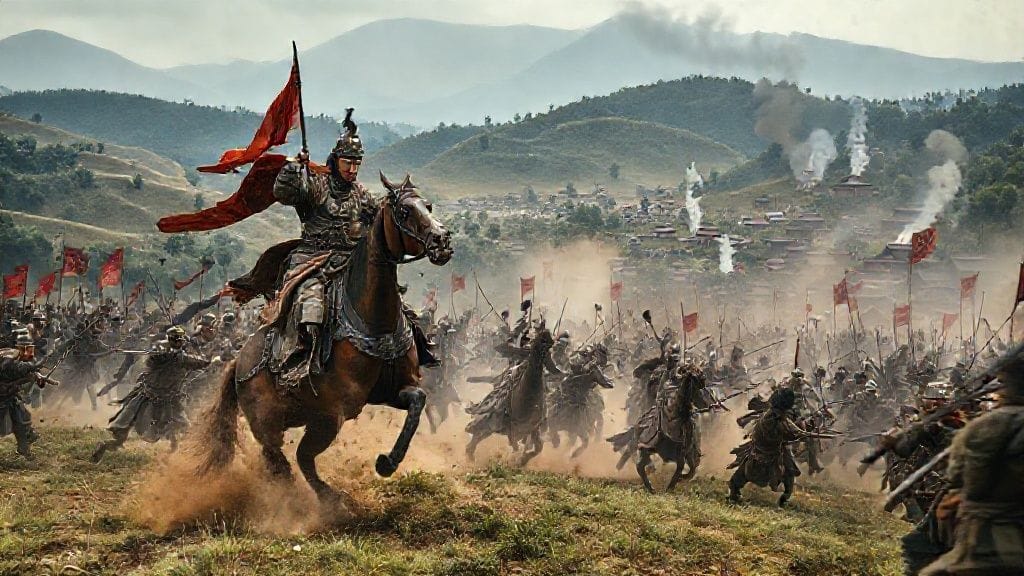
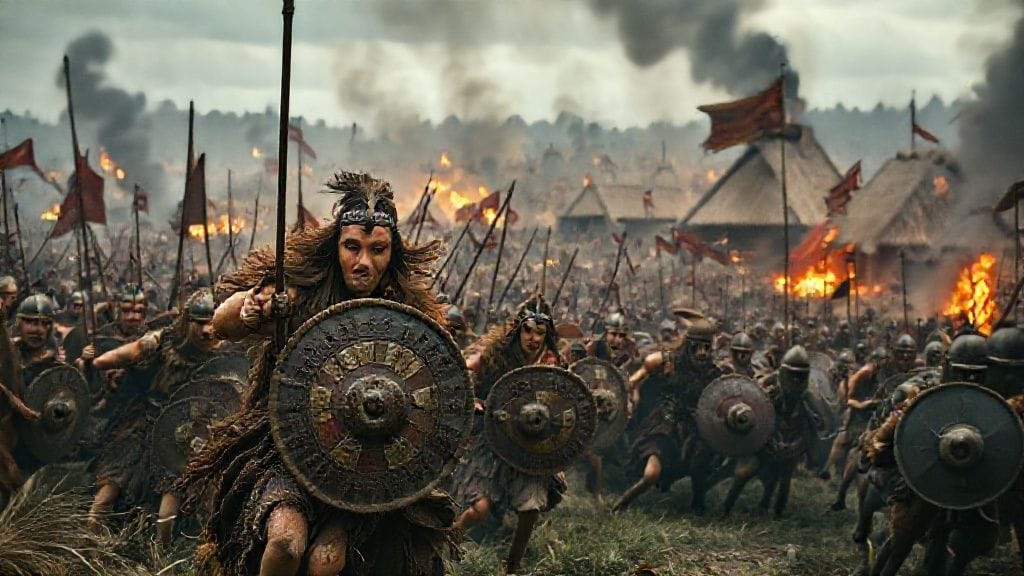
The attack came with terrifying speed. Iceni and Trinovantian warriors swarmed toward the city, chariots rattling over the roads Rome itself had laid. Archaeology has revealed layers of burning in the area, proof that the destruction was not just literary drama but physical fact. Once the rebels breached the flimsy defenses, they unleashed their rage on everything that represented Roman rule. Villas and houses of the colonists were looted and torched. Families who had believed themselves untouchable ran through streets choked with smoke, hunted down by people whose land they had taken.
Inside Camulodunum, some Romans and loyalists barricaded themselves within the temple of Claudius. For two days, they held out, the thick walls that had once inspired awe now serving as their last refuge. But no relief came quickly enough. The only nearby troops were a small detachment that attempted to rescue the city, led by a certain Petilius Cerialis. His infantry was ambushed and massacred; only some cavalry escaped. With that, the fate of Camulodunum was sealed. Rebels stormed the temple, slaughtered its defenders, and burned the shrine to the emperor-god. The sacred heart of Roman confidence went up in flames.
Camulodunum’s fall shocked the province. Thousands, perhaps more, died. News raced along roads and bridle paths alike. To the Britons, it was vindication—a sign that Rome could be struck down, that its “eternal” monuments were as vulnerable as any thatched roof. To Roman officials, it was a nightmare come true: a coordinated, ferocious uprising at the worst possible time, when their main forces were days or weeks away.
But this was only the beginning. The tide of Boudica’s rebellion, swollen with victory and fury, turned its gaze toward a younger, richer prize: Londinium.
Londinium in Flames: The Slaughter of a Roman Dream
Londinium in 60 CE was not yet the bustling capital it would become in later centuries, but it was already a thriving commercial hub. Perched on the north bank of the Thames, it had grown rapidly since the Roman invasion, its wooden wharves lined with ships from Gaul and beyond. Merchants walked its streets, speaking a babel of tongues—Celtic dialects, Latin, perhaps even Greek—while goods from across the empire changed hands. It was a place of promise, of profit, and of risk.
When Suetonius Paulinus heard of the disaster at Camulodunum, he marched his forces east with grim determination. He reached Londinium and surveyed the situation. The town contained merchants, families, soldiers, slaves—a population too large and poorly defended. His legions were too few to hold it against the swelling numbers of Boudica’s host. In one of the most chilling decisions of his career, he chose to abandon Londinium to its fate.
Tacitus records that Paulinus urged those who could to flee with him, but many stayed—too old, too tied down by property, too slow to believe that catastrophe was truly coming. They were still there when Boudica’s army arrived.
What followed was not a battle so much as a purge. Boudica’s warriors surged into the city, cutting down anyone associated with Rome. Shops and warehouses were looted; houses were smashed open. Flames roared along the streets, leaping from building to building. Archaeologists have found a thick “burnt layer” beneath modern London—a testimony to the scale of the destruction. Charred timbers, melted glass, and burned grains speak more eloquently than any text.
The violence, according to Roman sources, was total and merciless. Dio, writing with rhetorical flourish, describes the tortures inflicted on those captured, particularly on women, including noble Roman matrons. Some of these accounts are likely exaggerated, shaped as much by Roman fear and prejudice as by reality. But even allowing for hyperbole, the death toll was staggering. Tacitus estimates that between the destruction of Camulodunum, Londinium, and another town soon to fall, around 70,000–80,000 Romans and provincials were killed. The figure may be inflated, yet even a fraction of it would represent one of the deadliest uprisings in Roman provincial history.
In Londinium’s choking smoke, Boudica’s revolt reached its most terrifying momentum. Here, the abstract grievances of taxation and cultural humiliation became something brutally concrete. The bodies of Roman citizens lay amid the ruins of their imported luxuries; their wealth, their confidence, their supposed superiority lay in ash. For those who survived and fled, the image of a red-haired queen presiding over fire and death would never fade.
Yet behind the scenes of this triumph, new problems emerged. How long could such a vast, lightly organized army sustain itself? How could it transition from furious destruction to stable rule? Those questions would soon crash into the steel discipline of a Roman general determined to restore imperial honor at any cost.
Verulamium and the Road of the Dead
After Londinium, Boudica’s army moved on Verulamium (near modern St Albans), another center of Romanized life in Britannia. Unlike Camulodunum, it was not a colonia of veterans, but a municipium—a town with a significant local population that had adopted Roman ways. Its elites wore Roman-style clothing, built Roman-style houses, and participated in Roman-style government. To the rebels, such Britons were doubly traitorous: not only were they complicit in imperial rule, they had enthusiastically embraced it.
The pattern repeated. As Suetonius Paulinus continued maneuvering his troops, Boudica’s forces struck Verulamium before it could be adequately defended. Fires tore through timber buildings; statues toppled; shrines were desecrated. Again, non-combatants bore the brunt of the fury. Those who had once walked proudly in togas and spoke of Rome’s greatness now found that their citizenship, or near-citizenship, did not shield them. Death came with a Celtic war-cry, not a legal decree.
The route between these cities became a corridor of horror. Along the Roman roads—those straight, efficient arteries of empire—lay scattered corpses, blackened ruins, abandoned carts. Survivors from one town limped toward another, only to find that it too had fallen or was about to. Imagine, for a moment, being a provincial merchant with Roman citizenship, watching as the world you had invested in, the world you believed would protect you, collapsed in blood and smoke. The certainty that had once come with Roman rule was gone.
Yet for Boudica’s coalition, this was also a moment of precarious triumph. They had dealt three devastating blows to Roman authority in rapid succession. They had destroyed a temple to an emperor, a budding economic capital, and a Romanized town. They had sent governors, creditors, and colonists fleeing for their lives. Word of the revolt must have reached across the Channel to Gaul, perhaps even to Rome itself, where Nero and his court would have listened with tight faces.
Still, cracks were visible. Boudica’s army was vast but unwieldy, a loose confederation of tribes bound by outrage rather than a common long-term strategy. They traveled with families, with wagons, with the loot of towns, slowing their movements. The legions, for all their setbacks, remained intact as cohesive fighting units. They obeyed a single chain of command; they drilled; they could move swiftly and strike decisively.
On the road between the burned-out husks of Verulamium and Londinium, the future of Britannia hung in the balance. Somewhere beyond the horizon, Suetonius Paulinus was choosing the ground on which to make his stand. The storm that boudica’s revolt had unleashed was about to meet the rock of Roman military discipline.
Inside the Rebel Host: Warriors, Families, and Fury
To the Romans, Boudica’s army was a barbarian horde, a chaotic mass surging like a flood. Yet within that sea of warriors moved individuals with stories, hopes, and fears of their own. The rebel host included Iceni warriors, Trinovantian fighters, and likely members of other tribes who saw their chance to strike at Rome. They carried spears, swords, shields painted with bold designs, and they rode in chariots that clattered across the rutted roads with a sound that unnerved legionaries unused to this style of warfare.
Chariots, a hallmark of British warfare described even by Julius Caesar, gave elite warriors both mobility and visibility. Drivers maneuvered the vehicles close to the enemy lines, while fighters hurled javelins or dismounted to engage. The psychological effect of chariots, with their speed and noise, was significant, even if against disciplined infantry their tactical value was limited. To many Britons, chariots symbolized their own martial identity, their defiance of the tight, marching squares of Roman legions.
But this was more than an army. It was a moving people. Women and children accompanied the warriors in wagons. Some came because they had nowhere else to go—their homes already destroyed, their futures uncertain. Others came to witness vengeance or to encourage husbands, fathers, and brothers in battle. The rebels’ supply lines were improvised, relying on seized stores, foraging, and whatever arrangements local communities could offer. After the sack of cities, plunder fueled both survival and indulgence, but it also weighed down the host, slowing it and tying it to the luck of recent victories.
Religiously, the uprising was charged with meaning. Druids and other religious leaders may have interpreted omens, cast lots, or invoked the gods and goddesses of war, earth, and sky. Cassius Dio speaks of women dressed in black, like Furies, gliding among the warriors and shouting curses at Rome. Though he wrote much later and likely dramatized such scenes, they capture a truth: for many Britons, this was not just a political revolt but a sacred war, a chance to avenge broken oaths before both ancestors and deities.
Boudica herself moved among this throng as a living symbol. Mounted in a chariot or on horseback, she embodied the fury and hope of an occupied people. Tacitus offers a speech in which she is said to have contrasted Roman greed and effeminacy with British valor and chastity, insisting that Romans “are no more numerous than others whom we have already destroyed.” The historicity of the exact words is doubtful, but the themes ring true: the rebels believed that Rome was vulnerable, that its power was a façade about to crack.
Yet amidst the righteous anger, there must also have been doubts. Older warriors who remembered life before Rome knew that driving out the legions would not be easy. Some tribal leaders might have worried about reprisals, about the loss of potential trade, about whether a unified post-Roman order was even possible. But for the moment, the momentum of boudica’s revolt swept all before it. Victory seemed attainable. The road ahead, however, was leading them toward a place where Roman discipline would no longer retreat, but turn and strike.
Suetonius Paulinus: The General Who Turned Back the Tide
Gaius Suetonius Paulinus was no stranger to danger. Before his appointment as governor of Britannia, he had campaigned in Mauretania (in North Africa), where he led daring mountain operations and earned a reputation for toughness and determination. He was, in some ways, the perfect man to send to a rugged frontier province—aggressive, ambitious, and experienced in dealing with “barbarian” foes.
When boudica’s revolt exploded behind his back, he was deep in western Britannia, attacking the island of Anglesey (Mona), the spiritual center of the druids. Tacitus paints a vivid scene: Roman soldiers face British warriors lined along the shore, flanked by druids raising their hands to the sky and women in black shrieking curses. For the superstitious legionaries, it was a chilling sight, but discipline prevailed; the Romans crossed, massacred, and destroyed the sacred groves. The destruction of Anglesey was meant to crush the religious nerve of resistance. Instead, it coincided almost exactly with the outbreak of a far larger, more immediate crisis in the east.
News reached Paulinus of Camulodunum’s fall, then of Londinium’s. He now faced a brutal arithmetic. His forces consisted mainly of the XIV Gemina and XX Valeria Victrix legions, with detachments of auxiliaries. Another legion, the II Augusta, remained in the southwest and shamefully failed to join him in time—its commander too paralyzed or cautious to move. With perhaps 10,000 disciplined troops at his disposal, Paulinus was facing a rebel host that Roman sources estimated at 100,000 or more. Even if those numbers are exaggerated, the imbalance was staggering.
Yet Roman military doctrine had not made the empire great by avoiding battles. Paulinus understood that if he retreated endlessly, the province could be lost, morale shattered, and Rome’s prestige fatally undermined. He decided to strike—carefully, on ground of his choosing. Marching quickly along Roman roads, he gathered what forces he could and searched for a battlefield that would neutralize the rebels’ numerical advantage.
He found it along a narrow defile, perhaps near a forested area and with open ground in front. The exact location is lost—historians have debated sites from the Midlands to along the Watling Street—but the logic is clear. By anchoring his small army with woods or hills on either side and having a single approach before them, he could ensure that Boudica’s vast host could not fully surround or outflank him. They would be forced to attack head-on, where Roman formations and discipline could do their work.
As he waited for the rebels to appear, Paulinus must have understood what was at stake. Failure would mean not just his own death, but possibly the evacuation of Britannia, the loss of its resources, and humiliation at Nero’s court. Success, on the other hand, could turn this disaster into an affirmation of Rome’s resilience. On that unnamed road, the fate of the province, and of Boudica’s daring bid for freedom, converged.
The Final Stand: Battle on the Unknown Road
The morning of the final battle dawned with tension that must have been almost unbearable. On one side stood the ordered, glinting ranks of Roman legionaries—some 10,000 men, shields locked, pila (heavy javelins) ready, short swords at their sides. Behind them, clustered tightly, were auxiliary troops from allied peoples, cavalry units ready on the flanks. Their equipment was standardized; their officers barked orders in Latin; they had trained for this exact kind of confrontation.
On the other side, in front and stretching back toward a line of wagons where families had gathered to watch, was Boudica’s host. The rebels likely outnumbered the Romans several times over. War cries echoed across the field, mingling with the rattle of chariots and the murmur of thousands of feet. The wagons at the rear were a fateful decision—meant as a grandstand from which their families could observe victory, they would soon become a deadly trap.
Cassius Dio describes Boudica riding in a chariot with her daughters, driving through the ranks and speaking to her warriors. He claims she declared that she was not fighting for her kingdom or wealth—already lost—but for her “bruised body and outraged daughters,” and called upon the gods to witness that she, “a woman,” would lead men to liberty or death. Whether or not those words were actually spoken, they capture the mood: defiance, desperation, resolve.
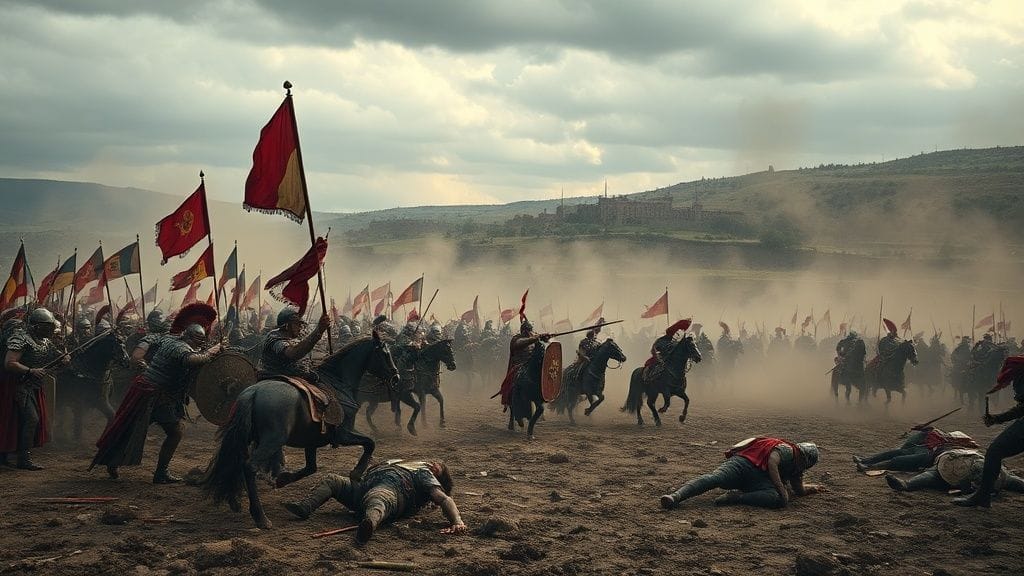
When the first waves of Britons charged, they did so with fierce courage. But courage alone was not enough. The Romans stood firm, letting the rebels close before hurling their pila in deadly volleys. Heavy javelins smashed into the advancing ranks, shattering shields, pinning arms, breaking the momentum. Those who survived the barrage crashed against a steel wall—legionaries who, on command, drew their short swords and stepped forward in disciplined counterattack.
The narrowness of the chosen battlefield now told. The British warriors could not fully deploy their numbers; they were funneled into a killing ground. Chariots, which required space to maneuver, found themselves squeezed and entangled amid dense masses of fighters. As bodies piled up, movement became more difficult. The Roman infantry, drilled to maintain formation even in chaos, advanced steadily, shield to shield, sword thrusting in short, efficient arcs.
Once the British front lines began to waver, Roman cavalry surged from the flanks, exploiting weakness and turning disarray into rout. Panic swept through the rebel host, and warriors tried to flee back toward the safety of their families. But the wagons and carts, arranged to witness triumph, now blocked their retreat. Horses crashed into overturned carts; men and women were trampled underfoot. Roman troops, sensing total victory, slaughtered indiscriminately.
Tacitus writes that “no quarter was given,” and claims that around 80,000 Britons died, compared to only 400 Romans. Such precise figures, especially for enemy casualties, are inherently suspect, more rhetorical than statistical. Yet the qualitative truth remains: it was a massacre. Boudica’s army, unstoppable in the open, undisciplined destruction of cities, was catastrophically unsuited to this kind of set-piece battle against a professional army on well-chosen ground.
As the sun moved across the sky, the field that had that morning teemed with hope and ferocity was carpeted with the dead—warriors, mothers, children, even horses, all mingled in the mud and blood. The uprising that had turned Britannia upside down was over, shattered in a single day’s fighting. The chariots fell silent. The rebel drums stopped. Only the clink of Roman armor and the moans of the dying remained.
Defeat, Death, and Silence: The End of Boudica’s Revolt
What became of Boudica after the battle? Here, the sources diverge slightly and the haze of uncertainty thickens. Tacitus, the more sober of our two main Roman witnesses, states simply that Boudica, unable to live with defeat, took poison and died. Cassius Dio, ever more theatrical, claims she fell sick and died, and that she was given a lavish burial. In either case, she did not fall alive into Roman hands. There was no triumphant parade of a captured rebel queen through the streets of Rome, no public strangling beneath the Capitoline Hill.
Her daughters, unnamed in the record but central to the emotional engine of the revolt, disappear entirely from history’s written pages. Did they die in the battle? Escape into obscurity among their people? The silence is heavy, an absence that says much about who ancient historians considered important and whose stories were dispensable. In this, as in so much else, boudica’s revolt leaves us with as many questions as answers.
For the surviving rebels, defeat meant brutal reprisals. Roman troops fanned out, punishing any communities suspected of participation. Captives were likely enslaved, sold off across the empire to toil in households and mines far from the green hills of Britannia. Local leaders who had thrown in their lot with Boudica might have been executed or stripped of status and property. Villages that had cheered the burning of Londinium now faced the cold reality of imperial vengeance.
Yet Suetonius Paulinus’s victory was not as secure as it might have appeared. The devastation of towns, the scale of casualties, and the near-collapse of provincial administration drew concern from Rome. Nero’s regime was not indifferent to the optics of such turmoil. A victory that left the province depopulated and economically shattered was almost as problematic as a loss. Rumors even circulated in Rome that Britannia might be abandoned—a testament to how close Boudica had come to changing the course of imperial policy.
In the immediate aftermath, though, the most tangible change was a numbing quiet. The fires had burned themselves out. The roads that had once carried rebel hosts now bore the tramp of Roman patrols. Sacred groves still smoldered in Anglesey; the temples and forums of Camulodunum and Londinium lay in ruins. Across eastern Britannia, families mourned husbands and sons, wives and daughters, with equal grief on both sides of the former battle lines.
The revolt, born from personal violation and collective humiliation, had ended in an orgy of destruction that left no one untouched. For the empire, it was a warning. For the Britons, it was a scar that would shape their experience of Roman rule for generations.
Counting the Dead: Violence, Propaganda, and Roman Memory
How do we measure the cost of boudica’s revolt? Ancient authors loved numbers, especially ones that illustrated the heroism of Romans or the savagery of their enemies. Tacitus’s claim that 70,000–80,000 Romans and allies were killed by the rebels, and that 80,000 Britons fell in the final battle alone, stretches credibility. Such figures may well have been rhetorical devices, meant to emphasize the scale of the crisis and the magnitude of Paulinus’s achievement.
Yet even if we reduce those numbers considerably, we are still dealing with a catastrophe. The destruction of three major towns, including a burgeoning economic hub like Londinium, represents not only lives lost but networks shattered—trade disrupted, local governance broken, religious life uprooted. The psychological toll on provincials, both Roman and British, must have been immense. For Romans, the revolt confirmed their darkest fears about the “barbarian” capacity for sudden, ferocious violence. For Britons, it revealed the terrible costs of challenging a global empire.
Violence in this story was not one-sided. Boudica’s forces committed massacres and, according to Roman sources, atrocities against captives. Romans, in turn, responded with their own ruthless suppression. Each side justified its actions within its worldview. To the rebels, they were avenging decades of abuse and sacrilege; to the Romans, they were punishing treachery and restoring the order that justified their self-image as civilizers.
Roman historians, writing for elite audiences, shaped the revolt’s memory to fit broader narratives. Tacitus used it, in part, to critique the greed and misgovernment of imperial agents, implying that Roman cruelty had provoked the catastrophe. At the same time, he praised the courage and tactical skill of Suetonius Paulinus. Cassius Dio, writing later, painted Boudica as both terrifying and admirable—a wild queen who exposed the empire’s vulnerabilities even as she confirmed its eventual invincibility.
Modern historians, working with these biased texts, cross-check them against archaeological evidence: burn layers, coin hoards buried in haste and never recovered, signs of sudden urban redevelopment in the aftermath. The picture that emerges is of a province stunned by upheaval, then gradually re-knit under firmer, and somewhat more cautious, Roman control.
In counting the dead and weighing responsibility, we confront a grim truth: the Roman Empire was built and maintained through cycles of violence like this, in which resistance was met with overwhelming force, and then smoothed over with roads, baths, and forums. Boudica’s revolt was one of the more dramatic flares in this process, but it was not unique. It is precisely because we can see it so clearly, thanks to detailed (if partisan) sources, that it forces us to scrutinize the true costs of imperial grandeur.
Aftermath in Britannia: Repression, Reform, and Uneasy Peace
In the months following the suppression of the uprising, Britannia hovered at a crossroads. On the one hand stood Suetonius Paulinus and the hardliners, who favored harsh reprisals and a renewed campaign of intimidation. On the other stood voices in Rome who argued that excessive brutality had caused the revolt in the first place. According to Tacitus, Nero eventually recalled Paulinus, replacing him with a more conciliatory governor, Publius Petronius Turpilianus, signaling a shift in policy.
This does not mean that Rome suddenly became gentle. Garrisons were strengthened, watch was kept on tribal leaders, and the military presence remained a constant reminder of who truly ruled. But there was now a wariness about pushing provincial populations too far. Some of the most rapacious financial practices may have been curbed; Roman administrators, shaken by how close they had come to disaster, were more careful to maintain at least the appearance of justice.
Urban reconstruction also began. Londinium rose from its ashes, rebuilt with wider streets and more durable structures. Over time, it would surpass its former self, becoming the administrative capital of Roman Britannia and a major trading center. Camulodunum and Verulamium were likewise rebuilt, though their trajectories differed. In rebuilding these towns, Rome sent a message: the empire endured, resilient and resourceful even after catastrophe.
For the Britons, the new equilibrium was uneasy. Some elites doubled down on cooperation with Rome, seeing no viable alternative and seeking advantage within the system. They adopted Roman dress, learned Latin, and sent their sons to serve in auxiliary units that might one day fight far from their ancestral lands. Others retreated into a sullen compliance, outwardly obedient but inwardly nursing grievances and preserving memories of freedom in story and song.
Rural communities absorbed the shock more slowly. Fields still needed to be tilled, animals tended, children fed. Scars from the revolt—burned villages, missing kin—became part of the landscape of memory. Over the decades, as new generations grew up under Roman rule, the uprising became both a warning and a legend. Among Roman officials, it was a lesson in the perils of arrogance. Among Britons, it was proof that even the mightiest can bleed.
From a distance of nearly two millennia, we can see a kind of grim compromise: Rome did not abandon Britannia, and Britannia did not rise again in a revolt of equal scale. Instead, the province slid into a pattern familiar across the empire: a blend of exploitation and integration, resistance and accommodation, Latin and local languages mingling in markets and homes. Beneath it all, though, the memory of Boudica’s chariots still rolled, a subterranean echo ready to be heard anew in later ages.
Between Legend and Record: How Historians Reconstruct the Revolt
Our knowledge of boudica’s revolt rests on a narrow base of literary sources, fleshed out by archaeology and comparative analysis. The two principal written accounts come from Tacitus, a senator and historian whose father-in-law Agricola later governed Britannia, and Cassius Dio, a Roman statesman writing some 150 years after the events.
Tacitus, in his Annals (Book 14), provides the most detailed and arguably most reliable narrative. He had access to official records, eyewitness testimonies, and perhaps stories transmitted through his own family’s connections. Yet he was no impartial reporter. Tacitus used provincial crises to critique the moral failures of emperors and their agents, weaving events into a broader argument about corruption, greed, and the loss of Republican virtues. His portrayal of Boudica is complex—sympathetic in her grievances, yet ultimately subordinate to the larger story of Roman resilience.
Cassius Dio, in his Roman History, adds vivid, sometimes lurid details: the appearance of Boudica, the supposed speeches, the supernatural portents. Writing in Greek for an elite audience of his own time, he shaped the revolt into a dramatic episode illustrating the dangers faced by Rome on its frontiers. His distance from the events freed him to be more imaginative, but it also means his account must be read critically, with awareness of his rhetorical aims.
Modern historians cross-examine these texts against the physical record. Excavations in London, Colchester (ancient Camulodunum), and St Albans (Verulamium) reveal burn layers that correspond roughly to the period of the revolt, confirming that major fires consumed these settlements. Coin hoards buried in the late 50s or early 60s CE and never retrieved suggest sudden upheaval. Changes in urban planning after the mid-first century hint at reconstruction efforts following widespread destruction.
Yet many specifics remain elusive. The exact site of the final battle is unknown, despite numerous proposals. The internal dynamics of the rebel alliance, the precise motivations of specific tribes, and the detailed decisions of Roman officials other than Paulinus are lost to time. We reconstruct them through inference, analogy with other revolts, and careful reading between the lines of biased sources.
As one modern scholar has observed, “Boudica exists for us at the intersection of Roman anxiety and British imagination.” That is, she appears where Roman fears of the frontier and later British desires for a heroic past overlap. Recognizing this helps us approach the revolt with both fascination and caution, honoring the real suffering and courage it involved while acknowledging how much of its story has been refracted through agendas not its own.
Boudica Through the Ages: From Savage Rebel to National Icon
For centuries after the revolt, Boudica’s name lay mostly dormant. Roman writers preserved her story, but it did not dominate medieval chronicles the way other figures did. It was only in the early modern and modern periods, especially from the 16th century onward, that she was rediscovered and transformed into a national symbol.
In Tudor England, as the country navigated religious upheaval and growing rivalry with continental powers, chroniclers and playwrights began to mine Roman sources for proto-English heroes. Boudica—often rendered as “Boadicea” or “Boudicea”—offered a powerful narrative: a native queen who rose against foreign oppression. In the age of Elizabeth I, parallels with a strong female monarch defending her realm were tempting, even if Boudica ultimately lost.
The 18th and 19th centuries, with their surging British imperialism, complicated her image further. On one hand, she was celebrated as a patriotic heroine, the defender of Britain against foreign domination. On the other, Victorians, themselves ruling over a vast empire, had to grapple with the uncomfortable fact that their national heroine had led a colonial revolt not unlike those they feared in India or Africa. Thomas Thornycroft’s famous statue of Boudica near Westminster Bridge, completed in the 19th century, captures this tension: she stands tall in a chariot, her daughters beside her, the embodiment of noble resistance—yet she also symbolically blesses an empire that had, in a sense, become Rome.
Romantic and nationalist writers retold her story with increasing embellishment. Poets imagined her speeches, novelists plunged into her psyche, and painters depicted her chariots charging through smoke-filled battlefields. In many of these works, the brutal realities of the revolt—the massacres of civilians, the bloody reprisals—were softened or reframed. Boudica became a martyr for liberty, a forerunner of later struggles for national self-determination.
In the 20th and 21st centuries, as attitudes toward empire, gender, and resistance shifted, so too did interpretations of Boudica. Feminist historians and writers have reclaimed her as an example of female leadership in a male-dominated historical record, emphasizing her role not merely as a symbol but as an active political and military leader reacting to gendered violence. Postcolonial readings, meanwhile, highlight the brutal asymmetry between Rome and the Britons, seeing in Boudica’s revolt a prototype for anti-imperial insurgency.
Popular culture has followed suit. Television documentaries, historical novels, and even video games feature Boudica as a charismatic, if sometimes romanticized, warrior queen. Some works dwell on the emotional trauma that fueled her uprising; others stress the tactical and political aspects of her leadership. In all, she has become a canvas onto which successive generations project their own concerns about freedom, justice, and identity.
From “savage barbarian” in Roman accounts to “noble patriot” in Victorian ones and “complex anti-imperial figure” today, Boudica’s image tells us as much about the societies that remember her as it does about the woman herself.
Women, Power, and Empire: The Deeper Meanings of the Uprising
Boudica was not the only woman in history to lead a revolt, but her prominence in the record invites us to think deeply about gender and power on the frontier of empire. In Roman ideology, public political and military leadership was overwhelmingly a male domain. Women could influence events from behind the scenes, but a woman riding at the head of an army was an unsettling anomaly. Roman authors repeatedly commented on this, some with scorn, others with a kind of horrified admiration.
In many Celtic societies, however, women’s roles were more flexible. They could own property, participate in legal transactions, and, in rare instances, inherit rulership. Boudica’s position as queen, and the expectation that her daughters could inherit alongside the emperor in Prasutagus’s will, reflect that different set of norms. When Roman officials flogged Boudica and violated her daughters, they not only committed personal crimes—they symbolically attacked the heart of Iceni political legitimacy. Their violence was gendered, aimed at discrediting and breaking a line of female-associated authority.
The response—boudica’s revolt—was, in part, a repudiation of that contempt. Her speeches in Tacitus and Dio, though literary constructions, emphasize that she fights “as a woman,” turning what Romans saw as a weakness into a rallying cry. Modern feminist scholars have noted that her story reveals both the vulnerabilities and the potentials of women in ancient power structures: Boudica could be dismissed and abused as a woman under Rome, yet as a queen among her own people, she could channel communal rage into one of the most serious challenges the empire ever faced in Britain.
Empire itself is gendered in the way it imagines conquered peoples. Romans often feminized subject populations—depicting them in art as bound women beneath the feet of a victorious, masculine Rome. In this symbolic universe, Boudica’s leadership was an affront: the feminized subject had seized the sword and turned it against the conqueror. No wonder Roman authors lingered on her as a kind of nightmare figure, simultaneously monstrous and compelling.
Looking at the revolt through this lens does not require us to ignore its complexities or its brutality. Instead, it invites us to see how gender, colonization, and violence intertwined in ancient Britannia, and how a single woman, pushed past the limits of endurance, could expose the contradictions of an empire that prided itself on order and law yet sanctioned lawless cruelty on its edges.
Echoes of Rebellion: Why Boudica’s Story Still Resonates
More than 1,900 years after chariots stormed through burning streets, the tale of boudica’s revolt continues to resonate. Why? Part of the answer lies in its inherent drama: a wronged queen, barbarian chariots versus disciplined legions, cities in flames, a climactic battle where the fate of a province hangs in the balance. It has all the ingredients of epic storytelling.
But beyond drama, the revolt speaks to enduring questions. It crystallizes the moment when an oppressed population, pushed beyond endurance, chooses violent resistance over submission. Readers in very different times and places have seen themselves in that choice—whether in colonial India looking back at the Indian Rebellion of 1857, in Ireland contemplating uprisings against British rule, or in modern movements challenging political or economic domination. The specifics differ, but the emotional logic—violation, outrage, uprising, repression—is hauntingly familiar.
Boudica’s story also invites reflection on the nature of empire. Rome appears here not just as a bringer of roads and baths, but as an extractive, often brutal power that could disregard its own laws when dealing with “barbarians.” At the same time, the revolt shows how deeply interconnected conqueror and conquered had become: Roman towns like Londinium were already woven into local economies; some Britons had a stake in the imperial order and suffered terribly from its disruption. Resistance and collaboration, heroism and atrocity, are mixed on both sides.
In an age when statues, national myths, and the legacies of empire are fiercely debated, Boudica stands at a crossroads. For some, she remains a straightforward symbol of national resistance, an ancient avatar of the struggle against foreign domination. For others, especially in postcolonial analysis, her revolt is a case study in the complexities and costs of violent resistance. Still others read her as a feminist icon who defied both Roman patriarchy and modern assumptions about women in antiquity.
Ultimately, the power of her story lies in its refusal to sit neatly within any one narrative. It is at once inspiring and tragic, triumphant and devastating. It forces us to confront uncomfortable truths: that justice and vengeance can blur into each other, that oppressed peoples can commit atrocities even as they fight oppressors, that empires can be both builders and destroyers. In listening carefully to the echoes of Boudica’s chariot wheels, we are listening, in part, to our own questions about power, identity, and what it means to resist.
Conclusion
Boudica’s revolt in 60–61 CE was more than a provincial uprising; it was a stress test for an expanding empire and a searing revelation of the human costs buried beneath Rome’s marble façade. Born from the collision of personal trauma, cultural humiliation, and systemic exploitation, it surged across eastern Britannia with volcanic force—annihilating Camulodunum, Londinium, and Verulamium, and momentarily convincing some that Roman rule itself might be swept from the island. Its end, in a slaughter on an unnamed battlefield, reaffirmed the grim effectiveness of Roman military power but left both victors and vanquished scarred.
Through the eyes of Roman historians like Tacitus and Cassius Dio, later filtered through centuries of British reinterpretation, Boudica has become a shifting symbol: barbarian menace, doomed patriot, imperial cautionary tale, feminist trailblazer. Archaeology grounds these stories in burnt timbers and scattered bones, reminding us that behind every legend stand real people whose lives were cut short or forever altered. The revolt illuminates the entanglements of gender and authority, the volatility of frontier societies, and the fragility of any peace built on fear and inequity.
In the end, Boudica did not expel Rome from Britannia. The roads were rebuilt, towns rose again, and Latin words mingled with Celtic speech for centuries more. Yet her defiance left a mark that outlasted the very empire she fought. As long as questions of domination and resistance, identity and memory, continue to matter—as long as we wonder how far is too far when power is abused—the story of boudica’s revolt will remain not just a chapter of ancient history, but a mirror held up to our own world.
FAQs
- Who was Boudica?
Boudica was the queen of the Iceni, a Celtic tribe in eastern Britannia. After Roman officials flogged her and raped her daughters following her husband’s death, she led a large-scale revolt against Roman rule around 60–61 CE, nearly driving the Romans out of parts of the province before being defeated. - What caused Boudica’s revolt?
The immediate triggers were the Roman rejection of King Prasutagus’s will, the confiscation of Iceni property, the public flogging of Boudica, and the rape of her daughters. These abuses crystallized wider grievances about heavy taxation, land seizures, cultural humiliation, and the oppressive behavior of Roman officials and colonists. - Which Roman towns were destroyed during the uprising?
According to ancient sources and archaeological evidence, the rebels destroyed Camulodunum (Colchester), Londinium (London), and Verulamium (St Albans). All three show significant burn layers dating to around the time of the revolt, indicating widespread fire and devastation. - How large was Boudica’s army compared to the Romans?
Roman historians claim that Boudica commanded over 100,000 warriors, while the Roman governor Suetonius Paulinus had about 10,000 troops, including two legions and auxiliaries. These numbers are likely exaggerated, but they reflect a real imbalance: the rebels vastly outnumbered the Romans, who relied on discipline and tactics rather than raw manpower. - How did the Romans finally defeat Boudica?
Suetonius Paulinus chose a battlefield that forced the numerically superior Britons to attack through a narrow front, preventing them from outflanking his legions. The Romans used volleys of heavy javelins to break the initial charge, then advanced in disciplined formations with infantry and cavalry, eventually routing the rebel army and inflicting massive casualties. - What happened to Boudica after the battle?
The exact details are uncertain. Tacitus says that Boudica took poison and died after her defeat; Cassius Dio reports that she fell ill and died, and that she received an impressive burial. There is no evidence that she was captured alive or taken to Rome, and her daughters’ fates are unknown. - How reliable are the ancient accounts of the revolt?
The main sources—Tacitus and Cassius Dio—were Roman elites writing for Roman audiences, with their own political and moral agendas. While they provide invaluable detail, they could exaggerate numbers, dramatize speeches, and frame events to criticize or justify imperial policies. Archaeology helps corroborate key elements, such as the destruction of cities, but many specifics remain uncertain. - Did Boudica’s revolt lead to major changes in Roman policy?
Yes, in important ways. Although the Romans crushed the uprising, the shock led to a more cautious approach in Britannia. The harsh governor Suetonius Paulinus was eventually replaced, and there was greater emphasis on fairer administration and avoiding the kind of abuses that had provoked the revolt, even as the military grip remained firm. - How has Boudica been remembered in later history?
Boudica has been reimagined many times: as a barbarian menace in Roman narratives, as a patriotic heroine in early modern and Victorian Britain, and more recently as a complex symbol of anti-imperial resistance and female power. Statues, novels, films, and academic works have all contributed to keeping her memory alive, often reflecting the concerns and values of each era. - Why is Boudica’s story still important today?
Her story raises enduring questions about resistance to oppression, the ethics of empire, and the roles women can play in political and military life. It also reminds us how historical narratives are shaped by those who record them and how figures from the past can become powerful symbols in contemporary debates about identity, justice, and power.
External Resource
Internal Link
Other Resources
- Encyclopaedia Britannica – general search for the exact subject
- Google Scholar – academic search for the exact subject
- Internet Archive – digital library search for the exact subject