Table of Contents
- The Dawn of a Turbulent Era: Asia Minor in the Mid-8th Century
- The Byzantine Empire at a Crossroads: Challenges from East and West
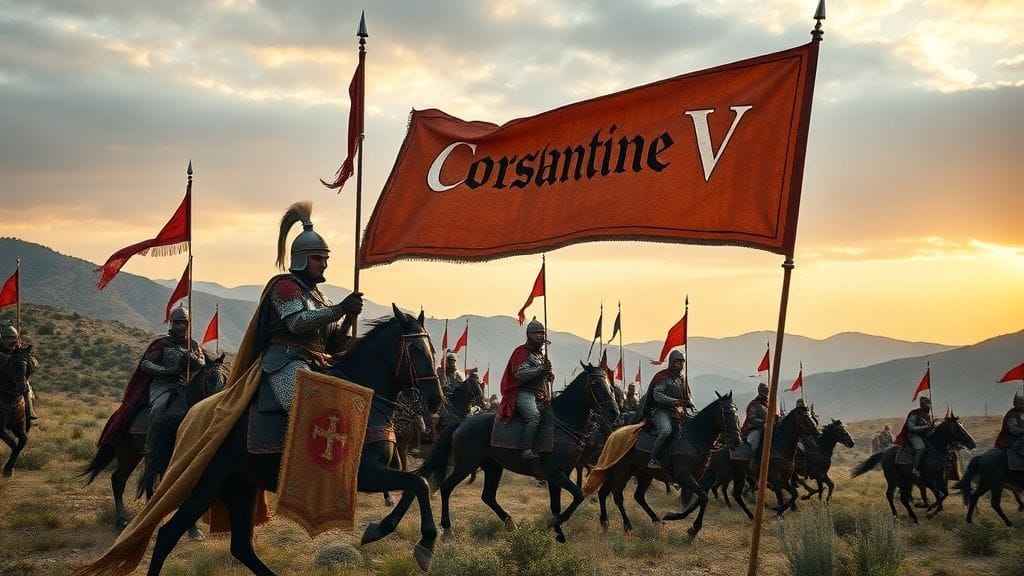
- Constantine V: The Soldier-Emperor Takes Command
- The Shadow of Iconoclasm: Religion and Rivalry at Home
- The Umayyad Threat: A Constant Pressure from the South
- Preparing for War: Military Reforms and Strategic Vision
- Asia Minor: A Land of Contest and Survival
- The First Strikes: Early Skirmishes and Border Clashes
- The Turning Tide: The 740s Counteroffensive Gains Momentum
- Battle of Akroinon: The Decisive Victory
- Fortifying the Frontier: New Fortresses and Garrisons
- Socioeconomic Impact: Refugees, Land, and Rebuilding
- Cultural Renaissance Amidst Conflict: Art and Identity
- The Role of the Thematic Armies and Local Loyalties
- Diplomatic Maneuvers: Relations with Neighboring Peoples
- The Decline of the Umayyads and its Byzantine Consequences
- Long-Term Consequences for Byzantine Asia Minor
- Legacy of Constantine V’s Campaigns in Byzantine Military History
- The Historians’ View: Chronicles, Bias, and Interpretation
- Asia Minor After the Counteroffensive: The Road to Stability
- Conclusion: A Story of Resilience and Renewal
- FAQs: Unraveling the Byzantine Counteroffensive
- External Resource
- Internal Link
The Dawn of a Turbulent Era: Asia Minor in the Mid-8th Century
The sun had barely crested the rugged hills of Anatolia when a distant thunder rolled over the plains—not a storm, but the echoes of clashing swords and war cries, foreshadowing a conflict that would reshape the fate of a great empire. Asia Minor, the strategic heartland of Byzantium, stood beleaguered. Its fertile valleys, ancient cities, and vital mountain passes had endured decades of raids, sieges, and sieges anew. For the people who lived here—the farmers, soldiers, and officials—theirs was a land caught between relentless foes and fragile hopes. At the center of this maelstrom was one emperor: Constantine V, a ruler as formidable as the terrain he fought to protect.
It was the 740s, and the Byzantine Empire was encircled by enemies on every side. The Islamic Umayyad caliphate to the south had pushed aggressively into Anatolia, threatening not only Byzantine lands but the very survival of the Christian empire’s eastern border. Meanwhile, internal strife, ideological battles, and wounded pride weakened Constantinople’s grasp. Yet in the midst of these challenges, the Byzantine counteroffensive under Constantine V emerged as a beacon of resilience, tactical brilliance, and ambition—one that would leave an enduring mark on Anatolia and the empire as a whole.
The Byzantine Empire at a Crossroads: Challenges from East and West
To understand the magnitude of Constantine V’s counteroffensive, we must first grasp the precarious state of the Byzantine Empire in the mid-8th century. Since the advent of Islam in the 7th century, Byzantium had been in a nearly perpetual state of conflict with Arab forces. Losses of territories such as Syria, Palestine, and Egypt had fundamentally altered the empire’s geography and economy. Asia Minor, once a hinterland of relative security, had become a primary battleground.
But it was not only foreign foes that imperiled Byzantium. Internally, a fierce ideological storm swept through the empire: the Iconoclast Controversy. The ban on religious images had fractured Byzantine society deeply, instigating political purges, rebellion, and even assassination plots. The religious division drained focus and resources, weakening the empire just as external threats grew more acute.
Constantine V came to power in 741 amidst this storm. His father, Leo III, had ignited the Iconoclast flame, and Constantine inherited the tough mantle of enforcing these policies while managing an empire beset by dangers.
Constantine V: The Soldier-Emperor Takes Command
Born in 718, Constantine V was no stranger to violence and political upheaval. As a prince, he was groomed in the art of war, witnessing firsthand the pressures faced by his father—Leo III the Isaurian. But where Leo was more a reformer and idealist, Constantine was a practical soldier, a man of action who understood that survival would demand steel and strategy.
Upon Leo III’s death in 741, Constantine ascended to the throne with the immediate challenge of quelling rebellions, suppressing religious factions opposed to Iconoclasm, and repelling increasingly frequent Arab raids. His reign would be defined not only by his religious policy but more tangibly by his military campaigns, particularly the vigorous defense and reconquest of Asia Minor.
The Shadow of Iconoclasm: Religion and Rivalry at Home
The Iconoclast controversy was more than theological doctrine—it was a civil war that permeated every layer of Byzantine life. Constantine V took up his father’s policy with vigor, implementing harsh measures against the veneration of icons, a stance that alienated the powerful monastic communities and the urban élites. The emperor’s severe repression of iconophiles was notorious: monasteries were closed or destroyed, and dissenters imprisoned or executed.
Yet to Constantine, the iconoclast stance was tied to empire survival. Icon veneration, he believed, called down divine wrath and weakened the empire in the face of external enemies. This conviction influenced how he marshaled the military and conducted campaigns, encouraging unity of purpose under the belief that the empire’s spiritual and territorial integrity were inseparable.
The Umayyad Threat: A Constant Pressure from the South
To the south of Asia Minor, the Umayyad Caliphate under leaders like Hisham ibn Abd al-Malik was at the height of its power, its military campaigns extending into Byzantine lands with increasing audacity. Fast and ferocious raids targeted the riches of Anatolia, aiming to pillage, weaken, and destabilize the frontier.
The Arab armies had their own motivations – religious zeal fused with territorial ambition and economic gain. To the Byzantine front-line communities, Arab raids brought devastation: villages looted, crops destroyed, and people either enslaved or displaced.
But by the 740s, the Umayyad Caliphate was also beginning to show internal signs of fragility—a factor that would soon play into Constantine V’s advantage.
Preparing for War: Military Reforms and Strategic Vision
Before striking, Constantine V knew that victory demanded more than courage. The Byzantine military had already undergone significant reforms under Leo III, but now imperial attention turned to strengthening forces and infrastructure in Asia Minor specifically.
Constantine revitalized the thematic system—the organization of troops divided regionally by themes—nestling loyal soldiers in strategic garrisons throughout the Anatolian plateau. He commissioned the construction of new fortresses and repair of ancient defensive walls. He restructured the field armies for speed and flexibility, favoring cavalry capable of rapid maneuvering over the long-established heavy infantry.
More than tactics, Constantine instilled a new spirit of resilience: the military was to be the empire’s bulwark against the might of the caliphate.
Asia Minor: A Land of Contest and Survival
The rugged terrain of Asia Minor was both an asset and a burden. Its mountains and plateaus offered natural defenses but also posed logistical challenges. Control of key passes such as the Cilician Gates meant controlling access between Anatolia and Syria.
Small towns and rural settlements dotted the landscape, many fortified, but many more vulnerable to starvation and destruction during these war years. Peasants were caught between draft calls for soldiers and the need to maintain their farms under threat of raid.
This was not merely land to be won or lost—it was home to countless communities whose fates hung in the balance of military campaigns.
The First Strikes: Early Skirmishes and Border Clashes
Constantine’s counteroffensive began with cautious probes—raids of his own into Arab-held territories that sought to disrupt Libyan supply lines and signal Byzantine resilience. Skirmishes erupted near the Taurus Mountains, where cavalry raids dashed through passes before retreating.
In the early 740s, these engagements were hesitant, as both sides tested strength and will. Yet, even in these small clashes, Byzantine forces demonstrated better discipline and coordination, signaling a turning tide in the making.
The Turning Tide: The 740s Counteroffensive Gains Momentum
By the mid-740s, Constantine’s campaigns gained decisive momentum. Drawing strength from motivated thematic armies, the Byzantines penetrated deeper into contested areas, seizing key strongholds abandoned by the increasingly overstretched Umayyads.
Fierce encounters, prolonged sieges, and daring raids marked this phase. The once-defensive posture of the empire gave way to a push that reclaimed territory and undermined Arab confidence.
Constantine’s strategic vision unfolded: first repel the invader, then strike in ways that would prevent further aggression.
Battle of Akroinon: The Decisive Victory
In 740 CE, the pivotal moment came at Akroinon (modern-day Afyonkarahisar). A large Umayyad force led a substantial incursion seeking to crush Byzantine resistance.
The battle was fierce and brutal, with both sides suffering heavy losses. Yet, the Byzantines, under the direct command of Constantine’s generals, managed to encircle and rout the enemy. The victory was not just military but symbolic: it proved that Byzantium could not only defend but decisively defeat the Umayyad armies invading Asia Minor.
Akroinon shattered the myth of Arab invincibility and marked the beginning of a long phase of Byzantine resurgence.
Fortifying the Frontier: New Fortresses and Garrisons
Following Akroinon, Constantine V ordered a massive program of fortification across Asia Minor. Ancient ruins were restored, new walls erected, and towns converted into military strongholds capable of withstanding prolonged sieges.
Garrisons were staffed with well-trained soldiers drawn from the thematic troops, often settled with their families to create communities invested personally in defense.
This ‘militarization’ of the frontier contributed to a new sense of security and stability that had long eluded the region.
Socioeconomic Impact: Refugees, Land, and Rebuilding
Military campaigns always carry human cost, and Asia Minor was no exception. Waves of refugees from devastated borderlands sought shelter deeper inside Byzantine territory, fueling tensions but also enriching cultural interactions.
Land reforms distributed confiscated territory to soldiers, encouraging settlement and cultivation. Markets began to revive, and urban centers recovered their commercial significance.
In this crucible of hardship emerged a gritty resilience among the population whose daily survival was inseparable from imperial fortunes.
Cultural Renaissance Amidst Conflict: Art and Identity
Despite the turmoil, or perhaps because of it, Asia Minor witnessed a cultural florescence under Constantine V’s reign. Iconoclasm profoundly influenced the artistic expressions of the time, steering artists toward innovative forms such as abstract decorative motifs and symbolic representations.
Military victories fueled a sense of divine favor, inspiring lavish celebrations, building programs, and coinage bearing imperial triumphs.
The era recalibrated Byzantine identity around martial values and state authority—an identity that would endure even as the empire evolved.
The Role of the Thematic Armies and Local Loyalties
Constantine V’s success owed much to the thematic armies: locally raised and maintained troops tied to specific regions. These forces were more than mere soldiers; they were peasant-farmers, craftsmen, and landholders bound to their homelands.
Such a system created strong communal loyalty and rapid mobilization potential. It also complicated imperial control, as generals and local elites gained influence. Constantine navigated this by careful appointments and ruthless suppression of dissent.
The thematic armies embodied both the strength and challenges of Byzantine military and political life.
Diplomatic Maneuvers: Relations with Neighboring Peoples
Outside of outright warfare, Constantine V engaged in diplomacy with neighboring peoples—Bulgars to the north, Armenians to the east, and various Turkic groups.
By forming alliances, exploiting inter-Arab rivalries, or offering tributes, he sought to isolate the Umayyads and open new fronts indirectly.
Such diplomacy was fragile but often effective: a testament to the complexity of power politics in the region.
The Decline of the Umayyads and its Byzantine Consequences
The 740s and 750s also witnessed the unraveling of the Umayyad Caliphate due to internal revolts, economic strain, and the rise of the Abbasids.
This shift profoundly altered the strategic landscape. Byzantine successes were reinforced by an enemy weakened from within, allowing Constantine V’s forces to press and consolidate gains.
The Abbasid rise would bring new challenges later, but for a moment, Byzantium regained the crucial initiative in Asia Minor.
Long-Term Consequences for Byzantine Asia Minor
The Byzantine counteroffensive under Constantine V reshaped Asia Minor in multiple ways. The frontier stabilized, providing a buffer zone securing Constantinople and the empire’s heartlands.
Newly fortified cities became economic and military hubs, fueling Byzantine recovery and expansion in following decades.
The campaigns laid the groundwork for later successes under emperors like Leo IV and Constantine VI, while reshaping local demographics and social structures.
Legacy of Constantine V’s Campaigns in Byzantine Military History
Historians regard Constantine V as one of Byzantium’s greatest soldier-emperors. His campaigns transformed the defensive posture of the empire into an aggressive defense strategy, combining military innovation with political astuteness.
The thematic system’s centrality expanded, and Byzantine military doctrine evolved to meet the realities of the 8th century.
His legacy is that of survival through strength—an enduring lesson for empires under siege.
The Historians’ View: Chronicles, Bias, and Interpretation
Our knowledge of the Byzantine counteroffensive comes from diverse and sometimes conflicting sources, such as Theophanes the Confessor and later Arab chroniclers.
Both Byzantine and Muslim writers framed events according to their religious and political perspectives, often emphasizing divine favor or repression.
Modern historians strive to piece together these narratives, balancing potential bias with archeological evidence, to reconstruct a balanced account of this turbulent chapter.
Asia Minor After the Counteroffensive: The Road to Stability
By the mid-750s, the frantic pulse of war had slowed, replaced by cautious rebuilding. Asia Minor, though scarred, enjoyed relative peace that allowed commerce to revive, cities to expand, and art to flourish.
Constantine V’s military victories enabled Byzantium to focus attention elsewhere, even as new threats loomed.
The counteroffensive was more than a series of battles—it was the foundation of Asia Minor’s resilience, a testament to the empire’s will to endure.
Conclusion: A Story of Resilience and Renewal
The Byzantine counteroffensive in Asia Minor under Constantine V is a saga of determination against overwhelming odds. It is a story told not only in the clash of steel but in the heartbeat of communities rebuilding from ashes, in the steadfast loyalty of soldiers defending their homes, and in the vision of a ruler who understood that survival demanded both faith and force.
Against the backdrop of ideological strife and imperial crisis, this military campaign reasserted Byzantine sovereignty over its crucial Anatolian heartland. It tempered the empire’s future conflicts and inspired a legacy of adaptability and courage.
As history looks back, the 740s and 750s remind us that states do not merely fall or triumph—they fight, falter, and rise again, shaped by the will of their people and the resolve of their leaders.
FAQs: Unraveling the Byzantine Counteroffensive
Q1: What triggered the Byzantine counteroffensive in Asia Minor during Constantine V’s reign?
A1: The primary trigger was the persistent threat of Umayyad raids and invasions into Asia Minor, coupled with the need to reinforce and reclaim lost territories. Internal motivations also included strengthening imperial control amid religious turmoil.
Q2: How did Iconoclasm influence Constantine V’s military policies?
A2: Iconoclasm was central to his ideology. He believed religious purity was linked to military success, leading him to enforce harsh policies at home while promoting martial virtues and unity against external enemies.
Q3: What was the significance of the Battle of Akroinon?
A3: The battle was a decisive Byzantine victory that broke the momentum of Umayyad invasions, boosted morale, and marked a turning point that allowed further Byzantine advances into contested areas.
Q4: How did Constantine V reform the Byzantine military?
A4: He restructured the thematic armies for greater mobility, increased fortress construction, promoted cavalry units, and integrated local troops to ensure rapid responses to threats across Asia Minor.
Q5: What were the civilian impacts of these military campaigns in Asia Minor?
A5: Civilians faced displacement, violence, and economic hardship but also gained from land redistribution, renewed security, and the gradual revival of commerce and urban life.
Q6: In what ways did the weakening of the Umayyad Caliphate affect Byzantine fortunes?
A6: The Umayyads’ decline due to internal revolts and succession crises lessened pressure on Byzantine frontiers, allowing Constantine V more freedom to conduct successful campaigns.
Q7: How are these events remembered in Byzantine historical tradition?
A7: Byzantine chronicles often frame the counteroffensive as divinely favored victories reinforcing imperial authority, though modern historians approach these with nuance, acknowledging propaganda and bias.
Q8: What long-term influence did Constantine V’s campaigns have on Byzantine military doctrine?
A8: They cemented the thematic system’s importance, emphasized combined arms tactics, and showcased the necessity of frontier fortification and local soldier communities for empire survival.

