Table of Contents
- The call to arms: Byzantium in the mid-10th century
- Nikephoros II Phokas: the warrior emperor rises
- The shadow of the Emirate of Crete: a thorn in Byzantium’s side
- Preparing the fleet and the armies: a grand strategic vision
- The Siege of Chandax: Crete’s impregnable city under assault
- A grueling siege: ten months of hardship and heroism
- The fall of Chandax: turning point in the Mediterranean
- Reclaiming Crete: restoring Byzantine dominance in the Aegean
- Cilicia and the Arab-Byzantine borderlands: the struggle continues
- Phokas’ Syrian campaigns: striking at the heart of Muslim power
- The capture of Tarsus and the transformation of Cilicia
- Byzantine strategy and military innovations under Nikephoros
- The role of diplomacy and alliances in the reconquest
- The cultural and religious impact of the reconquest in reclaimed territories
- The rise of Byzantium as a Mediterranean power again
- Internal politics and the costs of war: Nikephoros’ reign in perspective
- The assassination of Nikephoros II and its repercussions
- The legacy of the reconquest: shaping Byzantine military doctrine
- How Crete and Cilicia influenced later Eastern Mediterranean history
- The echoes of Nikephoros’ campaigns in modern scholarship and culture
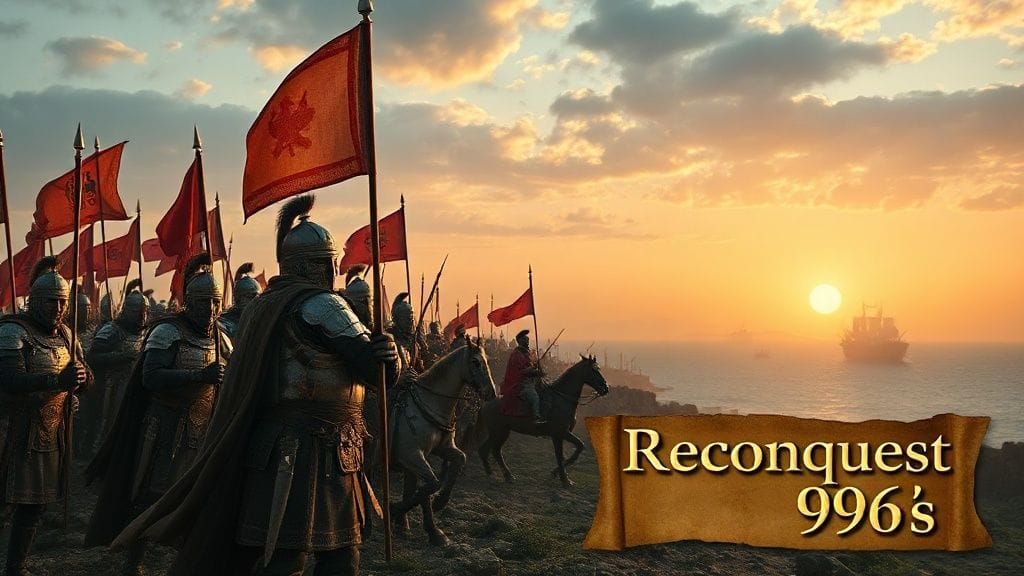
The sun was sinking behind the jagged horizon of the eastern Mediterranean as the sound of distant war drums echoed through the narrow streets of Constantinople. Across the waves, the island of Crete, long a haven for pirates and raiders, still held its defiant fortress city of Chandax. For more than a century, the Emirate of Crete had been the shadow looming over Byzantine commerce and security—a relentless thorn in the empire’s side. Yet now, under the iron resolve of a man called Nikephoros II Phokas, the emperor was ready to turn the tide. This was not just a military campaign; it was a crusade to restore lost honor and power to the Byzantine realm.
The call to arms: Byzantium in the mid-10th century
By the 960s, the Byzantine Empire was at a critical juncture. The vast territories once unified under earlier emperors had been chipped away by the rise of foreign powers—most notably the Arabs who controlled large swathes of the Levant and North Africa. The island of Crete had been seized by Andalusian exiles back in the early 820s, and since then, their pirates operated unchecked, preying on Byzantine shipping and coastal settlements. The empire’s heartland in Anatolia was also constantly threatened by Muslim emirates, including the powerful emirate based in Cilicia.
The situation was far from hopeless, however. The Macedonian dynasty had revitalized the empire’s military and fiscal strength after decades of instability, and the Byzantine army was evolving into an efficient fighting force. But success against Crete and the southern frontier required a leader of exceptional skill and vision. That leader would be Nikephoros Phokas, a general whose reputation was forged on the unforgiving battlefields of the East.
Nikephoros II Phokas: the warrior emperor rises
Born around 912 into the powerful Phokas family, Nikephoros exemplified the ideal of the soldier-emperor. A man of austere discipline and unyielding ambition, he was renowned for his fierce commitment to orthodox Christianity and his military brilliance. Before ascending to the throne in 963, Nikephoros spent decades honing his craft, recapturing lost territories and leading successful campaigns against Muslim forces in eastern Anatolia and Syria.
His ascendancy to the imperial throne was a recognition of both his military prowess and the need for a strong hand to lead Byzantium’s resurgence. Yet Nikephoros’ vision extended beyond mere defense: he saw an opportunity to strike decisively, to reclaim lost lands and restore Byzantine supremacy across the eastern Mediterranean.
The shadow of the Emirate of Crete: a thorn in Byzantium’s side
Crete’s strategic position in the Aegean Sea made it a jewel to control. Yet for over a century, the island had fallen into the hands of Muslim Andalusian exiles who transformed it into a pirate republic. From its capital, Chandax, corsairs launched raids that devastated Byzantine coastal regions, interrupted trade, and struck fear into the heart of the empire.
The reconquest of Crete was not only a matter of security but also a matter of prestige. Success meant reopening a vital artery of commerce and communication while eliminating a constant and destabilizing threat. However, Chandax was formidable—a well-defended city boasting thick walls and a determined fighting force. Previous attempts to reclaim Crete had failed miserably, including a catastrophic campaign in 949 that ended in disaster.
Preparing the fleet and the armies: a grand strategic vision
Nikephoros understood that retaking Crete would require careful preparation and overwhelming force. Drawing on the empire’s revitalized resources, he orchestrated the assembly of a massive expeditionary force: thousands of soldiers, skilled sailors, engineers, and supplies were gathered. The Byzantine navy, under his direction, was improved with innovations in shipbuilding and tactics, designed to maintain control of the seas.
The campaign, launched in 960, was a masterpiece of logistical planning. Troops were ferried across the Mediterranean, supplies stockpiled, and siege engines prepared. The emperor himself led from the front, a rarity in Byzantine imperial history, inspiring his men with shared hardships and a clear vision of victory.
The Siege of Chandax: Crete’s impregnable city under assault
The siege began with a grim determination. Chandax stood majestically behind its walls, mocking the approaching Byzantine forces with its imposing presence. But Nikephoros was not deterred. Utilizing a combination of land forces and a naval blockade, he set about strangling the city.
The defenders fought fiercely, using all the knowledge and resources at their disposal. It was a clash not only of armies but of cultures and ambitions—a battle for the soul of the Mediterranean.
A grueling siege: ten months of hardship and heroism
What followed was a ten-month ordeal marked by relentless assaults, harsh weather, and disease. Byzantine soldiers endured hunger and exhaustion, yet their discipline never faltered. Engineers constructed massive siege towers and battering rams, while infantry forces probed the defenses continuously.
Amid the carnage were stories of individual bravery and tragedy. Accounts tell of soldiers who scaled walls against impossible odds, or commanders who rallied retreating troops with impassioned speeches. Civilians trapped inside Chandax suffered equally, caught between hope and despair.
The fall of Chandax: turning point in the Mediterranean
In early 961, the Byzantine forces finally breached Chandax’s defenses through a carefully coordinated assault, exploiting a weakness in the city’s walls. The fall of Chandax was a shockwave—signaling not only the end of the Emirate of Crete but the revival of Byzantine naval power in the Aegean.
Nikephoros entered the city as a triumphant conqueror, determined to restore order and bring Byzantine law and religion back to the island. Crete’s liberation opened new possibilities for trade and security across the empire’s southern flank.
Reclaiming Crete: restoring Byzantine dominance in the Aegean
With Crete recaptured, Byzantine fleets were able to patrol freely, pushing pirate threats further away and consolidating the empire’s maritime supremacy. The island was integrated firmly into the empire’s administrative and ecclesiastical frameworks, becoming a vital bastion in the Aegean defense system.
The psychological impact on Byzantium was immense—where fear of raids had once dominated, now pride and confidence blossomed. Merchants returned, churches were rebuilt, and a new era of prosperity began to dawn.
Cilicia and the Arab-Byzantine borderlands: the struggle continues
But the success in Crete was only the beginning. The eastern frontier remained volatile, particularly the mountainous and fertile region of Cilicia. The Muslim emirates there, including the strategically crucial city of Tarsus, continued to challenge Byzantium’s authority.
Nikephoros did not hesitate to press forward. His campaigns in Cilicia aimed to dismantle enemy strongholds and reassert Byzantine control, extending the momentum gained from Crete. It was a dangerous game of attrition and surprise, fought across rugged terrain and fortified cities.
Phokas’ Syrian campaigns: striking at the heart of Muslim power
In a bold move, Nikephoros’ forces advanced beyond Cilicia into northern Syria, seeking to destabilize Muslim emirs and secure a buffer zone for the empire. These campaigns struck at the vital supply lines and forced rival powers into defensive postures.
The capture of key cities and fortifications in this region was not just strategic but symbolic. It sent a clear message: Byzantium was no longer on the defensive but determined to shape its destiny.
The capture of Tarsus and the transformation of Cilicia
Tarsus, a city with an illustrious history and formidable defenses, fell after a series of sieges and battles. Its capture was a crowning achievement of Nikephoros’ campaigns in the region, turning Cilicia from a contested frontier into a reliable Byzantine province.
This victory secured Anatolia’s southern approaches and allowed for more effective administration and integration of the newly recovered territories, stabilizing the region for decades to come.
Byzantine strategy and military innovations under Nikephoros
Throughout these campaigns, Nikephoros demonstrated a genius for military innovation. He emphasized aggressive cavalry tactics, improved siegecraft, and enhanced naval capabilities. His reforms in army organization balanced mercenary forces with native troops, improving morale and effectiveness.
More than this, Nikephoros fused military skill with ideological purpose, framing the reconquest as a holy mission to reclaim lands for Christendom—a narrative that inspired his troops and legitimized his reign.
The role of diplomacy and alliances in the reconquest
Despite the military focus, diplomacy was never far from Nikephoros’ strategy. Negotiations with neighboring powers, including fragmented Muslim emirates, supplied avenues to weaken opposition and secure truces when beneficial.
Terms of surrender often included religious leniency, trade agreements, and the resettlement of populations, revealing a pragmatic approach to governance alongside military might.
The cultural and religious impact of the reconquest in reclaimed territories
The Byzantine reconquest inevitably reshaped the cultural and religious landscape. Churches were rebuilt or restored, Orthodox Christianity was promoted, and Byzantine customs encouraged among local populations.
Yet these changes were gradual and complex, involving degrees of coexistence as much as dominance, setting the stage for centuries of cultural interaction in the eastern Mediterranean.
The rise of Byzantium as a Mediterranean power again
Nikephoros II Phokas’ campaigns marked the beginning of a new Byzantine ascendancy. The empire regained control over key maritime and land routes, reasserted political influence, and expanded its reach along the eastern frontier.
This period heralded a renaissance of Byzantine military might, economic vitality, and cultural confidence—one that would shape Mediterranean affairs for generations.
Internal politics and the costs of war: Nikephoros’ reign in perspective
However, the cost of the reconquest was high. The strains of extended warfare impacted the empire’s finances and social fabric. Nikephoros’ austere policies and military dominance earned him powerful enemies within the court.
His eventual assassination in 969 by conspirators, including his wife Theophano, revealed the fragile balance between military glory and political survival in Byzantium.
The assassination of Nikephoros II and its repercussions
The death of Nikephoros marked a turning point yet also underscored the volatile nature of Byzantine politics. His successor, John I Tzimiskes, himself a skilled general, continued the eastern campaigns but faced a transformed political landscape.
Nikephoros’ legacy was thus entwined with both triumph and tragedy, a tale of conquest shadowed by intrigue.
The legacy of the reconquest: shaping Byzantine military doctrine
The successes and lessons of the 960s campaigns deeply influenced Byzantine military doctrine. The emphasis on combined arms, strategic sieges, naval supremacy, and religious motivation became hallmarks of imperial military thinking.
Subsequent emperors drew on Nikephoros’ model to sustain and expand the empire’s frontiers for decades.
How Crete and Cilicia influenced later Eastern Mediterranean history
The recovery of Crete and Cilicia reshaped trade networks, altered the balance of power, and affected relations between Byzantium, the Muslim world, and emerging Western powers.
These regions became cultural crossroads and battlegrounds in the centuries that followed, with legacy threads reaching into the Crusades and Ottoman expansions.
The echoes of Nikephoros’ campaigns in modern scholarship and culture
Today, historians regard Nikephoros II Phokas as one of Byzantium’s most remarkable warrior emperors. His campaigns remain a subject of fascination for their blend of military innovation, religious fervor, and political drama.
From academic treatises to historical novels, the echoes of his reconquest continue to inspire and challenge our understanding of medieval power and identity.
Conclusion
The Byzantine reconquest of Crete and Cilicia under Nikephoros II Phokas was a defining chapter in the empire’s long saga. It stands as a testament to the resilience and ambition of a civilization striving to reclaim its destiny amidst a turbulent and fragmented world. Nikephoros embodied the tension between the sword and the crown, faith and power, conquest and governance. His campaigns not only restored lost territories but reignited Byzantine confidence and legitimacy at a moment when the empire’s fate hung precariously in the balance.
This story is more than a military chronicle; it is a human tale of vision and sacrifice, of stormy sieges, stalwart defenders, and an emperor who risked everything to shape history. The legacy of the 960s campaign reaches far beyond stones and scrolls—it resonates in the cultural memory of the Mediterranean, reminding us that empires rise and fall not only through battles won but through the courage to dream and act.
FAQs
Q1: Why was the reconquest of Crete so important to the Byzantine Empire?
A1: Crete’s strategic location controlled vital maritime routes in the Mediterranean. Its recapture allowed Byzantium to eliminate pirate threats, restore secure trade, and reassert naval dominance, which was crucial for the empire's economic and military stability.
Q2: Who was Nikephoros II Phokas, and why was he suited to lead these campaigns?
A2: Nikephoros II Phokas was a seasoned military commander and later emperor. Known for his discipline, tactical brilliance, and religious zeal, he combined strategic insight with personal bravery, making him uniquely qualified to orchestrate the ambitious reconquests.
Q3: How long did the siege of Chandax last, and what made it so difficult?
A3: The siege lasted approximately ten months. Chandax’s formidable walls, skilled defenders, and strategic location made it resistant to prior assaults. The lengthy siege tested Byzantine endurance and required innovative siege tactics and relentless pressure.
Q4: What were the main outcomes of the campaigns in Cilicia?
A4: The capture of key cities like Tarsus secured the southern frontier of Byzantine Anatolia, providing a buffer against Muslim emirates and enabling greater administrative control. It was critical for stabilizing the empire’s eastern borders.
Q5: How did the reconquest campaigns influence Byzantine military strategy?
A5: The campaigns emphasized coordinated land and naval operations, improved siegecraft, and combining religious motivation with military objectives. These principles shaped subsequent Byzantine warfare and imperial policy.
Q6: What internal challenges did Nikephoros II face during and after the reconquest?
A6: Besides external enemies, Nikephoros wrestled with court intrigue, noble opposition, and the burdens of war on the empire’s resources. His harsh policies and concentration of power eventually led to his assassination.
Q7: How did the reconquest affect cultural and religious life in Crete and Cilicia?
A7: After reconquest, Byzantine authorities worked to reestablish Orthodox Christianity, rebuild churches, and integrate populations culturally and administratively, though this process was gradual and complex.
Q8: How is Nikephoros II Phokas remembered in modern historical scholarship?
A8: He is regarded as one of Byzantium’s greatest military emperors, celebrated for his visionary campaigns and complex legacy, encompassing both remarkable achievements and political tragedy.

