Table of Contents
- The Dawn of August 3, 1347: A City at the Crossroads
- Calais Before the Siege: A Vital Port in Turmoil
- England and France at War: The Hundred Years’ Conflict Ignites
- Edward III’s Ambition: The Path to Calais
- The Siege Begins: Encircling a Fortress
- Life Under Siege: Calais’s Citizens in Desperation
- The Naval Blockade: England’s Grip Tightens
- The Role of Geography: Calais’s Strategic Significance
- French Resistance and Leadership: Defenders of Calais
- The Siege’s Human Toll: Stories of Courage and Suffering
- Turning Points: From Hope to Hopelessness
- The Fall of Calais: A City Surrenders
- Edward III’s Clemency and the Legend of the Six Burghers
- Immediate Aftermath: England’s New Foothold in France
- Calais as an English Stronghold: Centuries of Occupation
- The Siege in the Panorama of the Hundred Years’ War
- Cultural and Economic Consequences of Calais’s Capture
- The Memory of Calais: Historical and Literary Echoes
- Lessons from the Siege: War, Power, and Humanity
- Conclusion: From Fortress to Symbol of Endurance
- Frequently Asked Questions (FAQs)
- External Resource
- Internal Link
1. The Dawn of August 3, 1347: A City at the Crossroads
Under an iron-gray morning sky, the walls of Calais watched silently as the sun rose on August 3, 1347. The air hung thick with dust and anticipation, a palpable tension gripping the town that had withstood weeks of relentless siege. From the battlements, defenders peered anxiously toward the vast encampments of the English army, their banners fluttering like a dark promise against the horizon. Inside, the citizens were worn thin by hunger and fatigue — their fate, suspended between honor and survival, was about to be decided.
This was not just any day. It was the day the fate of Calais, a key port on the northern coast of France, would change forever. For months, the city had endured the stranglehold of one of the most significant military campaigns of the Hundred Years’ War. What was at stake was far more than mere territory; it was a crucial foothold in a brutal struggle for dominance — a struggle that would ripple across centuries.
The story of Calais’s capture is one of strategic brilliance, human endurance, and dramatic sacrifice. It reveals the endlessly layered theatre of medieval warfare, where politics, power, and people intertwined in a dance of life and death. As the gates finally opened, the world itself seemed to hold its breath.
2. Calais Before the Siege: A Vital Port in Turmoil
Calais, perched on the narrow coastline that bridges the English Channel and the continent, was a jewel coveted by kings and merchants alike. By the mid-14th century, it had grown into a bustling harbor, its docks alive with merchants from across Europe, its markets rich with goods flowing between England and France. The town’s prosperity rested on this trade, while its position made it a vital military asset.
Yet, beneath its vibrant surface, Calais simmered with unease. The Hundred Years’ War, ignited in 1337 by disputes over the French crown and the English claim, had brought conflict to its very doorstep. Raids and skirmishes had become common. The city’s walls, built to withstand older threats, now faced the grim reality of modern siege warfare, enhanced by cannons and organized armies.
To the French crown, Calais was a gateway whose loss would be intolerable. To Edward III of England, it was the key to turning the tide of war — a lodgment on the continent that could be defended and expanded, a permanent English presence on French soil. The pressure on the city’s leaders was immense, caught between defiant loyalty and the harsh truths of war.
3. England and France at War: The Hundred Years’ Conflict Ignites
The capture of Calais must be understood against the sprawling backdrop of the Hundred Years’ War, a conflict that tore through societies with a ferocity matched only by later global wars. The clash began over claims to the French throne, trade disputes, and deep-seated rivalries bound up with identity and sovereignty.
Edward III, keen to assert his claim, launched a series of campaigns into France, marking the war not simply as a series of battles but as a protracted siege of national wills. For over a decade leading to 1347, both sides had suffered setbacks and victories, but none so decisive as what Edward hoped to achieve at Calais.
The war, brutal and costly, was marked by the rise of professional armies, the shifting loyalties of nobility, and the hardship of not just soldiers but commoners caught in the crossfire. It was a war that blended chivalry with savagery, strategy with the raw capacity to endure suffering.
4. Edward III’s Ambition: The Path to Calais
Edward III, a king fueled by both political calculation and personal ambition, saw Calais as the prize that would legitimize his campaign. His army had already won a resounding victory at Crécy in 1346, routing the French forces and demonstrating the deadly efficiency of English longbowmen. Yet, in the wake of triumph comes the crucial test: holding ground.
Calais offered that rare prize — a fortified city accessible by sea, providing a foothold for further incursions. Edward’s strategy was clear: he would not merely raid the land and return home. Instead, he would lay siege, starve out the defenders, and, if needed, break down their will by unrelenting pressure.
Landing with thousands of soldiers, engineers, and fleet support, Edward encircled Calais, intent on cutting off all supplies. This was more than a military maneuver; it was an assertion of will, a demonstration to Europe that England intended to rule through strength and discipline.
5. The Siege Begins: Encircling a Fortress
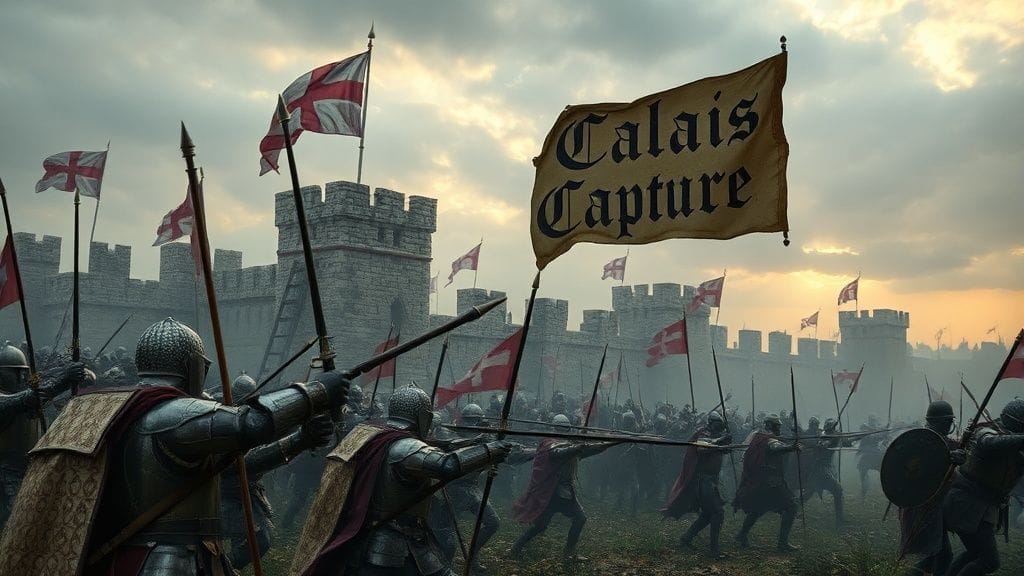
By the summer of 1346, the siege was underway. Edward’s forces erected a sprawling ring of fortifications, walls, towers, and ditches, forming a blockade that sealed Calais from relief or escape. The English built not only an external encirclement but a network of camps and supply lines capable of sustaining their army for months.
Inside the walls, the defenders braced for hardship. Supplies dwindled quickly; the normal rhythms of city life gave way to endless watchfulness and rationing. The siege was a test of endurance as much as arms, the slow grinding attrition wearing down the resolve of those within.
Meanwhile, English soldiers battled the elements, disease, and fatigue. The challenge of maintaining supply ships through stormy seas and navigating French attempts to break the blockade added layers of complexity to the campaign.
6. Life Under Siege: Calais’s Citizens in Desperation
For the people of Calais, siege meant hunger, fear, and uncertainty. Food became a sacred commodity; reports tell of rats and even leather being eaten as hunger gnawed at the population. The psychological strain was crushing — families clung to hope even as their strength failed.
The nobility and soldiers fought not just for the crown but to defend their homes and families. Yet the walls could only hold so long. Disease spread in cramped conditions; despair grew with each passing day.
It was a landscape of human suffering monotonous and profound, yet with sparks of heroism. Records speak of acts of kindness between enemies and the stoicism of those who faced the inevitable with dignity.
7. The Naval Blockade: England’s Grip Tightens
Crucial to the siege was England’s control of the sea. The English navy patrolled the Channel, intercepting French supply vessels and reinforcements. This naval blockade severed Calais’s lifeline, ensuring that starvation would become the weapon that ultimately shattered resistance.
The sea, usually a conduit of commerce and communication, was transformed into a barrier of despair. Occasional night raids and attempts to run blockades kept the siege tense and fluid, but over time the English tightened their grip.
Historian Jonathan Sumption described this phase as “a masterclass in medieval siegecraft, where control of the sea was as decisive as control of the land.” Indeed, without control of the waters, no army could hope to maintain a long siege on such a coastal city.
8. The Role of Geography: Calais’s Strategic Significance
Calais’s geography made it uniquely valuable and vulnerable. Sitting just 21 miles from the English coast, it was the shortest crossing point of the Channel. This close proximity rendered it a natural staging ground for English military operations deeper into France.
The city’s natural defenses — thick walls, the harbor, and surrounding marshlands — had spared it from capture for years. However, this geography was a double-edged sword. Encirclement by sea and land made it a trap once subdued.
It is incredible to consider how this narrow strip of land at the edge of Europe became a fulcrum upon which the balance of power shifted.
9. French Resistance and Leadership: Defenders of Calais
The French defenders, led by Jean de Vienne, the city’s governor and an experienced naval commander, displayed determined resistance. De Vienne’s leadership galvanized soldiers and citizens alike, insisting that surrender was unthinkable.
Messages were sent to the French court pleading for aid, but political and military circumstances limited Paris’s ability to send reinforcements. Internal disputes distracted French leadership at the worst possible moment.
De Vienne’s defiance was legendary. When finally forced to surrender, his refusal to betray Calais’s honor resonated deeply across France, becoming a symbol of steadfast loyalty in dire times.
10. The Siege’s Human Toll: Stories of Courage and Suffering
Beyond the grand strategies and political machinations, the siege was a tableau of profound human experience. Chroniclers tell of families torn apart, soldiers falling on both sides, and the crushing weight of despair tempered by brotherhood and loyalty.
One of the most enduring stories is that of the six burghers of Calais, men who voluntarily surrendered themselves to Edward III in a desperate bid to save the city. Clad in rough shirts and bare feet, they walked barefoot through the English camp, epitomizing both sacrifice and dignity.
This act, later immortalized in art and literature, reveals the human dimension often lost in the textbook telling of wars.
11. Turning Points: From Hope to Hopelessness
As weeks turned into months, the morale inside Calais deteriorated. Attempts at relief by the French failed, and starvation’s grip tightened. Rumors of treachery, exhaustion, and disease compounded the defenders’ plight.
Edward III’s army, by contrast, maintained discipline and supply lines, a testament to the organizational sophistication growing in medieval warfare. Slowly but inexorably, the city’s capacity to hold out vanished.
The turning point was less a battlefield confrontation than the grinding inevitability of hunger and isolation. It is a sobering reminder that wars are not always won by force of arms alone.
12. The Fall of Calais: A City Surrenders
On August 3, 1347, Calais’s walls were opened, but the real surrender was of spirit and endurance. Under negotiated terms, the city yielded to Edward III, who entered not with pomp but calculated resolve.
The surrender was a moment heavy with symbolism. It marked the first major English territorial gain on the continent, changing the war’s dynamic and setting precedent for future sieges.
Edward’s treatment of the city, especially his mercy toward the burghers, demonstrated a political acumen alongside military might. His decision sowed seeds of legend and fostered a narrative of chivalry that bolstered his claim to legitimacy.
13. Edward III’s Clemency and the Legend of the Six Burghers
The tale of the six burghers is perhaps the most human and poignant episode of the siege. These men — Eustache de Saint Pierre, Jean d’Aire, and four others — had come forward to surrender themselves to die, to spare Calais further suffering.
Edward III, moved or politically shrewd, spared their lives following the intercession of his queen, Philippa of Hainault. This act of clemency earned him respect and myth-making, painting him as a king of mercy amid brutal war.
The image of these burghers, barefoot and with ropes around their necks, became emblematic of sacrifice and loyalty, immortalized in sculptures and chronicles throughout history.
14. Immediate Aftermath: England’s New Foothold in France
With Calais in English hands, Edward III gained a strategic stronghold that enabled further military and economic incursions into France. The city became a vital link in maintaining supply routes, hosting English troops, and staging campaigns.
Politically, the capture embarrassed the French crown, exposing weaknesses in their defenses and leadership. It also signaled a shift toward a more prolonged and territorially focused phase of the Hundred Years’ War.
Calais remained under English rule for more than two centuries, its status as an English enclave in France a topic of contention and conquest through generations.
15. Calais as an English Stronghold: Centuries of Occupation
English governance transformed Calais into a military and commercial hub aligned with English interests. The city’s fortifications were reinforced, and it served as a customs point controlling trade from England to continental Europe.
Life in Calais became a microcosm of Anglo-French rivalry, with outbreaks of violence and cultural exchanges amid a city divided by identity and allegiance.
Its occupation lasted until 1558, when French forces under Francis, Duke of Guise, retook the city—an event as dramatic as its original capture, symbolizing the enduring tug-of-war between these neighboring powers.
16. The Siege in the Panorama of the Hundred Years’ War
The capture of Calais stands as a defining moment within the Hundred Years’ War. It punctuated a period of English ascendancy and set a template for siege warfare and territorial occupation.
Military historians credit the siege with highlighting the evolution of medieval armies from knights and feudal levies toward more professional and organized forces.
It also underscored the increasing importance of long-term strategy, logistics, and control of waterways in medieval conflict, lessons that reverberated in later European wars.
17. Cultural and Economic Consequences of Calais’s Capture
Economically, England’s control of Calais allowed it to tap into the continental trade routes and bolster its finances during a costly war. The city became England’s “gateway to Europe,” facilitating not only military campaigns but also commercial dominance.
Culturally, Calais’s status fostered an exchange of ideas, customs, and tensions that shaped identity on both sides. The city became a crucible of cultural hybridity — English and French mixing amid fortifications and marketplaces.
The siege and its aftermath inspired literary works, chroniclers’ accounts, and legends that enriched medieval history’s tapestry.
18. The Memory of Calais: Historical and Literary Echoes
The siege of Calais resonated far beyond the battlefield. Artists like Auguste Rodin immortalized the burghers in sculpture; chroniclers such as Froissart captured the drama in vivid narrative.
For centuries, Calais embodied themes of sacrifice, chivalry, and national identity, continuously evoked during wars, diplomatic disputes, and cultural reflections.
This legacy reveals how history is not simply recorded but lived and reinterpreted across generations, becoming part of our shared human story.
19. Lessons from the Siege: War, Power, and Humanity
Beyond the military triumph, the siege teaches enduring lessons about the nature of war: its toll on civilians, the interplay of mercy and cruelty, and the complexities of leadership under pressure.
Edward III’s blend of force and clemency demonstrates how power is wielded not only through conquest but through narrative and symbolism.
The burghers’ sacrifice reflects the moral dimensions of loyalty and the heavy costs borne by ordinary people in grand historical arcs.
20. Conclusion: From Fortress to Symbol of Endurance
The capture of Calais was more than a military event; it was a crucible of medieval history, a turning point in a war that shaped nations. The city’s walls, once stains with blood and tears, became silent witnesses to the passage of centuries and the flux of power.
Calais transformed from a beleaguered fortress to a symbol — of endurance, sacrifice, and the ceaseless human struggle between conflict and compassion. The echoes of 1347 remind us that history’s great moments are never merely about battles, but about people and their stories — resilient, tragic, and unforgettable.
Frequently Asked Questions (FAQs)
Q1: What strategic importance did Calais hold during the Hundred Years’ War?
A1: Calais was the closest French port to England across the English Channel, making it an invaluable military and trading hub. Its capture gave England a secure base for launching campaigns into France and controlling trade routes.
Q2: How did Edward III manage to maintain the siege for so long?
A2: Edward III utilized superior logistics, built extensive fortifications around Calais, controlled the sea to prevent supplies from reaching the city, and maintained the morale and discipline of his troops despite harsh conditions.
Q3: Who were the six burghers of Calais, and why are they significant?
A3: The six burghers were prominent citizens who volunteered to surrender themselves to Edward III to spare the city further suffering. Their sacrifice epitomized loyalty and courage, becoming a powerful symbol immortalized in art and history.
Q4: What were the consequences of Calais’s capture for France?
A4: The loss of Calais was a severe blow, providing the English with a permanent foothold in France, exposing French military weaknesses, and prolonging the conflict with a new phase focused on territory.
Q5: How long did England hold Calais, and what happened afterward?
A5: England held Calais for over 200 years, during which it became a crucial military and economic center. It was finally recaptured by France in 1558, ending English continental presence for centuries.
Q6: How did the siege affect the civilian population of Calais?
A6: Civilians suffered extreme deprivation due to starvation, disease, and constant fear during the siege. Their resilience amid hardship highlights the often-overlooked human cost of medieval warfare.
Q7: What role did naval power play in the siege?
A7: Naval blockade was critical; English ships cut off Calais from receiving supplies or reinforcements by sea, effectively starving the city into submission.
Q8: How has the capture of Calais been remembered in history and culture?
A8: Through chroniclers, art, and literature, the siege and capture of Calais have been remembered as a story of sacrifice, chivalry, and strategic brilliance, shaping the narrative of medieval European warfare.