Table of Contents
- On the Road to Edessa: An Empire on the Brink
- Rome in Crisis: The Shattered Third Century
- The Rise of Shapur I and the Sasanian Challenge
- Valerian’s Burden: An Aging Emperor at War
- Marching East: The Fateful Campaign Against Persia
- Edessa Under a Pitiless Sun: Camp of the Doomed Legions
- Pestilence in the Ranks: Disease, Hunger, and Despair
- The Fatal Parley: The Day an Emperor Walked into a Trap
- The Unthinkable Happens: The Capture of a Roman Augustus
- Chains and Humiliation: Valerian in Persian Captivity
- Images of Defeat: Rock Reliefs, Rumors, and Roman Shame
- Gallienus and the Fracturing Empire Left Behind
- Provincial Rebellion: The Palmyrene and Gallic Empires
- Persian Triumph and Sasanian Statecraft After Edessa
- Memory, Myth, and Propaganda: How the Story Was Twisted
- The Long Shadow: Military and Political Lessons of Edessa
- From Humiliation to Resilience: Rome’s Gradual Recovery
- Echoes Through the Ages: How Later Generations Saw Valerian
- Conclusion
- FAQs
- External Resource
- Internal Link
Article Summary: In 260 CE, at the city of Edessa on Rome’s eastern frontier, the world witnessed an event that contemporaries could scarcely believe possible: the capture of emperor Valerian by the Sasanian king Shapur I. This article traces the road to that catastrophe, from the internal breakdown of the Roman Empire in the third century to the rise of a confident and aggressive Persian monarchy. It reconstructs the campaign that brought an aging Valerian to Edessa, the plague and mismanagement that crippled his army, and the fateful negotiation that ended with his betrayal and imprisonment. The narrative then follows Valerian into captivity, exploring his likely treatment, the propaganda carved into Persian rock reliefs, and the shame that gripped Roman society. The capture of emperor Valerian became a defining symbol of Rome’s vulnerability, encouraging rebellions in the provinces and emboldening foreign enemies. Yet the story does not end in defeat alone: the article also shows how Rome adapted, restructured its military, and slowly regained its balance. Finally, it reflects on how later historians, theologians, and rulers interpreted the capture of emperor Valerian, turning a moment of disaster into a lasting lesson on power, pride, and imperial fragility.
On the Road to Edessa: An Empire on the Brink
The heat over northern Mesopotamia in the summer of 260 was the kind that sears memory onto the land. Dust clung to leather sandals, iron helmets burned to the touch, and over the starved plain near the city of Edessa, a Roman army waited for a relief that would never come. Somewhere within that vast, faltering camp walked an old man in a purple cloak—Publius Licinius Valerianus, emperor of Rome—grimly aware that he carried not just his own fate but the weight of a fractured empire. The capture of emperor Valerian was still unthinkable to his soldiers, a horror without precedent in the proud annals of Roman history. Yet the roads that led to Edessa had been laid for decades, paved not only with military blunders and foreign threats but with the invisible fault lines of a society in crisis.
To the young legionaries, many recruited in haste from distant provinces, the emperor still embodied an idea: the unbroken majesty of Rome. He had donned the armor of his office, taken up command in the East, and brought with him a promise that the world’s greatest empire could still impose its will on any enemy. But beyond the brittle faith of the soldiers, reality was harsher. The eastern provinces had burned again and again under Sasanian assaults. Cities along the Euphrates had been plundered, entire populations deported. And in the West, the Rhine and Danube frontiers pulsed with barbarian incursions that stretched Roman defenses past the breaking point. The emperor’s presence in Mesopotamia was both a desperate gamble and a last assertion of imperial dignity.
Edessa, perched on the edges of the Syrian steppe, had seen armies come and go for centuries. It sat at a crossroads of cultures—Greek, Roman, Syriac, Parthian, Persian—a place where empire was not an abstraction but a daily gamble. Merchants counted their profits in coins stamped with imperial faces that changed all too often. Local elites tracked rumors from distant Rome with a skeptical eye. And as Valerian’s troops crowded into the environs of the city, taking over wells, fields, and roads, the people of Edessa must have been torn between hope and dread. An emperor in their midst meant protection, perhaps honor. But it also meant that if things went wrong, they would be crushed beneath the wheels of history.
Yet on those parched days, as scouts brought back worrying reports of Persian movements and as disease began to flicker through the camp, no one in Edessa could truly imagine what was coming. Rome had lost battles before: Crassus had fallen at Carrhae, legions had been wiped out in German forests and Iberian hills. But the presence of an emperor on campaign usually signaled resolve, not ruin. That this campaign would end with the capture of emperor Valerian—his body and dignity surrendered into the hands of a rival king—was as inconceivable as the sun failing to rise.
And still, the signs were there. An empire overstretched. A monarch forced to fight on too many fronts. Enemies who had learned Rome’s weaknesses and no longer feared its name. Edessa, with its walls and churches and markets, became the stage upon which all these tensions converged. The situation had been decades in the making, shaped by the grinding crisis of the third century and the rise of a new eastern power that refused to live in Rome’s shadow. To understand how one of the world’s most powerful rulers could be taken prisoner on a dusty field in 260, we must step back into that age of iron and uncertainty.
Rome in Crisis: The Shattered Third Century
By the time Valerian was proclaimed emperor in 253, the Roman Empire was no longer the self-assured colossus that had dominated the Mediterranean in the days of Augustus and Trajan. It was a wounded giant, still immense but bleeding from dozens of cuts. Historians describe this period bluntly as the “Crisis of the Third Century,” an age when emperors rose and fell in terrifying succession, frontiers buckled, and the very idea of Roman invincibility cracked.
Economic instability rattled the empire. Coinage, once a reliable instrument of imperial authority, became a symbol of decay. The silver content of the denarius had been steadily debased, and by mid-century, money felt as thin as the trust it carried. Prices rose. Soldiers, who had grown accustomed to frequent donatives from short-lived emperors desperate for loyalty, demanded ever more. Provincial populations bore the brunt of increased taxation, requisitions, and corruption. What had once seemed like a mutual pact—protection in exchange for obedience—began to feel like simple exploitation.
Politically, the center could barely hold. Between 235 and 284, nearly fifty men would claim the imperial title, many ruling for only a few months or years before being assassinated, overthrown, or killed in battle. Valerian himself came to power as a compromise candidate, an elderly senator whose age and prestige gave a fragile semblance of stability after the brief, turbulent reign of Trebonianus Gallus. That an empire of Rome’s magnitude could pin its hopes on a man already in his sixties spoke volumes about its desperation.
Externally, the empire’s enemies sensed opportunity. Along the Rhine and Danube, confederations of Germanic tribes—Alamanni, Franks, Goths—pressed harder and deeper into Roman territory. Raids penetrated as far as Italy and the Balkans. In the East, meanwhile, a new force had arisen on the Iranian plateau: the Sasanian dynasty, more centralized and ideologically aggressive than the Parthian Empire it had replaced. The Sasanians rejected the careful balance and cautious diplomacy that had long characterized Parthian–Roman relations. Instead, they spoke the language of conquest and cosmic kingship, casting themselves as the rightful lords of all Iran and beyond.
The Roman military machine, which had once seemed inexhaustible, was heavily stretched. Legions that were supposed to guard one frontier were transferred hastily across provinces to plug gaps elsewhere, leaving their original stations vulnerable. Mobile field armies emerged, racing from crisis to crisis, but at the cost of local defensive depth. Civil wars further weakened the system; rival emperors and usurpers siphoned troops away from the frontiers into internal conflicts that left them both exhausted and exposed.
Within this maelstrom, ordinary lives were uprooted. Peasants along the Danube abandoned their farms to flee barbarian raiders and tax-collectors alike. Towns in Syria and Asia Minor huddled behind walls, watching the eastern horizon for banners bearing unfamiliar symbols. Caravans altered their routes to avoid regions where the imperial presence had grown faint. For millions, the empire was no longer the calm custodian of order but a distant power whose reach had grown erratic and whose promises no longer guaranteed safety.
It was into this fractured world that Valerian stepped as emperor. He did not create the crisis; he inherited it. But the decisions he made—or failed to make—would determine whether Rome could weather the gathering storms. And on the eastern horizon, the most dangerous storm of all already had a name: Shapur son of Ardashir, king of kings of the Iranians and the non-Iranians.
The Rise of Shapur I and the Sasanian Challenge
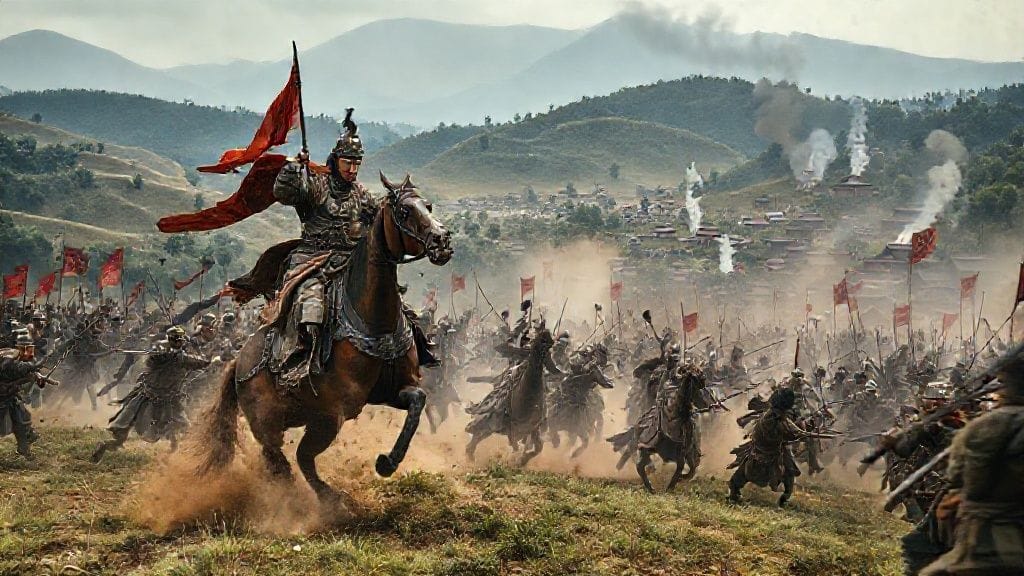
On the far side of the Roman eastern frontier, another drama had been unfolding, one every bit as consequential. Around 224 CE, a local ruler from the province of Persis, Ardashir I, overthrew the last Arsacid (Parthian) king and proclaimed a new dynasty: the Sasanians. Where the Parthians had ruled as a loose confederation of great noble families, the Sasanians aimed for something sharper, more centralized, more ideological. They revived ancient Iranian religious and royal traditions, presenting their kings as chosen by Ahura Mazda, the wise lord, to uphold cosmic order against chaos.
Shapur I, Ardashir’s son and successor, inherited not just a throne but a mission: to complete his father’s work and secure Iran’s place in the world as the equal—if not the superior—of Rome. Confident and ambitious, Shapur saw the Roman Empire not as a distant power to be placated, but as a rival to be challenged. Early in his reign, he tested Rome’s eastern defenses, probing the Euphrates frontier, capturing fortresses, and deporting populations deeper into Persian territory. Each campaign was both a military and psychological operation, aimed at undermining the aura of Roman inevitability.
Shapur’s vision is still carved into stone. At Naqsh-e Rostam and Bishapur in modern Iran, rock reliefs show the king triumphant over Roman emperors, their postures rigid with submission. On one panel, believed to represent the later victory over Valerian, a Roman ruler kneels before the mounted Shapur while another, probably Philip the Arab, stands or lies defeated nearby. These images are not mere decoration; they are manifestos in rock, declaring to all who see them that the king of kings has humbled the rulers of the West.
Shapur combined military skill with a keen sense of timing. He struck when Rome was distracted by internal strife or another frontier crisis. Under Gordian III and Philip the Arab, Rome fought back with some success, but the pattern was clear: the East was no longer a quiet theater. Antioch, the great metropolis of Syria, had already felt the fear of Persian incursion. By the mid-century, Shapur had sacked cities deep in Roman territory, taking artisans and laborers as captives to fuel his own building projects. Persian cities such as Gundeshapur were enriched by these forced migrations, their population a living testimony to Rome’s weakness.
In Shapur’s court, the rhetoric was bold. The Sasanians claimed all lands once held by the ancient Achaemenid Empire as their rightful domain—a claim that included much of Roman Syria and Asia Minor. Their inscriptions boasted of victories and prisoners. Shapur’s own trilingual inscription at Naqsh-e Rostam lists three major campaigns against Rome, crowing about captured cities and slaughtered foes. To Roman ears, these texts would have sounded like blasphemy; to Persian subjects, they were a promise of glory.
By the time Valerian became emperor, Shapur had already tested Rome and found the empire wanting. He had defeated several emperors in the field, secured plunder on a massive scale, and proved that Roman armies could be surprised and overmatched. Yet the greatest blow—the capture of emperor Valerian—still lay ahead. Shapur, like a hunter, was circling his prey, aware that one well-timed strike could bring down not just a legion but the prestige of an entire civilization.
Valerian’s Burden: An Aging Emperor at War
Valerian did not ascend the throne as a conqueror; he rose as a veteran statesman reluctantly pulled to the center of a collapsing system. Born into a senatorial family, he had served the empire for decades, earning a reputation for competence and honor. When the army and senate turned to him in 253, he was no young general hungry for glory, but an elderly official whose years should have promised retirement rather than command over a world-spanning war machine.
Yet the office he accepted left little room for rest. Almost immediately, Valerian took the unprecedented step of elevating his son Gallienus as co-emperor, dividing responsibilities between West and East. While Gallienus focused on the Danube and Rhine, Valerian turned his attention to the Persian front, where Shapur’s ambitions threatened to swallow key provinces. The arrangement was practical but risky; it underscored how perilous the situation had become, and it made clear that no single man could hope to manage the crisis alone.
Valerian’s age, somewhere around seventy when he marched east, is more than a biographical detail. It shaped how contemporaries saw him and how posterity judged him. Roman ideals of virtus—manly excellence—celebrated strength, endurance, and martial vigor. In this light, to see an old man in purple, hair gone white, attempting to lead armies in the brutal climate of Mesopotamia was both stirring and troubling. Was it courage or folly? Did his presence inspire confidence, or did it silently betray the exhaustion at the heart of Roman power?
Sources from later centuries, particularly Christian writers like Lactantius, would portray Valerian as a persecutor punished by God, claiming that his defeat and subsequent suffering were divine retribution for his actions against Christians. In his work On the Deaths of the Persecutors, Lactantius rehearses lurid tales of the emperor’s humiliation. Modern historians treat many of these anecdotes with deep skepticism, but their persistence in the tradition shows how the capture of emperor Valerian became a canvas on which different communities projected their own explanations and moral lessons.
For Valerian himself, the burden was more immediate and physical. He needed to raise and pay armies, negotiate with restless elites, and project confidence in all directions at once. Every decision risked catastrophe. Send too many troops east, and the Rhine might break; focus too much on the northern frontier, and Shapur would devour Syria. In this sense, Valerian’s march toward Edessa was not just a tactical maneuver; it was the embodiment of a difficult choice. He had decided that the Persian threat, at that moment, posed the most existential danger.
As he crossed into the eastern provinces, Valerian must have been acutely aware of his predecessors’ failures and partial victories. He knew of Gordian III’s young life cut short in the East, of Philip the Arab’s contested peace with Shapur. He probably carried the memory of Crassus’s disaster at Carrhae, a century earlier, like a ghost at his shoulder. The capture of emperor Valerian was still impossible to imagine, but the awareness of Rome’s vulnerability in Mesopotamia was very real.
Marching East: The Fateful Campaign Against Persia
The campaign that would eventually bring Valerian to Edessa began with a mixture of necessity and resolve. Shapur had renewed his offensives, sweeping into Syria and capturing key fortresses along the Euphrates. Antioch, the jewel of the eastern provinces, had been threatened more than once. The emperor could not remain aloof. To secure the East—and perhaps to restore some of Rome’s fading prestige—Valerian gathered a substantial army and moved toward the contested frontier.
The forces he assembled were impressive on paper: legions drawn from multiple provinces, auxiliary units, cavalry contingents, and local levies. Yet numbers alone hid serious weaknesses. Many of the legionaries were inexperienced, rushed through training to fill gaps left by recent wars and mutinies. Some units were understrength, their ranks depleted by previous battles or desertion. Supplies had to travel over long distances, through territories ravaged by previous campaigns. The logistical framework that had once sustained Roman armies across vast distances was frayed.
Still, the sight of imperial standards advancing eastward must have stirred hopes in the cities along the route. In Asia Minor and Syria, governors greeted the emperor with ceremonies, sacrifices, and ovations. For provincial elites, the arrival of the emperor promised at least temporary security and attention; for common people, it meant more ambivalently the presence of requisitions, levies, and the risk that their lands would become battlefields. Behind the rituals of loyalty, there was a shared question: could this army succeed where others had failed?
The initial phase of the campaign seems to have gone reasonably well. Roman forces retook some towns and fortresses, reasserting control over parts of the frontier. Yet Shapur, well informed by his own scouts and local allies, did not rush into a decisive engagement on Roman terms. He knew that time, distance, and disease were his allies. The closer Valerian’s army moved into the harsh landscapes east of the Euphrates, the more vulnerable it became.
The emperor’s destination, Edessa, had strategic as well as symbolic importance. Situated north of the main desert routes, it served as a staging point between Syria and Mesopotamia. From there, Roman forces could move south toward the Euphrates crossings or east toward key cities like Nisibis and Carrhae. To hold Edessa was to hold a gateway. But to encamp there under hostile observation, in punishing heat, with supply lines already strained, was to court disaster.
As the armies inched closer to their rendezvous, the perception of the conflict shifted. On the Roman side, this was a campaign of restoration, aimed at pushing back an encroaching rival and reestablishing the old boundaries. For Shapur, it was an opportunity—not just to repel another Roman thrust but to crush it so decisively that it would echo for generations. Neither side knew yet that the outcome would surpass even these expectations, and that the capture of emperor Valerian would enter the annals of both empires as a turning point.
Edessa Under a Pitiless Sun: Camp of the Doomed Legions
When Valerian’s army finally reached the vicinity of Edessa, likely in the late summer of 260, the emperor must have felt a mixture of relief and apprehension. Relief, because he had brought his forces to a key position on the frontier; apprehension, because the conditions were already deteriorating. Edessa itself, a thriving city with a strong Christian community and Hellenized elites, watched as tens of thousands of soldiers, pack animals, and camp followers spread across the surrounding fields.
At first, the city and the camp coexisted in uneasy partnership. Local wells and cisterns were drawn upon to meet the needs of this sudden influx. Merchants seized the chance to sell grain, oil, and wine at inflated prices. The Roman quartermasters struggled to maintain order, to ensure that soldiers did not pillage the very population they were meant to protect. Heat shimmered over the tents; armor grew rusted with sweat and dust. Night brought only partial respite. Songs, dice games, and murmured prayers mingled in the air as men tried to forget, for a few hours, the uncertainty of the coming days.
But this equilibrium did not last. The strain on resources quickly became evident. Wells began to run low. Livestock trampled fields that should have fed the city through the next year. latrines overflowed. Disease—always a lurking presence in ancient camps—started to spread. What began as a handful of fevers and stomach ailments soon turned into an outbreak. Ancient sources speak of “plague,” and while the exact nature of the epidemic cannot be determined, its effect was devastating. Men who had survived barbarian javelins and Persian arrows fell to invisible enemies carried by insects, water, and air.
In such conditions, discipline weakens. Officers, themselves not immune to illness, struggled to keep their units together. Desertions may have increased, as soldiers from nearby regions slipped away under cover of darkness to return to their families. Rumors circulated, whispered at first and then spoken aloud: that the gods had abandoned Rome, that Shapur’s magic—or his God, according to some—was stronger. Others clung more tightly to their rituals, making offerings, seeking omens, asking questions of astrologers and oracles. In this dense atmosphere of fear and faith, the prospect of a decisive battle began to feel less like a chance for glory and more like an appointment with doom.
From the walls of Edessa, civilians watched the unfolding crisis with growing horror. The same imperial presence that had promised safety now threatened to drag them down. If the Roman army broke, would the city be left to face Shapur’s forces alone? Would it be sacked, its inhabitants slaughtered or carried off as captives? Some wealthier citizens may have quietly sent their families away, toward safer towns inland, while they themselves stayed to protect their property and status. Others had no such choice; they simply waited and hoped that events beyond their control would not crush them.
Yet for all this, Valerian still had to act like an emperor. He received envoys, inspected troops, issued orders. To admit publicly the scale of the crisis would have been to invite panic. Instead, he sought some way to salvage the campaign, to negotiate a respite, or to catch Shapur off guard. It was amid this lethal mixture of illness, logistical collapse, and strategic uncertainty that the next, fateful step was taken.
Pestilence in the Ranks: Disease, Hunger, and Despair
The army at Edessa was not merely weakened; it was unraveling from within. Disease gnawed at its structure like rot in a beam. Fevers burned through the tents. Men who had marched for weeks under heavy armor now could not lift their heads from their bedrolls. Burial parties were overwhelmed. In some units, the number of dead and dying outstripped the living. The once proud formations of legions and auxiliary cohorts became clusters of listless, coughing, weakened humans, clinging to their standards more from habit than from hope.
Hunger followed closely behind. Supply columns, already strained, could not keep pace with the army’s needs, especially as illness disrupted the carefully planned routines of foraging and distribution. Local resources had been plundered to exhaustion. Grain, once measured out in orderly rations, became scarce. Soldiers who only months before had boasted of Rome’s inexhaustible wealth now fought over scraps of bread, or else went hungry into the night. Malnutrition made them more vulnerable to disease, and so the vicious circle tightened.
This was more than a military problem; it was a psychological catastrophe. Soldiers who lose faith in their cause—or in their chances of survival—are hard to command. Campfire conversations turned dark. Veterans muttered that this campaign had been cursed from the start. Younger men, seeing their officers fall, questioned whether their leaders knew what they were doing. Some blamed the Christians in their ranks for angering the gods; others blamed the traditional pagan sacrifices for failing to placate them. In such a climate, the authority of the emperor himself, though still real, was eroded by creeping despair.
Valerian would have received a constant stream of grim reports. Commanders came to him with lists of casualties and requests for guidance. Should they attempt to retreat to more secure positions, risking pursuit by Shapur’s cavalry? Should they try to push forward, gambling what remained of their strength on a bold strike? Or should they seek terms, hoping that the mere presence of the emperor as negotiator might secure a truce that would allow the army to pull back and regroup?
None of the options were good. Retreat with a sick, hungry army could turn into a rout. Offensive action with diminished forces might result in annihilation. Negotiation, on the other hand, required trust—and Shapur, renowned both for his victories and his cunning, was hardly an obvious partner for straightforward talks. Yet as the days dragged on and the army’s condition worsened, negotiation began to look like the least bad choice. The capture of emperor Valerian was not the intended outcome of this calculation; rather, he seems to have believed that his own stature could guarantee the good faith of the proceedings.
But this was only the beginning of the tragedy. For in choosing to enter into direct talks with Shapur, Valerian was stepping into a realm where Roman precedent was thin and personal risk high. No Roman emperor had ever allowed himself to fall alive into enemy hands. The idea seemed so remote that perhaps even Valerian, in his most anxious moments, did not fully consider it. He was still, after all, the Augustus, the embodiment of Rome. The notion that his person might be violated, his body constrained by foreign chains, was almost beyond imagination—almost.
The Fatal Parley: The Day an Emperor Walked into a Trap
The precise details of what happened next are obscured by time and by the bias of our sources, but the broad outline is clear enough. With his army debilitated by plague and supply shortages, Valerian opened negotiations with Shapur. Envoys crossed the no-man’s land between the Roman camp and the Persian lines. Messages were exchanged, terms proposed and modified. At some point, a meeting in person was arranged—or at least, that is how Roman tradition tells the story.
In the Roman imagination, diplomacy with a foreign king was supposed to be managed at a distance. Emperors sent envoys, letters, or at most, met rivals from a position of strength, surrounded by guards and ceremony that emphasized their superiority. For Valerian to place himself within reach of Shapur’s power, to walk—perhaps quite literally—into the Persian camp, violated this unwritten script. It signaled both his desperation and his belief that his identity as emperor would protect him.
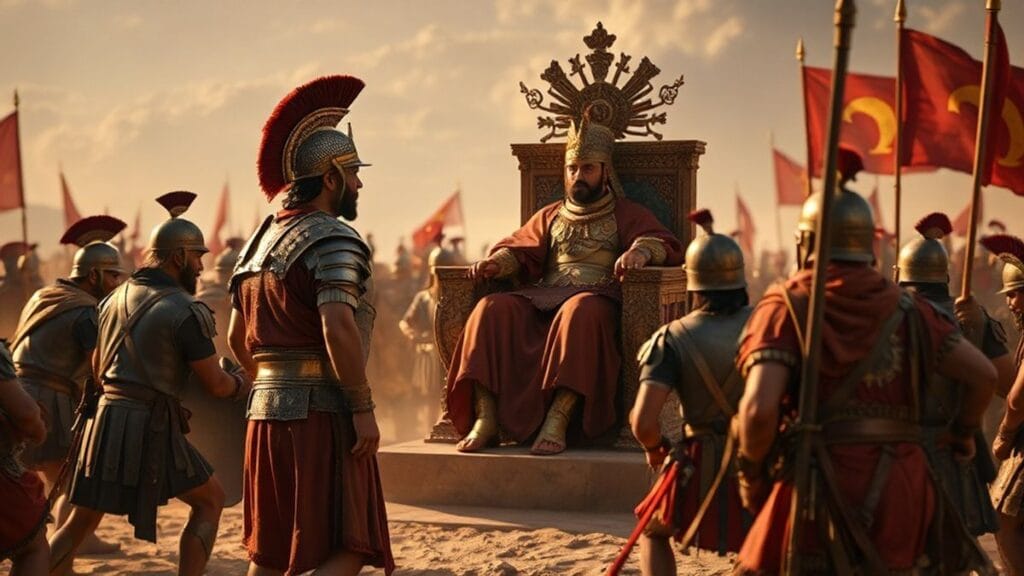
The scene, as later reconstructed by Roman and Christian writers, is almost theatrical. Valerian, robed and armored, advances under a flag of truce. Shapur, glittering in his own royal regalia, waits with an entourage of Persian nobles and warriors. Between them hangs the possibility of peace—or betrayal. What words were exchanged, what gestures made, we do not know. But at some crucial moment, the balance tilted. Romans would later say that Shapur broke faith, seizing the emperor in a treacherous act that violated the sacred laws of truce. Persians, on the other hand, memorialized only the outcome: the capture of emperor Valerian as the ultimate proof of Shapur’s preeminence.
Imagine, for a moment, what it would have felt like in the Roman camp when the news arrived. Officers and soldiers watched the horizon where their emperor had vanished in the direction of the Persian lines. Hours passed. No herald returned to announce terms. Instead, perhaps a handful of panicked messengers came back with a nightmare tale: the emperor had been taken, his body no longer his own, his guards dead or scattered. In that instant, something fundamental shattered. An emperor was not just a man; he was the living symbol of Rome itself. To lose him in this way was to see the divine armor of the empire pierced.
Accounts of this fateful meeting differ in their emphasis but agree on its shocking nature. The Roman historian Zosimus, writing centuries later, treats the event as a colossal misjudgment. Christian writers like Lactantius imbue it with theological meaning, the capture of emperor Valerian presented as divine punishment. Persian reliefs and inscriptions, by contrast, show no embarrassment, only triumph. Here, at last, was proof that Rome’s aura could be broken, that even the purple-clad Augustus could be compelled to kneel.
It’s astonishing, isn’t it? In a single day—perhaps in a single hour—centuries of Roman confidence in the inviolability of their emperor were overturned. The decision to attend the parley, the conditions of the meeting, the security arrangements: all these tactical details receded in the face of the overwhelming symbolic meaning. Rome had not merely lost a battle; it had lost the body of its ruler to a foreign enemy. The capture of emperor Valerian stood as a reversal of everything the empire believed about itself.
The Unthinkable Happens: The Capture of a Roman Augustus
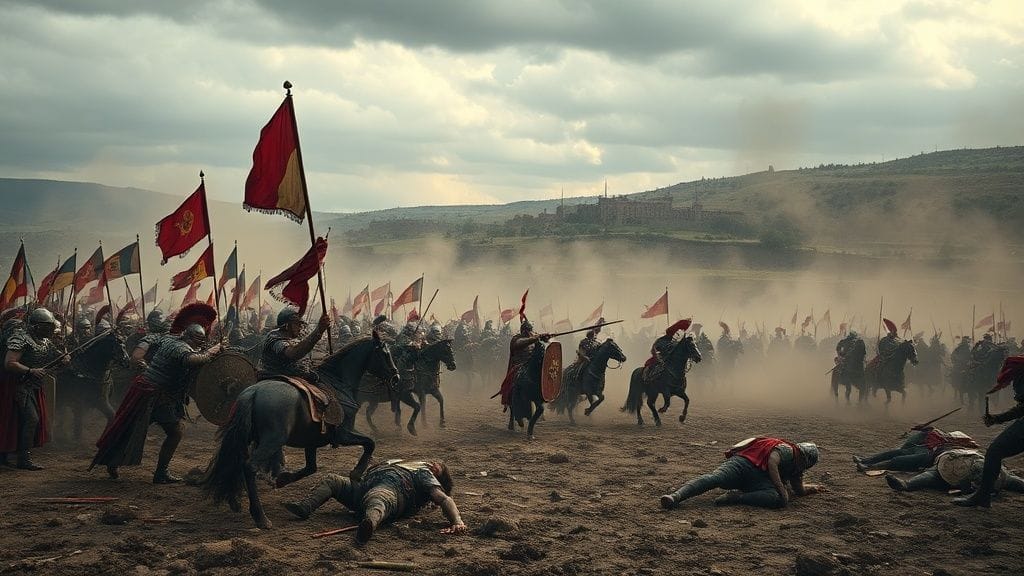
The language of the surviving sources struggles to capture the enormity of what occurred. The Roman world had witnessed defeats before—Catastrophes like Cannae and Carrhae, Varus’s disaster in the Teutoburg Forest, and the Gothic incursions along the Danube. But in all these, the emperors or leading magistrates had either died on the field or escaped with honor compromised but bodies intact. Never before had a reigning Roman emperor been taken prisoner alive by a foreign power.
Shapur understood the political theater of this moment perfectly. He did not kill Valerian on the spot. Death would have turned the emperor into a martyr or at least drawn a line under the event. Captivity, by contrast, allowed Shapur to display his triumph again and again, both at home and in the diplomatic messages he sent abroad. He had in his hands not just a man but a symbol—a living trophy representing the humiliation of Rome.
For the Roman soldiers, the emotional impact was devastating. Some units broke completely, retreating in disorder or surrendering en masse. Others tried to hold lines or negotiate their own terms. Leadership faltered. Without the emperor, competing commanders may have argued over the right course of action. Communications with the West were disrupted, and by the time news reached Gallienus, it was already stale, filtered through the panic and rumor of countless retellings.
In Rome itself, the announcement of the emperor’s loss must have hit like a thunderclap. Imagine senators gathering in the Curia, hearing from shaken envoys that Valerian had been seized. The Senate, already diminished in real power by the military nature of the imperial office, could do little more than express shock, perhaps anger, perhaps fear for their own status in a world where emperors could be snatched away by foreign kings. In the streets, meanwhile, the common people heard only fragments: talk of disaster in the East, of Persian victories, of an emperor in chains.
The capture of emperor Valerian did more than alter the balance of power in a single war; it ruptured a mental barrier. Rome had long painted its emperors as semi-divine figures, above the reach of ordinary misfortune. Even assassinations and palace coups took place within a closed circle of courtiers and guards. Here, by contrast, the emperor’s vulnerability was displayed to the whole world. He had been defeated not by conspirators in his own palace but by an alien monarch, a man who claimed equal—or superior—status.
Shapur capitalized on this ruthlessly. In his inscriptions, he made sure to emphasize that he had defeated and captured “Caesar Valerian,” listing alongside him the many Roman officers and soldiers taken after the battle. The message to his own subjects was clear: the king of kings had humbled the greatest rival power of his time. To neighboring states and client rulers, the implications were equally stark. Rome was no longer the unchallenged arbiter of their fate. There now existed a second pole of imperial authority, one capable of inflicting historic humiliation on the West.
Chains and Humiliation: Valerian in Persian Captivity
What happened to Valerian after his capture is one of the most haunting and debated questions of ancient history. We know he never returned to Roman territory, and we know that Shapur outlived him. Beyond these bare facts, we enter a realm where propaganda, moralizing tales, and fragmentary evidence intertwine.
Christian authors, especially Lactantius, tell stories designed to underscore the justice of divine punishment. According to him, Valerian, who had persecuted Christians, was subjected to grotesque humiliations in captivity. He writes that Shapur used the emperor as a living footstool, mounting his horse by placing his foot on Valerian’s bent back, and that after the emperor’s death, his skin was flayed, dyed, and hung in a Persian temple as a warning to all who defied Persian might. This vivid image has seared itself into the imagination of later generations, but most modern scholars view it as likely exaggerated or symbolic rather than a literal description.
What can be said with more confidence is that Valerian was displayed, in some form, as a trophy. The rock relief at Naqsh-e Rustam, widely believed to commemorate Shapur’s victories over Rome, shows a figure identified as Valerian kneeling before the mounted king, one hand raised in a gesture of supplication. Another figure, possibly Philip the Arab, stands nearby in a posture suggesting negotiated submission. Together, these images frame the capture of emperor Valerian as the pinnacle of Shapur’s reign, a moment when East visibly triumphed over West.
Valerian’s captivity likely included forced relocation to the Persian interior, away from the frontiers where he might inspire rescue attempts. Some Roman prisoners were settled in groups, used as labor for grand building projects, bridges, dams, and cities that strengthened the Sasanian state. One long-standing scholarly view suggests that Roman captives helped construct the great dam at Shushtar and parts of the city of Bishapur. If Valerian was held in such regions, he would have witnessed the strange afterlife of his defeated army: men who had once marched under the eagle now quarrying stone or directing water through channels in a foreign land.
We can imagine the emperor’s inner world only in fragments. An aging man, far from home, stripped of his titles, surrounded perhaps by a few remaining Roman officials or captives who still addressed him with the honorifics of a vanished reality. Did he hold on to hope of a rescue that never came? Did he send letters to Gallienus, now ruling alone, offering advice or final farewells? Did he see the rock reliefs that forever fixed his humiliation in stone? These questions have no clear answers, but they haunt the narrative.
It is possible that Shapur, despite his triumph, treated Valerian with a degree of pragmatic respect. A living emperor, even in chains, was a valuable diplomatic asset. Shapur could point to him as proof of his power when dealing with Rome’s neighbors or internal challengers. He may have paraded Valerian before Persian nobles to reinforce his own status. In this sense, the capture of emperor Valerian was a resource to be exploited, not merely an episode to be concluded with a swift execution.
Ultimately, Valerian died in captivity, probably some years after his initial seizure. The circumstances of his death are unknown. No Roman delegation recovered his body; no official funeral marked his passing in the imperial heartland. His memory, instead, was contested terrain—claimed by propagandists, moralists, and enemies alike. The man himself, reduced at the end perhaps to a solitary figure in a foreign court or fortress, disappeared into the shadows of history, his last thoughts unrecorded.
Images of Defeat: Rock Reliefs, Rumors, and Roman Shame
Few defeats in Roman history have been so visually immortalized as that at Edessa. At Naqsh-e Rustam and Bishapur, Shapur carved his victory into rock, ensuring that long after the details of the battle faded, the image of a kneeling Roman emperor would remain. These monumental reliefs stand as some of the earliest surviving visual records of one empire triumphing over the person of another’s ruler. They were, in effect, political posters on a grand, enduring scale.
To Persian viewers, these images conveyed a straightforward narrative: the king of kings had subdued the West. The posture of Valerian—kneeling, supplicating—reversed the normal direction of tribute. Instead of barbarians prostrating themselves before Rome, here was Rome’s own embodiment brought low. The physical landscape of Iran became a canvas of imperial ideology, where stone testified to the might of Shapur’s dynasty.
In Rome, of course, these reliefs were not seen by most citizens or even by many elites. What reached them instead were words: reports from traders, fragments of captured inscriptions, and eventually, the accounts of historians and polemicists. These reports added layers of rumor to the stark fact of the defeat. Some said that Shapur paraded Valerian in chains through Persian cities. Others claimed he kept him confined in a remote fortress. The more outlandish tales—like the flayed skin—likely developed over time, as storytellers sought images shocking enough to match the perceived enormity of the reversal.
Roman officialdom responded, predictably, with selective silence and spin. The regime of Gallienus had every incentive to downplay the disaster. Inscriptions in the West rarely mentioned Valerian’s fate in detail; when they did, they used euphemisms or veiled references. Gallienus was portrayed not as the son of a captive but as a capable ruler in his own right, engaged in defending the frontiers and suppressing internal rebellions. The shame attached to the capture of emperor Valerian lingered, but it was pressed to the edges of formal discourse.
Privately, however, it must have been deeply felt. For aristocrats who prided themselves on Rome’s destiny to rule, the news that an emperor had been taken prisoner undermined assumptions centuries in the making. It provoked uncomfortable questions: Were the gods still on Rome’s side? Had the empire overreached? Were its enemies now its equals? Such doubts ate away at the cultural confidence that had long supported Roman rule.
Interestingly, the event also took on a life of its own in religious polemic. Christian writers, often persecuted under Valerian’s rule, saw in his fate a providential lesson. Lactantius, as noted, presented the emperor’s suffering as a direct consequence of his persecution of the faithful, a narrative that allowed Christians to reinterpret Roman history so that God’s justice had the last word. Pagan writers, in turn, sometimes framed the disaster as evidence of neglected traditional cults. The same event became an argument in rival theological debates.
Thus, the capture of emperor Valerian existed in multiple realities at once: as stone images in a distant land, as hushed embarrassment in Roman political circles, as righteous schadenfreude in Christian communities, and as fodder for philosophical and religious interpretation. Over time, even as the immediate military consequences faded, the symbolic weight of the event only grew.
Gallienus and the Fracturing Empire Left Behind
While Valerian languished in Persian custody, his son and co-emperor Gallienus faced the near-impossible task of holding the remainder of the empire together. The news of his father’s capture did not arrive in a neat, official dispatch; it seeped in through reports, rumors, and the visible unraveling of Roman control in the East. Whatever personal grief Gallienus felt had to be swallowed quickly, for the world around him was disintegrating.
In the West, Germanic tribes pushed hard against the frontiers. The Alamanni reached into northern Italy, the Goths ravaged the Balkans and crossed into Asia Minor, even threatening cities that had long felt safe behind the empire’s defenses. In this maelstrom, Gallienus showed more talent than his tarnished later reputation might suggest. He reformed the cavalry, developed more mobile field armies, and fought a series of campaigns to stem the barbarian tide. Yet every victory was partial, every respite temporary.
The psychological shock of the capture of emperor Valerian weakened central authority and encouraged ambitious commanders to consider alternatives. If an emperor could be seized in foreign lands and vanish into captivity, perhaps imperial legitimacy was not as sacred as once believed. The army, increasingly the arbiter of power, found itself courted by generals with regional bases. In such an environment, loyalty to a distant, embattled emperor grew fragile.
Gallienus’s efforts were not aided by the Senate, which resented the rising importance of equestrian officers and military men at the expense of traditional aristocrats. Nor did provincial elites universally rally to him; their immediate concerns were local security and survival, not abstract unity. As long as Gallienus could not guarantee protection, some of them began to look for closer, more responsive centers of power. The capture of emperor Valerian thus had a centrifugal effect, pushing the empire’s peripheries away from its nominal core.
Yet Gallienus was not merely a victim of circumstance. He made deliberate choices that shaped Rome’s response to the crisis. He relaxed persecutions of Christians, perhaps recognizing that alienating a growing religious community was strategically unwise. He promoted capable officers regardless of senatorial pedigree, valuing military skill over noble birth. He focused his energies where he was physically present, letting the East, for a time, drift further out of direct imperial control while he secured the Rhine and Danube.
Still, the fractures spread. Within a few years of Valerian’s capture, entire regions would effectively secede, forming what modern historians call the Gallic Empire in the West and the Palmyrene realm in the East. The Roman world did not shatter completely, but it cracked into rival imperialities, each claiming continuity with Roman authority while acting with increasing independence. To understand how this came about, we must follow the shockwaves outward from Edessa into Gaul and the Syrian desert.
Provincial Rebellion: The Palmyrene and Gallic Empires
In the far western provinces—Gaul, Britain, and parts of Spain—the strain of repeated invasions and the perception of neglect from the central government produced a dramatic response. Around 260, Postumus, a military commander stationed in the Rhine region, was proclaimed emperor by his troops. Taking control of Gaul and setting up a court at Trier, he established what we now call the Gallic Empire, a breakaway realm that would endure for more than a decade.
Postumus presented himself not as a rebel but as a savior of the provinces, a man who would do what the distant Gallienus could not: protect local communities from barbarian incursions. He minted coins bearing traditional Roman imagery, presided over senatorial-style institutions, and maintained the facade of Roman orthodoxy. Yet the underlying reality was fragmentation. The unity that had once bound the provinces into a single political and economic system was loosening. The capture of emperor Valerian had dramatically highlighted the vulnerability of the central authority; Postumus and his followers simply acted on the implications.
In the East, a different but related story unfolded. The city of Palmyra, an oasis metropolis in the Syrian desert, had long prospered as a caravan hub connecting the Roman Mediterranean with the Parthian and then Persian interiors. Its leading family, that of Odaenathus, had cultivated ties with Rome while also maintaining local power and networks. With Valerian gone and Shapur threatening ever deeper incursions, the Roman state found in Odaenathus a crucial ally.
Odaenathus launched successful campaigns against Persian forces, recovering lost territories and harassing Shapur’s armies. Gallienus, recognizing his value, granted him grand titles and wide authority in the East. Effectively, Palmyra became a semi-autonomous protector of Roman interests, buffering the Persian threat. After Odaenathus’s assassination, his widow, the famous Zenobia, would expand this semi-autonomy into an almost fully independent empire, stretching from Egypt to Asia Minor.
Both the Gallic and Palmyrene “empires” reveal how the capture of emperor Valerian acted as both a symptom and a catalyst of deeper change. Provincial leaders stepped into the power vacuum left by a discredited and overstretched center. They wrapped themselves in Roman forms—titles, coinage, Latin inscriptions—while pursuing policies that reflected their own regional priorities. To many inhabitants of these areas, loyalty to “Rome” now came mediated through Postumus or Zenobia rather than through the distant, embattled court of Gallienus.
Rome, however, never accepted this fragmentation as permanent. Later emperors, beginning with Aurelian, would devote enormous energy to reasserting central control, reconquering both breakaway realms and stitching the empire back together. But that later story cannot erase the fact that, in the aftermath of Edessa, the Roman world had briefly become a patchwork of competing imperiums. The capture of emperor Valerian had not only humiliated Rome; it had shown that the empire could, under pressure, split into multiple centers of power.
Persian Triumph and Sasanian Statecraft After Edessa
For Shapur and the Sasanian court, the victory at Edessa and the capture of emperor Valerian marked the high tide of their early imperial project. The propaganda value was immense, but the practical gains were also significant. The Sasanians secured large numbers of captives—soldiers, engineers, artisans, and civilians—whom they resettled within Iran. These human resources helped fuel Sasanian urban and infrastructural development, especially in the southwestern regions.
The construction of cities like Gundeshapur, long associated with Roman prisoners, exemplifies this policy. Though the exact degree of Roman involvement is debated, there is little doubt that captured expertise—in engineering, architecture, and administration—enhanced Sasanian capacity. Bridges, canals, and fortifications dotted the landscape, underscoring that Shapur’s victories were not only about personal glory but about strengthening the state.
Diplomatically, Shapur used his triumph to negotiate from a position of confidence. While he did not permanently annex vast swaths of Roman territory—the frontier would remain contested for centuries—he forced Rome to recognize Persia as a coequal great power. The fantasy, sometimes entertained in earlier centuries, that Rome might eventually absorb the Iranian plateau, now lay utterly in ruins. Instead, a bipolar world took shape in the Near East: two empires, facing each other across a line of fortresses, client states, and contested cities.
Yet victory carried its own dangers. The aura surrounding Shapur’s reign set a high bar for his successors, some of whom struggled to maintain the same level of success. Internal aristocratic tensions, religious debates (particularly the rise of Manichaeism alongside Zoroastrian orthodoxy), and the constant financial cost of military preparedness all imposed limits. The Sasanian Empire did not become an unstoppable juggernaut after Edessa; it remained strong but also constrained by geography, demography, and the necessity of balancing multiple constituencies.
Nevertheless, the memory of the capture of emperor Valerian continued to serve as a cornerstone of Sasanian royal ideology. Later kings could look back to Shapur as a model of what a shahanshah should be: a ruler who not only defended Iran but humbled its greatest rival. In this way, the event helped shape Persian political culture for generations. It became a touchstone in royal narratives, a reference point for both pride and aspiration.
Roman-Persian relations in the following decades oscillated between war and uneasy peace. Treaties were signed, borders re-negotiated, and cities rebuilt. Each side learned to live with the other’s presence. But the ghost of Edessa lingered. Every time Roman envoys approached the Sasanian court, they did so under the shadow of that earlier meeting between Valerian and Shapur—a meeting that had rewritten the rules of imperial encounter.
Memory, Myth, and Propaganda: How the Story Was Twisted
As the decades turned into centuries, the bare historical outline of Valerian’s capture was wrapped in layers of myth and meaning. Different communities told the story in different ways, each emphasizing aspects that served their worldview. The result was a rich but tangled web of narratives, some rooted in fact, others in moralizing invention.
Christian writers, as already noted, saw in the capture of emperor Valerian a powerful instance of divine retribution. Lactantius, writing in the early fourth century, linked Valerian’s persecution of Christians directly to his downfall, presenting Shapur almost as an unconscious instrument of God’s justice. In this reading, the geographic and political complexities of the Roman-Persian frontier fade away; what matters is the theological lesson that no earthly ruler can defy the true God with impunity. As one modern historian, Fergus Millar, has remarked in another context, early Christian authors were “less interested in the mechanics of imperial government than in its ultimate relationship to providence”—a remark that helps explain their approach to Valerian’s fate.
Pagan authors, meanwhile, were more likely to frame the disaster in terms of moral decay and failure to honor the traditional gods. For them, the third-century crisis proved the dangers of neglecting the ancient cults and customs that had undergirded Rome’s rise. Some may have viewed Valerian as unlucky rather than wicked, but the humiliation he suffered became part of a broader narrative of decline. The capture of emperor Valerian fit easily into laments about lost virtues and corrupted institutions.
In Persian tradition, the emphasis lay on royal glory. Shapur’s inscriptions and the rock reliefs painted a simple, powerful picture: the king of kings had defeated multiple Roman emperors and taken one of them captive. Over time, these accounts were integrated into a broader Iranian cultural memory of resistance against western invaders—a memory that would echo even into the Islamic period, when Persian writers looked back on the Sasanian era with a mixture of nostalgia and critical distance.
Medieval and early modern historians, working with these biased and often fragmentary sources, contributed their own interpretations. Some embellished the tortures allegedly inflicted on Valerian, repeating and amplifying the story of the flayed skin. Others cast the event as a sign of Rome’s hubris or as a parable about the instability of worldly power. The capture of emperor Valerian was too rich a symbol to be left alone; it demanded exegesis, moral or otherwise.
Modern scholarship, while more cautious, cannot entirely escape the allure of the scene. Historians debate the exact circumstances of the capture, the reliability of our main sources, and the extent of Valerian’s suffering in captivity. Critical editions of Shapur’s inscriptions, archaeological studies of sites linked to Roman prisoners, and nuanced readings of literary texts all contribute to a more grounded picture. Yet even the most sober analysis must acknowledge that the event resonates on a level beyond raw data. It forces us to confront the fragility of systems that seem, in their own time, unshakeable.
In this way, the story of Valerian and Shapur continues to live at the intersection of fact and metaphor. It is a historical episode, yes, but also a reminder of how power is performed, remembered, and contested across cultures and centuries.
The Long Shadow: Military and Political Lessons of Edessa
The military catastrophe at Edessa and the capture of emperor Valerian pushed Rome to rethink some of its most fundamental assumptions. The third-century crisis, culminating in such symbolic defeats, revealed that the imperial system as designed in the first and second centuries could not simply be maintained unchanged. New threats, both internal and external, required new responses.
One key lesson concerned leadership and risk. Valerian’s decision to place himself in personal danger at the negotiating table—whatever the exact conditions—demonstrated the potentially catastrophic consequences of over-centralizing both symbolic and practical authority in a single individual. Later emperors grew more cautious about exposing themselves in the field, relying instead on trusted generals. While some would still die in battle, the specific scenario of a reigning emperor walking into a foreign camp under a flag of truce and not returning would never be repeated.
Another lesson lay in military organization. The vulnerability of a large, slow-moving field army, dependent on tenuous supply lines and encamped for long periods in hostile environments, became painfully obvious. In the ensuing decades, Roman military reforms moved toward more flexible, mobile forces. Cavalry units were expanded, and the distinction between frontier troops and central “field armies” grew sharper. The empire could no longer assume that large, set-piece battles near the enemy’s border were the best path to security.
Politically, Edessa highlighted the dangers of relying too heavily on the charisma or legitimacy of the emperor to hold the state together. The empire needed more resilient structures—administrative, fiscal, and ideological—that could withstand the loss or disgrace of a single ruler. This realization fed into the gradual shift toward a more bureaucratic, hierarchical imperial system in the later third and fourth centuries, particularly under Diocletian and Constantine. Multiple emperors (Augusti and Caesars), clearer regional responsibilities, and more formalized chains of command aimed to prevent the kind of systemic shock that followed Valerian’s fall.
The capture of emperor Valerian also influenced Rome’s understanding of its enemies. The Sasanians were no longer seen as a slightly more aggressive version of the old Parthian kingdom but as a robust, ideologically charged state with comparable resources and organizational sophistication. Diplomatic relations became more complex, with greater attention paid to protocol, prestige, and the delicate balance of power. Future emperors, such as Diocletian and Julian, would wage formidable campaigns against Persia, but always with the knowledge that their foes were not to be underestimated.
On the social level, the memory of Edessa contributed to a broader sense of vulnerability that pervaded the later empire. Panic, apocalyptic expectations, and a search for new sources of meaning and stability all found fertile ground. The rise of new religious movements, including the rapid expansion of Christianity, cannot be reduced solely to political events, but the atmosphere created by such crises undoubtedly shaped how people heard and received messages about salvation, order, and the end of days.
From Humiliation to Resilience: Rome’s Gradual Recovery
Yet the story of Rome after Edessa is not simply one of decline. In a testament to the empire’s underlying resilience, the decades following Valerian’s capture also witnessed remarkable recoveries and reforms. The same pressures that threatened to tear the state apart forced it to adapt in ways that would prolong its existence for over a century in the West and nearly a millennium in the East.
Gallienus, often criticized by ancient sources, played a key role in this adaptation. His military reforms, particularly the enhancement of cavalry and the emergence of more flexible field commands, laid groundwork for later successes. He learned to delegate, entrusting critical theaters to capable subordinates while focusing his own efforts where they were most needed. His tolerance toward Christians, though perhaps more practical than principled, reduced internal tensions that could have further weakened the empire.
After Gallienus’s assassination in 268, a series of capable emperors—Claudius II Gothicus, Aurelian, Probus—continued the work of stabilization. Claudius won a major victory over the Goths at Naissus, halting one of the most dangerous waves of barbarian invasion. Aurelian, in particular, stands out as a restorer. Between 270 and 275, he defeated the Palmyrene Empire in the East and the Gallic Empire in the West, reunifying the fragmented Roman world. He also began constructing the massive Aurelian Walls around Rome itself, a concrete acknowledgment that even the capital was no longer beyond threat.
This process of recovery did not erase the memory of Edessa; rather, it took place in its shadow. The capture of emperor Valerian remained a cautionary tale. Romans knew now, in a way they had not known before, that their emperors could be defeated, their armies destroyed, their provinces peeled away. Reform thus emerged not from complacency but from a sober recognition of danger.
The culmination of these adaptive efforts came under Diocletian and the Tetrarchy at the end of the third century. Diocletian reorganized the empire into a more manageable structure, sharing power among multiple emperors and making the imperial presence more geographically distributed. He reformed tax systems, stabilized the currency (albeit temporarily), and restructured provincial administration. While his reign had its own brutalities, especially toward Christians, it also provided a framework that would sustain the empire into the fourth century and beyond.
In this larger arc, the humiliation of Edessa can be seen as part of a crucible. The empire passed through fire, emerging scarred but reconfigured. The capture of emperor Valerian did not end Rome, but it forced Romans to imagine that end more vividly than ever before—and in so doing, it spurred the innovations that delayed it.
Echoes Through the Ages: How Later Generations Saw Valerian
Across the centuries, Valerian’s name has rarely appeared without its shadow—Edessa—close by. Later historians, theologians, and artists all grappled with his story, using it as a mirror for their own concerns and anxieties. The capture of emperor Valerian became less a discrete event and more a symbol, adaptable to many contexts.
In Byzantine writings, the memory of Roman-Persian conflicts, including Valerian’s fate, formed part of a long narrative of struggle along the eastern frontier. Byzantine emperors, heirs to both Roman institutions and Christian ideology, saw in the Sasanian Empire a formidable rival but also a known quantity. The story of Valerian served as a reminder of the peril of underestimating Iran—and of the need for pious and prudent leadership.
In the Islamic era, when Arab armies swept aside the Sasanian Empire in the seventh century, Muslim historians sometimes looked back on the earlier Roman-Persian clashes with a mixture of curiosity and didactic purpose. The humbling of Rome’s emperor prefigured, in their eyes, the ultimate fall of both ancient superpowers before the new religious and political order of Islam. Yet Persian authors, preserving elements of pre-Islamic tradition, retained pride in Shapur’s victory, seeing it as one of the great days of Iran.
In medieval Western Europe, knowledge of Valerian was more fragmentary, filtered through Christian texts like those of Lactantius, Jerome, and later compilers of saints’ lives and imperial histories. Here, the emphasis lay on the moral. Valerian, the persecutor, receives his just deserts; Shapur becomes an unwitting servant of God’s plan. The theological framework eclipses the complex geopolitical context of the third century. The capture of emperor Valerian appears as a morality play about pride and punishment.
The early modern period, with its renewed interest in classical antiquity and in critical historiography, brought more nuanced readings. Scholars compared Roman and Persian sources, weighed the reliability of Christian polemic, and wrestled with the gaps in our evidence. Enlightenment thinkers sometimes used the story to illustrate the volatility of despotism or the fickleness of fortune. Victorian historians, fascinated by Rome’s rise and fall, often placed Edessa within sweeping narratives of imperial decline.
In contemporary scholarship, the event is studied with an eye to structural factors: the fiscal pressures on the Roman state, the evolution of Sasanian military capacity, the dynamics of frontier societies. Yet the visceral shock of the capture still exerts a pull. Even in a world accustomed to coups, kidnappings, and diplomatic betrayals, the idea that the ruler of a superpower could be taken alive and kept in humiliating captivity continues to strike the imagination. It resonates with modern concerns about the fragility of global orders and the sudden reversals that can befall even the mightiest states.
Thus Valerian, a relatively obscure senator turned reluctant emperor, has achieved a kind of immortality—not through great conquests or enduring reforms, but through his misfortune. His name endures as a reminder that history is not a steady march of progress or a simple morality tale. It is a web of choices, accidents, and confrontations, in which even the most powerful can find themselves, suddenly and irreversibly, at the mercy of another’s will.
Conclusion
On a dusty field near Edessa in 260 CE, the Roman Empire confronted a truth it had long refused to acknowledge: that its power, however vast, was not absolute, and that its ruler, however exalted, remained a mortal man. The capture of emperor Valerian by Shapur I of Sasanian Persia shattered an illusion that had sustained Roman confidence for centuries. It exposed the weaknesses in Rome’s military structures, the fragility of its political order, and the vulnerability of its symbolic center.
Yet the story is not only one of humiliation and loss. Out of this disaster emerged new forms of resilience. The empire adapted, reformed, and, for a time, recovered. Its enemies, too, discovered the limits of their triumph, as internal tensions and external pressures reshaped the Sasanian state. The event became a shared reference point in Roman, Persian, Christian, and later Islamic memories—a moment to be explained, justified, lamented, or celebrated, depending on one’s perspective.
In tracing the road to Edessa and its aftermath, we see how individual decisions—Valerian’s decision to negotiate in person, Shapur’s choice to keep him alive—intersected with deep structural forces: economic crises, frontier pressures, ideological transformations. We see how a single day’s outcome could ripple outward, encouraging provincial separatism, prompting military reforms, and spawning centuries of reflection and myth. And we are reminded that empires, for all their pomp and durability, are human creations, subject to error, chance, and reversal.
Ultimately, the capture of emperor Valerian stands as both a warning and a lesson. It warns against the complacency that assumes any order is permanent simply because it has endured. And it teaches that out of even the most shocking defeats, societies can learn, adapt, and reimagine themselves—though never again with the same innocent certainty they once possessed.
FAQs
- What was the capture of emperor Valerian?
The capture of emperor Valerian refers to the seizure of the Roman emperor Valerian by the Sasanian Persian king Shapur I near the city of Edessa in 260 CE. Valerian, leading a large but weakened Roman army in the East, entered into negotiations with Shapur and was taken prisoner, becoming the first and only Roman emperor to be captured alive by a foreign enemy. - Why was Valerian campaigning in the East in 260 CE?
Valerian was campaigning in the East to counter the aggressive expansion of the Sasanian Empire under Shapur I, who had invaded Roman territories, captured cities, and threatened key centers like Antioch. As co-emperor with his son Gallienus, Valerian took direct command of the eastern front, hoping to restore Roman control and prestige along the Euphrates and in Mesopotamia. - How did disease contribute to Valerian’s defeat at Edessa?
Disease—likely a severe epidemic of plague or related illness—ravaged Valerian’s army as it encamped around Edessa. Overcrowding, poor sanitation, and strained supplies created ideal conditions for contagion. The resulting high mortality and loss of fighting strength undermined discipline and morale, leaving the army vulnerable and contributing significantly to Valerian’s decision to seek negotiations with Shapur. - What happened to Valerian after his capture?
The exact details are uncertain, but Valerian was taken into Persian custody and never returned to Roman territory. He was likely moved into the Sasanian interior and used as a living symbol of Shapur’s victory. Some Roman prisoners were employed in major construction projects, and Valerian may have witnessed this forced labor. Later Christian sources claim he was horrifically humiliated and flayed after death, but modern historians consider these stories exaggerated or symbolic. - How did the capture of emperor Valerian affect the Roman Empire?
The capture had profound psychological and political effects. It shattered the aura of imperial inviolability, encouraged provincial separatism (contributing to the formation of the Gallic and Palmyrene Empires), and revealed the weaknesses of Rome’s military and administrative systems. At the same time, it pushed later emperors to reform the army, reorganize imperial authority, and develop more flexible, resilient structures of governance. - How did Shapur I use his victory over Valerian?
Shapur I used his victory as both propaganda and policy. He commemorated it in rock reliefs and inscriptions, presenting himself as the king of kings who had humbled Rome. He exploited the mass of Roman captives to bolster Sasanian infrastructure and urban development. Diplomatically, the victory enhanced Persia’s status, forcing Rome and neighboring states to recognize the Sasanian Empire as a coequal great power. - Are the accounts of Valerian being used as a human footstool true?
The famous story that Shapur used Valerian as a human mounting block when getting on his horse comes from later Christian sources, especially Lactantius, who sought to portray Valerian’s fate as divine punishment. Most modern historians doubt the literal truth of this tale, viewing it instead as a vivid moralizing image meant to underscore the depth of his humiliation. - Did the Roman Empire recover from the disaster at Edessa?
Yes, though the process was gradual and difficult. Subsequent emperors, notably Gallienus, Claudius II, Aurelian, and Diocletian, implemented military and administrative reforms, defeated major barbarian invasions, and reconquered breakaway regions like the Gallic and Palmyrene Empires. While the empire was permanently changed by the third-century crisis, it did not collapse; instead, it evolved into a more bureaucratic, militarized, and regionally organized state. - How do historians today study the capture of emperor Valerian?
Modern historians combine literary sources (Roman, Christian, and later Persian accounts) with epigraphic evidence, rock reliefs, and archaeological findings. They critically assess biases and agendas in texts like those of Lactantius and Zosimus, cross-referencing them with Shapur’s inscriptions and material remains linked to Roman captives. This multidisciplinary approach allows for a more balanced, if still incomplete, reconstruction of the event and its consequences. - Why is the capture of emperor Valerian still significant today?
The event remains significant because it encapsulates themes that resonate across history: the fragility of power, the unpredictability of war, and the way a single moment can alter the trajectory of empires. It also illustrates how different cultures remember and reinterpret the same event for their own purposes. Studying the capture of emperor Valerian helps us understand not only the ancient Roman and Persian worlds but also broader patterns in the rise and fall of great powers.
External Resource
Internal Link
Other Resources
- Encyclopaedia Britannica – general search for the exact subject
- Google Scholar – academic search for the exact subject
- Internet Archive – digital library search for the exact subject