Table of Contents
- The Dawn Before the Storm: Lisbon on the Eve of the Crusade
- The Political and Religious Landscape of 12th Century Iberia
- The Second Crusade’s Unlikely Detour to the West
- Arrival of the Crusaders: A Clash of Cultures and Faiths
- Siege Tactics and the Battle for Lisbon’s Walls
- The Role of King Afonso Henriques: Strategist and Sovereign
- The City's Defenders: Muslim Leadership and Resilience
- The Turning Points: From Starvation to Surrender
- Aftermath of Conquest: Transformation of Lisbon’s Social Fabric
- Religious Zeal and Its Impact on Urban Development
- Lisbon as a Port of Expansion: Economic Consequences of the Capture
- The Crusaders’ Legacy: From Pilgrims to Settlers
- Chronicles and Chronicles: Eyewitness Accounts of the Siege
- The Capture in the Broader Context of the Reconquista
- Cultural Interactions: Between Conflict and Coexistence
- The Symbolism of Victory: Lisbon in Portuguese National Identity
- Architectural Changes and Fortifications Post-Conquest
- The Long Shadow: How 1147 Shaped Subsequent Crusading Efforts
- The Muslim Diaspora and the Memory of Loss
- The Crusade’s Secular and Religious Narratives: Propaganda and Reality
- The Importance of the Siege in Medieval Maritime Power
- Lisbon Today: Remembering the Siege and Its Legacy
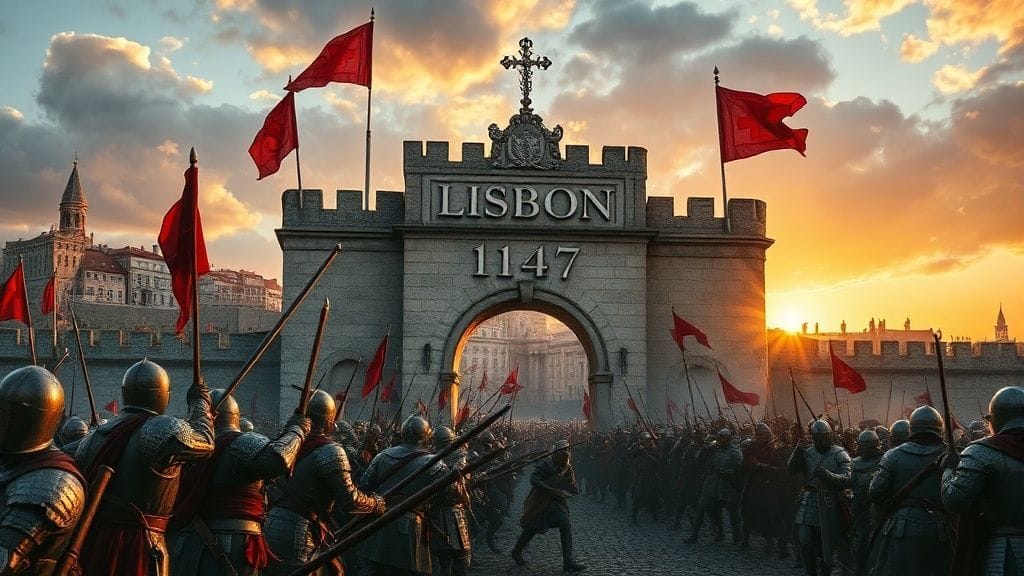
In the gray mist of an October morning in 1147, the tide whispered against the rocky shorelines of Lisbon as a fleet of hardened warriors and anxious pilgrims approached the city’s fortified quays. The air was thick with anticipation, tension, and a complex web of hope and fear. This was no ordinary arrival — it was the arrival of the Crusaders, swept not toward the Holy Land as planned, but toward Lisbon, a Muslim-ruled bastion standing at the crossroads of faiths, empires, and destinies. The capture of Lisbon would indelibly alter the arc of Iberian history and the wider Christian-Muslim world. Yet, more than just a military triumph, it was a turning point pregnant with human drama, political intrigue, and shifting identities.
The Dawn Before the Storm: Lisbon on the Eve of the Crusade
In the mid-12th century, Lisbon was a jewel of the Taifa realms, a vibrant city enriched by commerce, culture, and a layered population. Its streets echoed with the chatter of merchants dealing in silks and spices, its mosques gave voice to the call to prayer, and its walls held centuries of Islamic rule and influence. However, beneath this vibrant surface, Lisbon was a city on the edge of change, buffeted by the winds of the Reconquista — the Christian campaigns to reclaim Iberian lands from Muslim rule.
The city’s rulers, under the Almoravid dynasty, held fast, fortified and confident in their coastal stronghold. But to the north, Christian kingdoms were gaining momentum. Among them stood the burgeoning Kingdom of Portugal, led by the ambitious Afonso Henriques, determined to expand his realm and secure a lasting legacy.
The Political and Religious Landscape of 12th Century Iberia
The Iberian Peninsula in 1147 was a tapestry woven with conflicting powers and alliances. Christian kingdoms—Portugal, León, Castile, Aragón—jockeyed for position against Muslim taifas, shrinking and splintering under internal strife and pressure from the Reconquista.
Religious fervor inflamed these political ambitions. Crusading zeal, catalyzed by the Second Crusade called by Pope Eugenius III in 1145, was not limited to the eastern Mediterranean. The Iberian conflict was framed as a holy war, a re-conquest of Christian lands, justified by papal endorsements that equated the Iberian Muslims with enemies of Christendom.
This confluence of political motives and religious zeal set the stage for an extraordinary military expedition that would pivot in an unexpected but decisive direction.
The Second Crusade’s Unlikely Detour to the West
The Second Crusade, originally targeted at recapturing Edessa in the Levant, saw large contingents of crusaders from northern Europe set sail not towards Syria but to a different battlefield. Led by prominent knights, including English, Flemish, and German contingents under figures like King Conrad III of Germany and King Louis VII of France, a significant fleet arrived on the Atlantic coast of Portugal.
Invited by Afonso Henriques—who saw an opportunity to capitalize on their martial strength—the crusaders were persuaded to turn against Lisbon. This redirection was no mere coincidence; it was the product of tactical diplomacy and a shared goal underpinned by religious urgency. A crusade on the western front would both relieve the pressure on the Levant and secure vital lands at Europe’s western edge.
Arrival of the Crusaders: A Clash of Cultures and Faiths
The meeting of northern European crusaders with the Iberian kingdom was a confluence of distinct cultures, languages, and expectations. These crusaders, clad in chainmail and bearing crosses, were foreign to the Mediterranean climate and its intricate politics but driven by a single-minded devotion to their cause.
Landing near Lisbon’s harbor, they confronted a city prepared for siege, its defenders aware of the impending clash between two civilizations. Yet, behind the martial posturing lay complex dynamics — some Crusaders were mercenaries, others pilgrims, and many sought the promise of land and riches.
Siege Tactics and the Battle for Lisbon’s Walls
The siege of Lisbon began in earnest after a series of skirmishes and maneuverings. The Crusaders, supported by King Afonso’s forces, encircled the city, using a combination of traditional siege engines—battering rams, catapults—and naval blockades to cut off supplies.
Inside the city, Muslim defenders, experienced and determined, fought fiercely against the advancing Christian forces. Yet, as weeks passed, starvation and disease began to take their toll. The Crusaders’ relentless pressure and the strategic placement of siege lines gradually wore down the defenses.
The Role of King Afonso Henriques: Strategist and Sovereign
At the heart of the conquest was King Afonso Henriques, a complex figure whose passion for sovereignty reshaped the Portuguese identity. His alliance with the Crusaders was a calculated gamble; he deftly navigated the ambitions of foreign knights and the concerns of his own vassals.
His leadership balanced diplomacy with martial vigor, negotiating terms with some Crusaders while orchestrating relentless attacks on the city’s defenses. His vision extended beyond mere conquest — he saw a Lisbon integrated into a Christian kingdom, not simply a trophy of war.
The City's Defenders: Muslim Leadership and Resilience
Opposing the invaders was a formidable defense led by the city’s Muslim governor, Abu Zakariya. His leadership embodied a devotion to his people and faith, orchestrating the defense with tenacity and tactical acumen.
The defenders utilized the city’s formidable walls and intimate knowledge of the terrain, mounting sorties and counterattacks that complicated the Crusaders’ plans. Despite the eventual fall, their resistance etched a narrative of resilience into the city’s layered history.
The Turning Points: From Starvation to Surrender
Weeks turned to months as the siege unfolded, with Lisbon’s population suffering devastating shortages of food and water. Disease ravaged the cramped quarters behind the walls. Rumors of reinforcements never materialized for the defenders.
The decisive moment came when the city’s leaders faced the grim reality of capitulation. Negotiations resulted in terms that promised clemency to the inhabitants willing to convert or accept Christian rule, though the aftermath would prove far harsher for many.
Aftermath of Conquest: Transformation of Lisbon’s Social Fabric
The capture of Lisbon marked not only a military victory but also a profound social transformation. The Muslim population was subjected to expulsions, enslavement, or forced conversion. Christian settlers arrived to repopulate the city, altering its demographic and cultural makeup.
The liberation from Muslim rule also meant the imposition of new religious institutions, the establishment of churches, and the reorganization of civic life to align with Christian norms. Lisbon began its metamorphosis from a Muslim commercial hub into a burgeoning Christian capital.
Religious Zeal and Its Impact on Urban Development
The spiritual dimension of the conquest echoed through the city’s streets. New churches were erected on sites once sacred to Islamic worship. Religious orders, invigorated by crusading zeal, played key roles in administering the city and integrating it into the Christian world.
This period witnessed an investment in fortifications and urban planning aimed at both defense and the symbolic assertion of Christian dominion. The religious imagery and rituals of the city became tools of both faith and governance.
Lisbon as a Port of Expansion: Economic Consequences of the Capture
Strategically positioned on the Atlantic, Lisbon’s capture opened new avenues for economic expansion. The city became a crucial port for trade with northern Europe and later, a gateway in the burgeoning Age of Discoveries.
The control over Lisbon allowed the Portuguese crown to consolidate maritime ambitions, leveraging the city’s harbor to build a mercantile empire that would extend far beyond the peninsula’s borders.
The Crusaders’ Legacy: From Pilgrims to Settlers
Many of the Crusaders who participated in the siege chose to remain in Lisbon, enticed by land grants and new opportunities. This influx brought northern European customs, languages, and military techniques that blended with the existing Ibero-Mediterranean culture.
Their hybrid legacy endured, contributing to Portugal’s evolving identity as both a crusading kingdom and a maritime power, with echoes that would resonate for centuries.
Chronicles and Chronicles: Eyewitness Accounts of the Siege
The siege of 1147 was captured by chroniclers on both sides whose accounts reveal the brutal reality and the human stories beneath the geopolitical drama. From the Latin scribes of the Christian courts to Muslim historians lamenting loss, the narratives form a mosaic of perspectives.
These sources offer evocative details — from the cries of starving civilians to the valor of knights and commoners — painting a vivid picture of medieval warfare and its toll.
The Capture in the Broader Context of the Reconquista
Lisbon’s fall was one critical episode in the centuries-long struggle known as the Reconquista. It symbolized the turning tide as Christian kingdoms pushed farther south, reclaiming territory once lost.
This victory inspired further campaigns and emboldened the Portuguese kingdom’s status among its Iberian neighbors, shifting power balances and heralding a new era on the peninsula.
Cultural Interactions: Between Conflict and Coexistence
Despite conquest, fragments of Muslim influence persisted in Lisbon’s architecture, language, and customs. The interplay of Christian and Muslim cultures forged a complex tapestry marked by conflict yet also dialogue, adaptation, and hybridity.
This cultural negotiation shaped not only Lisbon but the broader identity of Portugal, embodying the paradoxes of medieval Iberia.
The Symbolism of Victory: Lisbon in Portuguese National Identity
The capture of Lisbon was enshrined as a foundational myth in Portuguese history, elevating Afonso Henriques as a national hero and the city as a symbol of Christian triumph.
It served to galvanize unity and pride, laying groundwork for the modern Portuguese state and its narrative of resilience and destiny.
Architectural Changes and Fortifications Post-Conquest
Post-siege, Lisbon underwent significant architectural modifications. Christian rulers commissioned fortifications, palaces, and cathedrals, transforming the skyline and securing their hold on the city.
These constructions were not merely defensive but carried ideological weight, asserting Christian permanence in a formerly Muslim space.
The Long Shadow: How 1147 Shaped Subsequent Crusading Efforts
The siege demonstrated the flexibility of crusading objectives and inspired similar campaigns in Iberia and beyond. It illustrated how crusading zeal could be harnessed for regional political goals and expanded the geographic scope of holy war.
This precedent echoed in later expeditions influencing medieval European military and religious policies.
The Muslim Diaspora and the Memory of Loss
The fall of Lisbon dispersed its Muslim inhabitants, many forced into exile or slavery. Their collective memory preserved stories of loss, resistance, and identity, carried across generations and geographies.
This diaspora contributed to the enduring cultural and political memory of the Reconquista’s human consequences.
The Crusade’s Secular and Religious Narratives: Propaganda and Reality
While contemporary Christian accounts celebrated the conquest as divine providence, a nuanced look reveals layers of political pragmatism, opportunism, and brutal realities.
The dual narrative of sacred mission and worldly ambition shaped medieval perceptions and modern historiography alike.
The Importance of the Siege in Medieval Maritime Power
Lisbon’s capture cemented the city as a key maritime power base, allowing Portugal to command Atlantic trade routes.
The city’s port became a launching point for exploration that would, centuries later, change the course of global history.
Lisbon Today: Remembering the Siege and Its Legacy
Modern Lisbon bears the marks of its historical layering—ruins, place names, and museums memorialize the 1147 siege. The event remains a touchstone for understanding Portuguese identity and the complex legacy of conquest.
Annual commemorations, scholarship, and public memory entwine to keep the past alive in the city’s present.
Conclusion
The capture of Lisbon in 1147 was more than a military event; it was a crucible of human experience where faith, ambition, culture, and survival intertwined. The siege brought profound transformation — for the city, its inhabitants, and the broader trajectory of Iberian and European history. It encapsulated the clash of civilizations that shaped medieval identity and echo the deep complexities of religious war and cultural exchange.
In the aftermath, Lisbon emerged not just as a Christian stronghold but as a living mosaic of its past, a city continuously reinvented by the memories and forces unleashed on that pivotal autumn day. Reflecting on this event invites us to ponder the costs and consequences of conquest, the resilience of communities, and the enduring power of history to connect us to our shared human story.
FAQs
Q1: Why did the Crusaders decide to attack Lisbon instead of continuing to the Holy Land?
A: The Crusaders were persuaded by King Afonso Henriques and local leaders who identified an opportunity to capture Lisbon, a valuable strategic and economic prize. Redirecting their efforts westward was also framed as part of the broader Christian holy war against Islam.
Q2: What role did King Afonso Henriques play in the siege?
A: Afonso Henriques orchestrated the alliance with the Crusaders, coordinated the siege efforts, and used the victory to consolidate the Kingdom of Portugal, marking him as a founding figure in Portuguese nationhood.
Q3: How did the capture of Lisbon affect the Muslim population of the city?
A: Many Muslims were expelled, enslaved, or converted. The fall disrupted centuries of Islamic rule, and the demographic shift profoundly altered the city’s social and cultural makeup.
Q4: What were the long-term economic impacts of Lisbon’s capture?
A: The city became a vital Christian port, facilitating expansion of trade networks and maritime exploration, which laid foundations for Portugal’s role as a leading seafaring power in the late medieval period.
Q5: How is the siege remembered in Portugal today?
A: It is a celebrated milestone in Portuguese history, commemorated through monuments, literature, and public events that highlight Lisbon's transformation and Portuguese identity.
Q6: Were there any notable chroniclers who recorded the siege?
A: Yes, various Latin Christian chroniclers detailed the siege, and Muslim historians recorded the loss, providing somber reflections that offer contrasting perspectives on the event.
Q7: Did the siege influence other crusading campaigns?
A: Yes, it expanded the concept of crusading to include Iberian conflicts, encouraging further military campaigns against Muslim-held territories in the peninsula.
Q8: What architectural legacies in Lisbon date back to the post-siege period?
A: Christian churches, fortifications such as the city walls, and urban restructuring projects were initiated to assert Christian dominance and protect the city from future threats.

