Table of Contents
- The Rhine Frontier on the Brink of Crisis
- The Making of Caracalla: A Childhood in the Shadow of Power
- From Co-Emperor to Sole Ruler: Blood on the Road to the North
- Who Were the Alamanni? Neighbors, Foes, and Reluctant Partners
- March to Upper Germany: The Empire Turns Its Gaze to the Rhine
- Steel and Standards: The Roman Army Caracalla Led into Germany
- First Clashes in the Forest: Ambushes, Skirmishes, and Fear
- The Campaign of 213: Fire, Negotiation, and a Manufactured Victory
- Blood, Mercy, and Propaganda: How Caracalla Crafted His Image
- Transformation of the Limes: Forts, Roads, and a Moving Frontier
- Voices from the Ranks: Soldiers, Officers, and the Emperor at War
- Life on the Other Side: Alamannic Villages under Roman Shadow
- The Politics Behind the Spear: Rome’s Internal Struggles and the German War
- Religion, Omens, and the Gods of War along the Rhine
- The Aftermath in Rome: Triumphs, Titles, and Silent Doubts
- From Victory to Vulnerability: How 213 Shaped the Later Empire
- Historians, Inscriptions, and Memory: Reconstructing the Campaigns
- Conclusion
- FAQs
- External Resource
- Internal Link
Article Summary: In the year 213, Emperor Caracalla campaigns against the Alamanni in Upper Germany, marching to the Rhine frontier to confront a confederation of tribes that challenged Roman control and prestige. This article follows that campaign from its roots in dynastic murder and imperial insecurity to its contested outcome on the forested borders of the empire. It explores how caracalla campaigns against the alamanni were driven as much by politics and image-making as by real strategic necessity. Through narrative scenes, we enter the world of legionaries on icy night watches, tribal leaders weighing survival against honor, and an emperor desperate to embody the warrior ideal. The story also traces how these events reshaped Roman frontier policy, strengthened and strained the army, and left a legacy of militarization that outlived Caracalla himself. We examine the sources, the archaeological clues, and the contradictions between Roman propaganda and likely reality. In doing so, the article shows how a seemingly limited frontier war foreshadowed the broader Germanic pressures that would, in centuries to come, transform the empire’s fate.
The Rhine Frontier on the Brink of Crisis
The winter skies over Upper Germany were often the color of lead, low and oppressive, pressing down on the dark line of forests beyond the Roman frontier. Along the Rhine, soldiers of the legions stood watch on ramparts slick with frost, peering across to a land that was both familiar and unknowable. For generations, Rome had maintained a guarded peace here: forts strung like beads along the river, roads cutting through marsh and woodland, patrols moving ceaselessly from tower to tower. But by 213 CE, the calm was fraying. Rumors moved faster than any dispatch: of new tribal coalitions, of raids slipping through gaps in the frontier, of a new force calling themselves the Alamanni.
It was into this tense landscape that Emperor Caracalla directed the full weight of imperial attention. The Rhine limes—Rome’s defensive boundary—had survived civil wars, mutinies, and previous clashes with Germanic peoples, yet there was a sense among commanders that something was changing. Communities across the river were no longer small, scattered groups easily bribed or bullied; they were confederations, drawn together by shared enemies and shared opportunities along the wealthy Roman provinces. The alarmed reports from the governors of Upper Germany did not describe a grand invasion, but something more insidious: continuous probing, burning farms just beyond the forts, extorting locals under Roman protection, and testing the reactions of an overstretched imperial army.
Caracalla’s decision to march north and personally lead the legions was not taken in a vacuum. The empire had been buffeted by internal instability and brutal succession struggles, and an emperor who had stained his hands with his own brother’s blood needed to reforge his image. The Rhine frontier offered him a stage—a place where he could present himself as the savior of the provinces, the stern protector of Roman order against a rising tide of barbarians. Even before the first troop columns left Italy, imperial scribes were preparing the words that would later inscribe stone: Germanicus Maximus, conqueror of the Germans.
But this was only the beginning. The story of how caracalla campaigns against the alamanni would unfold was written in more than decrees and carved titles. It would be etched into the lives of ordinary frontier farmers whose fields were trampled by marching boots, in the scars borne by legionaries who trudged through the dense, wet forests of Upper Germany, and in the whispered tales told around Alamannic fires—stories of an emperor who dressed like a soldier and who was said to rage like a storm god in battle. The frontier was on the brink of something new: not a single decisive clash but a grinding, complex confrontation that blurred the lines between victory and illusion.
The Making of Caracalla: A Childhood in the Shadow of Power
To understand why Caracalla would seize upon the Rhine campaign with such ferocity, one must first follow him back to the marble corridors of imperial palaces and the dimly lit private rooms where the future emperor learned that power was a precarious inheritance. Born Lucius Septimius Bassianus in 188 CE, he was the elder son of Septimius Severus, a hard-bitten provincial from North Africa who had fought and clawed his way to the throne during the civil wars that followed the year of the five emperors. In a move that would shape his son’s personality, Severus embedded both of his boys—Caracalla and Geta—into the machinery of power almost from birth, showering them with titles and parading them before the army.
As a child, Caracalla learned that the legions were the true arbiters of imperial fate. He watched commanders kneel before his father in Illyricum and Syria, and he listened as veterans swore loyalty not only to the emperor, but to his sons. It instilled in him both a deep reliance on military strength and a profound insecurity: loyalty could be won, but it could just as easily be bought away or lost in defeat. The boy who would one day lead caracalla campaigns against the alamanni was already, in a sense, campaigning from the moment he first donned a miniature military cloak and took part in reviews of the troops.
He was not raised for peace. The Severan dynasty was built on battlefield victories and uncompromising repression. Historians like Cassius Dio, a senator who viewed the young emperor with a mixture of contempt and fear, later described Caracalla as “inherently savage,” but such descriptions were colored by politics and hindsight. Still, even through the hostility, we glimpse a youth who cultivated a fierce, almost obsessive admiration for earlier warrior emperors and generals—Alexander the Great above all. Caracalla devoured tales of campaigns in Asia and Europe, memorized battle formations, and took every opportunity to present himself as a man of the sword rather than the stylus.
In the palace, tensions with his younger brother simmered and grew. Their mother, Julia Domna, tried to maintain a façade of unity, yet whispers of rivalry spread through court and camp. From the perspective of provincial administrators on the Rhine, this was distant drama, but in reality the brothers’ enmity would send shockwaves all the way to the frontier. The emperor the Rhine would eventually receive in 213 was already shaped by years of corrosive suspicion, by court factions that encouraged violence as a solution, and by a private conviction that only fear, not love, could secure loyalty.
Thus the boy who became “Caracalla” (a nickname derived from a Gallic cloak he liked to wear) stepped into adulthood already armored in aggression. He learned early that public displays of strength could obscure private doubts, and that war—real or staged—could bind the army to him more firmly than any legal decree. When the chance arose to direct Roman arms against the tribes of Upper Germany, he seized it not simply as a strategic necessity, but as an extension of a lifelong performance: the emperor as tireless soldier, the ruler as front-line warrior.
From Co-Emperor to Sole Ruler: Blood on the Road to the North
The road that would carry Caracalla to the Upper German frontier was paved in marble and blood. In 211 CE, when Septimius Severus died in distant Eboracum (modern York) while campaigning in Britain, he left the empire to his two sons. The ideal was a harmonious dual rule: Caracalla and Geta, co-emperors sharing power, advised by their mother. The reality was poisonous. Each controlled his own advisors and bodyguards; each sought the loyalty of the army. They divided palace wings and even planned to partition the empire itself. In a bitterly divided Rome, the prospect of civil war loomed over every ceremony and audience.
It ended, as so many Roman power struggles did, in a carefully orchestrated massacre. In late 211, Caracalla invited Geta to a reconciliation meeting in the apartments of their mother. As Julia Domna looked on, soldiers loyal to Caracalla burst into the room and cut his brother down, spattering blood across the empress’s robes. In the days that followed, the new sole emperor ordered a purge of Geta’s supporters, had his brother’s name erased from inscriptions, and forced senators and officers alike to swear oaths of loyalty to him alone.
This moment matters deeply for understanding why caracalla campaigns against the alamanni unfolded as they did. The empire now belonged to a man acutely aware that his legitimacy rested on fear, not affection. In Rome, the senate murmured and recoiled. In the provinces, particularly along volatile frontiers like the Rhine, commanders watched carefully, anxious to gauge the strength and stability of the new regime. Caracalla could not afford to appear as a hesitant administrator or a philosopher-king; he needed to be a commander in the field, decisive and implacable.
Almost immediately, he sought the company of the legions. He visited camps, increased pay, and emphasized a shared identity with soldiers, sometimes eating with them, often dressing in their gear instead of the traditional imperial toga. This cultivated camaraderie was not mere theater; it was strategy. Caracalla knew that if another rival emerged—perhaps another brother in arms, as his father had once been to previous emperors—only the army’s loyalty would stand between him and the fate he had inflicted on Geta.
And so, when tensions escalated along the German frontier, Caracalla recognized both the danger and the opportunity. A frontier campaign would reinforce the image he craved: the haunted, embattled ruler transfigured into a victorious general. A war in Upper Germany offered him a chance to redirect senatorial outrage into patriotic celebration, to distract the city of Rome from fratricide with news of barbarian defeat. It is astonishing, isn’t it, how often emperors turned to the frontiers when their thrones trembled at home.
Who Were the Alamanni? Neighbors, Foes, and Reluctant Partners
Across the Rhine and beyond the fortified line that snaked through river valleys and hills, the people Rome called the Alamanni were shaping their own response to imperial power. They were not a single tribe with a centralized king, but a loose confederation of groups bound by kinship, alliance, and common interest. Their name, often interpreted by modern scholars as “all men” or “a union of men,” reflected this composite nature: a gathering of warriors and families whose local identities were increasingly overlaid by a shared sense of opportunity—and threat—toward Rome.
By the early third century, economic and climatic pressures were reshaping life in central Europe. Archaeological evidence suggests shifting settlement patterns, with some communities moving closer to trade routes and fertile riverlands. Roman goods—glassware, weapons, jewelry—have been found deep inside what would then have been Alamannic territory, testifying to a relationship that was not simply hostile. Roman merchants traded, Roman officers negotiated, and frontier commanders sometimes paid subsidies to secure peace. The line between “barbarian enemy” and “frontier partner” was often blurred.
Yet the familiarity bred resentment as much as dependence. To Alamannic warriors who stood on ridges and watched Roman patrols move with drilled precision, the empire’s wealth was a constant lure. The fortified limes, with its towers and ditches, marked out a stark division: on one side, stone cities, tiled roofs, and bustling markets; on the other, simpler villages of timber and earth, less wealthy but fiercely independent. Raids across the boundary—sometimes small bands seeking plunder, other times large war parties—had been a feature of life for decades, but around the time caracalla campaigns against the alamanni began, something shifted. The raids grew bolder, more coordinated, and more sustained.
To Roman governors, these attacks were a test of their ability to protect their provinces. To Alamannic leaders, they were a means of securing cattle, slaves, and prestige. Success in war fed into honor and status inside the confederation; a chief who could return from the Roman lands with rich spoils and stories of forts humiliated or bypassed earned influence that no Roman title could match. Conversely, those chieftains who chose negotiation and tribute rather than battle had to justify their caution to ambitious young warriors eager to prove themselves.
We know very few of the names of these Alamannic figures. The Roman sources rarely record them, and the soil of Upper Germany has preserved few inscriptions of their own. This anonymity can mislead us into imagining the Alamanni as a faceless mass. In reality, every Roman decision on the frontier—the withdrawal of a cohort, the punitive destruction of a village, the acceptance of hostages—reverberated through networks of families, elders, and war bands, shaping the choices of men who were assessing whether to fight, to flee, or to bargain.
By 213, when Caracalla turned his attention to Upper Germany, the Alamanni were not merely troublesome raiders. They were a rising force, testing the boundaries of an empire that seemed less invincible than before. Some among them had already served as auxiliaries in Roman campaigns elsewhere, learning the empire’s strengths and weaknesses. Others had seen Roman cities, heard Latin curses and commands, and realized that the world beyond the forest could be both dangerous and irresistibly rich. The stage was set for confrontation not between strangers, but between uneasy neighbors who knew each other all too well.
March to Upper Germany: The Empire Turns Its Gaze to the Rhine
The decision to lead the army personally to Upper Germany was both strategic and theatrical. Early in 213, orders began to ripple out from imperial chancelleries: legions would reposition, auxiliary cohorts would reinforce vulnerable sectors, and supply trains would be assembled for long marches north. The empire’s immense logistical system roused itself like a giant, turning grain from African estates, weapons from Danubian workshops, and recruits from Italian towns into the sinews of a campaign on a distant frontier.
Caracalla’s journey from the heart of the empire to the Rhine was part procession, part reconnaissance. As he passed through cities in Gaul, he received delegations of local elites, promising protection from barbarian incursions and showcasing his commitment to their safety. Monuments would later depict him as stern and resolute, hand outstretched in the familiar imperial gesture of benefaction. Behind the sculpted calm, however, there was urgency. Reports from the frontier spoke not of one decisive defeat but of a pattern of small humiliations—Alamannic groups crossing the limes, threatening villages under Roman protection, and slipping back across the forests before a large response could be organized.
Caracalla understood the double audience he faced. On one side were the provincials of Upper Germany and Raetia, anxious farmers and traders who needed to believe that Rome remained strong. On the other were the Alamanni themselves, watching carefully for signs of weakness. Every movement of troops, every order to reinforce a fort or abandon a forward outpost, was read by both sides as a message. When caracalla campaigns against the alamanni commenced in earnest, they did so in a theater where perception was as crucial as steel.
The roads carried a river of marching men. Legionaries in heavy armor, auxiliaries from distant provinces carrying unfamiliar shields, cavalry units with their horses snorting in the cold air—together they turned provincial landscapes into corridors of war. Villages accustomed to modest garrisons suddenly found themselves hosting entire units, their granaries and barns requisitioned for imperial use. Some locals profited, selling food and services; others watched their stores dwindle and wondered whether Roman protection came at too high a price.
As the imperial column approached the Rhine, scouts and local guides brought intelligence of the lands beyond. They spoke of small settlements burned out during previous clashes, of cleared strips of land near the frontier that gave Roman archers a clearer field of fire, and of new paths the Alamanni were rumored to use to avoid patrols. Caracalla listened, questioned, and sometimes dismissed reports with a sharp, impatient wave. He was not interested in remaining on the defensive, comfortably behind walls. He wanted to cross, to strike first, to show the world—Rome and the Alamanni alike—that his reign would not be defined by hesitation.
Steel and Standards: The Roman Army Caracalla Led into Germany
The army that gathered around Caracalla in Upper Germany was a product of centuries of evolution, at once familiar to earlier emperors and distinctively Severan. Core to his forces were the legions stationed along the Rhine, battle-hardened units such as Legio VIII Augusta and Legio XXII Primigenia, men who had spent much of their lives in view of the dark line of German forests. To these he added detachments from other legions, picked units of cavalry, and numerous auxiliary cohorts recruited from across the empire—Batavians skilled in river fighting, archers from the East, and light infantry from the Balkans.
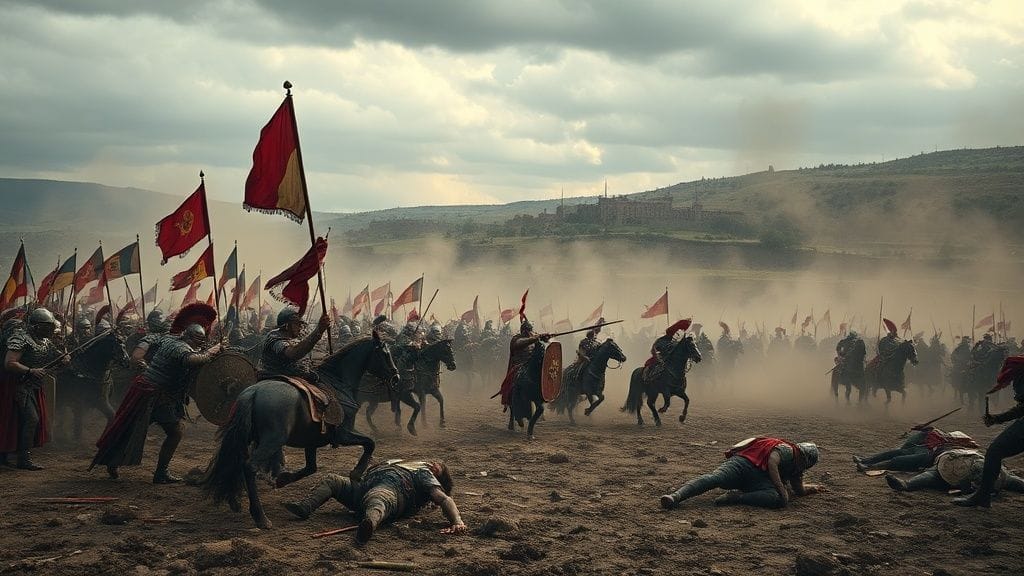
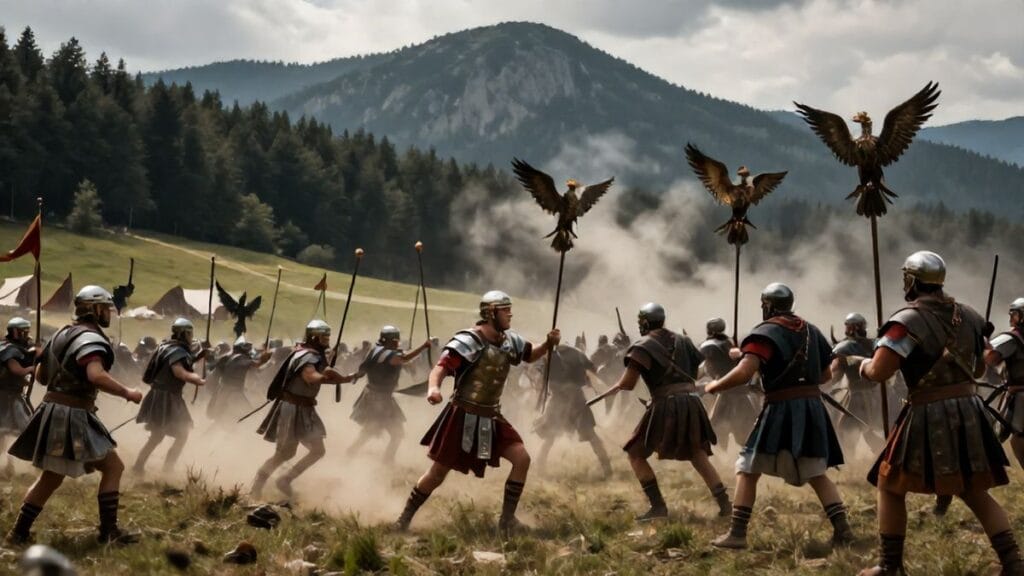
The visual impact of this army was immense. Legionaries wore segmented or scale armor, helmets gleaming with brass fittings, and carried large rectangular shields emblazoned with emblems that had meaning only within their units but which projected an aura of unshakeable order to any observer. Each legion marched behind its eagle standard, a sacred symbol protected at all costs. Drums, horns, and the clatter of equipment accompanied their movement, a mobile manifestation of Roman power meant to awe allies and enemies alike.
Under Caracalla, the army had become more than a tool: it was also his political base. His decision a year earlier to increase soldiers’ pay, though costly to the imperial treasury, had endeared him to the rank and file. Among the campfires that dotted the Rhine’s west bank, stories circulated of the emperor who would eat with common soldiers, who wore a simple cloak rather than the ornate trappings of peacetime rulers, and who spoke of himself as one of them. Whether all of these stories were true hardly mattered; they shaped expectations. A frontier campaign would bind him and the army tighter than ever—or, if mismanaged, tear that bond apart.
Operationally, the army faced a difficult task. Warfare against the Alamanni did not offer the neat, open-field battles that Roman military doctrine preferred. Instead, it demanded flexibility: small unit tactics, ambushes and counter-ambushes, rapid marches through difficult terrain. Cavalry scouts probed forward, engineering units checked and repaired bridges, and surveyors marked out temporary camps that could be fortified every evening. The discipline of the legions, honed in conflicts from Britain to Mesopotamia, was their advantage. But in the thick forests of Upper Germany, that advantage could be blunted by surprise and unfamiliar ground.
Nevertheless, morale was high. Caracalla’s presence, the promise of victory titles, and the opportunity for plunder all contributed to an atmosphere in which men were willing to endure the misery of cold, mud, and constant tension. As caracalla campaigns against the alamanni got underway, the legions stepped into the shadow of the trees with a confidence born of centuries of Roman success—and with little comprehension that the patterns of frontier warfare were slowly shifting beyond their old formulas.
First Clashes in the Forest: Ambushes, Skirmishes, and Fear
Once the Roman columns crossed into territory regularly traversed by Alamannic groups, the familiar rhythms of camp life gave way to a new kind of vigilance. Scouts reported movement in the woods: fleeting shapes, distant fires, horses’ tracks appearing overnight and then vanishing. The Alamanni avoided large, set-piece engagements at first. They knew the power of Roman formations in open ground. Instead, they harried the edges of the advancing army, striking at foragers, small detached parties, and supply wagons that lagged behind the main column.
For the soldiers, this was war of nerves. A legionary sent to cut wood or gather water might not return. A patrol dispatched at dawn might stagger back before dusk with bloodied survivors and tales of javelins arcing out of the foliage without warning. Night watches became grueling: men stood in the darkness, ears straining for the crack of a branch or the low murmur of foreign voices. False alarms were common; yet any guard who grew complacent risked not only his own life but the safety of the camp.
Caracalla responded with a mixture of discipline and reprisal. Commanders tightened marching order rules, forbidding soldiers from straying beyond defined perimeters. Engineering units cleared broad swathes of trees along paths to give archers a clearer field of view. When Roman patrols did manage to catch and defeat Alamannic raiding parties, the emperor ordered severe punishments for those captured in arms, sometimes having prisoners executed within sight of their own territory to send a brutal message.
Still, the problem persisted. The Alamanni knew the land intimately; they slipped across streams and through ravines, appearing where Roman officers least expected them. The first clashes of caracalla campaigns against the alamanni were thus not glorious battles but a grinding sequence of skirmishes and feints. Each side tested the other: the Alamanni probing for Roman weaknesses, the Romans probing for a chance to bring their enemy to decisive engagement.
Amid this tension, the human side of war surfaced in unexpected ways. Some Alamannic groups attempted negotiation, sending envoys to Roman camps under flags of truce. They offered hostages, tribute, or agreements to withdraw from disputed lands. For their part, Roman officers, acting under Caracalla’s increasingly hard line, were suspicious of any offer that seemed to fall short of outright submission. Yet even in the sternest of legions, there were men who recognized the faces of those they now called enemies—former trading partners, perhaps, or auxiliaries who had once served alongside them under the same imperial eagle.
The Campaign of 213: Fire, Negotiation, and a Manufactured Victory
The campaign reached its turning point not in a single, legendary battle engraved upon the collective memory of Rome, but in a series of operations that blended violence with diplomacy. Surviving literary sources, such as Cassius Dio and the fragmentary Historia Augusta, speak of Caracalla enticing some Alamannic groups with promises of peace, only to attack them once they had relaxed their guard. Whether these accounts are entirely accurate or exaggerated by hostile authors, they point to a campaign in which force and deception went hand in hand.
One probable pattern has emerged from modern reconstructions: Caracalla advanced deep enough into contested territory to intimidate and destabilize the Alamannic confederation, burning fields and some villages to demonstrate Roman reach. In response, various chieftains, burdened by the risk of famine and discontent among their followers, entered into negotiations. Some may have agreed to return captives, pay tribute, or withdraw from areas that Rome claimed as its own. Others, seeing an imperial force at the edge of its supply limits, hesitated or attempted to stall, hoping Roman determination would falter with the onset of poor weather.
At least twice, according to hostile reports, Caracalla lured groups of Alamanni into a false sense of security, then ordered attacks when they were unprepared. If true, this would align with his broader pattern of ruthlessness. The aim was not merely tactical success, but a carefully constructed narrative: the emperor had faced down a dangerous confederation and crushed it in battle. For the official record, the nuances of negotiation, half-kept promises, and uneasy truces were flattened into a single triumphant claim. Caracalla had defeated the Germans and earned the right to be called Germanicus Maximus.
In practical terms, the outcome of caracalla campaigns against the alamanni in 213 was likely a limited stabilization of the frontier rather than a total subjugation. Roman forces probably forced several significant Alamannic groups to retreat from forward positions and accept terms that temporarily reduced raids into Upper Germany. Yet the Alamanni were not destroyed; their confederation was bruised, not broken. Underneath the imperial boasts, a more complex reality persisted: one of negotiated coexistence punctuated by violence.
Nevertheless, the propaganda machine roared to life. Coins minted after the campaign depicted Caracalla in military dress, sometimes trampling a fallen barbarian or accompanied by the goddess Victoria. Inscriptions in frontier provinces praised his “restoration of peace” and “defeat of the most savage enemies.” The emperor himself encouraged the comparison to great conquerors of the past, positioning his time on the Rhine as a pivotal moment in defending the empire from barbarian chaos. Whether or not provincials believed every word, they were relieved, at least temporarily, to see an emperor who had come in person and forced some measure of order onto a restless border.
Blood, Mercy, and Propaganda: How Caracalla Crafted His Image
In the aftermath of the campaign, Caracalla moved swiftly to secure his image as the victorious border guardian. It was here that the brutal pragmatism that had characterized his rise to sole rule intersected with the theatrics of imperial self-presentation. Triumphs in Rome were not on the scale of earlier, more spectacular celebrations, but the symbolism was unmistakable: the emperor had confronted the barbarian and prevailed. Titles were added to his official name, statues showed him with an intense, furrowed brow and closely cropped hair, emphasizing military austerity over civilian refinement.
Public monuments in Upper Germany reflected the same message. Dedications by local governors and military commanders spoke of “our lord’s triumph over the Alamanni” and lauded his “divine foresight” in bringing the campaign to a successful conclusion. One inscription, cited in modern scholarship, praises him as the “restorer of the world,” echoing a well-worn imperial phrase but now anchored to his presence along the Rhine. Such texts, carved into stone and set up in view of soldiers and civilians, were carefully curated pieces of propaganda, meant to inscribe Rome’s version of events onto the very landscape of the frontier.
Behind these public declarations, however, lay a more ambiguous story. Some soldiers remembered the campaign not only for its victories but for the harshness with which Caracalla sometimes treated both enemies and his own men. Discipline was severe; deserters and those accused of cowardice faced brutal punishment. At the same time, the emperor could be generous, handing out bonuses and rewards to units that had distinguished themselves. This mixture of blood and mercy mirrored his larger political style: unpredictable, dangerous, yet occasionally beneficent in ways that bound recipients to him personally.
The duality extended to his treatment of defeated Alamanni. Some chieftains, once coerced into submission, were allowed to retain limited authority, now as clients of Rome, their status dependent on the emperor’s favor. Others were humiliated or executed, their deaths not only removing potential threats but serving as chilling lessons to those who might consider defiance. For Caracalla, the frontier was not just a line to be defended but a theater in which to demonstrate that loyalty brought security and rebellion brought annihilation.
As caracalla campaigns against the alamanni receded into memory, what remained was a narrative largely shaped by Rome. Within the empire, the story was one of decisive imperial action. Beyond the Rhine, in the camps and villages of the Alamanni, another story must have circulated—one of treacherous negotiations, sudden attacks, and a powerful but not omnipotent enemy. Those tales were never written down, but they would have lived on in spoken tradition, shaping how later generations of warriors viewed the vast stone and road network that marked the edge of Rome.
Transformation of the Limes: Forts, Roads, and a Moving Frontier
The campaign of 213 did not end with Caracalla simply turning his army around and returning to Rome. Its consequences were etched into the physical fabric of the frontier. Roman commanders, acting with imperial authorization, reevaluated their defensive posture in Upper Germany and neighboring provinces. Some forts were reinforced, their walls strengthened and ditches deepened. Watchtowers were repaired or rebuilt, signaling systems refined to allow faster communication along the length of the limes.
More subtly, the boundary between Roman-controlled land and the territories of the Alamanni became more fluid. In some areas, Rome pushed slightly forward, asserting control over key roads or river crossings that had previously been contested. In others, recognizing the difficulties of maintaining overextended positions in the face of continued raiding, the army may have consolidated, focusing on more defensible lines. Archaeological evidence in regions such as the Taunus and Odenwald suggests phases of rebuilding and reorganization in the early third century, consistent with a post-campaign recalibration.
These changes were not merely technical. They altered the daily experience of life along the frontier. Settlements just behind the limes felt the weight of increased militarization: more patrols, stricter controls on movement, and heightened tensions whenever unfamiliar faces appeared near the roads. At the same time, the presence of Roman infrastructure—bridges, stone roads, granaries—continued to draw economic activity. Traders, craftsmen, and opportunists followed the army’s trail, seeking to profit from the needs of soldiers and officials.
For the Alamanni, the transformed limes presented both obstacle and opportunity. Roman efforts to strengthen certain sectors might push raiders toward weaker points. Fortified positions could be circumvented by those who knew the land well enough to avoid patrol routes. Yet the increased Roman vigilance also carried risks for any group considering large-scale incursions. The psychological message of the post-213 landscape was clear: Rome had not retreated; it had sharpened its claws.
Thus, the legacy of caracalla campaigns against the alamanni included a frontier more tense, more organized, and more deeply embedded in the identity of both sides. The limes was no longer simply a line on a map; it was a living, contested zone where architectural stone and earthen ramparts embodied decades of confrontation, wary peace, and the occasional roar of open conflict.
Voices from the Ranks: Soldiers, Officers, and the Emperor at War
Though official histories spotlight emperors and generals, the reality of the campaign in Upper Germany was carried on the weary shoulders of ordinary soldiers. We catch only glimpses of them, through tombstones and votive altars that mention units and individuals stationed in the region. One can imagine a legionary from Pannonia, transferred west to reinforce the Rhine, carving a dedication to Mars or Jupiter after surviving a brutal winter patrol—a small, personal plea for protection etched into stone that would outlast empires.
For such men, caracalla campaigns against the alamanni meant long marches through unfriendly terrain, perpetual uncertainty, and the constant balancing of fear and duty. They slept in leather tents or crowded barracks, ate coarse bread and salted meat, and learned to read the subtle signs of impending attack: a sudden silence in the woods, an unusual absence of birdsong, the sense of unseen eyes watching from the tree line. Some would die nameless, their graves unmarked, their memories preserved only in the comradely stories of survivors.
Officers faced their own pressures. Centurions had to maintain discipline without pushing their men into mutiny; tribunes and legates juggled imperial directives with on-the-ground realities that did not always match the rosy assumptions of distant planners. The presence of the emperor himself was both a boon and a burden. Success brought immediate favor; failure could mean disgrace or worse. Every tactical decision became fraught when taken under the gaze of a ruler known for sudden, violent shifts of mood.
Caracalla’s interactions with the army were complex. He spoke their language, shared their hardships to a degree, and was known to visit the wounded. Yet the same hand that shook a veteran’s in gratitude could sign an order condemning another soldier to death for an infraction deemed unforgivable. This duality fed into a culture of hyper-vigilance within the camps. Loyalty was prized but also taken for granted; suspicion was never far behind.
And then there were the non-combatants: the camp followers, traders, craftsmen, and even families that orbited the moving engine of war. Their stories are even more elusive, but we know they were there, providing services, selling goods, carving out livelihoods in the shadow of legionary standards. For them, the campaign meant risk but also opportunity. As long as the army remained in a region, money flowed. When it moved on, some followed, while others stayed behind, their lives forever altered by the swirl of imperial power that had once passed through their fields and forests.
Life on the Other Side: Alamannic Villages under Roman Shadow
While Roman records center the imperial army, the Alamanni lived through 213 in a very different key—one of apprehension, adaptation, and stubborn resilience. Their villages were clusters of timber houses and farmsteads, often near arable land or pasture, sometimes nestled in clearings carved from the forest. Cattle and pigs rooted and grazed around these homes, and fields of grain marked out the limits of subsistence in a region with harsh winters and capricious seasons.
When the Roman army crossed the frontier, the impact on these communities was immense. Alarm runners would have spread the news: thousands of armored men were on the move, burning or seizing what lay before them. For some villages, the strategy was flight—gathering the most valuable possessions, driving livestock into hidden valleys or up into forested hills, and waiting until the storm had passed. Others fortified their positions as best they could, knowing that if caught, they might face looting or worse.
Chieftains had agonizing decisions to make. To stand and fight risked annihilation; to negotiate risked humiliation and subordination. The young warriors, fired by tales of ancestral courage, might demand resistance, while elders, who remembered previous Roman campaigns, counseled caution. This generational tug-of-war played out under the constant pressure of Roman maneuvers and the knowledge that food supplies were finite. Fire swept through some of these communities, either at Roman hands or as part of scorched-earth tactics to deny resources to the invading army.
Yet relationships with Rome were not solely defined by open conflict. Even during caracalla campaigns against the alamanni, some groups found ways to quietly resume forms of exchange—whether in stolen moments of trade or in the complicated status of those Alamanni who had become Roman allies or auxiliaries. These liminal figures, straddling two worlds, faced suspicion from all sides. To Romans, they were barbarians who had accepted the benefits of cooperation; to some of their kinsmen, they were dangerously close to being traitors.
In the evenings, around fires in hidden encampments or half-ruined villages, stories would circulate. No one present could have known that their people would one day, centuries later, leave an imprint on regions that Romans still thought of as securely theirs. But they did know, intimately, the weight of imperial attention. They saw how an emperor’s need for glory translated into burned fields and missing kin. And they learned, slowly, the rhythms of Roman strength and vulnerability, knowledge that their descendants would inherit and eventually wield with devastating effect.
The Politics Behind the Spear: Rome’s Internal Struggles and the German War
No frontier campaign exists in isolation from the political currents at the empire’s core. While Caracalla was in Upper Germany, senators in Rome watched events with a wary eye. Many still seethed over Geta’s murder and the subsequent purges. Others, pragmatic or fearful, clung to whatever stability the emperor’s presence offered. A successful German campaign could strengthen Caracalla’s hand, forestalling conspiracies and silencing critics. A failure, or even a perceived stalemate, might embolden those who dreamed, quietly, of regime change.
The imperial court, even while partially mobile with the campaign, remained a hive of intrigue. Advisors and generals jockeyed for influence, aware that the emperor’s favor could shift rapidly. Decisions about appointments in key provinces, commands over legions, and the distribution of spoils were all colored by calculations of loyalty and threat. An officer who showed too much popularity with the troops risked being seen as a rival. One who faltered in the field risked swift disgrace.
Within this context, the emphasis on portraying caracalla campaigns against the alamanni as an unequivocal success becomes clearer. The Rhine was not simply a border; it was a symbolic stage on which the emperor demonstrated his fitness to rule a vast, troubled empire. Victory in Upper Germany could be deployed rhetorically to counter senate grumblings about internal bloodshed: whatever his domestic faults, Caracalla could claim, he was the man standing between Roman civilization and the savage world beyond.
Yet behind the celebrations, financial and administrative strains deepened. The cost of the campaign, layered on top of previous military expenses and the pay raise Caracalla had granted, weighed on the treasury. New tax pressures and debasement of coinage would, in time, contribute to the economic turbulence that marked the third-century crisis. Thus, even as monuments declared the Rhine secure, cracks were spreading through the structures that sustained imperial power.
Caracalla’s own temperament did nothing to ease tensions. His paranoia, possibly exacerbated by guilt over fratricide and long-standing insecurity, drove him to see threats everywhere. He relied heavily on the army and less on the traditional elites of Rome, feeding resentment among senators who saw themselves sidelined. While the German campaign temporarily redirected attention outward, it did not heal these internal rifts. The spear pointed across the Rhine, but many eyes within the empire remained fixed on the man who held it, wondering how long he could balance on the edge of fear and adulation.
Religion, Omens, and the Gods of War along the Rhine
In an age when the divine was woven into every thread of daily life, war on the frontier was as much a spiritual as a physical undertaking. Before crossing into hostile territory, Roman officers would have sought favorable omens—examining the entrails of sacrificed animals, watching the flight of birds, and consulting astrologers and priests. Caracalla, like many emperors, combined a public adherence to traditional Roman cults with personal devotions shaped by his family’s eastern connections, including the worship of solar deities and mystery cults.
Along the Rhine, altars to Jupiter, Mars, and local river gods received renewed offerings. Soldiers promised sacrifices in exchange for survival or victory; some fulfilled those vows by dedicating stone monuments inscribed with terse formulas of gratitude. These votive stones, unearthed by archaeologists centuries later, are among the most poignant remnants of the campaign—simple, direct appeals from men who faced death in muddy clearings and dark woods.
The Alamanni, for their part, honored their own pantheon: sky gods, earth spirits, ancestors whose presence was felt in sacred groves and rituals passed down through generations. When they went to war, they, too, invoked divine favor, performing rites before battle and interpreting signs in the natural world. To Roman eyes, these practices seemed barbaric or primitive, but they served a similar purpose: to anchor human fear and hope in a cosmos that could be petitioned, if not fully controlled.
During caracalla campaigns against the alamanni, stories of omens—real or invented—circulated freely. A sudden storm might be seen as Jupiter’s displeasure or as a sign that the gods favored the side that suffered less. A dream recounted by a centurion could spread through the ranks as a warning or a reassurance. The emperor himself was not immune to such interpretations. If a particular sacrifice yielded ambiguous signs, it might delay or accelerate an offensive, threading divine consultation into the very fabric of military decision-making.
Religion thus served both as a solace and a tool. For common soldiers and warriors, it offered a framework for understanding the chaos and terror of battle. For leaders, it could legitimize choices and—when things went wrong—offer a way to explain failure without undermining their own personal authority entirely. The gods, ever conveniently distant, could be blamed as well as praised.
The Aftermath in Rome: Triumphs, Titles, and Silent Doubts
When Caracalla eventually left Upper Germany and returned south, the Rhine did not fall silent, but the empire’s gaze shifted back toward its capital. Rome received its emperor with the rituals appropriate to one who had secured a frontier. Senators assembled, whether enthusiastically or under duress, to greet him. Magistrates organized public ceremonies. News of the campaign filtered through the city’s teeming streets in the form of proclamations, gossip, and the slow, visual drip of new coinage bearing martial imagery.
Caracalla adopted, or had confirmed, titles that proclaimed his victory over the Germans. He might not have staged a full, traditional triumph—a lavish parade through the city—but the symbolism of conquest suffused his public presentation. Statues in military dress appeared in key locations; inscriptions in Rome and provincial capitals echoed the theme of an emperor who had shielded the empire from barbarian incursions. For a population accustomed to headlines of internal purges, this outwardly directed narrative offered a momentary shift in mood.
Yet beneath the surface, doubts persisted. Many in the senate viewed the German campaign as a calculated distraction, a manufactured opportunity for glory that did little to address deeper problems. Others, more practical, simply measured success by its most immediate metric: for the time being, the Rhine frontier was quieter, and caravans and river traffic faced fewer disruptions. Whatever their private misgivings about the emperor’s character, provincial elites in Gaul and Upper Germany could hardly deny that his presence had had some effect.
Caracalla himself seemed determined to extend his image as a tireless warrior. No sooner had he returned from the German frontier than he began to plan further interventions elsewhere, including ambitious designs on Parthia. The pattern was clear: this was a ruler for whom peace was not the absence of war but its postponement, a parenthesis between campaigns that validated his right to hold power. The echoes of caracalla campaigns against the alamanni, still reverberating in the forts and villages of Upper Germany, thus blended seamlessly into preparations for new theaters of conflict.
In the end, it would not be a foreign enemy that brought Caracalla down, but an assassin within his own entourage, far from the Rhine or the senate. His murder in 217, on the road near Carrhae in the East, closed a life lived under the constant shadow of violence. But in Rome, as in Upper Germany, memories of the German campaign lingered—some carved into stone, others living on in the wary calculations of those tasked with governing a frontier that was never truly secure.
From Victory to Vulnerability: How 213 Shaped the Later Empire
Looking back from the vantage point of later centuries, the campaign of 213 might seem like a minor episode: a limited operation on one frontier among many. Yet its significance becomes clearer when set against the trajectory of the third-century crisis. Within a few decades of Caracalla’s death, the empire would face multiple simultaneous invasions, rapid turnovers of emperors, economic instability, and the gradual erosion of its control over exactly those regions the Alamanni and other Germanic groups coveted.
In this longer arc, caracalla campaigns against the alamanni stand as both a warning and a precursor. They revealed that Rome’s frontiers were no longer buffered by a comfortable margin of uncontested territory. Instead, imperial and barbarian worlds pressed closely against one another, intertwined economically, culturally, and militarily. A single campaign, no matter how energetically prosecuted, could not permanently “solve” the problem of restless tribes whose internal dynamics and external pressures continued to evolve.
Caracalla’s response—a mix of aggressive forward operations and tightened frontier defenses—became a template of sorts. Later emperors would repeat the pattern: rushing to threatened borders, conducting swift punitive strikes, fortifying key points, and trumpeting their victories in inscriptions and coins. Sometimes these measures bought decades of relative calm; other times they barely kept chaos at bay. The essential imbalance, however, grew more pronounced as the third century progressed: Rome struggled to maintain the costs of its vast military apparatus, while groups beyond the frontiers gained in cohesion, experience, and ambition.
The Alamanni themselves would soon reappear in the historical record, testing Roman defenses further south and deeper into Gaul, sometimes even threatening Italy. What they learned in their early clashes with Roman forces during Caracalla’s reign—about the empire’s response times, its reliance on certain routes, its thresholds for negotiation—cannot be quantified, but it surely mattered. Knowledge passed down from one generation of leaders to the next, shaping strategies that exploited Roman vulnerabilities more effectively.
Thus, the German campaign of 213 was not an isolated triumph but an episode in a longer, more complex struggle. It showed that even an emperor deeply committed to the military, willing to lead in person and to invest heavily in the army’s loyalty, could at best contain, not eliminate, the pressures building along the frontiers. The Rhine would remain a contested space, a zone of contact and conflict, where the illusion of permanent security could be maintained only at escalating cost.
Historians, Inscriptions, and Memory: Reconstructing the Campaigns
Our understanding of Caracalla’s operations in Upper Germany rests on a fragile foundation of texts, stones, and sherds of material culture. Literary sources such as Cassius Dio offer vivid but biased narratives, written from the perspective of a senatorial elite often hostile to the Severan dynasty. Dio, for instance, emphasizes Caracalla’s cruelty and suggests that his dealings with the Alamanni were marked by treachery as much as valor. Modern historians, cautious of taking such accounts at face value, balance them against other evidence—inscriptions, coins, and archaeological findings.
Inscriptions from the region mention Caracalla’s German victories and his titles, anchoring the campaign in time and place even when details are scarce. One might find, for example, a dedication set up by a provincial governor in Mogontiacum (Mainz) praising the emperor’s “restoration of peace in Upper Germany” and thanking the gods for his protection. These formulaic texts, while lacking in narrative richness, confirm that something significant occurred in 213 that was understood by contemporaries as a campaign worthy of commemoration.
Archaeology adds another dimension. Excavations at forts along the Upper German-Raetian limes reveal phases of destruction and rebuilding, shifts in garrison composition, and patterns of supply that correspond roughly to the early third century. While it is often impossible to tie a particular burned layer or construction project directly to caracalla campaigns against the alamanni, the clustering of such evidence supports the picture of intensified military activity and frontier reorganization at this time.
Modern scholarship, synthesizing these threads, presents a nuanced view. As one historian has noted, “Caracalla’s German war appears less as a grand conquest than as a dramatic assertion of imperial presence in a frontier region under mounting strain” (a sentiment echoed in contemporary analyses of Severan military policy). This perspective highlights the performative and political aspects of the campaign without denying its real, if limited, military effects.
Memory of the campaign, both ancient and modern, is thus contested. Roman officialdom remembered it as a peace-restoring operation. Senatorial authors remembered it, when they mentioned it at all, as another example of an emperor seeking to cloak his crimes in martial splendor. The Alamanni left no written record, but their later history suggests that they remembered Rome as a formidable foe whose blows could be survived, whose lines could be breached again and again. For us today, tracing these echoes across time, the campaign offers a window into a world on the cusp of transformation, where empire and “barbarian” met not in a single cataclysmic clash but in a series of encounters that slowly remade both sides.
Conclusion
In 213, when Emperor Caracalla led his forces into Upper Germany, the clash between Rome and the Alamanni was about far more than a single frontier or a single year. It was a convergence of personal ambition and structural tension—a ruler haunted by fratricide seeking legitimacy through war, an empire straining to hold its borders, and a confederation of tribes probing those same borders for weakness and opportunity. The campaign unfolded as a mosaic of skirmishes, negotiations, betrayals, and carefully crafted propaganda, leaving behind a legacy that cannot be reduced to simple terms of victory or defeat.
Caracalla’s presence on the Rhine brought temporary stabilization and a new round of fortification and militarization along the limes. Yet the very need for such a high-profile intervention underscored how fragile Rome’s control had become, how dependent it was on the personal energy and ruthlessness of emperors who could not rule forever. For the Alamanni, the experience reinforced both the dangers and the possibilities of confronting Rome, lessons that would reverberate as their descendants continued to challenge the empire in the centuries that followed.
Ultimately, caracalla campaigns against the alamanni stand as a revealing episode in the long, uneven story of Rome’s encounter with the peoples beyond its northern frontier. They show an empire still powerful, still capable of projecting force deep into contested lands, but increasingly locked into a cycle of reaction and repression that did little to address the underlying dynamics driving frontier unrest. They also remind us that history’s grand narratives are built from the choices of individuals—emperors, chieftains, soldiers, and villagers—each negotiating fear, hope, and survival in their own way. In the cold forests of Upper Germany, under skies heavy with snow and smoke, those choices left marks that we can still trace, faint but indelible, across the landscape of the past.
FAQs
- Who were the Alamanni that Caracalla campaigned against?
The Alamanni were a loose confederation of Germanic groups living east of the Rhine, in regions of what is now southwestern Germany and neighboring areas. Rather than a single centralized tribe, they were a coalition of clans and local leaders united by overlapping interests, shared enemies, and economic ties, including both trade and conflict with the Roman Empire. - Why did Caracalla launch a campaign in Upper Germany in 213?
Caracalla moved against the Alamanni in 213 to address increasing raids and pressure along the Rhine frontier and to reinforce Roman authority in Upper Germany. Politically, the campaign also served to bolster his legitimacy after the murder of his brother Geta, allowing him to present himself as a warrior emperor defending the empire from barbarian threats. - Did Caracalla decisively defeat the Alamanni?
The evidence suggests that Caracalla achieved tactical and diplomatic successes that stabilized the frontier but did not destroy the Alamannic confederation. Roman sources and inscriptions celebrate a victory, and he assumed titles reflecting conquest, yet the Alamanni remained a significant force and continued to challenge Rome in later decades. The campaign was more a forceful assertion of power than a permanent solution. - How did the campaign affect the Roman frontier (limes) in Upper Germany?
In the wake of the campaign, the Romans strengthened and reorganized sections of the Upper German-Raetian limes. Some forts and watchtowers were rebuilt or reinforced, and defensive lines were adjusted to improve control over key routes and river crossings. This contributed to a more heavily militarized and closely monitored frontier zone. - What do our main sources say about Caracalla’s conduct in the campaign?
Senatorial authors like Cassius Dio portray Caracalla as ruthless and sometimes treacherous in his dealings with the Alamanni, alleging that he exploited negotiations to launch surprise attacks. These accounts are hostile and must be read critically, but they align with the broader image of Caracalla as an emperor who combined military energy with a readiness to use brutal tactics to secure his aims. - How did the campaign influence Caracalla’s relationship with the army?
The campaign reinforced Caracalla’s image as a soldier-emperor closely aligned with the legions. By personally leading operations, sharing hardships to some extent, and distributing pay and rewards, he deepened the army’s loyalty, which was crucial for maintaining his rule. At the same time, his harsh discipline and volatile temperament meant that this bond was rooted as much in fear as in admiration. - What was the long-term significance of the 213 campaign for the Roman Empire?
In the long term, the campaign foreshadowed patterns that would define the third century: recurring frontier crises, emperors relying heavily on the military for legitimacy, and increasingly costly efforts to maintain the limes. While Caracalla’s operations bought temporary security in Upper Germany, they did not prevent the later resurgence of the Alamanni and other groups who would play a major role in the pressures that transformed the empire.
External Resource
Internal Link
Other Resources
- Encyclopaedia Britannica – general search for the exact subject
- Google Scholar – academic search for the exact subject
- Internet Archive – digital library search for the exact subject