Table of Contents
- Shadows over Rome on the Eve of a New Augustus
- The Severan Gamble: A Soldier-Emperor and His Heir
- From Lucius Bassianus to Caracalla: The Making of a Prince
- War in the East: Parthian Flames and Imperial Ambition
- The Day caracalla proclaimed augustus: Ceremony in the Camp
- Voices in the Ranks: Soldiers, Standards, and Shouted Oaths
- Augusta, Augusta: Julia Domna and the Architecture of Power
- Imperial Propaganda: Coins, Statues, and the Fiction of Harmony
- The Silent Rival: Geta, Brother, Co-Augustus, Target
- Rome Reacts: Senate, People, and the Fear of a New Nero
- Growing into the Purple: Education, Tutors, and Ancient Expectations
- Tensions in the Palace: Rumors, Plots, and Fractured Loyalties
- From Heir to Killer: The Long Shadow of a Single Proclamation
- Across the Provinces: How the Empire Learned of a New Augustus
- Law, Citizenship, and the Road to the Constitutio Antoniniana
- Memory Wars: How Ancient Authors Judged Caracalla
- Archaeology of an Accession: Traces in Stone, Bronze, and Papyrus
- Echoes through Time: Succession, Violence, and the Roman Imperial Idea
- Conclusion
- FAQs
- External Resource
- Internal Link
Article Summary: In the winter of 198 CE, amid the dust of a distant eastern campaign, the Roman world changed course when caracalla proclaimed augustus and was lifted from imperial heir to imperial partner. This article traces the political calculations of Septimius Severus, the ambitions of his Syrian empress Julia Domna, and the anxious reactions of senators, soldiers, and provincials as a boy was wrapped in the ancient authority of Augustus. We follow the journey from Lucius Septimius Bassianus, an eager child on campaign, to “Caracalla,” a hardened, suspicious ruler whose bloody deeds would later stain the memory of his elevation. Again and again, we return to that key moment when caracalla proclaimed augustus, showing how a single ceremony in a military camp reshaped the empire’s succession and the psychology of power. Through narrative detail, analysis of propaganda, and the testimony of ancient authors, the story exposes the human drama behind imperial titles. As the empire adjusted to two Augusti and then to fratricidal violence, the proclamation of 198 emerges not as a mere formality but as the hinge of an era. By examining how and why caracalla proclaimed augustus, we uncover the roots of later reforms, massacres, and legal transformations that still fascinate historians. It is a tale of calculated love, theatrical politics, and the heavy price of being declared a living god before one had truly grown into manhood.
Shadows over Rome on the Eve of a New Augustus
The Roman Empire in the late second century CE was a realm of both astonishing confidence and gnawing anxiety. Marble-clad cities glittered along the shores of the Mediterranean; aqueducts delivered clean water; trade routes stitched together Spain, Egypt, Syria, and Britain. Yet under the smooth surface, scars of civil war and succession crises still pulsed. The Year of the Five Emperors, 193 CE, lingered in living memory, when armies on the Rhine, Danube, and in the East had each thrust forward their own candidate for the throne. Commodus had fallen victim to conspiracy, Pertinax had lasted a mere twelve weeks, Didius Julianus had bought the empire like an item at auction, and Pescennius Niger and Clodius Albinus had fought their bloody bids in the provinces. Out of this confusion emerged Septimius Severus, a cunning provincial from Lepcis Magna in North Africa, who claimed to restore stability while never forgetting that the purple was most securely held by force.
By the time caracalla proclaimed augustus in 198, the empire had spent half a decade learning what it meant to live under Severus. His rule was defined above all by the army. He increased soldiers’ pay, allowed them to marry, and loaded the Praetorian Guard with men loyal to him personally. Senators sensed that their role, once central to imperial legitimacy, had become ornamental. The true backbone of power was now the professional soldiery stretched along the frontiers. Severus knew this, and it shaped every decision he made about his succession. The boy who would become Caracalla did not grow up in a serene palace world of philosophers and jurists. He grew up amid camp fires, marching standards, and the harsh jokes of legionaries who knew they could make or unmake emperors.
Rome itself, meanwhile, watched with a mixture of fatigue and hope. The city had seen emperors come and go with dizzying speed, each promising a new golden age. The name “Augustus,” once the preserve of a single man, had become a title worn by dozens. It had acquired layers of meaning: divine favor, victory, stability, sometimes cruelty and excess. When rumors began to seep back from the eastern front that Severus intended to elevate his eldest son to the rank of Augustus, opinions divided. Some hoped that naming a clear heir early would prevent more civil war. Others remembered how the young Nero, raised above all inexperience into an icon of Roman power, had turned decadent and murderous. It is against this backdrop of memories and fears that we must place the event that would define a dynasty: the day caracalla proclaimed augustus before the watching legions.
The Severan Gamble: A Soldier-Emperor and His Heir
Septimius Severus did not inherit the throne; he seized it. That fact colored his every calculation afterward. He had marched on Rome with his Danubian legions, dismissed the old Praetorian Guard, crushed rivals in the East and West, and woven his own personal myth around the figure of the deified Marcus Aurelius. He styled himself an heir to the “good emperors” while carefully erasing those who did not fit his narrative. But usurpers face an enduring problem: How to make their power seem normal, legitimate, inevitable? For Severus, bloodline and military loyalty offered the solution. If he could pass the empire peacefully to a son who had already been accepted by the army, his own seizure of power might be retroactively sanctified, transformed into the foundation of a new, rightful dynasty.
His family seemed, at first glance, ideal for this project. Severus had married Julia Domna, a Syrian woman from the powerful priestly family of Emesa. She brought with her not only enormous prestige but also a network of elites in the East. Their union symbolized the empire’s increasingly cosmopolitan character: an African emperor, a Syrian empress, ruling from Rome over a Mediterranean world. They had two sons—Lucius Septimius Bassianus, born in 188, and Publius Septimius Geta, born three years later. From early on, Severus made clear that Bassianus, the elder, was his intended successor. He received the name Marcus Aurelius Antoninus, forging a fictive link to the revered philosopher-emperor. In time, he would acquire another, more colloquial label from his favorite long-sleeved garment: Caracalla.
The Severan gamble was not simply to name an heir; it was to grow that heir in the soil of the army rather than in the salons of the aristocracy. Severus took the boy on campaign, exposing him to the brutal rhythms of frontier life. He paraded him before the legions as Caesar, the junior imperial title, allowing soldiers to associate the child’s face with the continuity of pay, favor, and victory. When caracalla proclaimed augustus in that eastern camp in 198, he was not a stranger to the troops. He was the boy they had seen aging, the youth who had shared their marches and watched them bleed and die. Severus was betting that such familiarity would translate into a loyalty powerful enough to deter future challengers.
From Lucius Bassianus to Caracalla: The Making of a Prince
To understand the meaning of the day when caracalla proclaimed augustus, we must first step back into his childhood, into the world of Lucius Septimius Bassianus before the titles weighed on his shoulders. Born in Lugdunum (modern Lyon) while his father served as governor of Gallia Lugdunensis, the infant prince arrived not in Rome but on the imperial periphery. Even this origin told a story about the changing nature of the empire: the heart of power was no longer confined to the city on the Tiber. His early years passed in a swirl of movement as Severus’ fortunes rose. When his father became emperor in 193, the five-year-old Bassianus instantly became a living symbol of continuity. Statues began to sprout across the empire showing a small boy with heavy curls and serious eyes, the future carved into marble.
His new name, Marcus Aurelius Antoninus, was no accident. Severus understood the emotional weight of names. The Antonine dynasty, stretching back to Hadrian, had represented a kind of golden age in the popular imagination. By giving his son that name, Severus mobilized memory as a political tool. Caracalla would constantly be compared—favorably or not—to Marcus Aurelius, the philosopher-king who had written meditations about duty and virtue while camped on the frontiers. It is astonishing, isn’t it, that a boy who would one day be notorious for a fratricidal massacre was deliberately outfitted with the moral halo of a thinker-emperor? Yet this fusion of expectation and manipulation shaped his education. Tutors drilled him in Greek and Latin, rhetoric and law. He listened to officers recounting battles, to jurists debating statutes, to his mother’s advisers murmuring about omens.
Still, childhood for Bassianus was not a gentle seclusion. From the age of eight or nine he was presented to the legions, dressed in miniature armor, mounting horses under the watchful eyes of centurions. He watched prisoners paraded in chains and heard the thud of hammers as siege engines were assembled. He was taught to believe, quite naturally, that the empire’s fate was his own. Small wonder that when caracalla proclaimed augustus years later, he did so with a sense of inevitability, perhaps even entitlement. The boy had been trained to see the purple not as a precarious honor but as the natural extension of his person, a robe woven for him from birth.
War in the East: Parthian Flames and Imperial Ambition
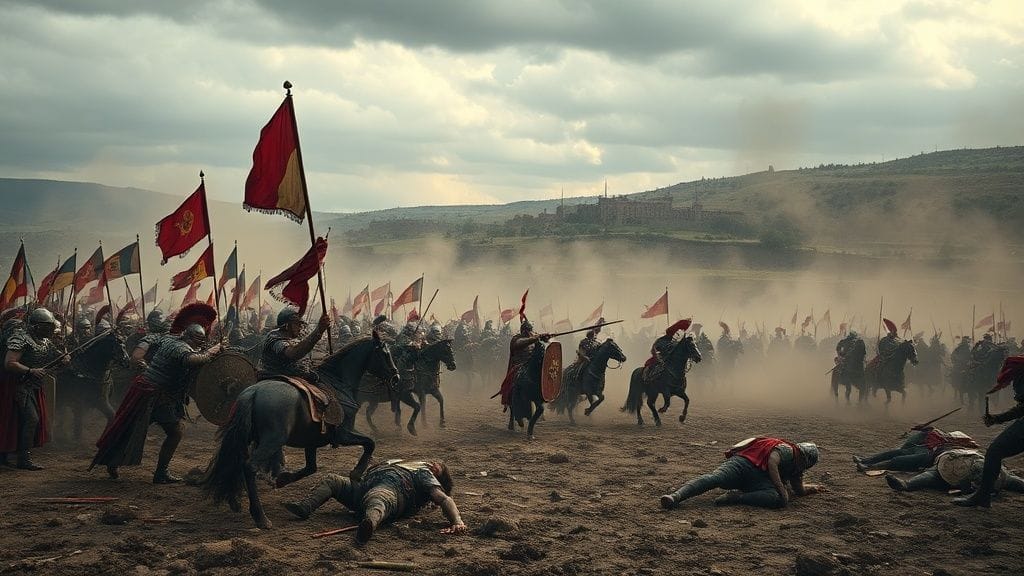
The backdrop to the proclamation of 198 was not Rome’s Senate House or Forum, but the dusty plains of Mesopotamia and the smoking ruins of Parthian cities. In 195 and again in 197–198, Septimius Severus launched major campaigns against the Parthian Empire, Rome’s great eastern rival. These wars provided an ideal stage on which to display his military prowess, win plunder for his soldiers, and demonstrate to the Roman people that their ruler could still humble foreign kings. In the East, where Julia Domna’s connections ran deep, Severus also sought to reinforce his legitimacy: he could appear simultaneously as avenger and patron, conqueror and benefactor.
Caracalla, still in his teens, accompanied his father on these campaigns. He witnessed the siege and eventual capture of Ctesiphon, the Parthian capital, in 198. Later, coins would celebrate the victory with images of a kneeling eastern figure labeled “PARTHIA,” the proud enemy now rendered submissive under Roman boots. Yet behind such cold images lay scorching realities: families uprooted, fields burned, temples rifled. For the soldiers, however, victory meant loot and promotion. For Severus, it meant an almost theatrical opportunity to amplify his personal glory and—crucially—to fuse that glory with his eldest son’s image. It was not by accident that caracalla proclaimed augustus during this frenzy of triumph.
Ancient authors preserved the impression that the campaign was a moving court as much as an army. Josephus had once written of Roman legions as “a city on the march,” and in Severus’ day that phrase seemed almost literal. Legal petitions were heard in tents; portraits of the imperial family were set up in makeshift shrines; scribes copied letters to governors across the provinces. Within this roving court, Caracalla was being rehearsed for the role he would soon assume. The army camp became the stage on which he would speak his first imperial lines. The timing of the proclamation, against the intoxicating backdrop of victory over Parthia, made the elevation seem almost a natural outgrowth of Roman destiny.
The Day caracalla proclaimed augustus: Ceremony in the Camp
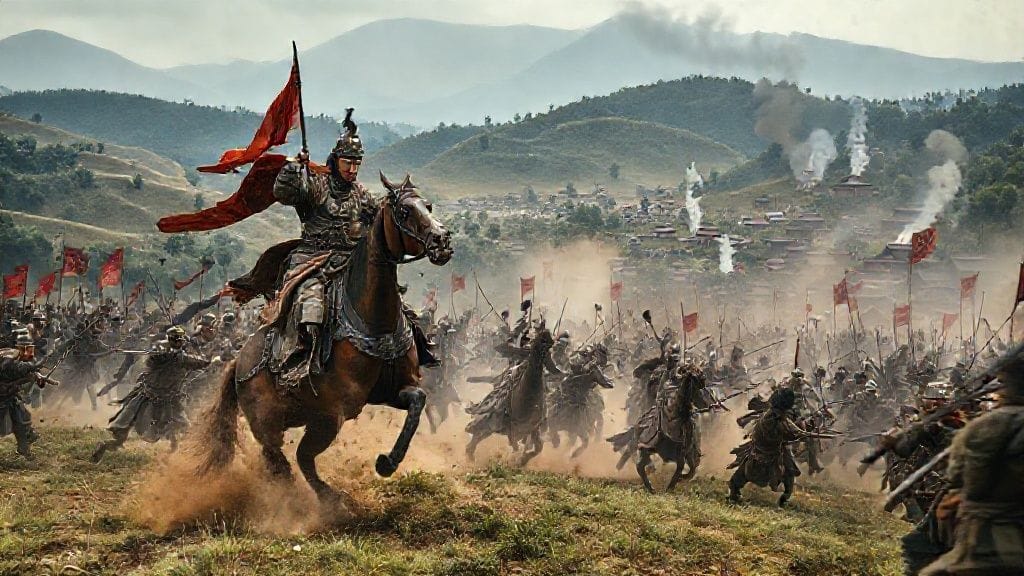
Imagine, then, a winter’s morning in 198 CE, somewhere in the East—historians place the scene likely near Ctesiphon or in a forward operating camp within Mesopotamia. The air is cool but dry, the sky a pale, flawless blue. Around the perimeter of the camp, legionary standards rise like a forest of colored metal and cloth. Trumpets blare, summoning cohorts to the assembly. Dust stirs as thousands of boots tramp toward the open space before the imperial tent. This was not an ordinary muster. Rumors had already circulated that something momentous was about to occur: the emperor was going to make formal what many in the ranks had already been encouraged to believe—that his son would not only be Caesar but now stand beside him as Augustus.
At the heart of this orchestrated moment stood a teenager with a serious face and watched eyes. When caracalla proclaimed augustus, he did so in a ritual thick with choreography and symbolism. Septimius Severus emerged first, clad in a military cloak, perhaps holding an eagle-topped standard or flanked by Praetorians in gleaming armor. Beside him, in a tunic edged with purple and a newly tailored cloak, was Marcus Aurelius Antoninus—Caracalla. Around them clustered the imperial entourage: Julia Domna veiled but visible, senior officers, provincial dignitaries, scribes ready to note down the event’s official wording.
The proclamation itself likely involved both a formal declaration and a choreographed acclamation. A herald may have cried out before the assembled armies that the emperor, by the will of the gods and the Senate, now named his son Augustus, partner in rule. The soldiers, trained and perhaps primed with donatives, would have shouted the traditional formula: “Ave, Imperator! Ave, Augustus!” When caracalla proclaimed augustus, he did not speak into a vacuum. He spoke into a roar of thousands of voices, the clashing of shields, the raising of right arms in salute. The boy’s own voice, if it was heard, would have been swallowed in a tide of sound that made him, in that instant, both central and strangely small—a single figure borne upward on the collective will of his father’s army.
Official versions of the event, echoed later in inscriptions and on coins, reduced this complex, emotional moment to a simple fact: “In the consulship of so-and-so, Marcus Aurelius Antoninus was raised to the rank of Augustus.” Yet to those present, the ceremony carried a heavier charge. It was a pledge that the pay, the donatives, the hard-won privileges that Severus had granted them would continue under this new Augustus. It was a reminder that emperors were made not only in Senate decrees but in the echoing parade grounds of distant camps. When caracalla proclaimed augustus, he was not merely honored. He was, in a very real sense, claimed by the army as their own.
Voices in the Ranks: Soldiers, Standards, and Shouted Oaths
History often records the voices of emperors and senators while leaving the murmurs of ordinary soldiers in silence. Yet the elevation of Caracalla to Augustus was as much a day for the common legionary as for the imperial household. The men in the ranks had followed Severus through civil war and the Parthian campaign. They had seen comrades fall, had endured long marches, and now stood in an eastern camp watching the birth of a new political reality. To them, what mattered was not subtle constitutional theory but the straightforward arithmetic of loyalty and reward: Would this youth, who had ridden with them and shared their hardships from a cushioned distance, prove generous? Would he protect their status? Would he remember their cheers when he sat on the throne alone?
Ancient historians, writing from senatorial perspectives, tended to dismiss Caracalla as a crude soldier-emperor, a man who later pandered to the army with gifts while bleeding the provinces dry. Cassius Dio, who sat in the Senate and witnessed much of this era, paints him as “naturally savage and brutal.” Yet even Dio concedes that the army loved him. That love did not emerge from nowhere; it was rooted in set pieces like the day caracalla proclaimed augustus. On that day, after the formal words were spoken, the real politics unfolded in the distribution of coin, the granting of promotions, the informal conversations in which officers repeated the message: “You have seen the new Augustus. He will look after you as his father has.”
To the standards—the eagles and emblems that embodied each legion’s pride—the elevation carried a sacred charge. Sworn oaths were renewed, now in the name of two Augusti. The images of Caracalla, freshly minted, would be hung beside those of Severus in the shrines at the center of each camp. Think of it as a kind of religious adoption: the legions taking into their small domestic pantheon a new protector. When caracalla proclaimed augustus, he was committing himself as much to these men as to the Senate in Rome. In some ways, the army would become his truest constituency, the one he would later favor even when it meant alienating civilians and elites.
Augusta, Augusta: Julia Domna and the Architecture of Power
Standing slightly behind the center of the stage, veiled in the dignified fashion of a Roman matron but radiating authority, was Julia Domna. She had already been granted the title Augusta, a female counterpart to the imperial honor borne by her husband. Her influence on the event when caracalla proclaimed augustus cannot be overstated. From the moment Severus seized power, Julia had been deeply involved in shaping the dynasty’s image. She appeared on coins, presided over literary salons, corresponded with philosophers and legal scholars. She embodied the ideal of a wise empress, a kind of living bridge between East and West, between Rome’s stern traditions and the new cosmopolitan order.
For Julia, the elevation of her eldest son was both a triumph and a calculated step in a longer game. She understood—as many senatorial observers did not—that power in this new age flowed through multiple channels: military, provincial, familial, religious. Her Syrian background linked her to the cult of the sun god Elagabal, and religious imagery subtlety infused Severan propaganda. In that context, the scene in the camp took on quasi-sacral overtones. The emperor’s family did not simply confer titles; they seemed almost to channel divine favor into new vessels. When caracalla proclaimed augustus, Julia stood as the mother of the new Augustus, the guarantor of continuity, the woman whose body had literally made this future possible.
There is an undeniably emotional dimension here often overlooked in cold political analysis. Julia, by then in her late thirties, watched a son she had seen as a bustled child in Lugdunum now acclaimed by thousands of hard-faced soldiers. Pride must have battled anxiety. The same acclamation that lifted him also placed him in the line of fire, turning him into a focal point for ambition and resentment. Julia had another son, Geta, who now trailed behind in rank but would later be granted the same title of Augustus. Already, seeds of rivalry were sown. As one modern historian has observed, “In creating co-emperors, Severus and Julia Domna created the conditions for fratricide” (cf. A.R. Birley, Septimius Severus: The African Emperor). Julia, with her sharp political sense, can hardly have been blind to the dangers even as she smiled for the watching troops.
Imperial Propaganda: Coins, Statues, and the Fiction of Harmony
Once the proclamation had been shouted in that eastern camp, its reverberations needed to travel the breadth of the empire. Most of the people who would live under the rule of the new Augustus would never see him in person. Instead, they would encounter him in metal, stone, and script. The machinery of imperial propaganda whirred into motion. Mints from Rome to Antioch began striking coins bearing the paired images of Septimius Severus and his son. Legends announced that “Imperator Caesar Lucius Septimius Severus Pius Pertinax Augustus and Imperator Caesar Marcus Aurelius Antoninus Augustus” now ruled together. The boy’s features were rendered with almost loving attention: the curls, the firm jaw, the gaze turned slightly toward the horizon, as if contemplating the future.
Statues soon followed. In cities across the provinces, local elites ordered new busts to adorn forums and basilicas. On arches and altars, inscriptions recorded vows for the health of the Augusti. The Senate in Rome ratified the elevation, securing the legal fabric of the act. This blend of imagery and inscription created what we might call the “fiction of harmony”: the idea that the empire was now ruled by a united father-son team, perfectly aligned, embodying both experience and youth. When caracalla proclaimed augustus, he did so into a world that would almost immediately begin smoothing the rough edges of reality into a polished story.
We can still touch that story today. In museums, coins from 198 and after show the two Augusti shaking hands, riding in a triumphal quadriga, or crowned by Victory. Such images were not mere decorative flourishes; they carried a clear message: the succession is settled, the future is secure. Yet behind the bronze and marble, human emotions churned. Caracalla’s sense of self was being shaped by an iconography that presented him as the equal of his father long before he wielded independent power. It is difficult to imagine that such constant visual flattery did not feed a growing impatience. The boy who had stood on the parade ground and heard the thunder of the legions might, in quiet moments, have looked at his own likeness on a coin and thought, with mingled excitement and resentment, “This is who I am supposed to be. Why must I still wait?”
The Silent Rival: Geta, Brother, Co-Augustus, Target
Every story of a favored heir contains, in its margins, the figure of the one left waiting. For Caracalla, that figure was his younger brother, Publius Septimius Geta. In the biographies of the Historia Augusta—a problematic but vivid late antique collection—we catch glimpses of a house divided: two boys tutored side by side, yet always measured against each other; two mothers’ favorites, although Julia Domna had to divide her affections by necessity. When caracalla proclaimed augustus in that eastern camp, Geta remained merely Caesar, a step behind in the imperial hierarchy. The difference was more than a technicality. Titles translated into precedence at ceremonies, honors from cities, the order in which names were carved into stone.
For several years, this asymmetry defined the brothers’ relationship. Caracalla, the elder, marked as Augustus, walked always in front; Geta, the younger, slightly behind. Sources suggest constant quarrels, mutual suspicion, even as Severus tried to insist on a united front. Yet the empire’s needs pushed in the opposite direction. The more the title of Augustus was extended—the more often rulers like Severus named co-emperors—the greater the chance of rivalry hardening into lethal hatred. From the moment caracalla proclaimed augustus, the path was laid that would end with Geta’s blood staining a palace floor.
In 209, perhaps in a belated attempt to balance things, Geta too was proclaimed Augustus. For a brief moment, the empire had three Augusti: Severus and his two sons. Official imagery displayed the trio side by side, a powerful visual of dynastic strength. But power shared uneasily is often power contested. When Severus died in 211 at Eboracum (York), his last advice to his sons, according to Dio, was chillingly simple: “Be harmonious, enrich the soldiers, and despise all others.” They followed the second and third commands more readily than the first. Within months, Caracalla arranged for Geta’s murder in their mother’s arms. That murder retroactively contaminated the bright day when caracalla proclaimed augustus. What had seemed then a celebration of continuity now looked, in hindsight, like the first act of a fratricidal tragedy.
Rome Reacts: Senate, People, and the Fear of a New Nero
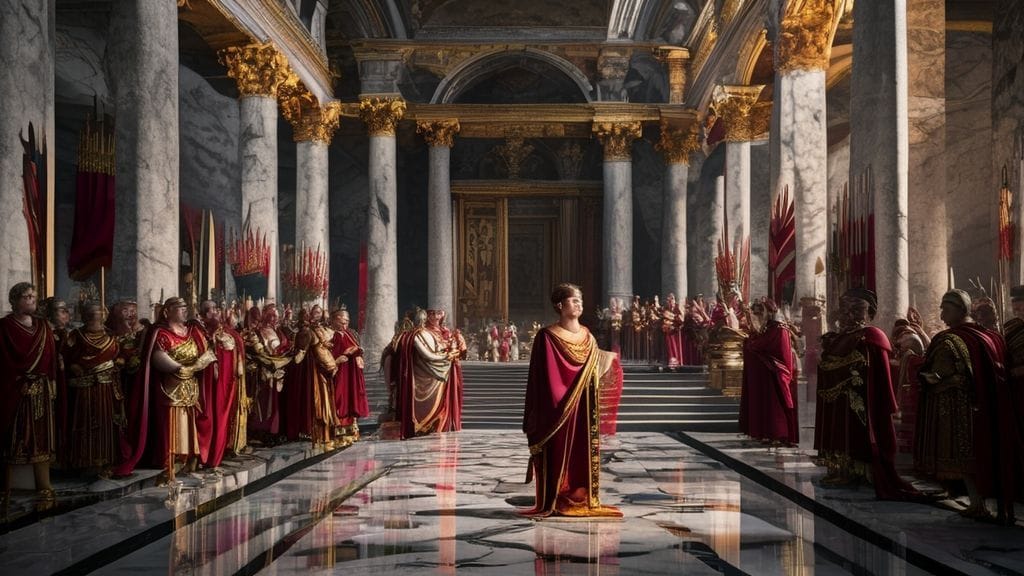
While the eastern legions roared their approval, Rome learned of the proclamation through couriers bearing dispatches sealed with imperial rings. The Senate Fathers assembled in the Curia, robes arranged just so, and listened as the letter was read aloud: the emperor informing them of his victory over Parthia and the elevation of his son. They passed decrees of congratulations and voted public honors. Yet behind the polished phrases, many must have felt a familiar chill. A young prince, raised amid luxury, granted the full powers of Augustus before his character had truly been tested—had Rome not seen this before?
The specter of Nero haunted every youthful accession. Though more than a century had passed since his reign, his memory lingered as a warning about the dangers of entrusting too much power, too early, to an impressionable mind. The Senate’s anxiety was not purely rhetorical. Under Severus, their authority had shrunk. Now, with Caracalla as co-Augustus, their influence risked being diluted further as a second emperor, deeply bound to the army, took his seat on the throne. Some senators may have comforted themselves with the thought that the elder Severus would guide his son, tempering youthful impetuosity. Others, more cynical or better informed, suspected that the same ruthless streak that had made Severus a successful usurper might well surface in his heir.
The people of Rome, too, reacted with a blend of curiosity and caution. Street gossip occasionally surfaces in literary sources: the jokes shouted in theaters, the graffiti scratched on walls. We can imagine snatches of conversation in crowded taverns: “Have you seen the new coin? The boy looks like his father.” “They say he wears some strange long Gallic cloak—that’s why they call him Caracalla.” “Another Augustus? Does that mean more taxes or more games?” The urban crowd had learned to read changes at the top largely through the rhythms of spectacle and distribution. If the proclamation of 198 brought new festivals, largesse, and visible signs of imperial favor, many would accept it with pragmatic indifference. Stability, after the chaos of earlier years, was a powerful selling point.
Growing into the Purple: Education, Tutors, and Ancient Expectations
From the day caracalla proclaimed augustus, the expectations that had always hovered around him hardened into a cuirass he could never remove. As Augustus, he now bore the tribunicia potestas (tribunician power) and the imperium maius that gave him authority over the army and provinces. His education, already intense, took on an even sharper edge. Tutors drilled him in the histories of earlier rulers. He would have read, or had read to him, the deeds of Augustus, Trajan, Hadrian, Marcus Aurelius. Each text was both example and threat: rule well, be remembered with honor; rule badly, be cursed like Nero or Domitian.
The Romans had a clear, almost ritualized concept of what a young emperor should be: pious, just, merciful to the humble, terrible to enemies. He was expected to preside over trials, listen to petitions, issue judgments that reflected a balanced mind. In the case of Caracalla, later anecdotes depict a youth increasingly resistant to such constraints, drawn instead to the raw immediacy of the camp and the battlefield. Whether these stories are fully accurate or colored by hindsight is difficult to say. But it is plausible that a teenager, having once felt the visceral thrill of hearing the legions cheer as caracalla proclaimed augustus, would find the dry formalities of senatorial speeches and legal consultations suffocating.
In one sense, Caracalla was locked in a cruel paradox. He was required to perform the role of sage ruler while still wrestling with the volatile emotions of adolescence. Ancient sources preserve small, telling moments: sudden rages at perceived slights; impatience with teachers who dared correct him; a habit of brooding. Over time, such traits would mature into the behavior that made him infamous. But those later storms began as flickers during these formative years, even as official rhetoric continued to present him as the ideal imperial youth. The more that coins and statues insisted on his serene virtue, the more private resentments may have simmered beneath the polished surface.
Tensions in the Palace: Rumors, Plots, and Fractured Loyalties
Imperial palaces, whether in Rome or in distant military camps, were hotbeds of rumor. Servants, secretaries, bodyguards, and palace freedmen formed whispering networks that carried fragments of information from bedroom to council chamber and back again. After caracalla proclaimed augustus, these networks hummed with new energy. Every word he spoke, every frown or smile, could be interpreted as a sign of future favor or anger. Courtiers recalibrated their strategies. Some attached themselves firmly to the elder Severus, trusting his proven ruthlessness. Others began quietly cultivating relationships with the young Augustus, gambling that his star would rise higher once his father passed.
Julia Domna, at the center of this intricate web, attempted to hold the strands together. She arranged dinners where senators and generals could meet her sons in carefully managed environments. She mediated disputes, soothed egos, tried to ensure that both Caracalla and Geta felt seen and valued. Yet structural tensions ran deeper than any single person’s ability to resolve. The very fact that Caracalla had been raised to Augustus earlier, in such a dramatic martial context, gave him a superiority that could not be undone. Geta’s later proclamation as Augustus seemed more like a concession than a true equalization. Loyalists to each brother formed invisible camps, waiting to see which would prevail.
It is in this atmosphere that the darker side of the Roman political system becomes clear. The titles of Caesar and Augustus, the rituals of proclamation, the parades and festivals—all were attempts to tame the succession problem that had plagued the empire since its inception. Yet they also created new battlefields inside the imperial family itself. The same act that thrilled the legions when caracalla proclaimed augustus planted seeds of suspicion that would grow into full-blown paranoia. Every advisor risked being seen as favoring one brother over the other. Every policy suggestion could be interpreted as a bid to strengthen one faction. The palace that had once symbolized unified imperial authority became, in effect, a house with two rival courts under the same roof.
From Heir to Killer: The Long Shadow of a Single Proclamation
When historians look back at the life of Caracalla, they cannot avoid its darkest moment: the murder of his brother Geta in 211, carried out, according to our sources, in their mother’s very embrace. That act—a collision of political calculation and raw emotional violence—casts a long, chilling shadow backward over the day when caracalla proclaimed augustus. What had once been celebrated as a consolidating move in 198 now appears, in retrospect, as the first wedge driven between two brothers who might otherwise have found a more modest coexistence as heir and spare.
The emotional logic is brutal but clear. By proclaiming Caracalla Augustus while keeping Geta in a junior position, Severus and Julia Domna created a hierarchy of value between their sons. Even when Geta later received the same title, the temporal gap lingered like a scar. Caracalla was the “first Augustus,” the one the legions had seen elevated in the flush of Parthian victory. In a system that rested heavily on seniority and public image, that early advantage could feel insurmountable—or, to the insecure, perpetually under threat. From this perspective, the day caracalla proclaimed augustus was also the day Geta began to be perceived, perhaps even by his own brother, as a rival who might someday attempt to overturn the original order.
By the time Severus died, each brother commanded his own circle of support. Negotiations to divide the empire between them, as some sources allege, hint at just how desperate the situation became. That such drastic plans were even discussed shows how far the unity projected in 198 had decayed. The eventual murder of Geta, followed by the damnatio memoriae that erased his image from monuments, was an attempt to resolve, through violence, a tension born of carefully staged harmony. The proclamation of Caracalla as Augustus, designed to prevent civil war by establishing a clear heir, ended up contributing to one of the most intimate civil wars possible: a war inside a family, concluded with a brother’s blood.
Across the Provinces: How the Empire Learned of a New Augustus
While palace intrigues unfolded at the center, the proclamation’s effects rippled outward through the vast provincial networks of the Roman world. Governors in Africa, Asia, Britain, and beyond received letters announcing the elevation. They, in turn, informed city councils, who convened to decide how best to honor the news. In the great port cities, heralds might stride into bustling marketplaces, reading aloud imperial rescripts to crowds of merchants and sailors. In more remote towns, the proclamation might arrive weeks or months late, carried by a dusty messenger who dismounted before the local curia and handed over the rolled parchment with its dangling seals.
Responses varied according to local circumstances. Some communities seized on the proclamation as an opportunity to display loyalty and secure favor. They voted to erect statues of the new Augustus in their forums, to rename festivals in his honor, to dedicate altars celebrating the “eternal stability” promised by the two Augusti. Others, grappling with tax burdens or the disruptions of war, may have greeted the news more coolly, seeing little difference between one distant emperor and another. Yet even indifference could be dangerous in a world where public enthusiasm was often demanded. Cities that failed to honor a new Augustus might later find themselves accused of ingratitude.
The very process by which caracalla proclaimed augustus in a far-off camp yet became known across the empire illustrates the sophisticated communication arteries Rome had developed. Inscriptions from places as far apart as Egypt and Britain soon bear the new, extended imperial titulature. Papyrus documents adjust their dating formulas to include the name of the young Augustus. For many provincial subjects, especially those not fully steeped in Roman political theory, the multiplication of imperial titles might have seemed like a ritualized cascade of names—Severus, Antoninus, Augustus, Pius—washed over them like an unending tide. Still, somewhere in each of these formulae lurked the echo of that original shout in the eastern camp, when caracalla proclaimed augustus over the din of shields and trumpets.
Law, Citizenship, and the Road to the Constitutio Antoniniana
One of the most far-reaching acts associated with Caracalla’s later reign was the Constitutio Antoniniana of 212, the edict that extended Roman citizenship to nearly all free inhabitants of the empire. Scholars still debate his motives—financial, political, ideological—but whatever the blend, this legal revolution can be traced back in part to the identity he forged from the moment caracalla proclaimed augustus. Named Marcus Aurelius Antoninus, steeped in the rhetoric of universal empire, he inherited a vision of Rome as a world state in which provincial elites increasingly shared in the privileges once limited to Italians.
As Augustus, Caracalla gained the power not only to wage war but also to shape the law. Emperors functioned as supreme judges and legislators; their rescripts and edicts could redefine the contours of citizenship, property, and punishment. The edict of 212—preserved in papyrus fragments and later summarized by jurists such as Ulpian—erased many of the remaining legal distinctions between Roman citizens and provincial subjects. It did not create equality in the modern sense; local hierarchies and imperial power remained firmly in place. But it did universalize a key badge of belonging. The young man who had first felt his imperial identity crystallize when caracalla proclaimed augustus now stamped that identity onto millions of others by law.
Ancient critics, including Dio, viewed this measure cynically, claiming that Caracalla simply wanted more citizens to tax and more bodies to conscript into the army. Those motives may indeed have played a role. Yet it is also possible to see the edict as an extreme expression of the same logic that had led Severus to elevate his son in a military camp: if the empire was fundamentally an armed commonwealth, why not fold as many as possible into the legal fiction of “Roman-ness”? The proclamation of 198 had linked Caracalla’s very person to the notion of imperial universality. The edict of 212 represented the legal consummation of that bond.
Memory Wars: How Ancient Authors Judged Caracalla
Any attempt to reconstruct the meaning of the day caracalla proclaimed augustus must grapple with the judgments of those who later wrote about him. Our principal narrative sources—Cassius Dio, Herodian, and the anonymous author of the Historia Augusta—were all, in one way or another, shaped by elite perspectives, senatorial biases, and moralizing agendas. Dio, a senator who lived through Caracalla’s reign, offers a portrait drenched in loathing. He describes the emperor as “a man of ungovernable temper, harsh and cruel,” whose accession only hastened a descent into tyranny. Herodian, writing in Greek for an educated audience, paints a more psychologically textured but still damning picture, focusing on Caracalla’s violent passions.
These authors rarely mention the proclamation of 198 except as a chronological marker. Yet their attitudes toward that event are implicit in their narratives. For them, the fact that caracalla proclaimed augustus at such a young age serves as one of the roots of his later monstrosities. Early power, in their view, corrupted an already difficult character. They contrast him unfavorably with models like Marcus Aurelius, who, though he too was raised in the purple, seemed to embody stoic self-discipline. The result is a moral tale in which the day of proclamation becomes the original sin of the Severan dynasty, the moment when unripe authority was thrust upon unsafe shoulders.
Modern historians take a more nuanced view, sifting these partisan accounts against material evidence—coins, inscriptions, archaeological remains. Some argue that Dio exaggerates, shaped by personal grievances and nostalgia for a senatorial order already in decline. Others note that while Caracalla’s crimes were real and brutal, his policies, such as the Constitutio Antoniniana, reveal a ruler who thought seriously about the structure of empire, even if his thinking was brutally pragmatic. As historian David Potter observes, “Caracalla’s reign demonstrates how the pressures of an increasingly militarized state shaped both the man and the memory of him” (The Roman Empire at Bay). Within this interpretive struggle, the proclamation of 198 emerges not as a simple mistake or inevitability, but as a focal point in an ongoing debate about power, youth, and the burdens of empire.
Archaeology of an Accession: Traces in Stone, Bronze, and Papyrus
One of the most striking aspects of Roman imperial history is how a single moment—like the day caracalla proclaimed augustus—can leave traces scattered across continents and centuries. Archaeologists and epigraphists, piecing together broken stones and faded ink, have reconstructed the spread of his new title through the empire’s many layers. In North Africa, inscriptions from Lepcis Magna, Severus’ hometown, adjusted their dedications to include mention of the “divine Septimius Severus and his son, the most noble Augustus Antoninus.” In the East, altars in Syria and Asia Minor invoked both Augusti together in prayers for stability.
Numismatic evidence is particularly abundant. Hoards unearthed in Britain yield denarii bearing the paired heads of father and son. In the eastern provinces, tetradrachms struck at Antioch portray Caracalla with increasingly mature features as the years pass, yet always retaining the echo of the youth present when caracalla proclaimed augustus. These coins, passed from hand to hand in markets, found in graves, or hidden in times of crisis, formed perhaps the most direct physical link between the average provincial and the distant co-emperor. Each inscription of “ANTONINUS AUG” was a microscopic repetition of the original proclamation.
Papyri from Egypt add another layer. Legal documents—wills, contracts, receipts—were dated according to the regnal years of the emperor or emperors. After 198, scribes began writing formulas that referenced both Severus and Caracalla. A mundane lease for a field in the Fayum might thus begin: “In the year X of the Imperator Caesar Lucius Septimius Severus… and of the Imperator Caesar Marcus Aurelius Antoninus, the lords Augusti…” Here, in the opening lines of a farmer’s contract, the distant echo of the eastern camp resounds. The papyri show, in a way no literary source can, how thoroughly the act of proclamation was woven into the bureaucratic fabric of everyday life.
Echoes through Time: Succession, Violence, and the Roman Imperial Idea
By the time Caracalla himself fell to an assassin’s blade in 217, stabbed on the roadside near Carrhae while relieving himself, the empire had endured the full arc of his transformation—from child prince to co-Augustus, from favored heir to fratricide, from imperial legislator to hated tyrant in senatorial eyes. The day caracalla proclaimed augustus lay nearly two decades in the past, yet its consequences continued to reverberate. Subsequent emperors studied the Severan experience with keen interest. Some imitated its practices; others swore, at least in principle, to avoid its pitfalls.
The core dilemma remained the same: how to ensure a peaceful succession in a state where armies made emperors. Severus’ solution—early elevation of an heir, tightly bound to the soldiers—worked in the short term but proved disastrous once rival heirs were introduced. Later, rulers from Diocletian onward experimented with even more complex collegiate systems, appointing multiple co-emperors (Augusti and Caesares) in the hope that formal structures might tame human ambition. The Severan story served as both inspiration and warning. The memory of how caracalla proclaimed augustus yet ultimately murdered his co-Augustus brother haunted these arrangements. Titles alone, it seemed, could not create trust.
On a deeper level, the events of 198 and their aftermath contributed to a gradual shift in the Roman imperial idea. As the third century wore on—a century of crises, short-lived emperors, invasions, and economic strain—the image of the emperor as a lone, quasi-divine figure gave way to a more pragmatic model of a military supervisor first among other powerful generals. Caracalla, with his intense identification with the army and his legislative universalism, embodied an early, if distorted, version of this new type. His proclamation as Augustus in a military camp rather than in Rome’s temples symbolized the move from city-based to army-based sovereignty. In that sense, when caracalla proclaimed augustus, he stood at a crossroads: one foot in the classical world of senatorial ritual and marble forums, the other in the harsher, more mobile, more militarized empire that would dominate late antiquity.
Conclusion
The moment in 198 CE when caracalla proclaimed augustus was far more than a ceremonial flourish on a distant frontier. It was the crystallization of a new conception of imperial power, forged in the fires of civil war and sustained by the loyalty of professional armies. A teenager, molded from birth to embody the continuity of a usurper’s regime, stood before cheering legions and accepted a title dense with history and expectation. Around him, his father calculated, his mother maneuvered, his brother fell a step behind. The soldiers saw in him a promise of continued favor; the Senate read in his name both the comfort of an Antonine echo and the threat of a new Nero.
From that winter morning flowed a chain of consequences: the deepening militarization of the imperial office, the hardening rivalry between Caracalla and Geta, the eventual fratricide that would stain the Severan house, and even the sweeping extension of citizenship in the Constitutio Antoniniana. The event bound Caracalla’s identity to universal empire and to the army in ways that neither law nor later propaganda could fully untangle. When we sift through coins, inscriptions, and papyri bearing his double name and title, we are, in effect, handling the aftershocks of that single proclamation.
Yet the story is not simply one of inevitability. It is a tale of choices—by Severus, by Julia Domna, by the legions, and, in time, by Caracalla himself. The decision to elevate him so early, in such a martial setting, helped shape the kind of emperor he would become: impatient with senatorial niceties, at home among soldiers, inclined to solve political dilemmas with the sword. The day caracalla proclaimed augustus shines, therefore, as a bright but unsettling landmark in Roman history, marking both the high confidence of an empire at its territorial zenith and the darker undercurrents that would trouble its third-century course. To stand imaginatively in that camp, feeling the ground shake with shouts of “Ave, Augustus,” is to sense both the intoxicating allure of Roman power and the fragility of the human lives entrusted with it.
FAQs
- When and where was Caracalla proclaimed Augustus?
Caracalla was proclaimed Augustus in 198 CE, most likely in a Roman military camp in the East during Septimius Severus’ Parthian campaign, probably near or shortly after the capture of the Parthian capital Ctesiphon. - How old was Caracalla when he was made Augustus?
Caracalla, born in 188 CE, was about ten years old when he was elevated from Caesar to Augustus, a very young age to receive full imperial status and powers. - Why did Septimius Severus decide to make Caracalla Augustus so early?
Severus wanted to secure the dynasty and prevent another civil war by presenting a clear heir closely tied to the army; proclaiming Caracalla Augustus in the field bound the legions’ loyalty to his son and bolstered the regime’s legitimacy. - What was the political significance of the proclamation for the Roman Empire?
The proclamation strengthened Severus’ new dynasty, emphasized the centrality of the army in imperial politics, and set a precedent for co-emperorship that would influence later imperial collegiate systems in the third and fourth centuries. - How did the Senate and Roman elites react to Caracalla’s elevation?
Publicly, the Senate confirmed the decision and granted honors, but many senators likely felt sidelined and anxious, seeing in the young Augustus the potential for another violent, army-backed ruler with little respect for traditional senatorial authority. - What role did Julia Domna play in Caracalla’s proclamation as Augustus?
Julia Domna was central in crafting the dynasty’s image and likely supported the timing and staging of Caracalla’s elevation, using her influence and Eastern connections to reinforce the legitimacy and visibility of her son as co-emperor. - How did Caracalla’s proclamation affect his relationship with his brother Geta?
By elevating Caracalla first, the proclamation created a built-in hierarchy between the brothers, fueling rivalry and suspicion that ultimately contributed to Caracalla’s decision to have Geta murdered after Severus’ death. - Did the proclamation have any long-term legal or social consequences?
Indirectly, yes: as Augustus, Caracalla later issued the Constitutio Antoniniana in 212 CE, granting Roman citizenship to nearly all free inhabitants of the empire, a legal transformation often connected to his identity and ambitions formed from the time of his proclamation. - How do we know about the event when Caracalla was proclaimed Augustus?
Our knowledge comes from ancient literary sources like Cassius Dio and Herodian, as well as from coins, inscriptions, and dated papyri that record his new status and titles beginning in 198 CE. - How is Caracalla’s proclamation as Augustus viewed by modern historians?
Modern historians see it as a key moment in the evolution of the Severan dynasty, illustrating the growing dominance of the army in imperial politics and highlighting the structural problems of shared rule and dynastic succession that would trouble the empire throughout the third century.
External Resource
Internal Link
Other Resources
- Encyclopaedia Britannica – general search for the exact subject
- Google Scholar – academic search for the exact subject
- Internet Archive – digital library search for the exact subject