Table of Contents
- A Winter Morning in Rome, 205: The Consul Rises Again
- From Severus’s Son to Imperial Heir: The Making of Caracalla
- The Roman Consulship in an Age of Emperors
- A City Waiting: Rome on the Eve of the Second Consulship
- The Day of Ceremony: Processions, Ivory Chairs, and Acclamations
- Politics Behind the Purple: Severus, Caracalla, and the Shadow of Geta
- Senate and Emperor: A Tense Partnership in 205
- Voices from the Streets: Ordinary Romans under the Severans
- Imperial Propaganda and the Making of an Image
- Caracalla’s Character Revealed: Cruelty, Discipline, and Restlessness
- Empire at the Crossroads: Frontiers, Legions, and Rising Pressures
- The Second Consulship as a Turning Point in Roman Politics
- From Consul to Sole Emperor: The Road Toward Blood
- Ripples Across Time: Legacy of the Second Consulship
- Caracalla, Lawgiver of the World: Citizenship, Tax, and Control
- Memory, Damnation, and Survival in the Ancient Sources
- Walking Rome Today: Traces of 205 in Stone and Silence
- Conclusion
- FAQs
- External Resource
- Internal Link
Article Summary: In the year 205, Rome witnessed the caracalla second consulship, an event that seemed purely ceremonial yet concealed deep fractures within the imperial household and the empire itself. This article follows that year as if walking through the streets of Rome, tracing the rituals, the political maneuvers, and the private fears standing behind the public celebrations. We explore how the caracalla second consulship served as a stage on which Septimius Severus projected the continuity of his dynasty, even as rivalry with his younger son Geta hardened into dangerous hatred. Through narrative reconstruction and historical analysis, the story reveals how this office—once the peak of republican ambition—became a tool of imperial propaganda and control. The article also shows how the caracalla second consulship foreshadowed later reforms, especially the extension of citizenship across the empire, and the brutal violence that would come to define Caracalla’s reign. It examines the experiences of senators, soldiers, and common Romans living under an emperor-in-waiting whose temper was already feared. Finally, it reflects on how ancient writers, biased and bitter, shaped our memory of both the consulship and the man, leaving us to sift their accounts to understand a crucial turning point in Roman history.
A Winter Morning in Rome, 205: The Consul Rises Again
The winter air in Rome in the opening weeks of 205 would have carried the smoke of countless hearths, the tang of wet stone, and the low murmur of a city that never truly slept. Dawn slid slowly over the Tiber, catching the tiles of the Palatine and the newly restored structures of Septimius Severus’s Rome. Somewhere above the Forum, in imperial chambers guarded by praetorians in gleaming cuirasses, a young man of twenty-six prepared to step into an office older than the empire itself. This was Marcus Aurelius Antoninus—better known to history, and to his enemies, as Caracalla—about to assume the caracalla second consulship.
By 205 he was no stranger to honor. He had already worn the consular insignia as a teenager; he had marched with his father against rival emperors and barbarians; he had been saluted Imperator, “commander,” by legions intoxicated with victory and reward. Yet this day felt different. This second consulship was not merely another line in a list of titles. It was both a promise and a warning to the Roman world: the Severan dynasty was here to stay, and Caracalla was its unshakable heir.
Outside, senators in white-bordered togas assembled, slaves fussing over the last creases. Lictors adjusted their fasces, those bundles of rods and axes that spoke of the state’s power to punish and to kill. Shopkeepers along the Sacred Way swept their thresholds, anticipating crowds and perhaps a better day’s trade. In taverns, rumors flowed as freely as watered wine: about the emperor’s health, about the tensions between Caracalla and his younger brother Geta, about tax burdens, and about the distant frontiers where soldiers froze and bled far from Rome’s marble splendor.
On this day, the caracalla second consulship would be proclaimed with trumpets, sacrifices, and carefully choreographed gestures of harmony. It was meant to suggest continuity—Rome’s ancient magistracy now bathed in imperial light. But this was only the beginning of the story. Beneath the ritual lay a young man whose rage was already legend among his intimates, an imperial father who trusted no one fully, and a younger brother who smiled in public and schemed in the privacy of his own fears. The consulship of 205 was the glinting surface; beneath it, swift and dark, currents of violence were already moving.
From Severus’s Son to Imperial Heir: The Making of Caracalla
To understand why the caracalla second consulship mattered, we have to step back two decades, to a world still ruled by Marcus Aurelius’s heirs and plagued by civil war. Caracalla was born in 188 in Lugdunum, in Roman Gaul, far from the ancestral memories of the Forum and Capitoline. His father, Septimius Severus, was a provincial from Leptis Magna in North Africa, a man of rugged persistence who had clawed his way from equestrian rank to senatorial dignities and then, during the chaos after Commodus’s death, to the purple itself.
From the outset, Caracalla’s life was scripted for power. Severus saw his dynasty as fragile in a world where emperors died by assassination and civil war was the most common form of succession. Caracalla received his first share of titles absurdly early: Caesar at eight, Augustus at ten, and co-emperor long before most Roman boys had finished their schooling. Instead of the quiet rhythms of rhetoric, philosophy, and the law, his education took place among campfires, siege trenches, and the disciplined brutality of the legions.
He grew up as a creature of war. Ancient sources—hostile yet oddly consistent—describe a boy fascinated by soldiers’ tales, more interested in weapons than books, copying the hard expressions of veteran centurions rather than the serene calm of statues in the Forum. Whether we believe every detail or not, it is clear that Severus shaped his son into a commander first and a statesman second. The father needed the son to be visible, adored by troops, feared by enemies, and unmistakably present whenever imperial success was on display.
Caracalla’s first consulship, bestowed at a very young age, was less about governing and more about rehearsing the role that the caracalla second consulship in 205 would ritualize. The consulship became a costume he wore while still growing into the role of emperor. It lent his name to public documents, placed his statues in forums across the empire, and taught him that Rome’s ancient offices were now merely steps on the staircase to supreme power. When he rode at Severus’s side, sharing acclaim for victories he barely understood, he was learning the most dangerous lesson of all: that the machinery of the Roman state existed to magnify him.
As he entered his mid-twenties, Caracalla had already seen rivers of blood shed for the survival of his house. The defeat of Pescennius Niger in the East, the brutal campaign against Clodius Albinus in Gaul, the savage reprisals against their supporters—these were the stories that carved themselves into his memory. In such a world, affection was always mixed with calculation, and loyalty had a price. When the young prince looked toward Rome in 205, he did not see a city of laws and balanced offices. He saw a stage on which his destiny, already drowning in violence, would be given a respectable, ancient name: consul.
The Roman Consulship in an Age of Emperors
By the time of the Severans, the consulship was an office suspended between glory and emptiness. In the days of the Republic, two consuls had commanded armies, presided over the Senate, and given their names to the year. Political careers were measured by the path that led to this summit. Elections were ferocious contests of money, influence, and oratory. The consul was the state’s living emblem.
The empire transformed all this. Augustus and his successors preserved the consulship as a symbolic link to the past, but its military power had been quietly transferred to the princeps—later, to the emperor. The consuls remained, but now they shared the stage with an office that eclipsed them. Yet their prestige endured. Years were still named after them; their images appeared in city records and provincial inscriptions. To become consul was to step into the long shadow of Cicero and Caesar, of Scipio and Marius.
In this altered landscape, imperial family members increasingly monopolized the highest offices. The consulship became a key tool of dynastic presentation. When an emperor appointed his son as consul, especially more than once, he wasn’t merely granting an honor. He was broadcasting a message to every town council and frontier camp: this is the man in whom my authority will live on. The caracalla second consulship was precisely such a proclamation.
In 205, the Senate still met under painted ceilings, still debated decrees, and still maintained the forms of republican governance. Consuls presided over these sessions; they supervised certain festivals, oversaw aspects of public administration, and lent their names to official records. Yet everyone knew that decisive power lay with Severus and the imperial court. For most senators, association with the emperor’s son through the consulship was both a reassurance and a threat. To applaud was to survive. To hesitate was to risk becoming invisible, or worse.
It’s astonishing, isn’t it? An office that had once embodied the freedom of Rome’s aristocracy had become a badge confirming their submission. And still, men coveted it. They still counted the years by the roll call of consuls. They still wrote in their memoirs: “I was consul under Severus and his son.” The caracalla second consulship, therefore, existed in two dimensions at once: as a faint echo of a dead republic and as a very real instrument of imperial theater.
A City Waiting: Rome on the Eve of the Second Consulship
To feel the significance of early 205, we must step into the streets themselves. Rome at this time was a city of nearly a million souls, the largest urban mass the Mediterranean had ever seen. Tenements leaned over narrow lanes; aqueducts stalked across the countryside like stone legions; temples and basilicas jostled for space with markets and slaughterhouses. The imperial family’s decisions, solemnly announced in the Senate, trembled through this maze as rumor, fear, expectation, or simple indifference.
In the months leading to the caracalla second consulship, the city’s rhythms were moderately stable, but the mood was not without unease. The Severan house had secured the throne after brutal civil war. Severus’s campaigns in Parthia had brought glory—and heavy costs. The rebuilding of Rome, the lavish donatives to the army, and the expansion of imperial bureaucracy demanded money. New taxes and stricter collection touched the lives of merchants, landowners, and small traders.
Yet there was also a strange optimism. The imperial forum built by Severus and his arches proclaimed victory and order. Games were staged; distributions of grain and occasionally money reassured the urban plebs. In some districts, Severus and his sons were genuinely popular, particularly among veterans settled near the city and those who admired their military vigor. When the official announcement came that Caracalla would hold the consulship again, many saw it as proof that the long nightmare of rapid imperial turnovers was over. At last, a stable dynasty, with heirs grown to manhood.
But behind the celebrations, another story whispered along the colonnades of the Palatine. The relationship between Caracalla and his younger brother Geta had grown ever more poisonous. Their mother, Julia Domna, moved anxiously between them, counselor, mediator, and sometimes shield. Severus, already wary and aging, watched both sons with a clarity sharpened by experience. He knew that Roman history was littered with brothers turned enemies: the Gracchi, the Antoni, the rival Caesars. The consulship for Caracalla alone in 205—without Geta sharing the honor—was more than a ceremonial choice. It carved an invisible line across the imperial household.
In the city, senators took note. The urban prefect supervised security more carefully than usual. The praetorian camp, just outside the walls, buzzed with activity, drills, and rotations of guard. When people spoke of the coming year, some did so with hope: another consulship for the heir apparent meant continuity. Others, more cautious, wondered if by shining all the light on Caracalla, Severus was deepening the darkness around Geta.
The Day of Ceremony: Processions, Ivory Chairs, and Acclamations
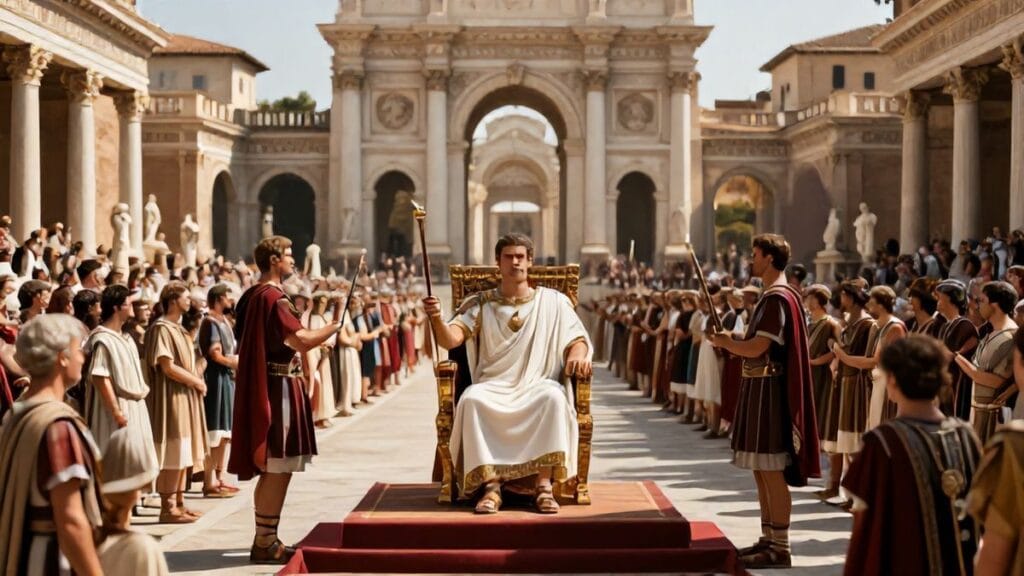
On the first day of Caracalla’s new term—the traditional Kalends of January—the city awoke to a theater as old as the Republic, now performed in an imperial key. Trumpets sounded in the Forum; magistrates assembled with their retinues; priests prepared animals for sacrifice, their knives as glittering as the jewelry of the magistrates’ wives watching from shaded balconies.
Caracalla donned the toga picta, the richly embroidered garment associated with triumphing generals and the highest magistrates. On other days he might wear the short Gallic cloak that later gave him his nickname, but today the costume was Roman to the marrow: purple, gold thread, and solemnity. The lictors walked before him, their fasces adorned with laurel, signaling joy as well as power.
As he made his way toward the Senate House, the crowd reacted in overlapping waves. Some cheered loudly, eager to be seen by imperial eyes. Others shouted more cautiously, gauging the mood. A few, no doubt, watched in silence, jaded by years of processions. Children stared at the gleam of weapons and the bright trappings of office. Slaves and freedmen, pressed to the edges, muttered their own judgments: about the generosity of the imperial grain dole, the favoritism shown to soldiers, the cost of living creeping ever upward.
Inside the Curia, the Senate rose as one. The consul took his seat on the traditional ivory chair, a piece of furniture whose legs and supports had witnessed centuries of debate and conspiracy. The symbolism was unmistakable: the same platform that had held men like Cicero and Pompey now supported the son of an African-born emperor. Rome’s aristocracy, once the engine of political competition, now served as audience and chorus for imperial drama.
Formal speeches flowed. Offers of congratulations, expressions of piety toward the gods, declarations that under the guidance of Septimius Severus and his illustrious son the empire would flourish. Caracalla responded in measured tones—or so the official records later claimed. In truth, the exact words are lost. What survives is the impression left on later historians: a prince playing at republican forms while knowing that his real power came from the sword, not the Senate’s applause.
Outside, sacrifices smoked on altars. The smell of burning flesh rose into the winter light, mingling with incense and the pungent odors of the crowds. Acclamations echoed along the Forum: “Ave, consul! Ave, Antonine!” At that moment, the caracalla second consulship seemed a fact as solid as the stones beneath their feet. No one standing there could see the blood that would soak those same stones a decade later when the prince-consul had become a tyrant-emperor.
Politics Behind the Purple: Severus, Caracalla, and the Shadow of Geta
No ceremony, however grand, can fully conceal fear. In the private rooms of the Palatine and in the tightly guarded corridors of power, the caracalla second consulship was read not just as honor but as strategy. Septimius Severus had spent his reign balancing three forces: the army, the Senate, and his own family. Of these, the last was the least predictable.
Caracalla had been groomed as heir from childhood. Geta, younger by a few years, had been given titles—including Caesar and, later on, Augustus—but not the same dazzling visibility. Ancient sources hint at Caracalla’s jealousy even of these lesser honors, claiming he could barely tolerate sharing anything with his brother. Cassius Dio, a senator who lived through these years and later wrote his history with thinly veiled relief at having survived them, tells of growing hostilities between the brothers, fanned by their respective supporters in court.
Why then place Caracalla again in the consulship, alone, in 205? For Severus, the answer lay in the art of signaling. The emperor was reminding the Senate and the provinces where true succession lay. Dynastic politics under the Principate thrived on repetition. Titles given once might be dismissed as gestures; titles repeated became statements carved into political stone. The caracalla second consulship confirmed what the first had suggested: this man, not his brother, stood at the center of the imperial design.
But the very clarity of this signal sharpened the divisions. Geta’s allies at court—administrators, intellectuals, and some senators who preferred his milder temperament—felt marginalized. Caracalla’s circle of generals, praetorians, and ambitious equestrians saw in the second consulship a chance to press their advantage. Each side whispered about the other’s supposed plots. Every minor appointment, every reassignment of a provincial governorship, took on the weight of a provocation.
Julia Domna, learned and politically astute, attempted to weave the household together, hosting literary salons, sponsoring philosophers, and presenting the imperial family as a cultured, united front. Yet behind the scenes, even she must have known that the consulship had become a wedge. In elevating one son publicly, Severus deepened the private rift between them. The spoils of office—a name on documents, precedence in ceremonies, authority over certain state functions—were small in themselves. But to men raised in an atmosphere where honor equaled survival, they were everything.
Senate and Emperor: A Tense Partnership in 205
Within the Senate of 205, the mood oscillated between cautious loyalty and sour resignation. Many senators were descendants of families whose ancestors had steered the Republic. They could recite the old stories of heroism and resistance: of consuls defying kings, of tribunes standing for the people, of noble lines that had guarded Rome against tyrants. Yet they also knew that in living memory emperors had banished, executed, or humiliated their peers for imagined slights.
The caracalla second consulship placed them in an old dilemma wearing new clothes. Publicly, their role was to applaud, to decorate the event with the authority of tradition, and to confirm Caracalla’s standing as a magistrate in the heart of Rome’s legal order. Privately, some doubted whether this young man—already known for his volatility—would be a protector or a predator once he held full power.
Senatorial careers in this era depended on imperial favor. A nod from the emperor or his son could mean a governorship in Asia, a lucrative post in Africa, or command of a legion on the Rhine. A frown could mean stagnation or worse. Thus, when Caracalla entered the Curia, the senators rose not only for the consul but for a future emperor whose memory would one day decide how their names were recorded, erased, or blackened.
The consulship also had an administrative reality. Consuls oversaw certain legal matters and worked alongside other magistrates in managing the city. Caracalla, however, could delegate much of this to experienced jurists and bureaucrats. His presence as consul therefore bore more symbolic than practical weight. Yet even symbolism shaped the everyday. Edicts, legal decisions, and official letters bearing the consular date of “the second consulship of Marcus Aurelius Antoninus” threaded through the empire’s paperwork, reaching as far as Britain, Egypt, and the Danubian frontier.
Behind closed doors, some senators must have remembered the cautionary tales of imperial heirs gone wrong. Nero had been celebrated as a cultured youth before turning into a tyrant. Commodus had been loved as the son of Marcus Aurelius, only to plunge the empire into chaos. Was Caracalla another such heir? The second consulship forced them to confront this question without being allowed to voice it. Silence, in 205, was a political survival skill.
Voices from the Streets: Ordinary Romans under the Severans
While senators weighed the subtleties of dynastic politics, most inhabitants of Rome experienced the caracalla second consulship as background noise to daily survival. The baker near the Forum worried about the price of grain far more than the composition of the imperial household. The dockworker on the Tiber thought of his aching back, not the official dating formula on legal documents.
Yet the consulship did touch them, indirectly. Public festivals associated with new magistrates brought games in the amphitheater and races in the Circus Maximus. Distributions of money or food, when they occurred, were eagerly anticipated. Even the poorest citizen—registered in the urban tribes, holding his fragile legal status as a Roman—could feel, for a day or two, that the state remembered him.
On the day Caracalla processed as consul, children might have clambered onto their fathers’ shoulders to see the glittering parade. Hawkers shouted, selling figs, nuts, and cheap wine. Fortune-tellers, banned from operating openly in some parts of the city, whispered prophecies in alleyways about the emperor’s house: two brothers sharing one empire, they said, was an omen of blood. Some may have recalled legends of Romulus and Remus, the twin founders whose story ended in fratricide.
For freedmen and provincials living in the capital, the Severan dynasty represented something new. An emperor from Africa, an empress from Syria, sons born in Gaul, advisers from every corner of the Mediterranean: the imperial family’s diversity mirrored the empire’s own sprawling geography. The consulship of Caracalla, the African emperor’s son, could be read as a sign that Rome’s center was no longer a narrow Italian aristocracy, but a far wider community of power.
Yet social inequalities persisted. Slaves, of course, had no voice in the great ceremonies except as laborers dressing the stage. Poor citizens might cheer in the circus and go hungry the next week. The consulship did not change the realities of overcrowded tenements, volatile employment, or the constant risk of illness. But it did offer a sense of continuity—an annual, cyclical reminder that Rome’s institutions still operated, that the world had not slipped into complete chaos.
Imperial Propaganda and the Making of an Image
In the ancient world, power lived not only in palaces and barracks but also in marble, metal, and words. The caracalla second consulship provided a perfect occasion for the imperial regime to craft and broadcast a carefully curated image of the heir. Coins minted during and after this year depicted Caracalla with the stern, mature features of a seasoned ruler, even though he was still in his twenties. Legends on these coins linked him with virtues such as “Pietas” (piety), “Virtus” (courage), and “Felicitas” (good fortune).
Public inscriptions, often erected by provincial cities eager to please, recorded his titles: Imperator, Augustus, consul for the second time. Each inscription was another voice repeating the same story—that Caracalla was not merely the emperor’s son but already an active participant in ruling. In theaters and forums from Spain to Syria, statues of him in consular garb stood beside those of his father and, sometimes, of his brother. The visual language suggested harmony and shared power, even as the reality grew more strained.
Literary propaganda also flourished. Court poets and panegyrists composed elaborate speeches praising the wisdom of Severus in granting the consulship again to such a deserving heir. These texts, delivered in the Senate or before audiences in Rome and other cities, painted Caracalla as the embodiment of Roman virtues: brave in war, just in peace, devoted to the gods. As often happens, the louder the praise, the more it revealed underlying anxieties.
One panegyric, now lost but alluded to by later writers, likely described the consul as “another Scipio,” recalling the general who had defeated Hannibal. The comparison was not accidental. Severus and his house had to persuade Rome that provincial origins did not mean barbarism. They could wrap themselves in the mantle of Rome’s war heroes, claim descent from the revered Antonine dynasty, and stand in the old offices like the consulship to legitimize their broader, more cosmopolitan regime.
It is through this blend of coins, inscriptions, and panegyrics that the caracalla second consulship becomes visible to us across the centuries. Without them, it would be one more bureaucratic note in the imperial chronicle. With them, we see how hard the Severan government worked to make a young man, still years away from full power, appear already indispensable.
Caracalla’s Character Revealed: Cruelty, Discipline, and Restlessness
How much of Caracalla’s later reputation was already visible in 205? Ancient sources like Cassius Dio and Herodian, writing with the bitter hindsight of his bloody reign, retroject his later cruelty back into his youth. They describe a boy prone to sudden anger, jealous of companions, and fascinated by tales of Alexander the Great’s ruthless conquests. Whether every anecdote is true or not, it is certain that by the time of the caracalla second consulship, many at court feared his temper.
He admired the military virtues of toughness and simplicity. Even as consul, he may have preferred the company of soldiers to that of philosophers and jurists. Stories tell of him eating rough camp food, marching on foot with the legions, and rejecting the soft luxuries of the palace. To the army, this projected authenticity and solidarity. To the Senate and urban elites, it hinted at a man who might value steel over law.
Caracalla’s restlessness also defined him. He did not seem to relish the slow, procedural work of governance. Legal reforms and administrative details, later associated with his famous edict on citizenship, were often delegated to jurists like Papinian, one of the greatest legal minds of the age. In 205, as consul, he sat at the heart of Rome’s legal machinery, but he already embodied its shift from senatorial debate to imperial decree.
There were also quieter facets to his character. Raised in a household where his mother patronized intellectuals and artists, he would have absorbed fragments of philosophy and rhetoric. But these, according to our sources, only furnished more refined justifications for his desires. When he imagined himself as a new Alexander, it was not the philosopher-king image he clung to, but the conquering general, the man before whom cities trembled.
Those who watched him in the Curia in 205—listening to speeches, responding with ceremonial phrases—confronted a paradox. Here was a young man who wore the toga of Rome’s oldest magistracy, yet whose soul had been forged in the brutal arithmetic of civil war and frontier campaigns. The caracalla second consulship did not moderate his nature. Instead, it gave it a legal frame and a historical echo, as if the fierce restlessness of the camp had marched into the heart of the law.
Empire at the Crossroads: Frontiers, Legions, and Rising Pressures
In 205, as Caracalla sat in Rome as consul, the empire’s frontiers stretched over 10,000 kilometers, from the storm-lashed coasts of Britain to the desert edges of Mesopotamia. Along these lines, legions guarded walls, river crossings, and mountain passes. Their loyalty was both the pillar and the potential undoing of any emperor. Septimius Severus, who had won his throne by marching with the Danubian armies, never forgot this.
The caracalla second consulship unfolded against a backdrop of mounting military strain. On the northern frontiers, Germanic tribes probed the Rhine and Danube defenses. In the East, the Parthian kingdom, though recently battered by Severus’s campaigns, remained a watchful rival. In North Africa and the East, local tensions simmered. Every year, thousands of men had to be recruited, trained, provisioned, and paid.
Severus had increased soldiers’ pay and allowed them to marry more openly, moves that bolstered their loyalty but burdened the treasury. To fund these measures, new taxes were imposed and old ones more strictly collected. Landowners grumbled; merchants adjusted their accounts; provincial cities negotiated desperately to meet imperial demands without bankrupting themselves. The emperor’s generosity to the army, in other words, required extraction from everyone else.
Within this context, the caracalla second consulship was not merely a Roman-city event. It was a message beamed outward to every legionary fort and provincial governor: the dynasty is secure; your stipends, your donatives, your legal privileges will continue under this young man when his father is gone. The image of a strong, militarily minded consul reassured troops who worried about what might follow the eventual death of Severus.
But the same pressures that required such reassurance also contained the seeds of future crisis. Costs were rising faster than revenues. The empire’s administrative complexity grew. The legal distinctions between citizens and non-citizens, between Italians and provincials, between soldiers and civilians, were increasingly hard to sustain in a world where provincial elites and urban masses demanded recognition. The storm clouds that would later drive Caracalla to issue his sweeping grant of citizenship to nearly all free inhabitants of the empire were already thickening, invisible above the gilded ceremonies of 205.
The Second Consulship as a Turning Point in Roman Politics
If we consider the sweep of Roman political evolution, the caracalla second consulship stands at a quiet but consequential bend in the road. The old Republican magistracies—the consulship, praetorship, aedileship—had long since lost their independent power. Yet they still functioned as training grounds for senators and as symbolic bridges between past and present. By giving Caracalla the consulship again, Severus was reaffirming that these venerable offices now served imperial, not aristocratic, purposes.
This shift had several implications. First, it clarified succession. The empire had stumbled repeatedly when emperors failed to designate clear heirs. The Year of the Four Emperors in 69, the chaos after Commodus’s murder—these were still recent enough to haunt political memory. A second consulship for the heir in 205 sent a signal that the Severan line would not leave succession to chance or civil war.
Second, it pressured the Senate to accept a new normal. Once, consular rank had signified the apex of senatorial ambition. Now, the highest, most prestigious consulships were effectively monopolized by the emperor and his family. Other senators could hold the office, but the truly “memorable” years were those named after rulers and heirs. Political capital was being rerouted from the broad aristocracy to the narrow imperial household.
Third, the consulship’s ceremonial dominance over the legal calendar meant that Caracalla’s name became woven into countless acts of governance: property sales, legal disputes, municipal decrees. Each document dated to his second consulship strengthened the habit of thinking of him as an inevitable presence in the machinery of the state. This normalization of his role made later, more sweeping acts—whether legal reforms or brutal purges—feel less like ruptures and more like extensions of an already familiar authority.
In retrospect, 205 reads like a hinge year. The caracalla second consulship marked the moment when the Severan dynasty seemed at its most stable, its capacity to blend old forms with new realities at its peak. What no one could see clearly yet was how this stabilization was built upon unresolved tensions: between brothers, between Senate and emperor, between army and civilian population, and between the empire’s fiscal needs and social expectations.
From Consul to Sole Emperor: The Road Toward Blood
History, alas, did not allow the calm image of the 205 consul to endure. After his second consulship, Caracalla’s trajectory arced inexorably toward sole power—and toward the infamous crime that would define his memory. As Septimius Severus aged and fell ill, he took both sons north to Britain for a final campaign. There, on the cold frontier, the family drama intensified.
According to Cassius Dio, Severus, sensing his approaching end, gathered Caracalla and Geta and urged them to live in harmony, enrich the soldiers, and ignore everyone else. It was advice born of cynicism and long experience. Yet even as he spoke, the rivalry he had unintentionally deepened by honors like the caracalla second consulship had become irreconcilable.
When Severus died in 211 at Eboracum (modern York), the empire passed formally to both sons as co-emperors. The fiction of unity barely lasted. They partitioned the palace, avoided eating together, and were said to have considered dividing the empire. Julia Domna again tried to mediate. But the structures that had elevated Caracalla through offices like the consulship had not taught him compromise. They had taught him to claim.
The outcome is notorious. Later in 211, Caracalla arranged a meeting with Geta in their mother’s apartments, under the guise of reconciliation. There, in a scene that the historian Herodian describes with grim vividness, assassins cut down Geta in his mother’s arms. Julia Domna was said to have been spattered with her younger son’s blood as she begged for his life. In the days that followed, Caracalla ordered a purge of Geta’s supporters; thousands may have died. The Senate, terrified, ratified his acts and erased Geta’s memory from inscriptions and statues.
Looking back, the second consulship of 205 seems like a prelude to this horror. It had elevated Caracalla’s sense of precedence, accustomed Rome to seeing him as the senior heir, and therefore made the idea of sharing power feel, to him, like a demotion. The ceremonial authority of the consulship had seeped into his self-identity. Once he held the entire empire, he wielded its powers with a brutality that shocked even an age accustomed to violence.
Ripples Across Time: Legacy of the Second Consulship
What, then, is the legacy of the caracalla second consulship? On one level, it is a footnote in a reign remembered for more dramatic events: the murder of Geta, the massacre of citizens in Alexandria, the emperor’s own assassination on the road in the East. On another level, it is a key to understanding how power in the Roman Empire cemented itself through ritual and office.
The consulship of 205 crystallized the Severan project: a provincial dynasty using Rome’s oldest institutions to legitimize its rule while quietly reshaping the empire’s social fabric. By placing Caracalla in the consul’s ivory chair again, Severus bound his son’s name to a calendar of law, to the memory of senators, and to the daily transactions of millions of subjects. It helped make Caracalla’s later commands—whether issuing coins, planning campaigns, or signing death warrants—feel like the acts of a man long accustomed to authority.
Later emperors would follow a similar pattern. Dynastic heirs continued to hold multiple consulships, sometimes absurdly early in life, turning the office into a royal ornament. The original republican dream of the consul as annually elected leader shared between equals had become a distant echo, overlaid by centuries of imperial usage. Yet it never vanished completely. Even in Late Antiquity, Christian emperors still named consuls, still dated years by their office, still clung to the forms born in the age of the Senate and People of Rome.
For historians, the second consulship is also a lens on the Roman world’s fragility and adaptability. It shows how political systems can preserve the language and symbols of a lost order while quietly converting them into tools of a new one. It also reveals how personal psychology—Caracalla’s jealousy, Severus’s determination, Julia Domna’s anxious diplomacy—intertwined with constitutional forms to shape outcomes of immense consequence.
Caracalla, Lawgiver of the World: Citizenship, Tax, and Control
A few years after the caracalla second consulship, in 212, the emperor issued an edict that would alter the legal landscape of the Mediterranean: the so-called Constitutio Antoniniana, which granted Roman citizenship to nearly all free inhabitants of the empire. Although the exact text is lost, papyrus fragments and later juristic discussion confirm its sweeping scope. Suddenly, millions who had previously held lesser statuses—Latin rights, local citizenships, or allied privileges—became Romans in the eyes of the law.
This transformation did not emerge from nowhere. The same financial and social pressures present in 205 had intensified. Expanding citizenship allowed the state to levy certain taxes more broadly and to knit provincial elites more tightly into the imperial system. It also reflected the long-term erosion of Italy’s special status and the growing prominence of provincial-born emperors and administrators.
Caracalla’s experience as consul in 205, presiding symbolically over Rome’s legal and political heart, likely shaped his sense of what citizenship meant. He had seen firsthand how the title “Roman” conferred privileges, obligations, and identity. His own name had traveled on consular dates to cities where local notables might have envied the full rights of citizens in Italy. When he later extended that status, he was both democratizing and exploiting it.
Scholars debate his motives. Some emphasize fiscal concerns, noting that certain taxes applied only to citizens and that expanding the citizen body increased revenue. Others point to ideological factors: a desire to appear as a universal benefactor, a cosmopolitan emperor whose rule embraced all free subjects. The truth likely lies in the intersection of calculation and image. Caracalla, the man who as consul had been projected as the embodiment of Roman tradition, now redefined who counted as Roman.
Cassius Dio, himself a senator and jurist, criticized the edict, suggesting it cheapened the value of citizenship and was driven mainly by greed. His perspective reminds us that reforms which appear inclusive can provoke resistance among established elites. From their view, the path that began with imperial heirs monopolizing offices like the consulship now ended in the dilution of the very identity those offices had once celebrated.
Memory, Damnation, and Survival in the Ancient Sources
Our knowledge of the caracalla second consulship and its context comes through the filter of ancient writers whose own lives were entangled with the regime. Cassius Dio served as senator and consular governor; Herodian may have worked within the imperial bureaucracy. Later compilers such as the author of the Historia Augusta wove rumor, invention, and thin scraps of fact into colorful biographies. Each had reasons—fear, resentment, moralism—to portray Caracalla in a certain light.
Dio, for instance, admits in his history to having narrowly survived Caracalla’s suspicion. He therefore writes with a mixture of relief and condemnation. When he describes the emperor’s youth, including episodes near the year 205, he often emphasizes his cruelty and instability, as if to explain the horrors that came later. Herodian, more rhetorical, paints dramatic scenes of palace intrigue, using Caracalla’s consulships as milestones on the road to tyranny.
Modern historians must navigate these biases carefully. They cross-check inscriptions, papyri, coins, and archaeological remains against the literary narratives. Sometimes these silent witnesses confirm the written accounts; sometimes they contradict them. A coin bearing Caracalla’s consular titles, found in a provincial hoard, may tell us more about how local elites perceived the regime than a senate speech laden with flattery.
In one sense, the second consulship survives best not in stories of great deeds—few are recorded for that year—but in the dry formulae of legal texts and the tiny legends on coins. Juristic writings preserved by later compilations like Justinian’s Digest occasionally refer to laws dated by his consulship. They are quiet proof that amid battles, purges, and imperial journeys, the machinery of law kept turning, its cogs inscribed with his name.
Caracalla himself never suffered damnatio memoriae, the formal condemnation that tried to erase disgraced emperors from history. His name remained on monuments and laws; his edict on citizenship endured in the practices of courts. This uneasy survival reflects Rome’s pragmatism. He had done things the state could neither ignore nor completely repudiate. The consul of 205, the murderer of 211, the lawgiver of 212—these were all the same man, and Rome had to live with that fact.
Walking Rome Today: Traces of 205 in Stone and Silence
Imagine standing today in the Roman Forum, the tourist crowds thinning toward evening, the shadows lengthening across broken columns. It takes effort to peel back nearly two millennia of collapse, reconstruction, and reinterpretation. Yet if you stand near the Curia Julia, the Senate House restored under Diocletian but still preserving the footprint of its earlier incarnations, you stand close to where the caracalla second consulship once unfolded in living color.
The paving stones beneath your feet may not be the exact slabs trodden by the consul in 205, but they lie on the same ancient ground. Look toward the Arch of Septimius Severus, still looming at the western end of the Forum. Its carved reliefs of Parthian victories are a stone chronicle of the father’s triumphs, under whose shadow the son’s career advanced. When Caracalla took his consular seat, those reliefs were new, their details fresh, their political message sharp.
Elsewhere in the city, fragments of inscriptions bear the faint letters “COS II” or “COS II DESIG,” marking Caracalla’s second term. In museums, coins display his face in stern profile, surrounded by titles that include his consular honor. To the casual viewer, these are just artifacts. For those who know the story, they are frozen moments in the life of a regime balancing on the edge of its own contradictions.
Walk across the Palatine Hill, where imperial palaces once sprawled in a labyrinth of marble halls, gardens, and private chambers. Somewhere here, in rooms now reduced to outlines of brick and stone, Julia Domna once watched her elder son depart to take his consular place, perhaps praying that the office would moderate him, draw him into the habits of law and reason. We know how that hope ended. But for that morning in 205, it must have glowed bright.
In the Baths of Caracalla, begun under his reign after he became sole emperor, grandeur reaches a different scale. Vast halls, soaring vaults, and intricate mosaics speak of resources unleashed, of an emperor determined to stamp his name on the cityscape. These baths did not yet exist in 205, but the man who would commission them was shaped in part by the ceremonial world of his second consulship. When we wander their ruins today, we move through the afterimage of a life that had already begun to tilt toward excess and self-deification in those earlier years.
Conclusion
The year 205, and with it the caracalla second consulship, sits in Roman history like a calm surface above a deep, unseen current. On the surface, it was a year of continuity: the emperor strong, his heir honored, the Senate performing its ancient rites, the people watching familiar processions wind through the heart of their city. The consulship itself seemed to reaffirm everything Romans liked to believe about themselves—that their institutions endured, that their leaders respected tradition, that the past and present formed a single, unbroken chain.
Yet beneath this ceremonial reassurance, the world was shifting. The consul of 205 was a man shaped by civil war and frontier violence, whose relationship with his brother was rotting from within, whose father relied ever more heavily on the loyalty of soldiers paid from an overstretched treasury. The old Republican office he held served a new master: not the collective will of the Senate and People, but the concentrated ambitions of a dynasty that drew its strength from the edges of the empire as much as from its center.
In the years that followed, the contradictions present but hidden in 205 would erupt into bloodshed and sweeping reform. Caracalla would become both fratricide and lawgiver, both the terror of cities like Alexandria and the emperor who declared millions of provincials to be Romans. The second consulship did not cause these later events, but it formed a crucial chapter in the story of how a young man internalized the symbols of supreme authority and came to see himself as their destined embodiment.
Seen from our own time, the consulship of 205 reminds us that political systems rarely break all at once. They bend and repurpose old forms, draping new realities in familiar garments. Rome in 205 looked, on festival days, much as it had a century earlier. But the meaning of its offices, the sources of its power, and the identity of those who could call themselves Roman were all in motion. In that tension between form and transformation, between ceremony and violence, the figure of Caracalla—consul, son, soldier, future emperor—stands as both symbol and warning.
FAQs
- Why was Caracalla’s second consulship in 205 significant?
It signaled the firm establishment of Caracalla as Septimius Severus’s principal heir and showcased the Severan dynasty’s control over Rome’s most prestigious traditional office. By holding the consulship again, Caracalla’s name became deeply embedded in the legal and political life of the empire, preparing subjects and soldiers alike to accept his future rule. - How did the consulship function during Caracalla’s time?
By the early third century, the consulship had lost much of its republican-era power but retained enormous prestige and ceremonial importance. Consuls presided over the Senate, gave their names to the year, and performed key religious and civic duties, while real decision-making power rested with the emperor and his close advisers. - What was the relationship between Caracalla and his brother Geta during this period?
Even in 205, tensions between the brothers were growing. Caracalla’s second consulship without Geta emphasized his seniority and intensified rivalry in the imperial household. This rivalry would later explode into open violence when Caracalla had Geta murdered in 211, after their father’s death. - Did ordinary Romans notice or care about Caracalla’s second consulship?
Most common people experienced the consulship through public ceremonies, games, and distributions associated with the start of the consular year. While they may not have followed court politics closely, they noticed the honors given to Caracalla and interpreted them as signs of stability, continuity, or potential change in their fortunes. - How is the caracalla second consulship connected to his later grant of universal citizenship?
As consul in 205, Caracalla was at the center of Rome’s legal system and political rituals, experiences that likely shaped his understanding of citizenship’s value. The financial and social pressures already present during his consulship intensified and contributed to his later decision in 212 to extend Roman citizenship widely, a measure that had both ideological and fiscal motivations. - What sources do historians use to study this period of Caracalla’s life?
Historians rely on literary accounts (especially Cassius Dio and Herodian), inscriptions, coins bearing Caracalla’s titles, papyri with legal dates, and archaeological remains in Rome and the provinces. These sources must be carefully compared because the literary texts often reflect strong biases against Caracalla, while material evidence offers a more neutral, if fragmentary, perspective. - Did Caracalla’s second consulship change the role of the Senate?
It did not radically alter the Senate’s formal powers, which had already been limited under previous emperors, but it underscored the body’s subordinate role. By presiding as consul and heir, Caracalla confirmed that the Senate was expected mainly to ratify and glorify imperial decisions rather than shape them independently. - How did the army view Caracalla during his second consulship?
By 205, Caracalla was already popular among many soldiers, who admired his martial demeanor and the Severan dynasty’s generosity toward the army. His second consulship, loudly publicized, reinforced his image as the destined military leader who would continue his father’s policies of favoring and rewarding the legions.
External Resource
Internal Link
Other Resources
- Encyclopaedia Britannica – general search for the exact subject
- Google Scholar – academic search for the exact subject
- Internet Archive – digital library search for the exact subject