Table of Contents
- Storm over the Channel: An Empire on the Brink
- From Menapian Shores to Roman Ranks: The Making of Carausius
- Pirates, Plunder, and Suspicion: The North Sea Command
- The Decision in the Shadows: When Carausius Declares Himself Emperor
- A New Capital at the Edge of the World: London under the Rebel Emperor
- Coins, Slogans, and Propaganda: Crafting Legitimacy across Britain and Gaul
- The Legions Choose a Side: Soldiers, Oaths, and Deserted Standards
- Life under the Breakaway Regime: Farmers, Merchants, and Islanders
- Rome Strikes Back: Diocletian, Maximian, and the First Failed Retaliations
- The Sea as Fortress: Fleets, Forts, and the Defense of the Channel
- Letters, Titles, and Half-Recognized Power: Diplomacy with the Tetrarchs
- Northern Gaul in the Balance: Towns, Garrisons, and divided Loyalties
- The Human Face of Rebellion: Veterans, Traders, and Provincial Elites
- The Fall of a Maritime Emperor: Allectus and the Assassination of Carausius
- Constantius Chlorus and the Reconquest: The End of the Island Empire
- Echoes in Stone and Silver: Archaeology of Carausius’s Britain
- Rebel, Usurper, or Visionary? Interpreting Carausius across the Centuries
- Conclusion
- FAQs
- External Resource
- Internal Link
Article Summary: In the winter winds of AD 287, as the Roman Empire strained under external attacks and internal divisions, Carausius declares himself emperor over Britain and northern Gaul, transforming the misty provinces of the northwest into the heart of a daring maritime empire. This article traces his rise from obscure Menapian origins to high Roman command, the accusations that pushed him into rebellion, and the moment of open defiance when he assumed the purple. We follow his attempts to legitimize his authority through propaganda, coinage, and a careful courtship of soldiers, merchants, and provincial elites. Across more than a decade of conflict and uneasy coexistence with Diocletian’s Tetrarchy, this breakaway regime forged its own identity, even as the official Empire plotted revenge. Yet behind the apparent stability lurked court intrigue and betrayal that would ultimately cost Carausius his life. By the time Rome reconquered Britain, the memory of the island emperor had already begun to shift into legend. Through narrative, analysis, and archaeological insight, we explore what it meant when carausius declares himself emperor in a world where Rome’s authority was supposed to be absolute.
Storm over the Channel: An Empire on the Brink
When the year 287 dawned over the gray surface of the English Channel, the Roman Empire was still vast, still proud, and yet unmistakably fraying at its edges. The sea that separated Britain from the continental mainland glittered with the hulls of ships—some bearing imperial standards, others hastily repurposed by pirates who haunted the coasts like a relentless disease. The shoreline forts, from the mouths of the Rhine to the winding estuaries of the Thames, lived in a state of constant tension, their garrisons listening at night not just for the swash of waves but for the scrape of unfamiliar anchors against stone.
For decades the Empire had struggled to hold together a world too large for a single pair of hands. Soldiers proclaimed their generals emperor; distant provinces flirted with autonomy whenever central power faltered. The third century had become a long crisis, a weary chain of rebellions, invasions, and assassinations. Emperors rose and fell at a dizzying pace, some reigning for only months before being swept aside. Economic instability gnawed at the foundations: debased coinage, inflated prices, and the gradual transformation of once-thriving towns into fortified refuges.
Britain and northern Gaul, remote from the opulent centers of Rome and Antioch, lived always with a sense of precariousness. These were frontier regions, lines drawn in mud and stone against peoples whom the Romans called barbarians: Franks and Saxons on the sea, Picts and Scots beyond Hadrian’s Wall. The roads were long, the sea-crossings harsh, and imperial edicts arrived late—if they arrived at all. In such a landscape, local commanders grew powerful, sometimes more familiar to their troops than the distant emperor whose image adorned their coins.
Into this environment steps a figure who would, for a brief but astonishing moment, bend the fate of these storm-tossed provinces to his will. In a world where legitimacy flowed from the city of Rome and its emperors, he would commit the ultimate act of defiance: he would proclaim that power could come from the edge of the Empire, from the shoreline where waves smashed against weathered stone. In 287, while the Channel winds howled and the imperial court looked on in outrage, Carausius declares himself emperor.
This declaration was not a thunderclap out of a clear sky; it was the culmination of slow-building tensions, of an empire’s weakening grip and a commander’s rising ambition. The Channel, once imagined by Roman poets as a moat protecting the civilized world from chaos, had become something else: a corridor of commerce, a highway for raiders, and, ultimately, the watery center of a breakaway realm. Yet even as the world watched this new island emperor with horror or fascination, the ordinary people of Britain and northern Gaul had simpler concerns—whether their crops would be harvested, whether their ships would reach port, whether their sons would return from the forts alive.
It is against this background of grandeur and fragility that we have to understand what it meant when carausius declares himself emperor. The act was not just a personal gamble; it was an event that tested the very meaning of Roman identity. Could there be a Rome outside Rome? Could a man without senatorial lineage, born far from the Seven Hills, clothe himself in the purple and be more than a usurper? The sea winds carried these questions from fort to fort, port to port, as the imperial world held its breath.
From Menapian Shores to Roman Ranks: The Making of Carausius
Carausius did not spring ready-made from legend, though later generations were tempted to imagine him that way. His roots lay not in Italy, nor in the ancient aristocracies of the senatorial families, but on the damp, low-lying shores inhabited by the Menapii—a people whose lands stretched across parts of what is now Belgium and northern France. The Roman historian Eutropius dismissively notes that he was “of very humble origin,” a phrase loaded with the snobbery of an elite that struggled to fathom how such a man could rise to imperial pretensions.
We know frustratingly little of his early life. Perhaps as a boy he watched Roman patrol ships hug the coastline, their bronze fittings glinting in the rare sunlight, and heard the barked commands of Latin in the mouths of foreign officers. The Menapian coast had long been a zone of contact and friction, where Roman customs seeped into local life even as the people retained their own traditions. It is not difficult to imagine that for an ambitious youth, the Roman army offered a ladder out of obscurity: a way to earn pay, status, perhaps even glory.
By the time Carausius entered service—likely as an auxiliary, one of the non-citizen troops that buttressed Roman power on the frontiers—the Empire had grown accustomed to integrating outsiders into its ranks. Many of its best soldiers came from the very peoples it had once subdued. Rigid though Roman society often appeared, its frontiers were laboratories of cultural mixing. Here, a Menapian could rise, given talent and luck, to command units of soldiers who spoke strange dialects and worshipped distant gods.
Carausius seems to have distinguished himself first in the campaigns of Emperor Maximian, one of Diocletian’s appointed co-rulers, against Germanic tribes such as the Bagaudae and perhaps the Franks. He learned the arts of war in the damp forests and muddy fields of northern Europe, where battles were less about grand maneuvers and more about endurance, logistics, and the ruthless control of supply routes. His reputation, though darkly colored in hostile sources, suggests a man of practical intelligence and calm under pressure.
In time, he was promoted to command a fleet—the Classis Britannica, or some formation closely linked to it—tasked with a crucial mission: to suppress the pirates who had grown bold on the North Sea and Channel. This was no minor assignment. Pirate raids did more than steal goods; they undermined confidence in Roman authority, terrorized coastal communities, and disrupted tax revenues. The man chosen to deal with them needed courage, organizational brilliance, and a willingness to act decisively in the shifting dances of sea warfare.
The sources hint that Carausius excelled at the maritime game, perhaps because he understood both sides of it. Having grown up amid coastal communities that lived by fishing, trade, and sometimes smuggling, he knew how such men thought and how they moved. His ships began to intercept raiders; captured vessels were hauled proudly into harbor, their crews chained, their cargo paraded as proof that Rome had not lost control. For a moment, it looked as if the Empire had found in Carausius the ideal admiral for a dangerous age.
And yet, in the crack between praise and suspicion, trouble crept in. As his fame grew, so did the whispers. Some claimed that he was allowing the pirates to raid freely, only to seize them when they returned home laden with plunder, ensuring that the richest spoils fell into his hands. Whether this was true or the invention of rivals, the effect was the same: in the corridors of imperial power, the Menapian commander began to look less like a savior and more like a threat.
Pirates, Plunder, and Suspicion: The North Sea Command
To understand why Carausius’s star both rose and darkened so swiftly, we have to picture the Channel not as a clean border but as a restless, contested space. The pirates who tormented Roman shipping were not caricatured villains drawn from a children’s tale. They were often impoverished coastal dwellers, disaffected warriors, and opportunistic leaders from across the North Sea—Franks, Saxons, and others—who had learned that the Empire’s trade routes were ripe for the picking.
Roman coastal trade carried grain, wine, ceramics, textiles, and sometimes even precious metals between Britain and Gaul. Every ship that vanished into the mist left behind a thread of loss that reached farmers, merchants, and tax collectors alike. For local villa owners, a successful pirate raid might mean the sudden disappearance of an expected cargo. For imperial administrators, it threatened the very perception of Roman invincibility. If pirates could come and go at will, what did that say about the legions, the forts, the taxes demanded in the name of security?
When Carausius took charge of the anti-piracy campaign, he controlled not only warships but also a narrative: the story that Rome would tell itself about whether the seas were safe. His fleet patrolled the coasts, intercepting raiders, seizing loot. According to the hostile account preserved by later Roman writers, he delayed action until returning pirates were rich with plunder, then swooped in to capture both men and goods. The implication was that he preferred to skim profit from the cycle of violence rather than extinguish it.
We cannot know if this accusation is fully accurate. It might be propaganda, crafted after carausius declares himself emperor to paint his earlier career in the darkest possible colors. Yet even propaganda often rests on a grain of truth. Commanders on distant frontiers did sometimes line their pockets, and the difference between “allowing” and “failing to prevent” could be blurred by fog, night, and the inherent difficulty of naval warfare. Whatever the precise reality, the perception at the imperial court hardened into one of treachery.
Maximian, Diocletian’s co-emperor in the West, could not ignore the rumors. An admiral who grew too independent, too wealthy, and too popular with his men was a greater danger than the pirates themselves. So an order went forth: Carausius was to be arrested and executed. It was an attempt to solve a complicated political problem with a simple stroke of the sword, but history rarely bends so obediently.
Somewhere along the Channel coast, perhaps in the bustling ports around Boulogne or the military harbors near the Rhine, the Menapian commander learned that his life was forfeit. In that moment, he faced a choice more extreme than most men would ever know: submit to imperial justice and die, or turn his fleet—and possibly the garrisons that trusted him—against the very Empire that had raised him. The waves outside crashed and surged; in the lamplit cabins of his flagship, maps were unrolled, messages drafted, loyalties tested.
It was here, in this crucible of suspicion and fear, that the idea of rebellion hardened into reality. Carausius had ships. He had men. He had money from captured booty. And just across the Channel lay Britain, poorly defended, historically restless, and distant enough from Italy to serve as a base for something entirely new. The stage was set for a drama that would shake the imperial imagination: the moment when carausius declares himself emperor of a realm born from sea, steel, and necessity.
The Decision in the Shadows: When Carausius Declares Himself Emperor
Imagine the scene: a council of officers gathered in a drafty hall or aboard a broad-decked flagship, oil lamps guttering as the Channel wind rattles the shutters. Rolls of parchment lie on the table—ship rosters, supply lists, coastal maps traced with crooked ink lines across the narrow sea. At the head of the table sits Carausius, no longer merely an admiral but a man standing on the edge of treason and transformation.
He knows the imperial verdict: execution. There will be no leniency, no understanding of the realities of frontier command. If he submits, his story ends with a sword stroke. If he flees, he becomes an outlaw. But there is a third path, one that had been taken by others before him—Postumus in the so-called Gallic Empire a generation earlier, countless short-lived usurpers on the Rhine and Danube. The Empire’s very instability offers its ambitious men a deadly kind of opportunity.
So in 287, with his fleet at his back and his officers weighing the risks, carausius declares himself emperor. The words themselves would have carried more than personal ambition. To his followers, they offered a radically different future: promotions, rewards, perhaps even a share in the plunder of imperial authority itself. To those who hesitated, the Menapian commander likely framed the choice starkly: follow me and live as partners in a new order, or remain loyal to an emperor who has already signed my death warrant.
News of his proclamation must have spread like wildfire along the coasts. Garrison commanders in Britain and northern Gaul began to receive conflicting signals—imperial dispatches condemning Carausius as a traitor, and messages from the man himself claiming the mantle of Augustus, the imperial title. Soldiers, many of them long unpaid and weary of distant rulers, had to decide whether their loyalty lay with anonymous emperors in Italy or with the charismatic admiral whose ships they could see anchored in their own harbors.
Carausius did not simply declare a vague rebellion; he named a realm. He staked his claim to Britain and to parts of northern Gaul, forging a maritime empire whose core lay across the Channel, not along the old Roman roads leading to Rome. His usurpation was both an act of pragmatic survival—he needed a base of power to resist Maximian’s wrath—and a bold experiment in political geography. The Empire, he implied, could be sliced, reassembled, and ruled from its rims.
The immediate effect was chaos mixed with exhilaration. In official Roman ideology, there could be only one emperor (or, by this time, a small, carefully managed college of rulers in agreement). To declare oneself emperor without their consent was to violate the cosmic order. Yet on the ground in Britain, the sun rose and set as it always had. Farmers still plowed, ships still sailed, markets still opened. Life did not collapse overnight. Instead, a slow, complex process of adjustment began, as provincial society recalibrated itself around the new power in its midst.
Over the months that followed, as carausius declares himself emperor again and again in edicts, letters, and minted coins, his claim began to take on the weight of habit. Each repetition made the unthinkable more ordinary: an emperor ruling from the island provinces, his fleet as his bodyguard, his face on local coinage. When messengers arrived from the continent bearing threats from Maximian, he could answer them not as a fugitive commander begging for mercy but as a rival sovereign offering negotiations—all the while strengthening his forts, his alliances, and his grip on the soldiers whose spears drew the new borders of his world.
A New Capital at the Edge of the World: London under the Rebel Emperor
To rule Britain and northern Gaul effectively, Carausius needed more than ships and loyal troops; he needed a center, a beating political heart to rival the imperial courts of Trier or Milan. He found it in Londinium—modern London—already a prosperous and strategically vital town by the late third century. Perched on the Thames, with easy access to the sea and inland road networks, Londinium had long been a commercial hub. Under Carausius, it began to take on the sheen of an imperial capital.
Archaeological evidence hints at this transformation. By the late third century, Londinium’s defensive walls were being strengthened and extended, encircling a town that had suffered but survived the instability of previous decades. Somewhere behind those battlements, Carausius and his advisors likely established a court: halls for audiences, offices for scribes, storerooms for the taxes and supplies that kept his regime afloat. The river, busy with merchant vessels and warships, became a lifeline connecting the breakaway regime’s British and Gallic holdings.
Imagine approaching Londinium under Carausius by ship. The first sight is the outline of the walls, stone and timber rising above the mudflats, punctuated by towers where sentries watch both river and road. Within, the town is alive with languages—Latin, Celtic tongues, perhaps the harsh sounds of Germanic dialects spoken by mercenaries and sailors. Traders haggle in the forum; officials in tunics marked with rank hurry between meetings. Somewhere, perhaps in a refurbished basilica or an adapted governor’s residence, the emperor himself holds court.
The very presence of an emperor in Britain must have been electrifying. For centuries, power had flowed outward from Rome; governors were appointed, regulations dispatched, taxes demanded from afar. Now, for the first time, the ultimate authority in the land walked the same muddy streets as provincial merchants and local landowners. Those who gained positions in his administration—scribes, tax collectors, military staff—found their careers transformed. For ambitious Britons and Gauls alike, the island empire offered chances that the distant central government might never have granted them.
Yet behind the bustle lay anxiety. Everyone knew that Maximian and Diocletian could not tolerate a rival. The walls were not just status symbols; they were insurance against a siege. Every warehouse of grain, every cache of weapons, every new ship added to the fleet was a reminder that this new capital existed under a looming shadow. In taverns near the docks, sailors might whisper of imperial armadas gathering in Continental ports, of enormous tax levies being raised to fund an invasion.
Still, there must have been moments of genuine pride. When carausius declares himself emperor before crowds in Londinium—perhaps during public ceremonies where he distributed donatives to the troops or staged games to entertain the populace—he was not speaking into a void. The cheers of assembled soldiers and citizens echoed off the stone and timber buildings, reverberating down alleys and across the Thames. For as long as the island empire endured, London was not just a provincial town. It was the seat of a man who dared to say he was Rome’s equal.
Coins, Slogans, and Propaganda: Crafting Legitimacy across Britain and Gaul
If soldiers’ loyalty was the first pillar of Carausius’s rule, the second was the tiny but potent world of coins—disks of bronze, silver, and occasionally gold that carried his image into every market stall and pay chest. For an emperor, legitimate or rebel, coinage was the most widespread medium of propaganda. It could project messages about power, piety, and destiny into tens of thousands of hands.
Carausius understood this brilliantly. He minted extensively in Britain, with London and possibly other mints like Colchester playing key roles. On his coins, he depicted himself in the traditional imperial style: laurel-wreathed or helmeted, stern-faced, side by side with deities such as Jupiter, Mars, and sometimes local personifications. He did not present himself as an upstart but as a rightful participant in the long line of Roman rulers.
Some of his coin legends are astonishingly bold. One famous series carries the legend “Restitutor Britanniae”—“Restorer of Britain.” In three words, he claimed that his rule was not a rupture but a renewal, a healing of wounds inflicted by neglectful or incompetent emperors on the mainland. Another inscription, perhaps even more daring, invoked concord and unity with the very emperors who sought his destruction. According to surviving specimens, certain coins show Carausius alongside Diocletian and Maximian, accompanied by slogans like “Carausius et Fratres Sui”, “Carausius and his Brothers.”
This was audacity wrapped in flattery. By depicting himself as brother to the recognized emperors, Carausius implicitly demanded acceptance within the imperial college. He posed a rhetorical question to elites and soldiers in Britain and Gaul: if he minted coins like a legitimate emperor, if he defended the frontiers and ensured the flow of grain and wealth, then on what grounds could anyone deny that he, too, was Rome’s rightful ruler in the northwest? As historian A.H.M. Jones later remarked, the coinage of Carausius amounted to “a manifesto in metal,” broadcasting his political philosophy one transaction at a time.
Propaganda went beyond coins. In inscriptions—few survive, but enough to suggest the pattern—he adopted full imperial titulature: Imperator Caesar Marcus Aurelius Mausaeus Carausius Pius Felix Augustus. The very choice of names linked him to admired emperors of the past, like Marcus Aurelius. Public ceremonies, festivals in honor of the gods, and building projects would all have been opportunities to reinforce his image as a pious, generous, and competent monarch.
Yet the coinage is where we can still feel his voice most clearly. When carausius declares himself emperor on those tiny disks—through portraits, titles, and striking slogans—he speaks not only to his own time but to ours. Artefacts dug up from British fields and riverbeds preserve this moment when a provincial admiral claimed the language and symbols of empire for himself, challenging the monopoly of legitimacy that Rome had long taken for granted.
The Legions Choose a Side: Soldiers, Oaths, and Deserted Standards
No emperor, however skillful at propaganda, could survive without the support of the army. In Britain and northern Gaul, the legions were both guardians and potential kingmakers. Their allegiance would determine whether Carausius’s rebellion fizzled out swiftly or hardened into a durable alternative regime.
By the late third century, several legions were stationed in Britain: among them, units like Legio II Augusta, Legio VI Victrix, and Legio XX Valeria Victrix, their eagles and standards familiar sights along the fortified lines of Hadrian’s Wall and the northern roads. In northern Gaul, other legions and auxiliary units held the Rhine frontier and coastal zones. Many of these soldiers had already seen the Empire’s fragility firsthand: delayed pay, rumors of assassinated emperors, abrupt changes in command.
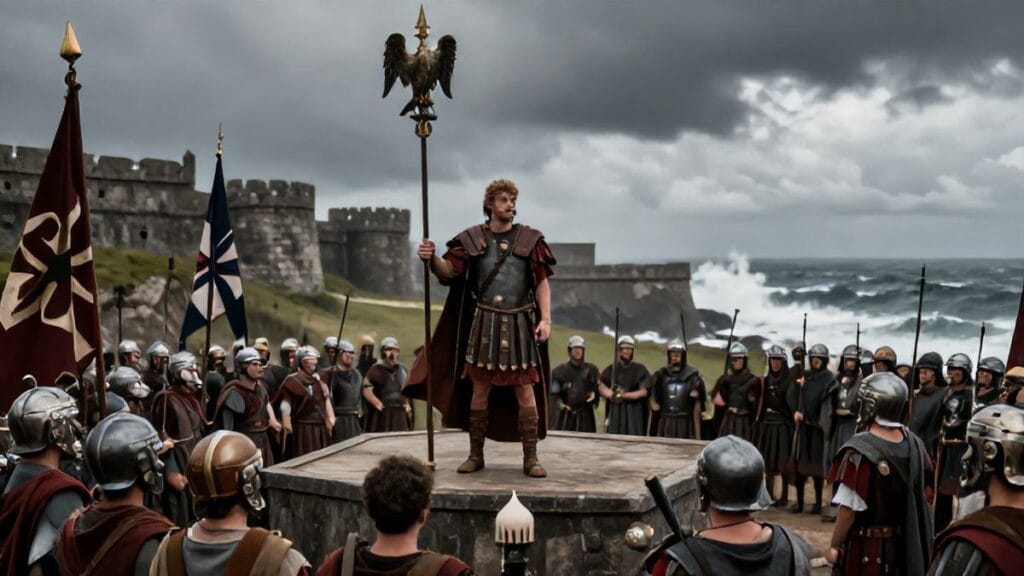
When the news broke that carausius declares himself emperor, officers must have called emergency assemblies. In parade grounds flanked by wooden barracks and stone principia, cohorts were drawn up in formation, standards gleaming in the pale northern light. There, before hundreds of watching eyes, centurions and tribunes relayed the proclamations: Carausius’s edict on one side, the official denunciation from Maximian on the other. The soldiers were forced to make a choice not in the abstract but with their lives and livelihoods at stake.
Many, perhaps most, in Britain chose Carausius. There were practical reasons. His fleet controlled the Channel; his forces physically occupied the island. To oppose him without strong continental support might mean isolation, even massacre. But there were also more positive inducements. Carausius, like many successful usurpers, likely offered donatives—bonus payments—to any troops who swore allegiance. He promised security, good leadership, and a share in the prestige of unseating the distant and untrusted central authorities.
In northern Gaul, the picture was more complex. Some garrisons sided with him, especially in coastal zones where his naval presence was strongest. Others remained loyal to Maximian, creating patchwork zones of control where towns or forts only a day’s march apart flew different imperial banners. Families with sons in opposite camps might find themselves torn not only geographically but emotionally, trying to calculate which emperor offered the safer future.
The mechanics of switching allegiance were themselves dramatic. A unit that decided to back Carausius might publicly salute his name—“Ave, Imperator Carausius!”—and order the old emperor’s portrait quietly removed from the headquarters. In some cases, careful rituals had to be observed to avoid appearing too fickle: oaths were solemn matters in a religiously charged military culture. But necessity, as always, had a way of smoothing over scruples. The Empire had seen many emperors rise and fall, and the soldiers had learned to adapt.
From Maximian’s perspective, each cohort lost to Carausius was not just a temporary setback but a hemorrhaging of imperial dignity. An emperor who could not hold his legions could not hold his realm. This is why, in later sources, the Menapian rebel is portrayed as such a dangerous figure: he had not merely defied orders; he had lured away the Empire’s professional killers, turning them into guardians of an unauthorized crown.
Life under the Breakaway Regime: Farmers, Merchants, and Islanders
Grand narratives of emperors and battles can easily eclipse the quieter stories of those who lived through these events as reluctant participants. For most inhabitants of Britain and northern Gaul, the day Carausius declared himself emperor did not involve palace intrigues or ceremonials. It involved weather, food prices, harvest yields, and the behavior of tax collectors.
Consider a farmer in the fertile valleys of southeastern Britain. His fields of wheat and barley rolled down towards a Roman road that led, eventually, to Londinium. Under the official Empire, he had grown accustomed to a certain pattern: tax assessments in grain or coin, occasional troop requisitions, and rare visits from provincial governors. After Carausius’s rise, some features changed and others stayed stubbornly the same. The taxes did not disappear; in fact, new military building projects and fleet maintenance may have increased the fiscal burden in some areas. Yet the faces of authority he saw—local officers, soldiers in their cloaks, scribes with wax tablets—were often the same men, now serving a different master.
In the port towns, the transformation was more visible. Merchants in Londinium, Rouen, or Boulogne watched with cautious hope as Carausius invested in securing sea lanes. If he could really keep the pirates at bay, trading might flourish. Some traders even found new opportunities in provisioning his fleet or supplying his armies. The coins they received in payment bore his image, not Maximian’s. Each transaction nudged their loyalties toward a simple truth: whatever the legal niceties, the emperor whose face they saw daily was the one whose laws and taxes mattered most.
For veterans settled on small landholdings in Britain’s interior, the island empire may have seemed like a return to an imagined golden age of strong local rule. They had fought on frontiers where incompetent emperors flitted across the stage and then vanished. A ruler who lived in Londinium, who paid their pensions on time, and who claimed to honor their service might earn a grudging respect, however tainted his reputation at the distant imperial court.
But life was not without fear. Rumors seeped into the countryside: tales of planned invasions by Maximian, of giant fleets being constructed in Continental harbors, of possible retaliations if Carausius fell. A family whose fortunes were tied to his regime—through a government contract or a son serving in his legions—had to grapple with the prospect that they might be branded traitors if Rome returned in force. Anxiety lived side by side with routine, as it so often does in times of political fracture.
Religion, too, offered both continuity and subtle change. Traditional Roman cults persisted: Jupiter, Mars, and the imperial cult itself, now centered on the person of Carausius. Local Celtic deities remained quietly worshipped in rural shrines. The emperor’s image might be displayed at altars dedicated to the safety of the state, his name invoked in public prayers for stability, even as priests and worshippers avoided direct entanglements in imperial politics. In a world where the divine and political spheres overlapped, recognizing Carausius in religious contexts lent yet another layer of legitimacy to his rule.
Rome Strikes Back: Diocletian, Maximian, and the First Failed Retaliations
From the vantage point of the imperial capitals, Carausius’s revolt could not simply be ignored. Diocletian and Maximian had embarked on an ambitious program to stabilize the Empire, known to historians as the Tetrarchy—a shared rule of multiple emperors designed to prevent exactly the sort of breakaways that Carausius now embodied. To leave him uncontested in Britain and northern Gaul would make a mockery of this new order.
So plans were laid for reconquest. Fleets had to be built or expanded, soldiers massed along the northern Gallic coast, supply lines secured. Inscriptions from the Tetrarchic period hint at significant military activity in the region, with Maximian personally overseeing campaigns against Germanic tribes and perhaps using these operations as a way to prepare for an eventual strike across the Channel. The imperial rhetoric framed Carausius as a pirate and bandit elevated beyond his station, a cancer that had to be excised.
Yet the first attempts to bring him down faltered. The Channel, so central to his power, proved a stubborn barrier to his enemies. Strong winds, tricky tides, and the sheer logistical challenge of transporting large forces across a sea patrolled by his experienced navy hampered Maximian’s efforts. One early expedition appears to have either failed or been abandoned, its ships perhaps scattered by storms or intercepted by Carausius’s fleet.
For the rebel emperor, each failed attempt was a propaganda windfall. He could present his survival as evidence of divine favor: the gods, it seemed, smiled upon his cause. New coins may have celebrated victories over “the Germans” or “the enemies of Rome,” blending vague external foes with the more specific threat from Maximian. To his subjects, especially in Britain, the inability of the continental emperors to dislodge him made his rule feel increasingly inevitable.
At the same time, Diocletian and Maximian were not idle. They reorganized the imperial military apparatus, strengthened coastal defenses, and honed the administrative machinery that supported war. Behind the scenes, they may have explored diplomatic options, dangling incentives before Carausius or his subordinates in hopes of fracturing his inner circle. The Tetrarchs were patient; they understood that time itself could be a weapon if used correctly.
This phase of stalemate—failed invasions on one side, cautious consolidation on the other—gave Carausius a precious commodity: years. In those years, as carausius declares himself emperor again through edicts, public ceremonies, and the steady churn of coin production, his regime matured. Children grew up in Britain knowing no other emperor; merchants recalibrated their networks around his policies. What had begun as a desperate bid for survival evolved into something resembling a coherent polity, however provisional its foundations.
The Sea as Fortress: Fleets, Forts, and the Defense of the Channel
Carausius’s empire was, above all, a maritime one. The narrow stretch of water that had once seemed a mere obstacle to be crossed now became his greatest ally, a living moat girded by sails and oars. To hold Britain and parts of northern Gaul against the determined hostility of Diocletian and Maximian, he had to turn the Channel into a defensive system as formidable as any land wall.
His fleet was the centerpiece of this strategy. Drawing on his years as a naval commander, he likely oversaw the construction and refitting of numerous ships: swift patrol vessels to scout and harass, larger transports to move troops and supplies, perhaps heavier warships capable of ramming and boarding enemy craft. Crews were recruited from coastal populations with long traditions of seafaring; discipline and training turned fishermen and traders into naval professionals.
Forts along the coast were reinforced or expanded. Archaeologists have identified elements of what later evolved into the so-called Saxon Shore forts: stone-walled strongholds at sites like Portchester, Richborough, and Dover, designed to guard key harbors and monitor sea traffic. While the fully developed Saxon Shore system may postdate Carausius, it is reasonable to see his regime as part of a continuum of militarization along these vulnerable coasts. Beacon systems, signal fires, and messenger routes stitched these installations into a network that could respond swiftly to any sign of imperial invasion.
On the opposite shore, in northern Gaul, similar measures were likely taken in the territories he controlled. Ports sympathetic to his rule became nodes in a trans-Channel defense-in-depth, where ships and fort garrisons supported one another. The sea was no longer just a boundary; it was a theater of coordinated action. A would-be invasion fleet had to run a lethal gauntlet of scouts, interceptors, and fortified harbors.
For the soldiers and sailors tasked with this defense, the daily reality involved relentless vigilance. They scanned the horizon at dawn and dusk, counting sails, assessing flags. A false alarm might mean a sleepless night; a real sighting of hostile ships might mean a desperate rush to arms. Freezing rain, sudden squalls, and fog that turned ships into ghostly silhouettes were as much enemies as Maximian’s generals.
Yet there was also pride in this work. Serving in the fleet of Carausius offered a sense of being part of something new, something that redefined what it meant to defend Rome’s world. Instead of guarding Rome itself, they guarded an alternative Roman center on the island. Each time an imperial reconnaissance mission was turned back or a supply convoy safely escorted across the Channel, the myth of invincibility that surrounded the breakaway regime grew thicker.
Letters, Titles, and Half-Recognized Power: Diplomacy with the Tetrarchs
No matter how strong his fleet or loyal his troops, Carausius could not ignore the political dimension of his rebellion. He needed not just de facto control but, ideally, some form of acknowledgment from the rulers on the continent. The Tetrarchs, for their part, had to weigh the cost of prolonged war against the dangerous precedent of recognizing a usurper. Between these competing needs, a strange diplomatic dance unfolded.
Evidence from coinage and later literary sources suggests that at some point, there was at least a tacit, temporary accommodation between Carausius and the Tetrarchs. Coins issued by Carausius that depict Diocletian and Maximian alongside himself, accompanied by legends implying fraternity and concord, hint at a moment when he hoped to be integrated into the imperial college. Whether the Tetrarchs ever seriously entertained this notion is unclear, but their immediate inability to dislodge him may have forced them into a grudging, practical tolerance.
Letters would have crossed the Channel—formal missives laden with titles and honorifics, carefully phrased to allow room for interpretation. Carausius might address Diocletian and Maximian as equals or near-equals, stressing his loyalty to the broader Roman order even as he insisted on his right to rule Britain and northern Gaul. They, in turn, would respond with veiled threats and carefully rationed politeness, refusing to concede the crucial point of legitimacy while perhaps hinting at negotiated paths to peace.
This liminal status—neither fully acknowledged nor immediately crushed—gave his regime a peculiar character. In official rhetoric on the continent, he remained a rebel. In the day-to-day practice of diplomacy, trade, and frontier management, he sometimes behaved like one ruler among several. Comparing him to earlier breakaway emperors like Postumus in the Gallic Empire, modern historians such as J.F. Drinkwater have argued that these regional regimes often sought not to destroy Rome but to claim a share of its authority for their neglected provinces.
For ordinary citizens and soldiers, the fine distinctions of diplomatic language mattered less than practical outcomes. If embassies traveled, if prisoners were exchanged, if trade routes continued to function, then it might appear that the quarrel between emperors was more technical than existential. Yet at the highest levels of power, the question gnawed: could the Tetrarchy tolerate a rival emperor who styled himself their “brother,” or would they eventually have to make an example of him?
Northern Gaul in the Balance: Towns, Garrisons, and Divided Loyalties
While Britain formed the core of Carausius’s empire, northern Gaul was both an asset and a vulnerability. It linked his island base to the continental economy, provided additional troops and resources, and extended his legitimacy into a region with a long Roman history. But its proximity to Maximian’s power centers also made it the front line of any reconquest effort.
Towns like Boulogne, Amiens, and Rouen found themselves caught in the shifting zones of control. A city loyal to Carausius might fly his banners, mint coins in his name, and host his garrisons—only to face siege or intimidation from loyalist forces if the balance of power shifted. Local elites, especially wealthy landowners and civic officials, had to navigate these dangerous waters with finesse. A misjudged oath of allegiance could mean confiscation of property or worse when the tide turned.
In garrisons along the Rhine and its tributaries, soldiers who had once served under Carausius might be pressured by Maximian’s agents to defect, offered pardons or promotions in exchange for betraying their commanders. Skirmishes, raids, and occasional full-scale battles likely punctuated the uneasy frontier, though the details are mostly lost to us. What remains clear is that northern Gaul was never as securely his as Britain; it was contested ground, an arena where his maritime power met the continental weight of the Tetrarchic machine.
For villagers and townsfolk, this meant living with a kind of chronic uncertainty. Rumors traveled faster than official news: a defeated cohort here, a burned granary there, a commander switching allegiance overnight. Women might hide family valuables in hopes of salvaging something from an anticipated sack; men might hedge their bets by quietly sending sons to serve in different armies, trying to ensure at least one child survived under whichever emperor ultimately prevailed.
Despite this volatility, Carausius’s control over parts of northern Gaul endured for years. Trade continued, taxes were collected, and administrative routines persisted. When carausius declares himself emperor in decrees read out in Gallic fora, he does so within a Roman civic framework that was already centuries old. His reign did not erase that heritage; it bent it toward a new regional center whose gravity was felt most strongly across the gray, restless Channel.
The Human Face of Rebellion: Veterans, Traders, and Provincial Elites
To understand the depth and limits of Carausius’s rule, we have to look beyond institutions and battle plans to the people who inhabited his world. His supporters were not an anonymous mass; they were veterans with scarred bodies and worn discharge diplomas, traders whose ledgers recorded hard-won profits, local aristocrats who held titles like decurion in their towns’ councils. Each group had its own reasons for tolerating—or even embracing—the island emperor.
Veterans formed a particularly important constituency. Their loyalty could be reinforced through land grants, tax remissions, and public honors. A veteran settled near a fort on the British coast might remember serving under Carausius in earlier campaigns, perhaps admiring his tactical skill or his willingness to share hardships with his men. When he heard that his former commander had become emperor, he might feel a surge of pride, mingled with calculation. A ruler who understood soldiers’ lives could be a better guardian of their hard-earned privileges than distant bureaucrats.
Traders, especially in ports and major road junctions, thought in terms of risk and opportunity. A stable Carausian regime meant predictable customs dues and secure shipping lanes. They might resent the extra levies imposed to fund the fleet but appreciate the reduced pirate attacks. Some enriched themselves by serving as intermediaries between his government and local communities, supplying contracts for grain, cloth, and shipbuilding materials. For them, politics was always filtered through the lens of commerce: whichever emperor provided the best business environment would win their sullen or enthusiastic support.
Provincial elites—wealthy landowners, town councillors, local magistrates—were perhaps the most ambivalent group. Their status had long depended on recognition from the central Empire: honorary titles, citizenship privileges, and membership in the complex hierarchy of Roman honor. Supporting Carausius risked alienating that broader network, yet resisting him openly when he controlled nearby garrisons and fleets could be suicidal. Many likely adopted a strategy of outward conformity combined with inward caution, serving his regime while maintaining family connections and investments in regions loyal to Diocletian and Maximian.
Personal stories, though largely unrecoverable, can be glimpsed at the edges of the archaeological and textual record. A tombstone in Britain might preserve the name of a soldier who died “in the service of our lord Carausius”; a hoard of coins buried in a Gallic field could represent a family’s desperate attempt to shield savings from punitive confiscations. In these fragments, we sense that the question of who ruled was never just abstract. It was woven into marriages, inheritances, local feuds, and acts of courage or betrayal that rippled down generations.
The Fall of a Maritime Emperor: Allectus and the Assassination of Carausius
No rebel emperor can rest easy. The very path to power—steeped in betrayal of a previous ruler—breeds an atmosphere in which conspiracies thrive. Carausius, who had turned against Maximian to save his own life and ambitions, must have known that the instruments of his rule could one day be used against him. In the end, it was not an imperial invasion but an internal coup that brought down the island emperor.
Enter Allectus, his finance minister (rationalis), a man who controlled the flow of money that sustained fleets, garrisons, and the broader apparatus of governance. As treasurer, Allectus occupied an extraordinarily powerful position: he knew which units were paid on time, which commanders were disgruntled, which cities groaned under tax burdens. He was, in effect, the nervous system of the regime, through which all financial signals passed.
Sometime around 293, after roughly seven years of Carausius’s rule, Allectus turned from servant to assassin. The motives can only be guessed: jealousy, fear of a falling-out with his master, or perhaps a calculated belief that he could negotiate more successfully with the Tetrarchs. In the enclosed spaces of palaces and barracks, rumors would have circulated: the emperor had grown paranoid, the treasury was stretched thin, key officers were beginning to waver. In such an atmosphere, a bold conspirator might see a narrow window of opportunity.
Ancient sources, terse and often hostile, tell us little of the exact circumstances. Perhaps it happened in Londinium, during a private meeting in a richly furnished chamber overlooking the Thames. Perhaps it took place in a coastal residence, with the cries of gulls and the crash of waves filtering in as an imperial guard unit, bribed or persuaded, turned its blades upon the man it was sworn to protect. One way or another, Carausius died violently, his blood spilling on British soil far from the city of Rome whose purple robes he had claimed.
When the news spread that carausius declares himself emperor no more, that his voice had been silenced and another man—Allectus—now styled himself Augustus, the reaction was likely mixed. Some might have felt relief, hoping that a more cautious and pragmatic ruler could secure a settlement with Diocletian and Maximian. Others, especially those personally loyal to Carausius, perhaps grieved or raged in private, understanding that the dream of an enduring island empire under its founding leader had ended not with a heroic last stand but with an act of treachery.
Allectus quickly moved to consolidate power, taking over the machinery of rule that Carausius had built. He may have purged the court of suspected loyalists, reissued coinage in his own name, and redoubled efforts to maintain control of both Britain and whatever remained of his Gallic holdings. Yet he lacked the unique combination of military charisma and maritime skill that had allowed his predecessor to survive initial imperial retaliation. His rule, from the start, was haunted by the knowledge that the Tetrarchs had not forgotten Britain—and that this time, they were better prepared.
Constantius Chlorus and the Reconquest: The End of the Island Empire
The man chosen to end the experiment begun when Carausius declared himself emperor was Constantius Chlorus, a capable general and Caesar (junior emperor) under the Tetrarchic system. Appointed by Maximian to oversee the western provinces, Constantius approached the British problem with patience, method, and the full backing of a reorganized imperial machine.
His strategy was twofold. First, he targeted the Gallic footholds that had been so vital to Carausius’s power and now remained under Allectus. In a carefully planned campaign, Constantius seized key ports, notably Boulogne, tightening the noose around Britain by cutting off its continental supply lines. By depriving Allectus of this bridgehead, he turned the Channel back into a barrier—but now one that worked against the island regime rather than for it.
Second, he prepared an invasion fleet powerful enough to challenge the remnants of Carausius’s navy. Ships were gathered, troops trained in amphibious operations, logistics painstakingly arranged. This was not the hurried, ill-fated thrust of earlier years; it was a deliberate operation backed by the full resources of an empire that had learned hard lessons from decades of crisis. When the time came, multiple fleets set sail, some apparently using the cover of fog to cross undetected.
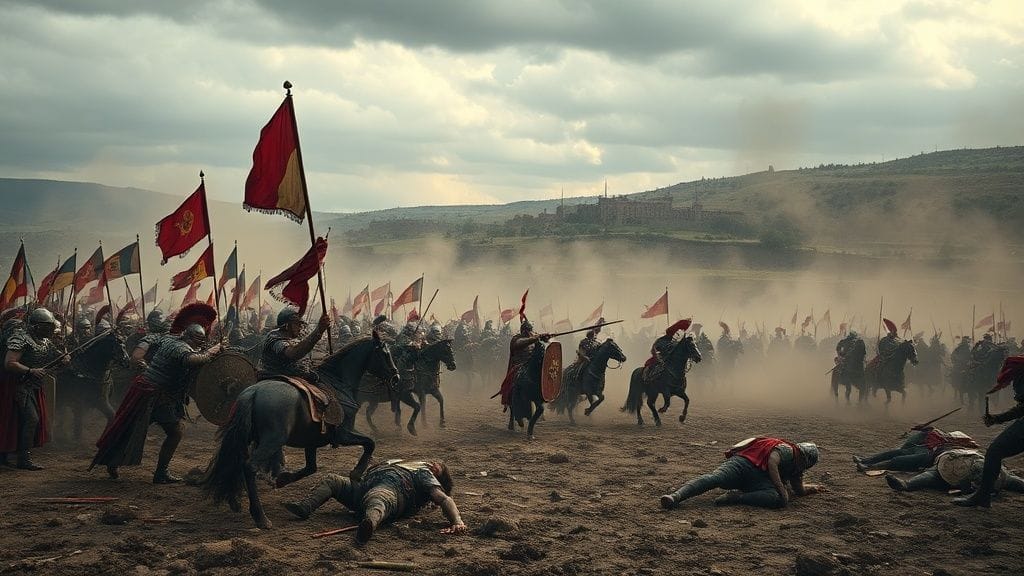
Allectus attempted to meet this threat, but fate and miscalculation converged against him. One portion of Constantius’s forces landed in southern Britain, near the region of modern Hampshire, evading the enemy fleet. Allectus marched to confront them, perhaps hoping to crush the invaders before they could link up with other contingents. Somewhere in the misty hills and fields of southern England, the two armies clashed.
The battle went badly for Allectus. His forces were defeated; he himself was killed, either on the field or while attempting to flee, according to sources like the panegyricists who later celebrated Constantius’s victory. Meanwhile, another detachment of imperial troops entered Londinium, where they are said to have slaughtered remnants of the island regime’s mercenaries who were plundering the city in the chaos. Imperial order, or at least a version of it, was restored with a combination of military precision and ruthless cleanup.
Constantius made a triumphant entry into London, greeted (so the official rhetoric insists) as a liberator by grateful citizens. Ceremonial distributions of money and grain, ritual thanksgivings to the gods, and public speeches hammered home the message: the aberration of the island empire was over; Britain was once more securely within the Roman fold. Statues and inscriptions celebrated Constantius as a savior, the man who had undone the work begun when carausius declares himself emperor and continued—without his talent or legitimacy—by Allectus.
In practical terms, the reconquest meant a reshuffling of elites, the reassertion of central tax control, and the integration of Britain into the increasingly bureaucratic Tetrarchic system. Garrison commanders were replaced, suspected collaborators punished, and new administrative boundaries drawn. The sea, that had once been the axis of an alternative empire, returned to its role as a corridor of imperial power radiating from the continent outward.
Echoes in Stone and Silver: Archaeology of Carausius’s Britain
Today, our understanding of Carausius’s reign does not rest solely on terse, hostile literary references. It also relies on the patient work of archaeologists and numismatists who have pieced together a mosaic of evidence from coins, inscriptions, building remains, and buried hoards. These fragments grant us glimpses into the world over which he ruled and the impact his brief empire had on the landscape of Britain and northern Gaul.
Coins are the most abundant witnesses. Thousands bearing his image have been found across Britain, from urban centers like London and Verulamium (St Albans) to rural sites and isolated farmsteads. Their distribution maps the reach of his authority and the economic networks that sustained it. Scholars analyze their metal content, iconography, and legends to reconstruct changes in policy and propaganda over time. Some series, struck in higher-quality silver, suggest efforts to restore confidence in the currency, aligning with his self-styled role as “Restorer of Britain.”
In towns, layers of construction and destruction hint at the stresses and adaptations of the late third century. Strengthened walls in London and other key centers speak to the militarization of urban life. Warehouses and granaries attest to the logistical demands of supporting fleets and armies. In some cases, signs of sudden burning or abandonment may correlate with the turmoil surrounding his rise or fall, though such connections must be drawn cautiously.
Rural villas also bear traces of this era. Some show expansions or renovations that may reflect prosperity under the relative stability Carausius provided, sustained by steady tax collection and protection from pirates. Others appear to decline or be abandoned, perhaps victims of shifting trade patterns, local insecurity, or the uneven impacts of military requisitions. The archaeological record thus reveals a patchwork reality: Carausius’s Britain was neither uniformly enriched nor uniformly impoverished by his rule.
Hoards of coins, buried and never retrieved, often cluster around periods of unrest. Several such hoards from Britain date to the late third and early fourth centuries, containing substantial quantities of Carausian coinage alongside issues of other emperors. Each hoard represents a moment of fear: someone deciding that the ground was safer than the marketplace or the strongbox. That many of these caches were never recovered suggests that their owners did not survive to see a stable peace return.
Inscriptions explicitly naming Carausius are rarer but significant. A fragment from Carlisle, for instance, appears to mention him in a military context, underscoring his reach into northern Britain. These carved letters, weathered but legible, offer a counterpoint to the hostile narratives of later imperial chroniclers. In stone as in silver, we see a man who fully inhabited the role of emperor, commissioning monuments and official texts like any recognized ruler.
Taken together, these archaeological echoes confirm that when carausius declares himself emperor, he does not merely adopt a grandiose title. He reshapes the material world of Britain and its neighboring provinces in ways that can still be traced centuries later: in the thickness of city walls, the patterns of coin circulation, and the scars of hurriedly buried treasure left forever underground.
Rebel, Usurper, or Visionary? Interpreting Carausius across the Centuries
How should we judge Carausius? The words available to us—rebel, usurper, pirate—come primarily from his enemies, men who had every reason to depict him as a dangerous aberration. Later historians, both ancient and modern, have grappled with the problem of seeing beyond this hostile framing to the reality of his rule and its meaning in the broader story of the Roman Empire.
Ancient panegyrists celebrating Constantius Chlorus naturally painted Carausius and Allectus as villains whose removal restored cosmic order. To them, the island empire was a symptom of crisis, an insult to Roman unity. Eutropius, for instance, summarizes him in a sentence or two, emphasizing his low birth and inglorious end. Such accounts flatten his complex reign into a morality tale about the punishment of presumption.
Modern scholarship, more sympathetic to nuance, has offered varied interpretations. Some historians see Carausius primarily as a pragmatic opportunist—a man who, faced with certain execution, chose rebellion and then used all available tools, from coin propaganda to naval strategy, to prolong his survival. Others emphasize the regional dimension, arguing that he gave neglected provinces a voice and focus, drawing parallels with the earlier Gallic Empire of Postumus. In this view, his reign speaks to recurring tensions between center and periphery in the Roman world.
There is also a temptation, particularly in British popular memory, to recast him as a kind of proto-national figure: an early “British” emperor who asserted the island’s distinct destiny against continental control. This is anachronistic—the people of his time thought in terms of Roman citizenship, provincial identities, and local loyalties rather than modern nationalism—but it reflects the enduring fascination with a moment when Britain briefly stood as an imperial center rather than a subordinate province.
Perhaps the most balanced approach is to see Carausius as a product of his age: the third-century crisis distilled into a single, vivid personality. He exploited imperial weaknesses but also filled real governance gaps. He was ruthless when needed, yet evidently capable of commanding loyalty and organizing effective defenses. He challenged the monopoly on imperial power not out of ideological rebellion against Rome itself but out of a determination to claim a share in its mantle for a region and a people he had come to know intimately.
When carausius declares himself emperor, he exposes the fragility of an empire that could still project immense force but could no longer convincingly pose as a single, harmonious order radiating from one city and one man. His brief, storm-tossed reign invites us to reconsider tidy narratives of imperial unity, reminding us that Rome was as much a contested idea as a political structure, and that its edges were places where new possibilities—however short-lived—could take shape.
Conclusion
In the gray winter of 287, when the winds shredded sails on the Channel and the Roman world trembled under the weight of its own contradictions, a Menapian admiral made a choice that would reverberate across decades and centuries. By proclaiming himself emperor over Britain and northern Gaul, Carausius did more than save his own life from imperial execution. He carved out a space—geographical, political, and imaginative—where the familiar grammar of Roman power was rearranged.
For nearly a decade, the island empire he founded endured. Its fleets patrolled dangerous waters; its coins clinked in the purses of farmers and merchants; its fortifications reshaped the skylines of towns like Londinium. Soldiers swore new oaths, provincial elites negotiated shifting loyalties, and ordinary people woke each day to a world where the emperor might live only a few days’ travel away rather than beyond the Alps. When at last the Tetrarchic machine, in the person of Constantius Chlorus, ground its way across the Channel and crushed the remnants of the breakaway regime, it did more than eliminate a rebel. It closed a chapter in which the provinces had dared, for a moment, to imagine themselves not as Rome’s periphery but as a center in their own right.
Yet the memory of that experiment never vanished entirely. It lingered in hoards of coins, in fortified shorelines, and in the muted hostility of official texts that could not quite conceal a grudging respect for the man they condemned. To trace the arc from Carausius’s obscure birth on Menapian shores to the bloody floor where he fell to Allectus’s conspiracy is to follow a thread through the fabric of late Roman history—a thread woven from ambition, fear, ingenuity, and the ceaseless interplay between center and frontier.
In the end, perhaps the most revealing fact is that the Empire survived him. Rome adapted, reorganized, and moved on, as it so often did. But the episode reminds us that imperial power was never as monolithic as marble statues suggest. When carausius declares himself emperor in that fateful year, he forces us—even now—to recognize that history’s greatest empires were not invulnerable monoliths but living systems, vulnerable to the audacity of a single determined man standing on a storm-swept shore at the edge of the known world.
FAQs
- Who was Carausius?
Carausius was a Roman military commander of Menapian origin, active in the late third century AD. Originally appointed to lead the fleet tasked with suppressing pirates in the North Sea and English Channel, he later rebelled against the emperors Diocletian and Maximian, proclaiming himself emperor over Britain and parts of northern Gaul. - Why did Carausius declare himself emperor?
He did so after learning that Emperor Maximian had ordered his execution, allegedly for profiting from captured pirate plunder. Facing certain death if he submitted, Carausius used his control over the fleet and coastal garrisons to seize Britain and parts of northern Gaul, declaring himself emperor as a means of survival and power consolidation. - How long did Carausius rule Britain and northern Gaul?
Carausius ruled for roughly seven years, from about AD 287 until his death around 293. During this period he established a functioning breakaway regime with its own capital, coinage, and military system centered in Britain, especially in and around Londinium. - How did Carausius try to legitimize his rule?
He relied heavily on propaganda and traditional Roman symbols of authority. He minted extensive coinage portraying himself as a legitimate emperor, sometimes even depicting himself alongside Diocletian and Maximian, and used slogans such as “Restorer of Britain.” He also adopted full imperial titles and likely sponsored public works, religious ceremonies, and donatives to the army. - What ultimately happened to Carausius?
Carausius was assassinated around AD 293 by his own finance minister, Allectus, in an internal coup. Allectus then took power in Britain, continuing the breakaway regime for a few more years until the Roman Caesar Constantius Chlorus invaded and reconquered the island. - How did Rome regain control of Britain?
Constantius Chlorus first captured key Gallic ports, such as Boulogne, cutting Britain off from its Continental support. He then launched a coordinated naval invasion of Britain. Allectus was defeated and killed in battle in southern Britain, and Roman troops under Constantius reentered Londinium, restoring imperial authority over the island. - Is Carausius considered a “British” emperor?
In modern popular memory he is sometimes portrayed that way, because he ruled independently from Britain and promoted the idea of restoring the province. However, in his own time identities were framed in Roman and provincial terms rather than modern nationalism. Carausius saw himself as a Roman emperor, not the ruler of a separate British nation-state. - What evidence do we have about Carausius and his reign?
Our knowledge comes from a combination of ancient literary sources, imperial panegyrics, inscriptions, archaeological remains, and especially coinage. His coins are particularly important; they reveal his titles, propaganda, and sometimes even his political messaging toward other emperors. - How did Carausius’s rule affect ordinary people in Britain?
Most everyday activities—farming, trade, local governance—continued, but under a different imperial name. Some communities benefited from increased security at sea and new military spending, while others suffered from higher taxes or localized instability. For many inhabitants, the change of emperor primarily affected who collected taxes and who commanded the local garrisons. - Why is Carausius significant in Roman history?
Carausius’s revolt highlights the fragility of Roman central authority during the third-century crisis and the growing importance of frontier provinces like Britain. His decade-long rule shows how a regional commander could leverage military and naval power to create an alternative imperial center, forcing Rome to confront the realities of decentralization and regional identity within its vast domains.
External Resource
Internal Link
Other Resources
- Encyclopaedia Britannica – general search for the exact subject
- Google Scholar – academic search for the exact subject
- Internet Archive – digital library search for the exact subject