Table of Contents
- The Twilight of a Monarch: June 7, 1492, Grodno
- Casimir IV Jagiellon: The Unifier of Poland and Lithuania
- Early Life and Rise to Power
- The Jagiellonian Dynasty and Its Ambitions
- Lithuania in the Late 15th Century: A Realm in Flux
- Poland and Lithuania: A Delicate Union under Casimir IV
- The Final Days in Grodno: Illness and Farewell
- The Death of a King: Immediate Reactions Across the Realm
- The Political Landscape at the Time of His Death
- The Succession Crisis and Its Stakes
- Casimir’s Legacy Through His Sons: The Future Kings
- Religious and Cultural Shifts Under Casimir IV
- Economic Foundations Laid by the Jagiellonian Rule
- Grodno: From Quiet Town to Historical Landmark
- Memory and Myth: Casimir IV in Lithuanian and Polish Identity
- The Jagiellon Dynasty’s Influence on European Politics
- Comparative Reflections on Monarchs of the Late Middle Ages
- The Evolution of Lithuania After Casimir’s Death
- The Rise of the Lithuanian Nobility and Magdeburg Rights
- Casimir IV’s Role in Defining Polish-Lithuanian Commonwealth Structures
- Conclusion: The End of an Era and the Dawn of New Challenges
- FAQs About Casimir IV Jagiellon’s Death and Its Impact
- External Resources
- Internal Link: History Sphere
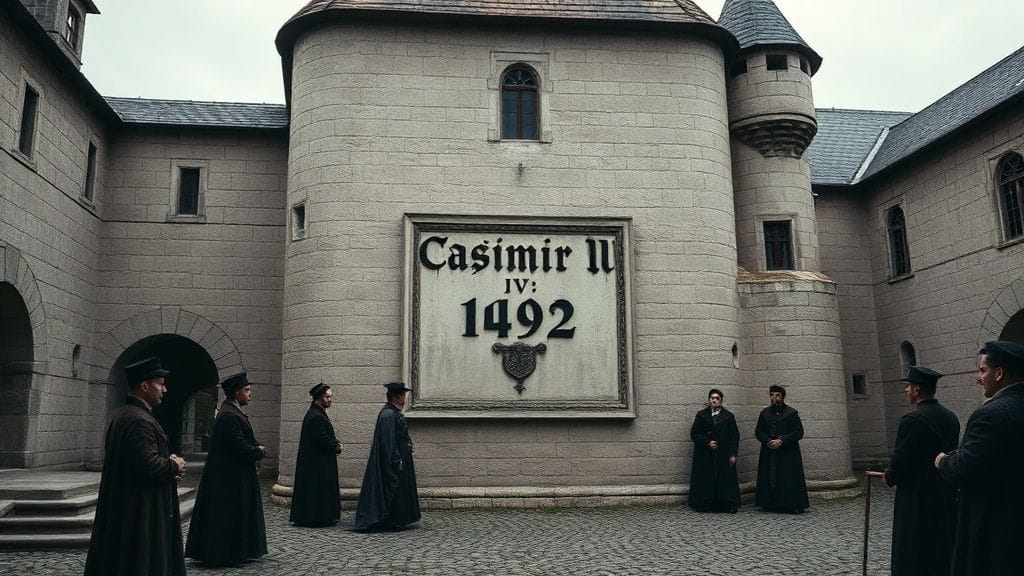
The sky over Grodno on that early day of June 7, 1492, was cast in steely gray—a faint chill hung in the air, a somber reflection of the kingdom’s mood. Behind the stone walls of the Quedlinburg Castle, nestled in the heart of Lithuania’s lands, the final breath of Casimir IV Jagiellon slipped quietly away. It was the death of a king, yes, but the fading of an era, a moment heavy with the weight of a lifetime spent stitching two great nations into a fragile, luminous union. The chamber was cloaked in stillness, save for the muffled sobs of courtiers and the distant tolling of bells, weaving a mournful melody that would echo across Poland and Lithuania.
Casimir IV’s passing did not crash like a thunderbolt on the unsuspecting realm; rather, it dawned as an inevitability long anticipated—yet it left a void no one could easily fill. This was a monarch who had weathered decades of upheaval, wars, and complex alliances. His death marked a decisive turning point, setting in motion a series of political struggles and cultural transformations that would shape Eastern Europe for centuries.
Casimir IV Jagiellon: The Unifier of Poland and Lithuania
Born in 1427 in Kraków, Casimir IV Jagiellon was more than just the King of Poland and Grand Duke of Lithuania—he was the linchpin of the Jagiellonian dynasty’s imperial aspirations. The son of Władysław II Jagiełło and Sophia of Halshany, his ascent was marked by both strategic marriages and military prowess. At a time when Europe was fracturing into narrow duchies and kingdoms, Casimir embodied a rare vision: the unity of diverse peoples under a shared crown.
The Jagiellonian dynasty was unique in its dual monarchy structure—a balancing act between Poland’s Catholic traditions and Lithuania’s pagan past now rapidly Christianized. Casimir’s reign was dedicated to reinforcing this bond, navigating not only foreign threats but the persistent internal dissensions gnawing at the fabric of his realm.
Early Life and Rise to Power
The young Casimir grew up amidst the turmoil of the Hundred Years’ conflict between Poland and the Teutonic Knights, wars intertwined with dynastic claims and territorial disputes. His education, steeped in both Latin learning and martial training, prepared him for a life where diplomacy and battlefield courage were inseparable.
When Casimir ascended the Polish throne in 1447, following the death of his father, the kingdom was both powerful and fragile. The Union of Krewo—signed decades prior—had joined Lithuania and Poland through the marriage of Władysław II to Queen Jadwiga, but the political realities of binding two culturally distinct entities remained tenuous under Casimir’s rule. His early years were dominated by consolidating control, quelling noble insurrections, and extending Polish influence into the Baltic region.
The Jagiellonian Dynasty and Its Ambitions
His reign coincided with the apex of the Jagiellonian dynasty’s ambitions. Stretching from the Baltic Sea to the borders of the Holy Roman Empire, Casimir’s dominions were a strategic buffer against the rising power of Moscow and the vampire-like expansion of the Grand Duchy.
The dynasty’s strategy was masterful: through marriages, treaties, and a deft mix of force and favor, Casimir IV shaped a political landscape where Poland and Lithuania acted not as rival states but as pillars of power with a shared destiny. His children, carefully wed across Europe’s noble houses, would carry forward his legacy, embedding the dynasty deep within the continent’s power games.
Lithuania in the Late 15th Century: A Realm in Flux
Yet Lithuania itself was far from stable. The Grand Duchy was grappling with its identity—caught between the lingering pagan traditions of its original peoples and the ever-encroaching influence of Catholicism from Poland. It was also rapidly evolving in its governance structures, with the Lithuanian nobility beginning to assert greater power.
Casimir’s court in Grodno functioned as an epicenter for these changes. Here, languages mingled, and ideas raced from Byzantium to the Baltic states. The political experiments initiated under Casimir, including grants of Magdeburg rights to Lithuanian cities, foreshadowed the eventual codification of privileges that would define much of Eastern European nobility’s relations with the monarchy.
Poland and Lithuania: A Delicate Union under Casimir IV
The union was not a simple amalgamation but a careful interleaving of power and separation. Casimir adeptly managed the Polish Sejm (diet) and the Lithuanian Council of Lords, ensuring each realm retained distinctive rights even under his overarching authority.
His reign saw concerted campaigns against the Teutonic Order, notably the Thirteen Years’ War (1454–1466), where Poland emerged victorious, diminishing the Order’s grip in Prussia. This military success strengthened Casimir’s position but heightened the stakes for his succession; his combined titles promised dominion but also invited competing factions maneuvering for influence.
The Final Days in Grodno: Illness and Farewell
By 1492, Casimir’s health had waned. The robust king who once led armies now found himself confined by age and illness. Grodno, his residence at the time, felt the gravity of these last days. Chroniclers recount a sovereign who remained mentally lucid yet distant, prepared to face his mortality.
Witnesses described an air of solemnity permeating the castle walls, as courtiers and family members gathered, perhaps aware that the end was near. The king’s passing was slow but inevitable—the weight of decades grounded him until his final breath was drawn in the quiet of a summer morning.
The Death of a King: Immediate Reactions Across the Realm
News of Casimir’s death rippled quickly through towns, villages, and capitals. In Kraków, Warsaw, Vilnius, and beyond, bells tolled as mourners convened to honor a king who had shaped their lives. Laments filled the air, but so did uncertainty.
Polish nobles worried about maintaining influence; Lithuanian lords contemplated their autonomy; and neighboring powers, from Moscow to the Holy Roman Empire, saw an opportunity ripe for exploitation. The political equilibrium maintained by Casimir’s steady hand was now fragile, a ship adrift in stormy seas.
The Political Landscape at the Time of His Death
Europe in 1492 was on the cusp of tremendous upheaval. While Casimir’s dominions in Central and Eastern Europe stood strong, the western frontiers experienced nascent movements that would erupt into the Renaissance and Reformation.
Internally, the Jagiellonian realm faced pressure from rising nobles pushing for privileges, antagonism from the rising Muscovite power, and the early rumblings of religious reform. The death of a monarch was always a test—one that would shortly see the mettle of Casimir’s sons tested.
The Succession Crisis and Its Stakes
Casimir left behind multiple heirs—most notably John I Albert and Alexander Jagiellon—who would each ascend to the Polish and Lithuanian thrones in succession. But the transition was far from smooth.
The nobility’s competing interests, foreign ambassadors’ intrigues, and emerging religious factionalism complicated matters. The question loomed large: would the union Casimir nurtured hold firm, or fracture under the weight of internal discord?
Casimir’s Legacy Through His Sons: The Future Kings
In the decades after his demise, Casimir’s legacy unfolded through the reigns of his sons, who each faced monumental challenges balancing tradition and innovation. John Albert’s attempts to assert dominance in regional politics met resistance, while Alexander’s later efforts helped cement the foundations of what would become the Polish-Lithuanian Commonwealth.
Casimir’s foresight in education, administration, and diplomacy lived on in their policies, even as the shifting tides of European power challenged the dynasty’s supremacy.
Religious and Cultural Shifts Under Casimir IV
Casimir’s reign deeply influenced the religious landscape. Under his patronage, Catholicism was promoted vigorously in Lithuania, encouraging the conversion of pagan nobles and commoners alike. His support for ecclesiastical institutions helped embed the Church as a pillar of state authority.
Simultaneously, his court became a melting pot of cultures—Polish, Lithuanian, Ruthenian, and even German elements mingled, spawning a vibrant cultural renaissance that would later permeate artistic and literary traditions.
Economic Foundations Laid by the Jagiellonian Rule
Beyond the sword and crown, Casimir IV was an astute economic strategist. He sought to invigorate trade routes stretching from the Baltic Sea to the Black Sea, improve urban charters, and foster economic privileges for noble classes that would ripple into greater productivity.
His policies encouraged the growth of cities like Vilnius and Grodno, transforming them into hubs of commerce and governance. Tax reforms and land grants aligned to bolster royal revenues and noble wealth alike, weaving a durable economic fabric.
Grodno: From Quiet Town to Historical Landmark
Once a subdued town along the Niemen River, Grodno’s significance rose alongside the Jagiellon dynasty. Casimir’s preference for Grodno as a retreat and administrative center laid the grounds for its future status as a vital city in Lithuania.
Today, Grodno is remembered not only for its medieval architecture but also as the final resting place of a king whose life shaped an entire epoch—a symbol of both an ending and a beginning.
Memory and Myth: Casimir IV in Lithuanian and Polish Identity
Centuries after his death, Casimir IV remains an emblem of national unity in Polish and Lithuanian historical consciousness. Folk tales, chronicles, and modern historiography paint him as the wise, benevolent ruler whose reign brought peace and prosperity.
His figure has become mythologized, at times idealized as a founder of shared cultural heritage—an enduring symbol for a region often riven by conflict.
The Jagiellon Dynasty’s Influence on European Politics
On the broader stage, the Jagiellon dynasty under Casimir IV became a formidable force in Central Europe. Their dynastic ties stretched into Hungary, Bohemia, and beyond, transforming the political map.
Casimir’s diplomacy balanced Western and Eastern interests, setting precedents for multinational governance and playing a subtle but significant role in the balance of power among European monarchies.
Comparative Reflections on Monarchs of the Late Middle Ages
Casimir’s reign invites comparison with contemporaries like Matthias Corvinus of Hungary or Ivan III of Moscow. All faced the challenge of consolidating fragmented lands into cohesive states amidst the fractured medieval world.
Yet Casimir’s dual monarchy was a unique experiment, one that prefigured the later concept of federations and supra-national states, distant for his time, but prescient in its complexity.
The Evolution of Lithuania After Casimir’s Death
After 1492, Lithuania’s internal dynamics accelerated. The Grand Duchy continued its Christianization, the nobility’s power grew dramatically, and tensions with Moscow intensified, leading to decades of military confrontations.
Casimir’s death marked both the end of a golden age and the beginning of a turbulent century that would reshape Lithuanian identity.
The Rise of the Lithuanian Nobility and Magdeburg Rights
A crucial development during and after Casimir’s reign was the expansion of Magdeburg rights—autonomy granted to towns and cities fostering self-government within the states.
This empowerment of the Lithuanian nobility and urban classes injected vitality into political structures but also diluted royal absolutism, planting seeds for future noble-led opposition.
Casimir IV’s Role in Defining Polish-Lithuanian Commonwealth Structures
Though the Commonwealth itself was officially established decades later, Casimir IV’s reign laid foundational governance structures that enabled this later political entity to emerge.
His balancing act between royal authority and noble privileges, alongside constitutional experiments, created the framework within which a vast, multiethnic polity could survive for centuries.
Conclusion
Casimir IV Jagiellon’s death in Grodno on that quiet day in June 1492 was not merely the passing of a king; it was the close of a chapter that had defined the trajectory of Central and Eastern Europe. His life was a testament to the art of ruling through contradiction—uniting disparate peoples, navigating turbulent tides, and laying the groundwork for a shared future.
From the battlefield to the council chamber, from the quiet halls of Grodno Castle to the bustling streets of Kraków and Vilnius, his influence is woven into the very fabric of both Poland’s and Lithuania’s histories. The delicate political structures he nurtured and the cultural synthesis he fostered resonate even today, reminding us how leadership, vision, and resilience shape nations across centuries.
Casimir left behind a legacy not of domination, but of collaboration; not mere conquest, but of connection. His story is an invitation to reflect on the complexity of unity amid diversity—a lesson as relevant now as it was five centuries ago.
FAQs
1. What were the main causes leading to Casimir IV’s death in Grodno?
Casimir IV died of natural causes related to age and declining health, typical for a king who had ruled for nearly half a century amid wars and political stress. The cold and quiet of Grodno were his final refuge where he spent his last days.
2. How did Casimir IV’s death affect the Polish-Lithuanian union?
His death triggered a succession crisis, challenging the fragile balance between Poland and Lithuania. Though his sons eventually maintained the union, the transition sparked noble rivalries and external threats, testing the union’s resilience.
3. Who succeeded Casimir IV as ruler?
John I Albert, his son, became King of Poland and Grand Duke of Lithuania initially, though his reign was marked by struggles. Later, Alexander Jagiellon also ruled, continuing the family legacy.
4. What was Casimir IV’s contribution to the Christianization of Lithuania?
As Grand Duke, Casimir vigorously promoted Catholicism, encouraging the conversion of native pagans and integrating the Lithuanian Church more closely with Rome, reinforcing religious and political unity.
5. Why is Grodno significant in the history of Casimir IV?
Grodno was Casimir’s favored residence during his later years and the place where he died. It became emblematic of his reign and is remembered as a historical landmark tied closely to his legacy.
6. How did Casimir IV’s reign influence European politics?
Through dynastic marriages and alliances, Casimir positioned the Jagiellonian dynasty as a major player in Central Europe, balancing the interests of Western and Eastern powers and shaping the political landscape.
7. What economic measures did Casimir IV implement?
He promoted trade, urban development, and granted privileges (like Magdeburg rights) to towns, strengthening economic foundations across Poland and Lithuania.
8. How is Casimir IV remembered today?
Both Poland and Lithuania regard him as a pivotal figure who strengthened their unity and identity. He is celebrated in historiography and folklore as a wise and just ruler.