Table of Contents
- The Dawn of a New Era: Guatemala City, September 15, 1821
- The Spanish Grip on Central America: Four Centuries of Colonial Rule
- Seeds of Rebellion: Enlightenment Ideas and Local Discontent
- The Role of the Creole Elite: Ambition and Identity in a Colonial World
- The Wider Colonial Context: Turmoil in Spain and the Americas
- September 15, 1821: The Emotional Proclamation of Independence
- The Act of Independence: Words that Changed a Continent
- Immediate Reactions: Joy, Fear, and Uncertainty in Guatemala and Beyond
- The Ripple Effect: Independence Movements in Central American Provinces
- The Brief Unity of the Federal Republic of Central America
- The Role of Key Figures: Mariano Gálvez, José Cecilio del Valle, and Others
- The Challenge of Nation-Building: Political Fragmentation and Rivalries
- The Influence of External Powers: Mexico, Spain, and the United States
- Economic Consequences: From Colonial Economy to Independent Statehood
- Cultural Awakening: National Identity and the Struggle for Unity
- Indigenous and Afro-descendant Communities: Silent Voices of Independence
- The Legacy of September 15: Annual Celebrations and Collective Memory
- Independence in the Shadow of Empire: Continuing Colonial Legacies
- The Evolution of Central American States: From Federation to Fragmentation
- International Impact: Central America and the Global Age of Revolutions
- Reflections on Freedom: Longing, Reality, and Future Aspirations
- The Endurance of a Declaration: How 1821 Shapes Central America Today
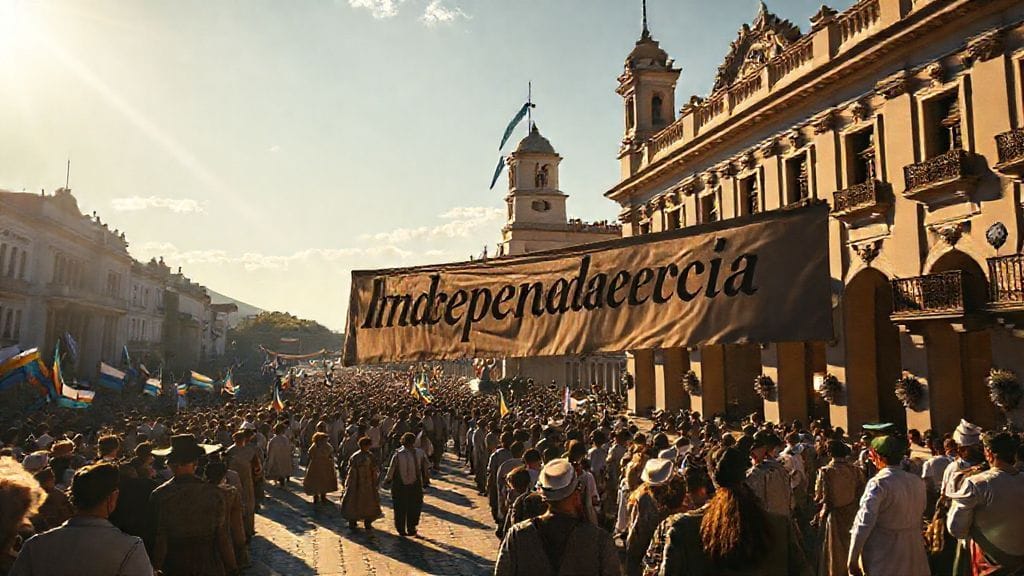
The dawn broke gently over the tiled rooftops of Guatemala City on September 15, 1821, casting a golden hue on the colonial buildings that for centuries had symbolized Spanish authority. Yet, on this tranquil morning, beneath the calm skies, a mighty wave surged through the hearts of the Central American people. A new destiny was being woven — one written not by distant monarchs or colonial governors, but by the voices and hands of those who had long dreamed of liberty. It was here, in the heart of Guatemala’s historic plaza, that the proclamation of independence was announced, transforming the course of history for the entire Central American isthmus.
For over 300 years, Central America had lain under the shadow of the Spanish Empire, a vast and complex colonial system that shaped the social, economic, and political fabric of the region. From the fertile highlands to the Pacific coast and Caribbean shores, indigenous civilizations were supplanted or subordinated, while a new colonial order emerged — one ruled by Spanish-born elites and their locally born descendants, the Creoles. But by the early 19th century, the winds of change were restless. Swept by Enlightenment ideals and the global currents of revolution, Central America’s diverse peoples began to question the legitimacy of colonial rule and dream anew of self-determination.
Yet independence was no spontaneous uprising. It was the culmination of decades of intellectual ferment, economic struggles, and political maneuvering. The elite Creoles, influential merchants, clergy, and local councils navigated a fraught path — balancing loyalty, fear, and ambition — amidst the convulsions shaking Spain itself, where Napoleon’s invasion and the abdication of King Ferdinand VII had plunged the empire into crisis. In this volatile environment, the provinces of Guatemala, Honduras, El Salvador, Nicaragua, and Costa Rica found a moment to finally voice their collective resolve.
That historic day, the intrepid leaders assembled in the City Hall of Guatemala, crafting and signing the Act of Independence — a document that declared Central America free from Spanish dominion. The air was thick with emotion as townsfolk, soldiers, and clergy celebrated a rupture with the past but also faced the tumultuous road ahead. Joy mingled with uncertainty, as freedom’s dawn promised opportunity as well as division.
Central America’s independence would reverberate beyond its borders, inspiring movements elsewhere but also grappling with internal challenges. The ideal of unity gave birth to the Federal Republic of Central America — a fragile political experiment that would eventually falter amid rivalries and regionalism. Economic transformations followed, shifting colonial trade patterns and testing the young republic’s resilience. Meanwhile, indigenous peoples and Afro-descendants, who had played crucial yet often overlooked parts in colonial and revolutionary contexts, found their futures tied to the unresolved questions of inclusion and citizenship.
Over two centuries later, the proclamation of September 15, 1821, remains a pivotal chapter in Central American identity — celebrated with parades, ceremonies, and reflection. It embodies the complex interplay of hope and struggle, of liberation and continuity, that defines the region’s history. This article embarks on an immersive journey through the intricacies of that transformative moment, tracing the origins, unfolding, and aftermath of Central American independence, to appreciate fully the courage and contradictions that shaped a new nation in the heart of the Americas.
The Spanish Grip on Central America: Four Centuries of Colonial Rule
To grasp the profound significance of the independence proclamation in 1821, one must first understand the deeply entrenched colonial system that had governed Central America since the early 16th century. Following Hernán Cortés’ conquest of the Aztec Empire in 1521, Spanish expeditions quickly extended southward into the lands of the Mayan civilizations and other indigenous groups inhabiting the isthmus.
Spanish colonial rule was marked by the establishment of the Captaincy General of Guatemala in 1609, which encompassed present-day Guatemala, Belize, Honduras, El Salvador, Nicaragua, and Costa Rica. The capital, Guatemala City, became the administrative and ecclesiastical hub, dominated by a rigid hierarchy that privileged peninsulares—Spaniards born in the Iberian Peninsula—and later their Creole descendants, over indigenous peoples, mestizos, and enslaved Africans.
Economically, Central America was integrated into the imperial trade system, exporting raw materials such as cochineal dye, indigo, sugar, and timber, while importing goods and culture from Spain. Socially and politically, colonial authorities imposed institutions like the encomienda system, which extracted labor and tribute from indigenous communities, often leading to coerced servitude and deep inequalities.
However, beneath this veneer of control, local identities festered. The diverse indigenous cultures and a growing Creole class began nurturing a sense of place and autonomy that occasionally clashed with imperial directives. By the 18th century, the Bourbon Reforms attempted to tighten control and modernize administration across the empire but often triggered resistance by intensifying taxation and limiting local privileges.
This simmering discontent was compounded by intellectual currents from Europe and the Americas, where ideas of liberty, equality, and sovereignty challenged the divine right of kings and colonial hierarchies. The Spanish monopoly over trade and governance seemed anachronistic to many Central Americans eager for change.
Seeds of Rebellion: Enlightenment Ideas and Local Discontent
The late 18th and early 19th centuries were a period of intellectual and political awakening across Latin America. The Enlightenment, with its emphasis on reason, rights, and popular sovereignty, penetrated the colonial elites through universities, salons, and printed works. Influentials like Francisco Morazán in Honduras and José Cecilio del Valle in Guatemala absorbed these ideas, believing that progress required breaking with colonial rule.
At the same time, external revolutionary models provided inspiration. The American Revolution (1776) and the French Revolution (1789) transformed the understanding of government legitimacy, while the Haitian Revolution demonstrated that enslaved peoples could overthrow oppressive regimes. Closer to home, the independence of the United States and the 1810 revolution in Mexico gave tangible proof that colonial chains might be severed.
But the motives behind the emerging independence movements were complex. While popular rhetoric highlighted liberty and equality, many Creole elites sought independence primarily to preserve their economic and social status, threatened by peninsular-born officials and the Bourbon Reforms.
Local grievances included heavy taxation, restrictions on trade, and exclusion from high public offices. The indigenous and mestizo majority often remained marginalized and impoverished, with little direct stake in the governing negotiations but living through the tumult of changing regimes.
The Role of the Creole Elite: Ambition and Identity in a Colonial World
By the dawn of the 19th century, a distinct Creole identity had emerged. These were the Spanish-descended peoples born in Central America, educated and wealthy, but denied the full privileges accorded to those born in Spain. They controlled land, commerce, and institutions but grew increasingly frustrated by the peninsular monopoly on top governmental posts.
Many Creole leaders aspired toward autonomy that would allow them to govern their territories, manage their resources, and protect their interests without interference from Madrid. However, their concept of independence often remained elitist, rarely extending full inclusion to indigenous or lower-class populations.
Key figures such as José Cecilio del Valle, a statesman, writer, and lawyer from Honduras, advocated for legal reforms and political rights, forming the intellectual backbone of the independence movement. Meanwhile, clergy like Dr. Mariano Gálvez and others played ambiguous roles—sometimes supporting independence, sometimes cautioning restraint.
For these elites, independence was both a political necessity amid the crumbling Spanish empire and an opportunity to reshape social and economic arrangements in their favor.
The Wider Colonial Context: Turmoil in Spain and the Americas
The political upheavals in Spain thwarted the empire’s ability to govern its overseas territories effectively. The Napoleonic invasion of Spain in 1808, which led to the imprisonment of King Ferdinand VII, created a crisis of legitimacy. The formation of local juntas to govern in the king’s absence inadvertently empowered creole leaders elsewhere to claim sovereignty.
In the Americas, the weakening of Spain’s military and administrative grip combined with local unrest and external threats catalyzed independence movements. Mexico’s 1810 insurgency, led by Miguel Hidalgo and José María Morelos, ignited a spiral of rebellion. Though these movements were often suppressed initially, they inspired regional counterparts.
Central American provinces watched these developments closely. The uncertainty in the imperial center loosened colonial ties and emboldened provincial leaders contemplating self-rule or even annexation to the emerging Mexican empire.
September 15, 1821: The Emotional Proclamation of Independence
On that fateful day in Guatemala City, a gathering of prominent colonial authorities, clergy, and key citizens convened in the Ayuntamiento (City Hall). The atmosphere was charged with a mixture of anticipation, fear, and fervor. News of Spain’s inability to effectively govern had reached the isthmus, and a decision loomed: continue under a fading empire or embrace the uncertain path of independence.
With solemnity, the Act of Independence was read aloud, declaring the sovereignty of the Central American provinces free from Spanish rule. The declaration was not merely political but deeply emotional — an assertion of collective identity after centuries of subjugation.
The plaza outside erupted with celebration, while behind the joy lurked anxiety over what the future might hold. It was, as one chronicler described, “a day when the land itself seemed to breathe anew.”
The Act of Independence: Words that Changed a Continent
The text of the Act was succinct yet powerful. It articulated the provinces’ right to self-government, affirmed loyalty to King Ferdinand VII in a symbolic gesture (reflecting hopes for restoration), and repudiated Spanish colonial authority. It reflected a negotiated consensus among the elite, balancing revolutionary zeal with a caution against chaos.
The document formally applied to all provinces of the Captaincy General of Guatemala, encompassing today’s Guatemala, El Salvador, Honduras, Nicaragua, and Costa Rica. It declared cessation of tribute payments to Spain and laid groundwork for the formation of local governments.
Though immediate sovereignty was declared, the Act also opened the door to various political possibilities, from independent republics to union with Mexico.
Immediate Reactions: Joy, Fear, and Uncertainty in Guatemala and Beyond
News of independence spread quickly, greeted with both jubilation and trepidation. In many towns, people danced in the streets and churches rang their bells. Yet, underlying the celebrations were questions about security, governance, and identity. Indigenous communities, often left out of these elite negotiations, wondered what the change meant for their lives.
Military commanders and former colonial officials faced difficult choices: align with new authorities or resist the upheaval. Some feared reprisals or loss of privileges, while others saw chance for advancement.
The Spanish crown, still officially claiming sovereignty, viewed the break as rebellion. However, Spain’s domestic struggles limited its capacity for reconquest. Meanwhile, neighboring Mexico eyed Central America’s future with interest.
The Ripple Effect: Independence Movements in Central American Provinces
While the Act represented a united declaration, each province reacted differently. Costa Rica was the first to fully embrace complete independence, while Honduras and Nicaragua experienced internal debates about their political course.
El Salvador saw popular resistance against potential annexation to Mexico, leading to tensions and armed conflicts. The regional complexity of Central America meant that unity would face many tests.
Thus, independence did not mean immediate stability but rather set the stage for a protracted struggle to forge functional governance structures across diverse societies.
The Brief Unity of the Federal Republic of Central America
In 1823, inspired by shared cultural ties and geographic necessity, the five Central American states formed the Federal Republic of Central America, an ambitious effort to unify politically and economically.
The federal experiment sought to balance regional autonomy with central authority, influenced by North American republican ideals. Its constitution endeavored to protect freedoms while promoting development.
Yet, deep-seated rivalries, economic disparities, and ideological conflicts between conservatives and liberals soon undermined the fragile union. By 1838-1841, the federation disintegrated into separate nation-states.
The Role of Key Figures: Mariano Gálvez, José Cecilio del Valle, and Others
History remembers independence not only through documents but through its architects. José Cecilio del Valle stands out as a scholar-statesman, whose writings and political vision sought to modernize and unify Central America. He was initially skeptical but ultimately a key mediator.
Mariano Gálvez, a liberal intellectual and lawyer, became one of the first leaders of Guatemala’s post-independence government, championing reforms but facing fierce opposition.
Other figures, from clergy to military leaders, played ambiguous roles that reflected the complexities of forging a new nation from colonial legacies.
The Challenge of Nation-Building: Political Fragmentation and Rivalries
The initial euphoria soon gave way to harsh realities. The new states faced daunting obstacles: ill-defined borders, weak institutions, class conflicts, and power struggles between liberals and conservatives.
Indigenous communities often resisted new elites’ authority, while political violence and instability plagued the region.
These struggles would shape Central America’s political landscape well into the 20th century, impeding efforts to build cohesive national identities.
The Influence of External Powers: Mexico, Spain, and the United States
The fate of Central American independence was entangled with broader geopolitics. Mexico briefly absorbed Central American provinces under Agustín de Iturbide’s empire, though the union was short-lived.
Spain, weakened but unwilling to relinquish claims, maintained some loyalist enclaves.
The United States exhibited growing economic and strategic interest, gradually influencing local politics and trade.
These interactions added layers of complexity to Central America’s nascent sovereignty.
Economic Consequences: From Colonial Economy to Independent Statehood
Independence disrupted established trade routes and economic dependencies. The newly independent states struggled to integrate into global markets while dealing with limited infrastructure and internal divisions.
Agricultural exports like coffee and bananas grew in importance, but wealth remained concentrated in elite hands.
Economic instability often reinforced political conflicts, as governments sought revenues through taxes that proved unpopular.
Cultural Awakening: National Identity and the Struggle for Unity
Independence sparked a cultural reawakening, as poets, artists, and intellectuals sought to define what it meant to be Central American.
Themes of freedom, native heritage, and modernity mixed in debates about language, education, and history.
Yet, regional diversity and internal differences complicated any unified cultural narrative.
Indigenous and Afro-descendant Communities: Silent Voices of Independence
While elites penned independence documents, indigenous peoples and Afro-descendants largely remained excluded from formal political power.
Their experiences and contributions were often marginalized, although their lives were profoundly affected by the transformations.
Later movements would seek to claim recognition and rights long denied.
The Legacy of September 15: Annual Celebrations and Collective Memory
September 15 became a symbol of Central American identity, commemorated each year with parades, speeches, and festivities.
The day reinforces narratives of courage and self-determination while inviting reflection on ongoing challenges.
It serves as a unifying moment for five nations sharing intertwined histories.
Independence in the Shadow of Empire: Continuing Colonial Legacies
Though political independence was achieved, many colonial social structures persisted—inequality, land concentration, and racial hierarchies remained entrenched.
The lingering influence of colonial institutions shaped Central America’s development and struggles for justice.
The Evolution of Central American States: From Federation to Fragmentation
The collapse of the Federal Republic led to the emergence of separate nations with distinct trajectories.
Border disputes, civil wars, and foreign interventions marked the 19th and 20th centuries.
Yet, common cultural and historical ties continue to inspire efforts at regional cooperation.
International Impact: Central America and the Global Age of Revolutions
Central America’s independence was part of a broader pattern of decolonization and empire collapse in the early 19th century.
It contributed to reshaping global power dynamics, challenging European colonialism.
The region’s experience echoed and influenced other independence movements worldwide.
Reflections on Freedom: Longing, Reality, and Future Aspirations
The proclamation of independence embodies humanity’s yearning for freedom, justice, and dignity.
Yet, it also illustrates the complexity of realizing these ideals amid competing interests and social realities.
Central America’s journey continues to inspire struggles for inclusion and equality today.
The Endurance of a Declaration: How 1821 Shapes Central America Today
The historic declaration remains a foundation for national identities and political discourse.
Its anniversary serves not only as celebration but as a prompt to examine how far the promises of 1821 have been fulfilled.
The legacy of independence lives on in the resilient spirit of Central America’s peoples.
Conclusion
On that luminous September morning in 1821, amid the echoes of Spanish church bells and the vibrant air of Guatemala City’s plazas, Central America took its first collective step toward self-rule. It was a moment suffused with hope—a profound declaration that centuries of colonial chains could be broken. Yet, as the story of independence unfolds, it reveals itself as an intricate tapestry woven with ambition, idealism, and contradiction. The creole elites who spearheaded the movement sought liberty but often within confines that left many marginalized; indigenous and Afro-descendant communities, invaluable contributors to the region’s vitality, found themselves sidelined in the political theatre.
The historic act was both an end and a beginning—a conclusion to imperial dominion and the genesis of nationhood filled with trials. The fragile unity of the Federal Republic, the political conflicts, economic upheavals, and social transformations that followed underscore the complexity of forging new countries upon old colonial legacies. The journey toward freedom was neither linear nor complete but remains a testament to the resilience of a people defining their destiny against daunting odds.
This anniversary is more than commemorative ritual; it is a mirror reflecting Central America’s ongoing pursuit of justice, identity, and sovereignty. The spirit ignited on September 15 endures in the voices of those who continue to shape the region’s future—an enduring call that freedom, though contested, is a right worth fighting for, again and always.
FAQs
Q1: Why did Central America declare independence in 1821 rather than earlier?
A1: The timing was influenced by Spain’s political crisis following Napoleon’s invasion, weakening colonial control. Additionally, decades of Enlightenment ideas and local discontent had matured, and external revolutionary examples inspired creole elites to act when the opportunity arose.
Q2: Who were the main leaders of Central American independence?
A2: Key figures included José Cecilio del Valle, known for his intellectual and political leadership, Mariano Gálvez, an early government reformer in Guatemala, and various local elites and clergy who negotiated the transition.
Q3: Did all Central American provinces agree on independence at once?
A3: While the Act was collectively signed, reactions varied across provinces. Some favored immediate independence, others worried about annexation or maintaining ties with Mexico. This diversity led to political tensions after 1821.
Q4: How did independence affect indigenous and Afro-descendant populations?
A4: These groups were largely excluded from political power during independence and often saw little improvement in social conditions. Their participation was mostly indirect, and struggles for rights and recognition persisted.
Q5: What happened to the Federal Republic of Central America?
A5: Established in 1823 to unify the region, the federation dissolved by 1838 due to internal conflicts, regional rivalries, and weak institutions, leading to separate nation states.
Q6: How did independence impact Central America economically?
A6: It disrupted colonial trade but also opened new markets and export opportunities. However, economic benefits mainly accrued to elites, and the region faced challenges such as debt and uneven development.
Q7: How is the independence day of September 15 celebrated today?
A7: It is a major national holiday across Central American countries, marked by parades, cultural events, speeches, and public ceremonies honoring the declaration and its historical significance.
Q8: What is the historical significance of Central American independence in a global context?
A8: It was part of the broader wave of early 19th-century decolonization, challenging European imperialism and contributing to the reshaping of the Americas politically and socially.