Table of Contents
- The Dawn of Christmas Day, 800: A Majestic Coronation Amidst Rome’s Ancient Walls
- The World on the Eve of Charlemagne’s Coronation: A Fragmented Europe
- Charlemagne: The King Who Dreamed of Empire
- The Papacy in Crisis: Seeking Power and Protection
- The Road to Rome: From Frankish King to Emperor of the Romans
- The Politics Behind the Crown: Pope Leo III’s Bold Gesture
- A Ceremony Frozen in Time: The Moment Charlemagne Became Emperor
- Reactions Across Christendom: Awe, Skepticism, and Rivalries
- The Symbolism of the Imperial Regalia and the Ancient Roman Legacy
- Charlemagne’s Vision: Reviving the Roman Empire in a New Form
- The Carolingian Renaissance: Culture, Learning, and Power
- Challenges to the New Empire: Internal Struggles and External Threats
- The Legacy of the Imperial Crown: Medieval Ideals of Authority
- The Holy Roman Empire: Charlemagne’s Shadow Through the Centuries
- The Coronation’s Impact on Church and State Relations
- Echoes Through History: How 800 AD Shaped Modern Europe
- Remembering Charlemagne: Myth, Memory, and Historical Debate
- The Final Assessment: A Momentous Beginning or a Political Game?
- Conclusion: The Enduring Power of a Crown
- FAQs About Charlemagne’s Coronation and Its Aftermath
- External Resource
- Internal Link
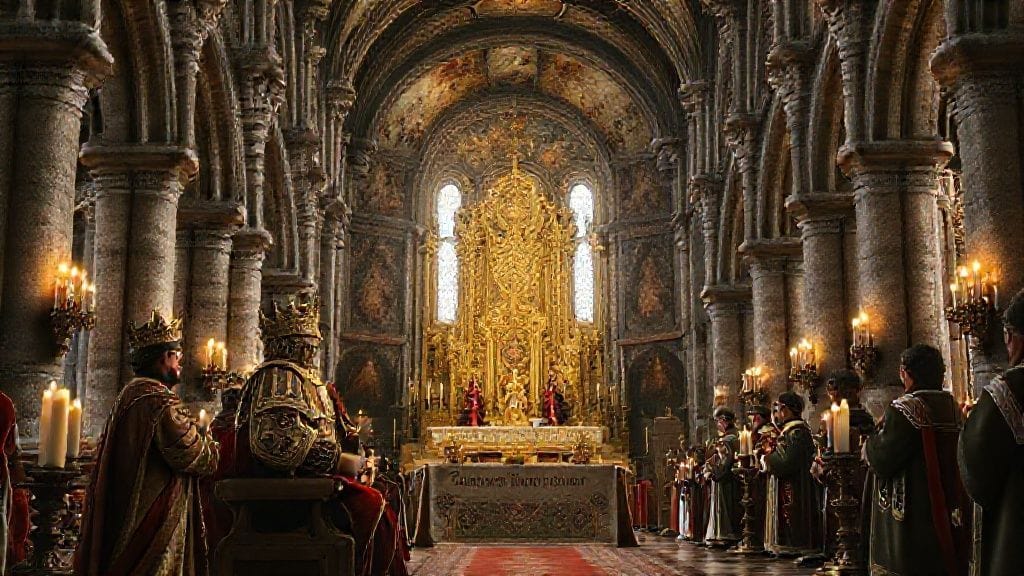
December 25, 800. The cold Roman winter was softened by a rare and electrifying spectacle inside the venerable walls of the Old St. Peter’s Basilica. Candles flickered, casting shadows on stone and flesh, while a hushed anticipation gripped all attendants. Among them stood Charlemagne, King of the Franks, cloaked in regal splendor but unaware that this day would forever mark him as a pivotal figure—not merely a monarch, but as the newly crowned Emperor of the Romans. The clang of the golden crown placed upon his head by Pope Leo III would echo through the annals of history, a thunderclap bridging ancient Rome and the medieval future of Europe.
It was more than a coronation; it was a seismic act that redefined empire, religion, and power in medieval Christendom. From a frail and fractured continent, crushed by centuries of turmoil following Rome’s fall, a new order began to emerge—one that would shape the Western world for centuries to come. But how did a Frankish king end up wearing the imperial diadem in Rome? What fractures and ambitions brewed behind this historic event? And most of all, what reverberations did it send through time and space?
The Dawn of Christmas Day, 800: A Majestic Coronation Amidst Rome’s Ancient Walls
The early morning air was filled with incense and the murmurs of dignitaries, warriors, and clergy crammed into the basilica's vast interior. Rome was not the flourishing capital it had once been. Its streets showed the wear of centuries of decline, invaders, and instability. Yet within those hallowed confines, an extraordinary revival was at hand. Pope Leo III, having survived political storms and violent attacks, was about to crown a foreign king as Emperor of the Romans.
As the sacred chants floated upward to the frescoed ceilings, Charlemagne knelt. The Pope lifted the sacred imperial crown and slowly placed it upon his head. The assembly broke into a mixture of reverent silence and awe. This was Rome again—reborn, transfigured—and the ancient mantle of imperial authority was passing from Byzantium and the legacy of Rome to a new West.
The World on the Eve of Charlemagne’s Coronation: A Fragmented Europe
The late eighth century was an epoch of disarray. The mighty Roman Empire had long ceased to govern the West; its eastern counterpart, Byzantium, lingered but struggled to exercise control or prestige over the western territories. Europe was a patchwork quilt of small kingdoms, tribal lands, and scattered cities, many vulnerable to external invaders like the Saxons, Avars, and Vikings, who were beginning their terrifying raids.
The Frankish Kingdom under the Carolingian dynasty, particularly under Charlemagne’s rule, had consolidated much of Western Europe under a relatively stable and forceful regime. Yet, unlike the ancient Caesars who ruled with unquestioned divine right, the legitimacy of such power was fragile. Rome and its Church remained symbolic centers of spiritual and political authority, and owning the imperial title meant invoking the heroic memory of a civilization that still captured imaginations.
Charlemagne: The King Who Dreamed of Empire
Born around 742, Charles, later known as Charlemagne or “Charles the Great,” had been a warrior king, scholar, and patron of the arts and religion. His ambition was as vast as the territories he conquered—modern France, parts of Germany, Italy, and beyond. More than a mere conqueror, Charlemagne sought to resurrect order and learning in a chaotic age.
His interest in reviving the imperial title was not simply vanity. He envisioned a revived Roman Empire in a Christian mold—a bulwark against paganism and chaos, an alliance between temporal power and spiritual guidance. The legacy of Augustus and Constantine was his inspiration. But to claim the crown in Rome, the Pope’s blessing was essential.
The Papacy in Crisis: Seeking Power and Protection
Pope Leo III’s position was precarious. Recent years had witnessed fierce rivalries in Rome, including violent attacks that left Leo bruised and politically vulnerable. His enemies accused him of various misdeeds, seeking to depose him in a brutal political game.
Aware that his authority was limited without powerful allies, Leo sought Charlemagne’s support. The Frankish king had intervened previously to protect the Church’s interests, earning the papacy’s tentative trust. Crowning Charlemagne was a calculated gamble, a move to solidify his position and assert the papacy’s right to crown new emperors—a symbolic declaration of the Church’s supremacy over earthly rulers.
The Road to Rome: From Frankish King to Emperor of the Romans
The journey to the coronation involved more than a simple procession. Over preceding months, intricate diplomacy, alliances, and rivalries played out. Charlemagne’s armies had defeated the Lombards in Northern Italy, consolidating his influence in the peninsula. His loyal envoys negotiated with Byzantine rulers who were unable or unwilling to assert their imperial claims in the West.
The papal invitation was extended, and Charlemagne made his way to Rome, welcomed both as a liberator and potential ruler. The political and religious landscape was fertile ground for the birth of a new empire—a second Rome.
The Politics Behind the Crown: Pope Leo III’s Bold Gesture
At the heart of the coronation lay an audacious political act—the papacy assuming the authority to crown an emperor. This was a rupture with Byzantine tradition, which held that the imperial title derived from the eastern Roman emperors.
By placing the crown on Charlemagne’s head without prior consultation with Byzantium, Leo asserted independence and shifted the balance of power toward the West. Some accounts suggest the king was unaware of the exact plan until the moment of coronation, adding to the drama and symbolism of the act: the Holy Roman Empire was born not by hereditary right alone but by a sacred mandate.
A Ceremony Frozen in Time: The Moment Charlemagne Became Emperor
Descriptions of the ceremony emphasize its solemnity and grandeur. The rite was layered with religious symbolism: blessings, the exchange of vows, the singing of Psalm verses, and a display of imperial insignia—the orb, sceptre, and the crown itself.
When the golden circlet was lowered onto Charlemagne’s head, an ancient power seemed to descend with it. The people responded with acclamations that echoed down the centuries. The crown was not merely a piece of metal; it was the visual and spiritual seal of empire.
Reactions Across Christendom: Awe, Skepticism, and Rivalries
Not everyone embraced this new imperial reality with open arms. The Byzantine Empire viewed it as a provocative usurpation. Their emperor still claimed the title of Roman Emperor, and the coronation was seen as a challenge to their legitimacy.
Within the Frankish realm and other emerging European centers, reactions ranged from enthusiastic support to political calculation. Some rulers balked at the sudden elevation of Charlemagne; others saw an opportunity to strengthen ties with a newfound imperial authority. The Orthodox East, meanwhile, regarded the event with growing suspicion, laying early seeds of the schism that would later split Christianity.
The Symbolism of the Imperial Regalia and the Ancient Roman Legacy
The imperial crown was laden with symbolism. It connected Charlemagne directly to the Caesars, the Christian emperors, and the grandeur of Rome. The regalia—the sword, orb, and sceptre—represented warfare, Christian dominion, and righteous rule.
This appropriation of Roman imagery was no accident. The Franks were crafting a new identity, one that could claim the continuity of the ancient empire despite the centuries that had passed. Through these symbols, they asserted legitimacy and universal authority.
Charlemagne’s Vision: Reviving the Roman Empire in a New Form
Charlemagne’s conception of empire was not just territorial. It integrated a Christian mission to bring order and civilization to barbarism. He championed law codes, standardized weights and measures, and encouraged the spread of Christian education.
His empire was a hybrid: Roman law, Christian doctrine, Frankish governance. It signaled a new medieval synthesis that would define Europe for centuries. The coronation was the spark that ignited this project.
The Carolingian Renaissance: Culture, Learning, and Power
Under Charlemagne’s reign, a cultural revival blossomed. Monasteries became centers of learning; manuscripts were copied; art and architecture flourished with new vigor. This renaissance was closely tied to the imperial ambition—merging spiritual renewal with political stability.
The court at Aachen became a hub of intellectual activity, home to scholars like Alcuin of York who helped shape educational reforms that would endure.
Challenges to the New Empire: Internal Struggles and External Threats
Despite its grandeur, the empire was fragile. Governing a vast territory with limited communication and infrastructure posed enormous difficulties. Regional nobles retained considerable power, and revolts sometimes erupted.
Externally, new threats emerged—Vikings raided from the north, Muslim incursions challenged southern borders, and Byzantine ambitions lingered. Charlemagne’s successors struggled to maintain the unity and vision he had forged.
The Legacy of the Imperial Crown: Medieval Ideals of Authority
The symbolism of the 800 AD coronation shaped medieval politics profoundly. The idea that imperial power was linked to divine sanction through the Church became a central doctrine.
This notion influenced the balance of power between kings and popes, fueling centuries of cooperation and conflict, including the Investiture Controversy and the rise of the Holy Roman Empire.
The Holy Roman Empire: Charlemagne’s Shadow Through the Centuries
Though Charlemagne’s empire dissolved after his death, the title of Emperor of the Romans persisted. Otto I’s coronation in 962 revived the imperial tradition, leading to the formation of the Holy Roman Empire which lasted until 1806.
Charlemagne’s legacy loomed large, a symbol of unity, authority, and Christian rulership that medieval rulers aspired to inherit.
The Coronation’s Impact on Church and State Relations
By crowning Charlemagne, Pope Leo III set a precedent—political authority could be granted by the Church. This duality sowed both cooperation and conflict in the centuries to follow.
The coronation marked a turning point where spiritual and temporal powers became intricately linked, influencing European governance, law, and diplomacy.
Echoes Through History: How 800 AD Shaped Modern Europe
The consequences of Charlemagne’s coronation reached far beyond the Middle Ages. It helped define the identity of Western Europe, setting foundations for modern nation-states, legal systems, and the concept of sovereignty.
The idea of a “Europe” united under Christian ideals and lawful rule owes much to this event.
Remembering Charlemagne: Myth, Memory, and Historical Debate
Over centuries, Charlemagne became a legendary figure—“Father of Europe,” a symbol of unity and justice. Yet historians debate the real extent and nature of his empire.
The coronation became a key episode in constructing myths of power, legitimacy, and divine favor; its memory continues to fascinate scholars and popular culture alike.
The Final Assessment: A Momentous Beginning or a Political Game?
Was the coronation a genuine rebirth of the Roman Empire or a crafty political maneuver? Both perspectives hold truth. It was a powerful synthesis of ancient tradition and medieval reality, a fusion that launched a new epoch in European history.
Ultimately, the event was less about personal glory and more about shaping an entire cultural and political landscape.
Conclusion
Charlemagne’s coronation on December 25, 800, was more than a solemn ceremony—it was a defining moment that recast the order of the Western world. Against the backdrop of a fragmented, violent Europe, a visionary king and a beleaguered Pope joined to resurrect the ancient imperial mantle in a Christian form. This act forged a new identity for Europe, linking past glories to future hopes.
The crown that rested on Charlemagne’s head symbolized the merging of earthly power with divine sanction, a legacy that influenced the medieval world’s conception of authority, governance, and faith. The echoes of that day continue to resonate, reminding us that history is shaped not only by battles or treaties but by moments charged with meaning, ambition, and faith.
Charlemagne’s empire may have crumbled, but the ideals it embodied helped build the foundations of modern Europe. His coronation remains a vivid chapter in the story of civilization itself—where crowns, crosses, and continents intersect.
FAQs
1. Why did Pope Leo III crown Charlemagne as Emperor of the Romans?
Pope Leo III sought a powerful protector amidst political turmoil and saw in Charlemagne a strong ally who could safeguard the Church and revive Western order. Crowning Charlemagne also asserted the papacy’s authority to grant imperial legitimacy independent of the Byzantine Empire.
2. How did Charlemagne’s coronation challenge the Byzantine Empire?
The coronation claimed the imperial title for the Western king, directly challenging Byzantine claims to be the sole Roman Emperor. Byzantium saw this as a usurpation and an act of political rivalry.
3. Was Charlemagne aware he would be crowned emperor before the ceremony?
Historical accounts vary. Some suggest Charlemagne was surprised, others that he consented. The element of surprise highlights the papal initiative in asserting ecclesiastical authority.
4. What was the significance of the date—Christmas Day—in the coronation?
Christmas symbolized birth, renewal, and divine favor, adding religious gravitas to the coronation. Celebrating the event on this holy day reinforced the sacred nature of Charlemagne’s new role.
5. How did Charlemagne’s reign influence European culture and learning?
His reign sparked the Carolingian Renaissance, a revival of art, literature, and education, fostering the preservation of classical knowledge and laying groundwork for medieval scholarship.
6. Did the Holy Roman Empire directly descend from Charlemagne’s empire?
While Charlemagne’s empire fractured after his death, the Holy Roman Empire, founded in 962 by Otto I, claimed continuity with his legacy, reviving the imperial title in the West.
7. How did the coronation affect the relationship between church and state in medieval Europe?
It created a dynamic where the Church claimed authority to legitimize rulers, intertwining spiritual and political powers and leading to centuries of collaboration and conflict.
8. Why is Charlemagne often called the “Father of Europe”?
Because his empire united much of Western Europe under a common Christian and cultural framework, influencing the political and cultural development of the continent’s future nations.

