Table of Contents
- The Dramatic Dawn of 774: A Crown Forged in Pavia
- The Rise of Charlemagne: From Frankish Prince to Powerful King
- The Lombards: Kings of Northern Italy Entangled in Strife
- The Clash of Kingdoms: Prelude to Conquest
- Charlemagne’s Italian Campaign: Strategy and Resolve
- The Siege of Pavia: A City on the Brink
- The Fall of Desiderius: Last King of the Lombards
- The Coronation Ceremony: Symbolism in the Heart of Italy
- Political Ripples Across Europe: A New Power Dynamic Emerges
- The Papacy’s Role and the Making of an Alliance
- The Lombard Legacy: Culture and Conflict After Conquest
- Frankish Administration in Italy: Integration and Resistance
- Charlemagne’s Vision: Towards a Unified Christian Empire
- Economic Shifts and the Control of Trade Routes
- Military Innovations and Lessons from the Campaign
- Charlemagne’s Crown and the Idea of Kingship
- Voices from the Past: Chronicles, Letters, and Eyewitnesses
- Europe’s Changing Map: The Carolingian Expansion
- The Long Shadows of 774: Influence Through the Centuries
- Conclusion: The Crown That Reshaped a Continent
- FAQs: Insights into Charlemagne’s Coronation and the Lombard Kingdom
- External Resource
- Internal Link
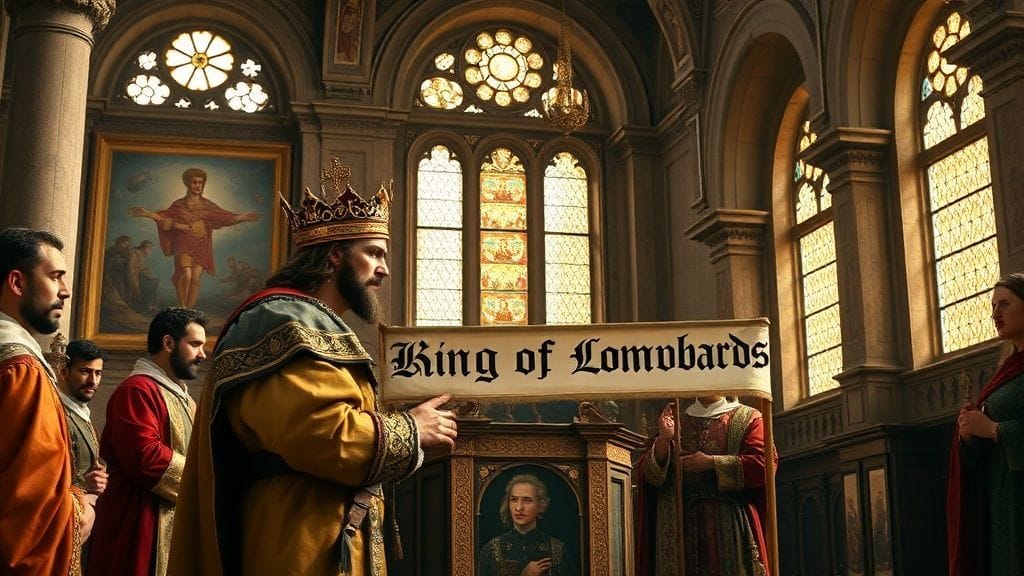
The year was 774. The northern Italian sky hung heavy with the smoke of siege fires, while the once invincible walls of Pavia—capital of the Lombard Kingdom—were reduced to a tense battlefield of endurance and will. Inside the city, despair mingled with defiant pride. Outside, Charlemagne, King of the Franks, stood poised on the cusp of destiny. This was not just the collapse of a kingdom; it was the crafting of a new chapter for medieval Europe. On that cold day in April, amidst the rubble and the praying crowds, Charlemagne was crowned King of the Lombards—a title that would cement his claim as a ruler destined to reshape the continent.
The Dramatic Dawn of 774: A Crown Forged in Pavia
The streets of Pavia bore the scars of war. Years of turmoil had drained the city, but the spirit of the Lombards lingered in every stone and alleyway. Meanwhile, just beyond the walls, the Frankish armies camped with an unwavering resolve that marked a turning point in European history.
The coronation was more than a ceremonial crown placement. It symbolized conquest, alliance, and a calculated move on the chessboard of power. Charlemagne—at just 31 years old—had already proven an adept commander and shrewd statesman. Now, crowned King of the Lombards, he added Italy to his growing dominion, tightening the bonds between the Frankish realms and the Papacy.
But before this moment of triumph, a tale of ambition, war, and diplomacy had unfolded over decades, setting the stage for a profound transformation.
The Rise of Charlemagne: From Frankish Prince to Powerful King
Born in 742, Charlemagne—Charles the Great—was the eldest son of Pepin the Short, the first Carolingian king of the Franks. Raised in a kingdom whose stability teetered from its Merovingian past, Charlemagne inherited a realm seeking strength and unity.
His youth was a blend of rigorous education and military apprenticeship. He was trained in Latin, law, and Christian doctrine, alongside swordplay and battlefield strategy—a combination that would characterize his reign. Upon Pepin’s death in 768, Charlemagne and his brother Carloman inherited the Frankish kingdom, ruling it jointly for a few tense years.
The rivalry between brothers and the fractious nobility forced Charlemagne to assert control decisively. Following Carloman’s death in 771, Charlemagne became sole ruler, free to pursue his ambitions of expansion and consolidation.
His eyes soon turned south, towards the geopolitically vital and tumultuous Italian Peninsula.
The Lombards: Kings of Northern Italy Entangled in Strife
The Lombards, a Germanic people who had invaded Italy in the late 6th century, had established a kingdom that stretched across much of northern and central Italy. Their kings held sway from Pavia, weaving together remnants of Roman Italy, Germanic traditions, and Christian authority.
Yet by the mid-8th century, the Lombard Kingdom was riddled with problems. Desiderius, the last Lombard king, had inherited a kingdom weakened by internal disputes, threatened by the growing power of the Papacy and the expansive ambitions of the Frankish realm.
Crucially, relations between Desiderius and Pope Adrian I had soured. The Pope, wary of Lombard encroachments and eager to secure his own temporal power, sought a protector — which he found in Charlemagne, whose growing strength represented a counterweight to Lombard ambitions.
The Clash of Kingdoms: Prelude to Conquest
The stage for conflict was set by complex alliances and betrayals. Desiderius sought to extend Lombard control over southern Italy, at odds with papal interests. Meanwhile, Pope Adrian I’s appeal to Charlemagne was nothing short of a plea for salvation—and a political gambit.
In 773, Charlemagne responded with military force, his armies crossing the Alps with remarkable speed and precision. The campaign marked an ambitious exercise in logistics and warfare, with Frankish troops confronting mountainous terrain, harsh winters, and a determined enemy.
The campaign was as much about ideology—defending Christendom and the Papal States—as it was about realpolitik and territorial expansion.
Charlemagne’s Italian Campaign: Strategy and Resolve
Charlemagne’s military leadership was distinguished by his ability to blend brute force with diplomatic skill. His Italian campaign was no exception. Marching alongside seasoned commanders and with the blessing of the Pope, Charlemagne led his army through treacherous passes into Lombard territory.
The Frankish forces swiftly secured key towns, cutting supply lines and isolating Pavia. Their strategy emphasized encirclement and attrition rather than headlong assaults, showcasing Charlemagne’s calculated patience.
Meanwhile, Charlemagne ensured that his alliances with local Italian nobles and the Church remained intact, a political balancing act that paved the way for future governance.
The Siege of Pavia: A City on the Brink
The siege of Pavia lasted nearly a year, testing the resolve of defenders and attackers alike. Food and morale within the fortress city dwindled, yet Desiderius refused to capitulate readily, invoking a proud Lombard legacy.
Historical records speak of hunger, disease, and tense negotiations in the shadow of the walls. The Frankish forces tightened their grip, and with every passing month, loyalty within Pavia frayed.
Finally, in June 774, the city surrendered. Desiderius was captured and sent into exile, marking the end of Lombard sovereignty.
The Fall of Desiderius: Last King of the Lombards
Desiderius’s fall was not merely a military loss but a symbolic upheaval. Captured and stripped of power, he was exiled to a monastery, a fate common for deposed rulers of the time.
His reign, marked by boldness but also by missteps, ended with his kingdom absorbed into Charlemagne’s expanding empire. Yet the Lombard spirit—its laws, customs, and people—would endure under new rulers.
Charlemagne’s ascent was spectacular, but it also heralded the twilight of an era for the Lombard people.
The Coronation Ceremony: Symbolism in the Heart of Italy
On April 774, in the basilica of San Michele Maggiore in Pavia, Charlemagne was crowned King of the Lombards. This ceremony was steeped in symbolism. By accepting the crown on Italian soil, Charlemagne signaled his legitimate authority over the region—not just by force but through divine sanction.
The crown itself, shaped from gold and jewels, embodied a fusion of Roman imperial tradition and Germanic kingship. The Pope’s blessing reaffirmed the alliance between secular and ecclesiastical power, a theme recurring throughout Charlemagne’s reign.
Observers reported a mix of awe and apprehension—awed by Charlemagne’s dominance, apprehensive about what this meant for Italy’s future.
Political Ripples Across Europe: A New Power Dynamic Emerges
The coronation fundamentally altered the political landscape of Europe. It expanded the Frankish Kingdom, and more importantly, it set a precedent for Christian kingship entwined with the Church.
Other powers, including the Byzantines and various Germanic tribes, took notice. The Papacy gained a powerful protector, yet its alliance with a foreign king complicated its autonomy.
Charlemagne had not just conquered a kingdom; he had positioned himself as the preeminent ruler of Western Christendom—a power center destined to shape medieval politics.
The Papacy’s Role and the Making of an Alliance
The Pope’s invitation to Charlemagne was a masterstroke of papal diplomacy. As threats mounted from Lombard aggression and the declining Byzantine influence in Italy, the Papacy needed a strong protector.
The alliance that saw Charlemagne crowned King of the Lombards reinforced the symbiosis of church and state. The Pope lent religious legitimacy; Charlemagne provided military might and political stability.
This partnership would deepen in years to come, culminating in Charlemagne’s imperial coronation in 800 AD, reshaping the medieval world order.
The Lombard Legacy: Culture and Conflict After Conquest
Though the Lombard kingdom ended, its cultural imprint did not vanish. Charlemagne preserved much of the Lombard law and customs, blending them into his vast empire’s legal mosaic.
Lombard nobility integrated into the Frankish feudal system, while new tensions simmered beneath the surface. In some regions, resistance persisted, and the blending of Frankish and Lombard traditions created a complex social fabric.
From art to architecture, from law to language, the Lombard influence remained a defining feature of northern Italy for centuries.
Frankish Administration in Italy: Integration and Resistance
Charlemagne’s conquest demanded effective governance. He introduced Frankish administrators, codified laws, and established counts loyal to him across Italy.
Though largely successful, the integration was not seamless. Resistance from Lombard nobles, local Italian lords, and even the Byzantine interests complicated efforts.
Yet Charlemagne’s administration laid foundations for future rulers, turning a patchwork of disparate regions into a more unified—and Christian—political entity.
Charlemagne’s Vision: Towards a Unified Christian Empire
The crowning of Charlemagne as King of the Lombards was a step toward a broader vision—a Christian empire in the West that echoed, and rivaled, the legacy of Rome.
This vision guided his policy of reforms in education, law, and religion, fostering a Carolingian Renaissance. His rule sought not merely territorial expansion but cultural and spiritual unity under Christian ideals.
The Italian crown was both a prize and a platform for this grand design.
Economic Shifts and the Control of Trade Routes
Control over Lombard territories meant access to critical trade routes across the Alps and into Mediterranean Italy. Charlemagne’s victory shifted the economic balance in favor of the Frankish realm, allowing for increased commerce and wealth accumulation.
Italian cities benefited from renewed stability, even as Frankish oversight reorganized taxation and trade regulation.
Maritime and land-based trade networks intertwined more closely with northern Europe, helping to knit the continent in new economic ties.
Military Innovations and Lessons from the Campaign
Charlemagne’s campaign against the Lombards showcased several military innovations: better coordination between cavalry and infantry, siege techniques adapted to Italian cities, and supply chain logistics over difficult terrain.
The protracted siege of Pavia emphasized patience and psychological warfare as much as brute force.
These lessons informed not only Charlemagne’s subsequent campaigns but military doctrine across medieval Europe.
Charlemagne’s Crown and the Idea of Kingship
Wearing the Lombard crown, Charlemagne projected an image of the ideal Christian king—divinely sanctioned, just, warrior, and protector of the faith.
This ideal contrasted with earlier tribal kingship, emphasizing responsibility not merely to subjects but to God.
In many ways, this moment shaped medieval concepts of kingship that would echo down centuries.
Voices from the Past: Chronicles, Letters, and Eyewitnesses
Our understanding of Charlemagne’s coronation and conquest comes alive through contemporary chroniclers like Einhard, Alcuin of York, and the Royal Frankish Annals.
These sources blend official propaganda and eyewitness accounts, providing a textured narrative full of political intrigue, human drama, and spectacle.
Letters between Charlemagne, the Pope, and other rulers reveal the delicate negotiations behind the throne, illuminating the human side of history.
Europe’s Changing Map: The Carolingian Expansion
With Italy under his belt, Charlemagne’s empire stretched from the North Sea deep into the Mediterranean basin.
This expansion redrew the European map, challenging Byzantine claims, threatening Muslim Spain, and uniting a vast territory under a new Christian hegemony.
This was the dawn of a Europe slowly emerging from the Dark Ages into a more interconnected medieval world.
The Long Shadows of 774: Influence Through the Centuries
The coronation in Pavia was a fulcrum in history. It set in motion events that led to the Holy Roman Empire’s rise and influenced Europe’s political factions for generations.
It shaped the relationship between Church and State, inspired artistic and cultural revivals, and established a precedent for medieval kingship.
Even today, historians see 774 as a turning point—between barbarism and civilization, fragmentation and unity.
Conclusion
Charlemagne’s coronation as King of the Lombards was far more than a military conquest or a mere title. It was a deliberately sculpted moment of transformation—political, cultural, and spiritual—that altered Europe’s trajectory. In the ashes of Pavia’s siege, a new order emerged: one that sought to unify diverse peoples under a banner of faith and governance, drawing from Roman legacies and Germanic traditions alike.
Through a blend of courage, strategy, and vision, Charlemagne crafted a kingdom that was a stepping stone toward what would become medieval Christendom’s heart. His crown in Pavia was the weight of history itself—a symbol that echoed through centuries, reminding us how individual ambition and broader currents of time intertwine to forge the fate of nations.
The story of 774 is a vivid tapestry of human will, divine mandate, and the relentless march of change. Charlemagne’s triumph set the stage for Europe’s rebirth, an epic narrative still reverberating in our collective memory.
FAQs
1. Why was Charlemagne crowned King of the Lombards in 774?
Charlemagne was crowned to legitimize his conquest of the Lombard Kingdom and to formalize his authority over northern Italy, solidifying his alliance with the Pope and expanding his empire.
2. Who were the Lombards, and why was their kingdom important?
The Lombards were a Germanic people who ruled much of northern Italy from the late 6th century. Their kingdom was strategically crucial due to Italy's rich lands and control over key trade routes.
3. What role did the Pope play in Charlemagne’s conquest?
Pope Adrian I sought Charlemagne’s protection against Lombard aggression, inviting him to intervene militarily. The Pope’s blessing and political support legitimized Charlemagne’s campaign and subsequent coronation.
4. How did the siege of Pavia unfold?
The siege lasted nearly a year, with Frankish forces encircling the city, cutting supplies, and wearing down defenders. Eventually, the Lombards surrendered, ending their kingdom.
5. What were the consequences of this coronation for Europe?
It shifted power towards the Frankish kingdom, strengthened ties between Church and state, and set the foundation for the later Holy Roman Empire and medieval Christendom’s political structure.
6. How did Charlemagne manage to govern the newly acquired Italian territories?
He appointed Frankish counts and administrators, preserved Lombard laws to some extent, and worked closely with the Papacy to maintain influence, though some local resistance persisted.
7. Did the Lombard culture survive under Frankish rule?
Yes, Lombard customs, laws, and nobility were integrated into the Carolingian empire, influencing the cultural and social fabric of northern Italy.
8. How is the event of 774 remembered today?
It is seen as a pivotal moment in medieval European history, marking the rise of Charlemagne as a unifying figure and setting the stage for the medieval European order.

