Table of Contents
- On a Winter’s Day in Saxony: The World of 804
- From Pagan Rivers to Frankish Frontiers
- Charlemagne’s Long War with the Saxons
- Faith as Strategy: Why the Diocese of Verden Was Established
- Choosing Verden: A Landscape of Marsh, Forest, and Power
- February 16, 804: The Day a Diocese Was Born
- Bishops, Monks, and Missionaries: The New Rulers in Vestments
- Conquest of Souls: Conversion, Resistance, and Everyday Life
- Law, Land, and the Sword of the Spirit
- Storms After Charlemagne: Verden in the Time of Fragmenting Empires
- Markets, Mills, and Monasteries: An Economy Grows Around the Altar
- Between Pagan Memories and Christian Stones: Cultural Transformation
- The Diocese Under Fire: Vikings, Feuds, and Frontiers
- High Medieval Glory and Quiet Administrative Power
- From Prince-Bishopric to the Dawn of Modernity
- Historians, Chronicles, and the Memory of 804
- Conclusion
- FAQs
- External Resource
- Internal Link
Article Summary: On 16 February 804, in the chilly North German plain of Saxony, Charlemagne formally ordered the diocese of Verden established, transforming a contested frontier into a structured Christian territory. This article traces the violent Saxon Wars that preceded that decision, and shows how a simple line in a royal capitulary hid a profound social revolution. It follows the new bishops and missionaries who arrived after the diocese of Verden established its authority, reshaping law, landownership, and belief. Through the voices of chronicles and the shadows of archaeology, we see how old pagan traditions survived, adapted, or were crushed. As the centuries pass, the diocese of Verden established in 804 evolves into a prince-bishopric wrestling with emperors, nobles, and invaders. Yet behind the political story runs a quieter tale of peasants, traders, and clergy who rebuilt their world around churches and markets. By the end, the article reflects on how the diocese of Verden established a new order that still echoes in modern Europe’s religious and cultural map.
On a Winter’s Day in Saxony: The World of 804
Imagine the flat, wind-swept plains of northern Saxony in February 804. The sky is low and iron-grey, the marshes along the Weser River stiff with ice, and the bare branches of oak and beech claw at the winter light. Smoke rises in thin threads from timber halls clustered near the riverbanks; beyond them, in the half-frozen fields, dark figures move slowly through the soil, keeping animals alive until spring. In this harsh landscape, a quiet transformation is taking place—one that most of the local people do not choose, and very few fully understand.
Far away from the thatched homesteads and wooden shrines, in the power centers of the Frankish Empire, Charlemagne and his advisors draft and confirm orders that will reshape this land. It is here that the diocese of Verden established its official beginning, not with a public ceremony that everyone could see, but with royal instruments, episcopal plans, and the slow turning of the imperial mind after decades of war. The Saxon frontier is no longer simply a region of raids and retaliations; it is a territory to be organized, pacified, and spiritually conquered.
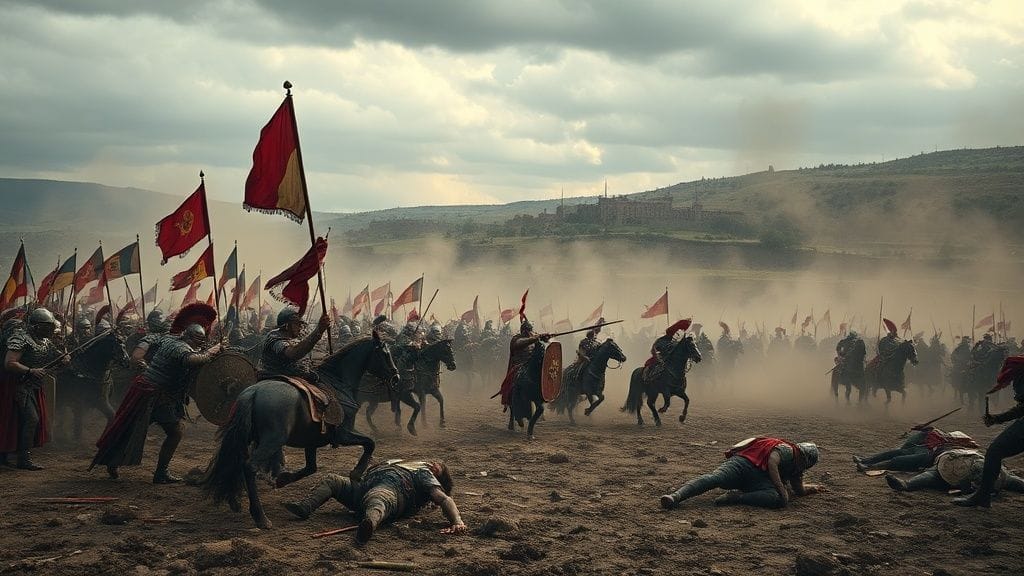
For nearly thirty years before this date, the Saxon lands had burned again and again. Fields were trampled under the hooves of Frankish cavalry; sacred groves were cut down; villages were relocated or emptied in forced deportations. The emperor who now orders a new bishopric to be planted in Verden is the same ruler whose armies once showed no mercy at Verden’s name-sake place, where, according to the Royal Frankish Annals, thousands of Saxon prisoners were executed in 782. That grim reputation hangs over the region like a lingering mist when, on 16 February 804, the imperial decision is codified: a diocese will guide this land, administer its churches, and knit it into the vast web of Christendom.
No trumpets sound in the Saxon villages on that day. The peasants do not mark the date on any calendar, for most can neither read nor write. Yet the consequences of this decision will seep into their lives in ways that are both intimate and immense: where they pray, where they pay tithes, what days they rest, whom they marry, how they inherit their land, and what happens to their dead. The simple fact that the diocese of Verden established its jurisdiction here means that, in the eyes of the Frankish court and the Church, this is no longer a border wilderness. It is a Christian diocese with a bishop, a cathedral, and a mandate to reorder souls as well as fields.
From Pagan Rivers to Frankish Frontiers
Before the Franks came in force, the region that would one day be called the Diocese of Verden lay within the loose patchwork of Saxon territories. These were not kingdoms in the formal sense, but a mosaic of tribal districts—Westphalians, Eastphalians, Angrians, and the Nordalbingians beyond the Elbe—each ruled by local elites whose power rested as much on custom and war-leadership as on any codified law. Verden’s future territory touched the Angrian lands, where the Weser wound its way northward toward the North Sea, and where trade routes linked inland settlements to coastal markets.
The Saxons worshipped their gods—Woden, Donar, and others—in sacred groves and at wooden pillars, the most famous of which was the Irminsul, perhaps a mighty tree or carved column symbolizing the firmament of the world. Rituals were local, seasonal, and deeply woven into cycles of farming and war. Sacrifices were made to secure good harvests, victory in battle, protection from disease. The rivers and forests were not just resources; they were alive with presence, danger, and blessing.
To the south and west, however, another world had been expanding: the Frankish kingdom, already Christian by the time of Charlemagne’s grandfather, Charles Martel, had become a dynamic and restless power. The Franks, ruled by the Carolingian dynasty, blended Roman administrative memories with Germanic traditions, and they saw the Saxon lands as both a threat and an opportunity. Raids flowed both ways across the frontier. Saxon war-bands rode south into Frankish territory, while Frankish forces retaliated, seizing hostages and demanding tribute.
For the early Franks, the frontier near Verden was a zone of unease—a place from which pagan warriors might descend, but also a route by which Christian influence might spread. Monks and missionaries, some from Anglo-Saxon England like the famous Boniface a generation earlier, were already part of the Frankish strategy of expansion. Chapels and small churches appeared near forts and royal estates. Long before the diocese of Verden established its formal structures in 804, Christian presence flickered in and out of the region, like small watchfires along a long, dark border.
Charlemagne’s Long War with the Saxons
Everything changed when Charlemagne came to the throne and turned his formidable attention to the Saxon question. Beginning in 772, and continuing with only brief pauses until 804, the Saxon Wars became a grueling, almost generational conflict. The sources speak of eighteen separate campaigns, of which the most infamous culminated in the mass execution at Verden in 782. Whether the number of victims—4,500—is precise or symbolic, the event became a dark symbol of Charlemagne’s ruthless resolve.
The Royal Frankish Annals, a near-contemporary narrative penned by court clerics, describe the war as a struggle between the “stubborn perfidy” of the Saxons and the divinely guided justice of the Christian emperor. Modern historians such as Pierre Riché and Rosamond McKitterick, however, have peeled back the language of propaganda to reveal more complex motives: control of trade routes, expansion of taxable land, elimination of a militarized pagan neighbor, and the consolidation of Charlemagne’s reputation as a ruler chosen by God. In these overlapping ambitions, religion and politics fused into a single, relentless project.
Year after year, royal armies marched north, building forts, burning villages, cutting down sacred trees, and demanding oaths of loyalty from Saxon notables. Again and again, after Charlemagne had moved on to other fronts—Lombardy, Spain, Bavaria—the Saxons rose in rebellion, slaying priests and destroying churches. Their resistance was not just political; it was spiritual. Every church burned was a statement that the old gods had not surrendered; every assassinated priest was a rejection of the foreign faith that came hand in hand with Frankish authority.
By the late 790s, the conflict entered a new phase. Exhausted by war and devastating reprisals, some Saxon elites accepted baptism and accommodations with the Frankish court. Others were deported en masse to internal regions of the empire, their lands given to loyal followers. Campaigns led by Charlemagne’s son, Charles the Younger, and his commander, the grimly efficient Count Theoderic, cut deeper into Saxon territory than ever before. At the same time, the imperial church was reorganized to follow in the wake of the army, establishing bishoprics in conquered lands so that the sword would be followed by the crozier.
By 804, after more than three decades of conflict, the Saxon Wars were finally declared over. But Charlemagne understood that military victory alone would not hold the land. It needed structure: firm, ecclesiastical boundaries, resident bishops responsible for souls and order, and cathedrals that would stand as monumental proof that Christ—and Charlemagne—now ruled here. This is the crucible in which the diocese of Verden established its existence: as a final act in a long, bloody drama of subjugation and integration.
Faith as Strategy: Why the Diocese of Verden Was Established
In the Carolingian worldview, faith was never merely a matter of personal belief. It was a tool of governance, a language of power, and a roadmap for organizing space. To rule effectively over newly conquered pagans like the Saxons, Charlemagne needed more than forts and garrisons; he needed networks of priests, bishops, and monasteries capable of reshaping local customs into Christian rhythms of life. That is why, in the wake of military victory, the diocese of Verden established its claim over this piece of Saxony—it was one tile in a carefully arranged mosaic of control.
The decision to found or reorganize bishoprics in Saxony was not ad hoc. Earlier in the 8th century, Boniface had spearheaded church reforms and the establishment of sees such as Würzburg and Erfurt, laying foundations for mission in the east. Under Charlemagne, this process intensified and took on a more explicitly imperial character. The emperor convened councils where bishops and counts helped define the ecclesiastical map of the realm. These were not just spiritual boundaries but administrative units, each tied to obligations: tithes, military support, legal jurisdiction, and the provision of clergy.
When the diocese of Verden established its role in 804, it did so alongside or in dialogue with other Saxon bishoprics, such as Minden, Hildesheim, and Halberstadt. Together, they formed a chain of Christian authority stretching across the formerly pagan north. Each diocese was expected to erect a cathedral church, keep a chapter of canons, maintain a school, and oversee a network of rural parishes. Bishops were to be the emperor’s eyes and hands, sending information back to court and implementing reforms in education, liturgy, and law.
There was another, subtler reason why a diocese here mattered. The trauma of the earlier massacre at Verden had turned the name into a grim touchstone, whispered with horror among Saxons and memorialized as a triumph of royal justice in Frankish memory. To plant a bishopric here was to overwrite that meaning with a different story: Verden was no longer simply a place where Saxon resistance had been annihilated; it was now a center of Christian civilization. The diocese of Verden established in this atmosphere, then, was a deliberate act of narrative as well as governance.
Choosing Verden: A Landscape of Marsh, Forest, and Power
Why Verden? The choice was not random. The site that would become the episcopal seat lay along the middle Weser, a river that formed a natural artery from the inner Saxon lands to the North Sea. Control of this river meant control of movement: of goods, of people, of news, and of troops. By anchoring a diocese here, the Franks could stabilize an important node in their northern network.
Archaeological studies of Verden and its surroundings suggest that this was already a settlement of modest regional importance by the early 9th century. Clusters of longhouses, storage pits, and workshops show that local elites had established themselves along the river, perhaps collecting tribute from nearby villages and overseeing trade. It was a perfect place for a bishop to plant his seat: close enough to existing power to draw on its resources, yet not so entrenched that it could easily defy the emperor’s will.
The landscape itself shaped the diocese’s early character. Marshes and low-lying meadows made travel difficult in winter and early spring; dense forests hemmed in the cultivated fields. To reach remote communities, priests and messengers had to follow winding tracks, cross fords, or travel by boat along narrow channels. The bishop of Verden’s authority, grand on parchment, often shrank in the face of mud, floodwater, and distance.
Yet this very difficulty made the act of founding a diocese here all the more symbolic. Where once only pagan shrines and local chieftains had held sway, now a stone or timber church would rise, probably modest at first but gradually rebuilt and expanded. Bells would ring across the fields, summoning people not to traditional gatherings in sacred groves but to Mass, confession, and baptism. The diocese of Verden established on this challenging terrain was meant to tame not only human hearts but the wild northern landscape itself, folding it into a Christian—and Frankish—order.
February 16, 804: The Day a Diocese Was Born
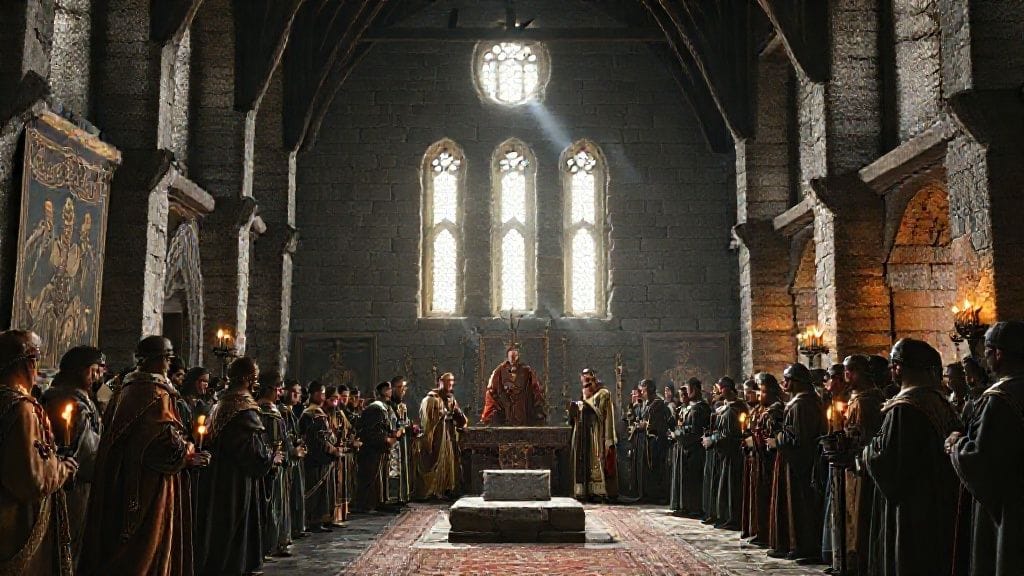
The exact scene on 16 February 804 is lost to us; no scribe left a detailed eye-witness account of the moment when Charlemagne’s decision was finalized. Yet we can reconstruct, from capitularies, charters, and later ecclesiastical records, the kind of acts that must have taken place. Somewhere—perhaps at a royal assembly, perhaps within the walls of a palatial complex—royal clerks wrote and sealed documents that confirmed the foundation or formal recognition of several Saxon bishoprics, including Verden.
The language of these texts would have been dry and formulaic, full of phrases about the “salvation of souls,” the “extension of the Christian religion,” and the “everlasting benefit” of the empire. They might list lands granted to the new bishopric: estates, forests, rights over certain villages, revenues from tolls or markets. They could also stipulate immunities, freeing church lands from certain taxes or obligations to lay officials. Every such clause was a lever of power, ensuring that the diocese could sustain itself and attract ambitious clergy.
At the same time, a candidate for the bishopric would have been chosen—perhaps already in office as a missionary or administrator, now invested with formal episcopal rank. He would travel to receive consecration from a senior bishop, swearing oaths of loyalty and obedience not only to the church but to the emperor as its protector. In turn, Charlemagne might grant him symbols of office: a staff, a ring, or even a banner, linking his spiritual mandate to the empire’s physical might.
From that point onward, in the eyes of the Frankish court and the wider Christian world, the diocese of Verden established its legal and spiritual presence. The date, 16 February 804, became a reference point in later documents—evidence of ancient rights and seniority in disputes with neighboring bishops or secular lords. What for Charlemagne was one decision among many in a crowded agenda became, for Verden, a kind of birthday, the moment when a frontier settlement was inscribed into the enduring map of Latin Christendom.
Bishops, Monks, and Missionaries: The New Rulers in Vestments
With the institutional act completed, the human story began. The first bishops of Verden—some known by name, others shadowy figures glimpsed only in stray references—faced a task that would have daunted even the most seasoned churchman. They had to build almost everything from scratch: the cathedral church, a community of canons to serve it, schools to train clergy, and a network of parishes across a rugged, sometimes hostile countryside.
Many of the clergy who came north were not locals. Some were Franks, reared within the disciplined world of Carolingian monasteries and cathedral schools, where the psalms were memorized from youth and Latin shaped the mind’s grammar. Others may have been Anglo-Saxons, whose own ancestors had once been pagan but had long since crossed the threshold into Christianity and even sent out missionaries of their own. They brought with them books, relics, liturgical vessels, and a sense of being agents of a greater mission.
The bishop of Verden wielded power in multiple registers. As a spiritual father, he preached, confirmed, and presided over solemn feasts. As an administrator, he convened synods, regulated the clergy, and apportioned resources. As a quasi-political figure, he reported to royal envoys, participated in imperial councils, and sometimes even commanded men or negotiated with neighboring lords. In time, Verden’s bishops would become prince-bishops, wielding temporal lordship as well as spiritual oversight—but even at the beginning, their role straddled two worlds.
Monks and missionaries fanned out from the episcopal center, founding small monasteries or “cells” along river branches and near strategic crossings. These houses, often dedicated to popular saints like Peter, Martin, or Mary, served as both spiritual outposts and engines of development. They cleared land, introduced new farming techniques, stored surplus grain, and became nuclei of settlement. Through them, the diocese of Verden established a rural presence more enduring than any garrison could provide.
Conquest of Souls: Conversion, Resistance, and Everyday Life
For the Saxon villagers who lived under the new diocese’s authority, the transformation of their religious world was not an abstract theological shift but a slow, sometimes wrenching alteration of habits and expectations. Baptism, once perhaps an emergency rite forced upon them after defeat, became a regular ceremony performed at set times of year. Priests instructed godparents, recorded names in baptismal lists, and expected attendance at Mass on Sundays and feast days.
Old rituals did not vanish overnight. Some were quietly integrated into Christian practice; others survived in the shadows, beneath the watchful eyes of priests and informers. A family might bring offerings to a nearby spring or tree, even as they crossed themselves and invoked the Trinity. When misfortune struck—a failed harvest, a sudden plague among livestock—people might whisper that the old gods were angry, or that the new God was strange and demanding. It’s astonishing, isn’t it, how long belief can linger in the cracks of an official order?
Charlemagne and his successors knew that mere persuasion often failed, so they buttressed Christianization with law. The famous Capitulatio de partibus Saxoniae, a set of laws directed at Saxony, imposed harsh penalties—even death—for certain pagan practices and for attacks on churches or clergy. Later capitularies moderated some of these extremes, but the principle remained: refusal to accept Christianity was not simply a spiritual error; it was treason against the empire. Under such pressure, conformity spread, though sincere faith may have lagged behind.
And yet, over time, the rhythms of Christian life began to root themselves in the soil of everyday existence. Children grew up having known nothing else; the annual cycle of feasts—Christmas, Easter, Pentecost, saints’ days—punctuated the agricultural year. The practice of confession invited people to tell their sins and worries to a priest, framing personal failures within a new language of guilt and redemption. The diocese of Verden established, sermon by sermon and sacrament by sacrament, a moral and spiritual vocabulary that redefined what it meant to be a member of the community.
Law, Land, and the Sword of the Spirit
The founding of a diocese was never only about belief. It was also about who owned land, who judged disputes, and who had the right to command labor and allegiance. As Charlemagne’s charters endowed the diocese with estates, forests, and rights to collect tithes, bishops and chapters became major landholders. Peasants who once owed service to local chieftains now found themselves tenants of the church, obliged to pay rents or perform labor on ecclesiastical fields.
The diocese of Verden established new legal frameworks in tandem with spiritual ones. Bishops held courts where they judged cases involving clergy, church property, and sometimes even laypeople. They enforced marriage laws, invalidating unions within forbidden degrees of kinship and condemning practices like polygamy or concubinage that earlier Saxon custom had tolerated. Their courts might also handle disputes over tithes, boundary lines between estates, or the rights to use common pastures.
This intertwining of law and religion could generate tensions. Local nobles might resent the immunities granted to church lands, seeing them as a drain on their authority and resources. Everyday villagers could feel squeezed between competing demands: the bishop’s tithe, the count’s tax, the noble’s claim to military service. Yet for some, the church also offered refuge and leverage. Sanctuary laws allowed fugitives to seek temporary protection at altars; written charters preserved rights against arbitrary seizure; and Christian norms enabled weaker parties—widows, orphans, the poor—to frame appeals in morally charged terms.
Over the decades, the diocese’s legal norms blended with surviving Saxon customs to form a hybrid order. Law codes, capitularies, and synodal decrees were recopied in the cathedral’s scriptorium, glossed and interpreted by generations of clerics. A powerful sentence from a council could echo for centuries, shaping local practice. As one later medieval chronicler put it, “What the fathers have bound, we dare not unbind”—a quiet acknowledgment that decisions made in Verden’s early days still cast long shadows.
Storms After Charlemagne: Verden in the Time of Fragmenting Empires
Charlemagne’s death in 814 unleashed a slow but relentless process of fragmentation. His empire, briefly spanning much of Western and Central Europe, splintered under his successors. Civil wars among his grandsons, shifting alliances, and external pressures all undermined the firm central control that had made the Saxon Wars—and their outcome—possible. In this altered landscape, the diocese of Verden established by a triumphant emperor had to learn to survive under less predictable masters.
In the 9th and 10th centuries, bishops of Verden navigated between competing royal and ducal powers. The East Frankish kingdom, evolving into what historians later label the Holy Roman Empire of the German Nation, began to coalesce under rulers like Louis the German and Otto I. Saxony, once a conquered periphery, became a heartland of royal power, with the Liudolfing (Ottonian) dynasty rising from Saxon nobility to imperial rank. This shift paradoxically strengthened and constrained Verden: on one hand, kings now had a vested interest in supporting Saxon bishoprics; on the other, local dukes and counts gained leverage to interfere in ecclesiastical appointments and property.
The bishops, aware that their status derived partly from ancient ties to Charlemagne, cultivated memory as a political tool. They cited old charters in disputes, reminded kings of the diocese’s venerable foundation, and emphasized its role in pacifying and Christianizing the north. A line in a 10th-century document might stress that a particular right had been granted “from the time when our people first received the faith,” a veiled invocation of 804 and all it represented. The diocese of Verden established its seniority in the hierarchy, no longer a raw frontier church but an institution with a history to defend.
At the same time, new threats emerged. Viking raiders probed up the rivers, burning churches and carrying off plunder. In some years, fear of dragon-prowed ships haunted the Weser’s banks. Verden’s bishops had to fortify their town, repair damage, and sometimes ransom captives. The memory of the Saxon Wars blended with fresh experiences of violence, reminding everyone that life near the empire’s northern edges remained precarious.
Markets, Mills, and Monasteries: An Economy Grows Around the Altar
Despite these storms, the long-term trend in Verden’s region was one of gradual economic development, closely tied to the presence of the diocese. Cathedrals were expensive to build and maintain; chapters needed income; hospitals, schools, and alms for the poor all required steady resources. As a result, the bishop and his canons fostered production, trade, and infrastructure.
One of the most visible signs of this process was the growth of markets. The bishop might receive royal permission to hold a weekly market or an annual fair, attracting merchants from surrounding areas. Under the protection of ecclesiastical authority, buyers and sellers could gather with some degree of safety, exchanging grain, livestock, salt, tools, cloth, and luxury goods. Over time, the settlement around the cathedral thickened with shops, workshops, and inns. What had begun as a frontier mission station became a modest urban center.
Monasteries associated with the diocese became engines of agricultural improvement. They drained marshes, cleared forests, and introduced new crop rotations. Mills, often owned by the church, harnessed water power to grind grain, giving the diocese another source of revenue. Peasants were sometimes required to use ecclesiastical mills or bakehouses, paying a fee or portion of their product in return—a system that bound everyday economic life tightly to church institutions.
As prosperity slowly increased, the material culture of Christianity also flourished. Stone or brick replaced timber in some churches; stained glass, painted altarpieces, and carved reliquaries appeared, even if on a humbler scale than in great metropolitan cathedrals. Pilgrims might come to Verden to venerate relics—perhaps a fragment of a saint’s bone or a particle of the True Cross—bringing offerings that fed both devotion and the diocesan treasury. The diocese of Verden established, almost unintentionally, the conditions for an urban economy that would anchor the region for centuries.
Between Pagan Memories and Christian Stones: Cultural Transformation
Culture is often slow to change, even when laws and institutions shift abruptly. In the countryside around Verden, echoes of pre-Christian Saxon identity lingered beneath the surface of Christian forms. Place names preserved the memory of old gods; seasonal customs, like winter feasts or springtime processions, carried ambiguous meanings that priests alternately condemned and tolerated. The Church’s challenge was to guide these energies without being swamped by them.
One strategy was reinterpretation. A sacred tree could become the site of a chapel; a spring once sacred to a local deity might be rededicated to a Christian saint, its waters now said to cure illness through holy intercession rather than pagan magic. Hagiographers—authors of saints’ lives—crafted tales in which Christian holy men confronted and defeated demons inhabiting such places, dramatizing the victory of the new faith in terms that resonated with older mythic sensibilities.
Education also played a crucial role. The cathedral school at Verden trained not only clergy but, in time, the sons of local elites who would go on to serve as officials or advisors. They learned Latin, the language of scripture and law, and were exposed to the intellectual world of the Carolingian and Ottonian renaissance: biblical exegesis, basic philosophy, rudiments of Roman law. Through them, the ideas and values of the Christian elite filtered outward into the lay aristocracy, shaping tastes in art, literature, and even warfare.
One medieval chronicler, writing centuries later, remarked that “in those lands where once only wild banners flew, now processions with crosses and relics move in solemn order.” His words, though poetic, capture a genuine transformation: a landscape once marked by the emblems of tribal war-lords had been re-inscribed with Christian symbols. The diocese of Verden established a new visual and ritual vocabulary—from church bells to stone crosses by the roadside—that gradually displaced the imagery of the old pagan world.
The Diocese Under Fire: Vikings, Feuds, and Frontiers
The story of Verden after its foundation is not one of uninterrupted progress. The 9th to 12th centuries, especially, were marked by episodes of acute danger. Viking raids from the north periodically swept up river systems like the Weser, targeting wealthy and poorly defended sites. Monasteries and churches, with their accumulated treasures and relatively pacific inhabitants, were prime targets. The chronicles record burned cloisters, looted altars, and monks or canons carried off into slavery.
In response, bishops fortified their seats. Earthen ramparts and wooden palisades, later replaced or reinforced by stone walls, surrounded cathedral precincts. Towers were erected not just as bell-towers but as lookouts and last refuges. Priests joined lay militias in defending towns; the line between the sword of the spirit and the sword of iron blurred in moments of crisis. The diocese of Verden established in peace became, in hard times, a military as well as spiritual actor.
Internal conflicts also tested the diocese. Noble feuds, dynastic disputes, and broader imperial struggles—like the Investiture Controversy of the 11th and 12th centuries—reverberated in Verden’s chapter house. Competing factions within the cathedral clergy might support different claimants to the bishopric, appealing in turn to pope and emperor. At times, rival bishops were elected, their supporters clashing in the streets or in the pages of polemical letters.
Yet through all this turmoil, the continuity of the institution held. Bishops came and went; some died in office, others were deposed, a few even left for higher posts. But the diocese as a structure persisted, anchored in its founding decision in 804 and in the steady work of administration and worship that continued day after day. Parish priests still baptized, married, and buried their flocks; monks still chanted the hours; peasants still paid tithes. The long shadow of that winter day in Saxony remained unmistakable.
High Medieval Glory and Quiet Administrative Power
By the High Middle Ages, roughly the 12th to 14th centuries, Verden had matured into one of many mid-sized but important bishoprics in the German lands. The expansion of population, cultivated land, and market activity brought new wealth. Stone architecture, in Romanesque and then Gothic styles, transformed the skyline: a more imposing cathedral, sturdy cloisters, parish churches in the surrounding towns and villages. Artisans carved intricate capitals, painted frescoes, and cast bells whose tolling carried across miles of countryside.
The bishops of Verden now bore titles that reflected enhanced temporal status. As prince-bishops, they exercised secular lordship over sizeable territories, collecting taxes, administering justice, and even minting coins with their own symbols. They attended imperial diets, took part in regional alliances, and occasionally raised troops for war. Their coats of arms appeared beside those of lay nobles, signaling that spiritual dignity had merged with princely rank.
Yet much of the diocese’s true power lay in quieter, administrative realms. The chancery kept meticulous records of land transactions, oaths of fealty, and legal decisions. Visitations—official inspections of parishes and monasteries—ensured that clergy kept discipline, maintained buildings, and adhered to liturgical norms. The bishop and his officials mediated disputes among lesser lords, arbitrated questions of inheritance, and supervised the care of the poor and sick through hospitals and confraternities.
In this complex web of responsibilities, the memory that the diocese of Verden established itself centuries earlier in the aftermath of the Saxon Wars lent a particular prestige. It could claim to be not just another territorial lord, but an old missionary see, a guardian of the region’s Christian identity. In charters and chronicles, scribes sometimes invoked Charlemagne’s name, tracing a line from the legendary emperor to the current bishop. One chronicle, paraphrasing older materials, declared that “in the days of the great Charles, the light of Christ was first fixed in Verden, and from that day it has not been extinguished.”
From Prince-Bishopric to the Dawn of Modernity
As Europe moved toward the early modern era, the world that Charlemagne had known receded further into legend. Yet the institution he had helped create at Verden endured, continually adapting to new circumstances. The late Middle Ages brought crises—plagues, famines, and wars like the conflicts of the late 14th and 15th centuries—but also new patterns of piety: lay confraternities, Marian devotion, and an increasing emphasis on personal interior faith.
The prince-bishops of Verden found themselves balancing between growing territorial states—especially the expanding power of the nearby duchies and, eventually, the influence of emerging Protestant rulers—and the demands of papal reform. The 15th century saw attempts to correct abuses: pluralism (holding multiple benefices), absentee bishops, and the sale of spiritual offices. Councils and papal legates urged stricter discipline, better education of clergy, and renewed preaching. Some bishops embraced these impulses; others resisted, preferring established privileges.
When the Reformation erupted in the early 16th century, the entire edifice of diocesan Christianity, built stone by stone since 804, came under existential strain. Lutheran ideas spread quickly through the German lands, especially in northern regions once missionized from centers like Verden. The diocese became a contested space, its parishes divided in sympathy, its chapter pulled between loyalty to Rome and accommodation with powerful Protestant neighbors. Over the following decades and centuries, Verden’s ecclesiastical structures would be secularized, reconfigured, or absorbed, echoing the fate of many old prince-bishoprics.
Yet even as political and confessional realities shifted, the long genealogy of the diocese left its imprint. Parish boundaries, local identities, and patterns of worship shaped by centuries of Catholic administration did not simply evaporate. The very notion that this region formed a coherent “diocese,” with Verden as its historic center, continued to inform historical memory and, in some respects, modern ecclesiastical organization. The diocese of Verden established on that cold February day had proved extraordinarily resilient, even as the world around it changed almost beyond recognition.
Historians, Chronicles, and the Memory of 804
How do we know what we know about the founding of the Diocese of Verden? The answer lies in the layered testimony of texts and stones. Medieval chronicles, such as the Royal Frankish Annals and later local annalistic traditions from Saxony, provide narrative frames—sometimes terse, sometimes embellished. Charters preserve the legal skeleton: grants of land, confirmations of rights, disputes settled at synods. Liturgical books and necrologies (lists of the dead) hint at networks of commemoration and patronage.
Modern historians have sifted these materials with increasing sophistication. Scholars like Heinrich Dannenbauer and others in the 19th and 20th centuries traced the development of bishoprics in Saxony, situating Verden among its peers and examining how its foundation served Carolingian policy. More recently, interdisciplinary approaches have incorporated archaeological evidence—church foundations, burial patterns, artefacts bearing Christian symbols—to flesh out the bare bones of written sources. The consensus remains clear: in 804, in direct connection with the end of the Saxon Wars, the diocese of Verden established its formal existence as part of a coordinated imperial strategy.
Debates persist over details: the exact territorial extent of the early diocese, the identity and background of its first bishops, the speed and sincerity of local conversion. Some scholars question the precise scale of earlier events like the Verden massacre, suggesting that later memory may have magnified or stylized them. Others probe the experiences of ordinary people, seeking in stray references and material culture the traces of how villagers navigated the shift from pagan to Christian frameworks.
What is striking, reading across centuries of scholarship and sources, is how a single administrative act—the creation of a diocese—can radiate outward into so many dimensions of human life. Political, social, economic, spiritual, and cultural histories all converge on that winter of 804. In studying how the diocese of Verden established itself and evolved, historians are not merely reconstructing ecclesiastical boundaries; they are charting the birth of a new kind of Europe, where religion and power intertwined to forge durable identities and institutions.
Conclusion
On 16 February 804, when Charlemagne and his advisors set the diocese of Verden on the map of the Frankish Empire, they were closing one chapter and opening another. The Saxon Wars, with their brutal cycles of conquest and rebellion, were drawing to an end. In their place arose a quieter, but in many ways deeper, campaign: the steady work of Christianization and administration that would shape northern Germany for a millennium. The decision to found a bishopric at Verden was an act of statecraft and faith, of practical governance and symbolic reordering.
From its earliest days, the diocese lived at a crossroads—between pagan past and Christian future, between local customs and imperial law, between the river’s commerce and the forest’s stubborn independence. Bishops, monks, and missionaries carved out an ecclesiastical landscape of churches, monasteries, and parishes. Peasants, nobles, and townspeople gradually absorbed new calendars, rituals, and legal norms. Over time, the diocese’s authority became so woven into everyday life that it was hard to imagine the land without it.
The subsequent centuries brought upheavals: Viking attacks, dynastic struggles, ecclesiastical reforms, the rise of the prince-bishopric, and finally the shocks of the Reformation. Yet through all these changes, Verden’s origins in 804 remained a touchstone of identity, invoked in charters and chronicles as proof of ancient standing. The diocese of Verden established that winter day offers a lens through which to view the larger story of Europe’s transition from tribal frontiers to a continent patterned by dioceses, parishes, and Christian polities.
Standing today amid the fields and towns that once lay under Verden’s pastoral care, it is easy to overlook how deliberate and contested that transformation was. But beneath modern roads and property lines, the contours of the old diocese still lurk, reminders that our landscapes are palimpsests of power, belief, and memory. To tell the story of Verden’s foundation is thus to remember that even the most enduring institutions began, once, as fragile decisions on cold winter days.
FAQs
- When was the Diocese of Verden officially founded?
The Diocese of Verden is generally considered to have been formally founded on 16 February 804, when Charlemagne and his advisors established a network of bishoprics in Saxony as part of the settlement that ended the Saxon Wars. - Why did Charlemagne create the Diocese of Verden?
Charlemagne founded the diocese to consolidate Frankish control over newly conquered Saxon territories, using the Church as an instrument of both spiritual conversion and political integration. A bishopric at Verden secured a key river route and symbolically overwrote the site’s earlier association with the massacre of 782. - Was the local population immediately converted to Christianity?
No. While many Saxons accepted baptism, sometimes under duress, genuine conversion was a gradual process that unfolded over generations. Old pagan customs persisted beneath the surface, and the Church used a mix of persuasion, education, and legal pressure to entrench Christian practice. - What role did the Diocese of Verden play in the Middle Ages?
Over time, the diocese became both a spiritual center and a temporal lordship. Its bishops administered parishes, enforced church law, promoted education, and, as prince-bishops, ruled territories, collected taxes, and participated in regional politics within the Holy Roman Empire. - How did Viking raids affect Verden?
Viking raiders targeted wealthy ecclesiastical centers along rivers like the Weser, and Verden was not spared. Churches and monasteries suffered attacks and looting, prompting the construction of fortifications and forcing bishops to assume more overtly defensive and sometimes military roles. - Did the Diocese of Verden survive the Reformation?
The Reformation brought major changes to Verden, as Lutheranism spread through northern Germany. Over time, the Catholic prince-bishopric was secularized and its territories reconfigured, though the historical memory and some ecclesiastical structures associated with the old diocese influenced later church organization. - What sources tell us about the founding of the Diocese of Verden?
Our knowledge comes from a combination of royal capitularies, charters granting lands and rights to the bishopric, narrative sources like the Royal Frankish Annals, later medieval chronicles from Saxony, and archaeological evidence of early churches and Christian burials. - Why is the foundation of Verden historically significant?
The foundation exemplifies how Charlemagne fused conquest with Christianization to reshape Europe’s frontiers. The diocese of Verden established a durable ecclesiastical and political framework in a once-pagan region, illustrating the long-term impact of Carolingian policies on the religious and cultural map of northern Europe.
External Resource
Internal Link
Other Resources
- Encyclopaedia Britannica – general search for the exact subject
- Google Scholar – academic search for the exact subject
- Internet Archive – digital library search for the exact subject