Table of Contents
- The Dawn of an Empire: A Winter’s Day in Aachen
- The Political and Religious Climate of Late 8th-Century Francia
- Charlemagne: The King on the Cusp of Legend
- From Warrior King to Emperor: The Path Toward Imperial Ambition
- The Role of the Papacy: Pope Leo III and His Struggles
- The Coronation’s Precursor: The Journey to Rome
- December 25, 800: The Moment the Crown Fell
- The Symbolism of Crowning: A New Political Theology
- Reactions Across Europe: Awe, Hesitation, and Resistance
- The Carolingian Renaissance: Reform and Cultural Revival
- The Imperial Idea: Revisiting the Roman Legacy
- Power Balances: Francia, Byzantium, and the Papal States
- The Immediate Reforms in the Wake of Coronation
- Aachen as the New Rome: Capital and Spiritual Center
- Legacy of Charlemagne’s Imperial Title on Medieval Europe
- The Evolution of European Kingship and Christendom
- Echoes Through Time: The Coronation’s Role in Modern Identity
- Charlemagne’s Reforms: Law, Education, and Church Governance
- Personalities Behind the Scene: Advisors, Bishops, and Nobles
- Challenges to the Empire: Borders and Internal Unrest
- The Struggle for Legitimacy: Papal vs. Imperial Authority
- Narratives and Myths: How History Remembered December 25, 800
- Conclusion: The Eternal Crown
- FAQs about Charlemagne’s Imperial Coronation
- External Resources
- Internal Link: Visit History Sphere
The Dawn of an Empire: A Winter’s Day in Aachen
On a cold morning of late December in 799, the chill in the air was not the only thing sharpening the senses of those gathered in the frigid halls of Aachen. Here, in the heart of the Frankish kingdom, a moment of immense portent was taking shape. The courtiers, clerics, and couriers were abuzz with rumors, shaded whispers, and cautious hope. Little did they know that within the year, the course of European history would pivot dramatically. The coronation of Charlemagne as Emperor was fast approaching—a spectacle yet to be fully realized but already bearing consequences that would reverberate for centuries.
The great hall, warmed faintly by flickering torches and bustling with the laborious steps of scribes and heralds, seemed to pulse with anticipation. Charlemagne himself, the towering figure both feared and revered, surveyed his realm from his throne in Aachen. By dawn, no one doubted that a transformation was imminent, one that would consolidate Church and State in a new political and spiritual synthesis. The boundaries of kingdoms would blur; the legacy of Rome would be invoked with renewed vigor.
But this day was just the prologue.
The Political and Religious Climate of Late 8th-Century Francia
The late 700s in Europe were a cauldron of change, tension, and ambition. The once fragmented Roman world had long since dissolved into numerous barbarian kingdoms, among which the Frankish realm stood out for its strength and stamina. Yet political authority remained fragile. Kings wrestled with dukes; the Church exerted spiritual power but sought political influence.
Francia under Charlemagne was a patchwork kingdom forged through alliance, conquest, and sometimes brutal subjugation. The Mediterranean was dominated by the Byzantine Empire, still fleetingly seeing itself as the heir of Rome but increasingly detached from northern Europe. Meanwhile, the Papacy in Rome was beset by internal strife and external threats, particularly from the Lombards.
This fracturing fostered a moment ripe for radical reinvention. Power needed new symbols; legitimacy demanded a broader, deeper foundation. Thus, the meeting of Crown and Cross awaited.
Charlemagne: The King on the Cusp of Legend
By 799, Charlemagne—Charles the Great—had carved out a reputation as the most powerful ruler in Western Europe since the fall of Rome. His reign, beginning in 768 alongside his brother Carloman before consolidating total control in 771, was marked by military prowess, administrative reforms, and a keen intellect for diplomacy and governance.
But Charlemagne was no ordinary king. Eye-witnesses described him as imposing in stature and spirit, capable of striking fear and awe in equal measure. His vision was not limited to mere territorial expansion; he sought a unification of peoples under a Christian banner, transforming the disparate tribes and duchies into a coherent empire.
He was surrounded by advisors and scholars eager to shape a new golden age—the Carolingian Renaissance. But beyond ambition and charisma was a man deeply entwined with the Church. It was not power alone he desired but sanctified authority.
From Warrior King to Emperor: The Path Toward Imperial Ambition
The step from king to emperor was more than a title; it was a declaration that one stood at the apex of Christendom. In the early Middle Ages, the emperor was regarded as the secular protector of the Church and a successor to Roman imperium. Yet no ruler in the West had claimed the imperial crown since the fall of the Western Roman Empire in 476.
Charlemagne’s vast conquests in Saxony, Lombardy, and beyond began to paint him as the only leader capable of renewing the ancient title. However, such ambition ran into diplomatic and theological questions. Byzantium, with its own emperors, claimed continuity from Rome; Rome’s own pope was cautious and often vulnerable to politics.
The journey toward empire was as much about negotiating these tensions as about marching armies or issuing edicts.
The Role of the Papacy: Pope Leo III and His Struggles
As Charlemagne consolidated his kingdom, Pope Leo III faced his own challenges. Elected in 795, Leo III’s papacy was marked by violence, political intrigue, and opposition from Roman nobility. In 799, an attempt on his life almost destroyed both his position and the papal independence.
Seeking protection, Leo turned to Charlemagne, who swiftly intervened in Italian politics. By late 799, when the pope came to Aachen to seek the king’s help, the relationship between the two men had deepened into a potent alliance.
Their shared interests converged in the idea of crowning an emperor who could protect both Rome and Christendom — a counterweight to Byzantine influence and a safeguard for the fragile papal states.
The Coronation’s Precursor: The Journey to Rome
While the seeds of empire were planted in Aachen, the final act was to take place in Rome. The long journey held both symbolic and practical importance. For Charlemagne, traveling to Rome in late 800 was a demonstration of power and a statement of supposed humility before the pope.
Crossing the Alps amid winter’s grip, the Frankish king's entourage was a massive spectacle, bristling with knights, clergy, and courtiers. News of the approaching monarch spread through the Italian peninsula, creating a blend of admiration and anxiety among local rulers and citizens alike.
Upon arrival, the relationship between Charlemagne and Leo III became a focal point of the political landscape. The stakes were high—each man had much to gain and much to risk.
December 25, 800: The Moment the Crown Fell
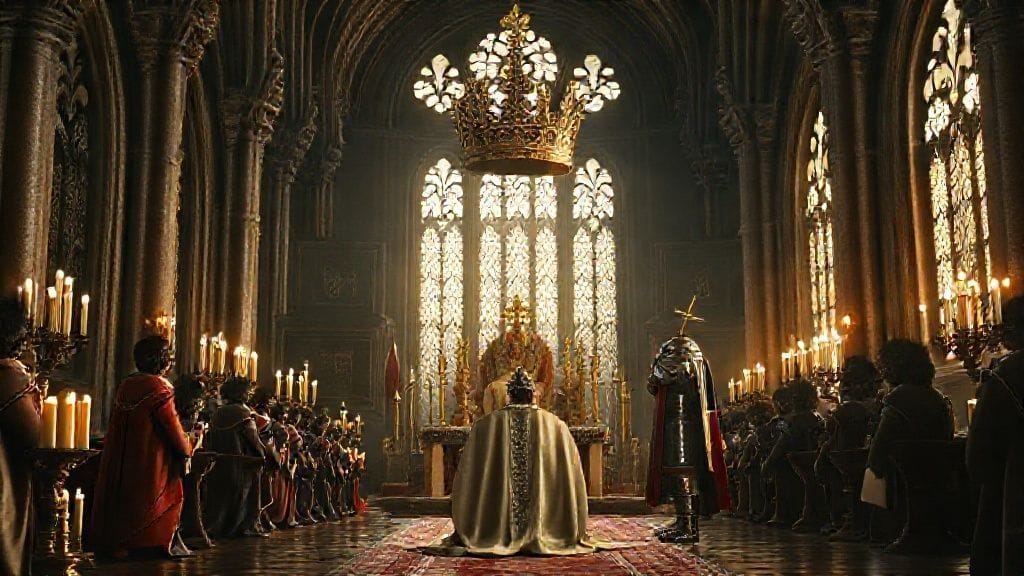
On Christmas Day of the year 800, St. Peter’s Basilica in Rome was filled with the whispered prayers of an expectant crowd. Charlemagne kneeled with a solemnity honed by years of battle and burden. Suddenly, the pope stepped forward and placed a golden crown upon the king’s head.
The hall erupted into awe. Charlemagne was now “Emperor of the Romans,” a title that signaled a break from centuries of political fragmentation.
This act was loaded with symbolism — the union of the Church’s spiritual authority and Charlemagne’s secular power. Yet, whether Charlemagne expected or desired this precise moment remains debated. Some chronicles suggest the king was surprised; others affirm it a premeditated act of political theater.
But it was unequivocally a turning point.
The Symbolism of Crowning: A New Political Theology
The crowning went beyond pomp. It was a carefully crafted political theology that reimagined kingship. The emperor was not just a ruler; he was God’s lieutenant on earth, charged with defending Christian civilization.
By reviving the Roman title, Charlemagne connected his reign to an ancient tradition, legitimizing his rule beyond tribal roots and emphasizing universal authority under the Christian God.
The pope’s role was equally significant—he became the one who invested emperors with divine right, placing the papacy as a central actor in the political order of Europe.
Reactions Across Europe: Awe, Hesitation, and Resistance
News of Charlemagne’s coronation spread like wildfire. While many of his subjects rejoiced and recognized the new stature of their king, others greeted the announcement with ambivalence or outright hostility.
The Byzantine Empire, still claiming its own imperial heritage, viewed the move as an encroachment on its legitimacy. Some Frankish nobles were wary of the growing power centralized in Charlemagne’s hands, which threatened local autonomy.
Furthermore, various tribal groups and distant rulers questioned what empire really meant in this new context—a question that would linger for generations.
The Carolingian Renaissance: Reform and Cultural Revival
The imperial coronation did not stand alone; it was embedded in a wider cultural revival often called the Carolingian Renaissance. Charlemagne’s reign fostered unprecedented patronage of the arts, education, and religious reform.
Monasteries and schools flourished, Latin scholarship was reinvigorated, and legal codes were standardized. This revitalization helped knit the empire together intellectually and spiritually.
The coronation thus symbolized not just political might but also a new dawn in European thought and identity.
The Imperial Idea: Revisiting the Roman Legacy
Charlemagne’s reign revived the idea of an empire rooted in the classical world but transformed by Christian values. The resurgent concept of imperium combined the authority of the Caesars with the spiritual mission bestowed by the Church.
This dual heritage was both a source of strength and conflict, shaping medieval politics and theology. The new empire was at once a continuation and a rupture—a reimagining that would influence rulers for centuries.
Power Balances: Francia, Byzantium, and the Papal States
The coronation shifted diplomatic equations dramatically. Francia emerged as a powerhouse, asserting itself against the older Byzantine Empire and securing influence over Italy through the papacy.
The Papal States, once vulnerable and politically weak, found in Charlemagne a protector who could guarantee their survival and autonomy.
Meanwhile, Byzantium wrestled with the reality of a rival empire asserting rights to imperial dignity in the West.
The Immediate Reforms in the Wake of Coronation
Charlemagne wasted no time in instituting reforms that reinforced his new status. Administrative centralization intensified, laws were codified, and Church hierarchy reorganized.
Counts and local leaders were held under tighter scrutiny. Education was promoted to create a learned clergy capable of implementing reforms.
These measures consolidated imperial authority and forged structure from previously fragmented power.
Aachen as the New Rome: Capital and Spiritual Center
Charlemagne’s choice of Aachen as his imperial capital was deliberate and loaded with meaning. Situated on the frontier of the Germanic world, Aachen embodied a new center of gravity for Europe’s burgeoning empire.
Here, the Palace Chapel blended Roman architectural techniques with Christian symbolism, envisioned as a physical manifestation of divine kingship.
Aachen became a pilgrimage site, a court of justice, and a cultural hub—a symbol of the empire’s cohesion and ambition.
Legacy of Charlemagne’s Imperial Title on Medieval Europe
The coronation set a precedent that reverberated through medieval Europe. It inspired numerous kings and princes to claim imperial authority and shaped the Holy Roman Empire’s foundation centuries later.
It also defined the political theology of rulership for generations, tying legitimacy explicitly to Church endorsement.
The concept of a Christian empire blending state and faith slowly evolved into the defining characteristic of medieval European identity.
The Evolution of European Kingship and Christendom
Charlemagne’s imperial title marked a transition from tribal kingship to a medieval model where monarchs were seen as both sovereign rulers and God’s earthly representatives.
This evolution intertwined the fate of the Church and state with kingdoms across Europe embracing Christianity as the core of their legitimacy and identity.
The emperor’s continuous dialogue with the papacy set patterns of alliance and conflict recurring throughout history.
Echoes Through Time: The Coronation’s Role in Modern Identity
Even today, the symbolism of Charlemagne’s coronation endures. European unity projects and historical narratives hark back to this moment of fusion between power, religion, and culture.
The figure of Charlemagne as “Father of Europe” echoes in modern debates about identity and continental coherence.
The coronation was not simply a medieval event; it was a foundational story for a civilization’s self-understanding.
Charlemagne’s Reforms: Law, Education, and Church Governance
Beyond symbols, Charlemagne enacted concrete reforms strengthening legal order, promoting literacy, and organizing Church practices.
The issuance of capitularies codified laws applicable throughout the empire. Monastic schools reshaped education, creating a learned elite.
Church governance reforms ensured bishops and abbots were loyal to imperial interests while reinforcing spiritual discipline.
Personalities Behind the Scene: Advisors, Bishops, and Nobles
The emperor was not alone in crafting this new world. Advisors like Alcuin of York, bishops, and trusted nobles were architects of reforms and cultural revival.
These figures provided intellectual muscle, spiritual guidance, and political savvy essential for maintaining the empire’s fragile coherence.
Their stories offer a window into the complex machinery behind a seemingly singular event.
Challenges to the Empire: Borders and Internal Unrest
Despite the grandeur, Charlemagne’s empire faced constant pressures. Border raids, internal revolts, and the challenge of governing a diverse populace required constant attention.
Maintaining control over Saxony, Lombardy, and other regions tested military and diplomatic capacities.
The coronation did not provide immunity from these struggles but rather intensified them by placing new expectations on imperial responsibilities.
The Struggle for Legitimacy: Papal vs. Imperial Authority
The delicate balance between papal and imperial authority established at the coronation presaged centuries of conflict over supremacy.
Who held ultimate power—the pope who crowned emperors or the emperor who protected the Church?
This duality would erupt in struggles like the Investiture Controversy, shaping Church-State relations for generations.
Narratives and Myths: How History Remembered December 25, 800
The coronation quickly became enshrined in legend and history. Chronicles portrayed it as a divine act, some emphasizing Charlemagne’s humility, others his destiny.
Some myths suggested the event was a surprise or an imposition by the pope, underscoring the ambiguous political reality.
These stories contributed to a lasting aura that transformed a political milestone into a foundational myth.
Conclusion: The Eternal Crown
Charlemagne’s imperial coronation was more than a ceremony; it was a fulcrum of history—a moment when fragmented kingdoms glimpsed unity, when the Church claimed a new role in worldly affairs, and when Europe began to write the story of its own identity.
From the cold halls of Aachen to the mosaics of Rome, this event stitched together legacies ancient and modern, secular and sacred.
The crown that settled on Charlemagne’s head on that December morning was a beacon, a promise, and a challenge—an eternal crown for a restless continent striving to define itself.
FAQs about Charlemagne’s Imperial Coronation
1. Why was Charlemagne crowned Emperor by the Pope instead of claiming the title himself?
The imperial title was deeply connected with the Church’s authority. By having Pope Leo III crown him, Charlemagne's rule gained divine legitimacy, positioning the Church as the source of imperial power.
2. How did the Byzantine Empire react to Charlemagne’s coronation?
Byzantium viewed the coronation as a challenge to its own claim as the Roman Empire’s successor. It caused diplomatic tension and a contest over legitimacy between East and West.
3. What reforms did Charlemagne implement after becoming emperor?
He enacted legal reforms through capitularies, promoted education via the Carolingian Renaissance, reorganized the Church’s hierarchy, and strengthened administration.
4. Did Charlemagne intend to be crowned emperor, or was the coronation a surprise?
Historical accounts differ. Some suggest Charlemagne was unprepared and surprised; others argue it was a preplanned act to solidify his authority.
5. How did Charlemagne’s coronation influence medieval kingship?
It redefined kingship as a Christian office sanctioned by the Church, merging political and spiritual leadership roles that became models for European monarchs.
6. What role did Pope Leo III play in the formation of the Holy Roman Empire?
By crowning Charlemagne, Leo III laid the groundwork for the Holy Roman Empire, establishing the papacy’s crucial role in legitimizing imperial authority.
7. Why was Aachen chosen as Charlemagne’s capital?
Aachen was strategically located and symbolically significant, with its palace chapel representing the fusion of Roman architecture and Christian kingship.
8. How is Charlemagne’s coronation remembered today?
It is celebrated as a founding moment of European unity and identity, inspiring modern cultural and political narratives about the continent’s shared heritage.

