Table of Contents
- The Twilight of a Golden Age: Charles IV’s Last Days
- Prague in 1378: A City on the Eve of Change
- The Rise of Charles IV: From Prince to Emperor
- A Visionary King: Charles IV’s Ambitions for Bohemia
- The Building of Prague: The Jewel of Central Europe
- The Cultural Renaissance Under Charles IV
- Political Landscape of 14th-Century Bohemia
- Charles IV’s Diplomatic Mastery and Electoral Influence
- The Final Chapter: Charles IV’s Health and Declining Years
- November 29, 1378: The Death of a Monarch
- The Immediate Aftermath in Prague and Beyond
- The Succession Crisis: Wenceslaus IV Ascends the Throne
- Bohemia’s Changing Destiny Post-Charles IV
- Charles IV’s Legacy in Architecture and Culture
- His Impact on the Holy Roman Empire
- The Memory of Charles IV in Czech National Identity
- Historical Perspectives: Evaluating the King’s Reign
- Anecdotes and Quotations: Voices from the Era
- The Long Shadow of Charles IV in European History
- Conclusion: The Man Who Shaped Bohemia and Beyond
- FAQs: Understanding Charles IV’s Death and Legacy
- External Resource
- Internal Link
From the dusk settled gently over Prague on that November evening in 1378, an era quietly slipped into history. The air outside the towering spires of the St. Vitus Cathedral was crisp, yet it carried a strange weight—the palpable sorrow of a city mourning its monarch. Charles IV, King of Bohemia and Holy Roman Emperor, breathed his last on November 29, 1378, closing the chapter on a reign that had illuminated Central Europe like a blazing comet.
This was no ordinary king, no fleeting note in the annals of medieval history. Charles IV was a figure whose life traced the contours of power, culture, and spirituality. His death marked the end of the “Golden Age” of Bohemia, leaving behind a Prague forever transformed—architecturally, culturally, and politically.
But to understand the significance of this moment requires a step back. It demands immersion into the struggles and triumphs that carved out Charles’s journey from a prince born into exile to an emperor who made Bohemia the heart of Europe.
The Twilight of a Golden Age: Charles IV’s Last Days
The final days of Charles IV were marked by the twilight of both his personal vitality and the glory he had wrought across his kingdom. At 62—a venerable age for the 14th century—illness had taken a slow hold upon him. The man whose hands had laid the foundations for the Charles Bridge and the University of Prague now found himself grappling with the frailty of the human body.
His death in the Royal Castle was not sudden but awaited, a gradual slipping into silence. Courtiers whispered prayers as the great king looked one last time upon the city he had so passionately shaped.
Yet even in his weakening state, Charles remained aware of the looming question of succession. His son, Wenceslaus, was untested, and the empire he envisioned hung fragile in balance. The weight of the crown was about to pass to uncertain hands.
Prague in 1378: A City on the Eve of Change
Prague in the late 14th century was a city transformed by the vision of Charles IV. Its winding cobblestone streets, shadowed by Gothic cathedrals and fortified walls, thrummed with trade and ideas. Market stalls buzzed with merchants from Italy, Poland, and the distant Mediterranean, while scholars debated theology and philosophy within the hallowed halls of the newly founded university.
Yet beneath its flourishing surface, Prague bore the tensions of a kingdom poised at a crossroads. The death of Charles IV would unsettle the delicate balance of power, unleashing forces that had been held in check only by his authority and diplomacy. The city—and Bohemia—stood ready to enter an uncertain new era.
The Rise of Charles IV: From Prince to Emperor
Born as Wenceslaus, son of King John of Bohemia, Charles IV arrived into the world in 1316 amidst political exile and uncertainty. His early years were shaped by the fractured geopolitics of Central Europe and his father’s ambitious, often perilous, campaigns.
Educated in France under the patronage of the French king, Charles absorbed not only knowledge but the importance of culture, law, and statesmanship. He returned to Bohemia not merely as a prince but as a man determined to rebuild his homeland’s fortunes.
Through a cunning combination of marriage alliances, political acumen, and royal diplomacy, Charles positioned himself to become King of Bohemia and later, Holy Roman Emperor. His ascent was emblematic of a new generation of rulers, blending medieval chivalry with Renaissance humanism.
A Visionary King: Charles IV’s Ambitions for Bohemia
Charles’s reign was marked by grand ambitions rooted in a deep sense of destiny for Bohemia. He saw his kingdom as the spiritual and political center of Europe, a beacon of culture and learning.
His founding of the University of Prague in 1348 was visionary—not only as the first university in Central Europe but as a symbol of enlightenment. For Charles, education was an instrument of statecraft, meant to produce learned clergy and bureaucrats loyal to the crown.
Moreover, his building projects—castles, bridges, and the Gothic embellishments of the cathedral—were physical manifestations of Bohemia’s rising status.
The Building of Prague: The Jewel of Central Europe
Walking through the streets of 14th-century Prague was to witness a city under construction—though not haphazard or rushed, but meticulous and ambitious. Charles IV personally oversaw projects that would redefine the city’s skyline for centuries.
The Charles Bridge, begun in 1357, was more than a crossing over the Vltava River; it was a statement of unity, grandeur, and innovation. The Old Town and New Town merged physically and symbolically through such infrastructure projects.
St. Vitus Cathedral, whose walls rose slowly during Charles’s reign, embodied the spiritual heart of the kingdom. Its soaring Gothic arches and stained glass were a testament to the intertwining of faith and power.
The Cultural Renaissance Under Charles IV
The age of Charles IV was nothing short of a cultural renaissance in Central Europe. The king invited architects, sculptors, and clerics from Italy and France, importing Gothic art and learning traditions.
His court became a hub of intellectual life, where Latin texts, religious manuscripts, and philosophical debates enriched Bohemian society. This cultivated atmosphere helped sow the seeds for the later Hussite movement and the development of Czech national consciousness.
Political Landscape of 14th-Century Bohemia
It was a time of competing noble houses, regional rivalries, and the persistent influence of the Holy Roman Empire. Bohemia itself was a kingdom with a proud tradition but also with internal divisions—nobility sometimes fractious and rebellious.
Charles IV’s diplomacy, both shrewd and sometimes ruthless, managed to keep these forces balanced. He was also an adept player in the imperial electoral politics, securing his position as emperor and advancing Bohemia’s interests within the empire.
Charles IV’s Diplomatic Mastery and Electoral Influence
Unlike many rulers of his time who relied solely on military might, Charles IV wielded diplomacy as a key weapon. His policy of intermarriage with other European royal families consolidated Bohemia’s alliances.
In 1356, he issued the Golden Bull, a constitutional document that shaped the Holy Roman Empire’s electoral system for centuries, underscoring his legacy beyond his kingdom’s boundaries.
The Final Chapter: Charles IV’s Health and Declining Years
In his final years, Charles experienced an accelerating decline in health, afflicted by illnesses less understood at the time. His diaries reportedly detailed bouts of pain and fatigue, yet he remained involved with state affairs.
His awareness of his mortality brought urgency to his preparations for succession and the management of his empire. The looming possibility of political instability without his steady hand was a persistent worry.
November 29, 1378: The Death of a Monarch
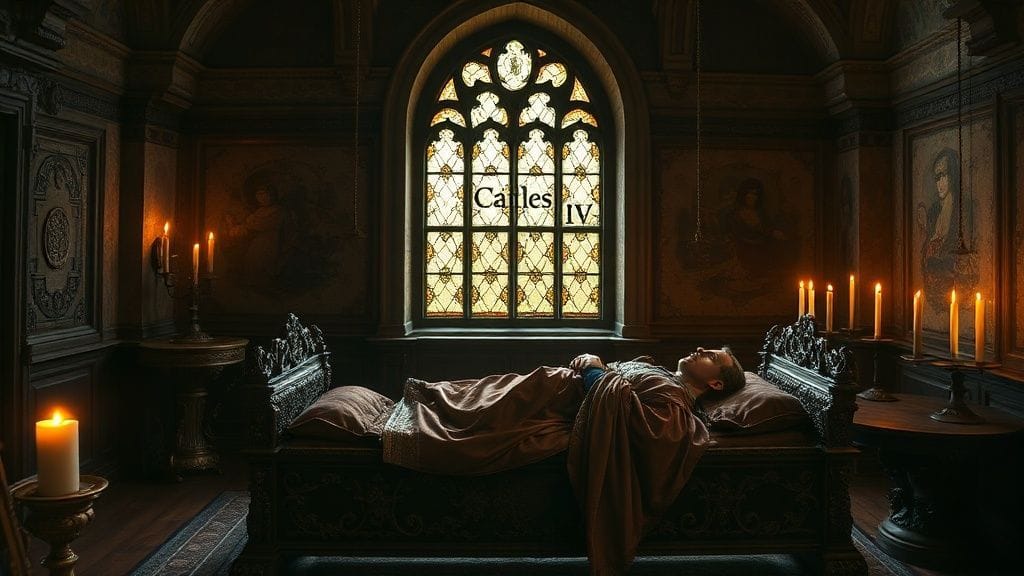
The morning of November 29, 1378, was quiet in the Royal Castle. Charles IV passed away surrounded by his closest advisers and family.
The news rippled rapidly through Prague. Bells tolled in mourning; markets closed, and citizens gathered to honor their sovereign. His funeral, a solemn and grand affair, was both a moment of grief and reflection on the man who had transformed their world.
The Immediate Aftermath in Prague and Beyond
Following his death, Prague was gripped by uncertainty. The power vacuum and the ambitions of various nobles made the transition delicate.
Europe watched closely, aware that the emperor who had acted as an arbiter and stabilizer was gone. Bohemia faced not only political challenges but also the task of preserving the cultural and administrative legacy Charles had left.
The Succession Crisis: Wenceslaus IV Ascends the Throne
Charles IV’s son, Wenceslaus IV, inherited the throne—yet the young king lacked his father’s political savvy and decisiveness.
His inability to command respect from the nobility and manage the empire’s complex politics would soon lead to internal strife and decline, illustrating the fragile nature of medieval dynastic succession.
Bohemia’s Changing Destiny Post-Charles IV
The years following Charles’s death saw the gradual erosion of the centralized power he had built. The kingdom became embroiled in conflicts that would culminate in religious upheaval and civil wars in the 15th century.
Yet Bohemia’s cultural foundations remained, testament to Charles’s lasting influence.
Charles IV’s Legacy in Architecture and Culture
Today, Prague's skyline—dominated by the Charles Bridge, St. Vitus Cathedral, and the historic Charles University buildings—reflects the enduring legacy of a king who believed in shaping not only politics but the very fabric of society.
His fostering of education and culture planted seeds that sprouted into vibrant Czech identity.
His Impact on the Holy Roman Empire
Charles IV reshaped the empire itself. The Golden Bull gave structure to the electoral process, which balanced power among the empire’s princes and checked the emperor’s own authority.
This legal and political innovation influenced European governance for centuries.
The Memory of Charles IV in Czech National Identity
Within Czech history, Charles IV occupies a mythical place akin to a founding father. Generations have looked upon his reign as a pinnacle of national achievement—a symbol of cultural pride, political sophistication, and spiritual depth.
His portrait appears in literature, art, and public consciousness as the “Father of the Homeland.”
Historical Perspectives: Evaluating the King’s Reign
Historians marvel at Charles’s ability to blend medieval chivalry with pragmatic governance and cultural patronage. Some critique his failure to establish a stable succession, yet few deny his role in elevating Bohemia onto the European stage.
His reign is a fascinating case study of leadership in a tumultuous medieval world.
Anecdotes and Quotations: Voices from the Era
An oft-quoted phrase attributed to Charles IV summarizes his vision: “Prague is my heart.” Anecdotes from chroniclers describe the emperor’s humility, his interest in scholarship—even playing chess amid state affairs—and the respect he commanded from contemporaries.
His contemporary, Petrarch, called him “the most Christian of kings,” recognizing his devotion as well as his political skill.
The Long Shadow of Charles IV in European History
While his death in 1378 closed one chapter, Charles’s influence persisted across centuries. His architectural projects, university foundation, and legal reforms echoed through the Renaissance and beyond.
Europe continues to study his model of enlightened monarchy.
Conclusion
Charles IV’s death was both an end and a beginning. It marked the close of a reign that elevated Bohemia from a medieval backwater to a vibrant European center—a kingdom illuminated by bridges, cathedrals, and a university.
Yet, it also signaled the fragility that shadows great men’s legacies: no matter the grandeur wrought in their lifetime, their passing brings uncertainty, challenges, and transformation.
Charles IV remains a deeply human figure—a man who dreamed of greatness for his homeland, walked through its streets with hope, and died knowing the tides of history would carry his people into an uncharted future.
His story resonates today as a testament to vision, resilience, and the enduring interplay between power and culture.
FAQs
Q1: What were the main causes behind Charles IV’s death?
Charles IV died of natural causes related to age and health complications common in the 14th century. Contemporary accounts suggest illness rather than violence or sudden events.
Q2: How did Charles IV’s death affect Bohemia politically?
His passing created a power vacuum and raised questions about succession. Although his son Wenceslaus IV inherited the throne, he struggled to maintain his father’s authority, leading to instability.
Q3: What role did Charles IV play in European politics beyond Bohemia?
As Holy Roman Emperor, Charles IV was a key figure in shaping imperial law through the Golden Bull and securing Bohemia’s prominence within European power dynamics.
Q4: What aspects of Charles IV’s reign are most celebrated culturally?
His patronage of architecture, foundation of the University of Prague, and promotion of the arts are considered pillars of his lasting cultural legacy.
Q5: How is Charles IV remembered in Czech national identity?
He is revered as the foundational figure of Czech statehood and culture—often called “Father of the Homeland” and symbol of medieval Czech glory.
Q6: Was there a succession crisis after his death?
Yes, although Wenceslaus IV succeeded him, his weak rule led to factionalism and set the stage for future conflicts in Bohemia.
Q7: What is the importance of November 29, 1378, historically?
This date marks the death of one of medieval Europe’s most influential monarchs, signaling a major transition for Bohemia and the Holy Roman Empire.
Q8: How can one learn more about Charles IV’s reign?
Countless historical works detail his life; visiting Prague and its monuments or exploring academic texts offers a rich understanding of his impact.