Table of Contents
- The Final Hour in Nancy: Dawn of January 5, 1477
- The Rise of Charles the Bold: From Duke to Dreamer of Empire
- The Embers of Ambition: Burgundy’s Place in Late Medieval Europe
- Lorraine’s Crossroads: A Land Caught Between Powers
- Storm Clouds on the Horizon: The Political Chessboard before Nancy
- The Eve of Battle: Charles Prepares for His Last Stand
- The Battle of Nancy: Clash of Steel and Will
- Death of a Duke: The Fall of Charles the Bold
- The Aftermath in Lorraine: Triumph and Tragedy
- Shattered Ambitions: The Fall of the Duchy of Burgundy
- Dynastic Ripples: The Fate of Mary of Burgundy
- France’s New Dawn: How Louis XI Consolidated Power
- The Holy Roman Empire’s Reaction: Emperor Frederick III’s Calculations
- The Legacy of Charles the Bold in European Memory
- Military Innovations and Lessons from the Battle
- The Human Cost: Lives Lost and Families Torn Apart
- Myth and Legend: The Duke in Art and Tale
- Lorraine’s Identity Forged in Fire
- Burgundy’s Cultural Renaissance and Its Abrupt End
- The Changing Map of Europe: Territorial Shifts and Stakes
- Conclusion: The Death That Redrew Europe
- FAQs: Understanding Charles the Bold and the Battle of Nancy
- External Resource: Further Reading on Wikipedia
- Internal Link: Visit History Sphere for More Stories
1. The Final Hour in Nancy: Dawn of January 5, 1477
The cold winter morning settled thickly over Nancy, a town shrouded in frost and tension, as if nature itself anticipated the storm ahead. The sky, a pale gray, barely dawned when the distant clangor of armor and rattle of marching men rippled through the streets and hills. From the east came the Duke of Burgundy, a towering figure wrapped in ambition and steel—Charles the Bold, a monarch poised on the precipice of greatness or ruin. The air was heavy with the scent of pine, smoke, and dread. That day, Nancy would witness the violent end of an age, the shattering of dreams, and the death of its most famed—and feared—ruler.
This was no ordinary battle. It was a collision of not just armies, but of visions, of stubborn pride and shifting alliances that had rippled across Europe for years. When Charles the Bold fell on January 5, 1477, it was not merely the death of a man—it was the death of an empire in miniature, a dream of grandeur that would echo through decades.
2. The Rise of Charles the Bold: From Duke to Dreamer of Empire
Born in 1433 into the Valois house, Charles de Valois-Bourgogne inherited a ducal mantle already swelling with weight and expectation. He was the only son of Philip the Good, himself a master of diplomacy and patronage, who had transformed Burgundy into a powerhouse straddling France and the Holy Roman Empire. But Charles was different—ambitious beyond measure, he sought more than consolidation; he sought expansion, dominion, and an empire that might rival kingdoms.
His nickname, “the Bold,” could have been both compliment and curse. Tenacious and reckless, he pursued wars against neighbors, flirted with alliances, and seemed to dream of uniting his lands into a coherent, sovereign kingdom. Yet, despite his firebrand reputation, he was also a cultured leader, a patron of the arts who brought Renaissance ideas northward. The world looked to Burgundy as a rich jewel—until its crown fractured under his ambition.
3. The Embers of Ambition: Burgundy’s Place in Late Medieval Europe
In the tangled web of 15th-century Europe, Burgundy occupied a liminal space, neither fully French nor German. Its territories stretched from the Low Countries through rich cities like Dijon, and into Lorraine's edges. With wealth built on trade, chivalry, and strategic marriages, Burgundy had blossomed into a cultural and political beacon.
Europe was, however, a tinderbox of competing powers: the Kingdom of France, the Holy Roman Empire, the Swiss Confederacy rising in independence, and the smaller principalities weaving their allegiances carefully. Burgundy's rising power unsettled kings and emperors. The dynasty’s ambitions clashed with France’s vision of centralization and the Emperor’s cautious balancing act.
Charles’s dream foreshadowed a continental upheaval, but the foundation on which he built—military conquest over diplomacy—would prove vulnerable.
4. Lorraine’s Crossroads: A Land Caught Between Powers
Lorraine itself was a jewel of strategic import—nestled between France and the Empire, it bore the scars and hopes of both realms. Its capital, Nancy, was a crossroads of culture, commerce, and military campaigns—an invaluable stronghold for whoever claimed it.
Duke René II of Lorraine, a seasoned warrior and diplomat, ruled this patchwork land. His allegiance was complex, tied to local loyalties yet wary of Burgundy’s expansion. When Charles pushed into Lorraine, it was not just a territorial move—it challenged René personally and the fragile balance of power in the region.
For residents of Lorraine, January 1477 was not only about armies and banners—it was about survival in the tide of great men’s ambitions.
5. Storm Clouds on the Horizon: The Political Chessboard before Nancy
By late 1476, the tension had escalated dramatically. Charles had suffered setbacks at the hands of the Swiss, whose fierce mercenaries harassed his troops and blocked his progress toward the Rhine. His army, though large and well-equipped, was battered and demoralized.
Meanwhile, René II had forged a critical alliance with the Swiss Confederacy, who were eager to check Burgundy’s expansion. The French crown, led by Louis XI, watched keenly—smelling opportunity to reclaim territories lost to Burgundy and to weaken a dangerous rival.
Old enmities and new alliances converged. The stage was set for a showdown where every participant understood what was at stake: power, pride, and legacy.
6. The Eve of Battle: Charles Prepares for His Last Stand
On the night before the battle, Charles moved his troops around Nancy’s fortifications. His mind raced, not just with strategy but also with the ghosts of his family and fate. Rumors whispered among the camp: was this next engagement the final chapter?
He had amassed formidable cavalry and heavy artillery, symbols of his wealth and military prowess. Yet the logistical challenges weighed heavily—winter supplies were scarce, and morale was fraying after months of campaigning.
The duke, ever the symbol of sheer will, insisted on pressing forward. His sleep was fitful; his commanders sensed the tension. Some feared overconfidence was clouding judgment.
7. The Battle of Nancy: Clash of Steel and Will
Morning broke on January 5 with a brutal clarity. The air was pierced by horns and war cries as Charles’s forces clashed with the combined army of René II and the Swiss.
The terrain around Nancy, hilly and wooded, shaped the battle’s grim choreography. The Swiss pike formations proved devastating, advancing relentlessly against Burgundy’s knights. The fierce resistance shattered the duke’s hopes of a quick victory.
Chaos swept through the battlefield. Amid the confusion, Charles reportedly fought with desperate valor, rallying his knights in a last, doomed charge. Witnesses would later recount a valiant figure cut down amid the carnage, his golden armor bloodied and broken.
8. Death of a Duke: The Fall of Charles the Bold
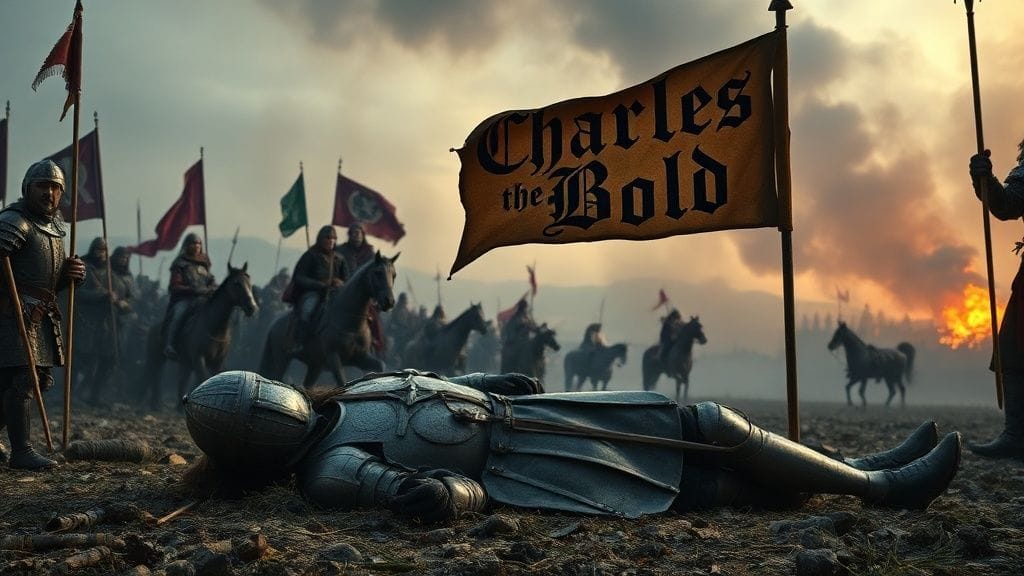
Charles the Bold was found dead either during the battle or shortly after. Accounts vary, but all agree on the symbolic weight of his death: the end of a saga.
His body was identified by his heraldic symbols and a medallion. It was a death that stunned Europe; a powerful ruler had perished not in his own bed, but on a bitter battlefield, far from the throne he dreamt of.
His passing signaled not only personal tragedy but the collapse of Burgundy’s independent aspirations.
9. The Aftermath in Lorraine: Triumph and Tragedy
For René II, victory at Nancy was both a deliverance and a challenge. He had defended his duchy and secured Lorraine’s position, but at great human cost. The city’s streets and fields bore the scars of war.
Public celebrations mixed with mourning; soldiers and citizens alike wrestled with the reality that their small land had stood at the crossroads of Europe’s fate.
Moreover, the death of Burgundy’s duke reopened political contests and opportunities, shifting the balance in Lorraine and beyond.
10. Shattered Ambitions: The Fall of the Duchy of Burgundy
Charles’s death destabilized his vast holdings. His daughter and heir, Mary of Burgundy, faced an uncertain future. The duchy, fragmented and surrounded by enemies, lay vulnerable.
The grand dream of a mighty Burgundian kingdom crumbled almost overnight. Territories began to be claimed by powerful neighbors—the French crown moved swiftly to annex key lands, while others looked to the Holy Roman Empire for intervention.
It was a turning point that reshaped borders and power dynamics in Western Europe.
11. Dynastic Ripples: The Fate of Mary of Burgundy
Mary was thrust into the vortex of politics, negotiating survival through marriage and diplomacy. Her union with Maximilian of Habsburg would tie Burgundy to a dynasty that would shape European history for centuries.
Yet her reign was marked by turbulence and the persistence of conflict over her inheritance. Mary’s personal tragedy echoed the larger story of a duchy that had once dared to dream of empire.
12. France’s New Dawn: How Louis XI Consolidated Power
Louis XI, “the Spider King,” capitalized on Burgundy’s fall. His long-term goal of uniting France under a strong, centralized monarchy found momentum.
The annexation of Burgundian territories not only expanded the French crown’s domain but also weakened the semi-autonomous powers that had challenged the monarchy’s authority.
The death of Charles the Bold was a critical stepping stone toward the France we recognize today.
13. The Holy Roman Empire’s Reaction: Emperor Frederick III’s Calculations
Frederick III, the Holy Roman Emperor, had maintained a cautious approach to Burgundy. Charles’s death gave him an opportunity to assert influence in the region without open war.
The empire’s fragmented nature meant that Lorraine and the Low Countries became contested ground yet again, but Frederick’s diplomacy sought to balance power and prevent chaos.
14. The Legacy of Charles the Bold in European Memory
Charles the Bold came to embody the archetype of the tragic hero—brave, bold, but undone by hubris. Chronicles and later historiography often reflect on his life as a warning and inspiration.
Artists and writers immortalized him, blending fact with legend, and his death became a symbol of the end of chivalry in some narratives.
15. Military Innovations and Lessons from the Battle
The Battle of Nancy demonstrated the effectiveness of Swiss infantry tactics over traditional knightly cavalry. The innovations of the Swiss pike squares reshaped European warfare.
Charles’s reliance on heavy cavalry failed against disciplined infantry and terrain advantages, marking a shift in medieval combat’s evolution.
16. The Human Cost: Lives Lost and Families Torn Apart
Beyond politics and power, the battle took hundreds of lives—knights, foot soldiers, and civilians alike. Families in Lorraine, Burgundy, and beyond grieved losses that rippled through generations.
The war highlighted the brutal human price of ambition and the fragile nature of peace in medieval Europe.
17. Myth and Legend: The Duke in Art and Tale
From illuminated manuscripts to folk songs, Charles the Bold inspired stories that blended history with myth. His final days and death became a canvas for exploring heroism, fate, and downfall.
His image fascinated Renaissance and later artists, cementing his larger-than-life persona.
18. Lorraine’s Identity Forged in Fire
The victory at Nancy became a foundational myth for Lorraine itself. It reinforced local pride and identity distinct from both France and the Empire.
The memory of the battle shaped the region’s culture, politics, and self-perception for centuries.
19. Burgundy’s Cultural Renaissance and Its Abrupt End
Burgundy under Charles had been a beacon of art, music, and courtly culture. His death brought a sudden end to this flourishing.
The dispersal of Burgundian treasures and artists changed the cultural landscape of Europe, influencing neighboring courts.
20. The Changing Map of Europe: Territorial Shifts and Stakes
The death of Charles the Bold marked a major realignment of borders in Western Europe. France grew, the Habsburgs entered more forcefully into the political arena, and local duchies adjusted.
It was a moment when medieval feudalism began to give way to early modern statecraft.
21. Conclusion: The Death That Redrew Europe
The death of Charles the Bold at Nancy was far more than a battlefield casualty; it was a pivot on which the destiny of Europe turned. In the frozen dawn of January 5, 1477, ambitions clashed, empires faltered, and a duke’s fall reshaped kingdoms.
His last stand remains a testament to the turbulent forces of power, identity, and legacy—reminding us how history’s course often hinges on the fate of individuals braver than their age.
Conclusion
Charles the Bold’s final battle and death at Nancy symbolize the twilight of medieval chivalry and the dawn of a transforming Europe. His life, marked by ambition and brilliance, ended not with triumph but a defeat that rippled through dynasties and shaped nations. Yet, it is in this dramatic fall that his enduring legacy lies—a poignant reminder of how power courts destruction and how the currents of history are steered by both human will and fate. The frozen fields of Nancy still echo with steel and sorrow, a silent marker of an age irrevocably changed.
FAQs
Q1: What were the main causes leading to the Battle of Nancy in 1477?
A1: The battle was the culmination of Charles the Bold’s expansionist policies, friction with Lorraine, alliances against Burgundy, and the struggle for dominance between France, the Holy Roman Empire, and rising Swiss forces.
Q2: Who was Charles the Bold, and why was he significant?
A2: Duke of Burgundy, Charles sought to create a powerful kingdom uniting his territories. His ambition, military campaigns, and patronage made him a key figure in late medieval Europe before his death ended Burgundian hopes.
Q3: How did the Battle of Nancy reshape European politics?
A3: The battle led to the collapse of Burgundy’s duchy, expanded French territory under Louis XI, and set the stage for Habsburg influence through Mary of Burgundy’s marriage, significantly reshaping Western Europe’s map.
Q4: What role did the Swiss Confederacy play in the battle?
A4: Allied with Lorraine, the Swiss troops employed innovative infantry tactics that decisively defeated the Burgundian cavalry, showcasing a shift in military strategy.
Q5: How is Charles the Bold remembered in history and legend?
A5: He is portrayed both as a tragic hero and an ambitious ruler undone by pride. His life inspires literature, art, and folklore centered on chivalry and downfall.
Q6: What happened to Mary of Burgundy after her father’s death?
A6: Mary quickly sought powerful alliances, marrying Maximilian of Habsburg to protect her inheritance, which eventually led to the foundation of Habsburg dominance in Europe.
Q7: How did Charles’s death affect the cultural landscape of Burgundy?
A7: The Burgundian court’s cultural flowering abruptly ended, dispersing artists and treasures and influencing neighboring courts’ Renaissance developments.
Q8: Why is Lorraine’s victory at Nancy significant for regional identity?
A8: It affirmed Lorraine’s sovereignty and distinct culture, fostering a local sense of pride and political autonomy in a contested border region.

