Table of Contents
- The Quiet Before the Storm: Life on the Kuril Islands
- The Chikurachki Volcano: A Sleeping Giant Awakes
- Early Morning, August 28, 2003: First Signs of Fury
- The Sky Turns Black: Ash and Fire Illuminate the Night
- Eyewitness Accounts: Voices from Paramushir Island
- The Science Behind the Fury: Understanding the Eruption
- The Evacuation: Balancing Human Safety and Isolation
- Ashfall and Lava: A Grim Portrait of Nature’s Power
- Environmental Impact: The Ravage on Flora and Fauna
- The Kuril Islands in Geopolitical Context: Russia’s Remote Frontier
- International Monitoring and Cooperation: Volcanoes Beyond Borders
- Local Communities: Tradition and Resilience in the Face of Disaster
- Media Response: The World Watches from Afar
- Lessons Learned: Advances in Volcanic Prediction Post-2003
- The Long Road to Recovery: Rebuilding on the Ashes
- The Chikurachki’s Legacy: Preserving Memory and Respecting Nature
- Reflections from Scientists: The Volcano’s Ongoing Dialogue
- Future Threats: Is Chikurachki Still Restless?
- Cultural Echoes: Myth and Meaning in Volcanic Eruptions
- Conclusion: Nature’s Grandeur and Humanity’s Fragility
- Frequently Asked Questions
- External Resource
- Internal Link
The Quiet Before the Storm: Life on the Kuril Islands
In the remote expanse of the North Pacific, where the cold seas wash the rugged shores of Russia’s Kuril Islands, life unfolds with a measured pace. These islands, a string of volcanic landmasses stretching between Japan and Russia’s Kamchatka Peninsula, harbor sparse communities, rich marine life, and dormant giants: volcanoes silently watching from their crowns. Among them stands Chikurachki, its peak often veiled by mist, a serene sentinel of geological time. For decades, locals and scientists alike regarded it with a wary respect, knowing that beneath its calm lay unpredictable forces waiting to rupture with devastating intensity.
The Chikurachki Volcano: A Sleeping Giant Awakes
Chikurachki Volcano, the highest peak on Paramushir Island, rises nearly 1,816 meters (5,958 feet) above sea level. Its name—Chikurachki—derives from the Ainu language, hinting at a deep indigenous connection to the land and the mountain’s mystical power. Prior to 2003, Chikurachki’s last notable eruption had been several decades earlier, its activity classified as moderate and relatively infrequent. Yet the Kuril Islands form part of the Pacific Ring of Fire, a notorious hotspot for seismic and volcanic events. As 2003 dawned, a restless tension hummed beneath the surface, imperceptible to the eye but impossible for seismographs to conceal.
Early Morning, August 28, 2003: First Signs of Fury
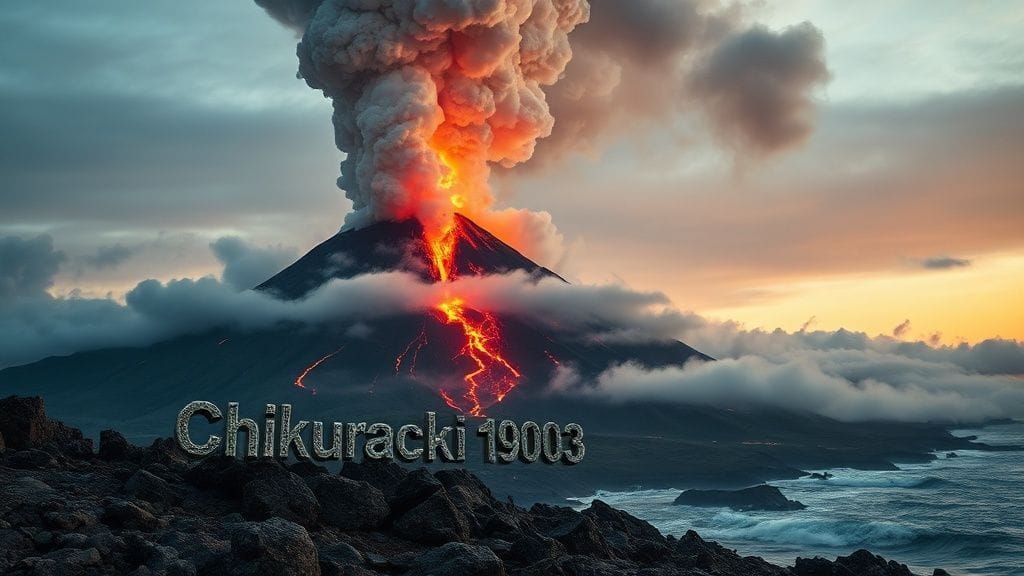
On the morning of August 28, 2003, residents of Paramushir Island were startled awake not by human disturbance but by earth’s primal voice. At approximately 3 a.m., seismic stations detected tremors escalating in intensity, a clear herald of imminent volcanic activity. By 4:30 a.m., Chikurachki had breached its confining crust. With a sudden roar that echoed across valleys and over icy beaches, a column of ash and gas erupted skyward, piercing the dawn sky with an ominous plume.
Scientists monitoring from nearby observation posts scrambled to record data, while the island’s small population braced against the unfolding onslaught. As ash began to fall like black snow, shadows lengthened and the air filled with a choking haze—nature’s grim reminder of its power.
The Sky Turns Black: Ash and Fire Illuminate the Night
The 2003 eruption was not a mere expulsion of smoke but a spectacle of raw, fiery intensity. Nightfall could not extinguish the volcano’s incandescent glow as molten lava poured down Chikurachki’s flanks, carving new scars into the ancient landscape. Ash clouds ballooned, pushing thousands of meters into the atmosphere, darkening skies hundreds of kilometers away.
Fishermen near the island reported the eerie sight of the night sky intermittently illuminated by fiery bursts. Ashfall coated roofs and sparked wildfires in the island’s sparse forests. The volcano's fury was quick to declare its presence, commanding attention far beyond this frozen corner of the world.
Eyewitness Accounts: Voices from Paramushir Island
One resident, an elderly fisherman named Ivan Petrovich, described the eruption with a mix of horror and awe: “I’ve lived here all my life. The mountain is part of us, but this… this was a different beast. The sky turned black like ink, and the earth trembled as if the gods themselves were angry.”
Meanwhile, scientists like Dr. Elena Markova, a volcanologist stationed nearby, detailed the onset with clinical precision but admitted the emotional weight: “Even for us trained to anticipate and interpret volcanic behavior, Chikurachki’s eruption was an awe-inspiring and humbling event. It reminded us that we are always guests in the realm of nature's might.”
The Science Behind the Fury: Understanding the Eruption
The eruption was classified as a Vulcanian type, characterized by explosive outbursts punctuated by intense ash emissions. Prior to the eruption, magma accumulated in shallow chambers beneath the volcano, building pressure until the Earth's crust could no longer contain the volatile gases trapped within.
Seismic readings showed a sudden increase in tremor frequency and magnitude, signaling the magma's upward rush. The violent explosion of gas and molten rock transformed the peaceful landscape with layers of ash and lava. The eruption lasted several days, with intermittent bursts reflecting the complex plumbing beneath Chikurachki's peak.
The Evacuation: Balancing Human Safety and Isolation
Paramushir Island’s small population faced a tough choice. Despite the danger, many residents chose to stay, holding onto their ancestral homes and livelihoods. However, authorities enacted precautionary evacuations for those in the immediate danger zone.
The isolation of the Kuril Islands created logistical challenges for evacuation and relief efforts. Supplies and support had to be mobilized across treacherous seas and rugged terrain. The local commitment to resilience, coupled with Russian emergency protocols adapted to volcanic crises, averted greater human tragedy.
Ashfall and Lava: A Grim Portrait of Nature’s Power
The fallout from Chikurachki’s eruption reshaped the island’s surface. Thick layers of volcanic ash smothered vegetation, while newly formed lava fields expanded the mountain’s dimensions. Thick ash penetrated homes and machinery, disrupting daily life and damaging infrastructure.
The volume of ejected material was staggering: estimations suggest that millions of cubic meters of ash and lava were expelled, blanketing the landscape and transforming it into a raw panorama of destruction and renewal. The event serves as a vivid reminder of geological forces that shape our planet—slow but sometimes violently fast.
Environmental Impact: The Ravage on Flora and Fauna
The eruption’s environmental aftermath was severe. The Kuril Islands’ unique ecosystems suffered significant setbacks as forests burned and ash suffocated plant life. Local animal populations, including migratory birds and marine species, faced altered habitats and disrupted food chains.
The long-term ecological effects would unfold over years, with both losses and unexpected opportunities for adaptation and succession. Scientists monitored the recovery, noting the initial devastation gradually gave way to pioneering species colonizing fresh volcanic soils.
The Kuril Islands in Geopolitical Context: Russia’s Remote Frontier
The Kuril Islands have long been a point of geopolitical tension, positioned between Russia and Japan with overlapping territorial claims. Chikurachki’s eruption, while a natural event, occurred against a backdrop of strategic importance.
Russia’s investment in monitoring and emergency response underscored the islands' value as more than a remote outpost. Environmental disasters like volcanic eruptions add complexity to political and military considerations, reminding all stakeholders of the uncontrollable natural forces at play.
International Monitoring and Cooperation: Volcanoes Beyond Borders
Volcanic activity in the Kurils does not exist in isolation. The eruption in 2003 prompted cooperation among Russian, Japanese, and international volcanological agencies. Real-time satellite data and seismic monitoring augmented ground observations, improving understanding of the volcano’s behavior.
Such collaboration highlights the essential nature of shared scientific vigilance in volcanic regions, where eruptions can impact air travel, climate, and populations far from their origin.
Local Communities: Tradition and Resilience in the Face of Disaster
Life on Paramushir Island is marked by a close relationship to nature’s rhythms, where local customs and traditions have evolved in constant dialogue with the land’s precarious balance. The eruption of 2003 tested this connection.
Despite hardship, communities displayed resilience: rebuilding homes, adapting fishing methods impacted by ash-laden waters, and reinforcing cultural identity through shared survival stories. This spirit embodies humanity’s tenacity amid natural threat.
Media Response: The World Watches from Afar
Though remote, Chikurachki’s eruption caught the attention of global media interested in natural disasters and geological phenomena. News agencies transmitted dramatic images of ash clouds and lava flows, capturing the imagination of a distant public.
Yet, the event remained underreported compared to larger eruptions elsewhere, a reminder of geographic and political marginalization of such remote natural narratives.
Lessons Learned: Advances in Volcanic Prediction Post-2003
The 2003 eruption sharpened scientific tools and protocols. Seismic and gas emission data led to refined predictive models that remain in use today. Regional monitoring networks expanded, integrating new technologies such as drone surveillance and satellite infrared imaging.
These advancements have improved early warning systems—not just for Chikurachki but for volcanic regions worldwide. The disaster catalyzed a deeper appreciation for multi-disciplinary approaches in disaster mitigation.
The Long Road to Recovery: Rebuilding on the Ashes
Recovery after the eruption took years. Infrastructure repairs, reforestation efforts, and public health measures to mitigate ash inhalation were vital. Local governments sought to balance economic needs—fishing, limited tourism—with environmental stewardship.
Communities found innovative solutions, blending traditional knowledge with modern science to restore living conditions while respecting the transformed land.
The Chikurachki’s Legacy: Preserving Memory and Respecting Nature
The 2003 eruption remains a defining chapter in the Kuril Islands’ history. Memorialized in local lore and scientific literature alike, it serves as a cautionary but hopeful symbol of nature’s cyclical power.
Schools teach the event as part of regional heritage, fostering awareness and preparedness among younger generations. The volcano’s renewed activity continues to remind all that vigilance is essential.
Reflections from Scientists: The Volcano’s Ongoing Dialogue
Volcanologists involved in monitoring Chikurachki speak of the volcano as a living entity—a dialogue between human understanding and nature’s inscrutable processes. Dr. Markova reflects, “Volcanoes are storytellers of the Earth’s inner workings; each eruption writes a page we strive to read, understand, and respect.”
Their work is as much about humility as it is about prediction—a dance with forces vastly older and more powerful than humanity.
Future Threats: Is Chikurachki Still Restless?
Since 2003, Chikurachki has exhibited intermittent activity with smaller eruptions and fumarolic emissions. Scientists monitor constantly, aware that the volcano’s pattern is one of patience punctuated by sudden acceleration.
Potential future eruptions pose threats not only to local populations but also to international air traffic corridors in the North Pacific. Preparedness remains paramount.
Cultural Echoes: Myth and Meaning in Volcanic Eruptions
Volcanoes have long been woven into the mythology of indigenous peoples of the Kurils. The 2003 eruption revived interest in these narratives, linking geological events to spiritual and cultural identity.
Stories of fire gods and earth spirits shaped by the land’s volatile nature endure, providing a human framework to interpret the terrifying yet awe-inspiring power witnessed during eruptions.
Conclusion
The eruption of Chikurachki Volcano in 2003 stands as a testimony to earth’s volatile spirit and humanity’s enduring resilience. Amidst the ash and fire, the people of Paramushir Island faced nature’s wrath with courage and solidarity, rebuilding not only homes but hope.
This event, distant yet vivid, reminds us how intimately our lives are bound to the restless planet beneath us. The Chikurachki eruption challenges us to respect the delicate balance between human ambition and natural force—an eternal dance where humility is our greatest strength.
FAQs
1. What triggered the 2003 eruption of Chikurachki volcano?
The eruption was caused by the build-up of magma and volatile gases in a shallow magma chamber beneath the volcano. Once the pressure exceeded the strength of the Earth's crust, a violent explosive eruption occurred.
2. How did local communities respond to the eruption?
While some residents were evacuated, many chose to stay, showcasing resilience and a strong attachment to their homeland. Emergency protocols helped minimize casualties and aid recovery.
3. What type of volcanic eruption was the 2003 event?
It was primarily a Vulcanian eruption, marked by explosive bursts of ash, gas, and lava flows.
4. What environmental impacts resulted from the eruption?
The eruption caused significant destruction to local flora and fauna, ashfall contaminated water sources, and forest fires were ignited, leading to long-term ecological changes in the region.
5. How has monitoring improved since the eruption?
Post-2003, seismic networks, satellite imaging, and gas analysis techniques have been enhanced to better predict future activity and improve early warning systems.
6. Why are the Kuril Islands geopolitically significant?
Located between Japan and Russia, the islands are subject to territorial disputes and are strategically important for military and resource access.
7. Are there ongoing risks of future eruptions?
Yes, Chikurachki remains an active volcano with periodic activity. Continuous monitoring is essential to forecast and manage risks.
8. How is the 2003 eruption remembered culturally?
The eruption is part of local lore and oral history, intertwined with indigenous myths and serving as a lesson in respect for nature’s power.

