Table of Contents
- The Dawn of September 18, 1810: A Nation’s Birth Cry
- Colonial Chile Under Spanish Rule: Seeds of Discontent
- The Influence of Enlightenment Ideas and Global Revolutions
- The Role of the Creole Elite: Between Loyalty and Desire for Autonomy
- The Napoleonic Invasion of Spain: Shaken Thrones and New Opportunities
- The Prelude to the Movement: Gatherings and Growing Tensions
- September 18, 1810: The Cabildo Abierto and the Birth of the Junta
- Key Figures of Chilean Independence: Heroes Emerging from Shadows
- From Santiago to the Provinces: Spreading Fires of Liberty
- The First Steps Toward Self-Government and Institutional Experimentation
- The Duality of Hope and Uncertainty: Challenges Facing the New Junta
- The Spanish Crown’s Response: Loyalty, Repression, and Fragmentation
- Civil Strife and Conflict: Early Battles and Political Divides
- The Role of Ordinary People: Patriots, Loyalists, and the Silent Majority
- Economic Underpinnings: Trade, Agriculture, and the Cost of Revolution
- The Cultural Awakening: Literature, Symbols, and National Identity Formation
- The Long Road: From Proclamation to Complete Sovereignty
- Chilean Independence in the Context of Latin American Revolutions
- International Reactions: European Empires and the New World Order
- Legacies of September 18: Modern Independence Celebrations
- Reflections on Freedom: The Human Cost and the Spirit of Resilience
The Dawn of September 18, 1810: A Nation’s Birth Cry
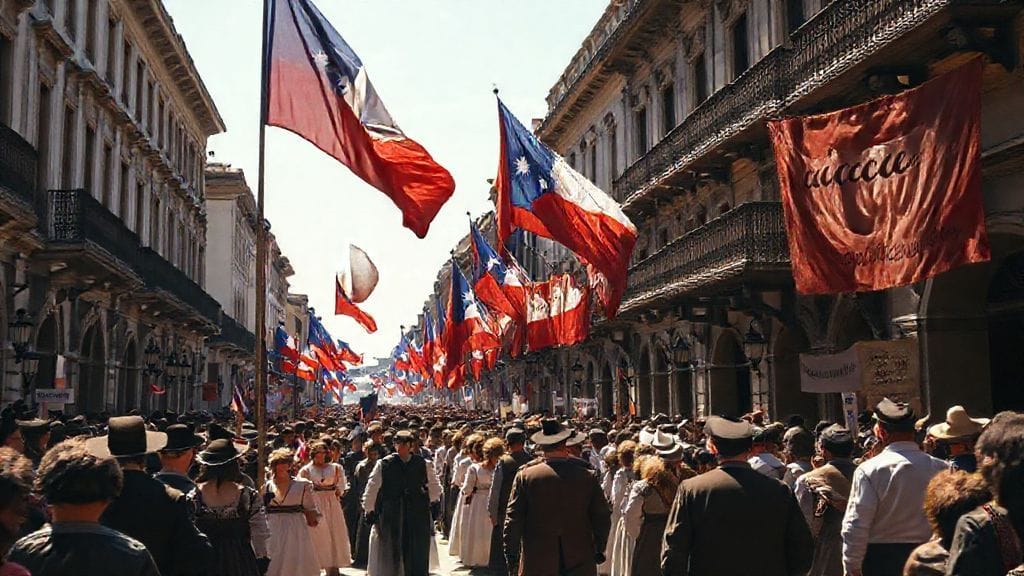
On the crisp morning of September 18, 1810, the Plaza de Armas in Santiago teemed with a restless crowd, their eyes fixed on the cabildo, the colonial council’s seat. The air was thick with anticipation, charged by murmurs of change and the scent of damp earth after early morning rain. This was no ordinary day. It was the day when Chile’s fate veered irrevocably toward self-determination. Voices rose in debate, hearts pounded with hope — touches of fear intersected with courage as a citizenry stood at the threshold of history.
For centuries, Chile had languished under the distant rule of the Spanish Crown, restrained by colonial structures and arbitrary decrees issued miles away across the Atlantic. Yet, on this landmark date, the first act of Chile’s independence movement unfolded, setting in motion a chain reaction that would challenge centuries of imperial dominance. This was not merely a political event but a profound social upheaval — a declaration that the age-old order was crumbling, and that a new world might emerge from the ashes of colonial rule.
It is impossible to fully grasp this moment without understanding the tempestuous currents that preceded it: a global revolution of ideas, a collapsing empire, and the ambitions of a society yearning to breathe freely. The Chilean independence movement was born of timing and tension, ignited by the collision of international conflict and local ambition. Through seasons of turmoil and triumph, September 18 remains etched in the collective Chilean consciousness — a date that transformed dreamers into architects of a nation.
Colonial Chile Under Spanish Rule: Seeds of Discontent
Long before that September morning, Chile was a distant outpost of the Spanish Empire — a sprawling territory governed through complex bureaucracies, military fortifications, and rigid socio-economic structures. The Captaincy General of Chile was administered by royal officials whose loyalty was pledged to kings thousands of miles away, who themselves were grappling with turmoil back in Europe. The colony’s economy relied heavily on agriculture, mining, and trade restricted by mercantilist policies that benefited the empire at Chile’s expense.
Yet life was not static. The indigenous Mapuche people fiercely resisted Spanish encroachment in the south, maintaining a tense standoff that defined much of the region’s military posture. Meanwhile, the colonists, especially the Creole elite — those of Spanish descent born in America — chafed under their political marginalization. Though economically prosperous in some sectors, these Creoles had no access to the highest colonial offices, reserved for peninsulares, Spaniards born in the Iberian Peninsula. The frustration simmered quietly, forming an undercurrent of dissatisfaction that would one day break open.
Social stratification intensified tensions further. The indigenous population, mestizos, and enslaved Africans occupied the lower rungs of society, excluded politically and economically. Within this rigid hierarchy, the idea of equality remained a distant, even revolutionary dream. But the seeds were sown — those who wanted more rights, more say, more freedom were no longer content to wait in silence. Chile’s transformation was seeded in these contradictions.
The Influence of Enlightenment Ideas and Global Revolutions
The late eighteenth century ushered in an era of Enlightenment philosophy, bringing ideas of liberty, equality, and popular sovereignty into the colonial consciousness. News of revolutions in America and France, with their dramatic assertions of human rights and republican ideals, spread across the Atlantic like wildfire. Pamphlets, books, and letters circulated clandestinely among Chile’s intellectual circles, inspiring debates that would previously have been unthinkable.
Thomas Jefferson’s Declaration of Independence and the French Revolution’s rallying cries were no longer distant echoes; they represented a blueprint, an ideological thrust that challenged monarchy and colonialism alike. The British Empire’s successes in North America and the subsequent independence of the United States resonated as proof that an empire could fall. Latin American intellectuals began to see themselves not merely as subjects but as citizens capable of governing themselves.
However, these new ideas also sowed divisions — between conservatives who still clung to monarchy and tradition, and radicals eager for sweeping reforms. The Catholic Church, deeply intertwined with colonial power, faced a dilemma: how to reconcile spiritual authority with the rising tide of secularism. Yet, despite uncertainties, the momentum toward independence was building, propelled by ideas that would soon overflow political boundaries.
The Role of the Creole Elite: Between Loyalty and Desire for Autonomy
At the heart of Chile’s independence movement stood its Creole elite — wealthy landowners, merchants, and professionals born in Chile but culturally Spanish. Their position was precarious, wedged between loyalty to the Crown and the desire for more political power. Many initially sought autonomy within the empire, echoing a moderate reformist stance rather than full revolution.
These men and women were educated abroad or had read widely; they understood European politics, trade networks, and the possibilities of governance. Notables like José Miguel Carrera and Bernardo O’Higgins embodied this class — figures whose personal ambitions intertwined with patriotic fervor. For them, independence was not just an abstract ideal but a pathway to reshape society on their terms, to break the monopoly of peninsulares, and to control Chile’s resources.
Yet, this push was complicated. Divisions among the elite themselves — between radicals and moderates, between Santiago and other regions — created a political mosaic that had to be navigated carefully. Their story is one of power struggles and collaboration, of visionaries and cautious tacticians united by a dream but differed in means.
The Napoleonic Invasion of Spain: Shaken Thrones and New Opportunities
Europe’s convulsions unleashed by Napoleon Bonaparte’s ambitions reached far beyond the continent, sending shockwaves through the Spanish Empire. In 1808, Napoleon’s armies invaded Spain, and King Ferdinand VII was deposed, replaced by Joseph Bonaparte, Napoleon’s brother. This unprecedented crisis of legitimacy in the mother country destabilized colonial rule — if the King was captive or replaced, what authority remained?
Spanish America, Chile included, found itself at a crossroads. Some colonies declared loyalty to the deposed Ferdinand and rejected the new French-imposed regime, but many began to question the colonial hierarchy itself. If Spain could not govern, why should its American possessions remain subservient?
The confusion was palpable — Royalist loyalists vied to preserve the empire, while local leaders exploited weak Spanish control to assert provisional authority. This historic rupture offered a political opening that Chile’s Creole elite could not ignore. The invasion was not merely a European conflict; it was a catalyst for revolutionary change in the Americas.
The Prelude to the Movement: Gatherings and Growing Tensions
In the months leading to September 1810, Santiago was a hotbed of political intrigue and debate. The cabildo abierto — an open town council — had been convened periodically throughout the colony’s history, but this assembly took on unprecedented significance. Discussions shifted from routine administrative matters to weightier questions of sovereignty and governance.
Rumors swirled. Meetings became more frequent and intense. The public square and social halls thrummed with passionate argument: Should Chile remain loyal to the Spanish Crown under its conventional structures, or take bold steps toward autonomy? Could they trust the promises of loyalty from the peninsulares, many of whom were seen as obstacles to change?
Together, these tensions culminated in that decisive day in September, when the people’s voices could no longer be contained. The legal and symbolic act of forming a Junta de Gobierno—a Government Junta—marked a break with tradition and an explosive assertion of self-rule.
September 18, 1810: The Cabildo Abierto and the Birth of the Junta
The moment arrived. On September 18, the cabildo abierto convened in Santiago’s central hall, attended by a broad spectrum of society — from landowners and military officers to intellectuals and representatives of the common people. Speeches ensued, debates consumed every hour, often heated but rooted in a shared undercurrent of hope.
Ultimately, the colonial officials consented to form a governing junta to administer Chile locally “in the name of King Ferdinand VII” — a diplomatic phrase reflecting lingering loyalty, but in reality a decisive move toward self-government. This junta represented Chile’s first step not simply toward reform, but toward independence.
This act might seem cautious, even ambiguous, but it was revolutionary. It shattered the colonial monopoly and asserted a political will that was new and irrepressible. The plaza outside witnessed rejoicing and the planting of patriotic symbols; the nation’s heartbeat quickened.
Key Figures of Chilean Independence: Heroes Emerging from Shadows
A handful of charismatic and resolute individuals emerged as architects and champions of Chile’s fledgling independence movement. José Miguel Carrera, a military leader whose influence would wax and wane, was instrumental in propelling radical reforms and organizing resistance. Bernardo O’Higgins, descendant of Irish nobility, combined military prowess with political vision, becoming a symbol of unity and tenacity.
Meanwhile, figures such as Juan Martínez de Rozas provided intellectual leadership, advocating for republican ideals and mobilizing popular support. Their stories are tales of bravery, sacrifice, ideological conflict, and personal ambition — qualities that humanized the grand narrative of revolution.
These men were imperfect, their motives multifaceted. Yet their resolve galvanized Chile’s movement, demonstrating that liberation required courage on and off the battlefield.
From Santiago to the Provinces: Spreading Fires of Liberty
While the movement ignited in Santiago, Chile’s diverse geography posed challenges to uniting distant regions. Provinces like Coquimbo, Valparaíso, and Concepción responded variably. Some embraced the idea of autonomy, driven by local elites eager for participation in this new order. Others remained loyalist, uncertain or fearful of the upheaval.
Communication delays and rugged terrain complicated coordination, but a network of political agents, military expeditions, and newsletters gradually knitted the disparate provinces into a single revolutionary cause. Each region contributed its unique character — coastal towns furnished naval support; inland cities, manpower and resources.
This diffusion of revolutionary energy underscored Chile’s transformation from a colony into a nation with a collective identity—a mosaic united in hope, yet fractured by geography and local interests.
The First Steps Toward Self-Government and Institutional Experimentation
With the junta established, Chile entered an experimental phase of governance. The new authorities faced immediate challenges: organizing defense forces, establishing taxation systems independent of Spain, and drafting laws that reflected Chilean realities rather than imperial decrees.
This period witnessed early struggles to balance power between military leaders and civilian authorities, as well as contentious debates on the extent of reforms. Inequality remained deeply entrenched, and the nascent government wrestled with building legitimacy among populations unused to political participation.
Yet these initial efforts laid foundational stones for Chile’s future institutions. Administrative innovation and the gradual assertion of sovereignty demonstrated that independence was more than a slogan — it was a practical, ongoing project.
The Duality of Hope and Uncertainty: Challenges Facing the New Junta
Though hopeful, Chile’s first government confronted profound uncertainties. The junta professed loyalty to King Ferdinand VII but acted autonomously, a diplomatic balancing act fraught with ambiguity. Internally, factionalism threatened unity: moderates preferred gradual reform and maintenance of order, radicals pushed for full independence and sweeping social changes.
Externally, the Spanish Crown sought to reassert control, dispatching loyalist forces to the colony. Neighboring territories also wrestled with similar upheavals, creating an unstable geopolitical environment.
Economic hardships compounded fears. The colony’s trade networks were disrupted; the cost of war began to strain resources. For ordinary Chileans, the future was unclear — promises of liberty were shadowed by the threat of civil war, hunger, and repression.
The Spanish Crown’s Response: Loyalty, Repression, and Fragmentation
Spain was not idle. The royalist authorities regarded the junta’s formation as rebellion. Loyalist armies were organized, and counter-insurgency efforts launched, leading to periods of violent conflict. Royalist propaganda sought to discredit the independence movement as lawless and dangerous.
Moreover, the empire itself was fragmenting. Other South American colonies followed suit, declaring their own intent to govern independently or form juntas. Spain, stretched thin by war, was unable to effectively suppress these movements.
This imperial crisis marked the slow dissolution of colonial order. The subsequent years would be marred by warfare—a brutal test of Chile’s resilience and desire for freedom.
Civil Strife and Conflict: Early Battles and Political Divides
Post-1810, Chile descended into a protracted struggle between patriots and royalists. Battles such as the Siege of Chillán and the Disaster at Rancagua became brutal turning points, with alternating victories and defeats. The internal political scene was no less turbulent, with coups, purges, and factional rivalries punctuating the fragile quest for unity.
For many, the initial idealism collided with harsh realities: betrayal, loss, and questions over the future direction of the independent state. Figures like Carrera faced exile, while O’Higgins’ leadership rose amid the chaos.
Civil strife was not simply political—it tore families and communities apart, leaving scars that would echo through Chilean society for generations.
The Role of Ordinary People: Patriots, Loyalists, and the Silent Majority
While history often remembers leaders, the independence movement deeply involved ordinary Chileans. Farmers, artisans, indigenous peoples, and freedmen each faced choices and consequences linked to the revolution. Many volunteered to fight, contributed supplies, or supported political cause in silence.
Their experiences reveal the movement’s human dimension: fears of violence, hopes for land reform, anxieties about social order. The war disrupted daily life, but also opened spaces for voices that colonial rule had suppressed.
Even among the “silent majority” — those neither fervently patriotic nor staunchly loyalist — the unrest birthed new social consciousness, laying groundwork for a more inclusive national identity.
Economic Underpinnings: Trade, Agriculture, and the Cost of Revolution
Chile’s economy was both a pillar of colonial control and a battleground for revolution. Agricultural exports, especially wheat and livestock, were vital, but mercantilist restrictions limited trade freedom. Independence threatened established economic links with Spain, but promised new opportunities, particularly with emergent markets such as Britain and the United States.
The war effort drained resources, requiring heavy taxation and borrowing. Blockades and instability disrupted commerce, causing shortages and inflation. For elite landowners, these were calculated risks; for peasants and workers, hardships intensified.
Eventually, Chile’s economic restructuring—freed from colonial constraints—would underpin its long-term viability as a sovereign nation.
The Cultural Awakening: Literature, Symbols, and National Identity Formation
Beyond politics and economics, the independence movement sparked profound cultural reawakening. Poets, writers, and artists began to articulate a distinct Chilean identity rooted in local landscapes, history, and aspirations. The flag, national anthem, and other symbols crystallized collective pride.
Institutions of education and press flourished, spreading republican values and recounting heroic tales. Intellectual salons buzzed with ideals that combined indigenous heritage, Hispanic tradition, and Enlightenment philosophy.
This cultural flowering helped unify disparate regions and peoples, knitting together the fragile fabric of a nation.
The Long Road: From Proclamation to Complete Sovereignty
While September 18, 1810 marked the inception of self-government, full independence was neither immediate nor linear. Chile’s struggle extended over a decade, interrupted by invasions, internal conflicts, and shifting alliances. True sovereignty was cemented with the victory at the Battle of Chacabuco in 1817 and the formal declaration of independence two years later, leaving behind the ambiguities of the junta era.
Nonetheless, the movement ignited in 1810 set an irreversible course. The courage, failures, and vision of those early years forged the Chilean nation-state that continues to evolve.
Chilean Independence in the Context of Latin American Revolutions
Chile’s experience was part of a broader wave of independence movements that reshaped the Americas. Inspired by shared ideals but influenced by local conditions, these revolutions reconfigured geopolitics. Leaders like Simón Bolívar elsewhere marched armies and drafted constitutions, while Chile navigated its own path through leadership and military endeavor.
The interconnectedness of these struggles underlines the global nature of Chile’s independence, linking it to human quests for freedom across continents.
International Reactions: European Empires and the New World Order
Chile’s bid for independence rippled across international waters. European powers watched cautiously, some fearing the spread of revolution and the loss of colonial revenue. Britain, however, with commercial interests, often supported or tolerated independence movements, hoping to open markets.
The complex diplomatic dance shaped Chile’s external relations for decades. Independence was not merely internal emancipation but a redefinition of Chile on the global stage.
Legacies of September 18: Modern Independence Celebrations
Every September 18, Chileans commemorate the birth of their nation with festivals, parades, and public ceremonies. The day is embedded in national memory not only as a political milestone but as a celebration of identity, resilience, and cultural pride.
These traditions reinforce the lessons of 1810 — that freedom is hard-won, fragile, and worth cherishing.
Reflections on Freedom: The Human Cost and the Spirit of Resilience
The Chilean independence movement is as much a story of sacrifice as it is of triumph. Blood was shed, families divided, and social orders shaken. Yet from these trials emerged a spirit of resilience — a commitment to self-determination, justice, and hope that continues to inspire.
The narrative of September 18, 1810 invites us to remember the complexity of revolution: where courage meets doubt, and history is forged in the hearts of ordinary and extraordinary alike.
Conclusion
Chile’s declaration of the independence movement on September 18, 1810, was a moment of profound transformation, not only politically but culturally and socially. Against the backdrop of global upheaval and imperial collapse, the people of Chile seized the opportunity to redefine themselves as free citizens, no longer shadows of a distant monarchy but architects of their destiny.
This profound event reveals the power of ideas to mobilize societies, the importance of leadership balanced with popular involvement, and the inevitable challenges of forging a new nation amid uncertainty and conflict. More than two centuries later, the legacy of that day remains a beacon — a reminder that freedom is born from courage, shaped by complexity, and sustained by shared purpose.
September 18 is not simply a historical anniversary; it is the eternal pulse of Chilean identity, echoing the sacrifices and dreams of those who dared to claim liberty and forge a future their descendants continue to defend and cherish.
FAQs
Q1: What triggered the Chilean independence movement on September 18, 1810?
A1: The invasion of Spain by Napoleon and the deposition of King Ferdinand VII created a legitimacy crisis in the Spanish Empire, prompting Chile’s Creole elite and other local actors to form a self-governing junta as a first step toward autonomy.
Q2: Who were the main leaders of Chile’s early independence movement?
A2: Figures such as José Miguel Carrera, Bernardo O’Higgins, and Juan Martínez de Rozas played pivotal roles through military leadership, political vision, and intellectual advocacy.
Q3: How did the Chilean independence movement relate to other Latin American revolutions?
A3: Chile’s movement was interconnected with broader regional movements inspired by Enlightenment ideas and global conflicts, contributing to the eventual fragmentation of Spanish America into multiple republics.
Q4: What role did ordinary Chileans play in the independence process?
A4: Farmers, artisans, indigenous peoples, and others participated as soldiers, supporters, or by enduring hardships; their involvement was crucial in sustaining the revolutionary effort beyond elite circles.
Q5: Why did the 1810 junta proclaim loyalty to King Ferdinand VII while acting independently?
A5: This was a pragmatic diplomatic stance to maintain legitimacy and avoid immediate confrontation with Royalist forces while asserting de facto local governance.
Q6: How did the Spanish Crown react to Chile’s declaration of autonomy?
A6: Spain attempted to suppress the movement through military force and political repression, leading to a prolonged conflict until Chile achieved definitive independence.
Q7: What were the economic effects of the independence movement on Chile?
A7: The disruption of trade and warfare caused hardship and required economic restructuring, but independence eventually allowed Chile to open trade with new partners and develop its economy.
Q8: How is September 18 celebrated in Chile today?
A8: It is the nation’s Independence Day, marked by patriotic events, cultural celebrations, parades, and public ceremonies highlighting national identity and historical memory.