Table of Contents
- A Dimming Light: The Final Days of Christine de Pizan
- The Historical Context: France and Europe at the Dawn of the 15th Century
- The Life of Christine de Pizan: From Court Poet to Woman of Letters
- Intellectual Brilliance in a Turbulent Era
- The Hundred Years’ War: Shadows over Christine’s World
- The Personal and Political: Christine’s Engagement with the Armagnac-Burgundian Conflict
- The Last Years: Retreat and Reflection in Poissy and Paris
- The Ambiguities of Death: Christine de Pizan’s Final Silence
- The Survival of a Legacy: Manuscripts, Myth, and Memory
- The Feminist Pioneering of Christine de Pizan
- The Cultural Milieu: Paris as a Center of Thought and Power
- Christine’s Literary Odyssey: From Ballads to Treatises
- The Controversies and Critiques During Her Lifetime
- Correspondence and Networks: Christine’s Circle of Influence
- Gender and Authorship: The Challenges Faced by a Medieval Woman Writer
- Death and Burial: The Mysteries Surrounding Christine’s Tomb
- The Rediscovery of Christine de Pizan in Modern Scholarship
- Christine’s Influence on Later Writers and Feminists
- The Political Undertones in Christine’s Final Works
- How History Remembers Christine de Pizan
- Conclusion: A Woman Ahead of Her Time, Echoing Through Centuries
- FAQs — The Enduring Questions Around Christine de Pizan’s Death and Legacy
- External Resource
- Internal Link
The narrow streets of Poissy, just outside Paris, were cloaked in the cold mist of early spring, a world slowly awakening from winter’s grip, yet still bearing the weight of centuries-old strife. It was here, around the year 1430, that one of the Middle Ages’ most luminous intellects—Christine de Pizan—breathed her last. The sound of a quill resting in silence echoed silently through the halls where she had crafted her words; the heart of a poet and philosopher ceased to beat. But who was Christine de Pizan at this final moment? What world did she leave behind, and what legacy did her death mark?
Her passing did not announce itself with loud fanfare. No royal decree echoed in the grand halls; no chronicler immortalized the moment with dramatic prose. Instead, it was a quiet expiration, almost lost within the upheavals of a France scarred by war, division, and sorrow. Yet, beneath this hushed farewell lay the end of an era—an era that would soon forget many of its daughters and scholars, but never Christine.
A Dimming Light: The Final Days of Christine de Pizan
The last known records place Christine in Poissy, a small town that had served as a royal retreat and ecclesiastical seat, where she likely lived under the care or patronage of religious institutions. Like a fading flame, her presence was noted less for grand gestures and more for the cumulative power of what she had accomplished. Born in Venice but raised in the literary epicenter of Paris, her death marked not just the physical cessation of life but a symbolic closing of a chapter for medieval literature and proto-feminist thought.
Circumstances of Christine’s last days are nebulous; some suggest she withdrew into a convent, seeking solace in faith after a life riddled with personal grief and political turmoil. Others propose that she remained a solitary figure in the capital’s fringes, pen in hand until fatigue claimed her. What is certain is that sometime around 1430, Christine de Pizan’s voice fell silent.
The Historical Context: France and Europe at the Dawn of the 15th Century
To appreciate the weight of Christine’s death, one must paint the grim tableau of Europe in her final decade. The early 1400s were dominated by the exhausting Hundred Years’ War between England and France—a conflict that shredded loyalties and devastated populations. Paris itself was a hotbed of factionalism, caught between the Armagnacs and Burgundians, its citizens caught in waves of violence and political upheaval.
This period saw the gradual collapse of the feudal order and the painful birth model of the modern nation-state. Intellectual life was undergoing transformations, with universities growing and manuscript culture thriving—but women’s voices were fundamentally marginalized in public discourse. Yet Christine de Pizan carved herself a place in this male-dominated intellectual landscape.
The Life of Christine de Pizan: From Court Poet to Woman of Letters
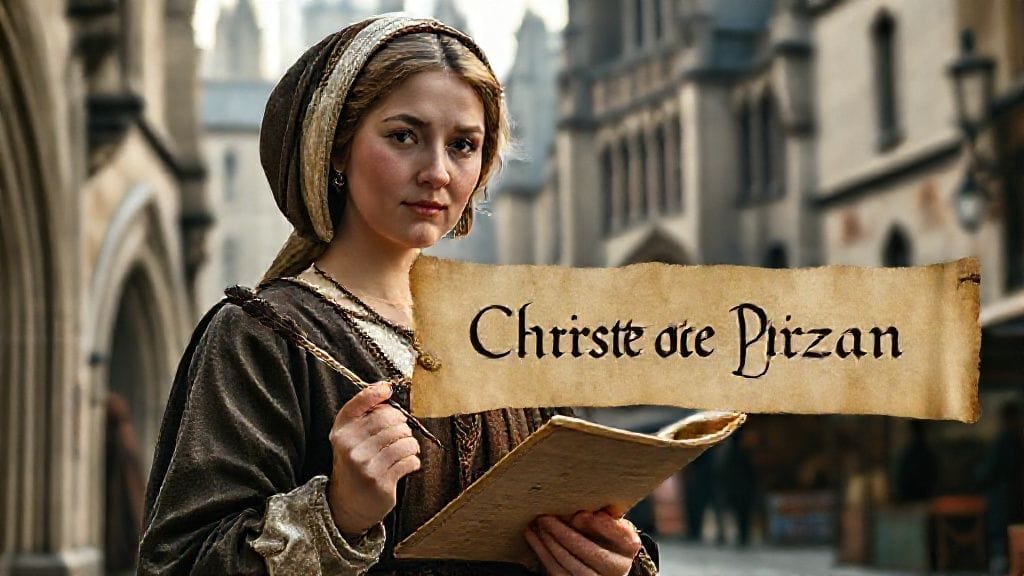
Born around 1364, Christine entered the world at the intersection of cultures—her father, Tommaso di Benvenuto da Pizzano, was a court astrologer who brought traditions from Italy to the French court of Charles V. This cosmopolitan background nourished her precocious intellect and love of letters. Widowed young, she defied convention by supporting herself and her children through writing—unheard of for women at the time.
Her early works reflected refined courtly styles: lyrical ballads, allegorical poems, and history wrapped in elegance. But as war and misfortune struck, Christine’s pen hardened. Her voice grew sharper, her ideas bolder.
Intellectual Brilliance in a Turbulent Era
Christine was not merely a poet; she was one of the first women in Europe to claim authorship as a profession, and the first to wield it with public seriousness. Her treatises argued for women’s moral and intellectual equality, challenging misogynistic traditions and defending women’s rightful place in history and society.
Her magnum opus, The Book of the City of Ladies, remains a timeless declaration—a fortress of female virtue and wisdom amidst pervasive prejudice. Yet, she also engaged deeply with the politics of her day, always aware that literature could not be divorced from reality.
The Hundred Years’ War: Shadows over Christine’s World
The protracted conflict between England and France was not merely a battlefield of armies, but one of ideas, propaganda, and identity. Christine’s life spanned the phases in which the war shifted from French confidence to English ascendancy, then back again with an inflection toward French nationalist resurgence inspired by figures like Joan of Arc.
Throughout these upheavals, Christine’s writings assumed urgency; she implored rulers to remember justice and the responsibilities of power, condemning violence while advocating for peace. The environment of relentless conflict shaped her worldview to its core.
The Personal and Political: Christine’s Engagement with the Armagnac-Burgundian Conflict
While the larger war waged abroad, internal French conflicts tore the kingdom apart. Christine’s writings reflect a deep knowledge of Parisian politics and emphasize the corrosive effects of factional hatred. Her connections to the royal court meant she was uniquely positioned to observe and comment on the intrigues that defined the city’s governance.
Her letters often reveal a woman trying to mediate and influence, hoping to foster unity in a land fractured by distrust. This engagement further distinguished her from court poets content with mere flattery.
The Last Years: Retreat and Reflection in Poissy and Paris
As the wars dragged on and her family circumstances evolved, Christine’s presence in Paris and Poissy deepened in solitude and contemplation. There is evidence to suggest she returned to religious life, spending much time in reflection on the spiritual as well as the political.
These decades likely saw her revisiting earlier themes with the wisdom of hindsight, aware that her generation was passing and that the world was transforming beyond all recognition.
The Ambiguities of Death: Christine de Pizan’s Final Silence
Unlike many contemporaries, the exact date and place of Christine’s death are not documented with certainty, a silence that historians find both frustrating and poetic. Her final withdrawal into near-obscurity aligns with the fate of many medieval women, whose lives were often lost to history soon after passing.
This mystery invites reflection: was her death intended to disappear quietly, or did the chaos of her times effectively erase the memory of an extraordinary woman?
The Survival of a Legacy: Manuscripts, Myth, and Memory
Despite the absence of a grand funeral or an official commemoration, Christine’s legacy survived in a constellation of handwritten manuscripts passed from scholar to scholar, women writers to students, changing hands over generations.
Her works became keystones for future debates about gender, authorship, and morality. The fragile pages bearing her signature were vessels transporting courage into the modern consciousness.
The Feminist Pioneering of Christine de Pizan
It is impossible to overestimate Christine de Pizan’s role as a proto-feminist—a woman who articulated a vision of female intelligence and virtue at a time when women’s minds and bodies were often dismissed or vilified.
Her death marked not the end of feminist advocacy, but a milestone along a winding path that today’s movements still trace. She remains a symbol of the resilience and endurance of women’s voices across ages.
The Cultural Milieu: Paris as a Center of Thought and Power
Christine’s life and death cannot be detached from the city that shaped her. Paris, still medieval in many ways but burgeoning with intellectual ferment, was a stage for her literary and political activity.
From its bustling book markets to its cathedrals and royal courts, the city was a crucible for the ideas and conflicts that inspired her. Poissy, quieter but equally significant, offered her a retreat near the heart of power—a liminal place between solitude and connection.
Christine’s Literary Odyssey: From Ballads to Treatises
Her literary trajectory—from courtly poetry to pointed treatises defending women and criticizing rulers—mirrors the tumult of her times and her personal growth.
The intensity and range of her writing provide a roadmap through shifting medieval mentalities, from chivalry and romance to ethics and politics interpreted through a female lens.
The Controversies and Critiques During Her Lifetime
Christine was not without critics; some accused her of stepping beyond prescribed social roles, while others dismissed her as a court propagandist. Yet many contemporaries recognized her talents; Christine navigated a treacherous cultural terrain with cleverness and dignity.
The debates surrounding her writings reveal the deep tensions about gender, power, and authority in her day.
Correspondence and Networks: Christine’s Circle of Influence
Letter writing was Christine’s lifeline, linking her with noble patrons, intellectual allies, and other writers. These correspondences illuminate how she circulated ideas, gained support, and sustained her career.
Through her epistolary exchanges, she became a node in the vibrant intellectual networks of late medieval Europe.
Gender and Authorship: The Challenges Faced by a Medieval Woman Writer
Christine’s persistence was extraordinary against the backdrop of gender norms that disfavored female authorship. The skepticism and outright hostility she confronted amplified the courage behind each page she wrote.
Her success redefined possibilities for women’s participation in cultural production.
Death and Burial: The Mysteries Surrounding Christine’s Tomb
There is no known grave for Christine de Pizan, a rarity for a woman of her stature and time. Speculation abounds about where she was laid to rest—some say a discreet convent chapel, others a forgotten church cemetery.
This lack of physical memorial contrasts with the enduring life of her words.
The Rediscovery of Christine de Pizan in Modern Scholarship
The 19th and 20th centuries witnessed a reawakening of interest in Christine, spurred by feminist historians and literary scholars. Her writings were re-edited, translated, and studied with fresh eyes, illuminating her role as a pioneer.
Today, her name carries renewed meaning, inspiring deeper appreciation of medieval women’s intellectual heritage.
Christine’s Influence on Later Writers and Feminists
From Mary Wollstonecraft to Simone de Beauvoir, echoes of Christine’s ideas resonate in feminist thought. Her insistence on equality, dignity, and respect laid early intellectual foundations that subsequent generations built upon.
Her life story itself became a template for reclaiming women’s neglected histories.
The Political Undertones in Christine’s Final Works
Even in her twilight years, Christine’s writings were politically charged, addressing rulers and citizens alike. She demanded justice, wisdom, and care for the vulnerable amid war and strife.
These messages remind us that literature can be an instrument of political engagement and moral exhortation.
How History Remembers Christine de Pizan
Christine de Pizan’s passage from celebrated intellectual to near obscurity and then to modern reverence encapsulates the vicissitudes of women’s history. Her death in Poissy/Paris symbolizes both an ending and a beginning—a silence pregnant with future voices eager to reclaim their heritage.
Conclusion
Christine de Pizan’s death around 1430 in Poissy or Paris closes the chapter of a remarkable life marked by intellect, courage, and vision. Yet, her silent farewell belies the reverberations her words continue to provoke centuries later. In a world rife with upheaval and uncertainty, she dared to imagine a society where women’s worth was recognized and celebrated.
Her story compels us to contemplate the power of the written word, the resilience of female agency amid adversity, and the enduring human quest for justice and knowledge. Though history has often muted her, Christine’s legacy remains a beacon illuminating the shared struggles and dreams of humanity across the ages.
FAQs
1. Why is the exact date and place of Christine de Pizan’s death uncertain?
Records from the early 15th century are fragmentary, especially regarding women, whose lives were less systematically documented. Christine’s death likely occurred quietly, without grand ceremony, and records may have been lost in the turbulence of war and political instability.
2. What were the main causes and influences on Christine’s writings during her final years?
The ravages of the Hundred Years’ War, internal factional conflicts, personal loss, and evolving gender norms deeply influenced her later works, prompting her to advocate for peace, justice, and women's dignity.
3. How did Christine de Pizan contribute to early feminist thought?
She was one of the earliest writers to defend women’s intellectual and moral capacities openly, challenging prevailing misogyny and constructing an alternative history where women were heroes and thinkers.
4. In what ways did Christine’s death affect the preservation and transmission of her work?
Her death coincided with an era where many female authors were forgotten. However, the careful copying and circulation of her manuscripts by admirers ensured her ideas endured, albeit often marginalized until modern rediscoveries.
5. How is Christine de Pizan commemorated today?
She is celebrated as a pioneering woman writer and feminist figure, with scholarly conferences, statues, and literary prizes bearing her name, recognizing her lasting impact.
6. Did Christine de Pizan live in a convent by the end of her life?
While some historians suggest she may have taken religious vows or lived in a convent, definitive evidence is lacking. Her later life was certainly marked by spiritual reflection, whether inside or outside formal religious communities.
7. What were Christine’s relationships with contemporaneous political powers?
She maintained connections with French royal courts and noble patrons, offering counsel through letters and writings, seeking to influence policies amid strife.
8. How have modern perspectives on gender altered the study of Christine de Pizan?
Contemporary feminist theory has re-framed Christine as a foundational figure, amplifying the significance of her work and life against the historical backdrop of women’s exclusion.