Table of Contents
- The Dawn of a New Era: July 2, 1964 in Washington, D.C.
- The Legacy of Segregation: Roots of Racial Inequality in America
- The Fight for Civil Rights: From Brown v. Board to Birmingham’s Fury
- Martin Luther King Jr. and the Moral Crusade for Justice
- The Political Battlefield: Kennedy, Johnson, and the Struggle for Legislation
- The Civil Rights Act: What It Promised to Change
- Behind Closed Doors: The Legislative Tangle and Fierce Opposition
- July 2, 1964: The Historic Signing Ceremony
- Voices on the Mall: Reactions from the African American Community
- Southern Resistance: The Whirlwind of Defiance and Defiance
- The Act’s Immediate Impact: Schools, Workplaces, and Streets
- The Long Road Ahead: The Civil Rights Act and the Voting Rights Movement
- Economic Shifts: How the Act Began Reshaping Opportunities
- Culture and Society: The Act’s Ripple in American Daily Life
- International Reverberations: America’s Image in the Cold War Era
- The Civil Rights Act in the Twenty-First Century: Legacy, Challenges, and Progress
- Remembering the Heroes: Beyond the Lawmakers
- The Act’s Limitations and the Continuing Quest for Equality
- The Civil Rights Act as a Beacon for Other Movements
- Conclusion: A Step Forward, Always a Work in Progress
- FAQs: Clarifying the Civil Rights Act and its Historic Meaning
- External Resource
- Internal Link
1. The Dawn of a New Era: July 2, 1964 in Washington, D.C.
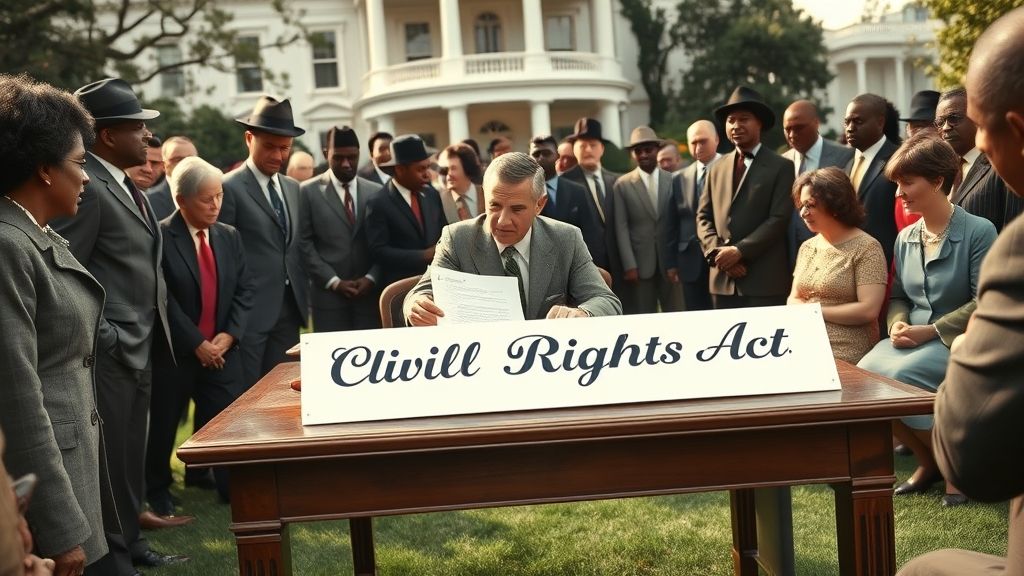
On a humid summer afternoon in Washington, D.C., July 2, 1964, crowds gathered with a collective breath held tight—hope mingled with exhaustion, exhilaration shadowed by decades of pain. Beneath the dome of the Capitol, President Lyndon B. Johnson signed into law the Civil Rights Act, a landmark decree promising to dismantle legalized racial segregation across the United States. The moment pulsed with a raw intensity: tears, applause, hushed sobs, an electric feeling that the nation teetered on the cusp of transformation.
Still, the thousands who listened, clapped, and watched knew the road ahead was treacherous. The act represented a victory won through relentless protest, staggering courage, and political maneuvering — but also a beginning, not an end. The day was a sunbeam cutting through a dark tunnel that stretched back centuries, piercing the heart of systemic injustice with the hope of a fairer tomorrow.
2. The Legacy of Segregation: Roots of Racial Inequality in America
To understand the import of the Civil Rights Act, one must journey back to a nation fractured at its founding. Slavery, Jim Crow laws, and entrenched racial hierarchies had for centuries woven deep roots into American soil. Following the Civil War and Reconstruction, Southern states erected legal barriers — literacy tests, poll taxes, “separate but equal” doctrines — effectively disenfranchising Black Americans and codifying segregation in schools, transportation, public accommodations, and employment.
The scourge of segregation was a system designed to subjugate millions, to stifle voices, and to deny basic dignity. It was not merely a social norm but a racial caste system, relentlessly enforced through violence, economic suppression, and legal frameworks sculpted to maintain white supremacy. The Civil Rights Movement was a rebellion not only against laws but against a nation’s complicity in inequality.
3. The Fight for Civil Rights: From Brown v. Board to Birmingham’s Fury
The cracks began appearing in the 1950s. The 1954 Supreme Court decision in Brown v. Board of Education declared segregation in public education unconstitutional, shattering the “separate but equal” myth. But the ruling sparked violent backlash in cities across America, from Little Rock’s integration crisis to Birmingham’s brutal police crackdowns on peaceful protestors.
The resistance hardened, but so did the resolve of activists. The Montgomery Bus Boycott, sparked by Rosa Parks’ simple, courageous act of defiance, marked a turning point. Grassroots organizing, mass marches, and legal challenges grew bolder — this was no longer just a regional struggle, but a national reckoning.
4. Martin Luther King Jr. and the Moral Crusade for Justice
No figure loomed larger than Martin Luther King Jr., the preacher whose rhetoric wove faith and justice into a tapestry of peaceful resistance. King’s leadership during protests in Montgomery, Birmingham, and Selma galvanized a fractured movement, transforming disparate grievances into a united moral crusade. His sermons echoed the promises of American democracy, exposing its hypocrisies.
King’s philosophy of nonviolent civil disobedience invoked empathy as a tool for change, shining a spotlight on the cruelty of segregation and galvanizing public opinion. His presence was both a balm and a beacon—providing black Americans and sympathizers a vision of justice that transcended bitterness and retaliation.
5. The Political Battlefield: Kennedy, Johnson, and the Struggle for Legislation
As civil rights protests intensified, political leaders found themselves in the crucible of history. President John F. Kennedy, initially cautious, acknowledged that federal intervention was necessary to curb violence and dismantle segregation. His assassination in November 1963 was a blow to the movement, yet it also propelled his vice president, Lyndon B. Johnson, into a pivotal role.
Johnson, a master of legislative strategy and political will, seized the moment, invoking Kennedy’s legacy to push the Civil Rights Act through a reluctant Congress. The showdown in Capitol Hill was brutal: filibusters, stalemates, and fierce Southern opposition threatened to derail the historic bill.
6. The Civil Rights Act: What It Promised to Change
The Civil Rights Act was expansive in scope: outlawing discrimination on the basis of race, color, religion, sex, or national origin. It aimed to desegregate public places, prohibit unequal application of voter registration requirements, and enforce fair employment practices.
For the first time in American history, it declared segregation in public accommodations illegal and empowered the federal government to oversee and enforce civil rights. This act laid the legal foundation for dismantling systemic racial barriers and signaled a profound ideological shift.
7. Behind Closed Doors: The Legislative Tangle and Fierce Opposition
Passing the Civil Rights Act was no simple feat. Southern senators staged an unprecedented 60-day filibuster, deploying every procedural tactic to stall and block the bill. Opponents railed that the act infringed on states’ rights and threatened the social order.
Yet, coalition-building across party lines, behind-the-scenes negotiation, and unyielding activism pushed the bill forward. Key figures such as Senator Hubert Humphrey and Senator Everett Dirksen crafted compromises to navigate the complex political terrain, illustrating how legislative skill and ethical imperatives collided.
8. July 2, 1964: The Historic Signing Ceremony
The ceremony itself was laden with symbolism. In the East Room of the White House, President Johnson signed the bill amid civil rights leaders, lawmakers, and the press. King was absent, due to his participation in a voting rights campaign in Mississippi, but his voice seemed to echo in the room.
Johnson famously stated, “The time has come for this nation to fulfill its promise.” The Civil Rights Act was a testament to patience and persistence. The ink on the document was a victory not just of law, but of humanity’s capacity to slowly bend the arc toward justice.
9. Voices on the Mall: Reactions from the African American Community
Across the country, African Americans greeted the act with cautious jubilation. For many, it was the fruit of decades of struggle, sacrifices, and risk. Churches held special services; newspapers hailed the triumph.
Yet, interviews revealed a mix of hope and skepticism. As scholar James Weldon Johnson had once warned, laws could not alone eradicate deep social prejudices, but they created a platform for future change. For everyday citizens, the act was a shield and a sword—a protection in law, a call to vigilance in practice.
10. Southern Resistance: The Whirlwind of Defiance and Defiance
The passage of the Civil Rights Act did not quell Southern opposition; it inflamed it. “Massive resistance” movements cropped up—state governments, local officials, and segregationists fought tooth and nail to skirt or sabotage enforcement.
From “freedom of choice” school plans to discriminatory hiring practices, the South became ground zero for contesting the new order. The battle lines drawn in Washington had merely moved to courthouses, city halls, and lunch counters—in classrooms, in workplaces, and on buses.
11. The Act’s Immediate Impact: Schools, Workplaces, and Streets
Despite obstruction, the Civil Rights Act began to reshape American society. Schools were forced to integrate, sometimes amidst violence and protests. Workplaces slowly diversified, and public accommodations ceased to legally exclude African Americans.
Employers, hotels, theaters, and restaurants carried the legal obligation to comply or risk judicial review. For the first time, federal agencies monitored discrimination, giving new teeth to civil rights enforcement. Yet, the pace of change was uneven, sometimes painfully slow.
12. The Long Road Ahead: The Civil Rights Act and the Voting Rights Movement
While the act tackled segregation and discrimination broadly, voting rights remained precarious. In the following year, the brutal “Bloody Sunday” march in Selma underscored ongoing voter suppression. The Civil Rights Act set the stage but was followed by the 1965 Voting Rights Act — another landmark in securing black Americans’ political voice.
Together, these laws reshaped the political landscape and redefined citizenship in America. Yet, fierce struggles and sacrifices continued—reminding all that legal victories are but milestones on a longer journey.
13. Economic Shifts: How the Act Began Reshaping Opportunities
Beyond social integration, the Civil Rights Act catalyzed important shifts in economic participation. Title VII’s ban on employment discrimination fostered workplace diversity, opening doors to previously barred professions.
Though economic disparities persisted, the Act empowered the Equal Employment Opportunity Commission to challenge discriminatory hiring, pay disparities, and promotion barriers. The act also indirectly encouraged greater access to education and training, planting seeds for future African American middle-class growth.
14. Culture and Society: The Act’s Ripple in American Daily Life
The Civil Rights Act penetrated everyday life, reshaping perceptions and interactions. For the first time in decades, Black Americans accessed hotels, restaurants, and entertainment venues previously forbidden.
This legal inclusion also challenged prevailing cultural narratives — TV shows, literature, and music began reflecting a more integrated America. The act emboldened communities to confront prejudice openly and fostered a growing dialogue about equality in schools, churches, and neighborhoods.
15. International Reverberations: America’s Image in the Cold War Era
In the midst of the Cold War, the United States’ internal race struggles were a potent weapon in Soviet propaganda, which painted America as hypocritical for preaching democracy abroad but practicing segregation at home.
The Civil Rights Act was thus not only a domestic victory but a strategic move in the ideological battle with the Soviet Union. It helped soften criticism overseas, bolstered America’s global standing, and added moral weight to its leadership on human rights.
16. The Civil Rights Act in the Twenty-First Century: Legacy, Challenges, and Progress
Decades later, the Civil Rights Act remains foundational in America’s legal framework for equality. Its principles have been invoked in subsequent struggles—for gender equality, disability rights, and LGBTQ+ protections.
Yet, challenges endure: systemic racism, voting restrictions, and economic inequality remind us that the promise of 1964 is not fully realized. The Act’s spirit lives on in contemporary movements like Black Lives Matter — a testament to ongoing vigilance and activism.
17. Remembering the Heroes: Beyond the Lawmakers
The passage of the Act was the triumph of many often forgotten in history: grassroots activists, ordinary citizens who braved violent backlash, and local leaders organizing boycotts and marches. Women like Ella Baker and Fannie Lou Hamer, and countless unnamed marchers, carried the movement forward.
Their courage, resolve, and sacrifices form the backbone of the Civil Rights Act’s story—a mosaic of human struggle inspiring generations.
18. The Act’s Limitations and the Continuing Quest for Equality
Despite its landmark stature, the Civil Rights Act could not erase centuries of injustice overnight. It primarily addressed legal discrimination but not social prejudice or economic inequality fully.
Many African Americans still faced barriers to housing, voting, and equitable policing. These limitations drove subsequent legislation and reforms, underscoring the Act as a vital but incomplete step.
19. The Civil Rights Act as a Beacon for Other Movements
The success of the Civil Rights Act ignited and inspired other social movements globally: women’s liberation, disability rights, Indigenous struggles, and LGBTQ+ activism all drew upon its legal and moral framework.
It became a model illustrating how persistent advocacy, combined with political action, could reshape societies—turning dreams of equality into tangible law.
20. Conclusion: A Step Forward, Always a Work in Progress
The legislation signed on July 2, 1964, was more than a law—it was a clarion call for justice, dignity, and national conscience. It emerged from the grit, tears, and unwavering hope of millions who refused to accept a divided America.
Yet, the Civil Rights Act is not a final destination. It is a landmark, a beacon lighting the path, reminding us that equality demands continual striving. Its story teaches that progress is possible when courage meets conviction, and the arc of history bends, ever so slowly, toward justice.
Conclusion
The Civil Rights Act of 1964 stands as a towering testament to the power of perseverance, unity, and moral clarity. It marked a pivotal turning point from a segregationist past toward a vision of a more inclusive America. But it also revealed the complexities of social transformation—the push and pull between entrenched systems and human aspiration.
Its legacy is woven into the fabric of American democracy, a reminder that laws alone cannot heal wounds, but they can empower those who dare to imagine a fairer world. As new generations confront enduring inequalities, the Act’s story offers not merely history but inspiration: that justice, though hard-won, remains within reach when courage insists.
FAQs
Q1: What were the main provisions of the Civil Rights Act of 1964?
The Act outlawed discrimination based on race, color, religion, sex, or national origin in employment, education, public accommodations, and federally funded programs. It authorized the federal government to enforce desegregation and created the Equal Employment Opportunity Commission (EEOC).
Q2: Who were the key figures behind the passage of the Civil Rights Act?
President Lyndon B. Johnson played a crucial role, as did civil rights leaders such as Martin Luther King Jr., legislators like Senator Hubert Humphrey and Senator Everett Dirksen, and countless activists whose grassroots efforts sustained the movement.
Q3: How did Southern states react to the Civil Rights Act?
Many Southern states mounted fierce resistance, employing legal and extra-legal tactics to obstruct enforcement. Segregationists organized “massive resistance” campaigns to preserve the racial status quo, leading to ongoing conflict and slow implementation.
Q4: Did the Civil Rights Act immediately end segregation and discrimination?
No. While it legally prohibited segregation, many communities and institutions resisted compliance. Change was gradual, often contested in courts and on the streets, requiring ongoing activism and subsequent legislation.
Q5: How did the Civil Rights Act influence other social justice movements?
It provided a legal and moral blueprint that various movements—women’s rights, disability advocacy, LGBTQ+ equality—adopted to challenge discrimination and pursue inclusion.
Q6: What was the international significance of the Civil Rights Act during the Cold War?
The Act helped counteract Soviet propaganda criticizing U.S. racial policies, bolstering America's image as a democratic nation committed to human rights, thereby strengthening its global standing.
Q7: Are there limitations to the protections offered by the Civil Rights Act?
While foundational, the Act did not fully address economic inequality, systemic racism, or voting rights, which required additional laws and continuous reform efforts to address.
Q8: How is the Civil Rights Act remembered today?
It is celebrated as a milestone in American history and civil rights, studied in schools and commemorated annually, yet it also prompts reflection on the ongoing need to fulfill its promises of equality.