Table of Contents
- A Sudden Tremor in an Ancient Town: The Colchester Earthquake, April 22, 1884
- The Quiet Before the Shake: Victorian Essex in the Late 19th Century
- The Geology Behind the Rumble: Understanding Earthquakes in England
- The Morning of April 22: A Town Awakens to the Unexpected
- Shattered Silence: The Immediate Physical Impact on Colchester
- Voices from the Ground: Eyewitness Accounts and Personal Narratives
- The Church Bells Rang Out: Damage to Colchester’s Historic Buildings
- Panic and Resilience: How Communities Reacted in the Aftermath
- The Role of Local Authorities: Emergency Responses and Relief Efforts
- Media Sensation: How Newspapers Reported the Event Across the UK
- Scientific Curiosity: Geologists and Seismologists Turn Their Eyes to Essex
- Comparing the Colchester Earthquake: A Rare Tremor in British History
- Broader Social Implications: Fear, Faith, and Folk Memories
- The Economic Shockwave: Repair Costs and Impact on Local Industries
- Cultural Legacy: How the Earthquake Entered Local Folklore and Identity
- Earthquakes in England Since 1884: Was It an Isolated Incident?
- Modern Perspectives: Revisiting the Colchester Earthquake with Today’s Science
- The Environmental Aftermath: Changes in Landscape and Soil Stability
- Lessons Learned: How the 1884 Tremor Shaped Future Monitoring
- The Human Face of Disaster: Stories of Loss and Survival
- The Colchester Earthquake in the Broader Context of British Natural Disasters
- Conclusion: Reverberations Beyond the Ground
- FAQs: Understanding the 1884 Colchester Earthquake
- External Resource: Wikipedia Link to the Event
- Internal Link: History Sphere Portal
1. A Sudden Tremor in an Ancient Town: The Colchester Earthquake, April 22, 1884
The morning of April 22, 1884, began quietly in Colchester, Essex—a town steeped in Roman history and known for its ancient walls and peaceful cobblestone streets. Then, at precisely 10:18 AM, an unexpected shaking gripped the town, sending ripples of alarm through its inhabitants. This was not the rumble of distant wheels or the pounding of hooves but the earth itself convulsing, an unsettling reminder that beneath the calm of everyday life, nature retains an unpredictable power.
For those in the streets, homes, and workshops of Colchester, this tremor was a startling disruption. Windows rattled, walls groaned and cracked, and the ground seemed to writhe beneath feet grown unaccustomed to such shifts. It was England’s strongest recorded earthquake of the 19th century, a seismic flicker in a land not known for such phenomena. And yet, the earth’s subtle revolt left an indelible mark—a chapter of natural history imprinted in brick, stone, and memory.
2. The Quiet Before the Shake: Victorian Essex in the Late 19th Century
In 1884, Colchester was a hub of Victorian England’s industrious spirit, yet it was also a town that wore its antiquity proudly. Nestled in Essex, north-east of London, Colchester was a mixture of cobbled lanes, timber-framed houses, and the looming presence of Norman and Roman fortifications. Its economy blended agriculture with emerging industrial trades, from brewing to engineering.
The population was a mosaic of tradesmen, farmers, clerks, and artisans, enveloped in a social fabric held together by church pews and market stalls. Life here was largely stable, predictable even—until the tremor that would awaken it from its placid rhythm.
3. The Geology Behind the Rumble: Understanding Earthquakes in England
England rests on a tectonic shelf far from the world’s most violent fault lines, yet it is not immune to occasional seismic activity. The United Kingdom experiences low to moderate earthquakes, usually registering below magnitude 4.0 on the Richter scale. But seismic fault lines crisscross beneath England’s surface, often hidden from view.
The Colchester quake is believed to have been caused by the sudden movement along a relatively unknown local fault line in the East Anglian Basin. Though the geology of southeastern England is dominated by sedimentary basins, stresses accumulating over centuries can release, causing such tremors. It is this rare, latent tension unleashed in 1884 that rattled Colchester—a geological hiccup vibrating through time.
4. The Morning of April 22: A Town Awakens to the Unexpected
Residents on that seemingly ordinary Tuesday morning were caught unprepared. A sharp, jarring tremor shook the earth, lasting approximately twenty seconds—a short but potent moment that felt like the ground was alive with unrest.
The tremor was preceded by a faint rumbling or humming heard by some, and immediately followed by a resonant ringing of church bells, triggered unintentionally by the vibrations. The sky was clear, the air cool; the shock came like a thief in daylight. People spilled from their homes, eyes wide, hearts racing.
5. Shattered Silence: The Immediate Physical Impact on Colchester
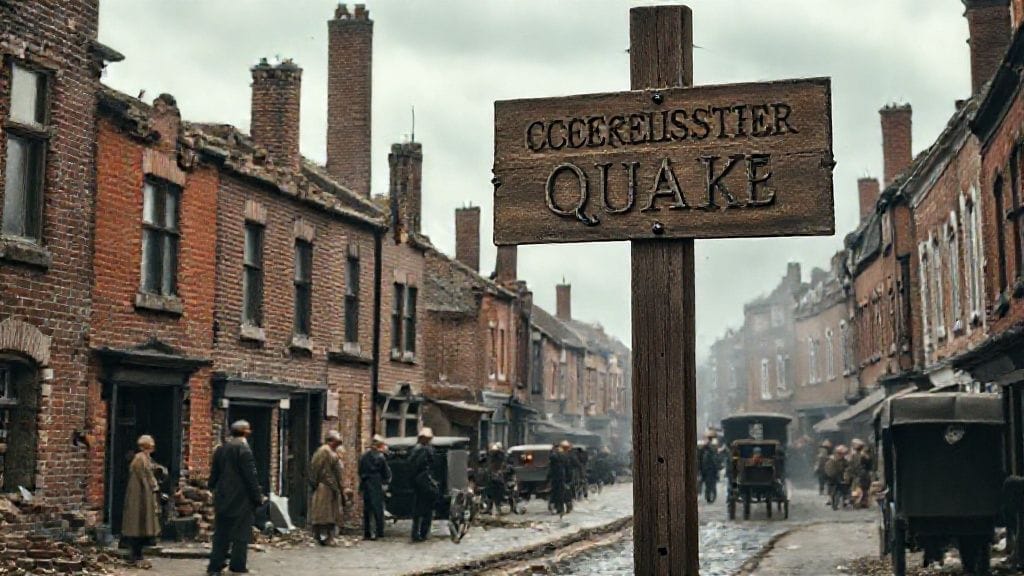
Damage was widespread though not catastrophic. Many older buildings, constructed before modern standards, suffered cracked plaster, broken chimneys, and dislodged roof tiles. The most dramatic damage occurred to Colchester's historic churches and public buildings, some of which bore scars visible even a century later.
In one compelling image, the ancient St. Mary’s Church bell tower showed significant cracks—a symbol of how even the most solid-seeming institutions were vulnerable. Some chimneys collapsed onto narrow streets, posing a threat but, miraculously, few severe injuries were reported.
6. Voices from the Ground: Eyewitness Accounts and Personal Narratives
Local newspapers collected the stories of stunned residents—shopkeepers who watched crockery bounce from shelves, schoolchildren who were thrown from benches, and farmers far outside town who felt the ground shift beneath their feet.
Mary Thompson, a seamstress, recalled, “The floor beneath me quivered, then heaved like the sea. I thought the devil was knocking on my door.” For others, like young apprentice William Heath, the tremor made “the very walls sing,” a metaphor capturing both fear and fascination.
These personal testimonies turned the earthquake into a shared experience of community, unspoken fears, and the strange wonder of natural forces unleashed.
7. The Church Bells Rang Out: Damage to Colchester’s Historic Buildings
Among the architectural casualties, churches bore the brunt. The reverberations loosened stones in spires dating back to the Middle Ages, some centuries earlier. The bell ropes, set swinging by the tremor, tolled an eerie, uncontrolled peal, echoing like a warning through the town.
That day, the historic Norman Castle itself, a sentinel of Colchester for nearly a millennium, survived with minor surface cracks but sustained no structural impairments. This resilience became an emblem of the town’s endurance—a fortress of memory amid the fleeting instability.
8. Panic and Resilience: How Communities Reacted in the Aftermath
Initial panic gave way to quick assessments and help. Neighbor checked on neighbor; children were shepherded from unsafe buildings; communes assembled in open areas fearing aftershocks that, thankfully, never came in force.
The incident awakened a collective consciousness about the fragility of human creations in the face of nature’s unpredictable energy. Yet, it also spurred acts of solidarity and calm, revealing the social threads that bind people in crisis.
9. The Role of Local Authorities: Emergency Responses and Relief Efforts
Colchester’s municipal leaders moved swiftly to assess damage and organize reconstruction efforts. While England lacked an official disaster response system at the time, local governments, aided by volunteer groups and the church, coordinated relief.
Trenches were dug to clear debris; temporary repairs were made to make homes safe; craftsmen worked double shifts restoring broken masonry. The event subtly shifted local governance’s appreciation for preparedness, even for the rarest of hazards.
10. Media Sensation: How Newspapers Reported the Event Across the UK
The earthquake captured the public imagination far beyond Essex. Newspapers like The Times and The Illustrated London News ran vivid reports, blending scientific curiosity with human drama. Headlines announced “The East Coast Shaken: A Rare Earthquake in England,” lending the event national significance.
Articles detailed eyewitness accounts, reported damages, and quoted scientific experts speculating about causes—as well as musings on whether England might face more such shocks. The coverage sparked debate and a new awareness of England’s geological vulnerability.
11. Scientific Curiosity: Geologists and Seismologists Turn Their Eyes to Essex
The Colchester earthquake piqued the interest of early seismologists and geologists, who began systematic analyses. They recorded the tremor’s intensity at approximately magnitude 4.6, relatively strong for the region.
This event became a case study in British seismic activity, a yardstick against which future quakes could be compared. It encouraged the nascent field of earthquake science in the UK, prompting establishment of monitoring stations in subsequent decades.
12. Comparing the Colchester Earthquake: A Rare Tremor in British History
England’s seismic history is marked by relatively minor shocks, but the Colchester event stands out. Compared with other well-documented tremors—such as the 1931 Dover earthquake or the 2008 Market Rasen event—1884’s quake was an early reminder that the British Isles’ geological stability is not absolute.
Indeed, the earthquake holds the distinction of being one of the most powerful recorded in England during the 19th century, making it an important benchmark in British natural history.
13. Broader Social Implications: Fear, Faith, and Folk Memories
In the Victorian era, natural disasters often elicited spiritual reflections and moral interpretations. Some locals viewed the quake as divine warning, sparking sermons and pamphlets urging repentance.
Folklore swiftly absorbed the event, with tales of earth spirits and ancient curses told in hushed tones. Over time, the earthquake became a part of local identity—an elemental story passed through generations that shaped communal consciousness.
14. The Economic Shockwave: Repair Costs and Impact on Local Industries
Beyond physical damage, the earthquake disrupted local economies. Repairing buildings strained household budgets, and some businesses experienced downtime as storefronts were cleared and refitted.
Though the earthquake did not cause widespread devastation, the costs of masonry repairs and temporary displacement had ripple effects on insurance, lending, and trade. In a town intertwined with agri-business and small manufacturing, even small shocks were felt keenly.
15. Cultural Legacy: How the Earthquake Entered Local Folklore and Identity
Decades after the shaking ceased, the Colchester earthquake retained an aura of mystery and awe. Local storytellers spun narratives blending fact with legend, embedding the event in Essex’s cultural tapestry.
Annual recollections, exhibitions, and even poetry commemorated April 22 as a day when earth and history briefly clashed, reminding residents of their place within time’s deeper forces.
16. Earthquakes in England Since 1884: Was It an Isolated Incident?
Subsequent English earthquakes have been infrequent and generally less severe, but the Colchester quake was not an isolated geological incident. The UK is monitored today by an extensive network detecting dozens of tremors yearly, though few are perceptible.
The 1884 quake remains a touchstone event, proof that beneath England’s serene landscape, deep tectonic nerves still stir occasionally.
17. Modern Perspectives: Revisiting the Colchester Earthquake with Today’s Science
With contemporary seismic technology, historical data can be reanalyzed to better understand events like Colchester’s quake. Geophysicists today see it as evidence of intraplate stress—tectonic pressure within a continental plate rather than boundary movement.
Modern computer modeling allows scientists to simulate the event, offering insights into potential aftershock zones and structural vulnerabilities that Victorian observers could not have imagined.
18. The Environmental Aftermath: Changes in Landscape and Soil Stability
Though no major surface ruptures were recorded, the earthquake subtly altered local soil stability. Minor landslips and subsidence affected farmland and roads, sometimes unnoticed but long-lasting.
Hydrological patterns were temporarily disturbed, wells showed variations in water clarity and flow, phenomena documented with growing scientific rigor in years following the event.
19. Lessons Learned: How the 1884 Tremor Shaped Future Monitoring
Though officially unanticipated, the Colchester quake motivated early seismic monitoring. The British Geological Survey, then in formation, integrated earthquake detection into its studies.
Municipal governments began considering earthquake resilience in building codes, however modestly. The 1884 shock planted seeds for a more cautious, scientifically engaged approach to natural hazards in Britain.
20. The Human Face of Disaster: Stories of Loss and Survival
While injuries were surprisingly low, the trauma lingered. For many, the earthquake was a first confrontation with the earth’s unpredictable force. Families shared whispered stories of sudden terror and relief.
One elderly resident, a Mr. George Chandler, described how “it felt like the ground was awakening angry, and the sky seemed to listen.” Such oral histories capture emotions beyond bricks and mortar—humanity’s eternal dance with an unruly planet.
21. The Colchester Earthquake in the Broader Context of British Natural Disasters
Though overshadowed by later events like the 1884 Bristol floods or various storms, the earthquake occupies a niche among British natural hazards. It reminds historians and disaster scholars that England’s environment includes sudden, even if rare, seismic risk.
This event enriches our understanding of the Victorian worldview, scientific evolution, and the complex layering of natural and social history.
22. Conclusion: Reverberations Beyond the Ground
The Colchester earthquake of April 22, 1884, was a brief tremor yet a profound disturbance—not only of the earth beneath historic Essex but of the sense of security that sheltered its people. It shook stone and psyche alike, reminding all that beneath tradition and routine lies an unpredictable Earth.
More than a geological footnote, the event woven into Colchester’s history offers a humbling narrative of resilience and wonder. In its aftermath, science, society, and spirit found new pathways, demonstrating humanity’s capacity to listen to the tremors beneath and grow stronger for them.
Conclusion
April 22, 1884, remains etched as a day when Colchester’s serene streets and ancient walls shook with nature’s sudden assertion. The earthquake was not just a physical event but a catalyst for reflection—on human vulnerability, community strength, and the profound mysteries beneath our feet.
As the people of Victorian Essex rebuilt their homes and their lives, they also rebuilt understanding, blending science and folklore, pragmatism and spirituality. The Colchester earthquake stands as a timeless reminder: even in lands of relative calm, the Earth’s restless heart is never far from the surface.
Through decades, stories have flown from shattered chimneys and ringing bells to the pages of newspapers and scientific treatises. They bring us closer to those frightened yet steadfast souls, reverberating across more than a century, inviting us to remember and respect our planet’s subtle powers.
FAQs
Q1: What caused the Colchester Earthquake of 1884?
A1: The quake was caused by a sudden movement along a previously unrecognized local fault within the East Anglian Basin. This released tectonic stress accumulated over time in the relatively stable geological plate underlying southeastern England.
Q2: How strong was the earthquake?
A2: The earthquake’s strength is estimated around magnitude 4.6 on the Richter scale, making it one of the most significant recorded tremors in England during the 19th century.
Q3: Were there any casualties?
A3: Fortunately, casualties were minimal or nonexistent. Damage was mostly to buildings and infrastructure. The low number of injuries is attributed to the relatively short duration and moderate intensity of the tremor.
Q4: How did the local population react to the earthquake?
A4: Initially, there was widespread alarm and panic, but it quickly gave way to community solidarity. Neighbors helped each other assess damage and safety, and authorities coordinated relief efforts swiftly despite limited resources.
Q5: Did the earthquake influence scientific research in the UK?
A5: Yes, it heightened awareness of seismic activity in Britain and encouraged more systematic seismic monitoring and geological study in the UK, laying groundwork for future earthquake science.
Q6: How is the Colchester earthquake remembered today?
A6: It remains a key event in Colchester's local history and folklore. Scientific study continues to revisit it as an important case in understanding intraplate earthquakes in Britain.
Q7: Is England at risk of future earthquakes?
A7: While England is not seismically active like more tectonically volatile regions, earthquakes of low to moderate intensity do occur occasionally due to intraplate stresses. Monitoring continues to minimize risks.
Q8: How did the earthquake affect local architecture?
A8: Some historic buildings, especially medieval churches and older homes, suffered structural damage such as cracks and dislodged masonry, prompting repairs and awareness about building resilience.