Table of Contents
- The Dawn of a Storm: Matthew Perry’s Last Breath
- A Life Carved by the Sea: Perry’s Naval Ascendancy
- Early Years and Formative Battles in the Age of Sail
- The Road to Diplomacy: From War Hero to Envoy
- The Opening of Japan: Perry’s Defining Moment
- The Black Ships and Eastern Horizons
- An Unfaltering Resolve Amidst Rising Tensions
- Perry’s Return to America: The Man Behind the Legend
- Illness and Decline: The Final Chapter Begins
- March 4, 1858: The Last Breath in New York City
- Public Mourning and National Reflection
- The Legacy of a Sea Captain in a Changing World
- The Hidden Influence: Perry’s Impact on American Imperialism
- Memory and Myth: Perry in History and Popular Culture
- From the Age of Sail to the Age of Steam: A Transitional Epoch
- The Perry Family and Continuation of Naval Tradition
- How Perry’s Death Shaped U.S.–Japan Relations
- Maritime Innovation and Perry’s Lasting Contributions
- Reflections of Contemporaries: Tributes and Critiques
- The Forgotten Corners: Where Perry’s Shadow Endures
1. The Dawn of a Storm: Matthew Perry’s Last Breath
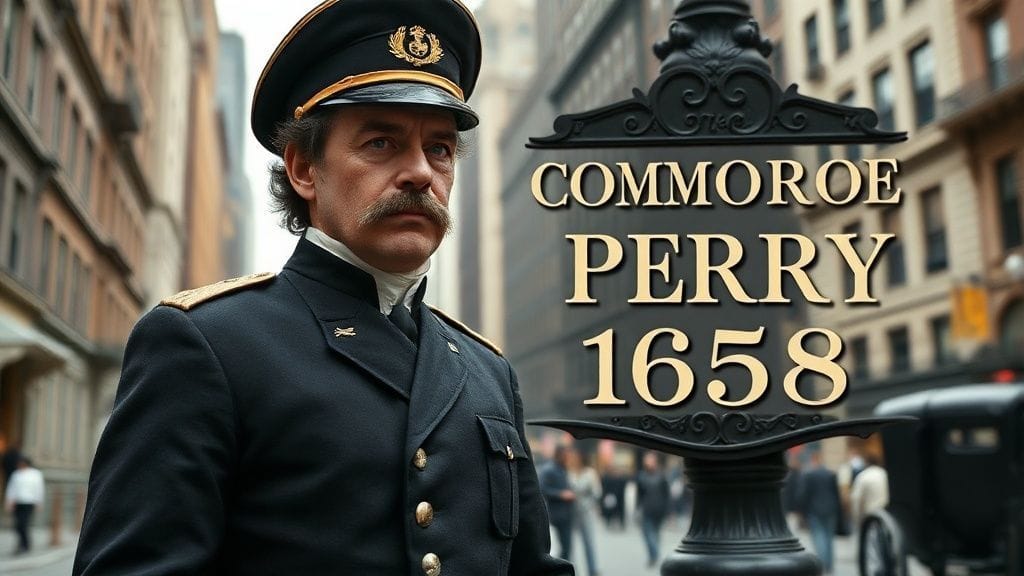
On the chill morning of March 4, 1858, the great commodore Matthew Calbraith Perry lay confined within the walls of his New York City residence, his robust frame worn thin by decades at sea and the quiet ravages of illness. Outside, the city pulsed with the restless energy of a nation on the cusp of transformation—a nation that still echoed the waves of change Perry himself had unleashed across the Pacific. As his breath grew shallow and the muffled streets whispered tales of expansion and conflict, Perry’s life neared its close in a quiet neighborhood far removed from the torrid diplomatic encounters and naval battles that had marked his illustrious career.
It was a death both solemn and symbolic — the passing of a man who had bridged two worlds, continents, and cultures through sheer willpower and unwavering resolve. The death of Commodore Matthew Perry was not just the end of a seasoned sailor but the closing of a chapter in American history that intertwined with the dawn of modern globalization, imperial ambition, and international diplomacy.
2. A Life Carved by the Sea: Perry’s Naval Ascendancy
Matthew Perry’s trajectory was forged by salt and wind, anchored in the traditions of naval warfare and the unfolds of early nineteenth-century American ideals. Born in 1794 in Newport, Rhode Island, Perry was steeped in maritime tradition from a young age. The son of a naval captain, his childhood was cradled by the sounds of crashing waves and the creak of wooden hulls. This environment shaped a young man who would come to embody the era’s naval spirit—a combination of discipline, adventure, and a restless hunger for discovery.
His ascent through the ranks was neither swift nor guaranteed. Perry’s early naval career was punctuated by engagements in the War of 1812 and decades spent confronting piracy and securing American maritime interests. Yet, beyond brute force, it was his methodical mind and diplomatic acumen that set him apart — qualities that would prove indispensable in the years to come.
3. Early Years and Formative Battles in the Age of Sail
The War of 1812 proved to be Perry’s proving ground. Amid the clash of wooden frigates and the roar of cannon fire, he learned the harsh lessons of naval combat and command under fire. Serving aboard vessels such as the USS Congress and the USS Java, Perry faced British blockades and privateers, durable enemies of a young American fleet intent on asserting itself.
More than mere skirmishes, these early engagements engraved in Perry the vital importance of naval strength bolstered by strategic diplomacy. It was a turbulent age, when empires sought dominance upon shifting tides and the sound of musket volleys intertwined with the relentless march of industrial progress.
4. The Road to Diplomacy: From War Hero to Envoy
Perry’s rise within the Navy was matched by his increasing involvement in complex diplomatic missions across the Atlantic and Pacific theatres. Unlike many of his contemporaries content with traditional naval roles, Perry ventured further — into the murky waters of political negotiation, treaty crafting, and international relations. His visits to South America and the Ottoman Empire exposed him to new political realities and underscored the interconnectedness of military might and diplomacy.
By the mid-1840s, Perry had established a reputation not only as a formidable seaman but also as a skilled negotiator, able to balance persuasion with the implicit threat posed by naval power. This duality would characterize his legacy and make him an instrumental figure on the world stage.
5. The Opening of Japan: Perry’s Defining Moment
It was 1853 when Matthew Perry etched his name permanently into the annals of history. Commanding a small fleet of technologically advanced steam-powered vessels, known infamously in Japan as the "Black Ships," Perry steamed into Edo Bay with a clear mission: to open Japan’s isolationist borders to American trade and diplomatic relations.
What followed was a tense standoff between two worlds. Perry’s imposing squadron, armed with the era’s latest weaponry and propelled by steam engines, was a spectacle and a threat to the secluded Tokugawa shogunate. His letter from President Millard Fillmore demanded the opening of ports for American vessels, promising peaceful intentions but making clear the potential for force.
The eventual signing of the Convention of Kanagawa in 1854 marked the end of over two centuries of Japanese isolation—a seismic geopolitical shift spearheaded by Perry’s audacious mission.
6. The Black Ships and Eastern Horizons
The sight of Perry’s Black Ships was unforgettable. Their dark hulls steaming steadily through fog and mist signified not only technological prowess but an urgent message from the West. Contemporary Japanese accounts spoke of awe and fear, as these newcomers challenged millennia of seclusion and tradition.
Behind the spectacle lay layers of strategic calculations: Perry understood that naval power was the language the Tokugawa shogunate respected; to negotiate effectively, he would wield steam and cannon as symbols of American industrial and military power. This interplay of might and diplomacy would redefine East-West relations and lay foundations for modern Japan.
7. An Unfaltering Resolve Amidst Rising Tensions
Perry’s mission was far from simple coercion. His steadfastness amidst cultural misunderstandings, visible impatience, and Japanese hesitation revealed a man driven by conviction and vision. Letters and journals from his crew depict a determined commander who balanced firmness with moments of reflection: he admired the discipline and customs of Japan even as he sought to dismantle its isolation.
Nevertheless, his continued presence in Japanese waters and his 1854 return to secure trade privileges intensified local debates. The tension between opening and tradition would ripple through Japanese society for decades, ultimately accelerating the Meiji Restoration.
8. Perry’s Return to America: The Man Behind the Legend
After his historic voyages, Perry returned to American shores hailed as a hero. But beyond the public adulation lay a man burdened by the weight of his achievements and the anxieties of what lay ahead. Perry was not merely a figure of national pride; he was a symbol of America’s expanding global reach, a living embodiment of manifest destiny projected overseas.
His final years would be shadowed by ill health and contemplation of the consequences his actions triggered, both for Japan and his own country’s imperial ambitions.
9. Illness and Decline: The Final Chapter Begins
By the mid-1850s, the vigorous commodore was afflicted with ailments that would ultimately claim his life. Physicians of the era diagnosed symptoms ranging from gout to the more nebulous "decline," a common phrase masking the slow deterioration of the body in the face of relentless physical demands.
Perry withdrew from active service, settling in New York City—a metropolis itself undergoing transformations from maritime port to burgeoning industrial hub. His health waned as the pressures of his legacy bore down; yet his mind remained sharp, and his correspondence revealed a keen interest in international affairs until the very end.
10. March 4, 1858: The Last Breath in New York City
The early hours of March 4 were quiet but heavy with an unspoken finality. Surrounded by family, close colleagues, and letters from distant admirers, Perry’s breathing slowed. The long saga of his life—marked by oceans crossed, treaties signed, and empires unsettled—was drawing to a close in a modest townhouse far from the storms of the Pacific.
News of his death quickly spread through naval circles and the press. The New York Herald lamented the loss of a man "who bridged the old world’s traditions and the new world’s ambitions." For many, Perry’s passing felt like the end of an era—a poignant reminder of the sacrifices entailed by progress.
11. Public Mourning and National Reflection
Perry’s death reverberated beyond his immediate circle. American newspapers dedicated obituaries that celebrated his daring and strategic mind. Cities like Newport and Washington prepared commemorations, naval officers penned heartfelt tributes, and the government acknowledged the commodore’s role in shaping foreign policy.
But this mourning was also tinged with introspection. Perry’s opening of Japan was a double-edged sword, heralding new opportunities but also introducing complexities in international relations that Americans were only beginning to grasp.
12. The Legacy of a Sea Captain in a Changing World
Matthew Perry’s legacy is woven deeply into the fabric of mid-19th-century history. His career encapsulates the twilight of sail-powered navies and the dawn of steam propulsion, of America wrestling with its identity as a maritime power and an emerging diplomatic force.
His actions helped pivot the isolated world of Tokugawa Japan into a global system while simultaneously signaling a shift in American policy—from isolationism to active engagement—foreshadowing decades of international involvement.
13. The Hidden Influence: Perry’s Impact on American Imperialism
Though celebrated as a diplomatic envoy, Perry’s role also illuminated the steely realities of American imperial ambitions. His mission was as much about protecting burgeoning commercial interests as it was about spreading goodwill. By compelling Japan to open itself, Perry set precedents for 19th-century gunboat diplomacy, where naval might underpinned negotiations.
This model of power would echo in subsequent American interventions and shape the nation's global posture for generations.
14. Memory and Myth: Perry in History and Popular Culture
In the decades following his death, Perry transformed into a figure of legend. Statues rose in his honor, and textbooks lauded his exploits. Yet, such mythologizing often glossed over the nuances—the resistance from Japanese factions, the consequences for Japanese sovereignty, and the evolving historical interpretations of his mission.
In modern times, Perry is remembered both as a harbinger of globalization and as a symbol of colonial intrusion, a dual legacy that continues to spark debate.
15. From the Age of Sail to the Age of Steam: A Transitional Epoch
Perry’s life marked the cusp of two epochs. Born into the era of wooden warships and sail, he embraced and propelled the transition to steam power and industrialized naval warfare. His Black Ships were not mere vessels but emblems of technological change that revolutionized maritime strategy.
This transformation was emblematic of wider societal shifts—where tradition met innovation, and the old world yielded to the new.
16. The Perry Family and Continuation of Naval Tradition
The Perry legacy did not end with Matthew’s death. His brother Oliver Hazard Perry Jr. and nephew Oliver Hazard Perry carried forward family naval traditions, serving with distinction in various capacities. The Perry lineage became intertwined with American naval history, emblematic of a family whose contributions spanned generations.
This continuity added a personal dimension to Matthew Perry’s public legacy, rooting it in kinship and personal sacrifice.
17. How Perry’s Death Shaped U.S.–Japan Relations
Perry never lived to witness the long-term effects of his mission, but his death came at a critical juncture. The treaty he helped forge initiated a sequence of events that propelled Japan’s rapid modernization and transformation into a regional power.
American policymakers, inspired by Perry’s precedent, continued to engage Asia with a mixture of commerce, diplomacy, and military preparedness—an approach that shaped Pacific geopolitics well into the 20th century.
18. Maritime Innovation and Perry’s Lasting Contributions
In addition to diplomacy, Perry championed naval modernization. His voyages demonstrated the strategic advantage of steam propulsion and ironclad ships, influencing naval architecture and tactics.
The lessons drawn from his expeditions informed training, shipbuilding, and tactical doctrines—foundations upon which modern naval forces would be built.
19. Reflections of Contemporaries: Tributes and Critiques
Contemporaries saw Perry through multifaceted lenses. Admirals praised his leadership; politicians lauded his accomplishments; Japanese officials expressed both gratitude and resentment. Samuel Clemens (Mark Twain), later in life, brushed Perry’s legacy with irony and critique, highlighting the complexities of cultural imperialism.
Such pluralism of views enriches the understanding of Perry’s place in history—not as a flawless hero, but as a man navigating morally ambiguous terrain.
20. The Forgotten Corners: Where Perry’s Shadow Endures
Far from the public eye, Perry’s influence lingers in unexpected places—archives preserving his correspondence, coastal landmarks bearing his name, and educational programs aiming to contextualize his contributions amidst broader historical narratives.
His story is a mosaic of conquest, diplomacy, innovation, and human endeavor—one that continues to influence how we perceive the intersection of power and culture.
Conclusion
Commodore Matthew Perry’s death in 1858 signaled more than the loss of a distinguished naval officer; it marked the sunset of an epoch in global history where the old world’s boundaries and the new world’s ambitions collided with thunderous consequence. His life was a blend of courage and calculation, of steam and sail, of gunboat diplomacy and genuine cross-cultural encounters.
From the naval skirmishes of the Atlantic coast to the mist-shrouded harbors of Japan, Perry traversed more than miles—he traversed the fragile line between conflict and cooperation, dominance and dialogue. His legacy is, at once, a testament to human determination and a mirror reflecting the complex dynamics of power, respect, and change. In remembering Perry, we glimpse the tides of history that continue to shape our interconnected world.
FAQs
Q1: What were the main causes that led Matthew Perry to sail to Japan?
A1: Perry was dispatched primarily to open Japan’s isolated ports for American trade, motivated by expanding commercial interests, strategic naval positioning in Asia, and the broader American policy of manifest destiny projected overseas.
Q2: How did Perry’s mission impact Japan’s political landscape?
A2: The forced opening of Japan catalyzed internal debates and dissent, weakening the Tokugawa shogunate and hastening the Meiji Restoration, which transformed Japan into a modernized imperial power.
Q3: What illnesses contributed to Perry’s death?
A3: Historical records indicate Perry suffered from gout and a general "decline" in health, compounded by years of physical strain and possibly chronic infections common among sailors of his era.
Q4: In what ways did Perry’s actions influence American foreign policy?
A4: His mission established a precedent for gunboat diplomacy, signaling a shift from isolationism to proactive engagement in Asia and fostering an imperialist outlook within U.S. diplomacy.
Q5: How is Perry remembered differently in the United States and Japan?
A5: In the U.S., Perry is often hailed as a pioneer of American expansion and diplomacy, whereas Japanese perspectives range from respect for his role in modernization to criticism of the coercive nature of his mission.
Q6: Did Perry’s family continue his naval legacy?
A6: Yes, members of the Perry family, including his brother and nephew, continued to serve with distinction in the U.S. Navy, maintaining the family’s maritime tradition.
Q7: What technological innovations did Perry introduce or popularize?
A7: Perry was an early advocate for steam-powered ships and modern naval artillery, demonstrating their strategic advantages in diplomacy and warfare.
Q8: How did Perry’s death influence subsequent U.S.–Japan interactions?
A8: His passing coincided with evolving relations wherein the foundational treaty he negotiated led to increased commerce and diplomatic engagement, paving the way for complex 20th-century dynamics.