Table of Contents
- The Cold Dawn of December 1991: A Gathering Amidst the Ruins
- The Twilight of the Soviet Union: Unraveling an Empire
- Belarus, Russia, and Ukraine: The Architects of a New Order
- Brest: The Unlikely Birthplace of a Commonwealth
- The Belovezha Accords: A Quiet Revolution in the Forest
- Intentions and Ambitions Behind the Agreement
- The Soviet Presidency’s Last Stand: Gorbachev’s Response
- Mixed Emotions: Joy, Confusion, and Betrayal Across the Republics
- From Dissolution to Confederation: Legal and Political Ramifications
- International Reaction: Allies, Adversaries, and the Global Balance
- The Commonwealth of Independent States: Structures and Membership
- The Protection of Peace and Stability: Aspirations Versus Reality
- Economic Turbulence and the Struggle for Cooperation
- Cultural Identity and Nationalism Rising in the Vacuum
- Legacy of the Commonwealth: Continuities and Failures
- The End of an Era, the Dawn of a New World Order
- The Human Dimension: Families Torn Between Old and New Borders
- Belarus’ Role: From Soviet Republic to Post-Soviet Actor
- The Commonwealth’s Place in the Twenty-First Century
- Memory and Myth: How December 8, 1991, Is Remembered Today
1. The Cold Dawn of December 1991: A Gathering Amidst the Ruins
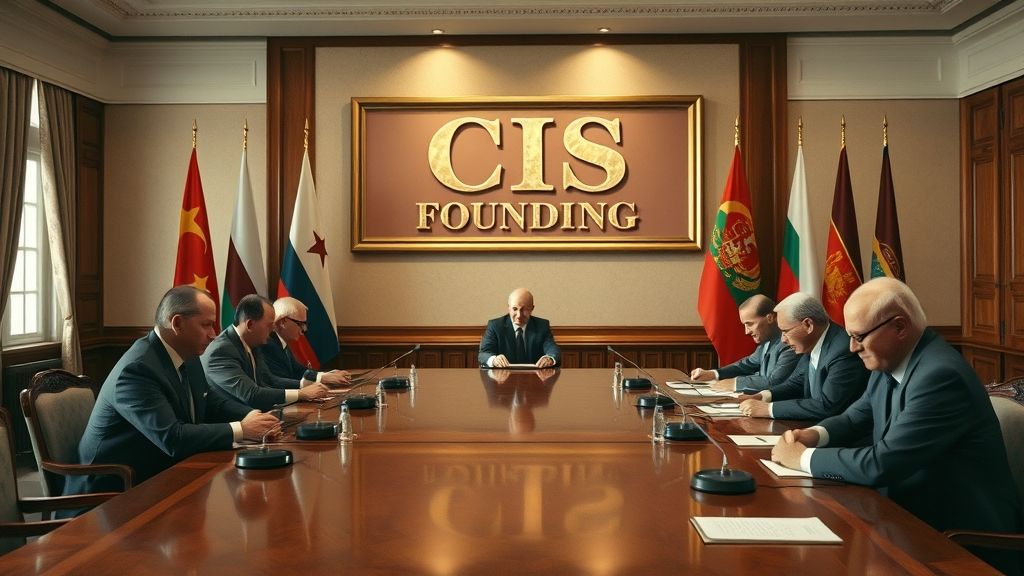
The morning of December 8, 1991, broke crisp and clear over the dense forests of Belarus. The air, sharp with the promise of winter, carried an unusual stillness that magnified the weight of what was about to unfold — an event so quietly monumental that it would ripple through decades and redraw the geopolitical map of the world. Deep in a nondescript government compound near Brest, three men met under guarded but intimate circumstances. They were not generals shouting orders on a battlefield nor kings wielding scepters in palaces, yet in this unassuming setting, history was being forged.
Amid the hum of the early day, Belarusian Leader Stanislav Shushkevich, Russian President Boris Yeltsin, and Ukrainian President Leonid Kravchuk sat around a wooden table, clutching at the remnants of a collapsing empire. Their signatures would dissolve the Soviet Union and birth the Commonwealth of Independent States (CIS)—a confederation meant to knit together their fledgling sovereignties and tame the chaos unleashed by the empire's fall.
2. The Twilight of the Soviet Union: Unraveling an Empire
To understand this decisive moment, one must first grasp the immense structure that was collapsing. The Soviet Union, a juggernaut forged in the fires of revolution and world war, had thrived on ideology, control, and unity enforced from Moscow’s Kremlin. Yet, by late 1991, the monolith was fracturing, fissures growing too wide to bridge.
Economic stagnation, nationalist stirrings, and the failures of Gorbachev’s reforms—perestroika and glasnost—had eroded faith in the union. Hardliners and reformists clashed, republics clamored for independence, and the once seemingly unbreakable Soviet ties frayed daily. The failed August Coup, a desperate attempt by conservative forces to preserve Soviet authority, had shattered illusions about the endurance of the USSR. The question no longer was if, but when and how the union would end.
3. Belarus, Russia, and Ukraine: The Architects of a New Order
Among all the republics spinning off from the Soviet nucleus, three held disproportionate influence—Russia as the core, Ukraine as the breadbasket and populous giant, and Belarus as a loyal yet independent-minded neighbor. Their leaders, driven by a mix of pragmatism, national interest, and a shared desire to avoid violent dissolution, convened to shape a new political reality.
Boris Yeltsin’s rise was meteoric; he embodied the post-Soviet hope for reform and sovereignty. Leonid Kravchuk, a shrewd politician navigating Ukraine’s nationalist waves, sought to safeguard his country’s newfound autonomy. Stanislav Shushkevich, lesser known but pivotal, bridged these ambitions with his steady stewardship of Belarus on the cusp of independence. Together, their calculations framed the accords that would sever Soviet bonds.
4. Brest: The Unlikely Birthplace of a Commonwealth
Why Brest? This city, more famous for its heroic stand during World War II, seemed an unlikely cradle for international accord. Yet its symbolic geography—nestled between East and West, a gateway to Europe—matched the transitional atmosphere perfectly. Away from Moscow’s glare and the chaos in capitals like Kiev, the forests around Brest offered a discreet venue where diplomacy could unfold away from public scrutiny.
Here, the leaders gathered in the Belovezhskaya Pushcha, a primeval forest rich in lore, its ancient trees bearing silent witness to the historic agreement that now bore their name: the Belovezha Accords.
5. The Belovezha Accords: A Quiet Revolution in the Forest
On December 8, 1991, the accords were signed. In essence, they declared that the Soviet Union “ceased to exist as a subject of international law and geopolitical reality.” This was not mere political symbolism — it was a legal abolition of a superpower.
The accords pledged the creation of the Commonwealth of Independent States as a framework for cooperation on issues from defense to economics. Importantly, the document rejected the use of force and affirmed the sovereignty of the participant states, signaling a break with the totalitarian past.
Yeltsin later recalled the surreal mix of gravity and relief in the room: “We all knew that we were either making a mistake that would haunt us or ending an era too long in the making.”
6. Intentions and Ambitions Behind the Agreement
Behind the formal statements were layered ambitions. For Russia, the CIS offered a way to maintain influence over former Soviet republics without the liabilities of the old union. Ukraine sought to affirm its independence while remaining economically connected to Russia. Belarus, historically caught between its powerful neighbors, aimed to secure its sovereignty without isolation.
This triad hoped that the CIS would be a cooperative space preserving security, trade, and cultural ties while preventing the chaos and conflict that could easily erupt amid disintegration.
7. The Soviet Presidency’s Last Stand: Gorbachev’s Response
Mikhail Gorbachev, the USSR’s final president, learned of the agreement after the fact. For him, the accords were a bitter blow that undermined his vision of a “renewed federation.” He condemned the Belovezha Accords as illegal and illegitimate, claiming they ignored the Soviet constitution.
Yet, Gorbachev’s power was waning; his warnings fell on deaf ears. Parliament convened for its last sessions; flags were lowered; the world watched as a superpower crumbled without dramatic battle or fiery collapse.
8. Mixed Emotions: Joy, Confusion, and Betrayal Across the Republics
For millions living in the former Soviet republics, December 1991 was a collision of hope and uncertainty. In Kyiv, celebrations mingled with anxiety. Belarusian streets echoed cautious optimism. In Moscow, a complex mélange of disbelief and relief played out as people grappled with the reality that the USSR was no more.
Families divided by new borders faced emotional turmoil. Soldiers stationed on foreign soil suddenly found themselves foreigners. Nostalgia for the past mingled with nationalist pride and the daunting promise of democracy and market economies.
9. From Dissolution to Confederation: Legal and Political Ramifications
Legally, the dissolution marked a historic precedent—the voluntary disbandment of a nuclear superpower by its own republics. The new CIS had to navigate murky waters: How to manage nuclear weapons control, economic integration, defense cooperation, and diplomatic representation on the world stage?
Russia inherited the Soviet seat at the United Nations, but questions about succession, debts, and treaties lingered. Meanwhile, the CIS struggled to find coherence with many republics joining only nominally or pursuing paths outside the Commonwealth.
10. International Reaction: Allies, Adversaries, and the Global Balance
The global community responded with a mix of astonishment and cautious optimism. The United States, allied powers, and China quickly recognized the independence of the new states. Western leaders saw in the dissolution the end of the Cold War’s bipolar world and the chance for new diplomatic engagement.
Yet, concerns loomed about nuclear disarmament, regional conflicts, and economic instability. Observers debated whether the world had become safer or simply entered a new, unpredictable phase of rivalry and cooperation.
11. The Commonwealth of Independent States: Structures and Membership
The CIS emerged as a loose confederation rather than a federation. Its structures prioritized consultation over enforcement and aimed to manage shared interests post-USSR. At its zenith, it included nine of the fifteen former republics.
But the Commonwealth lacked a strong executive authority or central budget, making its efficacy uneven. Internal differences on political reforms, foreign alignments, and economic policies often hindered cohesion.
12. The Protection of Peace and Stability: Aspirations Versus Reality
One of the CIS’s foundational claims was the promotion of peace and security. In theory, this was to prevent the violent nationalisms and territorial conflicts predicted by many observers. Yet, the subsequent decade saw wars—Most notably in Nagorno-Karabakh, Transnistria, and Chechnya—testing the Commonwealth’s ability to mediate.
These conflicts revealed the limits of the accords and the complexity of forging unity out of newly independent states, each charting its own destiny.
13. Economic Turbulence and the Struggle for Cooperation
Economically, the collapse of Soviet central planning unleashed profound disruptions. Trade corridors fragmented, currencies diverged, and inflation skyrocketed. The CIS’s mechanisms to harmonize policies were weak; competing national interests often obstructed integration.
Russia attempted market reforms, Ukraine and Belarus oscillated between dirigisme and liberalization. The Commonwealth became more a diplomatic forum than an engine of economic recovery.
14. Cultural Identity and Nationalism Rising in the Vacuum
The post-Soviet space experienced a renaissance of cultural identities long suppressed or homogenized. Languages, traditions, and histories reemerged as pillars of national consciousness.
Yet, nationalism cut two ways: a source of pride and social cohesion but also of exclusion, xenophobia, and conflict. Belarus itself grappled with forging a Belarusian identity distinct from Russian influence, navigating an uneasy post-Soviet reality.
15. Legacy of the Commonwealth: Continuities and Failures
Now more than three decades since the Commonwealth’s creation, its legacy is contradictory. On one hand, the CIS facilitated dialogue and some cooperation. On the other, it failed to forestall many conflicts and offered little economic integration compared to the EU or NATO.
Russia’s recent assertiveness—seen in Crimea’s annexation and ongoing tensions with neighbors—underscores the fragile unity and contestations underlying the Commonwealth.
16. The End of an Era, the Dawn of a New World Order
The dissolution of the USSR and the birth of the CIS symbolized not just a geopolitical shift but a philosophical rupture. The Cold War era ended; ideologies battled out in new ways; the global map was redrawn.
The Commonwealth of Independent States stands as a testament to the painstaking effort to balance history and modernity, sovereignty and cooperation, chaos and order.
17. The Human Dimension: Families Torn Between Old and New Borders
For ordinary people, the creation of the CIS meant coping with a new reality where kin might suddenly be foreigners, passports changed, and familiar certainties vanished. Migration patterns shifted; old economic ties broke; personal and collective identities were redefined.
Stories abound of families divided, lives uprooted, and dreams recalibrated under the shadow of the new Commonwealth.
18. Belarus’ Role: From Soviet Republic to Post-Soviet Actor
Belarus’ participation in the accords marked its entrance into statehood as a distinct player. Under Shushkevich’s leadership, Belarus navigated the tricky transition from Soviet republic to independent nation, balancing Russian ties with its own sovereignty.
The country’s continued key membership in the CIS speaks to its geopolitical orientation and the complexities of national self-definition in a post-imperial world.
19. The Commonwealth’s Place in the Twenty-First Century
Today, the CIS remains an organization of variable influence. While some members pull closer to Europe or NATO, others rely on the Commonwealth as a counterbalance or forum for dialogue.
It functions as a prism through which the evolving relations of the post-Soviet space can be understood—from cooperation to confrontation.
20. Memory and Myth: How December 8, 1991, Is Remembered Today
December 8, 1991, alternately viewed as a liberation, betrayal, or tragedy depending on perspective, has entered the complex mythology of post-Soviet history.
Commemorated quietly in Belarus and Russia, more prominently in Ukraine, the Belovezha Accords evoke reflection on the perils and promises of sudden independence, the meaning of unity, and the costs of empire’s end.
Conclusion
The creation of the Commonwealth of Independent States on December 8, 1991, near Brest, Belarus, was more than a mere political agreement; it was the closing chapter of a world order and the fragile opening of a new, uncertain epoch. The meeting of three leaders in the shadows of a primeval forest quietly reshaped millions of lives and altered the course of global history.
Behind the signatures lay the hopes of peace, cooperation, and sovereignty — hopes often challenged but never fully extinguished. The CIS embodied the paradoxes of post-Soviet space: shared history and diverging futures, the desire for unity and the reality of fragmentation.
As the post-Cold War decade marches onwards, the lessons from that cold December day resonate anew: that history’s turning points are neither simple nor final, but full of human complexity and enduring mystery.
FAQs
Q1: Why was the Commonwealth of Independent States created?
The CIS was established to manage the peaceful dissolution of the Soviet Union and provide a framework for cooperation between the newly independent republics in areas like security, economy, and diplomacy.
Q2: Who were the primary architects of the Belovezha Accords?
The leaders of Belarus (Stanislav Shushkevich), Russia (Boris Yeltsin), and Ukraine (Leonid Kravchuk) signed the accords, which declared the Soviet Union dissolved and created the CIS.
Q3: How did Mikhail Gorbachev react to the creation of the CIS?
Gorbachev condemned the accords as illegal and illegitimate, believing they violated the Soviet Constitution and undermined his vision of a reformed union.
Q4: What was the international community’s response?
Most countries quickly recognized the new states and welcomed the peaceful transition, viewing it as the end of the Cold War and an opportunity for new geopolitical alignments.
Q5: Did the CIS successfully replace the Soviet Union?
No. Although the CIS created a forum for cooperation, it lacked strong enforcement mechanisms and did not establish a political or economic union comparable to the USSR.
Q6: What were some challenges facing the CIS after its formation?
The member states experienced disputes over borders, ethnic conflicts, economic divergence, and differing political agendas, which tested the Commonwealth’s effectiveness.
Q7: What role did Belarus play in the post-Soviet era?
Belarus acted as a moderate force seeking to maintain close ties with Russia while pursuing its sovereignty, and remained a key member of the CIS.
Q8: How is the dissolution of the Soviet Union and the creation of the CIS remembered today?
It is remembered differently across countries—some see it as liberation and independence, others as loss and betrayal. The event remains a powerful symbol of transition in post-Soviet memory.