Table of Contents
- The Opening Day: A Diplomatic Stage Set in Berlin
- Europe's Balancing Act: The Stakes Behind the Congress
- The Decline of the Ottoman Empire: A Fading Giant
- The Eastern Question: An Age-Old European Dilemma
- The Players Convene: Powers and Personalities in the Room
- Bismarck’s Gambit: The Art of Mediation
- Clash of Empires: Russia’s Ambitions and Austria-Hungary’s Schemes
- Britain’s Watchful Eye: Naval Power and Colonial Concerns
- The Balkan Wildfire: Local Hopes and Fears
- The Shadow of the Russo-Turkish War: Setting the Stage for Negotiations
- From War to Peace: Negotiating Boundaries and National Aspirations
- The Fate of Bosnia and Herzegovina: A Contested Prize
- The Creation of an Autonomous Bulgaria: New Maps, New Tensions
- The Romanian, Serbian, and Montenegrin Gains: Small States Rise
- The Treaty of Berlin: Language of Diplomacy and Compromise
- Public Reaction Across Europe: Hope, Doubt, and Distrust
- A Pandora’s Box: Seeds of Future Conflicts Sown
- The Congress’ Impact on the Ottoman Empire’s Legacy
- Bismarck’s Legacy: “Honest Broker” or Political Puppeteer?
- Lessons from the Congress: International Diplomacy in the Age of Empires
- Conclusion: The Berlin Congress – An Event that Shaped Modern Europe
- FAQs: Understanding the Congress of Berlin
- External Resource
- Internal Link
The Opening Day: A Diplomatic Stage Set in Berlin
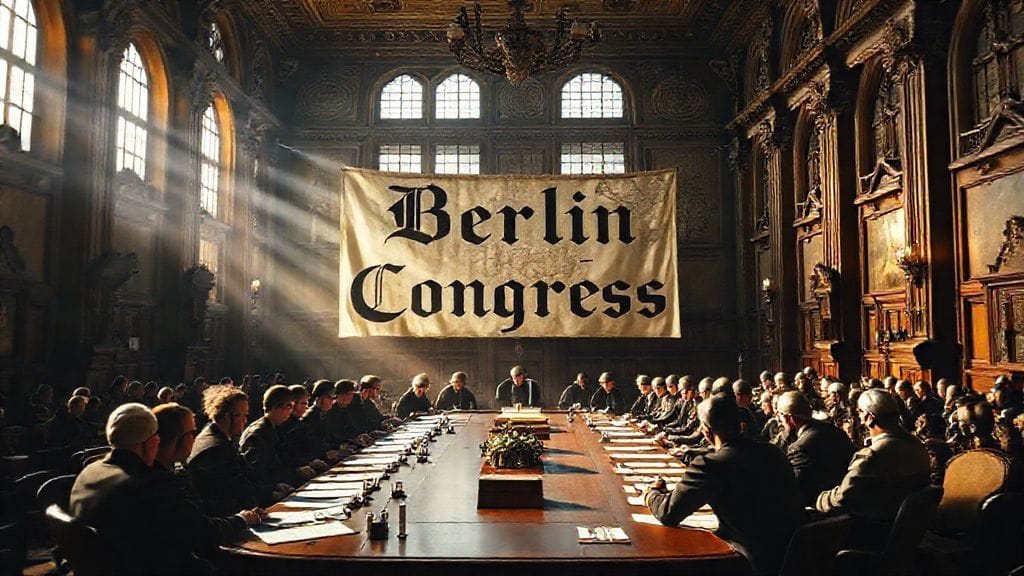
On a warm June day in 1878, the grand halls of the Reichstag in Berlin hummed with anticipation. Delegates from the great powers of Europe—Ambassadors, ministers, generals—had gathered under one roof, each carrying the weight of empires and the fragile hopes for peace. The air was thick with cigar smoke, and voices mingled in countless languages: French, German, Russian, Turkish. It was no ordinary gathering; it was the Congress of Berlin, convened to redraw the map of southeastern Europe after a brutal war that had shaken an old continent. The world watched. The future of the Balkans, of the Ottoman Empire, of Europe itself was about to be decided.
Europe’s Balancing Act: The Stakes Behind the Congress
The Congress of Berlin was no spontaneous convocation. It was born of necessity, a desperate attempt to manage the chaotic and violent unraveling of power in southeastern Europe. The "Eastern Question"—a puzzle involving the fate of the Ottoman Empire and its European territories—had long preoccupied diplomats. As the 19th century progressed, the once-mighty Ottoman Empire was visibly in decline, its grip on the Balkans weakening. The vacuum invited intervention: Russia sought influence in the region, Austria-Hungary eyed expansion, Britain feared threats to its naval routes, and the Balkan peoples dreamed of freedom. The Congress was the European powers’ answer to the explosive mix of nationalism, imperial ambition, and the threat of war.
The Decline of the Ottoman Empire: A Fading Giant
By 1878, the Ottoman Empire was described by many in Europe as the "sick man of Europe." Once an empire stretching from the gates of Vienna to the deserts of Arabia, it was now a shadow of itself. Corruption, economic difficulties, and administrative weakness had sapped its strength. Internal revolts and nationalist uprisings, especially in the Balkans, eroded its sovereignty. Russia, casting itself as the protector of Slavic and Orthodox Christians under Ottoman rule, had just emerged victorious from the Russo-Turkish War of 1877-1878. The empire’s heartlands in Europe were in peril of dismemberment.
The Eastern Question: An Age-Old European Dilemma
The Eastern Question was a diplomatic riddle for generations: How to handle the Ottoman Empire’s decline without unleashing a wider European war? The question lurked behind almost every major European alliance, conversation, and conflict in the 19th century. If the empire collapsed too quickly, would Russia gain too much power? Could Austria-Hungary maintain its multi-ethnic empire without a strong Ottoman buffer? And what of Britain’s maritime dominance if Russia controlled the Straits? The Congress of Berlin aimed to answer this, but the puzzle was anything but straightforward.
The Players Convene: Powers and Personalities in the Room
The Congress brought together the major powers: Germany, Russia, Austria-Hungary, Britain, France, Italy, and the Ottoman Empire itself. At its heart stood Otto von Bismarck, the German Chancellor, who hosted the conference in his own capital and sought to play the role of "honest broker." Each power sent emissaries: the shrewd and calculating Russian Foreign Minister Prince Gorchakov, Britain's cautious Lord Salisbury, the ambitious Austro-Hungarian Count Andrassy, and the fading but defiant Ottoman representatives. Personal rivalries, national ambitions, and the burden of history intertwined in the conference rooms.
Bismarck’s Gambit: The Art of Mediation
Bismarck’s role was pivotal. Known as the "Iron Chancellor," he had unified Germany through war and diplomacy but now sought to establish Germany as the central power broker in Europe. At Berlin, Bismarck presented himself as a neutral arbitrator aiming to preserve peace and balance. His diplomatic skill lay in keeping tensions from boiling over while extracting concessions from all sides. Behind his diplomatic smiles and gestures lay a profound understanding of power, language, and the art of compromise.
Clash of Empires: Russia’s Ambitions and Austria-Hungary’s Schemes
Russia entered the Congress fresh from military victory, expecting significant territorial gains and influence over the Balkan Slavs. Yet Austria-Hungary, fearful of Slavic nationalism spreading to its own diverse empire, sought to blunt Russian advances. The dual monarchy laid claim to Bosnia and Herzegovina, territories of strategic importance. These competing ambitions set the stage for tense negotiations where war threats—and the threat of diplomacy breaking down—were never far away.
Britain’s Watchful Eye: Naval Power and Colonial Concerns
Across the European continent, Britain observed carefully. London’s priority was maintaining control over the Mediterranean and protecting its route to India via the Suez Canal. A strong Russia dominating the Balkans could threaten these routes and unsettle the balance of power in Asia. Britain’s policy was one of cautious intervention: it sought to restrain Russia without getting embroiled in continental conflicts. Hence, British diplomats played a delicate game, pushing for solutions that would check Russian expansionism while avoiding direct confrontation.
The Balkan Wildfire: Local Hopes and Fears
Beyond great power politics, the Balkans simmered with local nationalism and deep-rooted fears. For centuries, peoples such as the Serbs, Bulgarians, Romanians, and Montenegrins had lived under Ottoman rule, dreaming of independence and self-rule. The Congress presented them a historic opportunity. Yet, these national aspirations often clashed with imperial interests. Would liberty come at the cost of stability? The Congress had to navigate an explosive mix of nationalism, ethnic tensions, and the aspirations of millions.
The Shadow of the Russo-Turkish War: Setting the Stage for Negotiations
The Congress was convened in the wake of the Russo-Turkish War (1877-1878), a brutal conflict that exposed Ottoman weakness and boosted Russian confidence. The war ended with the Treaty of San Stefano, which favored Russia and its Slavic allies by creating a large Bulgarian state under Russian influence. However, this treaty alarmed the other powers, who viewed it as a dangerous shift in European balance. The Berlin Congress was thus charged with revising San Stefano’s terms to placate rival powers, a delicate balancing act full of contradictions and tensions.
From War to Peace: Negotiating Boundaries and National Aspirations
The months of negotiations saw the drafting and redrafting of boundaries, the balancing of nationalist demands with imperial interests. The Congress dramatically reduced the size of Bulgaria created by the Treaty of San Stefano, dividing it into smaller autonomous regions. New frontiers were drawn—some with artificial lines imposed from afar. Each decision carried the weight of centuries of conflict and hopes. The painstaking diplomatic process revealed the art, compromises, and frustrations of peace-making.
The Fate of Bosnia and Herzegovina: A Contested Prize
Among the Congress' most contentious issues was the fate of Bosnia and Herzegovina, provinces nominally Ottoman but coveted by Austria-Hungary. Ultimately, the Congress allowed Austria-Hungary to occupy and administer these territories, though they technically remained Ottoman. This decision satisfied Austria-Hungarian expansionist desires but angered Slavic nationalists and Russia. It planted the seed for future crises—the proverbial tinderbox that would eventually ignite with tragic consequences in the 20th century.
The Creation of an Autonomous Bulgaria: New Maps, New Tensions
The Congress differed significantly from San Stefano by creating a smaller Principality of Bulgaria, nominally under Ottoman suzerainty but practically autonomous, and a separate province called Eastern Rumelia under Ottoman control but with a Christian governor. This division frustrated Bulgarian nationalists and Russia alike but aimed to reduce Russian influence. More than just territorial redrawing, it was a delicate political engineering that sought to balance power and contain instability.
The Romanian, Serbian, and Montenegrin Gains: Small States Rise
The Congress also recognized the independence or territorial gains of smaller Balkan states. Romania secured independence and territorial enlargement, Serbia and Montenegro gained lands and full recognition as independent states. For these nations, the Congress was a moment of national triumph, a symbol of liberation from centuries-old empires. Yet, these advances carried new responsibilities and uncertainties amid the region’s fragile peace.
The Treaty of Berlin: Language of Diplomacy and Compromise
The formal result, the Treaty of Berlin, was a text of diplomacy, legal jargon, and nuanced language designed to maintain peace while making concessions to all powers. It was praised in some quarters as a masterpiece of balance but criticized in others as a betrayal of national aspirations and a mere patchwork of rivalries. The treaty underpinned the international system of the late 19th century, yet left unresolved tensions lurking beneath the surface.
Public Reaction Across Europe: Hope, Doubt, and Distrust
News of the Congress’ decisions filtered to populations across Europe, often stirring profound emotions. While some celebrated the avoidance of a larger war, nationalist groups lamented compromises that fell short of their dreams. The Ottoman Turks grieved lost territories; the Slavs felt betrayed; diplomats sighed with relief. The press and public opinion revealed a spectrum from hope to skepticism toward the fragile peace engineered in Berlin.
A Pandora’s Box: Seeds of Future Conflicts Sown
Though the Congress temporarily settled disputes, it arguably sowed the seeds of future conflicts. The awkward territorial rearrangements and suppressed nationalist yearnings in the Balkans would explode decades later, fueling crises that culminated in World War I. The occupation of Bosnia-Herzegovina by Austria-Hungary, the division of Bulgaria, and the unresolved Eastern Question warned of unstable peace—a historical lesson in the limits of great power diplomacy when faced with profound social and national change.
The Congress’ Impact on the Ottoman Empire’s Legacy
For the Ottoman Empire, the Congress represented a public declaration of retreat. Its territorial losses were profound, and its position in Europe was drastically diminished. Yet, the empire endured, embarking on internal reforms and modernization efforts. The decisions of Berlin were both a symbol of twilight and a call to reinvention for the empire that had once captivated three continents.
Bismarck’s Legacy: “Honest Broker” or Political Puppeteer?
Otto von Bismarck emerged from the Congress with his reputation as a skilled statesman intact, but opinions differ on his legacy. Some hailed him as an "honest broker" who prevented a wider war; others saw him as a master manipulator shaping Europe to German advantage. His role illustrated the complexities of 19th-century diplomacy, where peace was often a façade of uneasy agreements between competing ambitions.
Lessons from the Congress: International Diplomacy in the Age of Empires
The Congress of Berlin remains a vivid example of 19th-century diplomacy, blending alliance politics, imperialism, nationalism, and crisis management. It highlights the challenges in reconciling diverse interests in a volatile world. More than a historical footnote, it teaches us about the art of negotiation, the perils of imposed peace, and the fragility of order in a multipolar world.
Conclusion: The Berlin Congress – An Event that Shaped Modern Europe
In the end, the Congress of Berlin was a moment of immense consequence. It reshaped the Balkans, redefined empires, and symbolized the complex dance of diplomacy. More than just a diplomatic summit, it was a crossroads where old orders collided with new ideas—nationalism, imperial rivalry, and the pursuit of peace. Its legacy echoes in the conflicts and alliances that shaped the 20th century. As we reflect on the Congress today, we see a vivid tableau of history’s endless interplay between power, ambition, and the fragile hope for peace.
FAQs
Q1: What triggered the Congress of Berlin in 1878?
The primary trigger was the end of the Russo-Turkish War (1877-1878), whose peace treaty favored Russia greatly and alarmed other European powers. To revise the treaty and manage the Eastern Question peacefully, the Congress was convened.
Q2: Who were the main participants of the Congress?
The Congress included Germany, Russia, Austria-Hungary, Britain, France, Italy, and the Ottoman Empire. Otto von Bismarck, German Chancellor, hosted and mediated the talks.
Q3: How did the Congress affect the Ottoman Empire?
The Ottoman Empire lost significant European territories, including Bosnia-Herzegovina (administered by Austria-Hungary) and Bulgaria’s autonomy was limited. It marked a notable decline in Ottoman influence in Europe.
Q4: What was the "Eastern Question"?
It referred to the diplomatic problem of what would happen to the territories of the declining Ottoman Empire in Europe, and how their redistribution would affect the balance of power among European nations.
Q5: Did the Congress prevent future conflicts in the Balkans?
While it temporarily averted war, the Congress created latent tensions by imposing artificial boundaries and frustrating nationalist ambitions—factors that contributed to the outbreak of World War I.
Q6: Why was Bismarck’s role significant?
Bismarck attempted to position Germany as a neutral mediator and preserve European peace. His diplomatic acumen shaped the Congress’ outcome and Germany’s role in Europe.
Q7: What happened to Bulgaria after the Congress?
Bulgaria was divided: a smaller, autonomous principality and the separate province of Eastern Rumelia under Ottoman suzerainty, limiting Russian influence and upsetting Bulgarian nationalists.
Q8: How did the local Balkan peoples view the Congress?
Many were disappointed, as their national aspirations were compromised by great power politics. While some gained independence, many saw the decisions as foreign impositions.