Table of Contents
- The Dawn of Independence: July 9, 1816, San Miguel de Tucumán
- A Nation in Turmoil: The Political and Social Landscape Before the Congress
- From Viceroyalty to Aspirations of Freedom: The Road to the Congress
- The Congress Convenes: The Gathering of Revolutionary Minds
- Voices of a New Nation: The Delegates and Their Dreams
- The Weight of History: Debates, Disputes, and Deliberations
- The Declaration of Independence: Choosing Liberty Over Empire
- Symbolism and Significance: The Birth of Argentina on Paper
- The Challenges Foreseen: Internal Divisions and External Threats
- The Role of José de San Martín and Other Key Figures
- Reactions Across the Americas and Europe: Echoes of Tucumán
- The Aftermath: Immediate Political Consequences and the Struggle for Unity
- The Congress Dissolves: A Fragile Hope Amid Conflicts
- Legacy of the Congress: Argentina’s National Identity Emerges
- Historical Memory: Commemorations and the Congress in Argentine Culture
- The Congress of Tucumán in the Broader Context of Latin American Independence
- The Social Impact: Indigenous Peoples, Afro-Argentines, and the Marginalized
- The Economic Hurdles Toward Sustained Sovereignty
- International Diplomacy and Recognition Strategies Post-1816
- From Revolution to Republic: Argentina’s Evolution after the Congress
- The Congress and the Concept of Sovereignty in the 19th Century
- Lessons and Reflections: How Tucumán Shapes Modern Argentina
- Conclusion: The Enduring Flame of July 9, 1816
- FAQs: Unpacking the Congress of Tucumán
- External Resource
- Internal Link
The Dawn of Independence: July 9, 1816, San Miguel de Tucumán
The hot midwinter air hung heavy over the colonial town of San Miguel de Tucumán as delegates from the United Provinces of the Río de la Plata gathered in the modest room assigned for the Congress. The rattle of horse hooves echoed from dusty streets, a city on the cusp of monumental change. Inside the chamber, the murmur of voices swelled into determined declarations — this was not merely a meeting, but the birth of a new nation’s soul.
On July 9, 1816, the Congress of Tucumán convened amid war shadows, economic uncertainty, and fervent dreams of liberty. It was a moment steeped in tension, hope, and challenge: an assembly born from years of struggle against colonial tyranny, feverishly debating the shape of sovereignty. The declaration that would come from these walls was destined to alter history, transforming disparate provinces tangled in political chaos into an independent Argentina.
But the road to July 9 was far from linear or peaceful. It was a journey marked by revolution, military campaigns, ideological contests, and immense human sacrifice. To understand this epochal day, we must travel back through time, examining the vibrant, volatile world the delegates inhabited — a world on the edge between old empires and new republics.
A Nation in Turmoil: The Political and Social Landscape Before the Congress
In the early 19th century, the territory now known as Argentina was part of the sprawling Viceroyalty of the Río de la Plata, a complex patchwork of provinces connected more by colonial administration than by shared identity. The fallibility of Spain’s imperial governance, exacerbated by the Napoleonic invasion of the Iberian Peninsula in 1808, created a crisis of legitimacy and power.
Local elites in Buenos Aires, Córdoba, Salta, and other cities faced stark choices: loyalty to a distant, destabilized crown or the pursuit of self-governance. The May Revolution of 1810 had already dismantled the viceregal government in Buenos Aires, symbolizing a bold step toward emancipation, but the fight was far from over. The subsequent years were rife with internal conflicts—between centralists who sought a strong Buenos Aires-led government and federalists defending provincial autonomy.
Social layers complicated this struggle. Creoles, mestizos, indigenous peoples, and enslaved Africans each played ambiguous roles, their hopes and grievances often sidelined by elite political agendas. Meanwhile, economic hardship loomed large, as war disrupted trade routes and agriculture, intensifying uncertainties that tested the fledgling unity of the provinces.
The Congress of Tucumán was convened within this unsettled milieu — a last gamble to enshrine sovereignty legally, unite warring factions, and give shape to a republic that could claim the allegiance of a fractious population.
From Viceroyalty to Aspirations of Freedom: The Road to the Congress
The path leading to the Congress was paved in blood and ideology. The May Revolution had initiated the fall of Spanish rule in the region, but destabilization created a power vacuum filled with regional caudillos and competing political visions. The War of Independence spread, fueled by leaders like Manuel Belgrano and Juan José Castelli, but its progress was uneven.
A significant impediment was the varying stance among provinces—some more inclined toward autonomy or confederation, others passionate about a singular national government. Buenos Aires wrestled with its economic dominance versus fears of provincial inequality. Added to this were looming external threats: Spanish loyalist armies sought to reclaim lost ground, while Portuguese Brazil eyed southern territories covetously.
Against this backdrop, General José de San Martín’s military campaigns in the Andes aimed to break the Spanish stronghold in Chile and Peru, a strategic move to ensure the independence of the entire region. Yet political unity at home was crucial to sustain such efforts — hence the political imperative for convening a congress with broad provincial representation.
The Congress was called to articulate a common stance, to formalize independence, and to chart a constitutional course that would balance competing interests within a new nation.
The Congress Convenes: The Gathering of Revolutionary Minds
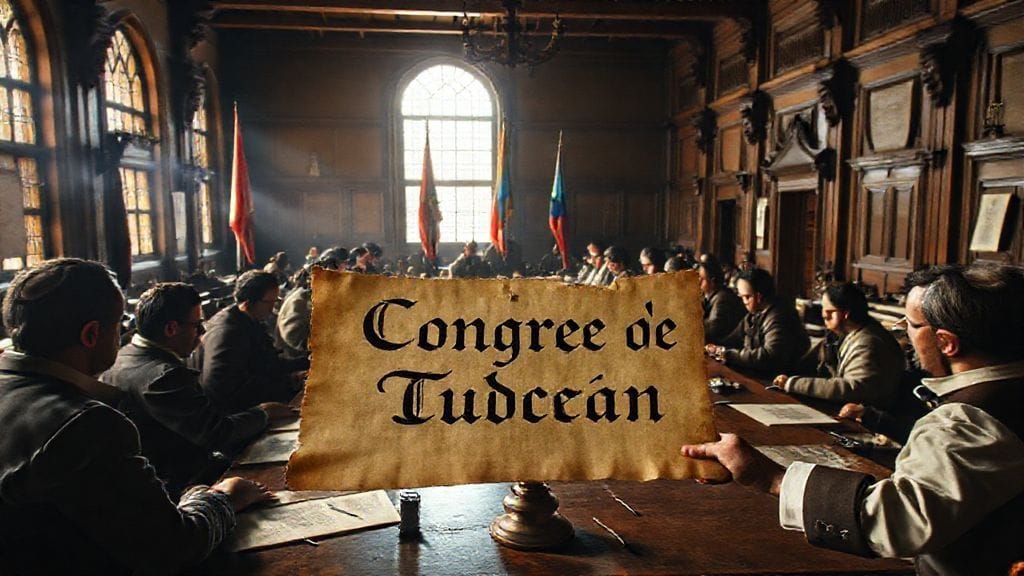
In late March 1816, representatives from fourteen provinces assembled in San Miguel de Tucumán, a city chosen for its relative safety and political neutrality. The delegation was eclectic: landowners, lawyers, military leaders, intellectuals—each bringing regional concerns and personal ambitions.
The assembly’s atmosphere was charged. The room’s wooden walls witnessed impassioned speeches invoking liberty, justice, equality, but also wary negotiations over borders, powers, and alliances. Papers rustled, ink stained quills, and the weight of history pressed upon every deliberation.
Angústias and fears intertwined with joy and defiant optimism. Many delegates were conscious that this gathering represented the culmination of a decade of sacrifice—a chance to finally define a homeland’s destiny outside imperial chains.
Yet tensions simmered. Provinces sought assurances their voices would not be drowned by Buenos Aires dominance. The gap between federalist and centralist dreams remained an unresolved fissure that would haunt discussions throughout the congress.
Voices of a New Nation: The Delegates and Their Dreams
Among the delegates were figures whose names etched themselves into the Argentine collective memory. Juan Martín de Pueyrredón, a staunch advocate for independence, promoted military and political unity. Francisco Narciso de Laprida, the voice of San Luis, eloquently argued for provincial rights and republican principles. Nicolás Rodríguez Peña, José Moldes, and others championed the ideals of Enlightenment thinkers adapted to local realities.
But beyond these leaders, the Congress included men shaped by diverse experiences—from criollo intellectuals influenced by European revolutions to provincial landowners fiercely protective of local customs.
Each delegate grappled not only with the abstract notion of independence but with concrete existential risks: war, famine, and factionalism. The decisions they made—often after nights of fraught debate—were born from the hope that Argentina could emerge united, sovereign, and free.
The Weight of History: Debates, Disputes, and Deliberations
Consensus was elusive. Debates dragged on about the form a government should take—monarchy, republic, or confederation? The fear of chaos loomed large, as memories of Paris’ Terror and other revolutionary excesses in Europe loomed in the Western imagination.
Questions of race and inclusion, the role of the Catholic Church, economic models, and relations with indigenous populations bubbled beneath the surface, though often overshadowed by more immediate political concerns.
The specter of Spain’s potential reconquest added urgency to the deliberations, fostering a shared desire for decisive action. Yet compromises were difficult: provinces quarreled over frontiers; the port city of Buenos Aires defended its trade privileges; interior regions demanded recognition.
Through hours of speeches, votes, and rewriting of documents, the Congress inched toward a historic resolution.
The Declaration of Independence: Choosing Liberty Over Empire
On the morning of July 9, 1816, as dawn broke over Tucumán, the Congress gathered to ratify the long-anticipated declaration. The document was succinct but profound. It proclaimed:
"In the name of Almighty God, the representatives of the United Provinces of South America, assembled in general Congress, appealing to the great judge of the world for the rectitude of their intentions, unanimously declare the United Provinces free and independent of the Spanish domination."
The words reverberated far beyond the room, signaling a definitive rupture with centuries of colonial subjugation. It was a declaration not only of political sovereignty but a resonance of centuries-long dreams for justice, dignity, and self-determination.
Celebrations erupted amid tears and embraces. Yet, beneath the joy lay the knowledge that the declaration was merely the starting gun in an ongoing struggle for legitimacy and survival.
Symbolism and Significance: The Birth of Argentina on Paper
Though independence movements had blossomed throughout the Americas, the Congress of Tucumán’s declaration was unique in blending local aspirations with universal ideals of the Enlightenment. It presented Argentina as a nation reborn, embracing republican values and sovereignty.
The document served as a beacon—a tangible symbol for soldiers on distant battlefields and citizens in remote estancias. It gave the provinces a legal and moral foundation to claim the rights of a nation, both to their people and the international sphere.
The act inspired art, literature, and patriotism, building a nascent Argentine identity that would be cultivated rigorously during the turbulent decades ahead.
The Challenges Foreseen: Internal Divisions and External Threats
Yet freedom acquired was fragile. The Congress itself was temporary, a stopgap amidst raging civil wars and looming foreign threats.
Federalists chafed under the idea of centralized authority; civil wars erupted, pitting provinces against each other. Spanish royalists maintained forces in Upper Peru (modern Bolivia), threatening to crush the revolution.
Additionally, Portuguese Brazil eyed expansionist opportunities, ultimately annexing Cisplatina, which would later become Uruguay. Economic distress bred discontent among the masses.
The leaders at Tucumán, though visionary, knew sovereignty demanded continuous defense—military, political, and ideological.
The Role of José de San Martín and Other Key Figures
General José de San Martín loomed large beyond the Congress walls. His campaign to liberate Chile and Peru was critical in securing independence across the continent.
Although San Martín was not formally part of the Congress, the delegates recognized the indispensable nature of his liberating armies. Coordination between political declaration and military success was imperative.
San Martín’s vision of a united South American liberation contrasted with more provincial, localized concerns. His legacy intertwined with the declaration, embodying the inseparable nature of political and military tactics in the independence process.
Reactions Across the Americas and Europe: Echoes of Tucumán
News of Argentina’s declaration rippled across the Americas, adding momentum to emancipation movements in Chile, Peru, Venezuela, and Mexico. It reverberated within international courts and monarchies wary of losing colonial possessions.
European liberals viewed the event as a hopeful sign, while conservatives feared the contagious nature of republican revolution. The transatlantic implications underscored the Congress’s significance as part of a global shift toward nationhood and self-rule.
Diplomatic recognition would take years, but the declaration enshrined Argentina’s birth certificate on the world stage.
The Aftermath: Immediate Political Consequences and the Struggle for Unity
After the Congress adjourned in February 1817, Argentina entered an era marked by intense internal conflict.
The dream of a unified republic began to fragment under competing visions of centralism versus federalism. Military caudillos emerged as dominant actors; political institutions remained fragile.
Nonetheless, the foundation laid in Tucumán provided an inescapable blueprint for nationhood. The declaration empowered leaders to claim legitimacy and demand autonomy in tense negotiations.
The Congress Dissolves: A Fragile Hope Amid Conflicts
The Congress’s dissolution did not mark an endpoint but rather the opening of new challenges. Provinces drifted apart in interests and identity, with civil wars erupting intermittently.
Yet the idea of independence, once declared, could not be erased. The Congress’s memory became a shared reference point for patriotism and national unity even in strife.
Legacy of the Congress: Argentina’s National Identity Emerges
Over time, the Congress of Tucumán transcended its immediate political role to become a symbol of Argentine identity.
July 9 remains a national holiday, celebrating freedom and republican values. The assembly’s ideals underpin Argentine civic education, art, and collective memory.
The Congress is taught not only as a moment of political transition but as the pivotal act of giving a country its soul.
Historical Memory: Commemorations and the Congress in Argentine Culture
From the erection of monuments to elaborate civic ceremonies, Argentina has celebrated the Congress’s legacy through generations.
Annual parades in Tucumán and Buenos Aires, school curricula, and public discourse keep the memory vibrant. The site of the Congress itself is preserved as a national historic monument.
This collective ritual reaffirms the values of liberty, sovereignty, and unity proclaimed over two centuries ago.
The Congress of Tucumán in the Broader Context of Latin American Independence
Argentina’s declaration was one chapter in a remarkable wave of independence movements sweeping Latin America in the early 19th century.
While sharing common goals with Simón Bolívar’s campaigns in the north and others southward, Argentina’s path was distinct in its internal divisions and regional complexity.
Yet, the Congress’s act connected Argentina to a larger continental narrative of anti-colonial revolution and the founding of new republics.
The Social Impact: Indigenous Peoples, Afro-Argentines, and the Marginalized
The Congress’s declaration primarily represented the interests of landowning Creole elites. Indigenous peoples and Afro-Argentines faced continued marginalization despite promises of liberty.
Their realities reflected the contradictions of revolutionary ideals confronted by entrenched racial and social hierarchies. Debates about citizenship and rights would continue to unfold in the nation’s subsequent history.
The Economic Hurdles Toward Sustained Sovereignty
Economic survival post-independence was challenging. The wars had devastated agriculture and trade networks.
Buenos Aires’ control of customs and trade sparked discord, while provinces demanded economic autonomy. Finding a sustainable model remained elusive throughout the 19th century.
International Diplomacy and Recognition Strategies Post-1816
While the declaration proclaimed freedom, international recognition was slow and cautious.
Argentina engaged in complex diplomacy with major powers like Britain, Portugal, and Spain to secure trade relationships and political legitimacy.
Over decades, Argentina’s posture as legitimate independent state was consolidated through treaties and diplomatic missions.
From Revolution to Republic: Argentina’s Evolution after the Congress
The Congress laid the legal and moral foundations upon which successive governments built institutions.
Though tumultuous, Argentina’s transformation from revolutionary provinces to a unified republic gained momentum throughout the 19th century.
Democracy, national symbols, and constitutionalism all trace their roots to the decisions made in Tucumán.
The Congress and the Concept of Sovereignty in the 19th Century
The Congress symbolized a global evolution in political thought: the shift from divine right monarchies to popular sovereignty.
Argentina embodied this transition by asserting that authority derived from the people, a radical idea spreading worldwide at the time.
Lessons and Reflections: How Tucumán Shapes Modern Argentina
Today, the Congress of Tucumán is more than a historical fact—it’s a living narrative about the cost and value of freedom.
Its story warns against underestimating the complexity of nation-building while inspiring ongoing quests for unity and justice.
Conclusion: The Enduring Flame of July 9, 1816
The Congress of Tucumán was a fleeting yet transformative moment, a beacon of hope slicing through the darkness of colonial subjugation. On that cold July morning in 1816, men gathered not only to declare independence but to envision a new destiny amidst uncertainty.
Their words sealed Argentina’s commitment to liberty, despite daunting obstacles yet to come. The legacy today endures in the nation’s spirit—a testament to courage, debate, and indefatigable hope. The Congress’s flame continues to inspire not just Argentina, but all who cherish the arduous journey from oppression to freedom.
FAQs
Q1: What prompted the convening of the Congress of Tucumán in 1816?
A1: The Congress was convened to unite the provinces politically, formalize independence from Spain, and navigate conflicting visions of government amid warfare and instability after the May Revolution and ongoing anti-colonial struggles.
Q2: Who were the main figures involved in the Congress?
A2: Key figures included Juan Martín de Pueyrredón, Francisco Narciso de Laprida, Nicolás Rodríguez Peña, and other provincial delegates. Though not a part of the Congress, General José de San Martín’s military campaigns strongly influenced the political context.
Q3: How did the declaration impact Argentina’s fight for independence?
A3: The declaration provided a legal and moral foundation for sovereignty, boosting morale and legitimizing the revolutionary cause domestically and internationally, although military and political challenges persisted.
Q4: Why was San Miguel de Tucumán chosen as the site for the Congress?
A4: Tucumán was chosen for its geographical centrality, relative safety from Spanish forces, and neutrality among conflicting provinces, making it an ideal location for representatives to assemble.
Q5: What were the major ideological conflicts within the Congress?
A5: Debates centered on the form of government (centralized republic versus federalism), inclusion of different social groups, political power balance between Buenos Aires and provinces, and approaches to religion and economy.
Q6: How is the Congress of Tucumán remembered today in Argentina?
A6: It is commemorated annually as Independence Day (July 9), with ceremonies emphasizing national unity, republican values, and the historic struggle for freedom. The Congress building is a national monument.
Q7: What challenges did Argentina face immediately after the Congress?
A7: Argentina faced civil wars between federalists and centralists, economic hardship, foreign threats from Spanish loyalists and Brazil, and the task of creating functional political institutions.
Q8: How does the Congress of Tucumán fit into Latin American independence movements?
A8: It was part of a broader continental wave of decolonization, interconnected with struggles in Chile, Peru, Venezuela, and elsewhere, sharing ideals but shaped by unique local conditions.