Table of Contents
- The Dawn of Destiny: Setting the Stage for Mecca’s Conquest
- The Heart of Arabia: Mecca before Muhammad
- Muhammad’s Early Struggles: From Persecution to Power
- The Treaty of Hudaybiyyah: A Fragile Peace with Mecca
- Rising Tensions: The Road to Inevitable Conflict
- The Mobilization of Faith and Force: The March to Mecca
- The Silent Approach: Strategy and Secrecy Under the Desert Sky
- The Fall of the Idols: Spiritual and Physical Liberation
- The Triumph without Bloodshed: The Surrender of Mecca
- The Farewell Address: Muhammad’s Message to the People
- The Immediate Aftermath: Transformation of a City and Its People
- The Conquest’s Impact on Arabian Politics and Society
- Religious Reconfiguration: Islam as the Unifying Force
- From Tribal Hostilities to Ummah: The Birth of a New Order
- The Conquest in Historical Memory and Islamic Tradition
- Global Repercussions: The Spread of Islam Beyond Arabia
- Lessons of Mecca: Power, Faith, and Reconciliation
- The Conquest’s Place in World History: A Turning Point
- Myths, Legends, and Reality: How Mecca’s Fall has been Told
- Legacy for Modern Islam and Contemporary Arabia
The Dawn of Destiny: Setting the Stage for Mecca’s Conquest
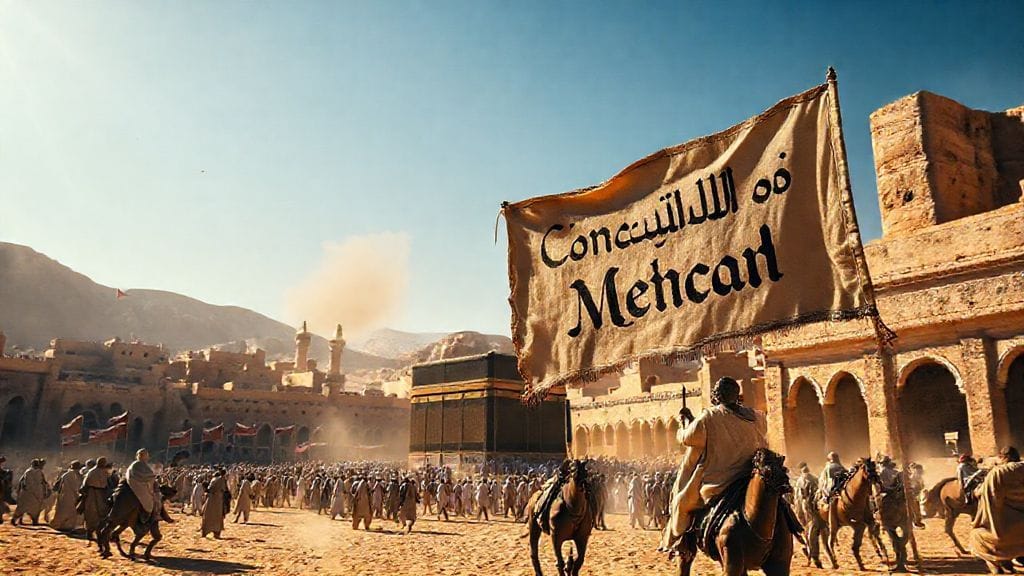
The desert air was still and heavy with anticipation on the early morning of January 630 CE. A vast army, led by the Prophet Muhammad himself, quietly crossed the barren sands toward the city that had for years been both a symbol of resistance and a spiritual battleground. Mecca, cradle of Arabian commerce and religion, stood unwittingly on the edge of seismic change. The moment was charged — silent, yet monumental. This was the hour when a man whose vision had been forged in the harsh crucible of exile would turn the tide of history and reclaim his birthplace, not merely as a conqueror, but as a unifier of a fractured land.
The conquest of Mecca was not simply a military victory. It was a culmination of decades of struggle, faith, and diplomacy, intertwined with human drama and shifting loyalties. It would mark the beginning of a new era, setting the stage for Islam’s rise from a desert revelation to a world religion. But how did this event, unfolding with an almost peaceful ease, come to be? What currents of history and conviction brought the desert tribes to surrender one of their greatest cities without swords drawn in battle?
The Heart of Arabia: Mecca before Muhammad
Mecca in the early 7th century was much more than a city; it was the spiritual and commercial hub of Arabia. At the crossroads of trade routes linking the Byzantine and Sassanian empires, this oasis was swelling with merchants, pilgrims, and clans. The Kaaba, a cube-shaped sanctuary, housed a pantheon of idols representing the polytheistic faiths of the various tribes, revered and protected fiercely as a source of prestige and power.
The Quraysh tribe controlled Mecca and its lucrative trade, wealth, and religious rites. Their influence radiated through alliances and patronages, binding the tribes within a framework where commerce and tradition seemed inseparable. Yet beneath this surface glitter lay deep rivalries, social inequalities, and the spiritual ferment that would soon shake the city’s foundations.
Muhammad’s Early Struggles: From Persecution to Power
Born into the Quraysh tribe but orphaned young, Muhammad’s early years were marked by personal loss and search for meaning. His prophetic mission began at age 40 with revelations claiming a single, omnipotent God challenging the old order. His message of monotheism, social justice, and compassion unsettled Mecca’s ruling elite. The initial reception included ridicule, persecution, and exile for Muhammad and his earliest followers, forcing them to seek refuge in Medina.
In Medina, Muhammad evolved from a persecuted preacher into a political and military leader. The community there thrived, blending religious vision with savvy governance. Over the course of a decade, Muhammad established a powerful foundation, challenging Mecca’s economic and spiritual hegemony. Tensions between the Muslim community and the Quraysh increased, setting the stage for confrontation.
The Treaty of Hudaybiyyah: A Fragile Peace with Mecca
In 628 CE, after years of intermittent skirmishes, Muhammad approached Mecca to perform the pilgrimage but was turned away. Instead of escalating to war, both parties negotiated the Treaty of Hudaybiyyah—a truce intended to last ten years. For many, the treaty seemed a setback; the terms appeared to favor the Quraysh, forcing Muslims to delay their pilgrimage and acknowledge Mecca’s authority.
Yet the treaty was a masterstroke of diplomacy. It allowed Islam to gain legitimacy and spread peacefully as word of the Muslim community and its fairness reached tribes across Arabia. It was a tenuous peace that masked rising frustrations but provided Muhammad critical space to strengthen his position.
Rising Tensions: The Road to Inevitable Conflict
Though seemingly stable, the Treaty of Hudaybiyyah unraveled within two years as allegiances shifted and violations occurred. A tribe allied with Mecca attacked a Muslim tribe protected by Muhammad, breaking the fragile trust. This act reignited fury among Muhammad’s followers, who saw it as a final breach.
Simultaneously, Muhammad’s growing influence unsettled the balance of power. More tribes pledged fealty to his cause, turning Islam from an isolated sect into a regional force. Mecca’s leaders faced the stark reality: accommodate this new power or face its wrath. The decision would lead to the march of an army tens of thousands strong toward the very heart of Arabia.
The Mobilization of Faith and Force: The March to Mecca
What distinguishes the conquest of Mecca from so many other historical sieges is its character—a combined surge of religious zeal and strategic calculation. Muhammad’s leadership inspired unity, framing the campaign not as an act of vengeance but of rightful reclamation.
With an estimated force of nearly 10,000 men—an unprecedented assembly in Arabian history—the Prophet disciplined and prepared his followers for the moment when Mecca would open its gates. The army’s movement was stealthy, avoiding unnecessary destruction, signaling a desire for peace even as it demonstrated undisputed power.
The Silent Approach: Strategy and Secrecy Under the Desert Sky
In the weeks leading to the conquest, Muhammad’s strategy was marked by restraint and subtlety. Rather than a full frontal assault, the Muslims advanced under the veil of secrecy, encircling Mecca and preventing support from reaching its defenders.
This approach caused confusion and isolation within the city. Many Meccans, unused to such political dynamics, were unsure whether to prepare for battle or negotiate. Rumors swirled as the massive force drew closer — but the Prophet’s restraint and discipline prevented chaos, something rare and remarkable in desert warfare.
The Fall of the Idols: Spiritual and Physical Liberation
The night of the conquest signaled a spiritual turning point more than a military one. Muhammad entered Mecca with minimal bloodshed; few skirmishes erupted, and many leaders surrendered immediately. The Prophet’s first act was profound: ordering the destruction of the idols that littered the Kaaba.
One by one, the images that symbolized polytheism toppled to the ground, purifying the sanctum as a place dedicated solely to the worship of one God. This act resonated deeply, marking the definitive end of the old religious order and the birth of Islam as the central faith of Arabia.
The Triumph without Bloodshed: The Surrender of Mecca
The peaceful surrender stunned many contemporaries and later historians alike. Muhammad’s clemency toward former enemies — including pardoning the Quraysh leaders— was a testimony to his vision of reconciliation and unity. His famous declaration, "Go, for you are free," to the Meccans encapsulated this approach.
Such magnanimity not only prevented further bloodshed but laid the groundwork for the integration of Mecca’s population into the new Islamic polity. It was a political and moral triumph that would echo through history.
The Farewell Address: Muhammad’s Message to the People
Following the conquest, Muhammad delivered his farewell pilgrimage and sermon—a moment that crystallized the spiritual and social ideals underpinning his movement. He emphasized equality, justice, and compassion, rejection of tribalism, and the unity of humanity under the banner of Islam.
These words became a cornerstone for Muslim ethics and law, influencing generations far beyond Arabia. The conquest of Mecca was thus not just a military event but a catalyst for a comprehensive societal transformation.
The Immediate Aftermath: Transformation of a City and Its People
Mecca quickly transformed from a city of clan rivalries and idol worship into the spiritual heart of the Islamic world. The economy adjusted; pilgrimage routes attracted new visitors; tribal hostilities diminished under Islamic law.
New leaders emerged, and the city became the seat of the growing Muslim empire. This transformation was not without challenges, but the foundations laid during and after the conquest ensured that Mecca retained its centrality for centuries.
The Conquest’s Impact on Arabian Politics and Society
The political landscape of Arabia was utterly reshaped. The decentralized tribal confederations gave way to the Ummah—a community defined by shared belief rather than lineage. This shift facilitated the rapid expansion of Islam across the peninsula and set precedents for the later Caliphates.
The conquest also demonstrated the effectiveness of combining religious ideals with pragmatic governance—a hallmark that distinguished Islamic leadership from other contemporary regimes.
Religious Reconfiguration: Islam as the Unifying Force
By purging Mecca of idolatry and proclaiming the city’s sanctity to Muslims alone, Muhammad redefined religious identity in Arabia. The Kaaba was now established as the sacred center of Islam, turning Mecca into a pilgrimage site rivaling the importance of older religious centers in the region.
This reconfiguration fostered a sense of shared purpose among disparate groups and provided a clear framework for communal worship and law, binding the new ummah.
From Tribal Hostilities to Ummah: The Birth of a New Order
The conquest marked the decisive end to internecine strife among Arabian tribes. While tribal loyalty did not vanish overnight, Islam created a political and ethical framework promoting cohesion.
The concept of the ummah transcended bloodlines, turning formerly hostile tribes into allies under a single religious and social order. This unity would empower the Islamic community to face challenges beyond the peninsula.
The Conquest in Historical Memory and Islamic Tradition
Over centuries, the conquest of Mecca has been immortalized in Islamic historiography and devotional literature. It is portrayed as a moment of divine favor, a culmination of prophecy, and a triumph of mercy and faith.
Yet historians debate the finer details—how much resistance was truly met, the negotiation processes, and the roles of various actors—reflecting the complex intertwining of history and religious narrative.
Global Repercussions: The Spread of Islam Beyond Arabia
Following the peaceful takeover, Islam rapidly transcended Arabian borders, influencing the religious, cultural, and political landscapes of the Middle East, Africa, and eventually beyond. The conquest demonstrated the power of a unified faith community combined with strategic leadership.
This event planted seeds for an empire that would shape trade, science, philosophy, and art for centuries.
Lessons of Mecca: Power, Faith, and Reconciliation
The conquest offers timeless lessons on leadership exercised with vision and restraint. It shows how a movement grounded in spiritual conviction can successfully unify fragmented societies without resorting to domination through fear.
Muhammad’s clemency, combined with political savvy, suggests possibilities for peace even in situations ripe for conflict, making the conquest resonate well beyond its historical context.
The Conquest’s Place in World History: A Turning Point
Few events in history equate with the significance of Mecca’s conquest. It marks the moment when a desert prophet transitioned from outcast to ruler, when Islam shifted from a regional faith to a civilizational force.
Its impact rippled through subsequent centuries, influencing geopolitics, inter-religious relations, and cultural developments worldwide.
Myths, Legends, and Reality: How Mecca’s Fall has been Told
Countless legends have grown around the conquest—from divine intervention to miraculous occurrences. Separating myth from reality requires careful examination of contemporary sources, archaeological evidence, and historiographical perspectives.
Understanding these layers enriches our grasp of the event’s complexity and enduring symbolism.
Legacy for Modern Islam and Contemporary Arabia
Today, the conquest of Mecca remains a defining chapter in Islamic memory, influencing religious practices and national identities. It also informs ongoing discussions on tolerance, governance, and cultural heritage in the Muslim world.
Mecca’s sanctity endures as a spiritual beacon, reminding millions of the city’s transformative past—a past born out of faith, struggle, and ultimately, unity.
Conclusion
The conquest of Mecca in 630 CE stands as one of history’s most profound chronicles of transformation—a moment when faith, strategy, and humanity converged to reshape a city and an entire world. In the silent approach of Muhammad’s forces, in the breaking of idols, and in the grace extended to former enemies, we witness the birth of a unifying vision that transcended blood feuds and old gods. It reveals the power of reconciliation, the blending of spiritual idealism with political acumen, and the creation of a community bound not by lineage but by shared belief.
This event speaks to anyone who has faced division and dreams of unity, who recognizes that true conquest lies not in destruction, but in healing and hope. The conquest of Mecca is thus not only a historical milestone but a timeless lesson—an invitation to courage, faith, and the possibility of peaceful transformation.
FAQs
1. Why was the conquest of Mecca significant in Islamic history?
The conquest marked the final consolidation of Muhammad’s power in Arabia, established Islam as the dominant religion, and transformed Mecca into the spiritual center for Muslims worldwide. It symbolized the triumph of monotheism over polytheism in the Arabian Peninsula.
2. How did Muhammad manage to capture Mecca with minimal violence?
Through strategic planning, the assembling of a large but disciplined force, and his reputation for clemency and fairness, Muhammad encouraged surrender and peacefully integrated the city’s inhabitants without widespread bloodshed.
3. What was the Treaty of Hudaybiyyah and how did it influence the conquest?
Signed in 628, it was a ten-year truce between Muhammad’s followers and Meccan leaders, allowing Muslims to strengthen their position and legitimacy. Its eventual breach led to renewed hostilities culminating in the conquest.
4. How did the conquest affect the tribal structure in Arabia?
It diminished tribal rivalries by promoting the concept of the Ummah—an Islamic community united by faith rather than blood. This shift created a new political and social order across Arabia.
5. What happened to the idols in the Kaaba after the conquest?
Muhammad ordered the destruction of all idols, cleansing the Kaaba and dedicating it solely to the worship of the one God, Allah, thus establishing a monotheistic focus for Arabian religious life.
6. How is the conquest remembered in Islamic tradition?
It is celebrated as a divine victory and a demonstration of Muhammad’s mercy and leadership, serving as a foundation for Islamic jurisprudence and spiritual identity.
7. Did the conquest of Mecca influence the broader spread of Islam?
Yes, it significantly enhanced the authority and credibility of Islam, enabling rapid expansion beyond Arabia into the Middle East and beyond.
8. What lessons does the conquest hold for modern society?
It teaches the power of compassionate leadership, the importance of reconciliation in conflict, and the unifying potential of shared values over divisive identities.

