Table of Contents
- The Final Days of an Emperor: Constantine at Nicomedia
- The Setting: Nicomedia, Bithynia’s Imperial Heart
- Constantine’s Reign: A Brief Recapitulation
- The Burden of Power: Constantine’s Health and Spirits
- The Illness Unearthed: Symptoms and Historical Records
- The Court Around Constantine: Allies, Heirs, and Enemies
- The Last Rite: Constantine’s Deathbed and Christian Faith
- The Date Eternalized: May 22, 337 AD
- The Immediate Aftermath: Shockwaves Across an Empire
- The Division of the Tetrarchy: Constantine’s Sons Ascend
- Christian Empire: The Religion Cemented by Death
- Nicomedia’s Role as an Imperial Nexus
- The Legacy of Constantine’s Death in Historiography
- The Political Earthquake: From Unity to Fragmentation
- Constantine’s Death in Cultural Memory and Art
- Reflections of a Dying Empire: Memoirs and Chroniclers
- The Mythos of Constantine’s Passing
- The Broader Historical Context of 4th-Century Rome
- Religious Transformations Sparked by a Mortal End
- The Shadows Cast by an Emperor’s Funeral
- Revisiting the Tomb: Archaeological and Textual Evidence
- Constantine’s Succession Crisis: Stability or Instability?
- The Human Element: Death as a Historical Turning Point
- Conclusion: The Eternal Emperor’s Mortal Farewell
- FAQs About Constantine’s Death and Its Impact
- External Resource
- Internal Link: History Sphere
The Final Days of an Emperor: Constantine at Nicomedia
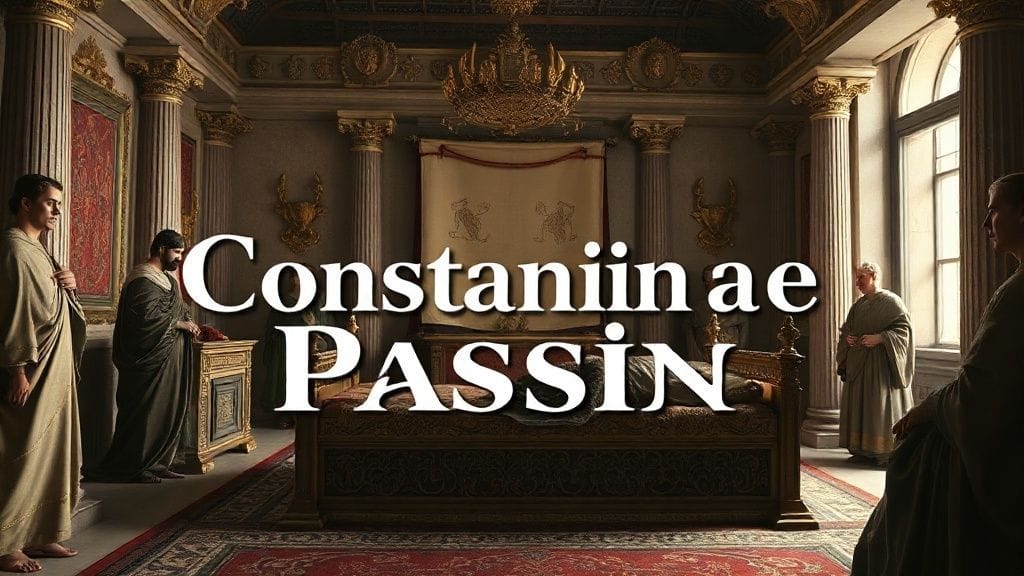
The spring sun shone with indifferent brightness over the city of Nicomedia in May of 337 AD. Across the marble steps of the imperial palace, a great shadow loomed—Constantine the Great, the man who had forged an empire and reshaped a world, lay gravely ill, his breath shallow and labored. Outside the grandeur of his chambers, soldiers and servants moved briskly, unaware that they were witnesses to history in its most fragile and human moment.
Constantine’s death was not just the passing of a ruler; it was the fading of a titan whose choices would echo through time. Within these final hours, we glimpse an emperor reduced not to the armor of command or the cloak of divinity he so often wore, but to a mortal man grappling with the inevitable end. It is here, in Nicomedia—a city that had been at the heart of imperial troubles and triumphs—that the curtain fell on a life that changed the Roman world forever.
The Setting: Nicomedia, Bithynia’s Imperial Heart
Situated on the cusp between Europe and Asia, Nicomedia (modern-day İzmit, Turkey) was a city of strategic and symbolic importance. Once the capital of Diocletian’s Eastern Roman Empire, it remained a jewel of administrative power and military stronghold. The choice of Nicomedia as the place where Constantine met his mortal fate was fitting: a crossroads of empires, cultures, and creeds, reflecting the vast diversity under his rule.
Nicomedia was more than a mere backdrop. It was a city steeped in both pagan tradition and the rising Christian faith that Constantine had championed. Its marble forums and busy streets echoed with the tension of an empire struggling to redefine itself as Constantine’s era drew to a close.
Constantine’s Reign: A Brief Recapitulation
Reigning since 306 AD, Constantine’s story is one of grit and vision. Emerging from a fractured empire riven by civil wars and usurpers, he prevailed through a combination of military savvy and political acumen. His victory at the Milvian Bridge in 312 not only secured his control of the Western Roman Empire but also heralded a turning point for Christianity.
Constantine’s conversion—whether genuine or politically motivated—altered the religious landscape. With the Edict of Milan in 313, Christians found unprecedented freedom, and pagan old orders faced gradual eclipse. Rome’s very soul was transforming, and Constantine was at its fiery center.
Yet power came at a price: relentless warfare, court intrigues, and a harsh drive for consolidation haunted his reign. By the time he reached Nicomedia in 337, Constantine’s empire was expansive but fragile.
The Burden of Power: Constantine’s Health and Spirits
Accounts suggest that the emperor’s health had been deteriorating for months. At more than 60 years old—a venerable age for the time—he was weary from decades of campaigning and governance. The stress of managing a sprawling realm, coupled with the recent purge of potential rivals, weighed heavily.
Chroniclers such as Eusebius and later historians note a shift in Constantine’s behavior: bouts of brooding, intense religious reflection, and a visible pallor that worried those close to him. Some modern scholars speculate on ailments ranging from chronic fever to advanced intestinal illness.
Whatever the diagnosis, the man who had once charged fearlessly into battle found himself confined by his own failing body, a king who could no longer wield the sword that had won him the crown.
The Illness Unearthed: Symptoms and Historical Records
Descriptions from sources like the Panegyrici Latini and later Christian hagiographies mention high fevers, exhaustion, and a possible gangrene affliction that seemed to undermine his vitality. Some historians hypothesize sepsis or a severe infection, exacerbated by the lack of advanced medical care.
Interestingly, Constantine, despite having adopted Christianity, was rumored initially reluctant to undergo full baptism before his death—a refusal perhaps indicative of the illness’s suddenness or his ambivalence. The precise medical cause remains debated, but what shines through is the unmistakable humanity of a man facing mortality.
The Court Around Constantine: Allies, Heirs, and Enemies
At his side were his three surviving sons—Constantine II, Constantius II, and Constans—each groomed to inherit parts of the empire. Yet, awareness of the fragile peace within the imperial household added tension to the emperor’s final hours. Factionalism simmered beneath the surface; ambitions hovered perilously close to open conflict.
The court physicians, priests, and attendants who surrounded Constantine were themselves actors in a delicate drama, where loyalty mixed with self-preservation. Shrouded in imperial ceremony, the emperor’s death was both a personal loss and a political chess move.
The Last Rite: Constantine’s Deathbed and Christian Faith
One of the most poignant notes of the final chapter is the emperor’s baptism conducted shortly before his passing. Historical tradition holds that Constantine delayed baptism until the end of his life—a practice reflecting contemporary Christian views on sin and purification.
The bishop who performed the rite reportedly applied water mixed with exorcised oil. Constantine’s death, minutes or hours later, marked not only the end of a physical life but the passage of a soul fortified by faith. This act sealed his legacy as the “first Christian emperor,” immortalizing him in both religious doctrine and imperial myth.
The Date Eternalized: May 22, 337 AD
May 22 carries a weight few dates possess—the moment a world shifted and legends were born. In the year 337, as the sun rose over Bithynia, whispers traveled through Nicomedia’s marble halls and, by nightfall, across continents: Constantine was dead.
This date is etched into the annals of history not only as a factual timestamp but as a symbol of transition—from pagan Rome to Christian Rome, from imperial unity to division, from mortal ambition to eternal memory.
The Immediate Aftermath: Shockwaves Across an Empire
News of Constantine’s death rippled instantly through the empire’s vast reaches. Governors, soldiers, and citizens grappled with uncertainty. Who would succeed? Would infighting erupt? What would happen to the fragile peace?
Roman cities witnessed both mourning and opportunism. The death unsettled alliances and renewed old fears. Yet, despite initial chaos, the imperial machinery moved quickly, emphasizing ritual, ceremonies, and declarations designed to reassure a restless populace.
The Division of the Tetrarchy: Constantine’s Sons Ascend
True to the tradition of tetrarchical governance, the empire was divided among Constantine’s three sons. Constantine II claimed Gaul, Britain, and Spain; Constantius II took the East; and Constans ruled Italy, Africa, and Illyricum.
This tripartite split promised continued stability but also seeded rivalries that would erupt into civil war within years. The unity imposed by Constantine’s iron will now rested in the hands of less dominant successors, each with their own ambitions and visions for Rome’s future.
Christian Empire: The Religion Cemented by Death
Constantine’s passing did not diminish the momentum of Christianity; rather, it accelerated its transformation from persecuted sect to state religion. His sons upheld the Christian cause, convening councils and suppressing pagan resistance.
The emperor’s death framed a religious narrative of martyrdom and sanctity, creating a template for imperial piety that would define the Byzantine and Western empires alike for centuries.
Nicomedia’s Role as an Imperial Nexus
Though overshadowed in later periods by Constantinople, Nicomedia retained significance during and after Constantine’s reign. As the place of his death, it became a symbol of transition—a physical locale where imperial power intersected with faith and fragility.
The city’s eventual decline belied its moment of supreme importance, immortalized by Constantine’s mortal farewell.
The Legacy of Constantine’s Death in Historiography
The treatment of Constantine’s death by historians reveals much about the evolving narratives of power. Early Christian chroniclers lionized the event as divine providence; pagan writers lamented the changing tides.
Modern scholars dissect the layers of myth and fact, understanding this moment as a pivotal hinge on which the ancient world turned toward medieval Christendom.
The Political Earthquake: From Unity to Fragmentation
Despite Constantine’s efforts to consolidate power, his demise revealed the empire’s deep structural vulnerabilities. Political centrifugal forces that had been held at bay surged forth anew.
The tumultuous decades following his death featured usurpations, religious conflicts, and territorial losses, painting his passing as both an end and a beginning.
Constantine’s Death in Cultural Memory and Art
From mosaics to manuscripts, Constantine’s death inspired artistic depictions blending realism and sanctity. His iconography as the “New Constantine” emerged, celebrating his role as God’s chosen ruler.
These cultural artifacts offer windows into medieval mindsets where history, legend, and faith intertwined.
Reflections of a Dying Empire: Memoirs and Chroniclers
Writers from Ammianus Marcellinus to later Byzantine historians reflected on Constantine’s rule and death with varying degrees of praise and criticism. Their chronicles preserved a human portrait—flawed, complex, immortalized.
Their words allow us to hear echoes of the emperor’s final breath across centuries.
The Mythos of Constantine’s Passing
Stories of visions, divine lights, and miraculous signs accompanied Constantine’s deathbed, weaving folklore into fact. These narratives shaped medieval spirituality and imperial ideology, making his death a moment of mythic significance.
The Broader Historical Context of 4th-Century Rome
The early 4th century was a crucible of change: dramatic shifts in governance, religion, and society. Constantine’s death marked a climax in a century defined by transformation, heralding new eras both glorious and turbulent.
Religious Transformations Sparked by a Mortal End
With the emperor’s death, pagan institutions faced accelerating decline. The Christian church’s political power grew, influencing law, culture, and daily life.
Constantine’s mortal end paradoxically immortalized the faith he elevated.
The Shadows Cast by an Emperor’s Funeral
The ceremonies surrounding Constantine’s burial were grand and symbolic. Whether in the mausoleum at Constantinople or Nicomedia, the rites blended Roman imperial protocol with Christian solemnity, reflecting a world in transition.
Revisiting the Tomb: Archaeological and Textual Evidence
Modern archaeology seeks traces of Constantine’s final resting place, offering new insights yet also preserving mysteries. The interplay of historical text and material culture keeps the emperor’s memory alive and debated.
Constantine’s Succession Crisis: Stability or Instability?
The division of the empire among his sons was meant to secure peace, but the road ahead proved rocky. Rivalry and civil war soon erupted, underscoring the fragile legacy left by Constantine’s death.
The Human Element: Death as a Historical Turning Point
Ultimately, Constantine’s death reminds us that history turns on human fragility. Beneath the crown and legend beats a mortal heart whose end reshaped empires and faiths.
Conclusion: The Eternal Emperor’s Mortal Farewell
Constantine’s death on May 22, 337, stands as one of history’s monumental farewells: a synthesis of human vulnerability and imperial grandeur. It ended an era of unity, faith, and ambition, paving the way for transformation and turmoil alike.
Here, in Nicomedia, the emperor who had redefined Rome’s destiny met his own. Yet death was but a doorway—one that led to enduring legacies, myths, and a world forever changed.
As chronicler Sozomen wrote centuries later, “Though he died, his works live on, eternal as the city he founded.” Indeed, through the mountains of history, Constantine’s mortal farewell still resounds.
FAQs
1. What caused Constantine the Great’s death in Nicomedia?
While precise causes remain debated, historical records suggest illness consistent with high fever and infection, possibly sepsis or gangrene. His advanced age and exhaustive reign likely contributed.
2. Why was Constantine baptized only on his deathbed?
Within early Christian practice, baptism at death was common to cleanse one of sins accrued throughout life. Constantine delayed it possibly from uncertainty or a wish to maintain imperial pagan rites longer.
3. How did Constantine’s death impact the Roman Empire’s political structure?
His death led to the division of the empire among his sons, initiating a period of fragmentation and internal strife that undermined the unity he had secured.
4. What role did Nicomedia play in Constantine’s life and death?
As a former imperial capital and a strategic city, Nicomedia was where Constantine died. It symbolized imperial continuity and transition, bridging the pagan past with the Christian future.
5. How did Christianity evolve after Constantine’s death?
Christianity's status elevated further; Constantine’s sons upheld and expanded its influence, paving the way for it to become the dominant religion of the empire.
6. How do historians view Constantine’s death in modern times?
Modern scholars see it as a turning point, marking both the end of an imperial unifier and the start of religious and political shifts that shaped late antiquity.
7. Were there any immediate successors or contenders who challenged Constantine’s sons?
Yes, the succession was marred by rivalry and usurpation attempts, reflecting the inherent instability of divided rule.
8. What evidence remains today of Constantine’s death and burial?
Archaeological evidence is scant and debated, but textual sources and some sites in Constantinople and Nicomedia hint at his final resting place.