Table of Contents
- The Final Dawn Over Constantinople: May 29, 1453
- The Last Byzantine Emperor: Constantine XI Palaiologos
- The Fall of an Empire: Byzantium on the Brink
- The Siege Begins: Mehmed II’s Ambitious Campaign
- Constantinople’s Defenses: Walls That Withstood Centuries
- The Emperor’s Resolve: Preparing for the Last Stand
- The Siege Tactics: Ottoman Innovations and Unyielding Assault
- The Human Toll: Defenders, Civilians, and the Weight of Desperation
- The Last Hours: The Final Assault and Constantine’s Last Battle
- The Death of an Emperor: Legend and Reality Collide
- The Fall of Constantinople: A City Forever Changed
- Political Aftershocks: The End of Byzantine Sovereignty
- The Rise of the Ottoman Empire: Mehmed II’s Conquest and Vision
- Cultural and Religious Impact: Christianity and Islam at the Crossroads
- The Legacy of Constantine XI: Myth, Memory, and Modern Symbolism
- From Ruins to Revival: The Transformation of Constantinople into Istanbul
- Europe’s Response: Fear, Reflection, and the Dawn of a New Era
- The Historical Debate: Chronicling the Battle and the Emperor’s Fate
- Human Stories from the Siege: Courage, Betrayal, and Survival
- The Siege in Art and Literature: Echoes Through Time
- Conclusion: The Eternal Emperor and the Fall That Shaped History
- FAQs: Unraveling the Myth and Facts of Constantine XI and 1453
- External Resources
- Internal Link
The Final Dawn Over Constantinople: May 29, 1453
The morning of May 29 was shrouded in an eerie quiet—an unnatural pause before the storm. As the first light crept over the walls of Constantinople, the city seemed to hold its breath. In the shadow of ancient fortifications, amid tension and despair, one man stood unwavering: Constantine XI Palaiologos, the Last Byzantine Emperor. His eyes traced the silhouette of thousands gathering beyond the horizon—Ottoman armies thirsting for conquest, led by the indomitable Sultan Mehmed II. That dawn was not just the beginning of a battle; it was the final curtain for an empire that had endured a millennium. The air was heavy with the promise of bloodshed, valor, and the end of an age.
The story of Constantine XI’s final stand at Constantinople is a tapestry of heroism, tragedy, and the inexorable tide of history. It is a saga of an empire clinging to life, a city resisting fate, and a man embodying the last flicker of Byzantine glory.
The Last Byzantine Emperor: Constantine XI Palaiologos
Constantine XI Palaiologos was no ordinary ruler. Born into the storied Palaiologos dynasty, he was the final emperor of the Byzantine Empire—a relic of Rome’s storied past and a symbol of Christian resilience against the rising tide of Islam and Ottoman ambition. Unlike many monarchs who retreated behind pomp and privilege, Constantine was renowned for his hands-on leadership, deep sense of duty, and a certain tragic heroism.
His reign began under impossible circumstances. Facing an empire now reduced to the city of Constantinople and some scattered territories, beset by internal strife and external threats, Constantine assumed his throne in 1449 with a weary but determined heart. He was a man caught between eras: holding the heritage of a Roman empire that once spanned continents and confronting the brutal military reality of the 15th century.
But who was Constantine XI beyond the throne? Accounts describe a tall, formidable warrior-emperor, schooled in both diplomacy and battlefield command. He was deeply devout, a Christian leader whose soul was tethered to his city’s faith and fate. He had married into the Trapezuntine dynasty, strengthening regional alliances, and his outlook was firmly fixed on preservation—yet he understood well the storm gathering on the empire’s doorstep.
The Fall of an Empire: Byzantium on the Brink
By the mid-15th century, the Byzantine Empire was a shadow of itself. Once a vast empire that controlled key lands across the Mediterranean and Near East, it had dwindled due to centuries of internal decay, crusades, plundering, and rising enemies. The empire’s capital, Constantinople, was a jewel geographically strategic—straddling Europe and Asia, guarding the entrance to the Black Sea—but militarily vulnerable.
The Ottomans, a rising power fueled by a fusion of shrewd politics and rigorous military organization, had set their sights on Constantinople since the late 14th century. Sultan Mehmed II, ascending the throne in 1451, inherited an empire hungry to cement its dominion and fulfill its destiny as heirs to the Roman legacy.
The Byzantines faced crushing odds. Their population was diminished; the treasury nearly bankrupt; their army weak and reliant on foreign mercenaries and militia. Diplomatic efforts to secure Western aid had met mixed success, with religious schisms and political rivalries preventing unified Christian resistance.
In this fraught climate, the city was more a fortress-city than a flourishing capital. Its golden age had been eclipsed by the stark reality of siege warfare and economic hardship. Yet Constantinople remained a crucial symbol—of Christianity’s eastern bastion, of Roman heritage, and of a civilization that refused to vanish quietly.
The Siege Begins: Mehmed II’s Ambitious Campaign
Mehmed II, known later as Mehmed the Conqueror, was a young and ambitious sultan who saw the fall of Constantinople not simply as a military victory but as a unifying mission for his realm. Determined to end centuries of resistance and open the gateway to Europe, he gathered an army estimated between 80,000 to 100,000 men—a combination of elite Janissaries, artillery units, cavalry, and naval forces.
The siege began in early April 1453. Constantinople’s defenders numbered fewer than 8,000, including locals, Genoese and Venetian mercenaries, and a small contingent of knights dispatched by Pope Nicholas V. The disparity was stark. Yet behind the city's walls flowed a current of fierce determination.
Mehmed’s forces used both traditional and innovative siege tactics, including monstrous cannons—the legendary basilicas of artillery—that relentlessly bombarded the ancient Theodosian Walls. The Ottoman navy blocked the Golden Horn, cutting off Byzantine access to crucial supplies and potential reinforcements.
But despite the overwhelming pressure, the city’s defenders held firm. The thick walls, some sections untouched for over a thousand years, absorbed the brunt of the bombardment. The defenders’ resolve electrified the city, inspiring fierce skirmishing and night sorties.
Constantinople’s Defenses: Walls That Withstood Centuries
The greatness of Constantinople’s defense lay largely in its formidable fortifications. The Theodosian Walls, completed in the 5th century AD, were architectural marvels consisting of double walls, towers, and a deep moat. For centuries, these walls had repelled invaders, from the Huns to Arab sieges, to Crusaders.
On landward approaches, the massive walls and moats deterred direct assault, forcing attackers to devise heavy siege engines or identify weak points. On the seaward side, the chain blocking the Golden Horn prevented Ottoman naval entry, ensuring a vital artery for supplies and communication remained tentatively open.
Constantine XI and his generals meticulously managed these defenses, repairing breaches, bolstering morale, and utilizing every soldier. Still, age and limited resources had taken their toll. The cannons’ relentless pounding began to chip away at the once impregnable walls, and the weight of impossibility pressed heavily on defenders’ spirits.
The Emperor’s Resolve: Preparing for the Last Stand
Constantine XI's leadership during the siege was a phenomenon of stoicism and impassioned courage. Foregoing safety, he roamed the walls and streets, rallying troops, preaching unity, and demonstrating a palpable resolve to sacrifice all for the city’s survival.
He sought to forge alliances, appeal to distant Western powers, and maintain transparency with his people. His speeches, however scarce in record, were reportedly stirring—blending appeals to faith, honor, and the legacy of Rome.
Throughout the siege, Constantine rejected offers to abandon the city, cementing his role not merely as ruler but as its last protector. His presence instilled hope among besieged Christians and sent a clear message to the Ottomans that the defense would be relentless.
The Siege Tactics: Ottoman Innovations and Unyielding Assault
Mehmed II’s military brilliance shone during the siege. Beyond superior numbers, he utilized the latest Ottoman military innovations, including revolutionary artillery crafted under the supervision of Urban, a Hungarian engineer.
The bombardment was relentless and effective at creating breaches in the walls. Mehmed also used psychological warfare, employing continuous musket volleys, noise, and sapping operations aimed at undermining morale and the walls themselves.
Navally, he bypassed the Golden Horn blockade by transporting ships overland on greased logs—a daring maneuver that inserted Ottoman vessels behind Byzantine lines.
Despite repeated charges and assaults, the defenders' discipline and the city's fortifications blunted the Ottomans. The siege dragged on for almost two months, each day fraught with tension, loss, and small, bloody victories.
The Human Toll: Defenders, Civilians, and the Weight of Desperation
Siege warfare is measured not just in cannonballs and walls shattered, but in human suffering. Inside Constantinople, civilians endured constant fear, food shortages, and overcrowding. Families huddled in dark basements, hearing the distant thunder of bombardment. Desperation was a daily companion.
Soldiers fought in extraordinarily harsh conditions—wearied, hungry, but fueled by desperation and duty. Among them were mercenaries whose loyalty was tested by dwindling pay and the horrors witnessed.
The churches, hospitals, and streets became sites of death and refuge. The elderly and children, with no means to defend themselves, were victims of despair and chaos. Chroniclers of the time speak of stoic heroism mixed with heartbreaking cries for mercy.
The Last Hours: The Final Assault and Constantine’s Last Battle
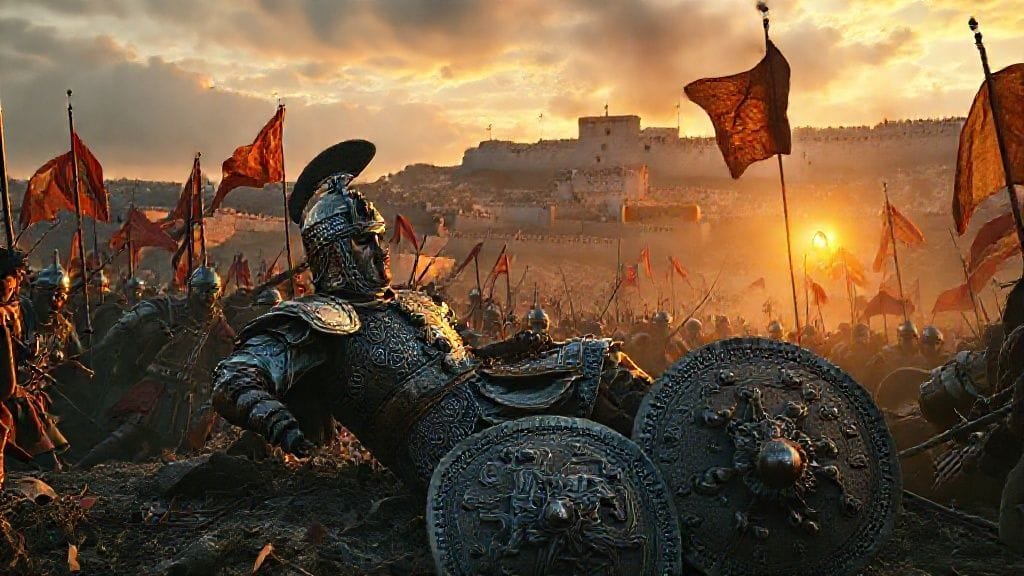
As May waned, the siege reached its brutal climax. On the night of May 28 and into the early hours of May 29, the Ottomans launched a desperate, massive assault. Cannon fire thundered, walls crumbled, and thousands surged forward through breaches.
Constantine XI was at the forefront, commanding personally alongside his men. According to rare eyewitness accounts, including that of Leonard of Chios, the emperor fought valiantly, refusing to flee despite the overwhelming enemy tide.
The battle devolved into brutal close-quarters combat amid the ruins of the walls, with desperation manifesting in every corner—swords clashing, arrows flying, and cries echoing through the dawn mist.
The Death of an Emperor: Legend and Reality Collide
Constantine XI’s death remains shrouded in legend and mystery. No definitive account survives. Eyewitnesses confirm he died in battle, fighting to the last breath, but the exact location and manner are lost to time.
Some stories depict him losing his sword, retreating into the streets, or leading a final rearguard action. Others suggest he vanished amidst the chaos, his body unrecovered. Ottoman soldiers respected the fallen foe; none claimed to have captured or killed him personally, adding to the mythos.
In Byzantine and later Greek lore, Constantine XI became the "Marble Emperor," prophesied to return in the city’s hour of need—a symbol of eternal resistance.
The Fall of Constantinople: A City Forever Changed
With the emperor’s death, the fortress-city fell into Ottoman hands. What followed was a turbulent, sorrowful day—a city sacked, churches plundered, and survivors faced harsh new realities.
Mehmed II ordered an end to widespread pillaging earlier than customary, intent on preserving Constantinople’s infrastructure and symbolism. He declared the city the Ottoman capital—transforming the heart of Byzantium into a center of Islamic power while retaining its cosmopolitan diversity.
The psychological impact was profound. Byzantium, the last remnant of the Roman Empire, had ceased to exist. For Christians, it was as if a bulwark against the East had crumbled forever.
Political Aftershocks: The End of Byzantine Sovereignty
The fall represented more than a single military defeat; it marked the official extinction of Byzantine sovereign authority. The empire that had endured for over a millennium was no more.
European powers, fragmented and embroiled in their politics, could do little to intervene effectively, signaling a grim new reality where the Ottoman Empire was the preeminent power in Southeast Europe and the eastern Mediterranean.
For Orthodox Christians, the loss disrupted ecclesiastical authority and political autonomy. The Patriarchate of Constantinople was subordinated under Ottoman auspices, reshaping religious and cultural dynamics in the region.
The Rise of the Ottoman Empire: Mehmed II’s Conquest and Vision
Mehmed II’s triumph was not merely military but civilizational. By capturing Constantinople, he secured control over strategic trade routes and a symbolic seat of power.
He embarked on ambitious urban renewal projects, inviting diverse populations—Greeks, Armenians, Jews, and Muslims—to settle the city. Under his vision, Constantinople (soon Istanbul) resumed its status as a vibrant, cosmopolitan metropolis and imperial seat.
The conquest accelerated Ottoman expansion into Europe, a process that would continue for centuries, altering the political and cultural map of the continent.
Cultural and Religious Impact: Christianity and Islam at the Crossroads
The fall of Constantinople forced a reckoning between two worlds. Christian Europe mourned a fallen bastion; the Islamic world celebrated a significant victory.
Religiously, the conquest signified a profound shift—the city’s great cathedral, Hagia Sophia, became a mosque, symbolizing the transformation. Yet Mehmed preserved much of the city’s Christian heritage, creating a millet system allowing religious minorities relative autonomy.
This coexistence persevered with tension, but also with moments of exchange—art, learning, and culture bridging divides amidst political domination.
The Legacy of Constantine XI: Myth, Memory, and Modern Symbolism
Constantine XI’s fate captured imaginations from the 15th century onward. To Greeks, he became a martyr and symbol of resistance against Ottoman rule. His supposed survival and prophesied return inspired hopes and national identity through centuries of domination.
In art, literature, and folklore, he is cast as the tragic hero—the "Marble Emperor" who sleeps beneath the city, destined to awaken one day. Nationalist movements in the 19th and 20th centuries invoked his image as an emblem of Greek independence and dignity.
His legacy transcends centuries, embodying the complexity of empire, faith, and the endurance of memory.
From Ruins to Revival: The Transformation of Constantinople into Istanbul
After the fall, Constantinople entered a period of profound transformation. Mehmed II’s investments rebuilt infrastructure, restored defenses, and revitalized the city’s economy.
Known as Istanbul, the city became the Ottoman imperial capital—a melting pot blending Byzantine architecture, Islamic culture, and vibrant commerce.
Over time, the city’s identity shifted dramatically, yet its ancient roots remained visible—in ruins, mosaics, and stories passed down through generations.
Europe’s Response: Fear, Reflection, and the Dawn of a New Era
News of Constantinople’s fall sent shockwaves across Europe. Monarchs and popes convened, alarmed about Ottoman advances.
Calls for crusades echoed, but fractured politics limited effective responses. The event accelerated the search for alternative trade routes to Asia, indirectly fueling the Age of Exploration.
Intellectually and culturally, the influx of Byzantine scholars into Western Europe helped ignite the Renaissance, transmitting ancient Greek knowledge that had been safeguarded in Constantinople.
The Historical Debate: Chronicling the Battle and the Emperor’s Fate
While Constantine XI’s death is undisputed, details remain debated. Contrasting accounts—from Venetian captains to Ottoman chroniclers—offer varying perspectives on the siege’s closing moments.
Historians grapple with sparse, sometimes biased sources, reconstructing the drama from fragments. Modern archaeology continues to reveal clues beneath Istanbul’s streets, but the emperor’s tomb remains undiscovered.
The blend of fact and folklore illustrates the difficulty of pinning down history amid legend.
Human Stories from the Siege: Courage, Betrayal, and Survival
Beyond emperors and armies, the siege was also the stage for countless personal dramas.
Tales of ordinary citizens showing heroism, mercenaries torn by divided loyalties, and families torn apart evoke the deep human cost of conquest.
Some figures, like Giovanni Giustiniani, a Genoese commander who was mortally wounded, symbolize the international dimension of the defense. Civilians sheltered in churches, clerics offering solace, and those forced to flee all form threads in the tapestry of the last days.
The Siege in Art and Literature: Echoes Through Time
The fall inspired generations of artists, writers, and historians—capturing the drama in frescoes, poems, and novels.
From Renaissance paintings depicting Constantine’s noble death to modern Greek literature reflecting on loss and hope, the siege remains fertile ground for creative expression.
These cultural echoes help preserve the memory, making the past resonate with new audiences.
Conclusion: The Eternal Emperor and the Fall That Shaped History
Constantine XI Palaiologos died with the walls of Constantinople crumbling behind him, embodying a civilization’s final breath. Yet in death, he became immortality’s symbol—a bridge between eras, faiths, and identities.
The fall of Constantinople was more than a military event; it was the pivot on which the medieval world ended and the modern began. It reshaped empires, religions, and cultures, leaving a legacy that endures in stone, story, and spirit.
In every stone of Istanbul, in every whisper of legend, echoes the last stand of a man who fought not just for a city, but for the soul of history itself.
FAQs
Q1: Why was Constantine XI considered significant in Byzantine history?
A1: Constantine XI was the last emperor of the Byzantine Empire, symbolizing its final resistance against Ottoman conquest. His leadership during the siege of Constantinople and his death in battle mark the end of a millennium-old empire.
Q2: How large were the opposing forces during the siege?
A2: The Ottoman forces numbered between 80,000 and 100,000, while the defenders, including citizens and mercenaries, numbered fewer than 8,000, creating a massive imbalance.
Q3: What military technologies played a decisive role in the siege?
A3: The Ottomans employed large cannons, notably the basilica cannon designed by Urban, which could fire massive stone balls capable of damaging Constantinople’s ancient walls.
Q4: How did Mehmed II treat the city after the conquest?
A4: While the city was initially sacked, Mehmed II quickly halted widespread looting, aimed to preserve infrastructure, and repopulated the city to transform it into the Ottoman capital.
Q5: What happened to the Byzantine population after the fall?
A5: Many inhabitants were killed, enslaved, or fled. Those remaining lived under Ottoman rule, with Christians maintaining some religious autonomy under the millet system.
Q6: Why is Constantine XI called the “Marble Emperor”?
A6: According to legend, Constantine did not die but was transformed into marble beneath the earth, destined to return when Byzantium is restored. This myth has sustained his place in Greek cultural memory.
Q7: How did the fall of Constantinople affect Europe?
A7: The event shocked Europe, leading to calls for crusades, increased exploration efforts, and influenced the Renaissance through the migration of Byzantine scholars westward.
Q8: Is there any confirmed record of where Constantine XI died?
A8: No precise location or circumstances are definitively confirmed; sources agree he died fighting during the final Ottoman assault, but details remain lost to history.