Table of Contents
- Border of Fire: Gaul on the Edge Before 298
- The Tetrarchs and the Fractured Empire
- Constantius Chlorus: Soldier, Strategist, Reluctant Emperor
- The Alamanni: Neighbors, Raiders, and Reluctant Foes
- Lingones: A Frontier City Under Shadow
- The Road to Clash: Campaigns of 297–298
- Into the Trap: The Alamanni Strike at Lingones
- The Battle of Lingones 298: Day of Decision
- Steel in the Streets: Urban Warfare Inside the Walls
- Constantius’s Counterstroke: Tactics, Terrain, and Turning Points
- Aftermath on the Field: Corpses, Captives, and Claims of Victory
- Voices from Gaul: Civilians, Veterans, and Merchants Remember
- Reforging the Rhine Frontier: Forts, Laws, and Settlements
- Propaganda and Memory: How Rome Told the Story
- From Lingones to Constantine: A Son Learns from His Father
- Lingones in the Long View: A Battle on the Road to Constantine’s Empire
- Modern Debates: Sources, Silences, and Archaeological Clues
- Conclusion
- FAQs
- External Resource
- Internal Link
Article Summary: In the late third century, Rome’s western frontier shuddered under pressure from Germanic confederations, and the battle of lingones 298 became one of those deceptively small engagements that changed the balance of power. This article follows the rise of Constantius Chlorus, his struggle to defend Gaul, and the sudden Alamannic strike that brought bloodshed to the walls and streets of Lingones. We explore the political experiment of the Tetrarchy, the fragile peace along the Rhine, and the ways in which this clash helped stabilize a border that had been bleeding for decades. Through narrative reconstruction of the battle of lingones 298—its ambushes, tactical feints, and brutal close combat—we trace how a single hard-fought victory could be forged into imperial propaganda. The story then widens to show how this victory secured Constantius’s reputation, shaped the environment in which his son Constantine grew up, and influenced the Empire’s march toward a Christian, centralized monarchy. Along the way, we confront the gaps in our evidence, weighing rhetorical panegyrics against archaeology and later chroniclers. By the end, the battle of lingones 298 emerges not as an isolated frontier skirmish, but as a vivid episode in the wider drama of Rome’s struggle to survive and adapt. It is a tale of fear and resilience in a Gallic city, of soldiers on a rain-swept field, and of how memory turns clash and chaos into the legend of salvation.
Border of Fire: Gaul on the Edge Before 298
In the final years of the third century, Gaul lived with a constant sense of unease. Market squares bustled, villas produced wine and grain, and imperial tax collectors moved from estate to estate, yet beneath that familiar rhythm lay a persistent dread from the north and east. The Rhine frontier, that long riverine shield separating Roman province from Germanic forest, had become less a static barrier than a vibrating line of tension. Since the middle of the century, waves of crisis had swept through this region: usurpers crowned in remote garrisons, cities besieged, and legions sometimes fighting each other rather than Rome’s external enemies.
To the inhabitants of Gaul—Roman colonists, Latin-speaking elites, and long-assimilated Celtic populations—the word “Alamanni” was more than an ethnographic label. It evoked burned farmsteads, missing relatives, and the smell of charred timber. The Alamanni were not a single tribe but a loose confederation of Germanic groups who had grown powerful in the vacuum left by earlier Roman campaigns and shifting alliances. They probed the Rhine year after year, sometimes repelled by legions, sometimes slipping across in small raiding parties that vanished back into the forests with captives and plunder.
By 298, the memory of the empire’s “Crisis of the Third Century” still haunted Gaul. Only a generation earlier, this region had briefly broken away as the Gallic Empire under Postumus and his successors. That secessionist experiment ended, but the trauma lingered: walls thicker than ever, militia training in provincial towns, and a wary awareness that the imperial center in distant Rome—or Nicomedia, or Milan—might not always be able or willing to protect them. The battle of lingones 298 would unfold in this atmosphere of fragile recovery and lingering fear.
Border fortresses along the Rhine, such as Argentoratum (Strasbourg) and Mogontiacum (Mainz), had been rebuilt, garrisons reinforced, and supply lines reorganized under new imperial initiatives. Patrols swept the riverbanks; signal towers lit up at signs of crossing. Yet the frontier was long, its defenses uneven, and the Empire’s resources divided among many threats: Persians in the East, internal rivals, and other Germanic confederations. For a determined and coordinated Alamannic incursion, there were still seams to exploit.
In the cities and countryside of eastern Gaul—Trier, Reims, and smaller centers like Lingones—rumors flew faster than official dispatches. Merchants returning from border markets told of unusual movements across the river, of chieftains forging new alliances, of smithies working through the night shaping spearheads and mail. Provincial governors knew from experience that such whispers could precede disaster. A single successful invasion could undo years of patient reconstruction, strip tax rolls bare, and shake confidence in imperial authority. It was on this unstable stage that Constantius Chlorus would step, charged with making Gaul safe again—or failing and letting it slip from Roman hands.
The Tetrarchs and the Fractured Empire
When the Alamanni looked across the Rhine in the 290s, they did not see a united Roman Empire under one familiar emperor. Instead, they faced an experimental political machine—the Tetrarchy—created by Diocletian to solve precisely the kind of chaos that had plagued Gaul and other provinces. By 298, the empire was nominally ruled by two senior emperors, the Augusti, and two junior colleagues, the Caesars, each with their own geographic spheres of responsibility.
Diocletian himself ruled primarily in the East, confronting Persia and reorganizing imperial administration from Nicomedia. In the West, his fellow Augustus Maximian bore the title and authority but increasingly shared operational burdens with his appointed Caesar, Constantius Chlorus. This system was designed to prevent the emergence of distant “strongmen” who might tear the empire apart. It also aimed to ensure rapid local responses to invasions before they spiraled into full-scale emergencies.
In official ideology, the Tetrarchs were not simply four men sharing power; they were portrayed as a harmonious college, “brothers in arms,” often represented together in sculpture, embracing as equals. Coins bore their images in pairs or groups, radiating the message that Rome was no longer at the mercy of whim and usurpation. As one panegyrist would later argue, the multiplicity of rulers only “doubled” or “quadrupled” Rome’s strength rather than dividing it. Yet beneath the marble facades and minted slogans lay practical tensions: overlapping jurisdictions, different priorities, and the immense task of coordinating campaigns separated by thousands of kilometers.
For Maximian and Constantius, the primary concerns were in the West: the North Sea coasts threatened by Saxon pirates, the British provinces frequently discontent and recently rebellious under the usurper Carausius and his successor Allectus, and the long, unstable line of the Rhine and Danube. The recovery of Britain in the early 290s, led by Constantius, had been an impressive feat of logistics and naval coordination. But victory across the Channel did not mean that the mainland could rest. Instead, Gaul was expected to resume its traditional role as a tax-producing engine and military recruiting ground, even as it shivered under the shadow of renewed barbarian incursions.
The Tetrarchy required victories—not just for security, but for legitimacy. Newly elevated Caesars like Constantius were under pressure to demonstrate their worth, to translate imperial decrees into real, tangible safety for the communities under their care. The battle of lingones 298 would become one such proof of competence, used later in court circles and ceremonial speeches to show that the system worked. A Caesar, stationed in the West, could respond swiftly to danger without waiting for an Augustus to cross half an empire.
Still, it is worth remembering that for the average inhabitant of Lingones, the conceptual elegance of the Tetrarchy mattered less than whether the city walls would hold, whether the granaries would be spared, and whether soldiers would arrive before the horsemen of the Alamanni appeared on the horizon. The complex administrative reforms of Diocletian and his colleagues—new tax rolls, restructured provinces, a clearer separation of military and civil authority—were distant abstractions. Protection would be measured in marching feet, the ring of armor, and the familiar eagles of Rome appearing on the road at the right time.
Constantius Chlorus: Soldier, Strategist, Reluctant Emperor
Constantius, later known as Constantius Chlorus—“the Pale”—did not spring from the old aristocracies of Rome. His origins were comparatively modest, emerging from the military class that increasingly supplied the empire with its rulers. Born around the mid-third century, probably in the western provinces, he advanced through the ranks as a capable officer, honing his skills not in the marble halls of senatorial villas but in the chilly camps and muddy fields where Rome’s frontiers were held or lost.
Later writers, including Eusebius and panegyrists at the court of his son Constantine, would idealize him as a kind of model soldier-emperor: just, self-controlled, and quietly effective. While such portraits are inevitably colored by hindsight and political needs, they fit what little we can glean of his personality from his decisions. He preferred discipline over spectacle, systematic campaigns over flashy charges, and long-term consolidation over short-term boasts. When Diocletian and Maximian selected their Caesars, Constantius’s proven record in the defense of the Rhine and his reliability during earlier upheavals made him a logical choice.
By the time he faced the Alamanni at Lingones, Constantius was no inexperienced general seeking his first taste of blood. He had already campaigned against the Franks and other groups along the Rhine. Most famously, he had orchestrated the reconquest of Britain from Allectus around 296, coordinating fleets and legions in a complex, amphibious operation that avoided the many pitfalls of bad weather and treacherous channels. His success there had stabilized an island whose defection had threatened imperial control over the North Atlantic and the Gallic coast.
Yet Gaul remained vulnerable. Constantius understood this well. Victory in Britain had removed a political rival, but it had not dismantled the structural reasons why groups like the Alamanni looked hungrily toward Roman lands. Population pressures, political struggles across the Rhine, and the wealth of Gaul—its villas, cities, and trade networks—meant that peace would always be precarious. To secure his western command, he needed not only to repel incursions but to demonstrate that raids would be costly, that Rome’s responses would be swift and decisive.
To picture Constantius in the days leading up to the battle of lingones 298, we must imagine a man in his middle years, hardened by campaigns, conscious of imperial expectations. He traveled with an entourage of officers, secretaries, and scouts, but often slept in the same kinds of leather tents that housed common soldiers. His decisions could shift the fate of whole provinces, yet every choice was made under the constraints of limited manpower, stretched supplies, and the ever-present possibility of revolt if taxes climbed too high or conscription became too heavy a burden.
There was also a personal, quieter thread weaving through these years: the presence of his son Constantine, who spent much of his youth in imperial courts and military camps. Though the younger Constantine would be summoned eastward by Diocletian and Galerius, his formative understanding of leadership, warfare, and the value of frontier victories was shaped by watching his father operate. In stories later told around Constantine’s own court, the triumphs of Constantius in Gaul—especially moments like the battle of lingones 298—would provide not just family pride but a model of how an emperor should fight and rule.
The Alamanni: Neighbors, Raiders, and Reluctant Foes
To Roman authors, the Alamanni were often depicted in stark, sometimes caricatured terms: tall, fierce, devoted to war, dwelling in thick forests beyond the Rhine. The very name “Alamanni” was interpreted as “all men,” a confederation of many peoples brought together, though modern linguistics and archaeology remind us that reality was more complex than imperial labels. They were a coalition of groups—some older tribal identities, some newer aggregations—who had found common cause in resisting Roman power and in exploiting Roman wealth.
By 298, the Alamanni had decades of experience in confronting the Empire. They had won and lost battles, negotiated treaties, and even supplied recruits to Roman armies under certain arrangements. Their leaders were no longer unfamiliar with Roman tactics or organization. Some had likely visited Roman territory as envoys or merchants, seen cities like Mainz or Cologne, and understood how Roman garrisons were distributed. The frontier was not an absolute wall but a zone of contact, exchange, and tension.
Pressure within the Germanic world also shaped their actions. Competition for leadership within the confederation, rivalries with neighboring groups such as the Franks, and the fluctuating climate and harvests could all push a coalition of chieftains toward organizing a major raid into Gaul. Raiding provided plunder, prestige, and land for resettlement if successful. It was also dangerous: a failed incursion could lead to losses that weakened a clan for years or opened it to attack from its enemies.
From the Alamannic perspective, the years around 298 may have appeared as an opportunity. Rome was clearly recovering from its earlier crises, but that recovery came with heavy demands on the provinces. Local discontent, war-weariness, and fluctuating garrisons along the Rhine created windows in which a determined coalition might break through, strike deeply, and return before a properly organized imperial response could be mounted. The battle of lingones 298 would show just how thin that margin of safety sometimes was.
We have no surviving Alamannic account of the campaign that culminated at Lingones. Their perspective must be inferred from Roman narratives and the broader patterns of frontier conflict. It is likely that their leaders knew they were taking a calculated risk, perhaps believing that Roman forces were tied down elsewhere or that Constantius was occupied with troubles in Britain or the interior of Gaul. If they could sack one or more cities, seize herds and stores, and carry off prisoners, they would return across the Rhine enriched and emboldened, tightening their control over followers eager for spoils.
Yet, as would soon become clear, Rome was not quite as distracted or unprepared as the Alamanni hoped. The Tetrarchic system ensured that a Caesar in the West had both the authority and the expectation to respond rapidly. And Constantius, with his experience in frontier warfare, would prove an opponent who understood the Alamanni’s strengths—mobility, shock charges, knowledge of the terrain—and would seek to turn those traits against them.
Lingones: A Frontier City Under Shadow
The city of Lingones, roughly corresponding to modern Langres in northeastern France, occupied a strategically significant position. Perched on a plateau, it commanded routes linking the Rhine frontier to the interior of Gaul. Merchants, soldiers, and imperial couriers all passed through or near its walls. It was not one of the great metropolitan giants like Trier or Lyon, but it was a vital node in the network sustaining Roman control over the region.
By the late third century, Lingones bore the marks of an era that had learned, painfully, about vulnerability. Its walls, originally built to display Roman power and provide a measure of safety, had been strengthened. Towers loomed over the approaches; gates were reworked to make assault more difficult. Within those walls, a mixture of stone houses, workshops, baths, and temples testified to the city’s prosperity and its integration into Roman political and religious life.
Yet even thick walls could not entirely banish anxiety. Tales of previous incursions circulated among the populace. Older residents remembered or had heard about times when distant fires on the horizon marked villages burning along the frontier. Merchants would occasionally arrive with stories of caravans attacked on roads closer to the Rhine. City councils received imperial edicts about organizing militias, stockpiling grain, and preparing refuges in case of emergency.
Lingones’s importance made it both a target and a symbol. To the Alamanni, seizing such a city—or even threatening it—would represent a major success, proof that they could penetrate into the Roman heartland. To Rome, the defense of Lingones was about more than protecting a local community; it was about demonstrating that the empire’s restored strength extended beyond the immediate line of the Rhine forts. If cities like this could be plundered at will, the credibility of the entire Tetrarchic regime in the West would crumble.
On the eve of the Alamannic incursion, daily life in Lingones likely retained a veneer of normality. Bakers lit their ovens before dawn; artisans hammered metal or carved stone; magistrates met in council to adjudicate disputes and oversee the city’s finances. Priests tended temples dedicated to Jupiter, Mars, the imperial cult, and local deities syncretized into the Roman pantheon. But beneath this everyday routine, tensions simmered. The empire was demanding more taxes and recruits; rumors of barbarian stirrings multiplied. When the first real signs appeared—refugees arriving from the countryside, riders galloping in with warnings, smoke smudging the distant sky—the city’s carefully maintained balance between fear and hope would be shattered.
The Road to Clash: Campaigns of 297–298
The battle of lingones 298 did not emerge from a void. In the preceding years, a pattern of testing and probing had developed along the Rhine frontier. Constantius and his subordinates conducted punitive expeditions against groups that had crossed into Roman territory, burning some settlements, seizing hostages, and refortifying key positions. These operations were intended not only to punish but also to shape the political map beyond the Rhine, rewarding cooperative chiefs and intimidating rivals.
Sources, including the Latin Panegyrics, allude to a series of engagements in which Constantius “tamed” the barbarians and restored secure communications across Gaul. One speech delivered in his honor boasted of “paths once closed by fear, now free for travel,” a clear signal that the emperor’s armies had reopened roads that had been unsafe for merchants and officials. Such rhetoric cannot be taken at face value, but it does reflect a genuine dynamic: campaign seasons spent marching through contested zones, repairing bridges, and securing supply depots.
For the Alamanni, these campaigns posed both a threat and a provocation. Each Roman success may have driven some groups further from the frontier while pushing others to consider bolder, riskier moves before Rome’s grip tightened fully. Chieftains seeking to maintain their status needed victories of their own. If Rome was once again reaching out aggressively across the frontier, better to strike now in force than to wait until the legions had rebuilt every fort and watchtower.
By early 298, intelligence flows on both sides intensified. Roman scouts crossed the Rhine at chosen points, gathering information on villages, musters, and the movements of notable leaders. Alamannic war bands tested Roman reactions, launching small raids here and there to see how quickly and in what numbers the legions would respond. The pattern resembled a dangerous dance: feints, withdrawals, sudden thrusts. Each side sought to read the other’s intentions while concealing its own.
At some moment—lost to us in scanty sources—a coalition of Alamannic leaders decided to commit to a major incursion. They would cross the frontier in strength, aiming not merely at border plunder but at the deep interior, where richer towns and cities lay unprepared. Lingones, with its strategic crossroads and visible prosperity, became an attractive target. If they could reach it before Constantius gathered his main forces, they might intimidate it into surrender or capture it in a swift assault.
Constantius, for his part, was likely operating on fragmentary reports. The frontier was long, and news traveled slowly, especially in bad weather. Yet he had long since learned that where there was smoke on the horizon and fearful whispers in the markets, a real threat often lurked. As indications mounted that a significant Alamannic force had broken through, he began to move, assembling troops from various garrisons, calling in detachments of cavalry and infantry, and gathering the logistical support required for a rapid march. He would have to balance speed against readiness: arrive too late, and Lingones might fall; arrive too early with too small a force, and he could be overwhelmed.
Into the Trap: The Alamanni Strike at Lingones
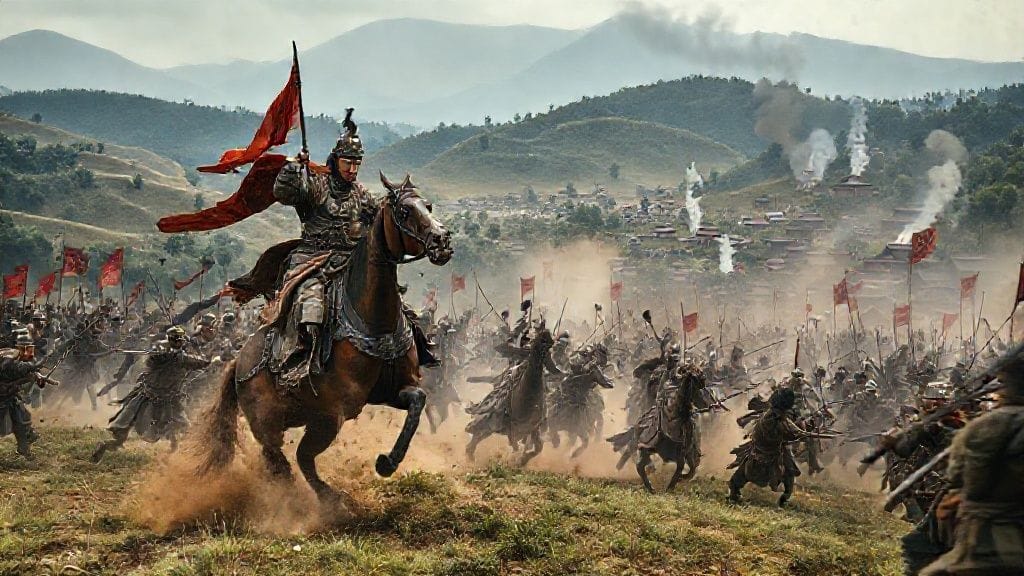
When the Alamannic warriors finally crossed into Gaul in 298, they moved with purpose. Their war bands consisted of agile infantry, often supported by horsemen, carried on a momentum of anticipation and the promise of loot. Their equipment varied: some elites wore mail or lamellar armor and carried oval shields painted with bright patterns; many more fought in simpler gear, relying on courage, numbers, and knowledge of terrain. They navigated by rivers, forest paths, and the advice of those who had raided before.
Villages along their path would have had little warning. Smoke pillars, screams, the thunder of hoofbeats—these were the first signs of the invasion. Some communities may have fled toward city walls like those of Lingones, seeking shelter behind stone and gate. Others, too far or too slow, would have faced the storm alone. The Alamanni seized provisions, animals, and captives, knowing that their foray into Gaul could not be sustained indefinitely. The deeper they went, the more they depended on foraging and speed to avoid encirclement by Roman forces.
As they approached Lingones, the city’s defenders faced a sudden, terrifying reality. Lookouts on the walls would have seen distant dust clouds, glints of metal, and perhaps burning hamlets behind the Germanic host. Panic spread among the inhabitants: some rushed to secure valuables, others pressed toward the gates, pleading for entry for family or clients still outside. The city authorities ordered gates closed, militias mustered, and stores checked. Messages were dispatched urgently, if not already sent, calling on Constantius to hurry.
To the Alamanni, Lingones was both prize and obstacle. If they could intimidate the city into paying a massive ransom, opening its gates and surrendering supplies, they could avoid a costly siege. Failing that, they might attempt a quick assault, counting on surprise, terror, and perhaps inside sympathizers to open a gate or lower a section of wall defenses. They knew that time was against them; somewhere behind them, Roman forces were undoubtedly marching.
According to later accounts, Constantius was indeed not far away when the Alamanni reached the vicinity of Lingones. The exact sequence is murky—our sources are brief, stylized, and sometimes contradictory—but a dramatic pattern emerges. The Alamanni, believing they had slipped past Roman field armies, suddenly found themselves confronted by the Caesar’s vanguard near the city, even as they were maneuvering around or pressing against its defenses. What was meant to be a one-sided terror campaign was swiftly transforming into a pitched confrontation, with stone walls at their backs and disciplined legions ahead.
It is easy to imagine the rising tension within the Alamannic camp: arguments among leaders about whether to press the attack on Lingones, retreat toward the Rhine with what they had, or turn to face Constantius and attempt to defeat him in open battle. Each choice carried risk. Retreat could descend into chaos and invite pursuit. A siege would consume irreplaceable time and supplies. Fighting Constantius directly offered the possibility of a spectacular victory—but also the danger of annihilation.
The Battle of Lingones 298: Day of Decision
The morning of the battle of lingones 298 likely dawned under a gray Gaulish sky, heavy with mist or low clouds. The plateau on which the city stood offered commanding views of the approaches, but it also constrained movement. To the defenders on the walls, the sight of Roman standards appearing—eagles and vexilla emerging on the horizon—must have been a moment of intense if cautious relief. The emperor’s man had come. To the Alamanni, those same banners were an ominous sign that their window of easy plunder had closed.
Our main narrative hints at a complex engagement in which Constantius managed to trap a substantial Alamannic force against the city. The Romans advanced with the steady rhythm of drilled legions, shields interlocking, javelins ready. Cavalry squadrons, drawn from both Roman and possibly allied Germanic units, hovered on the flanks, prepared to harry or block any attempt at escape. Constantius’s goal was not merely to push the enemy away from Lingones but to inflict a decisive defeat.
Positioning was everything. If he could drive the Alamanni toward the city walls or into unfavorable terrain—ravines, marshy ground, constricted passes—he could blunt their charging power and prevent them from using their mobility to full advantage. Conversely, the Alamanni would seek open ground where their warriors could surge forward in shock attacks, hoping to break Roman lines through ferocity and numbers before discipline could tell.
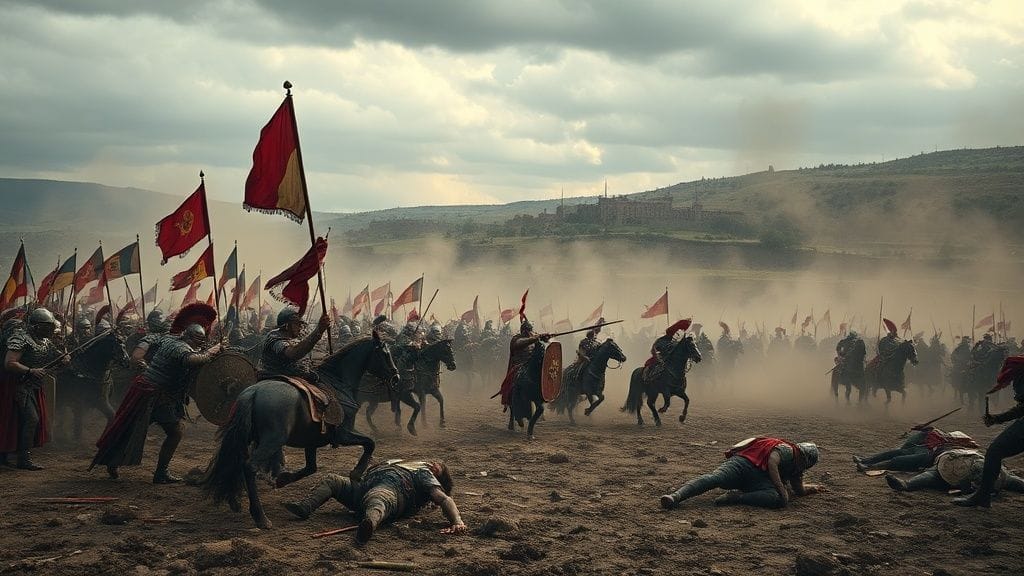
At some point, words gave way to war cries. Trumpets blared in the Roman ranks; the Alamanni beat weapons against shields. In a clash like this, the opening moments could be decisive. Roman skirmishers and archers might have loosed volleys to disrupt the enemy’s advance, followed by a coordinated volley of pila—heavy javelins—that shattered shields and impaled those in the front ranks. Then came the grind of close combat: swords hacking, spears thrusting, men slipping on blood-slicked ground.
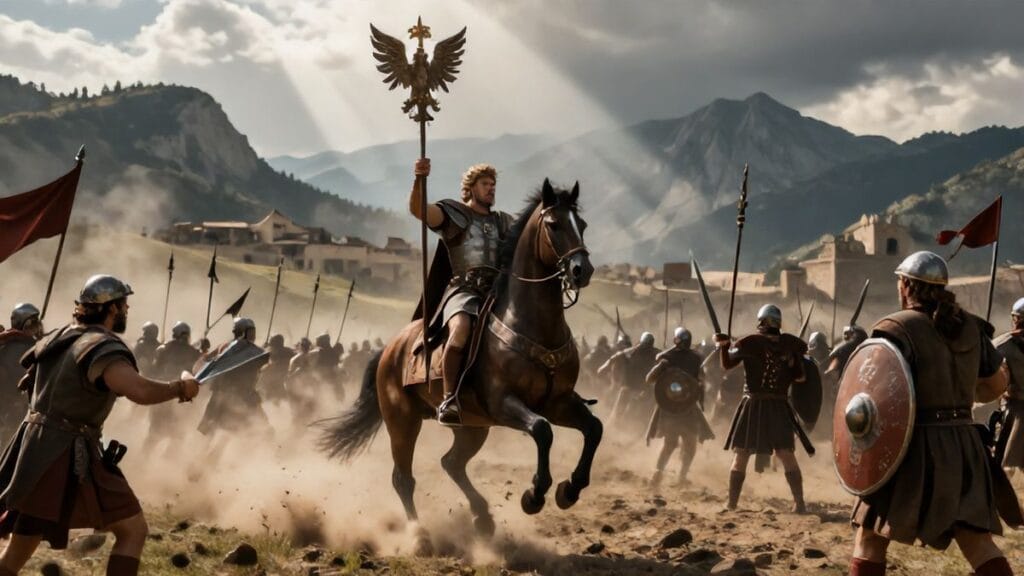
Constantius is portrayed in later praise as a commander who did not hide far from danger. One panegyrist insists that he “was seen in every part of the battlefield,” exhorting his soldiers, reinforcing weak points, and seizing opportunities. Whether literally omnipresent or not, his personal visibility likely mattered. In the chaotic storm of the battle of lingones 298, the sight of the Caesar riding along the line, cloak whipping in the wind, would have stiffened Roman resolve. Soldiers fought not only for pay or survival but for honor in the eyes of their commander.
Meanwhile, for the Alamanni, the situation was deteriorating. Behind them loomed the walls of Lingones, manned now by defenders emboldened by the Roman arrival. If driven too close, the Germanic warriors could come under missile fire from above or find themselves squeezed against the ramparts, trapped between stone and steel. Attempts to break out toward the open country were met by Roman cavalry charges, spears glinting as they slammed into flanks and rear-guards. The encirclement was not perfect, but every hour of fighting narrowed the enemy’s options.
At the heart of the battle, amid screams and horns, individual acts of courage or desperation played out unseen by chroniclers. A centurion rallied his cohort around a fallen standard; an Alamannic chief carved a bloody path through Roman ranks before being dragged down. The air filled with the reek of sweat, iron, and churned earth. Above it all, the walls of Lingones watched, their stones soon to become part of the story told about this day when Rome’s fate in Gaul hung in the balance.
Steel in the Streets: Urban Warfare Inside the Walls
One of the more dramatic elements in the tradition surrounding the battle of lingones 298 is the suggestion that some fighting spilled into or near the city itself. Later accounts claim that Constantius, in a moment of acute danger, sought refuge within Lingones, even leaping from a collapsed section of wall or gate to escape encirclement. The details are contested—possibly embroidered by panegyrists eager to dramatize his courage—but they point to a broader truth: the city and the battlefield were intimately entwined.
Whether the Alamanni briefly penetrated the defenses or merely pressed close enough to hurl missiles and scale ladders, the inhabitants of Lingones would have experienced a terrifying proximity to war. Urban combat in a Roman city was a nightmarish affair. Narrow streets became choke points; market stalls and carts turned into barricades. Citizens armed with whatever they could find—hunting spears, kitchen knives, improvised clubs—joined hastily organized militia units, ready to defend their homes if the walls were breached.
From the ramparts, youths and older men who could not march in the legions nonetheless played their part, hurling stones, tiles, and burning pitch down upon attackers. Women carried water for the exhausted, tended to the wounded in courtyards hastily turned into infirmaries, and prayed to any gods who might be listening: Mars to lend strength, Jupiter to shield the city, local deities to preserve hearth and family. The soundscape would have been overwhelming: the clash of arms outside, the crackling of fires, the cries of the injured echoing off stone.
If Constantius did indeed enter the city temporarily, regrouping or escaping a moment of crisis, his presence within the walls would have electrified the defenders. To have the Caesar himself among them, sharing their vulnerability, transformed them from passive spectators to active participants in an imperial drama. When the gates opened again—whether for a coordinated sally or to allow Roman units to redeploy—the people of Lingones would feel they were not merely being defended; they were defending alongside Rome.
Urban warfare left scars that endured long after the banners were furled. Buildings near the walls might have been damaged by siege engines or deliberate burning. Smashed roof tiles, arrowheads lodged in masonry, and scorched beams testified to the day when the frontier war touched the very streets of Lingones. These remnants, whether visible or buried, become the silent archaeological counterpart to written accounts, reminding us that the battle of lingones 298 was not fought solely in open fields but pressed harshly against Roman urban life itself.
Constantius’s Counterstroke: Tactics, Terrain, and Turning Points
Every battle hinges on moments where decisions, chance, and terrain converge. For Constantius at Lingones, the key was to transform a reactive defense into a decisive counterstroke. Instead of merely driving the Alamanni away, he sought to cripple their capacity to threaten Gaul for years. The city, its plateau, and the surrounding approaches became instruments in his strategic design.
By maneuvering his forces to interpose themselves between the Alamanni and their route back to the Rhine, Constantius forced the Germanic coalition into a deadly choice: attempt to break through disciplined ranks in adverse conditions or be crushed against the city and surrounding obstacles. He likely used a combination of infantry lines to pin the enemy and cavalry to exploit any sign of disorder. When Alamannic units wavered under sustained pressure, Roman horsemen could drive wedges into their formations, splitting them into smaller, more manageable pockets.
The terrain around Lingones, with its mixture of slopes, ravines, and plateau edges, favored those who understood how to anchor their lines and deny the enemy room to maneuver. Roman engineers, ever present in field armies, may have played a quiet but critical role by quickly fortifying temporary positions, digging trenches or erecting fieldworks that further constrained the Alamanni’s movements. Even small earthworks could funnel attackers into kill zones where missile troops and heavy infantry waited.
As the hours wore on, fatigue and morale became decisive. The Alamanni had marched deep into enemy territory, living off plunder, their supply lines tenuous at best. Their warriors fought fiercely, but every fallen leader, every failed charge eroded their cohesion. The Romans, for their part, fought with the knowledge that behind them lay the city and its inhabitants. Surrender or rout would mean not only personal ruin but the likely sack of Lingones and the loss of imperial legitimacy in the region.
Later praise of Constantius emphasized not just his bravery but his clemency. According to one panegyric, he spared many of those who surrendered, settling some across the frontier as foederati or using captives as labor. Whether this is idealized or fully accurate, it reflects a pragmatic imperial approach: kill enough to break resistance, but preserve human resources that could be harnessed for Rome’s benefit. Still, on the day of battle, mercy would have been thin. In the crush of combat, no quarter was asked or granted. Only after organized resistance collapsed could any policy of lenience be applied.
By sunset—if we imagine a full day’s battle—the issue was decided. The Alamannic incursion had been shattered. Bodies lay scattered across the fields and near the walls; groans of the wounded mingled with the cawing of crows already descending. The plateau of Lingones, which had watched so many caravans and peaceful processions, had become a killing ground. And yet, in the grim arithmetic of imperial strategy, this slaughter was counted as salvation.
Aftermath on the Field: Corpses, Captives, and Claims of Victory
The immediate aftermath of the battle of lingones 298 was grim, practical, and politically charged. On the battlefield, Roman soldiers moved among the fallen, checking for signs of life, dispatching enemy wounded who resisted, and collecting their own comrades for burial. Officers recorded casualties, noting which units had suffered most heavily. Priests or military religious officials oversaw rituals of thanksgiving to the gods for victory, perhaps offering sacrifices on hastily erected altars near the city.
Captives presented both a problem and an opportunity. Alamannic warriors who had been taken alive might be interrogated for intelligence about remaining forces beyond the Rhine. Some were likely marked for distribution as slaves, a grim fate but a valuable asset in the labor-hungry estates and workshops of the empire. Others, especially younger men, might be offered conditional clemency in exchange for service in auxiliary units. This practice had long allowed Rome to turn former foes into frontier defenders, though loyalty could never be assumed.
Within Lingones, the victory unleashed a different cascade of events. Families searched for relatives among the returning defenders, rejoicing in reunions or collapsing in grief at news of the dead. City leaders moved quickly to coordinate cleanup and reconstruction, clearing debris from streets and repairing damaged fortifications. Letters were drafted to higher authorities, reporting both the heroism of the city and the decisive intervention of Constantius. In a world where imperial favor could mean tax remissions, honors, or investments, it was vital that Lingones be seen as loyal and worthy.
For Constantius, the political use of this victory began almost immediately. Messengers were dispatched to Maximian and Diocletian, carrying news of the triumph and perhaps exaggerated numbers of enemy dead, as was customary. In time, court poets and orators would craft formal panegyrics, delivered on ceremonial occasions, that transformed the chaotic reality of battle into a polished narrative of imperial virtue. One such orator might speak of how “the barbarian hordes, swollen with arrogance, were crushed at the very walls of Lingones by your unconquered arms,” praising both the Caesar’s courage and the gods’ favor.
Claims of victory in Roman political culture were rarely modest. Numbers of enemies killed could swell dramatically, and the enemy’s intentions might be cast in the darkest possible light. Yet behind the embroidery lay a genuine accomplishment. The Alamanni had gambled on a deep incursion into Gaul and lost. Their losses in men, prestige, and perhaps leading chieftains would reverberate for years on the other side of the Rhine. And for the people of Gaul, the sharp memory of the battle of lingones 298 would blend with a renewed, if cautious, faith that Rome could still protect them.
Voices from Gaul: Civilians, Veterans, and Merchants Remember
History often survives in the voices of elites—emperors, generals, orators—yet the impact of battles like Lingones is felt most keenly in the lives of ordinary people. Imagine a veteran of the city militia, his arm permanently weakened by a sword cut taken on the wall that day. Years later, he might sit in a tavern, recounting to younger men how the sky darkened with arrows, how the Caesar’s standard appeared through the dust, how he himself had hurled a stone that struck down an enemy scaling ladder.
For a merchant whose warehouse stood near the gate, the memory would be mixed with anxiety about lost goods, disrupted trade, and the fragile line between prosperity and ruin. The days and weeks after the battle saw prices fluctuate as supply chains were interrupted. Some goods, especially accessible from safer southern routes, became scarcer or more expensive. But over time, as the roads re-opened and news of the victory spread, confidence returned. Caravans once again chose routes through Lingones, reassured that the city had withstood a major shock and that imperial forces had proven their effectiveness.
Families who had sought shelter within the walls, abandoning farms outside, faced harder choices. Fields might be trampled, livestock lost, houses burned. The Roman state, focused on macro-security and tax revenues, offered little direct compensation. Local communities had to help each other rebuild. Churches—or, more accurately at this pagan-dominated stage, temples and communal institutions—organized charity or mutual aid. The wounds of 298 were not only in the soil but in the economic fabric of the region.
Young children who watched from rooftops or courtyards would grow up with the battle as a formative story. To them, the clash outside the walls might be their earliest memory of the Empire’s reality: powerful, but not invulnerable; protective, but unable to prevent all suffering. Some would later serve in the legions themselves, explaining to comrades how, in their youth, they had seen the Alamanni defeated at Lingones. The battle of lingones 298 thus echoed across generations, shaping how Gauls understood both the dangers beyond the Rhine and their relationship with distant emperors.
Merchants from other regions also carried tales. In the south of Gaul or in Italy, people in busy ports heard differently inflected versions of the same story: how Constantius had saved a beleaguered city, how the Tetrarchy’s western arm proved its worth, how the Alamanni had been chastened. In time, these narratives blended with others, such as campaigns on the Danube or victories in Egypt, reinforcing a broader sense that the late third-century chaos had given way to a more ordered, if still fragile, imperial world.
Reforging the Rhine Frontier: Forts, Laws, and Settlements
Victories on the battlefield were only part of the larger process of securing Gaul. After the blood dried at Lingones, Constantius and his administrators turned once more to the long, grinding work of fortifying the Rhine frontier and reordering provincial structures. The lesson of the battle was clear: if a large Alamannic force could reach Lingones, the buffer zone along the border was still too permeable.
In the years following 298, efforts intensified to strengthen forts, expand watchtower networks, and improve roads for rapid troop movements. Some garrisons were reinforced; others were repositioned to cover previously underprotected stretches. Bridges and fords across the Rhine were monitored more closely, and new logistical hubs were established deeper within Gaul to ensure that field armies could be provisioned quickly in time of crisis.
Legal and administrative reforms also played a role. Diocletian’s broader tax reorganization, which introduced more systematic assessments based on land and people (the infamous capitatio-iugatio system), allowed the state to forecast and mobilize resources more predictably. Gaul, including the region around Lingones, was drawn more tightly into this fiscal web, which had a double edge: it provided the means to maintain frontier forces but increased the burdens on local populations. The memory of the Alamannic invasion could be used to justify these pressures: heavy taxes, officials might argue, were the necessary price of safety.
Rome also continued the policy of controlled settlement of some Germanic groups within imperial boundaries. Captured or negotiating Alamanni could be granted land under conditions, serving as buffer communities obligated to provide troops and intelligence. Such arrangements, if carefully managed, turned former raiders into semi-loyal frontier farmers and soldiers. But they carried inherent risks, as loyalties could shift with changing circumstances and leaders.
Over time, the frontier became not just a line of exclusion but a zone of shared, if uneasy, life. Markets sprang up where Roman and Germanic traders exchanged goods and information. Some individuals straddled identities, speaking both Latin and a Germanic tongue, serving in the imperial army one year and visiting kin across the river the next. The battle of lingones 298 thus sits within a broader process of interaction: war, yes, but also negotiation and hybridization, shaping the late Roman world that Constantine and his successors would inherit.
Propaganda and Memory: How Rome Told the Story
No Roman victory was complete until it had been narrated, sculpted, and minted into the collective memory of the Empire. Lingones was no exception. While we lack a detailed contemporary chronicle of the battle, echoes of the event reverberate through panegyrics—formal speeches praising emperors—and imperial iconography.
One surviving Latin panegyric, delivered at Trier (Panegyrici Latini VIII [V]), extols Constantius’s campaigns in Gaul and Britain, emphasizing how he restored security and prosperity. Though it does not dwell solely on Lingones, its rhetoric of “barbarian terror checked at the walls” and “cities liberated by your valor” strongly aligns with the narrative we reconstruct for 298. Such speeches were not neutral historical reports; they were crafted performances meant to exalt the emperor, reassure elites, and reinforce the ideological pillars of the Tetrarchy. Yet, as historians such as Timothy Barnes have noted, even panegyric hyperbole rests on real events, however filtered through flattery.
Coins issued in the years after the victory reinforced the message. On some, Constantius appears in military dress, holding a globe or spear, accompanied by legends celebrating his role as “Restorer of the World” or “Bringer of Peace.” These abstractions masked the messy details of battles like Lingones but ensured that subjects from Britain to Egypt associated the name of Constantius with stability and security. A small piece of bronze or silver could carry across the empire the idea that Gaul, once a zone of crisis, was now under firm control.
Monuments and inscriptions—now mostly lost or fragmentary—likely commemorated the victory as well. City councils eager to express gratitude might dedicate altars or statues to the emperor and the gods “in return for the salvation of the city.” Soldiers discharged after years of service could inscribe on tombstones or votive stones that they had fought in the great campaign against the Alamanni near Lingones. These physical markers reinforced memory in stone, giving the battle a presence in daily civic and religious life.
Yet behind the polished narratives lay silences. Roman propaganda rarely acknowledged the scale of its own casualties, the suffering of civilians, or the ambiguities of treaties and settlements. The Alamanni appeared as faceless hordes, instruments of chaos overcome by imperial order. Their motivations, losses, and perspectives vanished into the category of “barbarians,” an absence that modern historians struggle to overcome. The triumphal story of the battle of lingones 298 thus invites us not only to appreciate Rome’s skill in shaping memory but also to remain alert to what that memory leaves unsaid.
From Lingones to Constantine: A Son Learns from His Father
While young Constantine was not necessarily present at Lingones itself, the victory formed part of the world that molded him. Spending parts of his youth in the courts of Diocletian and Galerius and at times with his father, Constantine absorbed the lessons of frontier command and imperial image-crafting. Stories of the battle of lingones 298 would have circulated among officers, advisers, and courtiers as an example of how a Caesar should react under pressure: move swiftly, shield key cities, crush incursions decisively, and then convert battlefield success into political capital.
Constantius’s conduct in Gaul provided Constantine with a model of western rulership. When, after Diocletian’s abdication and a series of succession crises, Constantine eventually proclaimed himself emperor in 306 at York, he did so with the prestige of his father’s campaigns behind him. Troops in Britain and Gaul, many of whom had served under Constantius during his Rhine and British operations, saw in Constantine not only a charismatic commander but the continuation of a trusted line of leadership.
Later, as Constantine fought his own wars against usurpers and rivals—Maxentius in Italy, Licinius in the East—he would draw upon the same repertoire of strategies: rapid movement, careful exploitation of terrain, and skillful use of propaganda. His famous victory at the Milvian Bridge in 312, shrouded in Christian symbolism and visionary narratives, shares structural similarities with earlier frontier battles like Lingones. In both, an aggressive enemy is met near a vital urban center, decisively defeated, and then woven into a redemption story for the empire.
Moreover, the consolidation of Gaul under Constantius’s firm yet pragmatic rule created the stable platform from which Constantine could launch many of his initiatives. Without the earlier securing of the Rhine frontier and the restoration of confidence in cities like Lingones, the western provinces might not have been so willing or able to support Constantine’s later campaigns. The echo of Lingones can thus be heard in the drumbeats leading to some of the most famous moments in Roman—and indeed European—history.
Lingones in the Long View: A Battle on the Road to Constantine’s Empire
When viewed from the vantage point of centuries, the battle of lingones 298 appears as one link in a long chain of frontier conflicts. Yet its particular position in time—after the chaos of the mid-third century, before the rise of Constantine and the Christian empire—gives it a special resonance. It is a snapshot of Rome at a moment of adaptation, experimenting with new forms of governance, reasserting control, and redefining its relationship with both subjects and enemies.
Lingones was not a world-historical battle like Cannae or Actium, but it helped to shape the conditions under which more famous turning points would occur. By checking Alamannic expansion and reinforcing Roman confidence in Gaul, Constantius contributed to the stabilization of the West. This stability, in turn, made it possible for succession struggles among Romans—however bloody—to unfold without the immediate collapse of frontier defenses, giving individuals like Constantine room to maneuver.
The battle also illustrates the dual nature of Rome’s late imperial strength. On the one hand, the Empire remained formidable in its ability to mobilize troops, fortify borders, and crush incursions when competent leadership and resources aligned. On the other, the very need for a Tetrarchy, heavy taxation, and repeated frontier wars reveals a system under constant strain. Lingones was both a demonstration of resilience and a symptom of chronic vulnerability.
In the centuries that followed, the Rhine frontier would continue to see conflict. The Alamanni, despite setbacks, remained a persistent force, reappearing in later campaigns under emperors like Julian. Cities like Lingones would endure fresh threats as the Western Empire weakened in the fourth and fifth centuries. Eventually, the complex frontier world of Rome and the Germanic peoples gave way to a transformed political landscape, in which former “barbarians” ruled territories once governed from Rome.
Yet even as empires fell and new kingdoms rose, echoes of the late Roman world persisted: in law codes, road networks, urban layouts, and collective memories of battles like Lingones. To trace the outlines of that day in 298 is to glimpse both the achievements and the limits of Rome’s last great efforts to maintain its western dominion.
Modern Debates: Sources, Silences, and Archaeological Clues
Reconstructing the battle of lingones 298 is an exercise in careful reading and creative restraint. Our written sources are sparse, often indirect, and almost entirely Roman in perspective. Panegyrics, as already noted, are tendentious by nature, crafted to glorify emperors rather than provide dispassionate accounts. Later historians, such as Eutropius or Orosius, mention Constantius’s victories in Gaul only in passing, without detailed descriptions of individual battles.
Modern scholars therefore debate the exact location, scale, and sequence of events at Lingones. Some question whether all the dramatic elements reported—such as Constantius allegedly leaping from a collapsed gateway to escape encirclement—reflect historical reality or rhetorical flourish. Others argue that, even if some anecdotes are embellished, the core fact of a significant confrontation near the city remains well attested by converging indications. As historian A.H.M. Jones once observed in a broader context, “Panegyrics are not pure invention; they magnify real achievements, even as they conceal shortcomings.”
Archaeology adds another, if still fragmentary, layer. Excavations in and around modern Langres have revealed Roman walls, gates, and urban structures corresponding to the late imperial period. Traces of burning, repairs, or hurried modifications to fortifications can hint at episodes of conflict, though firmly linking these to the year 298 is challenging. Isolated finds of military equipment—arrowheads, spear tips, fragments of armor—tell us that soldiers once fought and trained in this landscape, but not precisely when or under whose command.
Debate also continues regarding Alamannic involvement specifically at Lingones as opposed to other frontier battles in the same era. Some scholars suggest that chroniclers may have compressed multiple engagements under a single, more famous label. Others maintain that the distinct mentions of Lingones in panegyric and later tradition justify treating it as a discrete event. The lack of Alamannic written records means that their side of the story must be reconstructed from patterns observed across many frontier conflicts, which inevitably introduces uncertainties.
These gaps and debates do not diminish the value of studying Lingones; rather, they remind us that history is often a mosaic assembled from broken pieces. With each new inscription, coin hoard, or reassessment of classical texts, our picture sharpens slightly—but it never becomes a photographic image. The emotional and political truth of the battle, however—the fear in Lingones, the stakes for Constantius, the gamble for the Alamanni—remains clear enough to justify its place in narratives of Rome’s struggle to preserve its world.
Conclusion
The story of Constantius Chlorus’s victory over the Alamanni at Lingones in 298 is more than a tale of swords and shields. It is the story of an empire at a crossroads, experimenting with new forms of rule, burdened by heavy demands, yet still capable of decisive action. The battle of lingones 298 unfolded against a backdrop of recovered but fragile stability, along a frontier where Roman cities and Germanic confederations eyed each other with a mix of fear, necessity, and grim respect.
For the people of Lingones, the battle meant survival. For Constantius, it meant proof that he was worthy of the purple, capable of shielding Gaul and justifying the Tetrarchic experiment. For the Alamanni, it was a costly lesson in the risks of deep incursions into Roman territory, shaping their strategies in years to come. And for Constantine, growing into his own role as emperor, it formed part of the inheritance of example and experience that would guide his later choices.
In the long arc of history, Lingones stands as a vivid episode that illustrates both the power and fragility of late Rome. The same state that could crush a large invading host near a provincial city would, generations later, struggle to prevent similar incursions from culminating in the sack of Rome itself. Yet on that day in 298, as the sun set over a bloodied plateau and the people of Lingones emerged from their walls to survey the field, Rome had won. The Rhine frontier was, for a time, secure; the Tetrarchs could point to yet another victory; and the empire continued its uncertain journey toward the Christian and post-classical worlds that awaited.
FAQs
- What was the Battle of Lingones 298?
The Battle of Lingones 298 was a confrontation in Gaul between Roman forces under the Caesar Constantius Chlorus and an invading coalition of Alamannic warriors. Fought near the city of Lingones (modern Langres) in the year 298, it ended in a decisive Roman victory that helped stabilize the Rhine frontier and reinforce confidence in the Tetrarchic system. - Who was Constantius Chlorus?
Constantius Chlorus, known as “the Pale,” was a Roman general elevated to the rank of Caesar under the Tetrarchy, serving primarily in the western provinces. He led successful campaigns in Britain and Gaul, including the win at Lingones, and later became Augustus. He was also the father of Constantine the Great. - Why did the Alamanni attack Lingones?
The Alamanni were a Germanic confederation living beyond the Rhine who frequently raided Roman territory for plunder, prestige, and sometimes land. Lingones, an important city on key routes in northeastern Gaul, offered a tempting target: rich, strategically located, and, the Alamanni hoped, reachable before Roman field armies could respond. - How reliable are our sources for the battle?
Our information comes mainly from Roman panegyrics and later summaries, which are biased toward glorifying Constantius and the Tetrarchs. While they confirm a significant battle near Lingones against the Alamanni, details such as exact troop numbers, tactics, and dramatic anecdotes may be exaggerated or stylized. Archaeology provides supporting context but few direct specifics. - What were the consequences of the Battle of Lingones 298?
The victory curtailed a major Alamannic incursion, reassured the cities of Gaul, and bolstered Constantius’s reputation as an effective defender of the West. It contributed to the broader stabilization of the Rhine frontier and helped create the conditions in which his son Constantine later rose to power, using a relatively secure Gaul as a base. - Did the battle influence Constantine the Great?
Indirectly, yes. Although Constantine may not have been present, the campaigns of his father in Gaul, including Lingones, provided a model of military leadership and frontier management. The prestige and stability created by Constantius’s victories were crucial assets when Constantine asserted his own claim to imperial rule after 306. - Where exactly did the battle take place?
The battle occurred in the vicinity of the Roman city of Lingones, corresponding to modern Langres in northeastern France, likely on the plateau or approaches controlled by the city. The precise battlefield has not been conclusively identified, but the topography of the area matches ancient descriptions of a fortified hilltop city and surrounding approaches. - How did this battle fit into the Tetrarchic system?
The Tetrarchy divided imperial responsibility among four rulers, and Lingones showcased how this system could work in practice. As Caesar in the West, Constantius had both the authority and obligation to respond quickly to frontier threats, and his success there served as proof that decentralized, regionally focused leadership could restore order after the crises of the third century.
External Resource
Internal Link
Other Resources
- Encyclopaedia Britannica – general search for the exact subject
- Google Scholar – academic search for the exact subject
- Internet Archive – digital library search for the exact subject