Table of Contents
- Cairo at Dawn: A City Awaiting Its Sacred Heart
- From Ifriqiya to the Nile: The Fatimid March Toward Egypt
- Jawhar al-Siqilli and the Birth of al-Qāhira
- The April Morning of 970: When Foundations Met the Sky
- Designing a Statement of Faith: Architecture as Theology
- Stone, Stucco, and Sunlight: Building the Early Mosque
- From Royal Sanctuary to People’s Mosque
- The First Lessons: How a Mosque Became a University
- Voices of Cairo: Merchants, Artisans, and Mothers Around al‑Azhar
- Rival Caliphates and Competing Truths
- Storms of Time: Crusaders, Ayyubids, and the Survival of al‑Azhar
- Restorations, Minarets, and New Courtyards: The Evolving Skyline
- Al‑Azhar as a Lighthouse of Knowledge
- Colonial Shadows and Modern Transformations
- Daily Life Within the Arcades: Prayer, Study, and Silence
- Memory in Marble: What the Foundations Still Whisper
- Conclusion
- FAQs
- External Resource
- Internal Link
Article Summary: This article traces the construction of Al‑Azhar Mosque in Cairo, beginning on 4 April 970 under the Fatimid Caliphate, and follows its transformation from a dynastic symbol into one of the world’s most enduring centers of learning. It opens with the tense, expectant atmosphere of a newly founded capital, al‑Qāhira, awaiting a spiritual core, then explores how the construction of al-azhar mosque served both as a statement of Shi‘i Fatimid legitimacy and as a practical sanctuary for worship and governance. Through vivid narrative and historical detail, we follow architects, laborers, scholars, and ordinary Cairenes as their lives intersect around this rising monument. The article examines political rivalries with the Abbasids, the shifting fortunes under Ayyubid and Mamluk rule, and the gradual broadening of Al‑Azhar’s intellectual horizons. It also considers the social fabric woven around the mosque—markets, homes, and schools clinging to its outer walls—as well as the emotional world inside its courtyard where students memorized verses by lamplight. By returning repeatedly to the construction of al-azhar mosque, the story shows how each added arch, dome, and minaret reflected changing epochs while preserving a continuous spiritual thread. Finally, it reflects on colonial pressures, modern reforms, and the way this tenth‑century building still shapes faith, identity, and memory in contemporary Cairo. The result is a sweeping, cinematic journey through more than a thousand years of history anchored to one April morning in 970, when chalk lines marked the future of a civilization.
Cairo at Dawn: A City Awaiting Its Sacred Heart
On an April morning in the year 970, Cairo was not yet the roaring metropolis we know today. It was a young city, barely a breath in the long story of the Nile. The first rays of sunlight slid over hastily laid brick walls and wooden scaffolding, over the tents of soldiers and the half‑finished homes of merchants who had followed an army and a dream. The air held more dust than perfume; the sounds were more clatter than song. Yet amid this unfinished landscape, a specific space had been cleared—a stretch of leveled ground within the new Fatimid capital, al‑Qāhira, “the Victorious.” Here, under a pale desert sky, the first gestures of a grand experiment in stone were about to begin.
That experiment was the construction of al-azhar mosque, a building that would become not only a monument of faith, but a protagonist in the long drama of Islamic and Mediterranean history. It is astonishing, isn’t it, that on that single plot of earth, still dotted with stakes and strings, centuries of sermons, debates, revolutions, and reconciliations were already implied? The men who gathered that day—architects with wax tablets, laborers with roughened hands, Fatimid officials wrapped in stately fabrics—could not possibly foresee that the foundations they were about to trace would one day support the weight of the hopes and anxieties of millions.
Cairo in 970 was an occupied promise. The Fatimids had recently taken Egypt from the Ikhshidids, carving their capital out of what had been military quarters and fields north of the older city of Fustat. The new city was meant to be more than a seat of government: it was a declaration that a rival caliphate, claiming descent from the Prophet’s daughter Fatima, had arrived in the heartland of the Islamic world. Palaces were already planned, avenues plotted, walls imagined. Yet, for all its political ambition, the city still lacked a definitive symbol around which both rulers and residents could gather—a place where the rhythm of the day could be measured in calls to prayer, and where the words of revelation could be recited beneath carefully carved arches.
This gap was not merely architectural; it was emotional, even existential. A city without a mosque at its heart was a city without a clear soul. The construction of al-azhar mosque was intended to solve that absence in a single gesture: raise a sanctuary that could function as a royal mosque, an ideological beacon, and a spiritual home. The name it would bear—al‑Azhar, “the Most Resplendent”—was itself a subtle echo of Fatima al‑Zahra, the luminous daughter of the Prophet Muhammad and ancestor, in Fatimid eyes, of their caliphs. Thus, before a single stone was set, the mosque was inseparable from a story about identity, bloodline, and divine favor.
Yet behind the grand proclamations and carefully drafted plans lay a more fragile reality: a city still stitching itself together, a society wondering what this new dynasty would mean for their lives, and workers who would spend years hauling limestone and timber with only a daily wage and the promise of God’s blessing to sustain them. Around the leveling ground of the future mosque, people already traded rumors. Would this be a palace mosque closed to ordinary worshippers? Would it be adorned with extravagances forbidden by scripture? Would it bring prosperity or more taxes? In their questions, we glimpse the anxious heartbeat of a city on the threshold of transformation.
From Ifriqiya to the Nile: The Fatimid March Toward Egypt
To understand why the construction of al-azhar mosque mattered so deeply, we must step back from Cairo’s dust and look westward, to the shores of North Africa and the ambitions of a dynasty that had outgrown its first home. The Fatimid Caliphate, founded in 909 in what is now Tunisia, had spent six decades ruling from al‑Mahdiyya and later al‑Mansuriyya. They claimed a lineage that passed through Fatima and Ali, presenting themselves as imams with both temporal and spiritual authority. But in the tenth century, power had more than one capital. To the east, in Baghdad, the Abbasid caliphs still presided over a different vision of the Islamic world, defended by scribes, jurists, and soldiers loyal to a competing narrative of who should lead the umma.
Egypt, perched at the crossroads of the Mediterranean and the Red Sea, was the prize in between. Whoever held Egypt held the grain that could feed armies, the ports that channeled trade from India and East Africa, the river that bound the land in a predictable cycle of wealth and scarcity. For the Fatimids, expanding into Egypt was not simple conquest—it was a statement that their caliphate was not a peripheral force but a central actor. It was also a test: could their institutions, their doctrines, their particular way of aligning the spiritual and political, take root in a land deeply woven into the Abbasid sphere?
Under al‑Mu‘izz li‑Din Allah, the Fatimid state reached for an answer. He sent his general, Jawhar al‑Siqilli—“the Sicilian”—eastward in 969. Jawhar’s army moved with an almost theatrical calm, aided by negotiations with local powers and the fatigue of an Egypt long tired of weak rule. The entry into Fustat was not a sacking but a transition, carefully managed to avoid the kinds of destruction that would poison future governance. Chroniclers describe Jawhar proclaiming security and justice, promising that the rights of the ahl al‑dhimma, the protected non‑Muslims, would be upheld, and that commerce would remain undisturbed. This was conquest framed as restoration.
Yet Jawhar did not intend to rule from the older city. Instead, he turned to a practice with deep symbolic meaning in the Islamic tradition: the founding of a new capital. Just as earlier rulers had built cities like Baghdad and Samarra as visible imprints of new eras, Jawhar traced out the plan for al‑Qāhira. It would be the city of the Fatimid imams, a stage on which their caliphate could perform sovereignty daily—through processions, legal judgments, and, crucially, communal prayer.
In that context, the construction of al-azhar mosque emerged as both necessity and theater. The Fatimids needed a congregational mosque from which the Friday sermon, the khutba, could be delivered in the name of the new caliph, publicly inscribing his authority into the hearts and ears of worshippers. But they also needed to persuade Egyptians that this new authority was not foreign or fleeting. Building a mosque in the new capital, rather than merely appropriating the existing great mosque in Fustat, was a way of saying: we are not temporary; we are planting ourselves in your soil.
Jawhar al-Siqilli and the Birth of al‑Qāhira
The figure at the center of these maneuvers, Jawhar al‑Siqilli, was himself a symbol of the Fatimids’ complexity. Likely of Byzantine or Sicilian origin, once enslaved and then elevated through the Fatimid military and bureaucratic ranks, he was a man whose life story embodied mobility and transformation. To him fell the task of translating the distant visions of al‑Mu‘izz into mud, mortar, and law along the Nile.
Jawhar’s foundation of al‑Qāhira was meticulous. According to later accounts, astrologers were consulted to determine an auspicious hour, and the city’s perimeter was marked with ropes hung with bells. When the signal was given, construction began with almost ritual precision. Palaces were plotted on the city’s spine; barracks, markets, and administrative quarters were arranged in a pattern that placed the caliph at the symbolic center of a carefully organized universe.
Within that plan, the positioning of the main mosque was more than utilitarian. It had to be close enough to the palaces to serve the caliph and his court, but not so close that it became an extension of the palace walls. Al‑Azhar was set slightly to the southeast of the central axis, accessible but distinct, a locus where divine speech and earthly power could meet without fully merging. When Jawhar or his architects paced the site, measuring out its boundaries, they were walking a line between the sacred and the strategic.
The decision to begin the construction of al-azhar mosque so soon after the founding of the city—within barely a year—speaks to its urgency. A capital could not truly function, in the tenth‑century imagination, without a congregational mosque. More subtle, perhaps, was Jawhar’s understanding that architecture could soothe anxieties. Raising prayer halls and courtyards signaled permanence; it told the people of Fustat and the surrounding villages that this northern encampment was not a transient garrison but a rising city whose skyline would soon rival those of Baghdad and Cordoba.
Somewhere between April’s heat and the cool night that followed, Jawhar must have allowed himself a moment of reflection. He had taken a land in the name of a distant caliph, drawn the map of a city that did not yet exist, and now he was commissioning its first great mosque. Did he imagine students one day leaning against the columns, debating law and philosophy in accents from as far as West Africa and the Indian Ocean shores? Or did he think only of the next task, the next supply caravan, the next letter to be dispatched back to North Africa? History is silent on his private thoughts, but the city itself stands as his answer: he built for more than his own lifetime.
The April Morning of 970: When Foundations Met the Sky
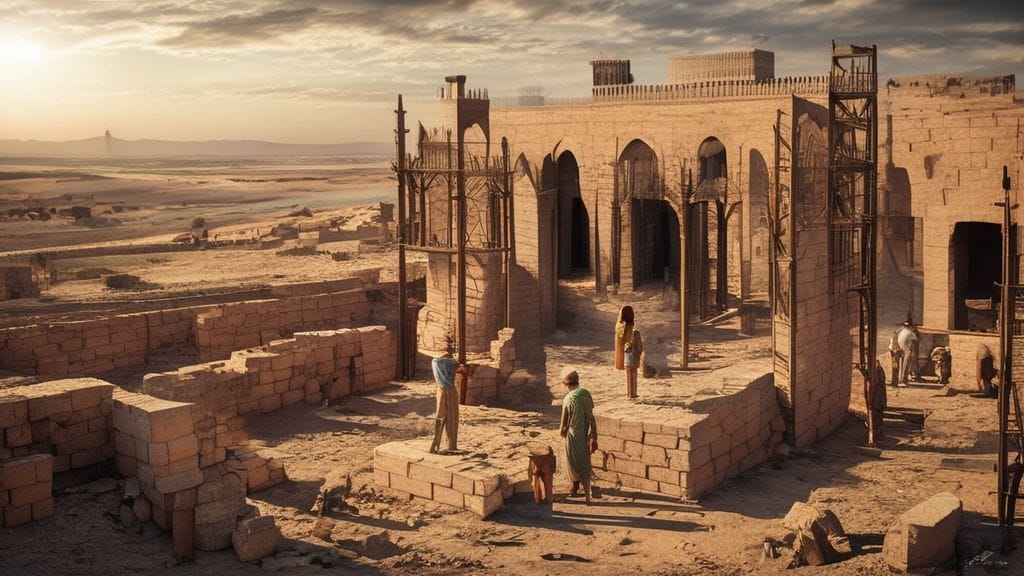
On 4 April 970, the designated date for the beginning of work, the building site would have been marked with chalk lines and wooden stakes. The bustle of preparation—surveyors, scribes recording expenses, foremen shouting instructions—melded into a single hum. This was the first physical step in the construction of al-azhar mosque, and though the ceremony may not have been lavish, its significance was profound. In the Islamic tradition, founding a mosque is a meritorious act; here, it was also a public announcement that the Fatimids were no longer merely visitors in Egypt.
Imagine the first blows of iron tools into the ground, the first stones maneuvered into place. The Nile’s light reflected off piles of limestone and brick brought from quarries around Cairo. Skilled craftsmen, some local and others perhaps accompanying the Fatimid army, conferred over templates and sketches. Underlying their practical concerns—how to span a certain width, how to stabilize a column—was the knowledge that every decision would echo in the building’s long future.
The founding prayer, if recited that day, would have asked for God’s blessing on the construction, for safety for the workers, and for the mosque to become a place of guidance. One can almost hear the murmur of du‘a, rising briefly above the clatter of work. The ground that had, until recently, known only soldiers’ footsteps and grazing animals was now consecrated with intention: here, people would line up shoulder to shoulder, turning their faces toward Mecca in disciplined rows, their whispers fused into a single tide of praise.
Not all looked on with enthusiasm. Some Egyptian notables, loyal in heart to the distant Abbasid caliph, regarded the new structure with unease. The recitation of the khutba in the name of al‑Mu‘izz would be more than ritual; it would be a weekly reminder that a rival claimant to the caliphate had materialized in their midst. For them, the construction of al-azhar mosque was a visible wound in the body of Abbasid legitimacy, a stone‑and‑stucco argument that the past order had been overturned.
Others, however, saw opportunity. Builders found steady employment. Merchants anticipated the rise in foot traffic that a major mosque always brought: worshippers would need food, clothing, ink, paper, and lamps. Women in nearby neighborhoods calculated how they might rent rooms to future scholars or sell bread to workers trudging home at dusk. The mosque, even unfinished, was already shaping an economy.
Designing a Statement of Faith: Architecture as Theology
The blueprint of Al‑Azhar was not neutral. Although details would change over centuries, the initial design sketched by Fatimid planners translated their theology and politics into brick and beam. Early Al‑Azhar followed the hypostyle model common in the region: a rectangular courtyard, or sahn, surrounded by arcades supported by rows of columns, with a prayer hall on the qibla side oriented toward Mecca. But within this shared vocabulary, the Fatimids spoke in their own accent.
They emphasized light and repetition. Arches framed arches, leading the gaze toward the mihrab, the niche indicating the direction of prayer. Inscriptions, though modest at first, began to appear on friezes and around doorways, weaving Qur’anic verses with praise for the ruling imam‑caliph. Here, theology was literally inscribed into the building. The Isma‘ili Shi‘i view of the imamate—as a lineage of divinely guided leaders—resonated in phrases that linked obedience to the caliph with obedience to God.
The very name “al‑Azhar” may have carried a quiet theological charge. By echoing Fatima al‑Zahra, it reminded worshippers of the Prophet’s family, the Ahl al‑Bayt, whose centrality was a core Fatimid claim. Without stating doctrine explicitly in stone, the building suggested it through naming and atmosphere. On Fridays, when the caliph or his representative delivered the sermon, these architectural cues turned the mosque into a carefully staged theater of legitimacy.
The construction of al-azhar mosque thus functioned as an architectural manifesto. Its columned halls were wide enough to embrace large congregations, yet intimate enough to allow a sense of nearness between preacher and people. The low, rhythmic arcades created a cadence of space, guiding movement and sightlines. In later centuries, observers would marvel at the serenity of Al‑Azhar’s proportions, but for its first users, the building’s scale and symmetry likely communicated something simpler: stability after disorder, order after uncertainty.
At the same time, the Fatimids did not attempt a radical break with prevailing aesthetic norms. They borrowed elements from existing Egyptian traditions, including reused columns—spolia—from older buildings. This reuse was practical and symbolic: it anchored the new mosque in a longer local history, calming fears that the Fatimids were alien rulers indifferent to Egyptian heritage. By blending new and old, the design offered a subtle promise: your past is not erased; it is being re‑framed.
Stone, Stucco, and Sunlight: Building the Early Mosque
The months and years following that first April morning were filled with the grind of construction. If we walk imaginatively through the site, we see teams of laborers lifting heavy blocks on simple cranes, artisans carving floral and geometric patterns into stucco panels, and supervisors pacing with wax tablets, tallying costs. The rhythm of the workday followed the sun, but it was punctuated by the five daily calls to prayer. Workers would pause, wash away dust with cool water where they could find it, and stand in improvised rows among the rising walls, praying within the very structure they were raising.
Limestone, abundant in the region, formed the bones of the building. Timber beams, hauled from further afield, spanned roofs and supported porticos. Craftsmen experimented with combinations of load‑bearing walls and columned spaces to achieve both openness and strength. The courtyard’s surface had to be leveled carefully, its center slightly lower to allow occasional rain to drain away—rare, but destructive when it came.
We know from later descriptions that the early Al‑Azhar was not yet the vast, intricate complex it would become. It was more modest in size, its ornamentation restrained by comparison to later Mamluk and Ottoman additions. But even in this first phase, details mattered. Carvers chiseled Kufic inscriptions along cornices; masons shaped pointed arches that would filter the morning light into delicate slices across the floor. The construction of al-azhar mosque was, in this period, a living workshop of skill and innovation, binding together local Egyptian expertise and techniques carried from Ifriqiya.
The workforce was likely mixed. Free laborers contracted for wages worked beside conscripted workers fulfilling obligations to the state. Some artisans may have come from Christian communities, bringing with them traditions of stone carving and building inherited from Coptic churches and older Roman structures. Their hands, regardless of creed, left marks on the mosque’s fabric: a curve of a leaf here, a precise joint there, a column capital subtly reminiscent of distant basilicas.
When, around 972, the mosque opened for prayer, the builders’ toil was briefly transformed into collective awe. Worshippers stepped into the courtyard and felt the sound of their footsteps diminished under the high ceiling of the prayer hall. Voices rose as the Qur’an was recited publicly in Al‑Azhar for the first time. For many, the building must have seemed impossibly grand compared to neighborhood mosques and prayer niches; for others, it signaled that the Fatimid project in Egypt was no longer an abstraction but a physical fact.
From Royal Sanctuary to People’s Mosque
Initially, Al‑Azhar served largely as a royal mosque for the Fatimid court and garrison. Its location within the walled city of al‑Qāhira—distinct from the older urban fabric of Fustat—ensured a measure of exclusivity. Guards regulated access; processions of court officials swept through its gates on Fridays; the caliph’s presence or absence was itself a form of political commentary. In those early years, the mosque’s most important function was to broadcast the Fatimid claim to the caliphate through the khutba.
But cities are unruly organisms, and buildings often escape the intentions of their patrons. As Cairo grew, walls became more porous, both literally and metaphorically. Merchants from Fustat and beyond began to visit the new capital, doing business with the Fatimid administration, supplying the needs of the palace and garrison. On Fridays, some stayed for prayer, drawn by curiosity or convenience. The words spoken from Al‑Azhar’s pulpit filtered outward, carried by travelers, traders, and pilgrims who repeated them in coffeehouses, markets, and homes.
The construction of al-azhar mosque had created a royal stage, but everyday usage slowly transformed it into a people’s space. Over time, areas near the mosque became home to markets and residential quarters less controlled by court protocol. Children darted between its outer walls and nearby alleys; water carriers rested in its shade. The sanctity of the space remained, but its exclusivity softened. The faithful came not only to hear official sermons but to seek personal solace, to recite supplications after loss or success, to simply sit and breathe in a place that felt closer to the divine.
Fatimid caliphs themselves sometimes encouraged this diffusion. Patronage of religious ceremonies, festivals, and charitable distributions around Al‑Azhar’s courtyard served to weave the dynasty’s image into the fabric of public piety. Bread and coins distributed in the mosque’s shadow fused gratitude to God with gratitude to the ruling house. For the average Cairene, the mosque was both a house of worship and a place where the otherwise distant state became concrete and visible.
The First Lessons: How a Mosque Became a University
Al‑Azhar did not become a great center of learning overnight. Its transformation from congregational mosque to university was gradual, shaped by both Fatimid policy and the organic habits of scholarly life. In the Islamic world, knowledge often gathered naturally wherever space, time, and patronage allowed. A respected jurist might begin teaching beneath a mosque’s arcade, attracting students who sat cross‑legged around him. Over years, those circles solidified into institutions.
Under the Fatimids, especially during the reign of al‑‘Aziz and al‑Hakim, deliberate steps were taken to nurture such circles at Al‑Azhar. The state endowed stipends for scholars and students, provided housing in nearby quarters, and stocked collections of books. Instruction in Isma‘ili Shi‘i doctrine, law, and philosophy took place alongside the teaching of Qur’anic recitation, Arabic grammar, and other foundational sciences. A contemporary Isma‘ili source might have described Al‑Azhar as a place where “the outer law and the inner truth” were both explored.
One can imagine an ordinary day during these formative decades. At dawn, worshippers gather for the first prayer. As the sun climbs, small circles of students begin to form under the colonnades, each with a teacher at its center. Tablets and pages of parchment are unrolled; ink is prepared. A young man from North Africa, still unaccustomed to the heat, listens intently as a scholar explains a point of theology, occasionally glancing up at the dome above the mihrab. In another corner, an Egyptian student parses lines of Arabic poetry, learning the cadences that will help him understand the Qur’an more deeply.
By the end of the Fatimid period, the construction of al-azhar mosque had yielded an unintended yet monumental consequence: the emergence of an institution that functioned as a university in all but name. Although the term “university” is anachronistic for this era, Al‑Azhar offered a structured environment for advanced study, with a curriculum, teachers appointed to specific chairs, and, eventually, certificates of learning that allowed graduates to transmit texts and opinions authoritatively. As historian Jonathan Bloom later observed in another context, “Architecture can be read as a document,” and in the case of Al‑Azhar, the growing number of niches, annexes, and dedicated study spaces testified to the mosque’s educational evolution.
This educational role would ultimately outlive the Fatimid dynasty itself. Ironically, a mosque founded to broadcast a specific political and theological message became, over centuries, a forum where diverse legal schools and theological trends debated. The very stones raised under Fatimid command would shelter generations of scholars whose loyalties lay far from Fatimid claims.
Voices of Cairo: Merchants, Artisans, and Mothers Around al‑Azhar
History often records caliphs and generals, but the story of Al‑Azhar is also written in the unrecorded lives of those who lived and worked in its orbit. By the late tenth and early eleventh centuries, the neighborhoods around the mosque buzzed with activity. Stalls selling parchment, ink, and textiles clustered along nearby lanes. Perfume sellers wafted scents toward worshippers as they emerged from prayer; bookbinders displayed leather‑covered volumes whose pages still smelled faintly of tannins and river water.
For merchants, the construction of al-azhar mosque had been a turning point, triggering the gradual migration of commerce toward the new capital. Contracts were signed in the shade of its walls, disputes resolved by qadis who prayed within its halls. Caravan leaders used the mosque as a reference point in their mental maps of the city: “We’ll meet near Al‑Azhar after Friday prayer,” they might say, confident that everyone knew where this new landmark stood.
Artisans found in Al‑Azhar both a patron and an inspiration. Carpenter workshops echoed the mosque’s arches in the frames of doors and windows. Glassmakers crafted lamps modeled on those hanging from its ceilings, their warm light turning night into a more forgiving, reflective time. Calligraphers trained their hands by copying Qur’anic passages traced on Al‑Azhar’s walls, their flourishing scripts later adorning marriage contracts, waqf deeds, and private letters.
Women, though less visible in official chronicles, were a constant presence in the life surrounding the mosque. They sent sons—and sometimes daughters—to study there, packed food to sustain them, and negotiated with landlords for affordable rooms near the precincts. A mother watching her child disappear into the flow of students at Al‑Azhar’s gate would feel the same mix of pride and worry that parents feel today when children step into universities half a world away. For families of modest means, the mosque represented both opportunity and sacrifice: a chance for social mobility through scholarship, purchased at the cost of years of hard work to support a studying child.
The soundscape around Al‑Azhar blended sacred and mundane. The adhan, the call to prayer, rose above the din of bargaining in the markets. Children’s laughter sometimes intruded into moments of solemnity; the bleating of goats tethered nearby reminded even the most absorbed scholar that life’s necessities continued outside the arcades. In this mixture, the mosque’s true role emerged: it was not an isolated monument, but a beating artery in the city’s daily circulation.
Rival Caliphates and Competing Truths
While Al‑Azhar rooted itself ever more deeply in Cairo’s soil, the ideological battle between the Fatimids and Abbasids continued to rage across the Islamic world. Friday sermons in Baghdad denounced Fatimid claims as illegitimate; Fatimid preachers in Cairo and beyond responded with reasoned arguments, allegorical exegesis, and sometimes sharp polemic. Al‑Azhar was one of the principal stages for this contest of narratives.
Within its walls, preachers developed sophisticated rhetorical strategies. They emphasized the Prophet’s family, the role of the imam as guide, and the spiritual benefits of allegiance to one’s rightful leader. They cited verses and hadith that, in their interpretive tradition, pointed toward the Fatimid line. Visitors from distant regions—traders from Yemen, pilgrims from the Maghrib—absorbed these messages and carried them home, where they mingled with local traditions and Abbasid‑influenced teachings.
The construction of al-azhar mosque thus had geopolitical implications. It provided the Fatimids with an institutional platform from which to export their message. As one later chronicler, al‑Maqrizi, noted in his al‑Khitat, the Fatimids “made Cairo the seat of their knowledge and their summons [da‘wa],” and Al‑Azhar was central to that project. While al‑Maqrizi wrote centuries later, in a Mamluk context often critical of the Fatimids, his acknowledgment of Al‑Azhar’s Fatimid origins underlines how deeply this tenth‑century construction shaped the religious map of the region.
Yet the very openness of the mosque as a public space also meant that non‑Fatimid views seeped in. Not every scholar who taught beneath its arches was an Isma‘ili partisan. Over time, Sunni legal and theological disciplines began to appear in its curriculum, especially as political tides shifted. The mosque was founded as a trumpet of a specific “truth,” but it gradually became an arena where multiple understandings of truth could contend, sometimes loudly, sometimes in quiet, painstaking study of shared texts.
Storms of Time: Crusaders, Ayyubids, and the Survival of al‑Azhar
No building that stands for more than a thousand years escapes upheaval. In the twelfth century, the Fatimid Caliphate faltered under internal strife and external pressure. The Crusaders pressed on Egypt’s borders; famine and mismanagement undermined confidence in the regime. In 1169, a new figure rose to power: Salah al‑Din Yusuf ibn Ayyub—Saladin—who would end Fatimid rule and restore nominal allegiance to the Abbasid caliph in Baghdad.
For Al‑Azhar, this political reversal could have spelled disaster. As a symbol of Fatimid rule and Shi‘i doctrine, it was vulnerable to being dismantled or marginalized. Saladin did, in fact, limit its role for a time, favoring newly established Sunni madrasas that aligned with his program of religious and political reform. The khutba in Al‑Azhar now echoed the Abbasid caliph’s name, a dramatic reversal from the chants that had once proclaimed Fatimid imams.
And yet, the mosque survived. Its endurance illustrates a paradox of monumental architecture: once a structure becomes deeply interwoven with the life of a city, it is costly—politically and practically—to erase. Saladin may have sought to shift doctrinal emphases, but he could not simply demolish a mosque that thousands relied upon for daily prayer and teaching. Over time, Al‑Azhar was repurposed rather than destroyed, folded into a new Sunni order while retaining its centrality as a locus of worship and knowledge.
This capacity for adaptation would characterize the next several centuries. Under the Ayyubids and later the Mamluks, Al‑Azhar received new endowments, renovations, and architectural embellishments. Its teaching shifted decisively toward Sunni legal schools, especially the Shafi‘i and Hanafi madhhabs. The construction of al-azhar mosque, once an instrument of Fatimid Shi‘i ambition, had laid a physical foundation flexible enough to support a very different ideological superstructure. Amid wars with Crusaders, internal coups, and economic swings, the mosque’s rhythms of prayer and study continued, tying generations together in a continuity often missing from royal palaces and fortresses.
Restorations, Minarets, and New Courtyards: The Evolving Skyline
Architecture is not static, especially when a building remains in continuous use. Over the centuries, successive dynasties left their marks on Al‑Azhar, turning the original Fatimid structure into a palimpsest of styles. Mamluk sultans, eager to demonstrate piety and solicit scholarly support, funded extensive restorations and expansions. Minarets rose over the mosque’s corners, each with its own personality—some slender and fluted, others stockier and more heavily decorated.
The courtyard grew more complex. Originally a simple open space bordered by plain arcades, it was gradually enveloped in more elaborate façades. Stone portals framed entrances with carved muqarnas, those cascading stalactite forms so characteristic of Islamic architecture. New domes crowned prayer niches; marble panels replaced simpler flooring, their cool surfaces polished by generations of bare feet. Indoor teaching spaces, or riwaqs, were added, each associated with a particular region or legal school—Riwaq al‑Maghariba for students from the Maghrib, Riwaq al‑Turk for those from Anatolia and Central Asia, and so on.
The construction of al-azhar mosque, once a singular event, now stretched into a perpetual process of building and rebuilding. Each generation thought of itself not only as a user but as a steward, responsible for passing the mosque on in a condition that reflected both reverence for the past and the priorities of the present. Some restorations were responses to damage—earthquakes, fires, or the simple fatigue of materials. Others were proactive embellishments, attempts by patrons to inscribe their names into the mosque’s history through dedicatory plaques and foundation inscriptions.
Ottoman rule brought further changes in the sixteenth and seventeenth centuries. New minarets rose, tilework appeared, and the mosque’s silhouette began to blend with the forest of domes and towers that defined Ottoman Cairo. Yet amid these changes, parts of the original Fatimid structure endured, especially in the layout of the courtyard and certain arcades. Visitors who looked closely could trace in a single glance a millennium of stylistic evolution: from austere Fatimid lines to Mamluk exuberance to Ottoman curves.
This layering complicates the question of what, precisely, we mean when we speak of the “construction of Al‑Azhar Mosque.” Do we mean the initial Fatimid phase ending around 972? The cumulative work of all later patrons? In truth, the act of construction never fully ended. The mosque is both artifact and process, a standing record of Cairo’s changing tastes, technologies, and political powers.
Al‑Azhar as a Lighthouse of Knowledge
By the late medieval period, Al‑Azhar had firmly established itself as a preeminent center of Islamic scholarship. Students flocked to it from across the Muslim world: from the lands of the Sudan and the Sahara, from the Maghrib and al‑Andalus, from Anatolia, Central Asia, and even the distant archipelagos of Southeast Asia. Many arrived with little more than a mat to sleep on and a burning desire to study.
Within the mosque, teaching followed traditional modes. A scholar would sit with students around him, book in hand. He would read a passage aloud, comment on it, solicit questions. When a student had studied a text thoroughly, the scholar granted him an ijaza, a license to transmit that work, often recorded in meticulous calligraphy at the end of a manuscript. These documents created chains of intellectual transmission linking past to present, tracing a line from teacher to teacher back to celebrated authorities and, ultimately, to the Prophet himself.
The knowledge cultivated at Al‑Azhar shaped not only religious life but social and legal norms across vast regions. Azhar‑trained judges staffed courts far from Cairo; Azhar‑endorsed fatwas influenced family law, trade practices, and communal disputes. The mosque’s minarets broadcast not only the call to prayer but the prestige of an institution whose shadow fell, metaphorically, across continents.
Yet behind the glamour of intellectual renown lay lives of hardship and discipline. Many students studied by day and copied texts or worked small trades by night to support themselves. Some slept in the mosque’s riwaqs, the stone cold in winter and the air oppressively warm in summer. Their letters home—few of which survive—likely mingled accounts of scholarly progress with confessions of loneliness and struggle. In their sacrifices, we see again how the construction of al-azhar mosque in the tenth century set in motion human stories that its founders could never have fully imagined.
Colonial Shadows and Modern Transformations
The nineteenth and twentieth centuries brought shocks of a different kind. European colonial expansion, the penetration of global capitalism, and the rise of the modern nation‑state all pressed upon Cairo and, by extension, Al‑Azhar. Napoleon’s invasion of Egypt in 1798 had already signaled a new era. French troops bivouacked in mosques; scholars from the Institut d’Égypte attempted to catalog the country’s antiquities and institutions, including Al‑Azhar itself. Though the occupation was brief, it foreshadowed deeper entanglements with Europe.
Under Muhammad Ali and his successors, efforts to modernize Egypt’s administration and military often bypassed traditional institutions like Al‑Azhar. New schools based on European curricula were established; secular legal codes began to supplement or replace sharia‑based courts. Some reformers criticized Al‑Azhar as conservative, resistant to change; others defended it as a guardian of identity amid a flood of foreign ideas and influence.
In the late nineteenth and early twentieth centuries, internal reforms reshaped Al‑Azhar’s structure. Curricula were systematized, examinations introduced, and a more centralized administration developed. In 1961, under President Gamal Abdel Nasser, Al‑Azhar was officially transformed into a modern university with faculties in various disciplines, including science and engineering. This move integrated the ancient institution into the framework of a modern nation‑state, with all the attendant tensions.
Throughout these transformations, the physical mosque remained a constant, its courtyards still echoing with Qur’anic recitation even as classrooms nearby discussed modern chemistry or international law. The construction of al-azhar mosque in 970 had produced a space flexible enough to function within radically different paradigms of knowledge. Where once the ruler’s legitimacy was proclaimed from the pulpit, now state officials sometimes attended ceremonies in which their policies were debated by scholars who drew on both classical texts and contemporary social science.
Colonial and post‑colonial observers often projected their own anxieties onto Al‑Azhar—seeing it either as a bastion of obscurantism or a potential engine of reform. Reality, as usual, was more complex. Within its walls, debates over the appropriate balance between tradition and innovation unfolded year after year, mirroring broader struggles in Muslim societies grappling with the modern world.
Daily Life Within the Arcades: Prayer, Study, and Silence
Today, if you step into Al‑Azhar Mosque at a quiet hour, you can still feel the weight of its history as a tangible presence. Sunlight filters through mashrabiyya screens, drawing delicate patterns on the marble floor. The murmur of distant traffic is muffled by thick walls, replaced by the soft rustle of turning pages and the low hum of voices reciting verses. Students sit in circles as they once did centuries ago, tablets replaced by notebooks, lamps by the glow of mobile phones, yet the basic posture of learning unchanged.
Prayer remains the beating heart of the space. At the appointed times, the adhan rises from the minarets, electronified now but carrying the same call that first echoed here over a millennium ago. Rows form with practiced ease: men in one area, women in another. In those moments, the distinctions of class and profession blur. A professor stands shoulder to shoulder with a janitor; a visiting tourist, guided by a local, imitates the postures of bowing and prostration. The mosque absorbs them all into a choreography older than any of them.
Between prayers, silence and sound alternate. Some worshippers stay to offer extra supplications, beads slipping through their fingers in repetitive devotion. Others read slowly through a mushaf, lips barely moving. In a corner, a small group discusses a legal issue, referencing both classical commentary and a recent legislative decree. The construction of al-azhar mosque has given them a shared space in which time collapses—where the tenth century and the twenty‑first converse in subtle, often unnoticed ways.
Tourists, too, wander through, cameras in hand, eyes lifting toward the forest of columns and the lacework of carved stone. Some are struck by the modest scale of certain sections compared to more monumental mosques elsewhere; others are moved by the feeling of continuity. Guides recount, in quick summaries, the story that you have now followed in more detail: the Fatimid foundation, the educational rise, the transformations under later regimes. Most visitors will forget many dates, but they often remember the atmosphere—a blend of tranquility and intensity difficult to find in purely monumental sites stripped of daily use.
Memory in Marble: What the Foundations Still Whisper
If the walls of Al‑Azhar could speak, what would they say about that morning of 4 April 970 when their foundations were first marked out? They might recall the scratch of chalk on earth, the shouted orders in accents from Ifriqiya and Egypt, the first stone sinking slightly into prepared soil. They would remember the hope of rulers and the skepticism of locals, the sweat of laborers and the prayers murmured by pious onlookers who saw in the construction of al-azhar mosque a chance to earn divine reward simply by assisting in small ways—bringing water, carrying tools, or offering words of encouragement.
Over the centuries, those foundations have supported not only physical weight but emotional and intellectual burdens. They have borne witness to sermons that stirred revolts and those that soothed unrest, to lectures that opened minds and debates that hardened positions. They have felt the tremors of earthquakes and the softer vibrations of countless footsteps. In their endurance, there is a lesson about how human projects, once set in motion, acquire lives of their own.
Standing in the courtyard today, if you close your eyes, the layers of time begin to peel back. The Mamluk minarets fade, the Ottoman domes recede, modern wiring disappears. What remains is a simple hypostyle space, open to the sky. You hear the gravel under the sandals of early worshippers, the low voice of a Fatimid preacher proclaiming the virtues of the imam, the shuffling of students gathering their few possessions. Open your eyes again, and the full complexity returns—evidence that the original act of construction was not a closed chapter but the first line in a long, unfinished text.
In this sense, the construction of al-azhar mosque was never solely about stone and mortar. It was about creating a vessel capacious enough to hold multiple readings of Islam, multiple regimes, multiple communities. Its continued resonance suggests that the Fatimid wager—that a grand mosque could anchor a new political and spiritual order—succeeded in ways they foresaw and in others they could never predict. Their dynasty fell; their doctrines were contested; but the building they raised continues to shelter seekers of God and knowledge alike.
Conclusion
The story that began with the first measured lines in the dust of a nascent capital on 4 April 970 has stretched across more than a thousand years. What started as an act of calculated statecraft—the construction of al-azhar mosque as the central symbol of a rising Fatimid Caliphate—has become one of the longest, most intricate narratives in the history of Islamic civilization. Built to embody a specific theological and political vision, the mosque soon exceeded those intentions, evolving into a shared space where power and piety, learning and livelihood, have interacted in endlessly varied ways.
We have watched Al‑Azhar mirror the fortunes of Cairo itself: its early optimism under the Fatimids; its adaptation through Ayyubid reorientation and Mamluk patronage; its endurance amid Ottoman rule; its confrontation with colonial modernity; and its ongoing role in a post‑colonial nation wrestling with tradition and change. Each phase added layers of stone and meaning, turning the original hypostyle hall into a complex organism. And through it all, the core gestures remained: lines of worshippers turning toward Mecca, circles of students bending over books, voices rising in supplication beneath a sky sometimes clear, sometimes clouded with the smoke of distant turmoil.
To stand in Al‑Azhar today is to feel the continuity between that first construction site and the living institution that survives. The same courtyard that once hosted Fatimid proclamations now hears debates over global ethics and contemporary law; the same foundations that once marked a divisive claim to the caliphate now support an institution that, however imperfectly, aspires to speak to a global Muslim community. The construction of al-azhar mosque was thus both a local episode in Cairo’s urban development and a turning point in the wider story of how Muslims built, inhabited, and reimagined sacred spaces.
Perhaps the most enduring lesson lies in Al‑Azhar’s capacity for transformation without erasure. It has been reconfigured, redirected, and reinterpreted, yet its essential functions—prayer and learning—have persisted. In an age when buildings are often treated as disposable, its thousand‑year continuity offers a quiet rebuke and a hope: that what we build with care, complexity, and an openness to future users can outlast our regimes, our arguments, even our names. The stones first set in 970 still whisper beneath every footstep: history is not a finished monument, but a construction that continues, day after day, within and around us.
FAQs
- When did the construction of Al‑Azhar Mosque begin?
The construction of Al‑Azhar Mosque began on 4 April 970 CE, shortly after the Fatimid general Jawhar al‑Siqilli founded the new capital of al‑Qāhira (Cairo) in Egypt on behalf of the Fatimid Caliph al‑Mu‘izz li‑Din Allah. - Why was Al‑Azhar originally built?
Al‑Azhar was built primarily as the main congregational mosque of the new Fatimid capital and as a symbol of the Fatimid claim to the caliphate. It served to project their Isma‘ili Shi‘i theology, host the Friday sermon in the name of the Fatimid imam‑caliph, and anchor their political authority in Egypt. - How did Al‑Azhar become a center of learning?
Teaching began informally in the mosque’s arcades as scholars gathered students around them to study Qur’an, law, language, and theology. Over time, especially under later Fatimid rulers, endowments, stipends, and book collections formalized these study circles, gradually turning Al‑Azhar into a major institution of higher learning recognized across the Islamic world. - What happened to Al‑Azhar after the fall of the Fatimid Caliphate?
After Saladin ended Fatimid rule in 1171 and restored nominal allegiance to the Abbasids, Al‑Azhar’s Shi‘i orientation was curtailed. However, the mosque itself was preserved and repurposed as a Sunni institution. Under Ayyubid and especially Mamluk patronage, it expanded architecturally and became a leading center for Sunni legal and theological studies. - Has Al‑Azhar’s architecture changed much since 970?
Yes. While parts of the original Fatimid layout and some structural elements survive, Al‑Azhar has been extensively altered and expanded by Ayyubid, Mamluk, Ottoman, and modern restorations. New minarets, domes, portals, and riwaqs were added over centuries, turning the mosque into a layered architectural record of Cairo’s history. - Is Al‑Azhar Mosque the same as Al‑Azhar University?
They are closely linked but not identical. The mosque is the original religious and architectural core founded in 970, while Al‑Azhar University, formally established in the twentieth century, is a broader institution encompassing faculties of religious and secular disciplines. The university grew out of the centuries‑old educational activity centered in the mosque. - Can non‑Muslims visit Al‑Azhar Mosque today?
In practice, respectful non‑Muslim visitors are often allowed into many parts of Al‑Azhar Mosque outside of peak prayer times, though local customs and regulations can vary. Modest dress and a quiet demeanor are expected, and certain prayer areas may be restricted. - Why is Al‑Azhar considered so influential in the Muslim world?
Al‑Azhar’s influence stems from its longevity, its role in training generations of scholars and jurists, and its reputation as a reference point for Sunni Islamic thought. Its fatwas, curricula, and scholarly debates have shaped religious discourse from North Africa and the Middle East to Southeast Asia and beyond.
External Resource
Internal Link
Other Resources
- Encyclopaedia Britannica – general search for the exact subject
- Google Scholar – academic search for the exact subject
- Internet Archive – digital library search for the exact subject

