Table of Contents
- Rome on the Edge: Setting the Stage for the Year 78 BCE
- Sulla’s Shadow: The Republic After the Dictator’s Reforms
- Two Men, One Magistracy: The Election of Lepidus and Catulus
- Marcus Aemilius Lepidus: Ambition, Grievance, and the Populist Pose
- Quintus Lutatius Catulus: Stoic Aristocrat and Guardian of the Sullan Order
- The Streets of Rome: Daily Life Under a Fragile Peace
- The Funeral of Sulla and the First Ruptures in the Consular Alliance
- The Agrarian Question: Land, Veterans, and the Seeds of Revolt
- Tribunes, Senators, and the Struggle Over Political Memory
- Beneath the Toga: Fears, Letters, and Whispers in the Curia
- The March of Lepidus: From Legal Opposition to Armed Rebellion
- Catulus Stands Firm: The Defense of Rome and the Battle for Legitimacy
- Blood in Etruria: Campaigns, Sieges, and the Breaking of Lepidus
- Pompey’s Rising Star: A Young General in an Old Republic
- Echoes in the Forum: How the Year 78 BCE Changed Roman Politics
- From Lepidus to Caesar: A Republic Learning to Devour Itself
- Human Faces of Crisis: Veterans, Italians, and the Dispossessed
- Memory, Historians, and the Contested Legacy of 78 BCE
- Conclusion
- FAQs
- External Resource
- Internal Link
Article Summary: In the year 78 BCE, the consulship of Marcus Aemilius Lepidus and Quintus Lutatius Catulus unfolded in a Rome that was exhausted by civil war yet incapable of true peace. This article follows that dramatic year from the funeral of the dictator Sulla to the armed march of Lepidus against his own city, and to Catulus’s somber defense of a wounded Republic. Through narrative reconstruction, political analysis, and attention to ordinary lives, it shows how the consulship of Marcus Aemilius Lepidus and Quintus Lutatius Catulus became the first great test of Sulla’s new order. Behind senatorial debates and legions in the field, we meet veterans guarding confiscated farms, dispossessed Italians nursing old wounds, and ambitious young men like Pompey watching the cracks spread. The story reveals how quickly constitutional forms could be weaponized when trust had collapsed, and how a single consular year could foreshadow the Republic’s slow descent into permanent civil strife. By placing speeches, letters, and later accounts side by side, the article explores the contested memory of Lepidus as rebel or reformer and Catulus as defender or reactionary. In doing so, it suggests that the consulship of Marcus Aemilius Lepidus and Quintus Lutatius Catulus was less an aberration than an omen of what Rome was becoming.
Rome on the Edge: Setting the Stage for the Year 78 BCE
The year 78 BCE opened in Rome with the stark, metallic chill that follows a long season of slaughter. The banners from Sulla’s victories had faded, the blood on the paving stones of the Forum had long since washed away, but the city breathed as if it had never forgotten the terror of proscription lists nailed to public boards. The consulship of Marcus Aemilius Lepidus and Quintus Lutatius Catulus began under a winter sky that seemed to hang low over the Capitol, heavy with unspent storms.
Rome in that winter was a paradox. Outwardly, the Republic was at peace. No great foreign enemy threatened the frontiers. The Mithridatic War, which had drawn Sulla eastward, was for the moment quiet. Legionary standards were not massing at the gates of the city; trumpets did not sound across the fields of Latium to call new levies against barbarian hordes. And yet, the silence itself felt fragile, as if the city was pausing only to draw breath before another convulsion.
This was a Rome that had seen its own citizens hunted and butchered in the name of legality. Men still remembered waking to find their patrons’ names on Sulla’s lists, to see statues toppled, estates seized, and once-powerful nobles reduced overnight to fugitives or headless corpses. The streets along which the new consuls would ride in procession were lined with buildings that had changed owners by violence; each façade was a monument not just to Roman grandeur but to the quiet, lingering feud between the winners and losers of Sulla’s civil war.
On the Palatine Hill, houses swollen with new wealth glowed with lamplight and marble. In the Subura, where alleys twisted and stank, families displaced from the countryside tried to rebuild lives in cramped insulae, nursing stories of confiscated fields in Etruria or Campania. Veterans of Sulla’s armies, rewarded with land in territories taken from their political enemies, now stood as armed pillars of the new order—farmers by day, potential soldiers by night, their loyalty bound as much to their dead general as to the Senate that had sanctioned his rule.
Into this landscape stepped Marcus Aemilius Lepidus and Quintus Lutatius Catulus, the two men chosen to wear the crimson-bordered toga and give their names to the year. The consulship of Marcus Aemilius Lepidus and Quintus Lutatius Catulus would be remembered not because Rome found stability, but because it revealed, with ruthless clarity, how little the Republic’s institutions could contain the resentments that had accumulated beneath Sulla’s dictatorship. The year was officially just one more in the long chain of Roman time—A.U.C. 676—but in the minds of many, it felt like the first true test of whether the Republic could live with what Sulla had done.
Already, rumors swirled in the Forum. Some said Lepidus had campaigned by appealing to the dispossessed, that he had spoken quietly in the porticoes to those who had lost land and sons. Others swore that Catulus, austere and taciturn, had been the creature of the Sullan aristocracy from the start, placed on the ballot as a guarantee that the reforms of the dictator would not be touched. Between them lay an uneasy equilibrium, a forced partnership in the highest office of the state at a time when even lesser friendships could be broken by a careless word about Sulla.
Sulla’s Shadow: The Republic After the Dictator’s Reforms
To understand the year 78 BCE, one must step back into the long shadow cast by Lucius Cornelius Sulla. His dictatorship had ended formally, but its consequences walked in every street and sat in every curule chair. Sulla had done what no Roman before him had dared in quite the same way: he had marched on his own city, twice, and then refashioned the state with the cold deliberation of an architect who begins by demolishing half the existing structure.
The Sullan constitution, as later writers would call it, was not a single law or decree but a package of reforms that re-ordered power in the Republic. The tribunate, once the proud tribune of the plebs’ arsenal, had been humiliated. Tribunes could no longer use their office as a stepping stone to higher magistracies. Their vetoes were restricted; their capacity to introduce legislation was hemmed in. The message was clear: the voice of the people would speak only under senatorial supervision.
The Senate itself had been swollen to around 600 members, primarily by the admission of Sulla’s own supporters and equestrian allies. Jury service in the standing courts was restored to the senatorial order, reversing the earlier Gracchan reforms. The courts that tried extortion cases and other crimes in the provinces now answered not to a mixed body of senators and equites but to men whose fortunes were entwined with those of the great aristocratic families.
These changes looked, on a tablet of bronze, like a return to an older, more “traditional” order, but everyone knew that behind them lay the terror of the proscriptions. Sulla had not simply legislated; he had massacred. When he resigned his dictatorship and strolled unguarded through the Forum, boasting that he had restored liberty, he did so as a man whose enemies were dead or dispossessed, whose friends held land and office, and whose veterans watched from the countryside. His “restoration” was a victory settlement imposed by one faction upon the rest of the Republic.
By 78 BCE, many Romans felt trapped in a constitutional skin that no longer fit the body of the state. The Italians, recently enfranchised after the Social War, had seen their hopes of rapid integration into Rome’s political life subtly thwarted. Ambitious men below the highest ranks of the nobility chafed at the narrowed pathways to power. The people, still crowding the contiones and assemblies, found their tribunes reduced, their grievances easily smothered in committee rooms and senatorial debates they could not attend.
Yet for a large portion of the Senate, the Sullan order represented not tyranny but salvation. They had survived a lethal contest with the populares, seen the Marian faction defeated and its leaders killed or exiled. The new courts, the weakened tribunate, the strengthened Senate—these were the barriers that, they believed, might prevent another Gaius Marius or another Saturninus from turning the urban plebs and Italian allies against them. To such men, any attack on Sulla’s settlement was not reform but treason, an attempt to reopen the wounds of civil war.
Thus, as the consulship of Marcus Aemilius Lepidus and Quintus Lutatius Catulus began, Rome was divided not simply by wealth or ancestry, but by memory. For some, the dictatorship was a necessary horror that had averted a worse fate; for others, it was an unhealed scar that throbbed whenever they saw the names of Sulla’s creatures inscribed on some monument or law. The year would test whether a Republic could coexist with such fundamentally divergent narratives about its recent past.
Two Men, One Magistracy: The Election of Lepidus and Catulus
The consular elections that elevated Lepidus and Catulus took place months before they donned the purple-bordered toga, but the fault lines they exposed would run beneath every decision of their shared year. In the comitia centuriata, where citizens voted organized by wealth and age, the Republic had tried once more to perform its own stability through ritual.
Marcus Aemilius Lepidus came from an ancient patrician family, the gens Aemilia, yet he campaigned with a tone that unsettled conservatives. He was no Marius, no rough-hewn soldier risen from obscurity, but he spoke, as some later remembered, with a sharpened sense of grievance about the dispossessed Italians and exiled nobles. Quintus Lutatius Catulus, by contrast, was a man whose very name evoked the aristocracy’s proudest memories: his father, Q. Lutatius Catulus the elder, had shared command against the Cimbri with Marius, and died a broken man when politics turned against him. The younger Catulus carried that legacy carefully, wearing it like an austere cloak.
On the day of the vote, the Campus Martius was a field of murmurs. Citizens queued in their centuries, moving toward the ballot-bridges under the watchful eyes of magistrates and clients. The veterans of Sulla, now settled in the countryside, contributed not just their votes but their presence as a reminder of what force underlay the Republic’s polite fictions. The dirt of the field, churned by countless sandals, bore the weight of expectations: would the people choose continuity, or hint at a desire for change?
Ancient sources hint at a tacit deal. The Sullan conservatives could accept Lepidus—so they thought—if he were paired with a man like Catulus, whose loyalty to the settlement appeared beyond question. Lepidus, in turn, might have believed that sharing office with Catulus would lend him enough establishment respectability to pursue a moderate revision of Sulla’s harsher measures. Whether such calculations were ever explicitly spoken in whispered meetings under colonnades, or merely assumed, the result was the same: the two were elected together, bound for twelve months in the tight harness of the consulship.
But this was only the beginning. The very nature of the consulship, with its equal imperium and inherent rivalry, meant that harmony was at best a hope, not a rule. Two men, each endowed with supreme civil and military authority, each with his own circle of friends, enemies, and obligations, were expected to govern in concert at a time when the memory of one-man rule was still raw.
From the first, there were signs that this partnership was an uneasy one. Behind closed doors, some senators muttered that Lepidus had courted too eagerly the favor of those marginalized by Sulla: families whose names had once appeared on the proscription boards, younger nobles who saw their advancement blocked by the swollen ranks of Sullan senators. Others, more sympathetic to Lepidus, whispered that Catulus was but the statue of Sulla carved in living flesh—a careful, rigid man who would rather let an injustice stand than risk the slightest weakening of the new order.
And yet, outwardly, the rituals were observed. The consuls took office amid auspices, sacrifices, and the applause of the people. They swore their oaths, presided over the Senate, and inscribed their names upon documents and decrees. For a brief moment, the fiction of unity held, like a thin crust over molten rock.
Marcus Aemilius Lepidus: Ambition, Grievance, and the Populist Pose
Marcus Aemilius Lepidus was not born to be a revolutionary. He entered public life bearing the weight and prestige of the Aemilii, one of the most venerable patrician houses. His ancestors had commanded armies, celebrated triumphs, and presided over the Republic in calmer times. The young Lepidus inherited not only a famous name but also the expectations that came with it: to serve Rome, to advance steadily through the cursus honorum, to die leaving his sons a reputation equal or superior to his own.
Yet history often twists the lives of such men. Sources suggest that Lepidus began as a Sullan ally or at least a beneficiary: he had held the praetorship under Sulla and, according to some accounts, had received the governorship of Sicily, a valuable post that could swell a man’s coffers. That he turned, within a few years, into the standard-bearer of opposition to the Sullan settlement speaks volumes about the fluidity—and cynicism—of late Republican politics.
Some modern historians, wary of romanticizing him, see Lepidus primarily as an opportunist. Had he not profited from the very system he later denounced? Was his talk of restoring confiscated property and repealing harsh measures merely a ladder to personal power, a way of mobilizing the discontented as Sulla had once mobilized the disgruntled nobles and veterans? Others, more sympathetic, argue that exposure to the human cost of Sulla’s regime—perhaps in the provinces, perhaps in Rome itself—reshaped his conscience, providing a genuine moral framework for his actions once in the consulship of Marcus Aemilius Lepidus and Quintus Lutatius Catulus.
What is certain is that Lepidus learned to speak the language of the wounded. In smoky taverns and in the more somber corners of aristocratic houses, he did not hesitate to allude to the injustices of the past few years: families stripped of ancestral lands, citizens killed without trial, the voice of the plebs reduced to a brittle echo. He presented himself as a man of noble lineage who had not forgotten that nobility carried obligations to the weak as well as privileges for the strong.
It is astonishing, isn’t it, how quickly such language could be both inspiring and terrifying? To a dispossessed Italian veteran of the Marian cause, Lepidus’s promises must have sounded like distant thunder, announcing a long-awaited storm that might wash away humiliation. To a Sullan senator, the same promises rang like the prelude to chaos, a signal that another demagogue sought to overturn the hard-won settlement and drag Rome back into civil war.
Lepidus’s household became a subtle political salon. Clients with dubious pasts found their way to his atrium. Exiled men’s relatives, dressed in mourning, came quietly to plead for the return of property or the revision of their kin’s status. Younger aristocrats, restless under the dominance of older Sullan magnates, listened closely when he hinted that a new distribution of offices and influence might be possible if certain laws were revisited.
Behind the public speeches lay private letters and consultations. We can imagine Lepidus poring over accounts of estates in Etruria, studying maps that showed where Sullan veterans had been settled, calculating where resentment was strongest and where he might, if it came to it, raise support beyond the city’s walls. In this sense, the consulship of Marcus Aemilius Lepidus and Quintus Lutatius Catulus was already haunted by the possibility of extra-constitutional force from the moment it began: Lepidus, whatever his initial intentions, never forgot that behind Roman law stood Roman legions.
Quintus Lutatius Catulus: Stoic Aristocrat and Guardian of the Sullan Order
If Lepidus was the face of discontent wrapped in patrician dignity, Quintus Lutatius Catulus was the embodiment of stern, conservative virtue. Reserved, serious, and unbending, he seemed carved from the same stone as the temples that ringed the Forum. To many senators, he represented exactly what Rome needed after the storms of the preceding decades: a man of principle, not charisma; of caution, not flamboyance.
Catulus had grown up in a household that had known both glory and humiliation. His father’s collaboration with Marius against the Cimbri in 101 BCE had once been celebrated. Yet later, as political tides shifted, the elder Catulus had been driven to despair and, as some sources report, to suicide. The son inherited not only his father’s name but an abiding awareness of how quickly Rome could turn upon its own leaders when faction and envy were unleashed.
This personal history likely contributed to Catulus’s deep mistrust of popular agitation and “reform” that came from outside the Senate’s careful deliberations. He had seen what happened when tribunes rallied the crowds against the elite, when noble reputations were sacrificed to feed the hunger of the assemblies. Sulla’s victory and subsequent reforms, though harsh, might have seemed to Catulus like the necessary bridle upon a state too prone to gallop into self-destruction.
Catulus moved through Rome with the quiet confidence of a man whose support ran deep within the ruling class. In the curia, his words carried weight; younger senators noted his careful phrasing, his refusal to resort to personal insults even when provoked. He spoke of “the mos maiorum,” the custom of the ancestors, not as a rhetorical flourish but as a binding rule. To him, the weakened tribunate, the restructured courts, the enlarged Senate were not Sulla’s personal fancies but a restoration of balance after decades of upheaval.
Yet behind the composed façade, Catulus must have felt strain. Sharing office with Lepidus meant living politically beside a man whom he increasingly viewed as dangerously irresponsible, perhaps even disloyal. As the months of their joint rule unfolded, he would watch with growing alarm as Lepidus pressed for measures that struck at the foundations of the Sullan order. Each proposal, each speech in the assembly, forced Catulus to choose: ignore, negotiate, or confront?
Those who knew him likely recognized in his tight jaw and furrowed brow during Senate sessions a man conducting a private war with his own fears. He had seen one Republic already shatter under the weight of ambition and class hostility. Now, during the consulship of Marcus Aemilius Lepidus and Quintus Lutatius Catulus, he found himself in the unsettling role of custodian—charged, whether by fate or faction, with holding together a fragile order that had been secured by rivers of Roman blood.
The Streets of Rome: Daily Life Under a Fragile Peace
While senators debated and consuls calculated, the life of Rome pulsed on. It is easy, when tracing the arc of political crisis, to lose sight of the ordinary people who carried water, baked bread, argued in wine-shops, and tried to make sense of the decisions taken by men in white togas. Yet it was in the streets, markets, and cramped apartments of the city that the consequences of Sulla’s regime and the policies of the new consuls were most immediately felt.
In the Subura, wheelwrights and cobblers rose before dawn, their workbenches lit by flickering oil lamps. They had their own version of recent history, told not through senatorial decrees but through memory: the day a neighbor vanished after his name appeared on a list, the sudden arrival of strangers claiming authority over a courtyard once owned by a proscribed man. To them, the consulship of Marcus Aemilius Lepidus and Quintus Lutatius Catulus might have seemed, at first, little different from any other year. Taxes still had to be paid, rents negotiated, and grain purchased—if the price was not too high.
On the Aventine, where many poorer citizens and freedmen lived, the mood was more volatile. Tribunes, though weakened institutionally, still had their circles of supporters, and rumors spread quickly: Lepidus would restore the aediles’ distributions; Lepidus would bring back exiles; Lepidus would challenge the veterans’ land grants. For every rumor in his favor, there was another casting doubt: he was a patrician pretending to care for the people; he was stirring unrest that would only bring more soldiers into their streets.
Merchants along the Tiber heard another set of whispers: that the provinces were restless, that tax-farmers pushed harder than ever to recoup losses taken when proscriptions had disrupted longstanding contracts. Slaves newly brought from the East, taken in wars that Sulla had left unfinished or only partially resolved, listened without understanding the Latin words but instinctively sensed the tension in their masters’ voices.
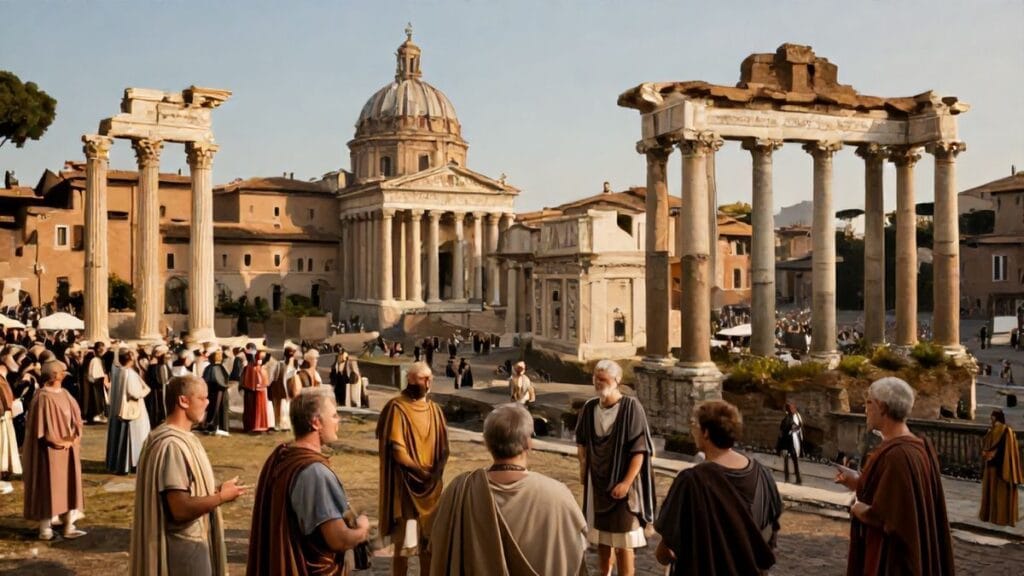
In the Forum itself, life was a theater of politics. Statues of Sulla and his allies stood in prominent places, their inscriptions proclaiming “Felix”—the Lucky. But every statue was also a provocation, a reminder to those who mourned the dead that their enemies were not only alive but honored. When Lepidus passed by these monuments with a thin smile or averted gaze, observers interpreted his expression according to their own hopes or fears.
Festivals offered brief respite. During the Lupercalia and other public celebrations, wine flowed, games were held, and for a moment the old communal rhythms reasserted themselves. Yet even in these spaces of sanctioned joy, one could not entirely escape politics. The seating at the games reflected the new hierarchies: senators in prominent places, equites behind, common citizens further back. Veterans, easily recognized by their bearing and scars, often claimed deference as the men who had “saved” Rome under Sulla. Those who remembered the days of Marius or Cinna clenched their teeth but said little.
Rome in 78 BCE, then, was a city living two parallel lives. On the one hand, the timeless rhythms of urban existence: births, marriages, trades, prayers. On the other hand, the deep undercurrent of unease: what if the laws changed again? What if a new strongman appeared? Would the property one held today still be one’s own tomorrow? It was into this atmosphere that Lepidus and Catulus would soon pour gasoline in the form of legislative proposals, public speeches, and, eventually, marching legions.
The Funeral of Sulla and the First Ruptures in the Consular Alliance
Lucius Cornelius Sulla died in 78 BCE, at his villa in Cumae, perhaps from complications of a long illness. His death was both an ending and an opportunity. It removed from the stage the one man whose personal prestige and military record could have overshadowed any consular authority, including that of Lepidus and Catulus. It also freed tongues: with the dictator buried, criticism of his regime could be more openly voiced—or more vigorously suppressed.
The decision to grant Sulla a public funeral in Rome was itself a political act. Catulus and the Sullan majority in the Senate supported it as a final affirmation of his role as restaurator rei publicae, restorer of the Republic. To them, a grand funeral procession, a pyre on the Campus Martius, and solemn eulogies were not merely rituals of mourning but statements of continuity: Sulla was dead, but his settlement lived.
Lepidus, according to later accounts, opposed or at least resisted this glorification. Some sources suggest he tried to obstruct the funeral honors, arguing that a man whose hands were stained with citizen blood should not be feted as a hero in the city whose streets he had once soaked in terror. Whether his opposition took the form of speeches in the Senate, maneuvers in the assemblies, or quiet mobilization of allies, it marked one of the first clear public rifts between the two consuls.
The day of the funeral, however, Rome stood still. The body of Sulla—now the corpse of a man who had commanded armies and dictated laws—was carried through the city amid incense and grief, both genuine and calculated. Veterans wept openly, thumping their breasts and recalling campaigns in Greece and Asia. Senators in white-bordered togas walked with measured steps; some may have remembered the mornings they had waited in fear to see whether their names would appear on the proscription lists.
As the procession moved along the Sacred Way, onlookers scanned the faces of the living. They watched Catulus’s composed solemnity and Lepidus’s carefully controlled expression. Here were the men who would shepherd Rome through the post-Sullan age—and already they were divided over how to remember the dead dictator. Was he to be canonized as a second founder, or quietly acknowledged as a necessary evil?
On the rostra, amid the wailing of hired mourners and the hush of the crowd, eulogies praised Sulla’s victories, his reforms, his alleged restoration of liberty. The words hung in the air like a challenge. To applaud was to endorse a particular version of recent history; to remain silent or scowl was to mark oneself, however subtly, as discontented.
For Lepidus, this moment was pivotal. Witnessing the spectacle of a city honoring a man many considered a butcher, he seems to have understood that there was space—dangerous, perhaps fatal, but real—for an alternative voice. The funeral was intended to close an era; instead, it helped open one. Afterward, as the pyre’s smoke dissipated into the winter sky, the consulship of Marcus Aemilius Lepidus and Quintus Lutatius Catulus was no longer merely an administrative arrangement. It was a battlefield of memory.
The Agrarian Question: Land, Veterans, and the Seeds of Revolt
If the memory of Sulla divided Rome at the level of symbols, land divided it at the level of survival. The agrarian issue—who owned which fields, under what terms, and by what moral right—had long haunted the Republic, from the days of the Gracchi onward. Under Sulla, it became a wound so deep that even many years of peace might not have healed it. In 78 BCE, it was still raw.
Sulla’s proscriptions had not merely eliminated political enemies; they had provided a legal mechanism for the wholesale transfer of property. Estates belonging to the proscribed were seized, auctioned off at knocked-down prices, and often ended up in the hands of Sulla’s supporters or were used to settle his veterans. Imagine an olive grove that had belonged to the same family for generations, suddenly transferred to a rough soldier who had followed Sulla from Italy to Asia and back. In the eyes of the law, the transfer was legitimate; in the eyes of the dispossessed, it was theft wrapped in official seals.
By the time the consulship of Marcus Aemilius Lepidus and Quintus Lutatius Catulus began, these veterans had put down roots—sometimes literally, planting vines and building farmhouses. Their children played among the walls of houses whose previous owners were dead, exiled, or scraping out a living in some corner of the city. Any attempt to revisit the property settlements of the Sullan era would pit justice for the old owners against the security of the new.
Lepidus saw, or chose to see, an opportunity in this tragic contradiction. He began to speak more openly about revising Sulla’s acts, particularly regarding land. Sources indicate that he proposed restoring property to at least some of those dispossessed, or at minimum reconsidering the legality of certain confiscations. To the dispossessed nobles and their allies, this sounded like long-delayed restitution. To the veterans and Sullan magnates, it sounded like a declaration of war.
In the Senate, Catulus and others argued vehemently against any such measures. They insisted that tampering with the foundations of Sulla’s settlement would undermine the entire postwar order. If land grants were called into question, what of legal judgments, manumissions, marriages, and contracts made under Sulla’s laws? The Republic, they said, could not live if it kept re-litigating the past.
Yet behind the elegant phrases lay a stark reality: vast swaths of Italian countryside were held in uneasy tenure. Old owners—some living in Rome, some in provincial exile—sent letters, hired advocates, and nurtured fantasies of return. New owners, though theoretically secure, slept with one eye open. Bands of brigands, often composed of displaced men with little left to lose, prowled the borders of these estates, a constant reminder that violence always lurked just beyond the edges of legality.
When Lepidus raised the agrarian question, then, he was not merely pushing a piece of legislation; he was touching the nerve of the entire post-Sullan settlement. The consulship that bore his and Catulus’s names would be remembered in part because it forced Romans to confront a disturbing truth: that peace based on unresolved injustice is not truly peace, but a lull between storms.
Tribunes, Senators, and the Struggle Over Political Memory
The battle over Sulla’s legacy played out not only in land disputes but in the very architecture of Roman politics. Central to this struggle was the tribunate of the plebs, once the proud defender of the common people. Sulla had shackled it, reducing its powers and severing its traditional link to the higher magistracies. In doing so, he had not just changed a job description; he had scarred Rome’s political identity.
During the consulship of Marcus Aemilius Lepidus and Quintus Lutatius Catulus, debate over the tribunate became a proxy for a larger fight about who should shape the future. Some tribunes themselves, elected under the new rules, were cautious, aware that any overt challenge to Sulla’s reforms might end their careers—or worse. Yet others saw in Lepidus’s rising rhetoric a chance to revive their office’s old vigor.
Lepidus encouraged this, at least indirectly. He spoke favorably of restoring some tribunitian powers, of allowing the tribunate once again to be a stepping stone rather than a cul-de-sac. His allies floated proposals to let tribunes introduce legislation more freely, to widen their scope of veto. Every such hint sent ripples through the Senate.
Catulus, for his part, responded with controlled but firm opposition. He argued that the weakened tribunate protected Rome from the kind of demagoguery that had convulsed the city during the days of the Gracchi and Saturninus. The people, he said, were not voiceless; they were simply represented through more orderly channels. To re-empower the tribunes was, in his view, to invite another round of confrontations between crowd and curia.
The struggle over the tribunate was also, more subtly, a struggle over history. If Sulla’s changes could be reversed, even partially, then his claim to have restored the Republic was weakened. His supporters feared a cascade: first the tribunate, then the courts, then the land settlements, until eventually the whole edifice came crashing down. The opponents of the Sullan order, conversely, believed that restoring at least some pre-Sullan institutions was necessary to cleanse the state of a kind of moral pollution.
Cicero, writing later, would note how dangerous it was to let each new political victory rewrite the rules entirely. But in 78 BCE, the cautionary voices were largely drowned out by the urgency of competing agendas. One contemporary observer, quoted by a later historian, supposedly remarked, “We live not in a Republic, but in the ruins of many republics piled one atop another.” Whether the remark is genuine or apocryphal, it captures the sense that Romans were increasingly legislating not for a stable future but against a traumatic past.
Beneath the Toga: Fears, Letters, and Whispers in the Curia
Public debates in the Senate and Forum were only the visible surface of Roman politics in 78 BCE. Beneath them lay a dense network of private conversations, letters, and whispered conspiracies that shaped the course of the consulship of Marcus Aemilius Lepidus and Quintus Lutatius Catulus as much as any formal decree. In a city where the wrong word could still lead to exile or worse, men spoke carefully—but they spoke.
Imagine a senator returning home after a contentious session, his litter swaying through the crowded streets. The clients who greeted him at dawn, the freedmen who managed his accounts, the wife who asked careful questions over dinner—all wanted to know: Where did things stand between Lepidus and Catulus? Were they united, as the official proclamations suggested, or were they drifting apart? Could one afford to back Lepidus publicly? Was it safer to stay close to Catulus and the solid block of Sullan conservatives?
Letters flew between Rome and the provinces. Governors wrote anxiously to their patrons, asking whether they should prepare to support one consul or another if matters came to a head. Commanders of legions, stationed in Spain, Gaul, or further east, received veiled inquiries about their loyalty to the existing order. In some of these letters, carefully preserved by later historians, we catch glimpses of a Republic already thinking in terms of which generals commanded which armies, an ominous habit in a state that still claimed to be ruled by laws, not swords.
Within the Senate, blocs formed and dissolved with dizzying speed. Some men tried to play both sides, praising Sulla’s reforms in principle while hinting that minor “adjustments” might be necessary. Others, more committed, attached themselves firmly to one consul. In smoky back rooms and shaded gardens, deals were brokered: votes traded, prosecutions promised or withheld, future magistracies parceled out contingent on the year’s outcome.
Fear was a palpable presence in these spaces. Older senators remembered the days when simply being associated with the wrong faction could mean seeing one’s name etched onto a proscription tablet. They had watched friends driven into exile or butchered in their doorways. If Lepidus’s more radical measures gained traction, would the pendulum swing back? Would Sullan loyalists find themselves hunted in turn?
Yet there was also hope—restless, impatient hope—among those who had lost under Sulla. Young men who had been children during the darkest days of the proscriptions were now of age to seek office. They had grown up with stories of fathers executed without trial, of uncles dispossessed. To them, Lepidus was more than a politician; he was a possible instrument of belated justice.
Thus, as winter turned toward spring, the internal atmosphere of Rome’s political class crackled with anxiety. Publicly, the consuls still sat side by side on their curule chairs; privately, the city’s elite began to prepare for a future in which they might stand on opposite sides of a battlefield.
The March of Lepidus: From Legal Opposition to Armed Rebellion
The break, when it came, was not sudden so much as inevitable. Tension that had built for months found its outlet in a familiar Roman pattern: one of the Republic’s leading magistrates chose to step outside the bounds of ordinary politics and turn toward arms. The consulship of Marcus Aemilius Lepidus and Quintus Lutatius Catulus, already fraying, now began to tear apart visibly.
Accounts differ on the precise sequence of events, but a broad outline can be drawn. Lepidus, frustrated by senatorial resistance to his proposals on land and the tribunate, sought to consolidate his support among those most deeply wronged by Sulla’s regime. He went north, to Etruria, where the density of Sullan land settlements and dispossessed communities created a fertile ground for agitation. There, he could present himself not merely as a voice in the Senate but as a leader in the field.
In Etruria, Lepidus’s rhetoric hardened. He spoke less of adjustment and more of reversal, less of compromise and more of undoing. Dispossessed families flocked to his side; disaffected communities, still bitter over how Sulla’s veterans had been planted among them like occupying forces, saw in Lepidus a chance to push back. Soldiers gathered—at first veterans and local levies, then more organized forces as Lepidus began to think, or was pushed into thinking, in military terms.
Meanwhile, in Rome, Catulus and the Senate watched with growing alarm. Were Lepidus’s movements a temporary pressure tactic, designed to force concessions? Or were they the prelude to an outright insurrection? Messengers shuttled between Rome and Etruria; demands were made, promises offered, threats whispered. The distance between negotiating from a position of strength and threatening civil war proved perilously small.
At some point—perhaps when Lepidus refused a formal senatorial summons to disband his forces, perhaps when he encouraged assemblies to pass measures contrary to senatorial decrees—the line was crossed. The Senate declared Lepidus a public enemy, just as it had once declared Marius and Cinna enemies of the state. The logic was bitterly circular: to challenge a settlement born of civil war was, in effect, to declare another.
Lepidus now faced a fateful choice. He could submit, disperse his forces, and trust to the mercy of a Senate dominated by the very men he had antagonized. Or he could embrace the role of rebel, march on Rome, and hope that his cause—and his troops—would carry him to victory before the weight of the state crushed him. He chose the latter.
As his legions began to move southward, the specter of Sulla’s earlier marches on Rome loomed over every mile. The Republic had once, long ago, prided itself on the idea that armies stayed outside the sacred boundary of the city, that consuls laid down their imperium at its edge. Those days were gone. Now, the march of a Roman army on Rome itself was almost a grim tradition, an option in every ambitious politician’s playbook.
Catulus Stands Firm: The Defense of Rome and the Battle for Legitimacy
When news reached Rome that Lepidus was advancing with an army, the city reacted with a mixture of dread and weary recognition. They had seen this play before. But this time, there was no Sulla at the head of a veteran army, no Marius subsisting in exile but ready to return. Instead, Rome looked to a different kind of leader: Quintus Lutatius Catulus, the other half of the consulship of Marcus Aemilius Lepidus and Quintus Lutatius Catulus.
Catulus was no flamboyant general, but he was steady. With the Senate’s backing, he moved quickly to organize the city’s defenses. Legions loyal to the Sullan order were summoned; commanders of proven reliability were appointed. Among them was a rising star whose name would one day overshadow both consuls of 78 BCE: Gnaeus Pompeius Magnus—Pompey the Great. At this moment, however, Pompey was still the ambitious young warlord whose force Sulla had once legitimized by extraordinary commands.
Catulus’s challenge was not merely military but moral. He had to frame the conflict in terms that would rally hesitant senators and citizens to his side. In speeches to the Senate and, perhaps, to the people, he presented Lepidus not as a reformer but as a new Marius, a man willing to plunge the Republic back into slaughter for his own gain. Catulus positioned himself as the defender of legality, of the senate’s authority, of the fragile peace that Sulla’s harsh measures had purchased.
His words carried weight, in part because many Romans were simply exhausted. The memory of barricades in the streets, of hastily raised militias, of heads displayed in the Forum as trophies—these were not distant tales but experiences from their own adult lives. Whatever they thought of Sulla’s crimes, many dreaded the prospect of reliving such horrors. Catulus’s promise was simple, if grim: stand with me, and however flawed this order may be, we will at least avoid another descent into chaos.
As Lepidus approached, Rome braced. Armories worked day and night; the city gates were inspected and repaired. Priests performed rituals to secure the gods’ favor, though one wonders what Jupiter or Mars thought of a city that so often invoked them to bless wars against itself. Mothers stocked grain and salted meat, uncertain whether siege or street fighting lay ahead.
In these days, the figure of Catulus took on a kind of grim nobility. He did not promise a bright new dawn; he promised to hold the line. When he conferred with Pompey and other commanders, he did so not as a charismatic warlord but as a guardian of an embattled system. The irony was sharp: to preserve a constitutional order born of a dictator’s arms, he now had to use arms again.
Blood in Etruria: Campaigns, Sieges, and the Breaking of Lepidus
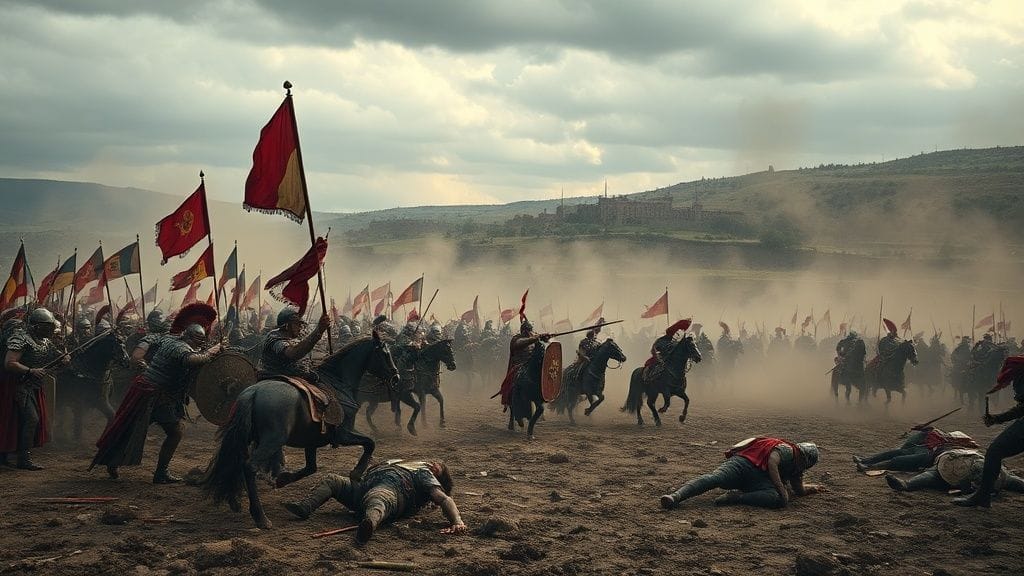
The confrontation between Lepidus and the forces loyal to Catulus unfolded not in the streets of Rome but in the fields and hills of Italy, especially Etruria. There, the political abstractions of senatorial debates gave way to the concrete realities of marching feet, clashing steel, and dying men.
Lepidus’s army, though energized by anger and hope, faced serious disadvantages. It was a coalition of the dispossessed and the ambitious, bound together by grievance more than by discipline. Some units were hardened veterans; others were hastily raised contingents who had never marched in formation under fire. Their cause—overturning the Sullan order, restoring lands, reviving the tribunate—was stirring, but in war, cause alone is not enough.
Opposing them were legions led by experienced commanders, operating under the authority of Catulus and the Senate. Pompey, in particular, moved against Lepidus with the confidence of a man who had already tasted military success in Sicily and Africa. To the Senate, he was a useful instrument: ruthless enough to crush rebellion, not yet powerful enough to dominate them entirely. In retrospect, it was a dangerous bargain, but in 78 BCE, survival trumped long-term caution.
Engagements flared across Etruria. Skirmishes near key towns tested the loyalties of local communities. Some cities, sympathetic to Lepidus’s promises or intimidated by his forces, opened their gates. Others held firm for the Senate, bolstered by the knowledge that Catulus’s armies were not far behind. Fields that had been contested by lawyers now became battlefields, sown with bodies instead of crops.
We know few precise tactical details of these campaigns, but the outcome is clear: Lepidus’s forces were gradually pushed back. A decisive clash or series of clashes broke his army’s cohesion. His coalition, never fully unified, began to fracture. Allies defected, units deserted, some communities that had welcomed him now hurried to demonstrate their loyalty to Catulus and Pompey, lest they face retribution.
Lepidus himself fled, his grand vision reduced to a desperate search for sanctuary. Some accounts suggest he tried to escape to Sardinia or further afield, hoping perhaps to regroup, to play the long game of Roman exile and return that had worked for others before him. But fortune, which had once smiled on Sulla, now turned her face from Lepidus. Within a short time, he was dead—whether from illness, wounds, or a final, futile confrontation remains debated.
In Etruria, the cost of his failure was measured not just in bodies but in deepened bitterness. Communities that had dared to support him now found themselves at the mercy of senatorial reprisals. Veterans who had remained loyal to the Sullan order hardened their attitudes, convinced that any loosening of the grip would only invite further rebellions. The land question, far from being resolved, was now layered with fresh grievances.
Pompey’s Rising Star: A Young General in an Old Republic
Among the many ironies of the consulship of Marcus Aemilius Lepidus and Quintus Lutatius Catulus, one stands out: in trying to contain Lepidus’s challenge, the Senate further elevated a man who would, in time, pose his own kind of challenge to republican norms. Gnaeus Pompeius Magnus, though not yet bearing the honorific “Magnus” in full imperial splendor, emerged from the campaign against Lepidus with enhanced prestige and a reputation as the Senate’s most effective sword.
Pompey was in some ways the anti-Lepidus. He came from a relatively new noble family, the Pompeii, whose rise owed much to his own and his father’s military talents. Where Lepidus had leveraged grievances against Sulla, Pompey had been among Sulla’s most successful protégés, commanding troops in Sicily and Africa with notable success. Now, tasked with assisting Catulus in suppressing Lepidus, he again proved his ability to organize, march, and win.
Catulus and Pompey were an unlikely pairing: the austere guardian of tradition and the young, ambitious general whose career already showed signs of stretching traditional frameworks. But in the crisis of 78 BCE, their interests aligned. Catulus needed a reliable commander; Pompey needed opportunities to display his prowess. Together, they became the hammer that broke Lepidus’s nascent revolution.
In the Senate, some voices expressed unease. Had they not just seen what happened when a single man—Sulla—amassed too much military and political power? Was it wise to keep leaning on generals like Pompey to resolve internal crises? Yet such voices were often drowned out by gratitude and fear. Lepidus had marched on Rome, or nearly so; his rebellion had to be crushed. In moments of danger, abstract principles yielded to concrete necessities.
In the months after Lepidus’s defeat, Pompey’s name was spoken with increasing respect, even awe. Veterans of his campaigns boasted of serving under him; younger men dreamed of joining his staff. Senators who had once dismissed him as Sulla’s creature now courted his favor. Catulus, though still the senior partner in legitimacy, had to navigate carefully around the growing power of this younger ally, whose popularity with the troops and the people could not be ignored.
Thus, paradoxically, the year that saw one consul crushed for overreaching and attempting to revise the Sullan order also saw the further empowerment of a man whose very existence depended on a pattern of extraordinary commands and military interventions that quietly eroded republican norms. The Republic, in trying to save itself from Lepidus, had fed another wolf at its door.
Echoes in the Forum: How the Year 78 BCE Changed Roman Politics
When the dust of Lepidus’s rebellion settled and the year 78 BCE drew to a close, Rome did not emerge unchanged. The consulship of Marcus Aemilius Lepidus and Quintus Lutatius Catulus left marks not only on the map of Italy but on the mental landscape of Roman politics. Even those who never picked up a sword now thought about their Republic differently.
First, the boundaries of acceptable political behavior had shifted yet again. Lepidus’s decision to turn from legislative proposals to armed force was condemned by the Senate as treason, but it also reinforced the perception that in moments of deep conflict, the ultimate arbiter was not law but arms. The precedent of Sulla’s marches had been invoked, tested, and, in a sense, normalized. Future politicians took note: if your enemies controlled the Senate, you might still find your path through the camp.
Second, the Sullan order, though defended by Catulus and his allies, emerged more brittle than before. The very need to defend it with legions rather than arguments exposed its fragility. Many Romans, even those who opposed Lepidus, could not help wondering: if the Sullan settlement were truly just and widely accepted, why did it provoke such desperate resistance? Why did it need constant reinforcement by arms?
Third, the figure of the “reformer” was subtly recast. Lepidus’s failure and death did not erase the grievances he had articulated; it merely discredited him as their champion. The land question, the status of the tribunate, the moral legitimacy of Sulla’s proscriptions—these issues did not vanish. They remained like embers beneath ash, waiting for another, perhaps more skillful, hand to fan them back into flame.
In the Forum, rhetoricians and young politicians read the events of 78 BCE as a cautionary tale. Some concluded that overt, frontal assaults on the Sullan system were futile; better to chip away gradually, to work within the forms of legality while subverting their content. Others, more radical, drew the opposite lesson: that only a leader with a stronger base, more disciplined legions, and greater charisma could hope to succeed where Lepidus had failed.
The people, too, adjusted their expectations. Many had watched the clash between Lepidus and Catulus from the sidelines, praying simply that fighting would not break out in their streets. But they had also heard Lepidus’s promises, seen Catulus’s uncompromising stance, and concluded that Rome’s rulers were, once again, playing out their struggles at the edges of legality. Trust in the Senate did not grow; if anything, it eroded further.
From Lepidus to Caesar: A Republic Learning to Devour Itself
In hindsight, the consulship of Marcus Aemilius Lepidus and Quintus Lutatius Catulus appears as part of a chain of events that would, over the next few decades, lead Rome from a flawed republic to something approaching monarchy. It was not the decisive break—that would come later, with figures like Caesar and Augustus—but it was an early rehearsal of themes that would recur with growing intensity.
One such theme was the use of constitutional office as a launching pad for extra-constitutional action. Lepidus was not some marginal agitator; he was a duly elected consul, entrusted with the highest annual magistracy in the state. When he turned toward rebellion, he did so not as an outsider but as a man deeply embedded in the system. Later, Caesar would do something similar, using his proconsular command in Gaul as the base from which to challenge the Senate’s authority.
Another theme was the weaponization of memory. The conflict between Lepidus and Catulus was in large part a battle over how to remember Sulla and his dictatorship. Was Sulla a hero who had saved the Republic, or a butcher who had poisoned it? Could his laws be accepted while his methods were condemned? Future crises would replay this dynamic: how to remember the Gracchi, how to remember Marius, how to remember each new strongman who reshaped the state.
Perhaps most importantly, 78 BCE demonstrated that the Republic could not easily process mass injustice. The dispossessions and killings of the Sullan era demanded some kind of reckoning. Lepidus attempted to provide one, albeit in a way that blended moral argument with personal ambition. His failure did not solve the underlying problem; it merely postponed it. Later leaders, from Catiline to Caesar, would find fertile ground in the resentments that Sulla had sown.
In this sense, Lepidus can be seen as a tragic forerunner. He reached for themes that would later be more successfully developed by others: the appeal to the dispossessed, the critique of senatorial arrogance, the promise to undo specific injustices. But he lacked either the military base, the political finesse, or the sheer luck that would favor later figures. His consulship, shared uneasily with Catulus, thus stands as a reminder that the Republic’s crisis was larger than any one man’s success or failure.
Human Faces of Crisis: Veterans, Italians, and the Dispossessed
Behind the sweeping narratives of the consulship of Marcus Aemilius Lepidus and Quintus Lutatius Catulus stand countless individuals whose names history did not preserve. To grasp the full impact of that year, we must look briefly at some of these human faces: the veterans, the Italians, the dispossessed nobles and commoners whose fates pivoted on decisions taken far above them.
Consider a Sullan veteran settled in Etruria. He fought at Chaeronea, at Orchomenus, perhaps in the East, following Sulla for years. Upon demobilization, he received a plot of land, once owned by a man whose name he scarcely knew, marked on a list he never saw. For this soldier, the parcel represented not only material security but honor: proof that his service had meaning. When Lepidus began to speak of revising settlements, he heard not justice but the threat of losing everything earned at the point of a sword.
Now imagine the son of a proscribed man, living in Rome in 78 BCE. His father’s estate had been confiscated; he grew up in a rented apartment in a noisy insula, hearing stories of a villa and fields that were no longer his. He watched the veterans parade through the Forum, their bearing confident, their loyalty claimed by politicians. When Lepidus promised to revisit old wrongs, the young man’s heart must have leaped. Yet even he may have hesitated when rebellion actually broke out; between the dream of justice and the reality of renewed civil war lay a chasm.
Italian communities, too, were torn. Many had only recently been admitted to citizenship after the Social War and still felt like second-class Romans. The Sullan land grants had sometimes cut across old communal boundaries, introducing new owners whose ties to local traditions were thin. When Lepidus appeared in Etruria and other regions, promising redress, some towns saw a chance to push back against what they perceived as a colonial imposition by Rome’s victorious faction. Others, weary of conflict, clung tightly to whatever order currently prevailed.
Women, often invisible in the formal political histories, experienced these events in acutely personal ways. Widows of the proscribed navigated the delicate politics of patronage, seeking protection from senators who might one day champion their cause—or betray it. Wives of Sullan veterans managed households on contested lands, balancing hospitable gestures to local neighbors with a constant fear of resentment boiling over. For them, the march of Lepidus and the mobilization of Catulus’s forces were not grand historical moments but threats to the fragile stability they had painstakingly built.
These intersecting lives remind us that the year 78 BCE was not simply a chapter in a constitutional history but a lived experience of insecurity and hope. The consulship that bore the names of Marcus Aemilius Lepidus and Quintus Lutatius Catulus was, at its core, about whose stories would be acknowledged and whose suffering would be brushed aside in the name of “order.”
Memory, Historians, and the Contested Legacy of 78 BCE
How we remember the consulship of Marcus Aemilius Lepidus and Quintus Lutatius Catulus depends heavily on the voices that have reached us. Those voices are not neutral. Most surviving narratives of this period were written by men of senatorial rank or sympathies, often decades later, when the outcomes of subsequent struggles had colored their interpretations of earlier ones.
Sallust, writing about the moral decay of the Republic, saw in episodes like Lepidus’s revolt symptoms of a deeper disease—ambition unmoored from virtue, greed clothed in rhetoric. Cicero, who navigated his own perilous career amid the Republic’s storms, referred to Lepidus in passing as a cautionary example of what happened when a man overreached. To them, Catulus often appeared as a figure of dignity and restraint, the kind of aristocrat Cicero himself aspired to be recognized as: principled, measured, faithful to the Senate’s authority.
Modern historians, with access to a wider array of evidence and a keener sensitivity to structural injustice, have sometimes reevaluated Lepidus. They ask whether labeling him simply a “rebel” or “agitator” obscures the legitimacy of the grievances he voiced. Some argue that while his methods were reckless, his goals—to mitigate the harshest effects of Sulla’s regime, to restore some balance between Senate and people—were not inherently villainous. Others counter that in a context as fragile as 78 BCE, any attempt to reopen the questions Sulla had settled by force was bound to produce renewed violence.
Catulus, too, has attracted scrutiny. Was he a statesman bravely holding back the tide of chaos, or a rigid conservative unwilling to concede even modest reforms that might have defused later conflicts? The truth likely lies between these poles. He was a product of his time and class: a man who had seen the Republic nearly destroyed by popular violence and who thus treated almost any challenge to senatorial supremacy as an existential threat.
What remains clear, across these interpretations, is that the consulship of Marcus Aemilius Lepidus and Quintus Lutatius Catulus marked a critical moment in Rome’s long, painful attempt to live with the legacies of civil war. As one modern scholar has observed, “The year 78 was less a storm than the rumble that precedes it, when men first realize that the sky will not clear simply because they avert their eyes” (a formulation that, though paraphrased here, captures the mood found in several academic discussions of the period).
In studying this year, we are forced to confront uncomfortable questions that reach beyond Rome: Can a political community built on unresolved mass injustice ever truly stabilize? How should societies remember leaders who combined institutional reforms with brutal repression? And what happens when the instruments designed to preserve order—armies, emergency powers, political patronage—become themselves engines of further instability?
Conclusion
The year 78 BCE, carried by the names of Marcus Aemilius Lepidus and Quintus Lutatius Catulus, stands as a haunting chapter in the late Roman Republic’s slow unravelling. On its surface, it was a tale of two consuls, once colleagues, who became antagonists over the meaning of Sulla’s dictatorship and the future of the Republic. Beneath that surface, however, the consulship of Marcus Aemilius Lepidus and Quintus Lutatius Catulus exposed the deeper fractures in Roman society: between victors and victims of civil war, between old traditions and new power structures, between the law as written and the law as enforced by armed men.
Lepidus’s trajectory, from establishment patrician to rebel marching on Rome, revealed how little room there was in Sulla’s settlement for genuine redress of grievances. His failure did not disprove the justice of those grievances; it merely demonstrated that, in that moment, the Republic was unwilling—or unable—to address them without resorting to the same violence that had created them. Catulus’s steadfast defense of the Sullan order, meanwhile, preserved a fragile peace at the cost of locking in the resentments that would fuel future conflicts.
In the short term, the Sullan system survived. Land grants remained largely intact; the tribunate stayed weakened; the Senate’s dominance was reaffirmed by force. Yet the very fact that Rome had once again resolved a political crisis through arms rather than compromise eroded confidence in its republican ideals. Every time a consul like Lepidus or a general like Pompey used legions as political instruments, the old distinction between imperium abroad and civic life at home grew thinner.
Looking forward, we can trace a line from this year to the later convulsions of the Republic: to Catiline’s conspiracy, to Caesar crossing the Rubicon, to the proscriptions of the Second Triumvirate. Each of these crises would replay, in different keys, the themes first starkly dramatized under the consulship of Marcus Aemilius Lepidus and Quintus Lutatius Catulus: contested memory, unresolved injustice, and the ever-present temptation to resolve political disagreements with marching columns of soldiers.
And yet, there is a final irony. The Republic did not fall in 78 BCE. It endured, adapted, produced great orators, generals, and laws even as its foundations weakened. Ordinary Romans continued to work, love, worship, and hope under its institutions. In this sense, the year of Lepidus and Catulus is a reminder that political systems can both function and decay at the same time—delivering order in the present while quietly sowing the seeds of their own transformation. For Rome, that transformation would, in time, lead from republic to empire. For us, their story offers a mirror held up across two millennia, asking what kinds of injustice we, too, are willing to leave unresolved in the name of a precarious peace.
FAQs
- Who were Marcus Aemilius Lepidus and Quintus Lutatius Catulus?
They were the two consuls of Rome in 78 BCE, leading magistrates of the Roman Republic. Lepidus came from an ancient patrician family and ultimately positioned himself as a critic of Sulla’s regime, while Catulus, from a distinguished but more recently embattled lineage, became one of the staunchest defenders of the Sullan constitutional settlement. - Why is the consulship of Marcus Aemilius Lepidus and Quintus Lutatius Catulus historically significant?
It is significant because it was the first major test of Sulla’s post-dictatorial order. During their year in office, simmering tensions over land confiscations, the weakened tribunate, and the memory of the proscriptions erupted into open conflict when Lepidus raised an army and challenged the Senate, prompting Catulus and his allies to respond militarily. - What role did Sulla’s reforms play in the crisis of 78 BCE?
Sulla’s reforms centralized power in the Senate, weakened the tribunate, and ratified massive land confiscations and legal changes imposed after civil war. These measures created deep resentments among dispossessed families, Italian communities, and politically marginalized groups. The crisis under Lepidus and Catulus was in large part a struggle over whether and how to revise this harsh settlement. - Did Lepidus have genuine reformist intentions, or was he just ambitious?
Historians are divided. Some view Lepidus mainly as an opportunist who exploited popular grievances to advance his own power, pointing to his earlier cooperation with Sulla. Others argue that, while certainly ambitious, he also articulated real injustices suffered under Sulla and sought, however clumsily, to address them. The lack of Lepidus’s own writings makes it hard to separate conviction from calculation. - How did Quintus Lutatius Catulus respond to Lepidus’s challenge?
Catulus opposed Lepidus’s proposed revisions to Sulla’s settlement in the Senate and, once Lepidus raised an army in Etruria, helped organize the military response. With the support of the Senate and commanders like Pompey, Catulus oversaw the defeat of Lepidus’s forces, preserving the Sullan order and reinforcing the idea that challenges to it would be met with armed force. - What role did Pompey play in suppressing Lepidus’s revolt?
Pompey acted as a key military commander on the Senate’s side, helping to defeat Lepidus’s forces in Italy. His success in this campaign enhanced his reputation and further entrenched the pattern of relying on powerful generals to resolve internal political crises—a pattern that would later contribute to the Republic’s collapse. - Did the defeat of Lepidus resolve the underlying problems in the Roman Republic?
No. While Lepidus’s defeat secured the immediate survival of the Sullan system, it did not address the deep grievances over land, the status of the tribunate, and the legacy of the proscriptions. These unresolved issues continued to fester and would later be exploited by other ambitious leaders, contributing to further crises. - How did ordinary Romans experience the events of 78 BCE?
Most ordinary Romans experienced them through economic uncertainty, rumors, and occasional mobilization rather than direct battlefield participation. Urban plebs worried about grain prices and security, dispossessed Italians and exiles saw a fleeting chance for redress, and Sullan veterans defended their new holdings. The year was felt as another episode of instability in a generation already marked by civil war. - Is Lepidus best understood as a precursor to later figures like Caesar?
In some respects, yes. Lepidus used a high magistracy as a platform to challenge the dominant political order, appealed to the grievances of the dispossessed, and eventually took up arms against the Senate. While he lacked Caesar’s military base and political genius, his career anticipates the fusion of reformist rhetoric and armed power that would characterize later leaders. - What long-term impact did the consulship of Marcus Aemilius Lepidus and Quintus Lutatius Catulus have on the Republic?
Its long-term impact lay in reinforcing the idea that political disputes over constitutional arrangements and historical injustices could—and perhaps had to—be settled by military force. It further legitimized the intervention of generals like Pompey in internal politics and left Sulla’s contentious settlement in place, ensuring that the Republic’s unresolved conflicts would resurface in even more destructive forms in the following decades.
External Resource
Internal Link
Other Resources
- Encyclopaedia Britannica – general search for the exact subject
- Google Scholar – academic search for the exact subject
- Internet Archive – digital library search for the exact subject