Table of Contents
- A Winter Coronation in a Fractured Kingdom
- The Fragile Heir: Louis the Stammerer Before the Crown
- From Charlemagne’s Shadow to a Diminished West Francia
- Charles the Bald’s Final Gamble and the Succession Crisis
- Compiègne in December 877: Setting the Stage for a Crown
- Inside the Ceremony: Rituals, Relics, and Sacred Oil
- Voices in the Hall: Bishops, Nobles, and the People’s Murmur
- A King with a Stammer: Speech, Weakness, and Perceived Legitimacy
- The Church as Kingmaker: Hincmar of Reims and the Theology of Power
- Nobles on the Rise: Oaths, Autonomy, and the Price of Support
- Enemies at the Borders: Vikings, Bretons, and the Weight of the Crown
- Family Ties and Rivalries: Queens, Brothers, and the Next Generation
- A Brief Reign: Laws, Charters, and the Daily Reality of Louis’s Kingship
- Death After the Crown: The Aftermath of a Short-Lived King
- From Coronation to Capetians: Long Shadows on French Monarchy
- Memory, Myth, and the “Stammerer”: How History Judged Louis
- Conclusion
- FAQs
- External Resource
- Internal Link
Article Summary: On 8 December 877, in the royal city of Compiègne, the coronation of Louis the Stammerer as King of West Francia unfolded under winter skies and the heavy weight of dynastic expectation. This article traces the world that produced this anxious ceremony, from the crumbling legacy of Charlemagne to the fragile realm Charles the Bald left behind. It plunges into the rituals, politics, and whispered doubts that surrounded the coronation of louis the stammerer, revealing how sacred oil, noble oaths, and a hesitant voice shaped a king’s fate. We follow Louis from overlooked prince to consecrated monarch, exploring how his personal weakness combined with structural crises—Viking raids, noble autonomy, and church power—to define his tragically brief rule. The narrative then turns to the broader consequences, showing how this coronation of louis the stammerer symbolized the slow shift from imperial unity to the seeds of the French monarchy. Along the way, eyewitness-style reconstructions, charters, and chronicles bring to life the fears and hopes of those who gathered in Compiègne. Ultimately, the article argues that the coronation of louis the stammerer was less a triumphant beginning than a desperate attempt to hold together a realm on the verge of transformation. And yet, through this fragile king and his uncertain moment, we glimpse the birth of political patterns that would shape medieval France for centuries.
A Winter Coronation in a Fractured Kingdom
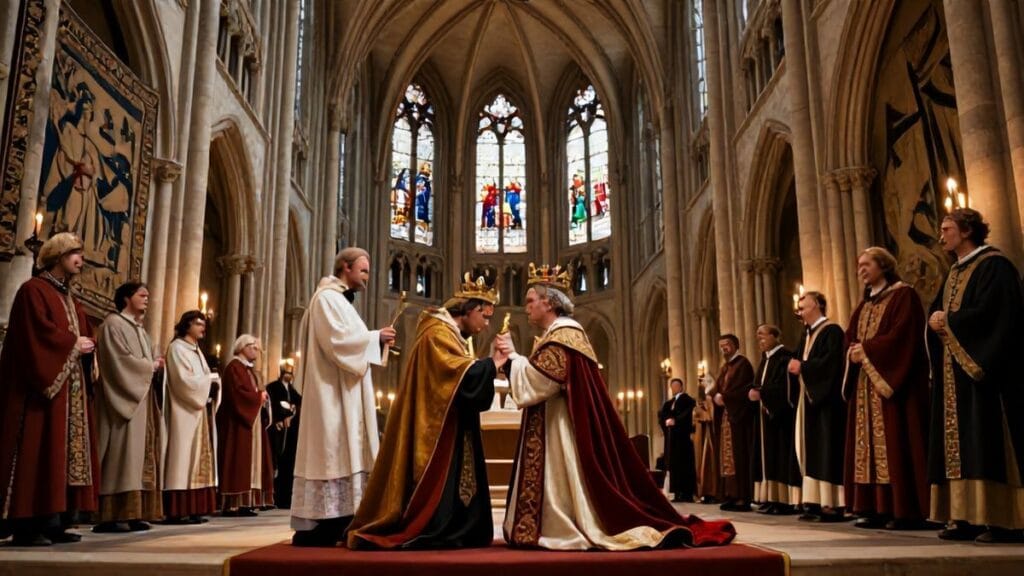
The air in Compiègne on 8 December 877 would have held that particular bite known only to northern winters: cold enough to sting the skin, damp enough to seep into bone and stone. Torches spat and smoked under the low, gray sky as processions wound their way toward the royal chapel. Inside, the smell of incense tried, and failed, to mask the mingled scents of wool, damp leather, and human breath. This was not the triumphant enthronement of a conqueror at the height of his power; it was the anxious, almost hurried coronation of Louis the Stammerer, a man whose very nickname betrayed how uncertain many considered his fitness to rule.
The coronation of louis the stammerer as King of West Francia was meant to bring stability. Instead, it took place in a moment of profound insecurity. His father, Charles the Bald, emperor and king, had died just weeks earlier, far from home in the Alps, his last campaign against rebellious Italian nobles cut short by illness and exhaustion. The West Frankish kingdom, carved out of the Carolingian Empire by the Treaty of Verdun in 843, was no longer the confident realm of Charlemagne’s heirs. It was a patchwork of principality-like territories, fortified monasteries, over-mighty nobles, and royal estates scarred by years of war and Viking raids.
And yet, within the walls of Compiègne, ceremony demanded a different story. Bishops, clad in resplendent vestments, rehearsed chants and prayers affirming divine support for the new king. Noblemen, weighing their own power and opportunities, nonetheless prepared to swear oaths of fidelity. Scribes sharpened their quills to record each step of the liturgy, knowing that the written word could confer legitimacy long after the echoes of the chanting had faded.
Somewhere in the palace complex, Louis himself waited—no longer the overlooked son but not yet the undisputed ruler. To approach the moment of his consecration, he needed not only faith in God’s grace but also the carefully choreographed endorsement of men who did not fully trust him. The coronation of louis the stammerer thus became a performance addressed to two audiences at once: heaven, invoked by anointing and prayer, and earth, embodied by the watchful eyes of counts, bishops, and warriors whose loyalty was anything but guaranteed.
Yet this was only the beginning. To understand why this winter ceremony mattered so deeply, we must step back into the world that created Louis—his childhood overshadowed by greater men, his adulthood haunted by expectation and failure, and his brief reign caught between continuity and collapse.
The Fragile Heir: Louis the Stammerer Before the Crown
Louis was not born to be the obvious successor of a great empire; he entered the world in 846 as just one more branch on a family tree already burdened with too many princes and too many claims. His father, Charles the Bald, had spent much of his life fighting his own brothers and rebellious nobles simply to secure his portion of the Carolingian inheritance. By the time Louis was old enough to understand words like “oath” and “realm,” the map of his world was already laced with fractures.
From early on, Louis was different, and everyone knew it. The chroniclers tell us that he spoke with difficulty—his words hesitated on his tongue, tripping and breaking before they reached the listeners. In a culture that prized public speaking, negotiation, and the authoritative proclamation of law, such a stammer was not a harmless quirk. It cast doubt on his capacity to command in council and inspire in battle. The nickname “le Bègue,” the Stammerer, was not a private family joke; it was how history chose to remember him, as if his entire being was contained in a speech defect.
But it would be a mistake to see Louis as weak in all respects. Sources hint at a pious, even conscientious character. Unlike some of his more flamboyant ancestors, he was not known for spectacular cruelty or reckless ambition. He married twice—first Ansgarde of Burgundy, then, controversially, Adelaide of Paris—and fathered sons who would themselves briefly become kings. His life, like that of so many medieval princes, revolved around itinerant courts: moving from royal estate to royal estate, attending councils, listening to petitions, and watching his father constantly negotiate with the great men of the realm.
Yet behind all of this lay a persistent insecurity. Charles the Bald, already older when Louis was born, had other sons, including Louis the Younger in the East Frankish kingdom. Succession plans constantly shifted as political alliances and treaties changed. For much of his youth, Louis the Stammerer hovered in the uncomfortable space between heir-apparent and spare, useful but not essential. His health was not robust; his presence did not fill a hall like that of a warrior-king. To some, he seemed destined for a quiet, secondary role: perhaps a sub-king in Aquitaine or a loyal son governing on behalf of a more commanding relative.
It is astonishing, isn’t it, how quickly fate can turn? A decade of diplomatic maneuvers, deaths, and rebellions would eventually put Louis at the center of West Francia’s future. But the man who walked toward the altar at Compiègne in December 877 carried the burdens of those early doubts in every step. The coronation of louis the stammerer was, in many respects, a public attempt to erase years of private hesitation—an act of collective will meant to transform a hesitant prince into a sacred monarch.
From Charlemagne’s Shadow to a Diminished West Francia
To truly grasp the meaning of Louis’s coronation, we must revisit a story that had already become legend: the rise and fragmentation of Charlemagne’s empire. Less than a century before Louis’s anointing, Charlemagne had ruled over a vast dominion uniting much of Western and Central Europe. The image of the great emperor—crowned in Rome on Christmas Day 800, sword on hip, cloak heavy with gold embroidery—haunted every subsequent Carolingian king. Each wore a crown that seemed slightly too large, a reminder that comparison with the giant of the past was inevitable.
After Charlemagne’s death, his son Louis the Pious tried to preserve the unity of the empire. But Frankish tradition favored dividing territories among sons, and dynastic politics tore at the fabric of the realm. The Treaty of Verdun in 843, the famous partition of the Carolingian Empire, created three major kingdoms: East Francia, Middle Francia, and West Francia. West Francia, eventually the heartland of what would become France, was the realm inherited by Charles the Bald—Louis the Stammerer’s father.
Charles’s kingdom was rich but vulnerable. Bordered by the North Sea and the Atlantic, sliced through by navigable rivers like the Seine and the Loire, West Francia offered tempting targets to Viking raiders. Monasteries, which stored not only relics but also treasure and manuscripts, became regular victims. Cities like Paris fortified their bridges and walls, but royal armies could not be everywhere at once. Year after year, annals recorded grim entries of burning, plunder, and ransom.
At the same time, regional powers hardened. Great families such as the Robertians (ancestors of the Capetians) in the Île-de-France and the counts of Flanders, Anjou, and Toulouse increasingly acted like miniature kings in their own territories. They built stone fortifications, raised armies loyal to themselves, and often negotiated directly with both the crown and external foes. As royal authority seemed less and less capable of immediate protection, local power became more attractive.
In this landscape, the coronation of louis the stammerer was both a continuation of imperial tradition and a symptom of decline. The ceremonies of consecration, anointing, and oath-taking harked back to Charlemagne and even earlier kings. But the kingdom over which Louis was to be crowned was smaller, more fragmented, and much more dependent on the cooperation—or at least the non-interference—of powerful nobles and bishops. The grandeur of the imperial past loomed over a present in which the king’s horse might have to ride around newly fortified noble strongholds that owed him only nominal allegiance.
It is in this tension between memory and reality that the Compiègne coronation must be placed: a ceremony wrapped in the liturgical language of unshakable kingship, performed in a polity increasingly defined by negotiation, compromise, and the slow erosion of central control.
Charles the Bald’s Final Gamble and the Succession Crisis
By the mid-870s, Charles the Bald was an aging ruler with a résumé of hard-fought compromises and half-won triumphs. He had survived rebellions, outlived some of his rivals, and even managed to secure the imperial title in 875, allowing himself to be crowned emperor in Rome. Yet the crown he wore in his last years did not rest easily. The imperial dignity brought fresh obligations in Italy and new enemies among the Frankish nobility, who feared being drawn into distant conflicts.
Perhaps sensing his mortality, Charles increasingly turned to securing the succession. In a realm accustomed to turmoil at the death of kings, planning ahead was not a luxury but a political necessity. However, every attempt to name and reinforce a clear heir intersected with complex webs of marriage, previous treaties, and the self-interest of great men. Louis the Stammerer, already an adult by this time, emerged as the logical candidate to succeed in West Francia, even if few perceived him as a natural war leader.
In 875–876, Charles’s last Italian adventure proved catastrophic. Pushing across the Alps into a contested political climate, he sought to defend, and extend, his authority in a land wracked by rebellious nobles and rival claimants. The campaign was grueling. Supplies were hard to secure; winter approached; disease stalked the camps. In October 877, at the Mont Cenis pass, Charles’s body finally failed him. Surrounded by exhausted retainers and religious attendants, he died far from Paris, leaving behind a realm without a present king.
News of his death traveled slowly but relentlessly northward. When it reached West Francia, it hit like a chill wind through every court and stronghold. Without the emperor’s personal presence to overawe them, nobles could begin imagining alternatives to straightforward succession. Some may have thought of inviting another Carolingian prince; others perhaps silently measured whether a weaker king like Louis could be molded into a pliable tool.
The crisis was not only political but emotional. A generation had grown up knowing only Charles as their ruler, with all his flaws and compromises. His death raised primal fears of invasion, looting, and lawlessness. It is in this climate of uncertainty that preparations for the coronation of louis the stammerer began. Rather than a coronation following the peaceful, orderly death of a well-prepared monarch, this would be an emergency consecration—performed soon after the news of Charles’s passing, as much to calm nerves as to assert dynastic legitimacy.
Key figures around Louis, particularly leading bishops and some influential counts, understood the stakes. If they waited too long, competing claimants could rally forces; if they acted too hastily, they risked alienating major nobles who had not been properly consulted. The choice of Compiègne, an important royal residence with both political and sacred resonance, was strategic. Here, under the gaze of relics and within reach of traditional power centers, they would attempt to transform a moment of fear into a solemn transfer of grace.
Compiègne in December 877: Setting the Stage for a Crown
Compiègne was not merely a convenient location on the royal itinerary; it was a symbol. Nestled in the forests of northern West Francia, on the banks of the Oise River, the city had long served as a favored royal residence. Charlemagne himself had passed through; Charles the Bald had invested in its buildings and religious institutions. A palace, a chapel, monastic establishments: together they formed a small universe of royal power and sanctity.
In early December 877, Compiègne must have hummed with preparation. Messengers arrived on lathered horses, carrying news, instructions, and, no doubt, arguments. Artisans and servants were pressed into service, cleaning halls, arranging benches, preparing vestments, and furnishing the altar. Vestment chests were opened; gleaming chalices were polished; liturgical books were taken out and reviewed. It was not enough to crown a king; the visual and sensory language of the ceremony had to reassure all present that this was a legitimate continuation of divinely sanctioned rule.
The weather itself played a role in setting the mood. Short days and lingering fog created a world in which torchlight became almost theatrical. Attendees would have trudged through mud and cold wind to reach the buildings where the ceremony would take place. Above them loomed the silhouettes of wooden and stone fortifications—structures meant to reassure, yet also visual reminders that force lay behind every oath.
Louis arrived not as a conqueror but as an heir in need of affirmation. His retinue, though respectable, likely seemed modest compared to the entourages of his father’s heyday or the magnificent assemblies of Charlemagne described in older chronicles. Still, the staging remained careful. The royal insignia—sword, scepter, crown—had been prepared. The holy oil, believed to transmit a spark of God’s authority, waited in a carefully guarded vessel. Bishops rehearsed the words they would speak on behalf of an entire people.
Among them, one figure stands out: Hincmar, Archbishop of Reims, the most influential prelate of the West Frankish realm. Though the coronation did not occur at Reims, as later French tradition would dictate, Hincmar’s presence and his liturgical expertise were crucial. He had already written about the theology of kingship, insisting on the sacred nature of an anointed ruler while also emphasizing the moral obligations he bore. Now, in Compiègne, he was to put those ideas into action once again.
The atmosphere was tense but not chaotic. Bodies moved according to prescribed roles; the liturgy imposed order on anxieties. Still, under the chant and the murmur, one basic question persisted: would this coronation of louis the stammerer truly secure the future of West Francia, or was it a fragile shield against storms already on the horizon?
Inside the Ceremony: Rituals, Relics, and Sacred Oil
The coronation and consecration of a Carolingian king were at once political theater and sacred drama. Every gesture, every phrase, every object mattered. Though the exact liturgy used at Compiègne has not survived in full, scholars reconstruct it from coronation ordines—ceremonial books—that circulated in the 9th century. From these, we can imagine the choreography of Louis’s transformation from prince to king.
The ceremony likely began with a formal presentation of Louis before the assembled nobles and clergy. A bishop—perhaps Hincmar himself—would have asked those present if they accepted this man as their king. Their answer, ideally a resounding “Fiat” (“Let it be so”), gave the impression of consent, even if real opposition was muted by social pressure or strategic silence. This brief, scripted moment of “election” was crucial: it tied royal authority not only to birth but also to the visible—if limited—assent of leading men.
Next came the oath. Louis would have promised to protect the Church, uphold justice, and defend the weak. These were not empty words. In a world where royal justice still mattered, where bishops looked to the crown for support against local bullies, the king’s public commitments shaped expectations. In some ordines, the future king swore to maintain peace and equity according to the laws of his forefathers—a reminder that a Carolingian ruler was, in theory, bound by tradition and divine law.
Then, at the heart of it all, was the anointing. A bishop dipped his thumb into the holy oil and traced a cross upon Louis’s forehead, perhaps also on his chest, shoulders, or hands. With this gesture, the unseen world was called upon: the Holy Spirit was invoked, the king’s body marked as a vessel of sacred responsibility. “As Samuel anointed David king over Israel,” the prayer might have said, “so may this servant be anointed over the people given to him.” A chronicler like the anonymous author of the Annals of Saint-Bertin would later summarize such scenes in a few lines, but in the moment, the hush would have been palpable.
Only after the anointing came the crowning. A circlet of metal, likely adorned but not extravagantly so, was placed upon Louis’s head. He was given a scepter and perhaps a rod or staff, symbols of his role as both judge and protector. Cloaked in royal garments, he became a living icon—no longer just a man with a stammer, but a consecrated ruler whose body and voice were, in theory, instruments of God’s will.
Mass followed. The newly crowned king would offer gifts at the altar, perhaps placing a golden chalice or a patterned cloth before the relics that anchored the sacred space. Priests and bishops sang, incense drifted upward, and the participation of Louis in the liturgy underscored his dual position: both a layman and, through anointing, in some sense part of the sacred hierarchy.
Outside, in the courtyards and streets, the populace waited. Not everyone would see the ceremony, but all would feel its effects. Bells rang. Heralds announced the new king. Feasts, however modest, were held. For a brief moment, the coronation of louis the stammerer brought a sense of renewal—a ritualized promise that order would continue, that someone stood between them and chaos.
Voices in the Hall: Bishops, Nobles, and the People’s Murmur
Within the building where Louis was consecrated, layers of power and expectation intersected. No coronation was ever simply about the king; it was also about those who surrounded him. Bishops, abbots, counts, and lesser nobles all had their reasons for attending—and their own calculations about what this new reign might mean.
The bishops saw in the ceremony both an affirmation of their theological vision and an opportunity to reassert their political leverage. By anointing the king, they acted as mediators between heaven and the earthly ruler. The Church framed itself as the guardian of rightful order, the voice that could praise, advise, or rebuke the monarch. Hincmar and his colleagues knew that a royal government weakened by internal strife and external threat would turn more frequently to ecclesiastical counsel and support, increasing their real influence.
The secular nobles, by contrast, assessed the moment with a mixture of relief and ambition. A crowned king was better than no king at all—an empty throne invited civil war—but a king perceived as personally fragile could also be an opportunity. In private corners of the hall, whispered conversations would have turned quickly to castles, offices, and immunities. Who would be named to command which region? Would the king confirm old privileges or dare to revoke them? Could land be obtained in exchange for loyal service, or perhaps for turning a blind eye at the right moment?
And then there was the “people,” that vast and varied mass that medieval texts so often compress into a single word. Townsfolk, minor knights, servants, peasants come into the city on errands—all formed a kind of background chorus. They might not articulate political theories, but they felt taxation, violence, and insecurity in their bodies and their livelihoods. For them, the coronation of louis the stammerer signaled continuity and hope: a new king might crack down on brigands, stabilize coinage, or simply project enough authority to deter opportunistic local lords.
Yet behind the celebrations, doubt lingered. Some older men present could remember earlier coronations—Charles the Bald, Louis the Pious, perhaps even stories passed down of Charlemagne himself. They would have noted the smaller scale, the more tentative air, the heavy presence of intermediaries. As one later chronicler would reflect, writing of the waning Carolingians, “The name of empire remained, but its strength was scattered” (a sentiment echoed in the Annals of Fulda and other sources). The murmur in the hall was therefore not just joy; it was also a collective attempt to persuade themselves that the old rituals still held their former power.
A King with a Stammer: Speech, Weakness, and Perceived Legitimacy
Public speech was central to Carolingian kingship. Royal capitularies—edicts combining law and instruction—were read aloud in assemblies. Kings addressed their armies before battle, listened to petitions in councils, and negotiated in person with bishops and nobles. A ruler’s voice was, in many ways, his primary instrument of persuasion and authority. Against this background, Louis’s stammer mattered deeply.
Chroniclers do not dwell on specifics. We are not told exactly how his speech faltered: did he repeat syllables, pause unexpectedly, struggle to begin phrases? But the very fact that his nickname, “the Stammerer,” became attached to him in official memory suggests that contemporaries perceived his manner of speaking as a significant trait. In a world where physical deformities or visible weaknesses were often read as clues to inner character, a speech impediment could easily be interpreted as a sign of hesitation, lack of resolve, or even divine disfavor.
And yet, the coronation of louis the stammerer confronts us with a paradox. The ritual proclaimed him as God’s chosen, the anointed sovereign of West Francia. But each time Louis had to stand and speak—whether reciting his coronation oath, presiding over a council, or addressing troops—his very voice undermined the image of unshakable authority. We can imagine moments of awkward silence, courtiers straining to understand, perhaps an impatient noble shifting his weight while the king fought to articulate a command.
Still, we should not reduce Louis to his impediment. The fact that he reached the throne at all points to reserves of resilience. He navigated a court where sharp tongues and sharper swords circled ceaselessly. He maintained enough support among leading magnates and bishops to be accepted as king. Some might even have viewed his softness as an asset: a king who did not dominate by sheer force of personality could be easier to influence.
Modern readers may be tempted to see Louis through the lens of contemporary understandings of disability and difference. The Middle Ages, however, operated with different assumptions. A stammer could be mocked in private, pitied in religious discourse, or used as evidence in political rumor. But once a man had been anointed, his body and voice were incorporated into a sacral framework. Criticizing the king’s stammer too openly risked blasphemy, or at least disloyalty. Thus, the court learned to live with the dissonance: a king whose anointed lips sometimes betrayed him when he most needed to sound firm.
In the end, Louis’s way of speaking did not cause the collapse of his authority—his reign was too short, his power too constrained by larger forces. But it colored how contemporaries and later historians judged him. In a sense, the coronation of louis the stammerer was also an attempt to crown not just a man but a wounded image of kingship itself, an image increasingly out of step with the emerging realities of 9th-century politics.
The Church as Kingmaker: Hincmar of Reims and the Theology of Power
Among the figures orbiting Louis on that December day in 877, Archbishop Hincmar of Reims dominated the religious landscape. A seasoned statesman and prolific writer, Hincmar had spent decades advising Charles the Bald and shaping the ideological foundations of West Frankish kingship. His treatises and letters reveal a mind convinced that the proper ordering of Christian society required a sanctified monarch guided (and occasionally corrected) by the episcopate.
In one of his most famous works, Hincmar elaborated a vision of kingship in which the ruler was at once shepherd and judge, accountable to God and bound by the moral expectations of the Church. “The king,” he wrote, “is established in the image of the divine judge, so that in justice he may govern those committed to him.” Though the specific quotation varies across manuscripts, the sentiment is clear: royal power is delegated, not absolute; it is a ministry of justice, not a license for arbitrary will.
This makes the coronation of louis the stammerer especially revealing. With a weaker king on the throne, bishops like Hincmar could reasonably expect their interpretive authority to grow. They stood between scripture and the sword, claiming the right to admonish the monarch if he strayed from Christian duty. In practice, this meant that every coronation oath, every liturgical formula, was loaded with significance. When Louis swore to protect the Church, he bound himself to an institution that considered itself co-responsible for the salvation of the realm.
The Church also provided continuity in a politically fragmented world. Monasteries and bishoprics, while not immune to local pressures, had long memories and written archives. When royal lineages faltered, it was often ecclesiastical scriptoria that preserved histories, genealogies, and legal precedents. Thus, in Compiègne, as bishops processed in solemn file, they carried with them not only relics but also the weight of recorded tradition. Their participation in the coronation of louis the stammerer signaled that this young, hesitant king stood in a line that stretched back to earlier anointed rulers and, through them, to the kings of the Old Testament.
But this partnership was always delicate. The Church’s dependence on royal protection meant that too weak a king could spell trouble: monasteries ravaged, ecclesiastical immunities violated, diocesan boundaries ignored. Hincmar and his peers needed Louis to be strong enough to act, yet malleable enough to heed advice. The coronation therefore functioned as a public contract. In exchange for spiritual legitimacy, Louis owed the Church defense and deference. Whether he could fulfill this role in a realm beset by external raids and internal fragmentation remained an open question.
Nobles on the Rise: Oaths, Autonomy, and the Price of Support
Every coronation is also a negotiation, and in late 9th-century West Francia, the balance of power between crown and nobility had shifted dramatically since Charlemagne’s day. Counts and dukes who attended the ceremony at Compiègne did so not as humble vassals groveling before an all-powerful monarch, but as regional magnates whose cooperation had to be courted and, often, rewarded.
These lay lords controlled fortified strongholds, local courts, and private followings of armed men. In many regions, they collected revenues and enforced justice in ways almost indistinguishable from royal authority. They could, and often did, fight one another, sometimes dragging the king into disputes. Their loyalty to the crown was conditional: a mixture of habit, genuine allegiance, personal ambition, and fear of what might happen if royal power collapsed entirely.
During the coronation of louis the stammerer, such nobles would have been asked to swear oaths—not only general fidelity to the king but also more specific promises concerning peace, defense, or support in upcoming campaigns. In return, Louis would confirm them in their lands and offices, perhaps extend immunities, and almost certainly promise not to undermine their established rights without good reason. These mutual acknowledgments, whether spoken publicly or sealed in subsequent charters, formed the fabric of political life.
But each concession to local autonomy chipped away at royal leverage. Over past decades, Charles the Bald had been forced repeatedly to grant immunities—protections exempting certain lands from ordinary royal officials—in order to secure support. Great abbeys, guarded by noble patrons, operated almost like semi-independent enclaves. The crown’s fiscal base narrowed. Thus, when Louis ascended the throne, he inherited not only external threats but also an internal structure that left him heavily dependent on the goodwill of men who increasingly thought of themselves as quasi-sovereigns.
Some of these nobles would later become central figures in the rise of the Capetian dynasty and the decline of Carolingian authority. Looking back from the later Middle Ages, historians would see them as seeds of a new order. But in December 877, they were simply powerful lords watching a young king take the stage, carefully measuring how far they could push, and how much they stood to gain by backing him—for now.
Enemies at the Borders: Vikings, Bretons, and the Weight of the Crown
While torches flickered in Compiègne, ships and swords glinted elsewhere. The coronation of louis the stammerer did not pause the kingdom’s external threats. Indeed, one of the chief reasons a king was needed—as opposed to a purely aristocratic confederation—was the persistent danger posed by enemies around and within West Francia’s frontiers.
Foremost among these adversaries were the Vikings. For decades, Scandinavian raiders had moved along the coasts and rivers, pillaging monasteries, extorting tribute, and occasionally wintering in fortified camps deeper inland. Charles the Bald had alternated between direct military confrontation and pragmatic payoffs, sometimes granting land or silver in exchange for a temporary peace. Such strategies might buy time, but they also signaled weakness, encouraging further incursions.
To the west, in Brittany, semi-independent rulers maintained a tenuous and often hostile relationship with the Frankish crown. Breton leaders like Salomon had at times accepted titles and nominal vassalage, while also resisting deeper Frankish penetration. Borderlands saw cycles of raids, reprisals, and shifting alliances. Any new king who hoped to project strength needed to reckon with these proud and resilient neighbors.
In the south, the Muslim presence in al-Andalus and occasional incursions across the Pyrenees created another axis of concern, albeit one less immediate to Louis personally. Alliances with local counts, some of whom had complex relationships with both Christian and Muslim leaders, required careful diplomacy. West Francia’s geographic position meant that threats rarely came from a single direction; rather, they formed a shifting mosaic of danger and opportunity.
For Louis, crowned amid these pressures, the crown was as much a military burden as a religious and legal one. His subjects expected him to lead or at least sponsor campaigns, to defend river valleys and border regions, to ensure that no region was left entirely at the mercy of invaders. But he lacked the charisma, experience, and perhaps the physical stamina of earlier warrior-kings. The coronation of louis the stammerer could bind his person to the idea of defense, yet no ritual could conjure armies without the cooperation of magnates—or the money to pay for them.
Every raid that went unanswered chipped away at faith in the monarchy. Every successful defense, on the other hand, could bolster the king’s standing. Louis’s short reign would not be long enough to establish a clear pattern one way or the other, but the weight of expectation settled on his shoulders the moment the oil touched his brow.
Family Ties and Rivalries: Queens, Brothers, and the Next Generation
No medieval king ruled alone. Behind and beside Louis stood a complex web of family relationships—wives, children, half-brothers, in-laws—each with their own ambitions and anxieties. These familial ties could stabilize a reign by creating networks of loyalty, or they could fracture it through rivalry and contested claims.
Louis’s marital history was a source of both strength and controversy. His first wife, Ansgarde of Burgundy, bore him several children, including sons Louis (the future Louis III) and Carloman. However, their union seems to have lacked the firm ecclesiastical and political support needed to make their sons’ claims entirely unquestioned. Later, Louis married Adelaide of Paris, herself connected to powerful noble families and a valuable ally in the capital region. This second marriage overlapped, in complicated ways, with his existing ties to Ansgarde, prompting disputes about legitimacy that would reverberate after his death.
During the coronation of louis the stammerer, the presence or absence of these women and their children would have been carefully noted by observers. A queen, properly recognized, enhanced the king’s image of stability and continuity. Her role in patronizing churches, distributing alms, and interceding on behalf of petitioners made her a crucial figure in daily politics. At the same time, any hint of rivalry between potential heirs could make magnates hedge their bets, cultivating relationships with multiple possible future rulers.
Louis also had to navigate relations with other Carolingian branches. The East Frankish king Louis the German and his sons, for instance, had strong claims to parts of the old empire and were quick to exploit any sign of weakness in West Francia. Diplomatic marriages and treaties tried to hold the wider family together, but the underlying reality was competition. A misstep by Louis could invite foreign intervention under the guise of fraternal concern.
In this sense, the coronation was as much about the next generation as about the present king. By placing the crown on Louis’s head, the ceremony implicitly presented his offspring as the natural future rulers of West Francia. Bishops and nobles who participated were, consciously or not, investing in a dynastic line that might extend decades into the future. That the reality would prove much more fragile only highlights the gap between ceremonial intent and historical outcome.
A Brief Reign: Laws, Charters, and the Daily Reality of Louis’s Kingship
Louis the Stammerer’s reign, tragically short, lasted barely two years—from his coronation in December 877 until his death in April 879. Compared to the long, complex government of his father, his time on the throne might seem like a historical footnote. Yet charters, capitularies, and scattered chronicles let us glimpse the daily work of this fragile kingship.
Louis issued charters confirming lands and privileges to monasteries, bishops, and lay lords. Each document, written in careful Latin, bore not only his name and titles but also formulaic expressions of piety and justice. For example, one surviving charter granted immunity to the abbey of Saint-Denis, invoking both the salvation of Louis’s soul and the well-being of his realm. In such texts, we see a king trying to operate within established traditions, using written acts to secure alliances and reward loyalty.
He also convened councils and assemblies, where secular and ecclesiastical elites gathered to discuss pressing matters. These might include responses to Viking activity, local disputes between nobles, or the application of older capitularies in changing circumstances. Louis’s voice, halting or not, would have been heard in these meetings. His authority, sanctified in the coronation of louis the stammerer, gave legal force to collective decisions.
Nonetheless, he faced limits at every turn. Financial constraints restricted his ability to mount sustained military campaigns. The growing independence of regional powers made it difficult to impose uniform solutions. Some scholars have argued, based on the patchy record of his interventions, that Louis governed more as a mediator among factions than as an effective central ruler. He tried to be a just Christian king, but the machinery of the state he inherited was already grinding unevenly.
Ordinary subjects might have noticed only modest differences between the late years of Charles the Bald and Louis’s reign: who collected their taxes, who judged their cases, which banners flew over nearby fortresses. For them, the king was a distant figure, known primarily through rumor, coins, and the conspicuous rituals of power. The coronation of louis the stammerer had given them a name to invoke in oaths and prayers. Whether that name could command reality as strongly as the old stories of Charlemagne was another matter.
Death After the Crown: The Aftermath of a Short-Lived King
In April 879, scarcely more than a year after his coronation, Louis the Stammerer died at Compiegne, the very royal center that had seen his elevation. Illness, perhaps exacerbated by chronic weakness and the stress of kingship, brought his brief rule to an end. West Francia once again stood on the edge of a succession crisis, and the carefully staged assurances of December 877 were exposed as painfully fragile.
Louis left behind young sons—Louis and Carloman—who would be crowned as co-kings, as well as unborn or newly born offspring whose status would soon be contested. The nobility, already accustomed to bargaining over succession, weighed their options. Some looked eastward, considering alliances with other Carolingian branches; others tried to secure the best terms from the child-kings’ regents. The Church, too, had to recalibrate, reinterpreting the will of God in the face of yet another premature royal death.
The aftermath of Louis’s passing underscored the limits of coronation as a tool of stability. The coronation of louis the stammerer had momentarily synchronized heaven’s blessing with political necessity, but no ritual could guarantee longevity or competence. In the years that followed, West Francia would see further partitions, alliances, and contests, each eroding the unquestioned prestige of the Carolingian name.
Yet even in failure, the memory of Louis’s reign left traces. His sons, however briefly, carried forward his line. Charters continued to cite their father’s acts, either as precedents or as points of contrast. Monastic annals noted his piety and his struggles, sometimes gently, sometimes with a hint of resigned judgment. One could almost hear, between the lines, a collective sigh: another king who could not fully live up to the burden of his inheritance.
It would take more than half a century and the eventual accession of Hugh Capet in 987 for a new royal dynasty to take lasting root in West Francia. But the incremental weakening of Carolingian authority, visible in the figure of Louis the Stammerer, set the stage. As his successors stumbled through similar patterns of brief reigns, contested successions, and increasing noble autonomy, the memory of that winter coronation in 877 remained as a marker—a moment when the old form tried valiantly to hold against new realities and began, irrevocably, to give way.
From Coronation to Capetians: Long Shadows on French Monarchy
The story of French monarchy is often told as a transition from Charlemagne’s vast empire to the more compact, but enduring, Capetian kingdom. Between these two poles lies a century of experimentation, decline, and adaptation—a period in which the coronation of louis the stammerer occupies a poignant place. It illustrates both the persistence of Carolingian ideology and the gradual emergence of patterns that would later define medieval France.
One of the most striking continuities is the central role of consecration. The ritual anointing of Louis in Compiègne anticipated the sacral aura that would become almost synonymous with French kingship under the Capetians. Later generations, especially from the 11th century onward, would look back to Carolingian ceremonies as precedents legitimizing the unique holiness of their own monarchy. The oil, the oaths, the alliance with the Church—all these elements survived, even as the dynasty changed.
At the same time, Louis’s troubled reign underscored the importance of princely cooperation and regional power, hallmarks of the political landscape in which Hugh Capet eventually rose. The magnates who watched the coronation of louis the stammerer were, in some cases, direct ancestors of those who, a century later, would gather at Senlis and elect Hugh as king. Their experience of weak Carolingian rulers, short-lived reigns, and recurring crises taught them that the person of the king, while symbolically central, could be politically negotiable.
Institutionally, the tools of government—charters, assemblies, royal itineraries—remained similar across the late Carolingian and early Capetian periods. What changed was the balance of power. Where once a mighty ruler like Charlemagne could compel obedience across vast distances, men like Louis the Stammerer could only nudge and negotiate. The Capetians, inheriting a world of strong local lords, would have to build their authority patiently, often through marital alliances, judicious patronage, and the slow expansion of a royal domain around Paris and the Île-de-France.
Seen from this broader perspective, Louis’s coronation appears less as an isolated event and more as a chapter in a long, uneven transition. The old Carolingian ideal—of a single, divinely blessed ruler holding together a Christian people under God’s law—was fading but not entirely extinct. The future Capetian practice—of kings functioning as first among powerful princes, gradually consolidating a more modest but firmer core of power—was not yet fully formed. Louis stood uncomfortably between these models, his stammer mirroring the hesitations of an entire era.
Memory, Myth, and the “Stammerer”: How History Judged Louis
History can be cruelly selective. Of all the things Louis the Stammerer was—son, husband, father, king—posterity chose to remember first his impediment. The very label “the Stammerer” freezes him in a moment of vulnerability, as if each time we speak his name we reenact the smoothed-over amusement or disapproval of his contemporaries. Yet the sources themselves reveal a more complex and, in some ways, more sympathetic portrait.
Monastic annals and later chroniclers depict Louis as pious and well-intentioned, if not especially strong. They do not accuse him of tyranny or moral corruption—the gravest sins a medieval ruler could commit in ecclesiastical eyes. Instead, they frame his reign as unfortunate: a good man in bad circumstances, a fragile king trying to hold a fragile kingdom together. As one later writer paraphrased the sentiment surrounding such rulers, “He wished to do right, but the times were too heavy upon him,” a line that could easily apply to Louis.
Modern historians, examining charters and political contexts, have added nuance. They note that Louis, despite his weaknesses, managed to exercise real authority in some domains. He confirmed important privileges, maintained a working relationship with major nobles, and kept the basic apparatus of royal governance functioning—no small achievement in an era of constant strain. They also stress that his stammer, while symbolically potent, should not be overemphasized at the expense of the structural forces limiting any king’s power at that time.
Still, the coronation of louis the stammerer lends itself to a certain tragic reading. It is easy to imagine the ceremony as a brave, almost desperate attempt by a political system to convince itself that the old ways still worked. The incense, the chants, the holy oil: all these elements combined to declare that this hesitating man was the chosen guardian of a Christian people. For a brief moment, under the vaulted ceilings of Compiègne, that declaration must have felt true. But outside, the Vikings still sailed, the nobles still schemed, and the map of Europe continued to shift.
Perhaps the most honest way to remember Louis is not as a failure, but as a sign. His life and reign signal a threshold, a point at which the Carolingian dream of unified, unambiguous imperial power could no longer be maintained. Through him, we see both the enduring power of ritual and the limits of ceremony in the face of economic, military, and social change. The coronation of louis the stammerer thus becomes more than an episode in royal biography; it becomes a lens through which to view the slow transformation of medieval Europe, from empire to kingdoms, from centralized authority to negotiated lordship.
Conclusion
On that cold December day in 877, as the words of consecration echoed through the halls of Compiègne, few in attendance could have guessed how swiftly Louis’s reign would end, or how emblematic his coronation would become of a broader historical turning point. The coronation of louis the stammerer brought together almost every tension of late Carolingian West Francia: the lingering grandeur of Charlemagne’s legacy, the rising autonomy of nobles, the growing influence of the Church, and the relentless pressure of external enemies.
Louis himself, with his hesitant speech and uncertain presence, embodied the fragility of royal authority in his era. Anointed with holy oil, crowned with the symbols of ancient power, he nevertheless governed within tight constraints. His short reign did not reshape the kingdom, but it illuminated the realities of kingship in a time of fragmentation: the need to negotiate, the reliance on local powers, and the increasingly symbolic role of the monarch as a focus of unity, rather than a master of every region.
In the decades and centuries that followed, new dynasties would rise, new forms of governance would develop, and the French monarchy would gradually acquire the outlines we recognize from later medieval history. Yet the patterns that shaped that evolution were already visible in Louis’s world. The rituals of coronation, the sacral language of kingship, the interplay between crown and Church—all of these would endure, adapted to new circumstances.
Remembering the coronation of louis the stammerer, then, is not merely an exercise in recalling a minor king. It is an invitation to listen closely to a moment when ceremony and reality diverged, when the language of unbroken continuity masked profound change. In that divergence lies a lesson: that power is always performed as well as exercised, and that even the most splendid rituals cannot fully hide the cracks in the structures they are meant to uphold.
FAQs
- Who was Louis the Stammerer?
Louis the Stammerer (Louis II of West Francia) was a Carolingian king who ruled the kingdom of West Francia from 877 to 879. Son of Charles the Bald, he inherited a realm beset by Viking raids, powerful regional nobles, and the lingering expectations of Charlemagne’s imperial legacy. - When and where did the coronation of Louis the Stammerer take place?
The coronation of louis the stammerer as King of West Francia took place on 8 December 877 in Compiègne, a key royal residence in northern West Francia. The ceremony occurred shortly after the death of his father, Charles the Bald, and was intended to stabilize the kingdom during a moment of uncertainty. - Why was Louis called “the Stammerer”?
Louis received the epithet “the Stammerer” because he had a speech impediment that made his public speaking hesitant or difficult. In a culture that valued oral proclamation and persuasive speech, this trait marked him as a less-than-ideal war leader in the eyes of many contemporaries, though it did not prevent his consecration as king. - What role did the Church play in his coronation?
The Church, represented by powerful bishops such as Hincmar of Reims, played a central role in the coronation by organizing the liturgy, performing the anointing, and framing Louis’s rule as a sacred office. Through consecration, bishops claimed both to legitimize the king and to hold him morally accountable to Christian principles of justice and protection of the Church. - How long did Louis the Stammerer rule, and how did he die?
Louis ruled for a brief period of about two years, from his coronation in December 877 until his death in April 879. He died at Compiègne, likely of illness, leaving behind underage heirs and triggering renewed succession struggles in West Francia. - What were the main challenges facing Louis’s reign?
Louis faced multiple challenges: ongoing Viking raids along major rivers, semi-independent regional nobles who guarded their autonomy, contested succession within the wider Carolingian family, and financial constraints limiting effective royal action. These structural problems would have confronted any king of the time, and Louis’s personal frailty made them even harder to manage. - How did his coronation influence the development of the French monarchy?
Louis’s coronation exemplified the sacral and ritual elements of kingship—especially anointing and Church involvement—that later became central to the French monarchy under the Capetians. At the same time, the weakness of his authority highlighted the growing need for cooperation with powerful nobles, a dynamic that shaped the gradual emergence of a more regionally grounded French kingdom. - Are there contemporary sources that mention Louis the Stammerer?
Yes. Contemporary and near-contemporary sources such as the Annals of Saint-Bertin, the Annals of Fulda, royal charters, and letters of bishops like Hincmar of Reims mention Louis, his coronation, and his short reign. These texts, though often terse and biased, provide the basis for modern reconstructions of his life and times.
External Resource
Internal Link
Other Resources
- Encyclopaedia Britannica – general search for the exact subject
- Google Scholar – academic search for the exact subject
- Internet Archive – digital library search for the exact subject

